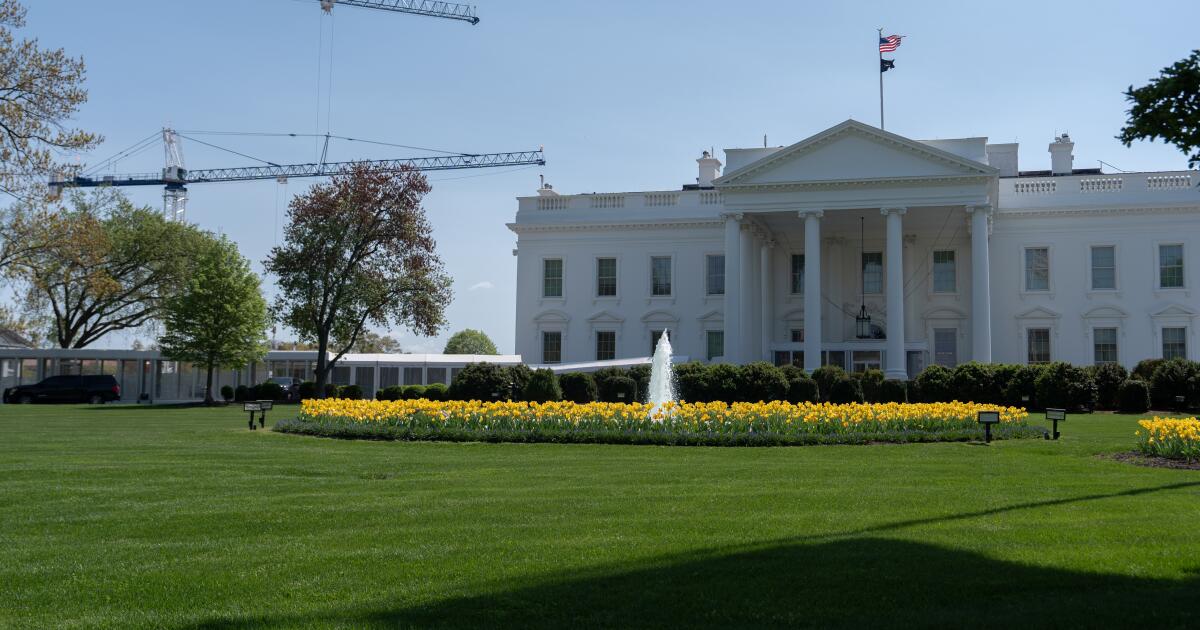
WASHINGTON — The U.S. Secret Service said Sunday it was investigating reports of overnight gunfire near Lafayette Park, which is across the street from the White House.
No injuries were reported and no suspect was found after a search of the park and the surrounding area after midnight, the agency said in an online post.
President Trump was spending the weekend at the White House, which had no immediate comment on the incident. White House operations remained as normal but security in the area was increased, according to the Secret Service.
The park has been fenced off for weeks of renovations.
The Secret Service said it was working with the D.C. Metropolitan Police Department and U.S. Park Police.
WASHINGTON — The Trump administration is arguing that a judge’s order to halt construction of a $400-million ballroom creates a security risk for President Trump as it asks a federal appeals court to pause the ruling.
In a motion filed Friday, National Park Service lawyers say that the federal judge’s order to suspend construction of the East Wing ballroom is “threatening grave national-security harms to the White House, the President and his family, and the President’s staff.”
“Time is of the essence!” the lawyers write, citing materials that will be installed to make a “heavily fortified” facility. The ballroom construction also includes bomb shelters, military installations and a medical facility, according to the filing. The ballroom is part of Trump’s plans to remake public buildings and institutions in Washington during his remaining years in office.
U.S. District Judge Richard Leon in Washington on Tuesday ordered the temporary pause of the construction project that has included demolishing the East Wing of the White House. He concluded that unless Congress approves the project, the preservationist group suing to stop it is likely to succeed on the merits of its claims because “no statute comes close to giving the President the authority he claims to have.”
The White House is owned by the federal government, not the president. Even the website of the National Park Service, which filed the motion, makes clear that “the White House is owned by the American people.”
The judge suspended enforcement of his order for 14 days, acknowledging that the administration would appeal his decision.
Leon’s ruling and the appeal come the same week a key agency tasked with approving construction on federal property in the Washington region gave final approval to the project.
In his ruling, Leon, who was nominated by Republican President George W. Bush, suspended enforcement of his order, recognizing that “halting an ongoing construction project may raise logistical issues.”
Leon also addressed national security in his ruling, saying that he reviewed information that the government privately submitted to him and concluded that halting construction wouldn’t jeopardize national security. He exempted any construction work that is necessary for the safety and security of the White House from the scope of the injunction.
Trump lashed out at the ruling, while noting that it would allow work on underground bunkers and other security measures around the White House grounds to continue — even though those will be paid for by taxpayers. Trump has pledged that he, along with private donors, will cover the costs for the ballroom itself.
But the National Park Service argues in its motion that the president has “complete authority to renovate the White House” and the current state of the grounds, which is an open construction site, make it harder to protect the White House.
“Canvas tents, which are necessary without a ballroom, are significantly more vulnerable to missiles, drones, and other threats than a hardened national security facility,” the motion says.
The Trump administration is asking the appeals court to make a decision on its request by Friday. It also asked that the 14-day suspension of Leon’s order be extended by two weeks so the case can be taken to the Supreme Court.
Across the country, President Trump has installed handpicked loyalists as top federal prosecutors. Several have been pushed out after legal battles because they lack Senate confirmation to serve as U.S. attorneys.
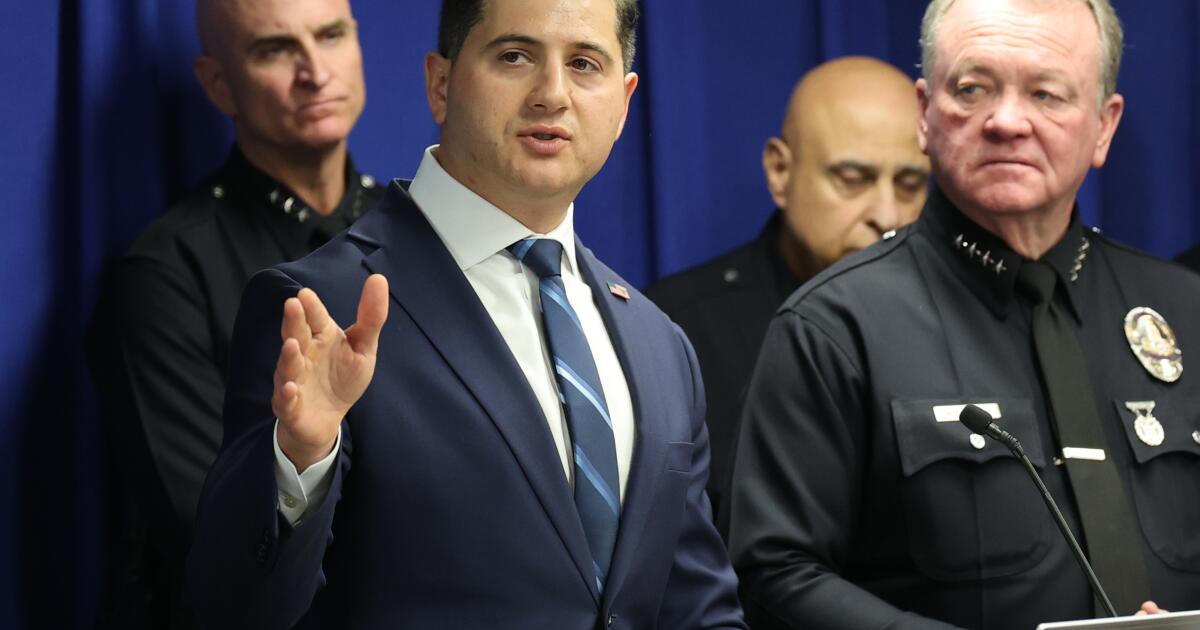
But in Los Angeles, Bill Essayli wields the power of a top prosecutor under a lesser title: “first assistant.”
Essayli clocked his first full year in office this week. He has survived the kinds of challenges that sunk Trump picks in other states through a combination of legal gamesmanship by the U.S. Department of Justice and a lack of action by judges in the Central District of California.
Essayli has used his position to act as one of Trump’s fiercest legal foot soldiers. He has pursued criminal charges against protesters, activists and immigrants while dropping cases involving administration allies and supporting lawsuits over transgender and environmental policies in California.
After Trump’s firing Thursday of U.S. Atty. Gen. Pam Bondi, it’s unclear how her replacement will handle continuing battles over the legality of Trump’s appointees. Essayli is popular with high-level administration officials, and received a congratulatory post on X from Vice President JD Vance over the filing of fraud cases earlier this week.
A conservative former state Assembly member from Riverside County, Essayli, 40, was sworn in as interim U.S. attorney last April. Around the time he hit that role’s 120-day limit, Bondi made him a “special attorney” and designated him “first assistant.” A federal judge later disqualified Essayli as acting U.S. attorney, finding he was “not lawfully serving” in the top role. But the judge said he had no authority to undo Essayli’s designation as first assistant. With no one above him in the office, that title leaves Essayli as the de facto U.S. attorney.
In other jurisdictions, members of the federal bench have exercised their authority to appoint an interim U.S. attorney. Chief U.S. District Judge Dolly M. Gee’s chambers did not respond to a request for comment about why no similar action has been taken in L.A.
A court spokesman declined to comment. Essayli did not respond to a request for comment. The White House referred questions to the Justice Department.
A Justice Department spokesperson issued a statement that praised Essayli for prosecuting “drug cartels and transnational criminal organizations, sex traffickers, violent street gangs, leftist rioters and domestic terrorists, fraudsters, and child predators.”
“It is a disservice to our prosecutors and the American people when judges prevent the President and the Attorney General from installing qualified and capable prosecutors who will aggressively enforce our laws and make America safe again,” the Justice Department spokesperson said.
The lack of action by Gee, a President Obama appointee, has surprised some legal observers, especially given the swiftness with which judges in other districts have acted. It also has frustrated some former federal prosecutors that fled the office under Essayli’s chaotic tenure.
One former assistant U.S. attorney, who left the office under Essayli and requested anonymity to discuss sitting judges who will likely preside over future cases of theirs in the district, accused Gee and others of “shirking their responsibilities” by not appointing someone to the vacant U.S. attorney post.
Another former Central District prosecutor who left the office before Essayli’s appointment said Gee was being practical, taking a “protective” stance to “keep the court away from the ire and invectives coming out of the White House.”
It is “unfair to say the court is abdicating its authority,” said the ex-prosecutor, who also requested anonymity to speak candidly about the district’s judges.
Under long-standing Senate tradition, individual senators can block a U.S. attorney nominee in their home state by withholding their “blue slip,” which clears a nominee’s path to a confirmation hearing.
Trump has tried to skirt the Senate confirmation process to appoint top federal prosecutors in multiple states, including New Jersey and Virginia, where two of the president’s personal lawyers were named U.S. attorney — who immediately moved to zealously advance the president’s agenda and, in some cases, prosecute his rivals.
In Virginia, Trump replaced U.S. Atty. Erik Siebert, a nominee who was under Senate consideration, with one of his former personal attorneys, Lindsey Halligan. Siebert had refused to prosecute some of Trump’s political enemies and resigned. In her first ever criminal case, Halligan swiftly moved to indict former FBI Director James B. Comey. The prosecution was later thrown out and Halligan’s appointment deemed illegal.
In New York’s Northern District, when judges moved to oust the president’s former campaign attorney — who received the same “first assistant” designation as Essayli — Justice Department officials promptly fired his replacement.
Erwin Chemerinsky, dean of the UC Berkeley School of Law, said Trump’s attempts to bypass the normal confirmation processes are unconstitutional.
“This is very troubling because it circumvents the constitutional procedure of having the president nominate and the Senate confirm. That’s crucial to checks and balances,” he said. “This allows the president to appoint whoever he wants.”
Though Essayli has more law enforcement experience than many of Trump’s chosen prosecutors, he’s still struggled to achieve courtroom victories. His prosecutors have lost nearly all the cases they’ve brought to trial against anti-Trump protesters and abandoned others after grand juries refused to return indictments.
Meghan Blanco, a former federal prosecutor and veteran defense attorney, suggested Gee’s inaction with Essayli might be a clever act of resistance. Rather than picking a fight with the White House, Blanco said, the judges are letting the top prosecutor fall on his face.
“If you’re a judge and displeased with what DOJ is doing and the shenanigans they’re pulling … you let the Essayli appointment play out,” Blanco said. “No one has seen a U.S. attorney’s office lose the way this office is losing now.”
Sen. Adam Schiff (D-Calif.) told The Times this week that he is working with Sen. Cory Booker (D-N.J.) to craft legislation to clarify the procedures required to appoint U.S. attorneys and prevent Trump and future presidents from circumventing the Senate.
The legislation, which Schiff did not describe in detail, faces an uphill battle even if Democrats retake the Senate in the upcoming midterms. But the California senator said he is committed to challenging Trump’s maneuvering.
Schiff said Essayli “could not be confirmed and for a reason: He lacks the judgment, temperament and integrity required of a U.S. attorney.”
Laurie Levenson, a Loyola Law School professor and former federal prosecutor, said local federal judges may believe it would be “more disruptive to try and put somebody in when the administration will just fire them.”
But their inaction, she said, has effectively confirmed Essayli as U.S. attorney — and highlights “a real weakness in the system” that demands a legislative fix.
“The bottom line is you have an administration that just doesn’t want to follow the rules,” she said. “There has to be some political will to have Congress do its duty.”
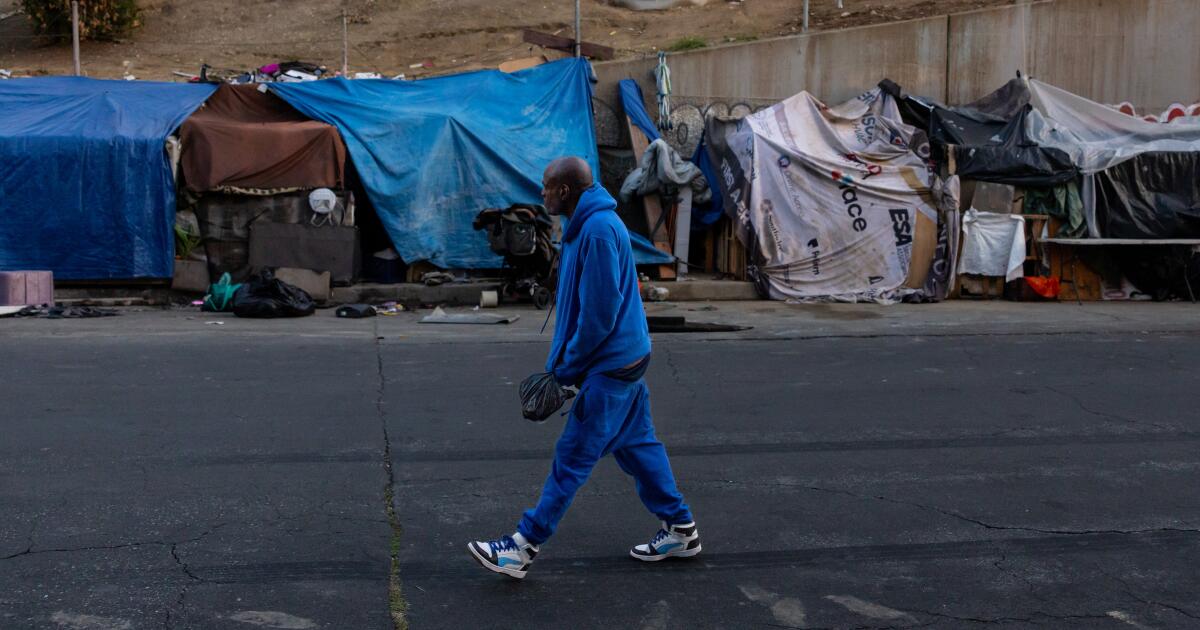
WASHINGTON — President Trump is singling out the Los Angeles Homeless Services Authority as a cautionary tale about Democratic mismanagement of publicly funded programs, using it to justify proposed cuts to homeless assistance services across the country.
Trump’s proposed budget for the next fiscal year, released Friday, asks Congress to eliminate the Continuum of Care — a federal program that funds housing and services for homeless Americans — citing concerns about “fraud and corruption” among local agencies that administer it.
The White House points to LAHSA, which manages many homeless services for the city and county, as the example of why the program needs to go.
“LAHSA has an abysmal record of reducing what is the highest number of street homeless individuals in the United States, and an independent audit issued in March 2025 found that the authority failed to accurately track billions of Federal and local dollars,” the budget says.
The local agency pushed back in a statement after the budget was released.
“Cutting this funding or destabilizing the Continuum of Care program would directly result in more tents on our streets, not fewer,” said Gita O’Neill, the agency’s interim chief executive, adding that under its leadership unsheltered homelessness in Los Angeles has fallen 15% and that 90% of the program’s funding goes “directly to rental assistance.”
Local officials are already grappling with homeless service cuts at the state and county level given budget constraints and LAHSA warned Trump’s proposal would make matters worse.
“If anything, we need additional funding to cover rising costs, not fewer, to maintain our current momentum,” the agency said Friday.
The funding dispute over homelessness services is one front in a broader budget assault on California programs by the Trump administration.
Trump’s proposal also asks Congress to eliminate millions in funding from state initiatives the White House is characterizing as wasteful, ineffective or “woke.”
The cuts, if enacted, would cancel $4 billion in unspent funding for the state’s high-speed rail project, which the White house called a “boondoggle,” and strip grants from the Fair Housing Advocates of Northern California, which the budget criticized for “actively working to dismantle systems of power and privilege that favor whiteness.”
Smaller items are also targeted on the White House’s chopping block: a Los Angeles gelato festival, a dance building in Santa Cruz — which the White House dubs “one of the richest cities in the nation” — and a $3-million grant for a playground tied to an unspecified performing arts center in California.
Trump’s proposed cuts to California projects are part of a broader effort by the Trump administration to reshape federal spending priorities, largely by trading social programs for a massive military buildup.
The president is asking Congress to approve $1.5 trillion for defense and to slash $73 billion from domestic programs, a massive restructuring that would leave states, including California, to absorb costs Washington no longer wants to carry.
Trump made that vision explicit at a private Easter lunch at the White House on Wednesday, telling guests that the federal government should no longer be responsible for funding social programs that many Americans rely on.
“We can’t take care of daycare. We are a big country,” Trump said. “We are fighting wars. We can’t take care of daycare.”
If states want to offer those services, Trump said, they should raise taxes to pay for them.
“Medicaid, Medicare, all these individual things, they can do it on a state basis,” he said. “We have to take care of one thing: military protection.”
His proposed budget reflects that priority, which lawmakers will need to contend with as they grapple with the mounting costs of the Iran war and an economic fallout from a military operation that has left Americans paying more items, including gas pump.
Under the proposed budget, Trump is also seeking to make some investments in California projects.
The White House, for example, is seeking $152 million from Congress to turn Alcatraz back into a maximum-security prison, an idea the president has talked about for several years.
He also called on Congress to establish a National Center for Warrior Independence at the West Los Angeles VA Medical Center.
Times staff writer Andrew Khouri, in Los Angeles, contributed to this report.
NEW YORK — This is not the run up to the midterm elections that Republicans wanted.
A year and a half after winning the White House by promising to lower costs and end wars, Donald Trump is a wartime president overseeing surging energy costs and an escalating overseas conflict that many in his own party do not like.
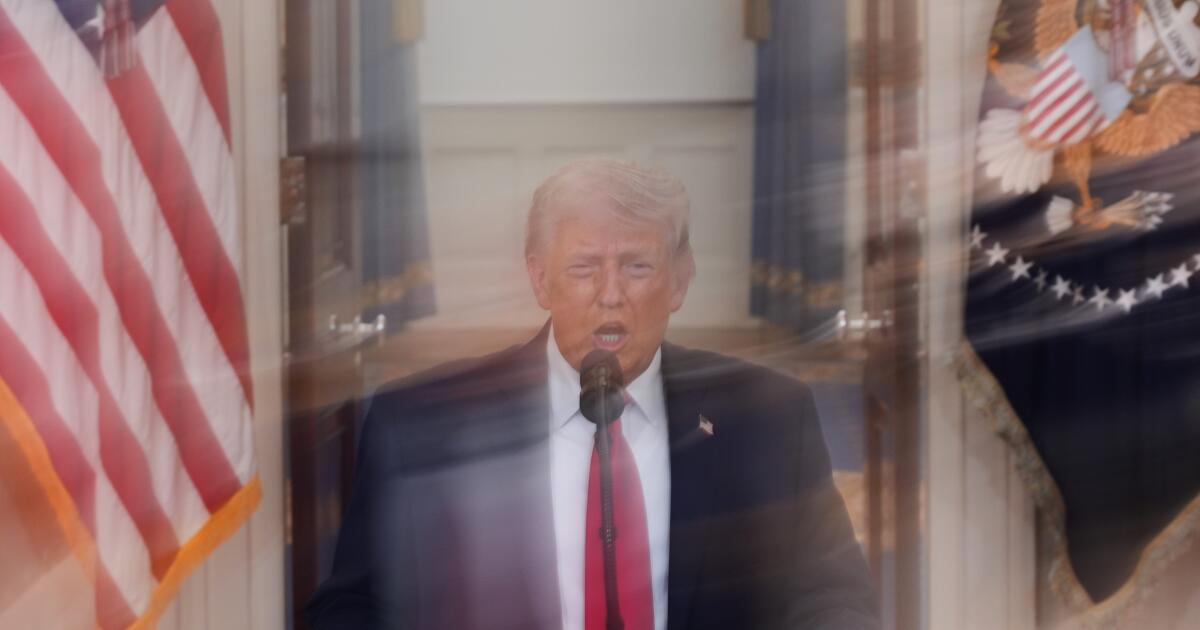
He offered little clarity to a nation eager for answers this week during a prime-time address from the White House, his first since the U.S. and Israel attacked Iran more than a month ago, simultaneously suggesting that the war was ending and expanding.
“Thanks to the progress we’ve made, I can say tonight that we are on track to complete all of America’s military objectives shortly, very shortly,” Trump said. “We’re going to hit them extremely hard over the next two to three weeks.”
Trump’s comments come roughly six months before voters across the nation begin to cast ballots in elections that will decide control of Congress and key governorships for Trump’s final two years in office. For now, Republicans, who control all branches of government in Washington, are bracing for a painful political backlash.
“You’re looking at an ugly November,” warned veteran Republican pollster Neil Newhouse. “At a point in time when we need every break possible to hold the House and Senate, our edge is being chipped away.”
Republicans confront evolving political landscape
It’s hard to overstate how dramatically the political landscape has shifted.
At this time last year, many Republican leaders believed there was a path to preserve their narrow House majority and easily hold the Senate. Now they privately concede that the House is all but lost and Democrats have a realistic shot at taking the Senate.
Republicans are also struggling to coalesce around a clear midterm message on Iran.
The Republican National Committee has largely avoided the war in talking points issued to surrogates over the last month. The leaders of the party’s campaign committees responsible for the House and Senate declined interview requests. Many vulnerable Republican candidates sidestep the issue, unwilling to defend or challenge Trump publicly.
The president remains deeply popular with Republican voters, and he has vocal supporters like Sen. Lindsey Graham of South Carolina.
“That was the best speech I could’ve hoped for,” he wrote on social media after Trump’s address on Wednesday evening. Graham said Trump “gave the American people a clear and coherent pathway forward.”
Trump made little effort to sell the conflict to Americans before the initial attack. Five weeks later, at least 13 U.S. service members have been killed and hundreds more injured. Thousands more troops have converged on the region, and the Pentagon requested $200 billion in new funding.
The Strait of Hormuz, a key passage for a fifth of the world’s oil, remains closed. The average price for a gallon of gasoline in the U.S. was $4.08 on Thursday, according to AAA, almost a full dollar higher than on President Joe Biden’s last day in office.
On Wednesday, Trump insisted that gas prices would fall quickly once the war concluded but offered no solution for reopening the Strait of Hormuz. Instead, he invited skeptical U.S. allies to do it themselves.
He insisted that the war would be worth it.
“This is a true investment in your grandchildren and your grandchildren’s future,” Trump said. “When it’s all over, the United States will be safer, stronger, more prosperous and greater than it has ever been before.”
Former Rep. Marjorie Taylor Greene, a Georgia Republican who was once among Trump’s most vocal allies in Congress, lashed out against his Iran policy.
“I wanted so much for President Trump to put America First. That’s what I believed he would do. All I heard from his speech tonight was WAR WAR WAR,” she wrote on social media. “Nothing to lower the cost of living for Americans.”
Time is not on Trump’s side
About 6 in 10 U.S. adults say the U.S. military action in Iran has “gone too far,” according to AP-NORC polling from March. Roughly a third approve of how he’s handling Iran overall.
The possibility of sending U.S. forces into Iran also appears politically unpalatable.
About 6 in 10 adults are “strongly” or “somewhat” opposed to deploying U.S. troops on the ground to fight Iran. That includes about half of Republicans. Only about 1 in 10 favor deploying troops.
At the same time, Trump’s approval ratings have remained consistently weak. About 4 in 10 Americans approve of how he’s handling the presidency, roughly in line with how it’s been throughout his second term.
Republican strategist Ari Fleischer, a senior aide in former President George W. Bush’s administration, acknowledged that Trump has not received the polling bump in this war that Bush got after invading Iraq.
Bush, of course, worked to build public backing for the Iraq War before going in. Immediately after the 2003 invasion, Bush’s popularity soared, as did the stock market.
Public sentiment and the economy soured only after the conflict stretched on. It ultimately spanned more than eight years, spawning a generation of anti-war Republicans — and sowing the seeds of Trump’s “America First” foreign policy.
“My hope is that the Trump experience is the exact opposite of the Bush experience,” Fleischer said.
He said Trump must win the war decisively and quickly to avoid a further backlash, saying there could be a “very significant political upside if things end well, oil comes down and markets rally.”
Fleischer added that Trump’s actions will matter much more than his words.
“Ultimately, he is not going to get judged on his persuasion or his explanations or his assertions, he’s going to get judged on results,” he said.
Peoples writes for the Associated Press. AP writer Linley Sanders in Washington contributed to this report.
WASHINGTON — A Florida airport was cleared to be renamed after President Trump on Monday, hours before the president separately revealed plans for a Miami skyscraper planned to house his presidential library.
Florida Gov. Ron DeSantis signed a bill allowing Palm Beach International Airport to be renamed the President Donald J. Trump International Airport. The change is set to take place in July, formally rebranding the airport near Trump’s Mar-a-Lago estate.
Later Monday, Trump posted a video to social media that appears to show digital renderings for his presidential library. Set to dramatic music, the video unveils a piercing tower along the Miami skyline emblazoned with the signature “Trump” lettering seen on his other towers.
The video includes panning shots of the tower’s exterior and interior, with a presidential jet parked in the lobby alongside a gold escalator like the one Trump rode down while launching his presidential campaign in 2015. Other shots show a giant ballroom like the one he’s planning for the White House, a replica Oval Office, rooftop gardens and a large, gold statue of Trump.
A credit says the design comes from Bermello Ajamil, a Miami-based firm. Trump posted the video with no explanation beyond a link to a new website for the library. The website says, “coming soon,” with a link to donate money.
The White House did not immediately respond to questions about the plans.
Miami Dade College gave up a nearly three-acre plot of downtown real estate as a gift for the future library. A judge in December dismissed a complaint challenging the gift on grounds that the college’s board didn’t give sufficient public notice. The site is valued at more than $67 million.
Trump’s son Eric previously said the library will be “one of the most beautiful buildings ever built” and “an Icon on the Miami skyline.”
Since he returned to the White House, Trump has pressed to get his name on all manner of American institutions, including the U.S. Institute of Peace, the Kennedy Center for the Performing Arts and U.S. currency.
In Palm Beach, a stretch of road from the airport to Trump’s estate was recently renamed Donald J. Trump Boulevard.
Rep. Eric Swalwell, a leading Democratic candidate for governor of California, has accused President Trump of trying to sway the election following reports that FBI Director Kash Patel may release documents from a decade-old investigation into the congressman’s ties to a suspected Chinese spy.
According to a report by the Washington Post, Patel has directed agents in the bureau’s San Francisco office to redact the case files for public release. According to the outlet, it’s highly unusual for the FBI to release case files tied to a probe that did not result in criminal charges.
The investigation centered on Swalwell’s ties to a suspected intelligence operative, Christine Fang, or Fang Fang, who worked as a volunteer raising money for his congressional campaign. Swalwell cut off ties to Fang in 2015, after intelligence officials briefed him and other members of Congress about Chinese efforts to infiltrate the legislative body.
Swalwell was not accused of impropriety.
The FBI did not immediately respond to a request for comment.
“Through great reporting, we now know the outrageous ends the White House will go to target political opponents,” Swalwell said in a prepared statement Saturday, calling the decade-old story “nonsense.”
“Donald Trump is targeting me. He’s trying to influence the election,” Swalwell said in a post on X. “There is only one reason why: he’s scared.”
Swalwell accused Trump of “desperately trying” to stop him, because he’s now the favored candidate for California governor.
“What Trump wants the most is to have a Western White House. An enabler on the opposite coast,” he said. “A lot of people have bent the knee to this administration. But I will not. And neither will the people of California.”
It’s not the first time Swalwell has accused the administration of targeting Trump’s political opponents.
Last year, Swalwell sued Federal Housing Finance Agency Director Bill Pulte, accusing him of criminally misusing government databases to target Trump’s political opponents. Pulte had accused Swalwell of mortgage fraud and referred him to the Justice Department for a potential federal criminal probe. Swalwell dropped that suit this month.
Swalwell, a former prosecutor who ran for president in 2020, announced his bid for California governor in November. Swalwell said his decision was driven by the serious problems facing California and the threats posed to the state and nation with Trump in the White House.
U.S. Sen. Adam Schiff (D-Calif.), who has endorsed Swalwell for governor, shared the Post story on X Saturday, saying, “This abuse of the FBI is as dangerous as it is unlawful.” Schiff served with Swalwell on the House Intelligence Committee, where they riled Republicans by investigating President Trump during his first term.
Schiff served as the lead manager of Trump’s first impeachment and Swalwell as a manager of Trump’s second impeachment.
“Time and again, the President and his appointees have weaponized the Department of Justice against those who dare stand up to Trump,” Schiff wrote. He added that there was no doubt that Trump and Patel “will stop at nothing to try to tell Californians who their next governor should be.”
The Post story unleashed a flood of critiques from California politicians, including Rep. Jimmy Gomez (D-Los Angeles), who sits on the House Intelligence Committee. On X, Gomez accused Patel of “wasting resources” on a “closed, decade-old case where Swalwell cooperated with the FBI and was found innocent of any wrongdoing.”
“Reopening it now, right as he leads in the polls and ballots are about to drop, is a political hit-job!” Gomez said. “Trump and Kash Patel are weaponizing the FBI against people they deem political enemies.”
Rep. Jamie Raskin of Maryland, the top Democrat on the House Judiciary Committee, released a statement accusing Patel of working at “the behest of the White House” and “wasting the resources of the FBI and perhaps violating the Hatch Act by ordering agents to spend hours preparing a political smear file for a personnel vendetta.”
According to the Associated Press, Fang came into contact with Swalwell’s campaign as he was first running for Congress in 2012. She also participated in fundraising for his 2014 campaign and helped place an intern in his office, the report said. Federal investigators alerted Swalwell to their concerns — and briefed Congress — about Fang in 2015, at which point the California Democrat says he cut off contact with her, the AP reported in 2021.
In 2023, the House Ethics Committee closed a two-year investigation into the allegations of his ties to Fang.
In closing the probe, the ethics committee wrote in a letter to Swalwell that it had “previously reviewed allegations of improper influence by foreign agents and in doing so, cautioned that Members should be conscious of the possibility that foreign governments may attempt to secure improper influence through gifts and other interactions.”
Times staff writer Kevin Rector contributed to this report.
It’s like that time Pinocchio became a real boy: News that was labeled “fake” last week is real today, per the Kennedy Center, and Bill Maher will indeed be the 27th person to receive the Mark Twain Prize for American Humor.
The White House strongly dissed the Atlantic’s reporting (followed by unreporting) last week that Maher was the next in line for the 2026 prize that Conan O’Brien got last year and Kevin Hart picked up the year before that. The Twain honor has been bestowed on comics almost annually since 1998 by the Kennedy Center, a “tired, broken, and dilapidated” building that President Trump slapped his own name on in December and plans to close for two years’ worth of renovations starting July 4 — hence the response from White House flacks.
“Literally FAKE NEWS,” said Steven Cheung, White House director of communications, on his official X account reacting Friday to the Atlantic story. Karoline Leavitt, White House press secretary, said in a statement to the publication, “This is fake news. Bill Maher will NOT be getting this award.”
But People reported Thursday that although the Atlantic’s news was deemed “fake” at the time, according to word from a White House official, the situation had “evolved” in the six days since then.
You say tomato, I say to-mah-to? At any rate, Bill’s getting the Twain, given previously to comedic luminaries including Richard Pryor, Whoopi Goldberg, George Carlin, Lily Tomlin, Steve Martin, Lorne Michaels, Tina Fey and Dave Chappelle.
Maher had no response on social media, perhaps reserving his reaction for the upcoming “Real Time With Bill Maher” episode due out Friday on HBO or his next “Club Random” podcast. But he did issue a dryly amusing statement Thursday in a Kennedy Center news release, saying, “Thank you to the Mark Twain people: I just had the award explained to me, and apparently it’s like an Emmy, except I win.”
(Maher’s show has been nominated for Emmy Awards 22 times, from 2004 through 2024, including 13 nods for variety series and the rest for writing, directing and personal performance. It has won exactly zero of those times. Even Susan Lucci only had to wait through 18 Daytime Emmy nominations before she finally won on the 19th — and proceeded to lose out on two more.)
The comic’s statement continued: “I’d just like to say that it is indeed humbling to get anything named for a man who’s been thrown out of as many school libraries as Mark Twain.”
“For nearly three decades, the Mark Twain Prize has celebrated some of the greatest minds in comedy,” Roma Daravi, vice president of public relations for the Kennedy Center, said in a statement of her own. “For even longer, Bill has been influencing American discourse — one politically incorrect joke at a time.”
Maher, a self-described liberal who has no love for the Republican Party, found himself in strange-new-respect territory among conservatives in recent years after he started slamming far-left ideology as ruthlessly as he slammed the far right. Then last spring he accepted an invitation for dinner with Trump at the White House, and many heads exploded.
“OK, as you know, 12 days ago, I had dinner with President Trump, a dinner that was set up by my friend Kid Rock because we share a belief that there’s got to be something better than hurling insults from 3,000 miles away,” said Maher, who lives on the West Coast, on the April 11, 2025, episode of “Real Time.”
“And let me first say that to all the people who treated this like it was some kind of summit meeting, you’re ridiculous. Like I was going to sign a treaty or something. I have — I have no power. I’m a f— comedian, and he’s the most powerful leader in the world. I’m not the leader of anything except maybe a contingent of centrist-minded people who think there’s got to be a better way of running this country than hating each other every minute.”
Maher said he brought with him to the dinner a list of almost five dozen epithets the president had hurled his way over the years, intending to ask Trump to sign it for him. Which the president did. And after sharing some anecdotes from the visit, including some snappy retorts, Maher told his audience that Trump was “much more self-aware than he lets on in public.”
“I never felt I had to walk on eggshells around him. And honestly, I voted for Clinton and Obama, but I would never feel comfortable talking to them the way I was able to talk with Donald Trump. That’s just how it went down. Make of it what you will.”
The Mark Twain Prize will be given to Maher at a gala set for June 28, with Netflix streaming the event at a later date, yet to be determined.
WASHINGTON — Pressure is mounting on Congress to end the funding shutdown that has resulted in travel disruptions, missed paychecks and even warnings of airport closures, but lawmakers have yet to resolve the underlying issue of reining in President Trump’s immigration enforcement operations.
Senators intend to vote Thursday on a Republican proposal that would fund the Transportation Security Administration and much of the Department of Homeland Security, except the enforcement and removal operations conducted by U.S. Immigration and Customs Enforcement. That plan is expected to fail.
Democrats argue it does not go far enough at putting guardrails on officers from ICE, Customs and Border Protection and other federal agencies who are engaged in the immigration sweeps, particularly after the deaths of two Americans protesting the actions in Minneapolis.
Trump, who has largely left the issue to Congress to resolve, threatened to send the National Guard to airports, in addition his deployment of ICE agents who are now checking travelers IDs — a development drawing concerns.
“They need to end this shutdown immediately or we’ll have to take drastic measures,” Trump said Thursday during a Cabinet meeting at the White House.
With Congress set to leave town by week’s end for its own spring break recess, calls are intensifying for an end to the 41-day stalemate that’s put the livelihoods of TSA officers at risk as they provide airport security without pay.
Multiple airports are experiencing greater than 40% callout rates of TSA workers and more than 480 of its nearly 50,000 transportation security officers have now quit during the shutdown. Nationwide, nearly 11% of TSA workers — more than 3,200 on a single day — missed work.
Trump stays out of the fray
The Republican president initially signed off on the plan the GOP senators brought to him late Monday. By Tuesday, he said he would not be happy with any deal.
Trump did not directly address the status of negotiations late Wednesday evening during an annual fundraising dinner for the House Republicans’ campaign committee as Speaker Mike Johnson, R-La., works to keep majority control of the chamber in the November elections.
But Trump criticized Democrats for refusing to settle their demands on immigration changes. On Thursday, he revived his campaign for senators to end the filibuster as a way to overpower opposition to GOP policies, something most Republican senators do not want to do.
The GOP’s big tax cuts bill that Trump signed into law last year funneled billions to DHS, including $75 billion for ICE operations, ensuring the money is flowing for his immigration and deportation agenda even with the funding shutdown. ICE and other immigration officers are still being paid.
The situation is partly of Trump’s making, a strategy the president put in place last fall when he cut a deal with Democrats to end a previous federal shutdown. At that time, Trump agreed to fund the federal government, except for DHS, which was then put on temporary funding that has expired.
A stopgap measure
The Republican offer added one new restraint on immigration officers, funding the use of body cameras that had previously been agreed to. It excluded other policies that Democrats have demanded, such as that federal agents wear identification, remove their face masks and refrain from conducting raids around schools, churches or other sensitive places.
Senate Democratic leader Chuck Schumer of New York said they needed to see real changes. “We’ve been talking about ICE reforms from day one,” he said.
Democrats had been in several days of talks with the White House, including with border czar Tom Homan, that appeared to be making progress toward a deal. The White House presented its own offer with several items Democrats had been demanding, including officer IDs and training.
But those negotiations broke down over the weekend.
Republicans say Democrats are putting the country at risk. They say the Trump administration has already made strides to meet Democrats’ demands and has shown a new approach to its immigration operations, swearing in Oklahoma Sen. Markwayne Mullin as the new homeland security secretary to replace Kristi Noem.
But conservative Republicans also panned the proposal, demanding full funding for immigration operations and skeptical of the promise from GOP leaders that they would address Trump’s proof-of-citizenship voting bill in a subsequent legislative package.
Senate Majority Leader John Thune, R-S.D., said late Wednesday that if Democrats put a “more realistic offer on the table, we’ll be back in business.”
Asked if Congress would consider a stopgap measure to temporarily fund the department, Thune said: “We’ll see.”
Airport lines grow as TSA workers endure hardships
Passengers are facing more four-hour waits to clear security at George Bush Intercontinental Airport in Houston.
The airport’s website said Thursday morning that travelers should expect to wait two hours, 30 minutes in the security line at one of its open terminals and four hours at the other.
Lines and wait times are expected to grow Thursday and Friday because of “significantly higher passenger traffic,” according to an update on the airport’s website.
“This is a dire situation,” the acting TSA administrator, Ha Nguyen McNeill, testified at a House hearing Wednesday.
She described the multiple hardships facing unpaid TSA workers — piling up bills and eviction notices, even plasma donations to make ends meet — and warned of potential airport closures if more employees refuse to come to work.
“At this point, we have to look at all options on the table,” she said. “And that does require us to, at some point, make very difficult choices as to which airports we might try to keep open and which ones we might have to shut down as our callout rates increase.”
She cited the growing financial strain on the TSA workforce.
“Some are sleeping in their cars, selling their blood and plasma, and taking on second jobs to make ends meet,” she said.
McNeil also said TSA officers working at the nation’s airports have experienced a more than 500% increase in the frequency of assaults since the shutdown began.
“This is unacceptable, and it will not be tolerated,” McNeill said.
Mascaro and Freking write for the Associated Press. AP writers Rebecca Santana and Ben Finley in Washington; Wyatte Grantham-Philips in New York; Rio Yamat in Las Vegas; Russ Bynum in Savannah, Ga., and Gabriela Aoun Angueira in San Diego contributed to this report.
WASHINGTON — President Trump will travel to Beijing for a rescheduled summit with Chinese President Xi Jinping on May 14 and 15, the White House announced on Wednesday.
Trump had been scheduled to travel to China later this month but previously announced he was delaying the trip so he could be in Washington to help steward the U.S. and Israeli war against Iran. The Republican president had announced a rescheduled trip even though the war in Iran continues and the U.S. is pressing Tehran to accept a ceasefire proposal.
The president and First Lady Melania Trump also plan to host Xi and his wife, Peng Liyuan, for a White House visit later this year, press secretary Karoline Leavitt said.
Leavitt, when asked if the new dates for Trump’s trip could suggest he believes the Iran war could end soon, offered an optimistic tone that the conflict could reach an endgame before he travels.
“We’ve always estimated four to six weeks,” Leavitt responded. “So you could do the math on that.”
The United States and Israel launched the attacks against Iran on Feb. 28.
The China trip had been planned for months but began to unravel as Trump pressured Beijing and other world powers to use their military might to protect the Strait of Hormuz, a critical waterway for the flow of oil. The strait has been effectively closed as Iran targets energy infrastructure and traffic through it.
Trump said last week while meeting with Irish Prime Minister Micheál Martin in the Oval Office that he would be going to China in five or six weeks’ time instead of at the end of the month. He said he would be “resetting” his visit with Xi.
“We’re working with China — they were fine with it,” Trump said then. “I look forward to seeing President Xi. He looks forward to seeing me, I think.”
Trump’s visit to China is seen as an opportunity to build on a fragile trade truce between the two superpowers, but it has become tangled in his effort to find an endgame to the war in Iran. Soon after pressing China and other nations to send warships to secure access to Middle Eastern oil, Trump indicated last week that his travel plans depended on Beijing’s response, though he added then that the U.S. didn’t need help from the allies that rebuffed his request.
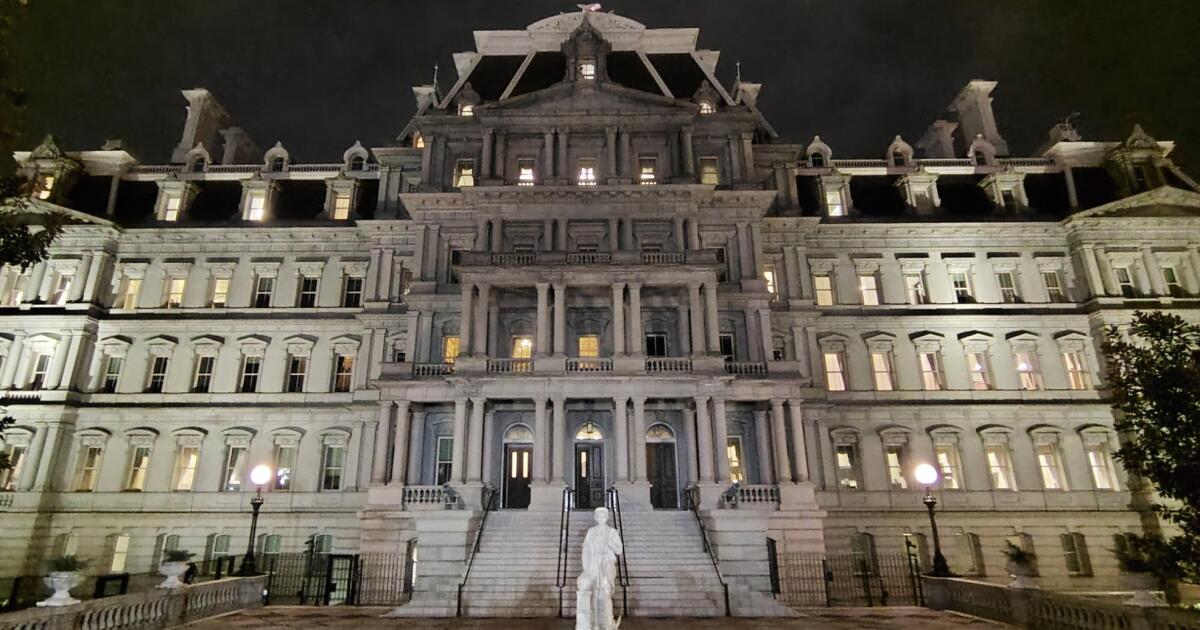
ANNAPOLIS, Md. — A statue of Christopher Columbus has been placed on the grounds of the Eisenhower Executive Office Building adjacent to the White House, the latest effort by President Trump’s administration to recognize the controversial explorer.
The statue is a replica of one that was tossed into Baltimore’s harbor in 2020 during Trump’s first term at a time of nationwide protests against institutional racism.
Trump endorses a traditional view of Columbus as a leader of the 1492 mission seen as the unofficial beginning of European colonization in the Americas and the development of the modern economic and political order. In recent years, Columbus also has been recognized as a primary example of Western Europe’s conquest of the New World, its resources and its Native people.
“In this White House, Christopher Columbus is a hero, and President Trump will ensure he’s honored as such for generations to come,” the White House posted on X.
“We are delighted the statue has found a place where it can peacefully shine and be protected,” said John Pica, a Maryland lobbyist and president of the Italian American Organizations United, which owns the statue and agreed to lend it to the federal government for placement at or near the White House.
The statue, made mostly of marble, was created by Will Hemsley, a sculptor based in Centreville on Maryland’s Eastern Shore.
The original statue was toppled by protesters July 4, 2020, and thrown into Baltimore’s Inner Harbor during the national social justice reckoning in the months after the police murder of George Floyd in Minneapolis. It was one of many statues of Columbus that were vandalized around the same time, with protesters saying the Italian explorer was responsible for the genocide and exploitation of Native peoples in the Americas.
In recent years, some people, institutions and government entities have displaced Columbus Day with the recognition of Indigenous Peoples Day. President Biden in 2021 became the first U.S. president to mark Indigenous Peoples Day with a proclamation.
Trump dismisses the shifting views on Columbus as the work of “left-wing arsonists,” bending history and twisting Americans’ collective memory. “I’m bringing Columbus Day back from the ashes,” he declared last April. Echoing his 2024 campaign rhetoric, he complained that “Democrats did everything possible to destroy Christopher Columbus, his reputation, and all of the Italians that love him so much.”
WASHINGTON — President Trump said Saturday that he will order federal immigration officers to take a role in airport security starting Monday unless Democrats agree on a bill to fund the Department of Homeland Security.
In a pair of social media posts, Trump first threatened and then said he had made plans to put officers from U.S. Immigration and Customs Enforcement in airports if the congressional standoff continues. He made the announcement as a partial shutdown contributes to long lines to pass through screening at some of the nation’s largest airports.
The president suggested ICE agents would bring the administration’s immigration crackdown into the nation’s airports, promising to arrest “all Illegal Immigrants.”
“I look forward to moving ICE in on Monday, and have already told them to, ‘GET READY. NO MORE WAITING, NO MORE GAMES!’” Trump wrote while spending the weekend in Florida.
The move appears to be a pointed effort to expand the type of immigration enforcement that has become a sticking point in Congress. Democrats pledged to oppose funding for the Department of Homeland Security unless changes were made in the wake of a crackdown in Minnesota that led to the fatal shootings of two protesters. Democrats are asking for better identification for federal law enforcement officers, a new code of conduct for those agencies and more use of judicial warrants, among other measures.
The Minnesota operation was tied in part to allegations of fraud involving Somali residents. On Saturday, Trump said ICE officers sent to airports would focus on arresting immigrants from Somalia who are in the United States illegally. Repeating his criticism of Somalis, he said they “totally destroyed” Minnesota.
“If the Democrats do not allow for Just and Proper Security at our Airports, and elsewhere throughout our Country, ICE will do the job far better than ever done before,” Trump said.
Trump’s posts did not offer additional detail on how ICE would take a role in airport security and what it meant for the Transportation Security Administration, which screens passengers and luggage for hazardous items.
The vast majority of TSA employees are considered essential and continue to work during the funding lapse, but they are doing so without pay. Call-out rates have started to increase at some airports, and Homeland Security said at least 376 have quit since the partial shutdown began Feb. 14.
On Saturday, in a rare weekend session, the Senate rejected a motion by Democrats to take up legislation to reopen TSA and pay workers who are now going without paychecks. Republicans argue that they need to fund all parts of the Department of Homeland Security, not just certain ones. A bill to fund the agency failed to advance in the Senate on Friday.
There were signs of progress, though, with the restarting in recent days of stalled talks between Democrats and the White House. On Saturday, Republican and Democratic senators were set to meet for a third consecutive day with White House officials behind closed doors as Senate Democratic leader Chuck Schumer of New York spoke of “productive conversations.”
Senate Majority Leader John Thune (R-S.D.) urged the bipartisan group to act quickly. He has said that Democrats and the White House need to find compromise as lines at airports have grown.
“If that group that’s meeting can’t come up with a solution really quickly, things are going to get worse and worse,” Thune said Saturday.
Binkley writes for the Associated Press. AP writer Mary Clare Jalonick contributed to this report.
WASHINGTON — A federal arts commission on Thursday approved the final design for a 24-karat gold commemorative coin bearing President Trump’s image to help celebrate America’s 250th birthday on July 4.
The vote by the U.S. Commission of Fine Arts, whose members are supporters of the Republican president and were appointed by him earlier this year, was without objection. It clears the way for the U.S. Mint to begin production on the coin, whose size and denomination are still under discussion.
“As we approach our 250th birthday, we are thrilled to prepare coins that represent the enduring spirit of our country and democracy, and there is no profile more emblematic for the front of such coins than that of our serving President, Donald J. Trump,” U.S. Treasurer Brandon Beach said in a statement.
The unprecedented move marks yet another example of Trump and his allies circumventing conventional past presidential practices — and even the law — to get what he wants. It’s the latest instance of Trump putting his name and likeness in the historical archive, following his renaming of the U.S. Institute of Peace, the Kennedy Center performing arts venue and a new class of battleships, among other tributes.
Federal law says no living president can appear on U.S. currency. But Megan Sullivan, the acting chief of the Office of Design Management at the Mint, said the Treasury secretary has authority to authorize the minting and issuance of new 24-karat gold coins, which Scott Bessent has used to get around that prohibition and put Trump on a coin.
She presented the coin’s final design at the commission’s March meeting on Thursday and said Trump had approved it.
“It is my understanding that the secretary of the Treasury presented this design, as well as others, to the president and these were his selection,” Sullivan said.
The White House and the Mint did not immediately respond to electronic and telephone requests for comment.
The front of the coin features an image of Trump in a suit and tie and with a stern look on his face. His fists rest on top of what is supposed to be a desk as he leans forward. Lettering on the top half of the coin spells “LIBERTY” in a slight arc. Directly underneath that are the dates 1776-2026. The words “IN GOD WE TRUST” are at the bottom, with seven stars on one side of the coin and six stars on the other side.
The reverse side depicts a bald eagle midflight with “UNITED STATES OF AMERICA” on the right side and “E PLURIBUS UNUM” on the left side.
“I know it’s a very strong and a very tough image of him, and I think it’s fitting to have a current sitting president who’s presiding over the country over the 250th year on a commemorative coin for said year,” said Commissioner Chamberlain Harris, a top White House aide to Trump.
The coin will be part of a “very limited production run,” Sullivan said, but the number has not been determined. The size and denomination of the coin also have not yet been decided, she said. Some commissioners noted Trump’s fondness for big things as they advocated for the largest size coin.
The Mint, which is part of the Treasury Department, has looked at a size for the Trump coin that is larger than its 1-ounce gold coin, which is about 1.3 inches in diameter, Sullivan said.
Its largest coin is 3 inches, “so we’re looking somewhere in there,” she said.
“I think the president likes big things,” said Commissioner James McCrery II, who was the architect on Trump’s design proposal for a 90,000-square-foot ballroom addition to the White House. The fine arts commission approved that proposal at its February meeting.
Harris told McCrery she agreed with him. She works in the White House as a special assistant to the president and deputy director of the Oval Office.
“I think the larger the better. The largest of that circulation, I think, would be his preference,” Harris said, speaking of Trump.
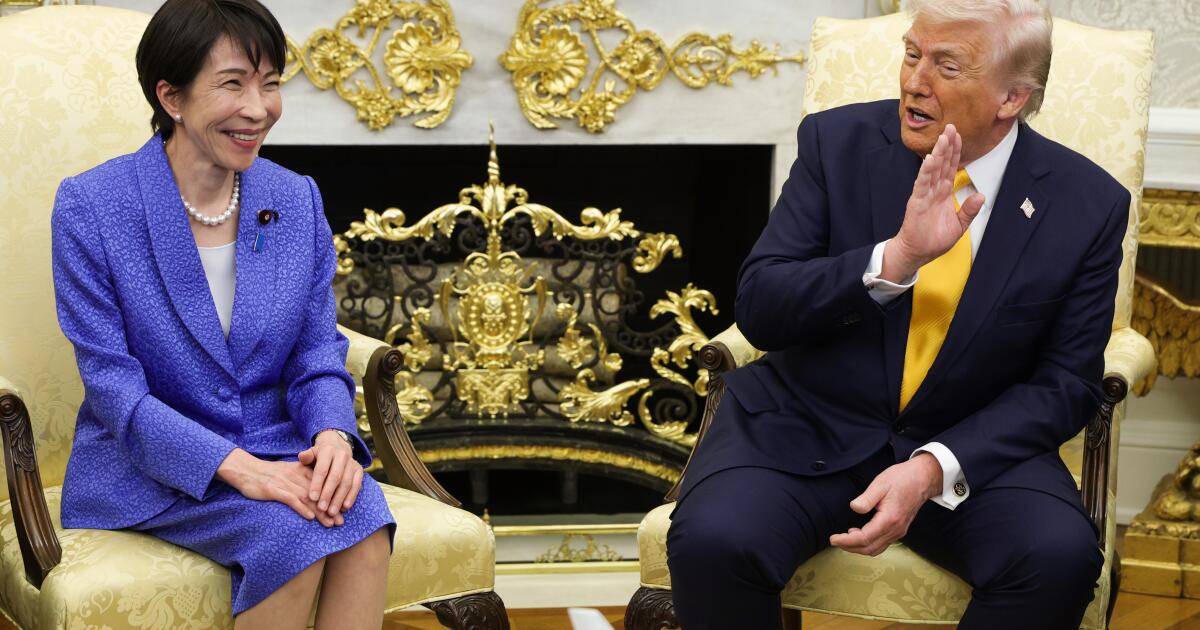
WASHINGTON — Before Japanese Prime Minister Sanae Takaichi departed for Washington, she told her nation’s lawmakers that her Oval Office meeting with President Trump on Thursday would be “very difficult.”
Actually, it was awkward.
After a reporter questioned Trump about not warning Japan before launching his “surprise” offensive in Iran, Trump said that surprise was the point.
“Who knows better about surprise than Japan?” Trump said, turning toward a visibly tense Takaichi, seated next to him. “Why didn’t you tell me about Pearl Harbor, OK?”
The joke hung in the air. There was brief and muted laughter.
Takaichi’s eyes appeared to widen, but she kept her expression neutral as the the cameras rolled. She did not comment on the president’s remark. (She smiled at other times during their meeting.)
When leaders of the United States and Japan have raised the events of Dec. 7, 1941 — the day of “infamy” that plunged the U.S. into World War II — the circumstances have previously been far more solemn.
In 2016, President Obama and Japanese Prime Minister Shinzo Abe scattered petals together on the waters of Pearl Harbor to honor the more than 2,400 killed in the attack. Abe laid a wreath in honor of the dead.
“Ours is an alliance of hope that will lead us to the future,” Abe said, speaking to World War II veterans after paying tribute at the Pearl Harbor memorial. “What has bonded us together is the power of reconciliation, made possible through the spirit of tolerance.”
Japan, long constrained by its pacifist constitution, is now under intense pressure from the White House to support the U.S.-led war in Iran.
“Look, I expect Japan to step up, because, you know, we have that kind of relationship, and we step up in Japan. We have 45,000 soldiers in Japan,” Trump said. “We spend a lot of money on Japan, and we’ve had that kind of relationship.”
Trump has made a habit of going off script during televised Oval Office encounters with foreign leaders.
A meeting with Ukrainian President Volodymyr Zelensky devolved into an on-camera shouting match with Trump and Vice President JD Vance repeatedly berating Zelensky for “gambling with World War III” and not showing enough gratitude for U.S. support.
And when South African President Cyril Ramaphosa visited the White House, he said he was “ambushed” when Trump dimmed the lights and played a video promoting widely debunked claims of white genocide in South Africa.
By comparison, the Japanese prime minister’s summit in Washington was mild. For her part, Takaichi focused her statements on a new $550-billion trade pact involving Alaskan oil.
As for Iran, along with America’s European allies, Takaichi had already signaled she would not send warships to the embattled Persian Gulf to protect oil shipments through the Strait of Hormuz. But Takaichi promised cooperation in other areas, perhaps in a logistical support role.
“I firmly believe that it is only you, Donald, who can achieve peace across the world,” she told Trump.
WASHINGTON — The Department of Homeland Security will soon be under new management, an opportunity to reset President Trump’s immigration agenda or to double down on his signature campaign promise to conduct the largest deportation operation in American history.
The White House’s political director recently encouraged party lawmakers during a retreat at the Republican president’s golf club in Florida to focus on immigration enforcement against criminals, a pivot from the mass deportation agenda he ran on. House Speaker Mike Johnson said the aggressive operations have created a “hiccup” for the party, which is now embarking on a “course correction.”
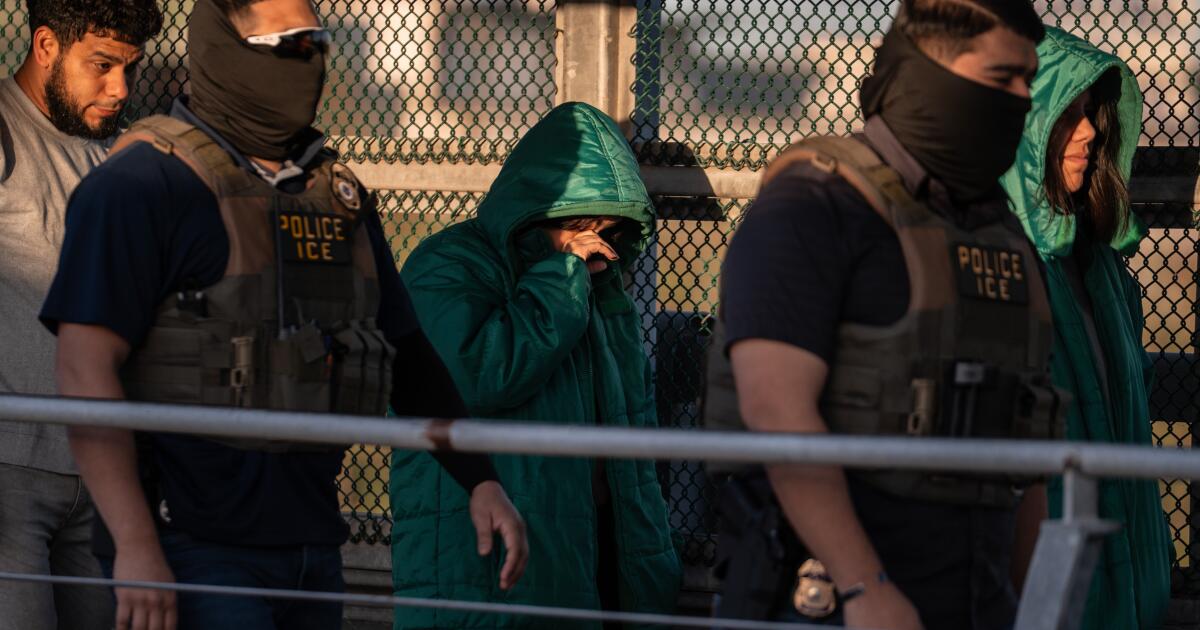
Yet all indications are that Trump’s mass deportation operation is not stalling but intensifying, with billions of dollars being spent to hire Immigration and Customs Enforcement officers, build warehouse detention sites and meet the administration’s goal of rounding up and removing some 1 million immigrants from the U.S. this year.
“We are at an interesting moment where it has been an inflection point — the public has finally seen what mass detention and mass deportation mean,” said Sarah Mehta, who tracks the issue at the American Civil Liberties Union.
“This is not an agency that’s slowing down,” she said. “They’re really going forward with some of the cruelest policies.”
White House spokeswoman Abigail Jackson said the president’s policies have sent immigrants out of the U.S., either through forced deportations or on their own, and sealed up the U.S.-Mexico border.
“Nobody is changing the administration’s immigration enforcement agenda,” she said.
Senators ready to grill Trump’s DHS nominee over deportations
The questions put Homeland Security at a crossroads. Secretary Kristi Noem is on her way out, and Trump’s nominee to replace her, Sen. Markwayne Mullin of Oklahoma, appears this week for Senate confirmation hearings.
After the intense deportation sweeps in Minneapolis and other cities — and the deaths of at least three U.S. citizens at the hands of officers — Democratic lawmakers are refusing to provide routine funding unless the department changes its policies.
At the same time, those who believe Trump won the White House with his mass deportation agenda are disappointed the administration did not achieve its goals last year and insist he must do better.
“There has been a lot of talk in Congress and now in the White House about kind of backing away from President Trump’s, candidate Trump’s, mass deportation promise,” said Rosemary Jenks, co-founder of the Immigration Accountability Project, which argues for deportations.
“We believe that now is an opportunity,” she said. “We’ve got to get the deportation numbers up.”
A nation of immigrants no longer?
The debate is playing out as the United States, celebrating its 250th year, squares its founding as a nation of immigrants with images of masked federal agents breaking car windows and detaining people suspected of being in the U.S. without proper legal standing.
The Congress, controlled by Republicans, provided some $170 billion in last year’s tax cuts bill to fuel the effort, more than tripling the budget of ICE.
GOP Sen. Eric Schmitt of Missouri, in a fiery speech, fought back against the Democrats’ proposed restraints. “This question about deporting illegal immigrants was on the ballot. President Trump was not bashful,” he said. “And the American people supported the idea that we are going to deport people.”
Yet there are signs of cracks in the Trump coalition. Some Republicans prefer what one called a more humane approach and are sharing their views with Mullin.
Sen. Ron Johnson (R-Wis.), considered a stalwart against illegal immigration, said in his state it’s immigrants who milk most of the dairy cows, and he’s heard from restaurant groups that rely on immigrants to fill jobs.
“Can we just turn back the clock and have … all these people who came in here illegally, just be back home?” he asked.
“In terms of actually implementing that, it’s a lot tougher — particularly, in fact, when you realize a lot of these people, most of them, came here to seek opportunity, wanting freedom,” he said. “They’re working, supporting their family, contributing to organizations and community.”
Mass deportation group wants more
The Mass Deportation Coalition, a group of conservative organizations including the Heritage Foundation and Erik Prince, founder of the security firm Blackwater, was formed recently to keep the administration on track.
It calls last year’s focus on removing violent criminal immigrants “phase one” and says “phase two” should focus this year on deporting immigrants beyond those with violent criminal histories.
Mark Morgan, who served as acting head of ICE and Customs and Border Protection during Trump’s first term and is part of the coalition, said that doesn’t mean roving patrols through Home Depot parking lots. It’s about strategic enforcement focused on immigrants at worksites and those who have overstayed visas and whom a judge has already ordered removed, he said.
But they’re facing opposition from within the Republican Party, Morgan said, particularly from those who want to narrow deportation to mainly criminals and from business groups that want to ease up on worksite enforcement.
“The Republicans that are saying that their definition of targeted enforcement is only criminal, they’re wrong. They’re on the wrong side of this,” he said.
“That’s why you see some of the base that’s really becoming apoplectic because they’re like, ‘Wait a minute. You’re talking about only removing criminals now? That’s not what you promised,’” Morgan said.
What’s coming next
The deportation advocates as well as those working to protect the rights of immigrants see that the Trump administration’s best chance at reaching its goals is creating an environment so unwelcoming for immigrants that they just leave — what’s often called self-deportation.
Mehta, at the ACLU, expects the administration will step up efforts to end temporary permissions that allow immigrants to remain in the U.S. — particularly refugees and asylum seekers — while their cases are making their way through the system. She called it a “deliberate attempt to make people undocumented — to take away lawful status — and then to be able to enforce against them.”
Sen. Alex Padilla (D-Calif.) said he fears that more nonviolent immigrants will be rounded up to fill the new warehouses being equipped as the Trump administration tries to reach its deportation goals.
That’s unacceptable, he said, and among “the key questions that Senator Mullin will have to answer at his confirmation hearing.”
Mascaro, Santana and Cappelletti write for the Associated Press.
WASHINGTON — After two weeks of war with Iran, the Trump administration is being forced to temper its expectations of a swift end to the conflict, with U.S. intelligence and defense officials expressing doubt it can achieve the overthrow of Iran’s government and the destruction of its nuclear program through military means.
It was an outcome forewarned by analysts at the State Department, the CIA and the Pentagon, who together alerted the administration to the pitfalls full-scale war with Iran would bring before President Trump decided to proceed, two U.S. officials told The Times, granted anonymity to speak candidly.
Certain military goals of Operation Epic Fury laid out at the start of the war are still seen as achievable at the Pentagon, with U.S. and Israeli strikes making steady progress degrading Iran’s ballistic missile infrastructure, its drone program and its navy.
But a prewar U.S. intelligence assessment, that an air assault was unlikely to topple the Islamic Republic, still holds, with the intelligence community now casting doubt the assault had any more political effect than to radicalize a government already devoted to the destruction of Israel and harming the United States.
A military procession in Tehran carries the casket of Ali Shamkhani, political advisor to Iran’s last Supreme Leader Ayatollah Ali Khamenei, who was also killed in U.S.-Israeli attacks.
(Atta Kenare / AFP/Getty Images)
Concern has only grown that Iran’s new government will make the fateful strategic decision to build a bomb after the war, unless Trump decides to escalate the conflict with a perilous ground invasion. And the White House now contends with a new mission imperative, created by its decision to launch the war itself, of reopening the Strait of Hormuz to vital shipping traffic that carries 20% of the world’s daily oil and liquid natural gas supply.
The foreign policy strategy Trump publicly laid out as his playbook for the conflict — to come down hard on the government, decapitating its leadership, and hope the remnants would seek mercy — has not worked, with Tehran looking for new ways to expand the war and maximize pain for the U.S. administration.
Trump has minimized the conflict as an “excursion” that would end “very soon,” while also calling it a war, vowing to take the time he needs to “finish the job.” He says it will conclude whenever he decides to end it.
It remains possible that a declaration from Trump that the fighting is over results in a ceasefire, as it did in June of last year, when Trump demanded an end to 12 days of war between Iran and Israel. But the Iranians have a vote, too — and senior leadership in the Islamic Republic have made plain they plan to continue fighting this time whether Trump likes it or not.
On Friday, the Pentagon announced that an additional expeditionary unit of 2,500 Marines was being deployed to the region to support the effort.
“Starting wars is an easy matter,” Ali Larijani, secretary of Iran’s Supreme National Security Council, wrote on social media. “Ending them does not happen with a few tweets.
“We will not leave you until you admit your mistake and pay its price,” he added.
It is a sore lesson for a president whose decade in public life has been distinguished by an exceptional ability to warp reality to his liking.
“The White House has created a dilemma for America: If it declares victory and ends the war, it leaves in place a weakened Iranian government with the means and renewed motivation to pursue nuclear weapons,” said Reid Pauly, a professor of nuclear security and policy at Brown University.
“If it presses on with the war,” Pauly added, “it risks the kind of mission creep that may eventually find American boots on the ground.”
In a news release last week, the White House said that, “from the opening hours of this historic campaign, the objectives were clear: obliterate Iran’s ballistic missile arsenal and production capacity, annihilate its navy, sever its support for terrorist proxies, and ensure the world’s leading state sponsor of terrorism will never acquire a nuclear weapon.”
Yet, at the start of the operation, Trump issued a promise to the people of Iran that, at the end of the U.S.-Israeli campaign, Iran’s military and paramilitary infrastructure would be so badly hobbled that a rare, generational opportunity would emerge for them to take their government back.
“To the great proud people of Iran, I say tonight that the hour of your freedom is at hand,” Trump said. “Stay sheltered. Don’t leave your home. It’s very dangerous outside. Bombs will be dropping everywhere. When we are finished, take over your government. It will be yours to take. This will be probably your only chance for generations.”
Trump said in the days that followed he would need to have a say over the next ruler, after assassinating the country’s longtime supreme leader, Ayatollah Ali Khamenei. But the Iranian system of clerics and militants defied the president, selecting in Khamenei’s son a man viewed as even more hostile to the West than his father was.
Israeli leadership, too, set out regime change as a goal of the war. Yet even their officials now say that a substantial leadership change in Tehran is an unlikely result.
Trump would go on to insist on the “unconditional surrender” from the Iranian government, a demand that he later said would be satisfied by the incapacitation of Iran’s military.
Repeating his conviction that the war will end soon, Trump told Fox News’ Brian Kilmeade in an interview Friday that he would order an end to the fighting “when I feel it. When I feel it in my bones.”
“The problem with the administration’s approach is that it has constantly shifted its goals. Some are achievable, such as degrading Iran’s conventional force. Others are not, such as picking the next leader of Iran,” said Ray Takeyh, a scholar on Iran at the Council on Foreign Relations.
“The mixed messages have led to confusion at home,” Takeyh added, “and lack of planning for oil shortages and getting the Americans out of the region shows that process and personnel can actually matter.”
Mark Dubowitz, CEO of the Foundation for Defense of Democracies, said the joint U.S.-Israeli campaign was always designed to unfold in three phases: degrading Iran’s ability to wage war, reducing Iran’s ability to repress democratic forces inside the country, and finally, encouraging the Iranian people to rise up.
“The president controls the strategy, but no president fully controls the endgame because the regime gets a vote,” Dubowitz said. “The endgame is not a scripted political transition directed from Washington. It is a regime under simultaneous military, economic, and internal pressure — to strip of its war-making and repression capabilities — and whether that produces succession, fracture, or collapse will ultimately be decided in Tehran.”
Whether the conflict will achieve the destruction of Iran’s nuclear program is an equally grave question in Washington, where officials are debating over a list of stark options on how to physically destroy, bury or retrieve the fissile material that Tehran could use to build a nuclear weapon — a threat seen as only more grave under the stewardship of an angry and vengeful government.
“The war was publicly justified, to the extent it was justified at all, in terms of destroying Iran’s nuclear program. Very few strikes have been directed against nuclear-related targets, however — almost certainly because those that survived last June’s attacks are invulnerable to air attack,” said James Acton, co‑director of the nuclear policy program at the Carnegie Endowment for International Peace.
“Unless the U.S. and Israel attempt high-risk special forces operations or a ground incursion,” he added, “Iran will end the war with its surviving nuclear infrastructure largely intact and greater incentives to build the bomb.”
Pauly agreed it is unrealistic to expect the United States and Israel can destroy Iran’s nuclear program through air power alone. The U.N. International Atomic Energy Agency believes Iran has roughly 440 kilograms — about 970 pounds — of 60% highly enriched uranium, possibly spread across multiple facilities.
“Securing this material will require either U.S. ground troops or, after some coercive bargain is reached, international inspectors,” Pauly said.
In an exchange with reporters last week at the Pentagon, Defense Secretary Pete Hegseth had few details to offer on what U.S. options were to remove or eliminate an accessible uranium stockpile, enriched to near weapons grade, that had been buried in a U.S. operation last year intended on obliterating the nuclear threat.
Diplomacy, he suggested, might be required to secure the material.
“I will say we have a range of options, up to and including Iran deciding that they will give those up,” he told reporters, “which of course we would welcome.”
President Trump was uncommonly lucky in his first term, neither inheriting nor provoking a crisis of the sort that tests U.S. presidents, until COVID struck in his final 10 months. (He failed that test, contributing to his 2020 reelection defeat.) Trump 1.0 was bequeathed a growing economy from President Obama, and the incoming president assembled a roster of capable advisors who often acted to prevent him from doing nutty things at home and abroad.
Trump 2.0 made sure that no such human guardrails populated his second Cabinet, only genuflecting enablers. Unrestrained, he has presided over one crisis on top of another, all of his own making. Tariff mayhem and high prices. Armed agents and troops in American cities. Repeated violations of court orders. Demolition at federal agencies and the White House.
And now Trump has taken the nation to war against Iran in league with Israel’s Benjamin Netanyahu. Depending on the moment and the audience, a contradictory Trump is either claiming the war is “very complete” or that much remains to be done to “decimate” Iran. On Wednesday he blithely told Axios, “Any time I want it to end, it will end,” even as U.S. officials planned further actions.
In any case, Trump’s war of choice and the killing of the supreme leader of Iran’s terroristic theocracy now has spawned another potential crisis, counterterrorism experts warn: the risks of retaliatory terrorist threats at home. And that is a threat, whether from homegrown extremists or sleeper cells of the sort that came alive for 9/11, that is likely greater because of the initial self-induced crisis of Trump’s second term: his whacking of the federal government.
Trump authorized Elon Musk’s destruction of the bureaucracy in the name of “government efficiency” and continues to exact retribution against any federal employee who had anything to do with investigating and prosecuting him during his interregnum. Longtime agents and operatives have been eliminated at the FBI, Justice Department, Department of Homeland Security, CIA and elsewhere. Especially at the FBI, counterterrorism experts with centuries of collective experience are gone and many who remain have been diverted to Trump’s top priority: mass deportations.
Consequently, the president who promised to “Make America Safe Again” has arguably made Americans less safe.
I raised this scary prospect just over a year ago as Trump’s teardown of the purported Deep State was underway. And now a Mideast war that Trump promised never to start has further incentivized Iran and its jihadi proxies to hit back, just as he’s diminished the nation’s early-warning systems.
Enough intelligence remains, however, that even in the days before Trump ordered the first strikes against Tehran, government analysts were picking up “worrisome signs” of Iranian plotting against U.S. targets, the New York Times reported. After the U.S.-Israel onslaught and death of Ayatollah Ali Khamenei on Feb. 28, the government intercepted a possible Iranian “operational trigger” to “sleeper assets” outside Iran, according to ABC News.
Counterterrorism expert Colin P. Clarke, executive director of the Soufan Center, which focuses on global security and transnational terrorism, wrote this week in the Atlantic that U.S. agencies’ record of disrupting Iranian-backed plots in America was in jeopardy given the recent changes in funding, personnel and priorities. “Because of this,” he concluded, “the U.S. homeland is arguably more vulnerable than it has been in a long time.”
In a follow-up exchange of emails, Clarke told me, “Many of this administration’s moves have been myopic — shifting counterterrorism resources to immigration, firing FBI agents working counterintelligence, etc. A week before the U.S. went to war with Iran, the FBI Director Kash Patel was off gallivanting in Milan at the Olympics [where he struggled to chug a Michelob Ultra, a firing offense in its own right] when he should have been preparing for the potential for an Iranian response on U.S. soil.”
Patel’s preposterous partying with the U.S. men’s hockey team while war-planning was underway in Washington was widely, justifiably mocked. But it stands as a metaphor for the entire Trump administration’s cavalier attitude toward homeland security. Its abusive focus on both migrants and citizens protesting on the migrants’ behalf is a distraction from actual threats to the country.
Patel, like his boss at the Justice Department, Atty. Gen. Pam Bondi, has made plain in words and actions that the president’s political enemies are the real public enemies No. 1. One of Bondi’s first acts was creation of a “weaponization working group” to identify, fire or prosecute those in her department who’d investigated and prosecuted Trump, many of whom also had experience in domestic and transnational terrorism. The association representing FBI agents called her purges “dangerous distractions” from the work “to make America safe again.”
Days after starting the Iran war, when homeland security should have been on red alert, Trump fired his secretary of Homeland Security, Kristi Noem. Her costly cosplaying as the homeland’s heroine on horseback in anti-migrant videos, along with her penchant for luxury jets allegedly to transport deportees, was too much even for him.
Yet all three “national security” officials — Noem, Bondi and Patel — simply reflect Trump’s own warped approach and blasé attitude toward the homefront.
When Time magazine last week asked the commander in chief whether Americans should be worried about potential terrorist strikes at home, he replied, “I guess.”
“We plan for it,” he added. “But yeah, you know, we expect some things. Like I said, some people will die. When you go to war, some people will die.”
The administration is planning for it all right. An extraordinary number of senior Trump officials have taken up residence in houses on military bases, including Bondi, Noem, the secretaries of State and Defense, Marco Rubio and Pete Hegseth, and White House consigliere Stephen Miller.
The rest of us just have to keep our fingers crossed. I guess.