Hollywood unions split: DGA, IATSE seek settlement while WGA fights to block Paramount-Warner merger
Citing Hollywood’s already struggling production economy, two influential industry unions have jointly called on Paramount Skydance Chairman David Ellison and California Atty. Gen. Rob Bonta to settle their antitrust fight.
The Directors Guild of America and the International Alliance of Theatrical Stage Employees — which represent a combined 200,000 union members — are turning up the political pressure to try to resolve the clash over the Paramount-Warner Bros. merger, which has already carved deep divisions throughout the industry.
The DGA and IATSE’s unusual missive comes as Paramount has been trying to drum up support for the deal and while
development projects reportedly are being put on hold. Paramount executives and others have decried the delay in deciding whether the deal moves forward. Bonta and Paramount are now poised to slug it out in an Oakland courtroom next spring.
“Our collective members are concerned about their futures, and the future of the industry,” DGA Executive Director Russell Hollander and IATSE President Matthew D. Loeb wrote Thursday in their three-page letter to Ellison and Bonta.
“We are aware of productions that have been put on hold or canceled altogether, leading to further reductions in available work for our members and other industry workers,” the letter reads in part.
The effort adds heat to a growing campaign urging Bonta to bend in his fight to block the industry- reshaping deal that would combine the Warner Bros. and Paramount film and television studios, HBO, CBS, CNN, HGTV and Comedy Central.
Earlier this week, California’s Democratic gubernatorial nominee, Xavier Becerra, said he favored a settlement. Republican Steve Hilton has decried the antitrust lawsuit as being politically motivated.
Gov. Gavin Newsom, who leaves office next year, has stayed above the fray.
Paramount and Bonta’s office didn’t immediately comment.
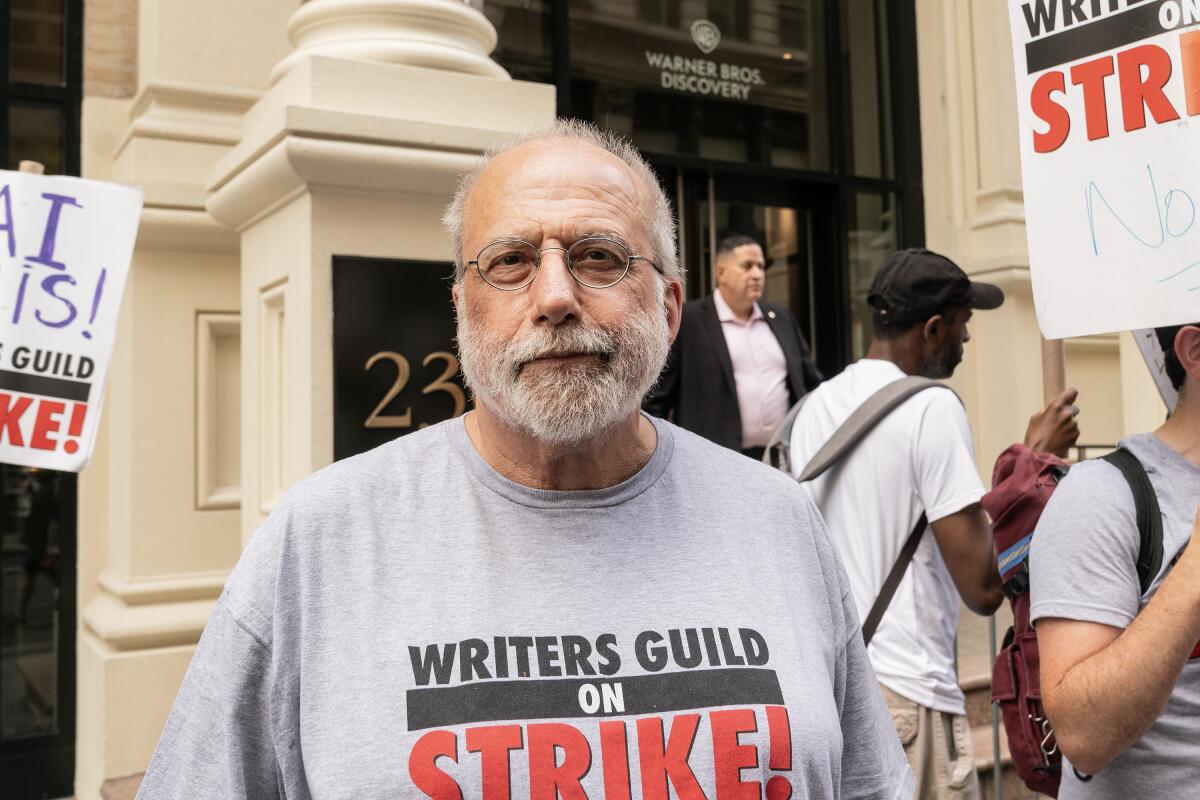
The Writers Guild of America last month joined Bonta’s coalition of state attorneys general in filing lawsuits to upend the $111-billion transaction, saying the Paramount-Warner combination violates U.S. antitrust laws and would decimate the entertainment industry by erasing jobs and reducing pay.
At issue is the $81 billion in debt that Ellison would have to take on to pay Warner Bros. Discovery shareholders for the keys to the studios and HBO.
WGA leaders and others have warned that level of debt would choke the two historic studios, creating a more devastating sequel to 2019‘s combination of the Disney and Fox studios, and the 2022 takeover of Warner Bros. by Discovery.
The union leaders conceded they weren’t merger fans, and they stopped well short of asking Bonta to throw in the towel.
Instead, they listed nine conditions — including requiring Paramount to maintain its operations in Hollywood and a commitment to make film and television shows in the U.S. — as part of any settlement.
The unions want Ellison to make an enforceable commitment that Paramount and Warner Bros. studios each release 15 films into theaters a year. They also want a 45-day theatrical window so that cinema chains can continue their rebound.
Some of the DGA and IATSE terms may be difficult for Ellison to swallow. Already, Paramount is looking to shave expenses to come up with the $81 billion promised to Warner Bros. shareholders. Sources have said Ellison’s suggestion to move Paramount from its picturesque Hollywood campus is designed, in part, to attract financial incentives from another state, such as Tennessee, eager to help with a relocation.
Among the conditions, the DGA and IATSE asked that Paramount’s and Warner Bros.’ motion picture units be kept as “as separate studios, with each studio maintaining its own production, distribution, marketing and exhibition groups as distinct divisions.”
One of the goals of the merger is to shave costs by consolidating overlapping business divisions and back-office functions.
The union leaders also want Warner Bros. television studio to operate independent from the Paramount and CBS production arms. They called on HBO to remain a linear television channel and available on third-party platforms, including Amazon.
Loeb and Hollander’s requests are designed to keep production jobs in the U.S.
They asked Ellison to commit to producing films and TV shows in the U.S. “at no less than the average percentage produced in the United States during the last five years” excluding 2020, the pandemic year, and 2023, when two strikes idled production.
“Our goal, with respect to the proposed merger, has always been to achieve an outcome that ensures a vibrant, competitive marketplace for the production, distribution, and licensing of film and television programming that serves the interests of consumers and filmmakers alike,” Hollander and Loeb wrote.
“We believe that these conditions, if secured through a binding agreement, will largely serve this purpose,” the said.
Bonta previously has said his preference would be structural remedies — divesting key business units — rather than “behavioral” compromises that could evaporate soon after the merger closed.
Should the two sides fail to hash out a settlement with conditions, Loeb and Hollander asked Ellison and Bonta to seek an earlier trial date for the legal showdown.
A federal judge set a March 2 date — despite Paramount’s request to hold the proceedings in November.