wga

Writers Guild brace for tough negotiations with major studios

It has been nearly three years since Hollywood writers went on a historic strike that lasted 148 days and ushered in an extraordinary period of labor unrest that virtually shut down the film and TV business.

Now, writers are poised to commence another round of bargaining with the major studios on a new three-year film and TV contract. Few observers think the union is girding for another showdown, especially at a time when many of its members are struggling to find work amid media consolidation and belt-tightening.

But in advance of negotiations that begin on Monday , union leaders are eager to dispel any perception that they might have scaled back their demands.

“Our members have shown many times that they’re willing to fight for what we need as a collective group,” WGA West President Michele Mulroney said in an interview. “And there’s no exception here.”

With its current contract expiring on May 1, the WGA hopes to improve its members’ healthcare plans, increase streaming residuals and expand AI protections.

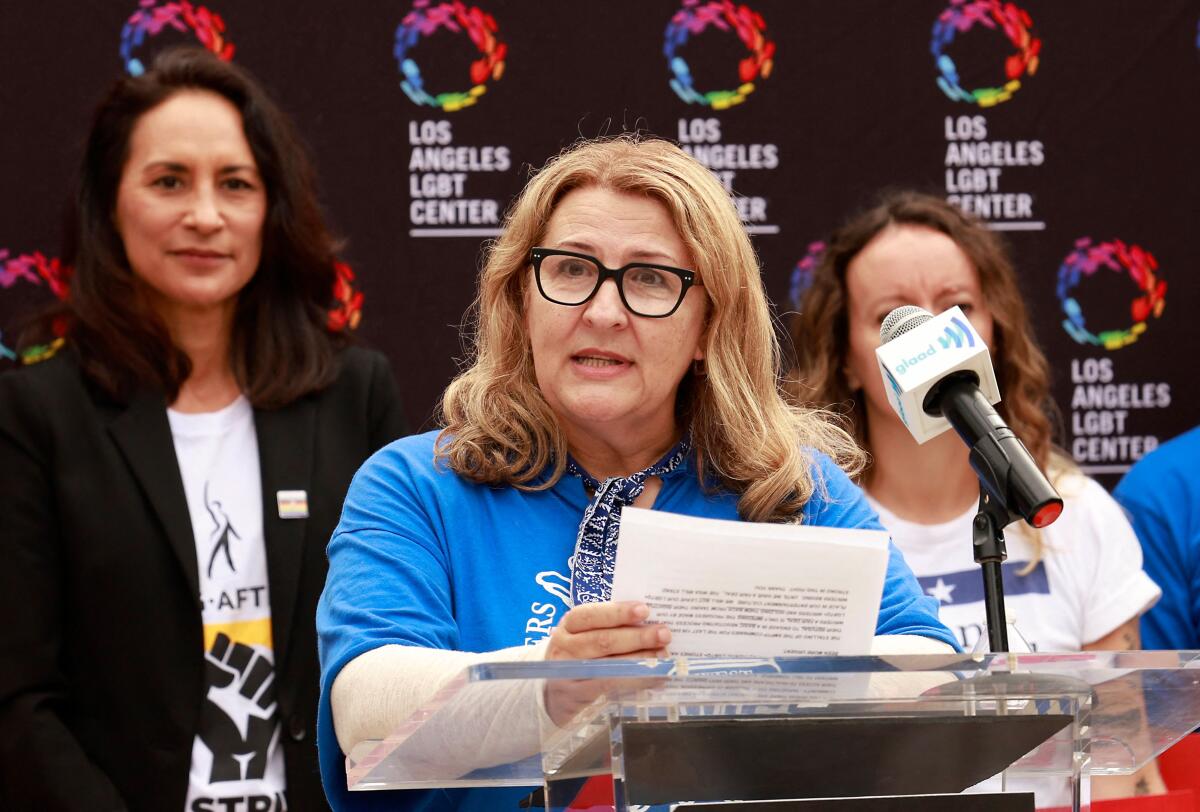
Michele Mulroney speaks

Michele Mulroney speaks as the Screen Actors Guild (SAG-AFTRA) and Writers Guild of America (WGA) join GLAAD in releasing the 11TH Annual GLAAD Studio Responsibility Index at The Village at Ed Gould Plaza Los Angeles LGBT Center in Los Angeles, California, on September 14, 2023.

(Michael Tran/AFP via Getty Images)

Ellen Stutzman, the union’s executive director, said despite popular belief, the studios have weathered the transition from cable television to streaming “very well,” citing their efforts to maximize revenue with streaming bundling, rising subscription fees and advertising revenue.

“Writers are watching as Netflix and Paramount are fighting it out to acquire Warner Bros… Paramount is spending $81 billion,” said Stutzman. “There’s money for a fair deal for writers.”

The union leaders agree that this year’s negotiations are all focused on the sustainability of a writer’s career.

A spokesperson from the Alliance of Motion Picture and Television Producers, which represents the major studios in negotiations, said in a statement that they look forward “to engaging in a constructive and collaborative bargaining process with the WGA. Through continued good-faith dialogue, we are confident we can reach balanced solutions that support talented writers while sustaining the long-term success and stability of our industry and its workforce.”

A top priority for the WGA is to increase the caps that companies contribute to the union’s healthcare plan. Union officials say the current cap has remain unchanged for two decades as healthcare contributions have steadily declined due to fewer writers working.

AI is also top of mind for the WGA.

In 2023, the guild secured various AI protections by establishing that AI isn’t a writer and nothing it produces is considered literary material.

But as major studios start to make deals with AI companies, like Disney’s $1 billion investment into OpenAI’s Sora platform, many writers are concerned about how their work could be used.

“AI is using [studios’] IP, which is stuff that we wrote to license these models,” said John August, the co-host of the “Scriptnotes” podcast and WGA’s negotiating committee co-chair. “With the Sora deal, it seems clear that the companies intend to monetize this IP for use with AI.”

August says the union will be skeptical toward arguments that it’s still too early to seek more safeguards around such a nascent industry, citing the union’s past history with the rise of DVDs and the internet and how profoundly those technologies changed the compensation for writers.

“If you’re taking the work that we created to generate AI outputs, we are owed money. They’re using our work to do something down the road,” added August.

WGA’s negotiating committee also is looking to boost streaming residuals, expand the minimum number of people allowed in a writers’ room and add protections for scribes working on pilots.

“We very much hope that lessons were learned in 2023 and that the AMPTP will come to the table ready to take our proposal seriously and to make a fair deal, and to do that quickly,” Mulroney said. “It provides stability for the companies and for our membership. It’s better for everybody.”

WGA is entering contract negotiations nearly a month after the actors’ union, SAG-AFTRA, began its bargaining sessions. Last week,
the AMPTP said it was extending negotiations another seven days.
Source link

SAG-AFTRA extends contract negotiations as WGA finalizes demands

As Hollywood writers continue contract negotiations with major studios, one topic remains front and center: the role of artificial intelligence.

On Friday, the Writers Guild of America released a list of contract demands, which 97% of the union membership supports. Though some details have yet to be revealed, many of the union’s asks involve expanding protections over the use and abuse of AI, in addition to improved health coverage and higher residuals.

AI and streaming residuals were central issues in strikes by actors and writers in 2023.

WGA’s current contract, which expires May 1, established that AI isn’t a writer and nothing it produces is considered literary material. It prohibits companies from giving writers AI-generated scripts for a rewrite fee or requiring writers to use AI software, and a company must disclose whether any written materials were developed using AI.

The union says its current demand is to simply “expand” these protections. Other priorities include increasing contributions to the WGA benefit plans, raising minimums for “page one” rewrites and boosting streaming residuals.

The Screen Actors Guild-American Federation of Television and Radio Artists has identified similar issues as it negotiates a new contract for actors. Last week, SAG-AFTRA and the bargaining group for the major studios disclosed that they are extending their negotiations for seven days. The discussions began Feb. 9.

The union, whose contract expires June 30, is expected to propose what has been called the Tilly tax, a fee that studios would have to pay to the union in exchange for using an AI actor. This demand is in response to the first AI actor, Tilly Norwood, being introduced to Hollywood. Though the bot has yet to star in a major project, the fear of AI-generated characters taking jobs is real for many actors. The bot’s creator, Xicoia, also recently announced the expansion of its AI actor universe, called the “Tillyverse.”

WGA’s negotiations are set to start Monday and will be led by Ellen Stutzman. The studios will be represented by the Alliance of Motion Picture and Television Producers’ new president, Gregory Hessinger.

The negotiations are happening as WGA West’s own staff members have been on strike, forcing the guild to call off its L.A.-based award show. The staff union, with more than 100 employees, are similarly demanding higher pay and protections against AI.

Source link

WGA cancels Los Angeles awards show amid labor strike

The Writers Guild of America West has canceled its awards ceremony scheduled to take place March 8 as its staff union members continue to strike, demanding higher pay and protections against artificial intelligence.

In a letter sent to members on Sunday, WGA West’s board of directors, including President Michele Mulroney, wrote, “The non-supervisory staff of the WGAW are currently on strike and the Guild would not ask our members or guests to cross a picket line to attend the awards show. The WGAW staff have a right to strike and our exceptional nominees and honorees deserve an uncomplicated celebration of their achievements.”

The New York ceremony, scheduled on the same day, is expected go forward while an alternative celebration for Los Angeles-based nominees will take place at a later date, according to the letter.

Comedian and actor Atsuko Okatsuka was set to host the L.A. show, while filmmaker James Cameron was to receive the WGA West Laurel Award.

WGA union staffers have been striking outside the guild’s Los Angeles headquarters on Fairfax Avenue since Feb. 17. The union alleged that management did not intend to reach an agreement on the pending contract. Further, it claimed that guild management had “surveilled workers for union activity, terminated union supporters, and engaged in bad faith surface bargaining.”

On Tuesday, the labor organization said that management had raised the specter of canceling the ceremony during a call about contraction negotiations.

“Make no mistake: this is an attempt by WGAW management to drive a wedge between WGSU and WGA membership when we should be building unity ahead of MBA [Minimum Basic Agreement] negotiations with the AMPTP [Alliance of Motion Picture and Television Producers],” wrote the staff union. “We urge Guild management to end this strike now,” the union wrote on Instagram.

The union, made up of more than 100 employees who work in areas including legal, communications and residuals, was formed last spring and first authorized a strike in January with 82% of its members. Contract negotiations, which began in September, have focused on the use of artificial intelligence, pay raises and “basic protections” including grievance procedures.

The WGA has said that it offered “comprehensive proposals with numerous union protections and improvements to compensation and benefits.”

The ceremony’s cancellation, coming just weeks before the Academy Awards, casts a shadow over the upcoming contraction negotiations between the WGA and the Alliance of Motion Picture and Television Producers, which represents the studios and streamers.

In 2023, the WGA went on a strike lasting 148 days, the second-longest strike in the union’s history.

Times staff writer Cerys Davies contributed to this report.


Source link