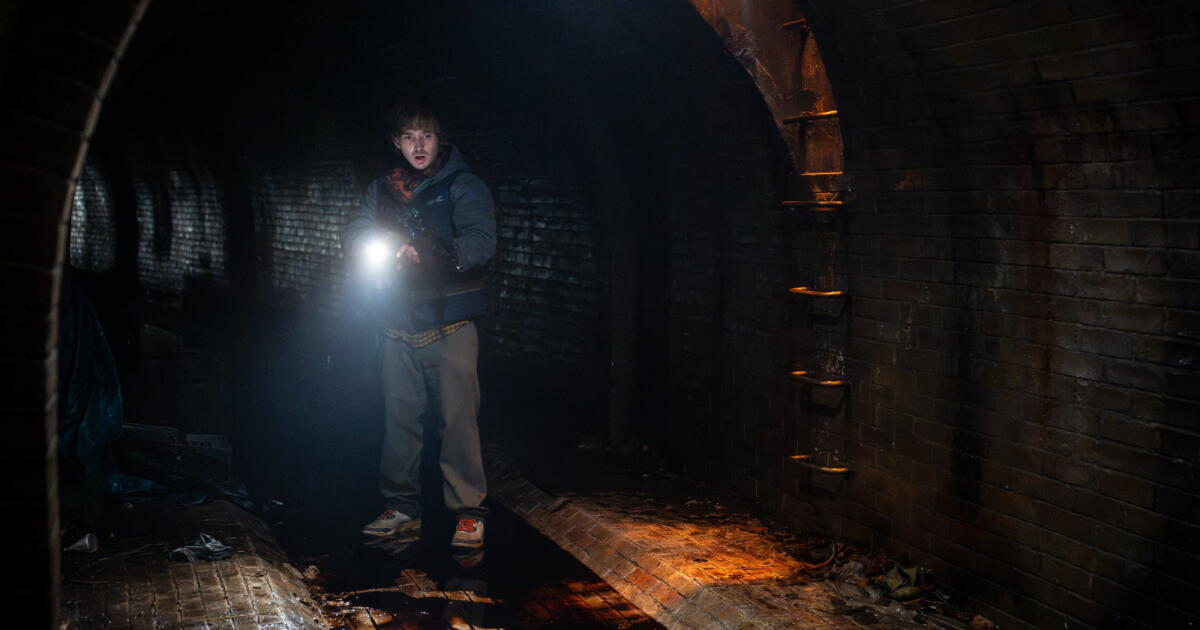
After his existential suburban horror epic “Weapons” became an Oscar winner (for Amy Madigan’s chilling supporting performance as Aunt Gladys), filmmaker Zach Cregger has dashed off a fun little riff on one of his favorite video games. His “Resident Evil” reboot is the eighth film in the big-screen franchise based on the Japanese zombie survival game, though Cregger’s “Resident Evil” is its own beast — put those Milla Jovovich movies out of your head entirely.
There are, of course, a few shared strands of DNA in the screenplay by Cregger and Shay Hatten: an evil company, Umbrella Corporation, responsible for a virus that mutates humans into zombies and all manner of monsters, located in the lovely Raccoon City. But our hero, Bryan (Austin Abrams), a hapless medical courier, knows none of this when he takes a gig delivering what he thinks is an organ on the snowy mountain roads to the metropolis.
Abrams, who was a standout in the ensemble cast of “Weapons,” has another big movie out this fall in which he stars as the lone protagonist, “Whalefall,” and the two films comprise an apt survival thriller double feature. In “Resident Evil,” Abrams’ Bryan spends much of his lonely mission muttering to himself in annoyance and sometimes victory, much like a gamer would. During one self-reflective moment, Bryan yells, “Yeah! Video games!” elated at how his shooting is improving.
Cregger’s approach to “Resident Evil” is to seamlessly blend the cinematic with a gaming experience and his adaptation best mimics the feeling of playing an actual game or watching someone else play one. At one point, Bryan and a comrade he meets along the way (Paul Walter Hauser) marvel at the shooting skills of Maxine (Kali Reis) as if they’re watching her play the game too.
Immediately, Cregger establishes a camera that follows closely behind Bryan, a similar motif to the cinematography he used in “Weapons.” As Bryan starts to encounter the strange beings who appear on the outskirts of Raccoon City, the game mechanisms click into place. Different characters — villains and helpers — pop up along his journey, as well as different tools and weapons. He frequently encounters locked doors, obstacles and empty spaces that he has to explore. Cregger uses first-person-shooter point-of-view shots, with the long barrel of a rifle or automatic weapon lining up our sights; one running gag sees Bryan, completely hopeless with guns, having to shoot the locks off of gates.
What was already a very darkly funny and incredibly gross film gets even more disturbing as Bryan ventures into the Raccoon City hospital, trying to make his delivery. He encounters monsters that vomit acid or explode with zombie rats; one particular ward is full of undulating sacs of bloody viscera.
Cregger remains one of our finest horror image-makers, creating surreal and snowy landscapes that are as beautiful as they are disturbing: the red and blue lights of a flipped police car in a blizzard, dark pools of blood and mysterious footsteps, tentacles greeting and meeting each other, stomach acid decimating an elevator. With impeccable sound design and an eerie score by Ryan and Hays Holladay, Cregger delivers a textured, wholly realized world.
But our guide is just a regular guy, which lends to the charm. Bryan is dealing with relationship problems that add to the urgency of his desire to survive, but he’s also just a dude with questionable self-preservation instincts, which makes for a good adventure. He has an overwhelming desire to help, which leads to some ridiculous circumstances and is a quality that Cregger plays for laughs. Abrams plays the goofball well and we’re constantly rooting for him, even as his fortunes take a turn in a tragic reversal that we’ve seen in monster movies before.
Cregger wears his influences well and they aren’t just video games but pulled from the history of horror. Still, he blends it all into his own vision so it doesn’t feel derivative. While the unwieldy ending might get away from him, the tightly controlled and efficient stretch that precedes it is the work of a new master, one who delivers imaginative, terrifying and hilarious thrills and chills, whether he’s reanimating a dead franchise or dreaming up his own uncanny vibe. “Resident Evil” might be his most playful — and gooey — film yet.
Katie Walsh is a Tribune News Service film critic.
‘Resident Evil’
Rated: R, for strong bloody violence, gore and language throughout
WASHINGTON — The United States has confirmed for the first time that it has deployed weapons in space.
Air Force Secretary Troy Meink told the Air and Space Cyber Conference in Maryland on Monday that the U.S. has fielded “on-orbit space control weapons capable of defending the Joint Force against hostile adversary action.”
Meink did not detail what the weapons were or how they work. In 2024 the U.S. said Russia was developing a new anti-satellite weapon that could be launched from space. At the time the White House said the danger wasn’t imminent.
But reports of the anti-satellite weapon reflected longstanding worries about space threats from Russia and China, given that much U.S. infrastructure is dependent on satellite communications.
In his remarks, Meink also said the Air Force was adding more autonomous systems to its capabilities and predicted the service would look “radically different” by 2032. For example, he foresaw one-way attack drones replacing artillery as the “primary killer.”
“We are increasing readiness against existing threats,” he said.
Weekly insights and analysis on the latest developments in military technology, strategy, and foreign policy.
Castelion, a startup begun by former SpaceX employees, has provided the first view of its Blackbeard hypersonic weapon. The first look at what has been billed as a lower-cost missile comes as the company announces that it has secured $1 billion in new financing, which it says will help get its first hypersonic weapon into production as part of its ambitious manufacturing strategy. While hypersonic weapons have very attractive qualities, they are extremely expensive and that cost will likely keep them from being bought in large quantities or used against wider target sets. Castelion is focused on trying to shift that, building hypersonic capabilies that can be bought in large quantities and used more freely, even if they have reduced performance.
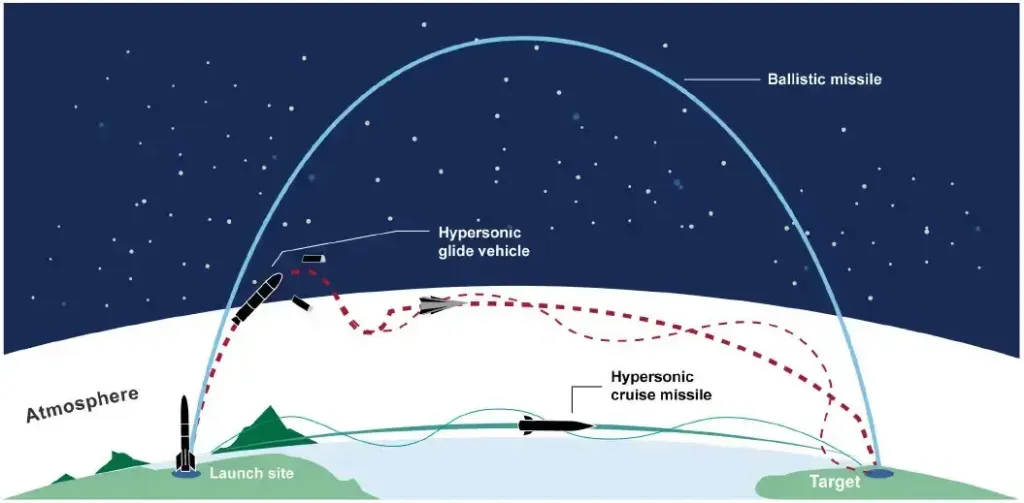
A profile photo at the company’s headquarters reveals a weapon with a ballistic missile-like booster, on top of which is mounted an unpowered hypersonic glide vehicle (HGV). The booster brings the HGV to the desired velocity and altitude before releasing it toward its target. The concept is in contrast to air-breathing cruise missiles capable of traveling at hypersonic speeds. Hypersonic speed is generally defined as anything above Mach 5, which larger ballistic missiles also reach in the course of their flights. More precise performance figures for Blackbeard are lacking, but Castelion has previously hinted it could hit targets out to just under 500 miles.
A graphic showing, in very basic terms, the differences in flight trajectory between a hypersonic glide vehicle (HGV) and a traditional ballistic missile, as well as air-breathing hypersonic cruise missiles. GAO
Both stages of the weapon have cruciform fins, while the HGV features a prominent ‘chine’ line along the length of its body, and a slightly beaklike nose. The trolley on which the weapon is mounted provides some idea of its overall size. The blue stripes seen on each stage normally signify that a munition is an inert, non-explosive round utilized for training or tracking purposes. This would indicate a real (unarmed) missile rather than a dummy or mockup.
The company has previously said that it was aiming to have a more finalized Blackbeard design by 2027, so there is still potential for more design changes to come. We have reached out to Castelion for more information.
Castelion has previously released images of various missiles with very different, far more simple designs, which it has said “are representative of the low-cost internally developed test vehicles we use to enable rapid subsystem design iteration and to ground our performance models in real-world test data.”
Various Blackbeard test articles, emphasizing their difference compared to the latest design. Castelion Corporation
OCTOBER 5, 2025
Two more development flights completed Sunday.
Each test validates vertically integrated subsystems and components from new suppliers nationwide – tightening the link between engineering and manufacturing to deliver capability faster. pic.twitter.com/t4tKM2cPx9
Some of these earlier experimental configurations also look to feature tail sections that are at least heavily inspired by, if not lifted directly from Standard-series surface-to-air missiles as used by the U.S. Navy and other navies globally.
Castelion yesterday also announced it had received Series C financing, comprising $800 million in equity financing and $250 million in committed financing. The equity round values Castelion at approximately $13 billion.
The company says it will use the funds as it transitions from development and flight testing toward producing Blackbeard in significant quantities.
Castelion claims the weapon is the first hypersonic strike system to be designed from the outset to be substantially less expensive and easier to manufacture at scale than traditional high-end missile systems.
“Deterrence depends on unapologetic American strength; highly capable weapon systems that adversaries fear produced in quantities they can’t imagine at a price taxpayers can afford,” Castelion CEO and co-founder Bryon Hargis said.
Another flight test in the books – this time @Spaceport_NM. Our second flight in the past 30 days.
The best way to stay ahead of your adversary in a prolonged competition is to have faster learning cycles than they do. pic.twitter.com/9n776j8XWr
The company says Blackbeard has gone from a clean-sheet design to a program of record in less than four years, with fielding targeted for 2027. Castelion has also secured more than $500 million in U.S. military contracts over the past 18 months.
A major part of the company’s strategy is its Project Ranger campus in Sandoval County, New Mexico. Castelion describes the roughly 1,000-acre facility as the largest dedicated hypersonic missile manufacturing site in the United States. The company previously committed more than $250 million of its own capital to infrastructure at the site and says it will now invest hundreds of millions of dollars more to expand production capacity.
That emphasis on manufacturing is central to how Castelion distinguishes Blackbeard from many existing hypersonic programs. The company has designed the weapon and its production processes around the expectation that large numbers will eventually be required.
“There’s a manufacturing renaissance underway and this round turbocharges American production of Blackbeard,” Hargis said. “Designed in California, built in New Mexico, supplied from small and large businesses across the United States; Blackbeard is an example of what America can do when private capital and Government work together.”
In May of this year, the Pentagon outlined plans to acquire at least 10,000 Blackbeard missiles, as well as a similar number of lower-cost cruise missiles, over the next three years.
These framework agreements are part of a larger effort to rapidly expand U.S. reserves of long-range, standoff weapons and, at the same time, strengthen the defense-industrial base so manufacturers can keep producing those weapons at a high rate over the long term.
The U.S. Army has made clear it is interested in employing Blackbeard in a ground-launched mode, as you can read more about here. Army budget documents confirm it is pursuing Blackbeard aggressively, but through a phased approach that offers multiple off-ramps. The service has previously talked of firing Blackbeard from new uncrewed launcher vehicles, as well as from existing M142 High Mobility Artillery Rocket System (HIMARS) launchers. How many Blackbeard missiles are compatible with each of these launch systems is unclear.
Another test article that Castelion has used in previous testing related to Blackbeard in front of a palletized launcher loaded on a truck. CastelionCorporation
“The mission of Blackbeard Ground Launch (GL) is to attack/neutralize/suppress/destroy using hypersonic missile delivered precision fires (seeker based) against time sensitive moving targets and hardened targets at a much-reduced cost per missile than currently exists in the Army inventory,” the Army stated in its proposed budget for the 2026 Fiscal Year. “Blackbeard Ground Launch (GL) is an affordable, mass-produced hypersonic weapon designed for mid-range precision. The Army will leverage advancements in technology, materials, and cost-effective production methods to provide superior capabilities through fast, iterative design cycles, flexible hardware development, and modern manufacturing practices.”
Meanwhile, earlier this year, Castelion announced receipt of a contract from the Navy to integrate Blackbeard onto the F/A-18E/F Super Hornet carrier strike fighter and transition the system to an early operational capability in 2027. This will involve extensive system safety and certification testing, flight testing, and other integration activities related to carrier-based operations. This development may well be connected with halting plans for an air-launched, air-breathing hypersonic anti-ship cruise missile. A version of Blackbeard could also find its way onto Navy ships and submarines, as well as ground-based launchers, as we have discussed in the past.
A U.S. Navy F/A-18F with a heavy air-to-air load-out, including four of the very long-range AIM-174B air-to-air missiles. point_mugu_skies
In fact, the Army has also said that the ground-launched version of the weapon that it expects to receive will leverage an “existing air-launched, extended-range Blackbeard design,” without providing more information.
The U.S. Air Force has also awarded Castelion contracts in the past in relation to long-range strike weapon concepts, and TWZ has previously reached out to that service for more information.
Regardless, Castelion’s ambitions extend beyond Blackbeard. The company says it has been developing a much longer-range precision strike weapon for several years and will now accelerate its development and testing. That system is intended to reuse technologies, components, and manufacturing techniques developed for Blackbeard.
Another Blackbeard-related test launch. CastelionCorporation
With a huge demand signal from the Pentagon, Castelion is also working on defensive systems based on the same development and manufacturing philosophy. The company says those efforts are focused on lowering costs, increasing production rates, and providing greater magazine depth for air and missile defense.
The strategy responds to the fact that the U.S. military’s growing interest in hypersonic weapons has been accompanied by persistent questions about production capacity and cost. Hypersonic systems are technically demanding, but the ability to manufacture them in meaningful numbers is ultimately just as important as demonstrating that an individual weapon can fly.
Castelion is betting that a different approach to development and manufacturing can change that equation.
“Castelion is at the forefront of defense manufacturing in the nation,” said Tom Ochinero, chairman and founding partner of Interlagos Capital, which provided some of the equity financing. “They’re building the capabilities to produce thousands of hypersonic weapons a year, something the U.S. has never seen before.”
One of the designs that Castelion has shown in the past. CastelionCorporation
This reflects a steadily growing U.S. military-wide push toward lower-cost precision munitions that are relatively simple to manufacture, while also drawing on non-traditional defense contractors to develop and produce them. Such efforts are widely viewed as essential to building up stockpiles in an economically sustainable manner ahead of a major contingency, such as a large-scale conflict in the Pacific with China, and ensuring a steady supply of weapons throughout a prolonged war.
The next test of this model will be whether Castelion can translate its relatively rapid development timeline into sustained production at the scale it is promising. With Blackbeard targeted for fielding in 2027 and a new generation of longer-range and defensive systems already in development, the company is positioning itself as much as a defense manufacturer as a missile developer, but this remains very much an unproven concept in this notoriously tricky area.
The new view of Blackbeard at Castelion’s headquarters offers a glimpse of the hardware at the center of that effort.