The Sports Report: Dodgers’ bullpen is no longer a weakness
Dodgers bullpen is no longer a weakness
From Mirjam Swanson: And you thought the bullpen was going to be the weakest branch.
In the four aces, you trusted. The Dodgers’ stellar starting rotation of Yoshinobu Yamamoto, Tarik Skubal, Blake Snell and Tyler Glasnow? A quartet who can strong-arm anyone.
And you probably figured Freddie Freeman would get it going. You had faith in playoff risers Max Muncy, Kiké Hernández and Teoscar Hernández — and in the Dodgers’ playoff-proven offense overall.
You were not, however, so bullish on the bullpen.
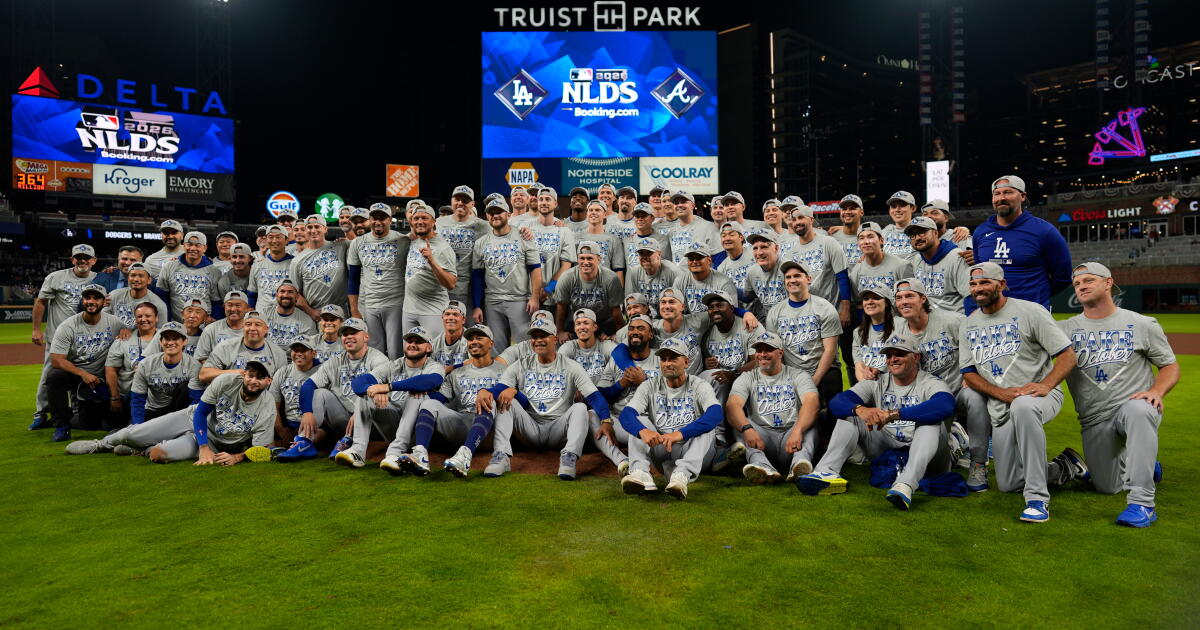
That was the proverbial, annual question mark entering the best-of-five National League Division Series against the Atlanta Braves, whom the Dodgers vanquished with a 4-1 victory Wednesday at Truist Park to set up an NL Championship Series rematch with the Milwaukee Brewers.
Dodgers: Reasons to believe, reasons to worry
From Bill Shaikin: As Dave Roberts delivered his victory address, dressed in a gray cap and a gray T-shirt that commemorate a triumph the Dodgers consider merely a speed bump on the road to the main event, the manager was not shy.
“There is no more talented team than the Los Angeles Dodgers,” Roberts told his players amid clubhouse floods of champagne and beer. “This is the best organization in sports, top to bottom. We’re smarter. We’re better. And we’re tougher.”
The Dodgers had eliminated the Atlanta Braves in the National League Division Series. For the three-peat, that’s one postseason party down and two to go.
“This one is going to be special,” infielder Miguel Rojas said. “We have the motivation of winning three times in a row. That’s all we can think about right now. It’s never going to be easy in baseball. You have to go through tough things. But this team showed it before, and it showed it in this series.”
Nothing is guaranteed in October, not even the Dodgers in the World Series. For the Dodgers, here are four positive signs and four warning signs:
Doncic, Reaves click in Lakers preseason win
From Broderick Turner: The bond between Luka Doncic and Austin Reaves is as real as it gets.
And though it was just a preseason game Thursday night, Doncic and Reaves showed why they form one of the most dynamic offensive backcourts in the NBA.
The Lakers duo linked up on the very first play against the Sacramento Kings, with Reaves passing to Doncic as he cut to the basket before scoring while being fouled.
Both played 25 minutes, with Doncic finishing with 23 points on six-for-16 shooting during the Lakers’ 114-110 win over the Kings at Crypto.com Arena. Reaves had eight points on two-for-seven shooting, eight assists and five
MLB postseason schedule
All times Pacific
Division series
American League
No. 2 Cleveland vs. No. 6 Chicago White Sox
Chicago White Sox 3, at Cleveland 0 (box score)
Chicago White Sox 4, at Cleveland 3 (box score)
Cleveland 9, at Chicago 3 (box score)
Cleveland 9, at Chicago 5 (box score)
Saturday at Cleveland, 5 p.m., TBS/truTV/UniMas/HBO Max
NLCS
No. 1 Milwaukee vs. No. 2 Dodgers
Sunday at Milwaukee, 5 p.m., FOX/FS1/FOX Deportes/FOX One
Monday at Milwaukee, 2 p.m., FOX/FS1/FOX Deportes/FOX One
Wednesday at Dodgers, 5 p.m., FOX/FS1/FOX Deportes/FOX One
Thursday at Dodgers, 6 p.m., FOX/FS1/FOX Deportes/FOX One
*Friday, Oct. 16 at Dodgers, 6 p.m., FOX/FS1/FOX Deportes/FOX One
*Sunday, Oct. 18 at Milwaukee, 5 p.m., FOX/FS1/FOX Deportes/FOX One
*Monday, Oct. 19 at Milwaukee, 5 p.m., FOX/FS1/FOX Deportes/FOX One
ALCS
No. 1 Tampa Bay vs. Cleveland/Chicago winner
Monday, at Tampa Bay, 5 p.m., TBS/truTV/UniMas/HBO Max
Tuesday at Tampa Bay, 5 p.m., TBS/truTV/UniMas/HBO Max
Thursday at Chi/Cle, 3 p.m., TBS/truTV/UniMas/HBO Max
Friday, Oct. 16 at Chi/Cle, 3 p.m., TBS/truTV/UniMas/HBO Max
*Sat., Oct. 17 at Chi/Cle, 5 p.m., TBS/truTV/UniMas/HBO Max
*Monday, Oct. 19 at Tampa Bay, 2 p.m., TBS/truTV/UniMas/HBO Max
*Tuesday, Oct. 20 at Tampa Bay, 5 p.m., TBS/truTV/UniMas/HBO Max
* if necessary
World Series starts Friday, Oct. 23
Secret to Matthew Stafford’s success
From Sam Farmer: Both NFL most valuable players. Both bound for Canton. Both surgically precise with their passes.
Matthew Stafford and Josh Allen are two of the best liars in football.
Peyton Manning sat in the studio and cued the video. Stafford looked off a Philadelphia safety last Sunday to hold him in place. He froze a cornerback with a glance. Then he threw an out-and-up to Puka Nacua, absorbing a big hit as he released the ball.
“That’s a lot of looking off,” Manning said.
Hall of Fame linebacker Luke Kuechly, watching from his own home studio, agreed.
“The quarterback will lie to you,” Kuechly said. “He’s going to look you off. He’s going to pump you. But the one thing that never lies to you is the route.”
This day in sports history
1943 — Bob Hoernschemeyer throws six touchdown passes, an NCAA record for a freshman, to lead Indiana past Nebraska 54-13.
1965 — The United States wins the Ryder Cup 19½-12½ at the Royal Birkdale Golf Club in Southport, England. Arnold Palmer clinches the title, beating Peter Butler 2 up. It’s the 13th victory for the Americans in this event, which began in 1927. Britain, a three-time winner, last won in 1957.
1974 — The Washington Capitals lose their first NHL game, 6-3 to the Rangers at New York’s Madison Square Garden.
1982 — Al Del Greco kicks six field goals for all of Auburn’s points in an 18-3 triumph over Kentucky.
1983 — Buffalo’s Joe Ferguson passes for 419 yards and five touchdowns in an 38-35 overtime win against Miami. Uwe Von Schamann of the Dolphins misses two field goals in the overtime and Joe Danelo ends the game with a 36-yard field goal.
1991 — The San Jose Sharks gain their first NHL victory, defeating the Calgary Flames 4-3.
1993 — Minnesota’s Scott Eckers passes for 402 yards and a school-record six touchdowns in his first college start, sending the Gophers past Purdue 59-56.
1993 — Carey Bender rushes 33 times for 417 yards, setting an NCAA all-division single-game rushing record, in Coe’s 69-7 Division III victory over Grinnell.
2004 — Texas Tech beats Nebraska 70-10, the worst lost in the Cornhuskers’ storied 114-year history.
2004 — Texas loses to Oklahoma 12-0, getting shut out for the first time in 282 games and ending the longest streak in the country.
2010 — Mike Brinkley passes for six touchdowns and Armond Smith runs for five scores to lead Union (Ky.) to an 84-55 victory over Bethel (Tenn.) in an NAIA game.
2010 — Derek Stepan becomes the fourth player to score three times in his NHL debut to lead the New York Rangers to a season-opening 6-3 win over the Buffalo Sabres.
2011 — Sebastian Janikowski kicks four field goals, including three from at least 50 yards (54, 55, 50), in Oakland’s 25-20 win over Houston. Houston’s Matt Schaub throws for 416 yards and two touchdowns.
2011 — The NHL returns to Winnipeg, but Carey Price stops 30 shots and the Montreal Canadiens dampen a city celebration with a 5-1 victory over the Jets.
2015 — Sepp Blatter, hoping to return to power as FIFA president, is banned for 90 days, essentially ending his 17-year reign as the leader of soccer’s governing body. UEFA President Michel Platini also gets a 90-day ban following an investigation of financial misconduct at FIFA in a Swiss criminal case.
2016 — Tom Brady returns from his four-game “Deflategate” suspension, passing for 406 yards and three touchdowns to Martellus Bennett in the New England Patriots’ 33-13 victory over the Cleveland Browns.
2022 — Dutch Red Bull driver Max Verstappen secures his second consecutive World F1 Drivers C’ship after finishing in front of Sergio Pérez and Charles Leclerc in the Japanese GP at Suzuka.
Compiled by the Associated Press
This day in baseball history
1928 — Baseball World Series: NY Yankees beat St. Louis Cardinals, 7-3 at Sportsman’s Park to become first to sweep consecutive World Series; Babe Ruth hits smashes three HRs for Yanks.
1934 — Baseball World Series: St Louis Cardinals rout Detroit Tigers, 11-0 at Navin Field to clinch 4 games to 3 series victory and third championship.
1966 — Baseball World Series: Baltimore Orioles claim first championship in franchise history; edge Dodgers, 1-0 at Memorial Stadium for 4-0 sweep; MVP: Orioles outfielder Frank Robinson.
1988 — Dennis Eckersley saves all four games in Oakland’s ALCS victory over Boston.
2005 — Chris Burke hits a home run in the bottom of the 18th inning and Roger Clemens pitches three scoreless innings of relief in Houston’s 7-6, series-ending victory over Atlanta in the NLDS. The longest postseason game in history takes 5 hours, 50 minutes.
Compiled by the Associated Press
Until next time…
That concludes today’s newsletter. If you have any feedback, ideas for improvement or things you’d like to see, email me at houston.mitchell@latimes.com. To get this newsletter in your inbox, click here.