Warthogs

A-10 Warthogs Arrive In England Festooned With Nose Art And Mission Markings From Epic Fury

Nearly a dozen A-10C Thunderbolt II attack jets landed at RAF Lakenheath in the U.K. earlier on Friday, sporting mission marks from operations in the Middle East as well as their distinctive nose art. The photos were taken by aviation photographer Andrew McKelvey, who told us that 11 Warthogs landed at Lakenheath at about 3 p.m. local time. McKelvey was kind enough to share his photos with us.

According to the Coronet East X account, the jets belong to the 75th Fighter Squadron and arrived through Aviano Air Base in Italy from Muwaffaq Salti Air Base in Jordan.

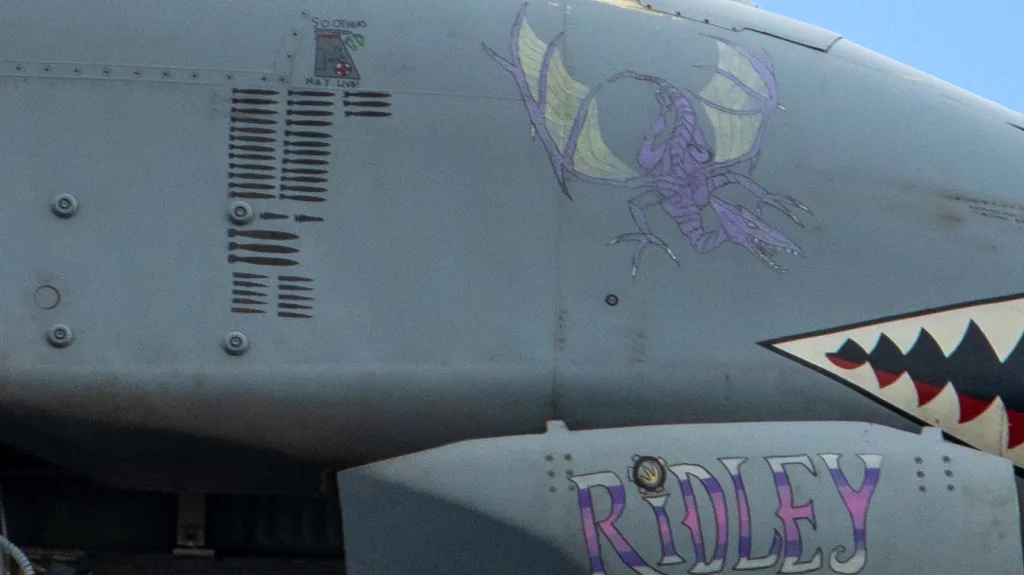
One of the most interesting shots shows one of the jets with an F-15E tail marking, green footprints of the Air Force Pararescue Jumpers (PJs) and the words “So others may live,” which is their motto. As we have previously reported, A-10s took part in the daring mission to rescue two F-15E crewmembers whose Strike Eagle was shot down over Iran, acting in the Sandy low-altitude escort role for the rest of the rescue package. One A-10 was struck by Iranian fire and crashed. The pilot survived.

You can see the F-15E tail mark on this A-10. Andrew McKelvey
Andrew McKelvey

So it is possible that the Warthog with this marking took part in the F-15E crew’s CSAR operation or another one that we do not know of. We reached out to the 75th Wing for more information.

Following a long aviation tradition of personalizing aircraft, the Warthogs are emblazoned with colorful nose art that includes Nintendo game characters homages like Ridley the giant purple space dragon, ‘Diddy Kong,’ King Dedede, Samus Aran, Star Fox and Little Mac. Non video game references include Macho Man, Doc Holiday and the Reaper.

We have previously noted that personnel have applied nose art as part of other deployment to Muwaffaq Salti, which appears to be becoming something of a trend in the region. F-15Es from RAF Lakenheath are well known for their often comical nose art designs and the practice is now allowed after the USAF forbid it unless under very particular circumstances for many years.

Andrew McKelvey

The mission marks show a mix of weapons used against Iranian targets. They include Small Diameter Bombs, GBU-12 Paveways, Advanced Precision Kill Weapon System (APKWS) laser-guided rockets, AGM-65 Maverick air-to-surface missiles. Miniature Air-Launched Decoys (MALDs) and generic bombs that probably signify Joint Direct Attack Munitions (JDAMs). The A-10 notorious gun is also represented.

Andrew McKelvey
Andrew McKelvey
Andrew McKelvey
Andrew McKelvey
Andrew McKelvey
Andrew McKelvey
Andrew McKelvey

There are also a couple of target type ‘kill’ markings seen, as well. This includes a pair of boats and a truck that appears to have made a giant secondary explosion, based on the mushroom cloud marking.

Screenshot

As we have previously reported, the venerable Warthogs were pressed into service helping to destroy the Iranian Navy, strike Iranian proxies in Iraq and Syria, and take part in the aforementioned rescue mission, among other tasks, as part of Operation Epic Fury.

Andrew McKelvey
Andrew McKelvey

All this took place as the seemingly ceaseless debate between the Air Force and Congress about the future of these jets and their survivability in future conflicts rages on. We recently wrote that an amendment added to the House Armed Services Committee’s version of the National Defense Authorization bill threw a lifeline to the jets. It called for the Secretary of the Air Force to keep supporting A-10 training, testing, experimentation, maintenance, and sustainment efforts through to the planned retirement date, as well as preserving lessons learned and operational expertise from A-10 missions to help shape future replacement systems.

Regardless of what ultimately becomes of the A-10, the markings seen in these pictures shows they still provided a lot of value in this most recent fight.

Contact the author: howard@twz.com

Howard is a Senior Staff Writer for TWZ. He writes frequently about conflict, focusing heavily on the Middle East and Ukraine, and interviews with military and intelligence officials and industry leaders from around the globe. He lives near Tampa, Florida, home of U.S. Central Command, U.S. Special Operations Command.


Source link

A-10 Warthog’s New Aerial Refueling Probe Is Now Operational In The Middle East

Recently published imagery confirms that the A-10C attack jet is now operating in the Middle East with its new refueling probe fitted, something that has been achieved remarkably fast. As we reported at the time, the Warthog’s probe-type aerial refueling capability was first demonstrated in early April, and the adaptation comes as the jet cruises into the twilight of its career after it got a small reprieve from final retirement.

The U.S. Air Force has released images showing an A-10C using its Probe Refueling Adapter to take on fuel from an HC-130J Combat King II earlier this month, somewhere in the U.S. Central Command (CENTCOM) area of responsibility. The Warthogs in question belong to the 107th Fighter Squadron from Selfridge Air National Guard Base, Michigan, which deployed to the Middle East in early April.

A U.S. Air Force A-10C Thunderbolt II aircraft approaches an HC-130J Combat King II aircraft for aerial refueling in the U.S. Central Command area of responsibility, May 9, 2026. (U.S. Air Force photo)
A U.S. Air Force A-10C Thunderbolt II aircraft approaches an HC-130J Combat King II aircraft for aerial refueling in the U.S. Central Command area of responsibility, May 9, 2026. U.S. Air Force photo
Two U.S. Air Force A-10C Thunderbolt II aircraft approach an HC-130J Combat King II aircraft for aerial refueling in the U.S. Central Command area of responsibility, May 9, 2026. (U.S. Air Force photo)
Two A-10Cs approach an HC-130J Combat King II for aerial refueling in the U.S. Central Command area of responsibility, May 9, 2026. U.S. Air Force photo

As we discussed in the past, the Probe Refueling Adapter could be of significant importance to the A-10 and the wider Air Force, during a future fight in the Pacific. Clearly, however, it is equally applicable to ongoing operations in the CENTCOM theater.

Indeed, the Air Force previously confirmed that the Probe Refueling Adapter effort was in response to an urgent combatant command requirement.

Adding the Probe Refueling Adapter is also relatively straightforward, since it makes use of the existing air refueling receptacle on the nose of the A-10. In turn, this means that the A-10 loses its regular nose-mounted receptacle.

An A-10C receives fuel from a KC-135 via its nose-mounted receptacle over an undisclosed location within the U.S. Central Command area of responsibility. U.S. Air Force photo by Airman 1st Class Travis Knauss

As of April, the non-probe-equipped A-10 was only able to refuel from the KC-135, since the KC-10 had been retired, and the KC-46 was not yet certified to refuel the Warthog. This last issue is due to a long-running “stiff boom” problem, which runs the risk of damaging the receiving aircraft. The addition of the probe also means that the A-10s can now refuel from KC-46s too, which have a built in hose and drogue system, as well as a boom.

However, the A-10 can now take on fuel from Air Force HC-130s and MC-130s, or even Marine Corps KC-130s, as well as KC-130Js from other operators. Initial tests of the Probe Refueling Adapter involved an HC-130J from the 418th Flight Test Squadron.

These refuelers can operate from shorter runways and can offload fuel at very low altitudes, something the KC-135 is not able to do. Pairing the A-10 with these kinds of tankers, which can routinely operate from shorter fields and do so with far more flexibility, provides expanded aerial refueling flexibility for mission planners.

A U.S. Air Force loadmaster watches an A-10C Thunderbolt II aircraft approach his HC-130J Combat King II aircraft before conducting aerial refueling in the U.S. Central Command area of responsibility, May 9, 2026. (U.S. Air Force photo)
A U.S. Air Force loadmaster watches an A-10C approach his HC-130J before conducting aerial refueling in the U.S. Central Command area of responsibility, May 9, 2026. U.S. Air Force photo

Working with the HC-130 and MC-130 is especially relevant for the A-10, bearing in mind its combat search and rescue ‘Sandy’ mission. This involves the jets providing escort and close air support for special operations helicopters working to retrieve personnel from highly contested territory. A-10s have flown this very mission over Iran. Already, HC-130s and MC-130s provide fuel to rotary-wing aircraft during these kinds of operations, and a probe-equipped A-10 would provide extended endurance and range in such scenarios.

The Probe Refueling Adapter also comes with a degree of flexibility. The Air Force describes it as “a field-configurable solution designed for installation by operational flight line personnel.”

“Units can install or remove the adapter in a matter of hours, allowing aircraft to be reconfigured between boom and probe refueling capability based on mission requirements,” the service says.

A U.S. Air Force pilot watches an A-10C Thunderbolt II aircraft approach his HC-130J Combat King II aircraft while flying before conducting aerial refueling in the U.S. Central Command area of responsibility, May 9, 2026. (U.S. Air Force photo)
A U.S. Air Force pilot watches an A-10C approach his HC-130J before conducting aerial refueling in the U.S. Central Command area of responsibility, May 9, 2026. U.S. Air Force photo
A U.S. Air Force A-10C Thunderbolt II aircraft flies in the U.S. Central Command area of responsibility, May 9, 2026. (U.S. Air Force photo)
A head-on view of a probe-equipped A-10C in the U.S. Central Command area of responsibility, May 9, 2026. U.S. Air Force photo

It is also notable that the Air Force imagery shows that the A-10s in CENTCOM are now also using the Angry Kitten electronic warfare pod.

The Angry Kitten had previously been test flown on the A-10, but had not been seen in an operational context. The store is also used operationally by Air Force F-16s and HC-130s and Navy F/A-18E/Fs. Angry Kitten was originally developed to replicate hostile electronic warfare threats during testing and training, as part of a cooperative effort between the Air Force and the Navy, but was so effective that it was adapted to operational use.

Using advanced Digital Radio Frequency Memory (DRFM) technology, Angry Kitten detects and ‘captures’ radio frequency (RF) signals. Those signals are then manipulated and retransmitted. For example, RF signals from an enemy air defense radar can be recorded and sent back in a way that creates false or otherwise confusing tracks. The same data can also be used for broader intelligence-gathering purposes. You can read more about the capabilities of the pod here.

A U.S. Air Force A-10C Thunderbolt II aircraft approaches an HC-130J Combat King II aircraft for aerial refueling in the U.S. Central Command area of responsibility, May 9, 2026. (U.S. Air Force photo)
Close-up of the Angry Kitten pod under the left wing of a U.S. Air Force A-10C in the U.S. Central Command area of responsibility. U.S. Air Force photo

As well as the Angry Kitten pod, the A-10C seen in the accompanying imagery carries a Litening targeting pod and a pair of 500-pound-series Joint Direct Attack Munitions (JDAM).

Returning to the Probe Refueling Adapter, the A-10 is now putting it through its paces in an operational context in the Middle East.

But as we have discussed in the past, equipping A-10s and other combat jets with probes makes a good deal of sense for Pacific contingencies, too. They could also be operated alongside smaller tactical tankers, which could also play a very important role in that kind of conflict.

A U.S. Air Force A-10C Thunderbolt II aircraft refuels from an HC-130J Combat King II aircraft in the U.S. Central Command area of responsibility, May 9, 2026. (U.S. Air Force photo)
Close-up of a U.S. Air Force A-10C as it refuels from an HC-130J Combat King II aircraft in the U.S. Central Command area of responsibility, May 9, 2026. U.S. Air Force photo

Simply put, the receptacle and boom mode of aerial refueling is optimized for plugging in at higher altitudes, for maximum efficiency and safety. However, in the Pacific, combat operations are likely to require fighters to take off with heavy loads from short runways, potentially battle-damaged ones, then immediately hook up to a tanker. Lower-level refueling using a probe is much more appropriate here and, indeed, is entirely in line with the Air Force’s Agile Combat Employment (ACE) strategy. This envisages fighters hopping from one austere forward airfield to another, keeping them close to the action, but farther away from the enemy’s strikes. Such airfields can also be accessed by standard C-130 transports, which can also help support tactical jets with spares, weapons, crews, etc.

There is also the fact that higher-level aerial refueling puts the tanker and receiver at higher risk of detection and engagement by the enemy. Aerial refueling assets, in particular, will be among the highest-priority targets for China in any confrontation in the Pacific. Indeed, there is a whole Chinese development thread focused on air defenses to engage aircraft like these, and other critical force-multipliers. Having refueling operations and tankers operate at a lower altitude puts them below the radar horizon, providing another layer of survivability, especially when working from islands closer to major target areas.

Three U.S. Air Force A-10C Thunderbolt II aircraft fly in formation after aerial refueling from an HC-130J Combat King II aircraft in the U.S. Central Command area of responsibility, May 9, 2026. (U.S. Air Force photo)
Three U.S. Air Force A-10Cs fly in formation after aerial refueling from an HC-130J in the U.S. Central Command area of responsibility, May 9, 2026. U.S. Air Force photo

While the A-10 continues to evolve, the Air Force is still committed to its plans to retire the type for good before the end of the decade. For the time being, however, the Warthog is still in demand in combat theaters.

If the Probe Refueling Adapter concept could be extended to fighters like the F-16 and F-15, and potentially even future versions of the F-35A, these aircraft could rely more heavily on C-130 tankers, which are, at least in some cases, better suited to the ACE concept. Meanwhile, the larger KC-46s and KC-135s could operate somewhat further from the battlespace, including dragging tactical aircraft to and from the theater of operations, as well as supporting bombers and transports.

For some time now, the Air Force has also been looking at the possibility of acquiring the kinds of tankers that would be better suited to the kinds of mission likely to be encountered in the Pacific theater, albeit retaining the boom and receptacle method.

Now that the Probe Refueling Adapter is being proven in a combat theater, its success there could help keep the A-10 relevant throughout the last few years of its service, and perhaps even longer.

Contact the author: thomas@thewarzone.com

Thomas is a defense writer and editor with over 20 years of experience covering military aerospace topics and conflicts. He’s written a number of books, edited many more, and has contributed to many of the world’s leading aviation publications. Before joining The War Zone in 2020, he was the editor of AirForces Monthly.


Source link