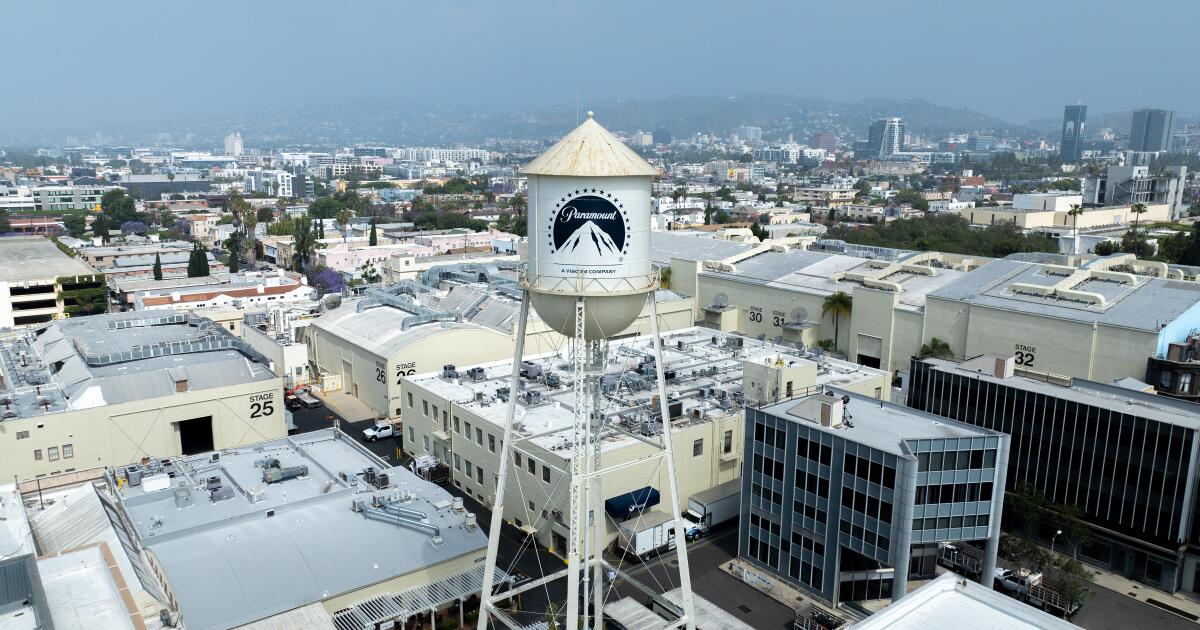
Warner

Larry Ellison pledges $40 billion personal guarantee for Paramount’s Warner Bros. bid

Billionaire Larry Ellison has stepped up, agreeing to personally guarantee part of Paramount’s bid for rival Warner Bros. Discovery.

Ellison’s personal guarantee of $40.4 billion in equity, disclosed Monday, ups the ante in the acrimonious auction for Warner Bros. movie and TV studios, HBO, CNN and Food Network.

Ellison, whose son David Ellison is chief executive of Paramount, agreed not to revoke the Ellison family trust or adversely transfer its assets while the transaction is pending. Paramount’s $30-a-share offer remains unchanged.

Warner Bros. Discovery’s board this month awarded the prize to Netflix. The board rejected Paramount’s $108.4-billion deal, largely over concerns about the perceived shakiness of Paramount’s financing.

Paramount shifted gears and launched a hostile takeover, appealing directly to Warner shareholders, offering them $30 a share.

“We amended this Offer to address Warner Bros. stated concerns regarding the Prior Proposal and the December 8 Offer,” Paramount said in a Monday Securities & Exchange Commission filing. “Mr. Larry Ellison is providing a personal guarantee of the Ellison Trust’s $40.4 billion funding obligation.”

The Ellison family acquired the controlling stake in Paramount in August. The family launched their pursuit of Warner Bros. in September but Warner’s board unanimously rejected six Paramount proposals.

Paramount started with a $19 a share bid for the entire company. Netflix has offered $27.75 a share and only wants the Burbank studios, HBO and the HBO Max streaming service. Paramount executives have held meetings with Warner investors in New York, where they echoed the proposal they’d submitted in the closing hours of last week’s auction.

On Monday, Paramount also agreed to increase the termination fee to $5.8 billion from $5 billion, matching the one that Netflix offered.

Warner Bros. board voted unanimously to accept Netflix’s $72-billion offer, citing Netflix’s stronger financial position, the board has said.

Three Middle Eastern sovereign wealth funds representing royal families in Saudi Arabia, Qatar and Abu Dhabi have agreed to provide $24 billion of the $40.4-billion equity component that Ellison is backing.

The Ellison family has agreed to cover $11.8-billion of that. Initially, Paramount’s bid included the private equity firm of Jared Kushner, Trump’s son-in-law, but Kushner withdrew his firm last week.

Paramount confirmed that the Ellison family trust owns about 1.16 billion shares of Oracle common stock and that all material liabilities are publicly disclosed.

“In an effort to address Warner Bros.’s amorphous need for ‘flexibility’ in interim operations, Paramount’s revised proposed merger agreement offers further improved flexibility to Warner Bros. on debt refinancing transactions, representations and interim operating covenants,” Paramount said in its statement.

Paramount has been aggressively pursuing Warner Bros. for months.

David Ellison was stunned earlier this month when the Warner Bros. board agreed to a deal with Netflix for $82.7 billion for the streaming and studio assets.

Paramount subsequently launched its hostile takeover offer in a direct appeal to shareholders. Warner Bros. board urged shareholders to reject Paramount’s offer, which includes $54 billion in debt commitments, deeming it “inferior” and “inadequate.” The board singled out what it viewed as uncertain financing and the risk implicit in a revocable trust that could cause Paramount to terminate the deal at any time.

Paramount, controlled by the Ellisons, is competing with the most valuable entertainment company in the world to acquire Warner Bros.

Executives from both Paramount and Netflix have argued that they would be the best owners and utilize the Warner Bros. library to boost their streaming operations.

In its letter to shareholders and a detailed 94-page regulatory filing last week, Warner Bros. hammered away at risks in the Paramount offer, including what the company described as the Ellison family’s failure to adequately backstop their equity commitment.

The equity is supported by “an unknown and opaque revocable trust,” the board said. The documents Paramount provided “contain gaps, loopholes and limitations that put you, our shareholders, and our company at risk.”

Netflix also announced Monday that it has refinanced part of a $59 billion bridge loan with cheaper and longer-term debt.

Bloomberg contributed to this report.

Source link

Warner Bros. rejects Paramount’s hostile bid, accuses Ellison family of failing to put money into the deal

Warner Bros. Discovery has sharply rejected Paramount’s latest offer, alleging the Larry Ellison family has failed to put real money behind Paramount’s $78-billion bid for Warner’s legendary movie studio, HBO and CNN.

Paramount “has consistently misled WBD shareholders that its proposed transaction has a ‘full backstop’ from the Ellison family,” Warner Bros. Discovery’s board wrote in a Wednesday letter to its shareholders filed with the Securities & Exchange Commission.

“It does not, and never has,” the Warner board said.

For Warner, what was missing was a clear declaration from Paramount that the Ellison family had agreed to commit funding for the deal. A Paramount representative was not immediately available for comment Wednesday.

The Warner auction has taken a nasty turn. Last week, Paramount launched a hostile takeover campaign for Warner after losing the bidding war to Netflix. Warner board members unanimously approved Netflix’s $72-billion deal for the Warner Bros. film and television studios, HBO and HBO Max.

In its letter, the Warner board reaffirmed its support for Netflix’s proposal, saying it represented the best deal for shareholders. Warner board members urged investors not to tender their shares to Paramount.

Board members said they were concerned that Paramount’s financing was shaky and the Ellison family’s assurances were far from ironclad. Warner also said Paramount’s proposal contained troubling caveats, such as language in its documents that said Paramount “reserve[d] the right to amend the offer in any respect.”

The Warner board argued that its shareholders could be left holding the bag.

Paramount CEO David Ellison attends the premiere of "Fountain of Youth" in 2025. (Photo by Evan Agostini/Invision/AP)

Paramount Chief Executive David Ellison has argued his $78-billion deal is superior to Netflix’s proposal.

(Evan Agostini / Evan Agostini/invision/ap)

Paramount Chairman David Ellison has championed Paramount’s strength in recent weeks saying his company’s bid for all of Warner Bros. Discovery, which includes HBO, CNN and the Warner Bros. film and television studios, was backed by his wealthy family, headed by his father, Oracle co-founder Larry Ellison, one of the world’s richest men.

In its letter last week to shareholders, asking for their support, Ellison wrote that Paramount delivered “an equity commitment from the Ellison family trust, which contains over $250 billion of assets,” including more than 1 billion Oracle shares.

In regulatory filings, Paramount disclosed that, for the equity portion of the deal, it planned to rely on $24 billion from sovereign wealth funds representing the royal families of Saudi Arabia, Qatar and Abu Dhabi as well as $11.8 billion from the Ellison family (which also holds the controlling shares in Paramount). This week, President Trump’s son-in-law Jared Kushner’s Affinity Partners private equity firm pulled out of Paramount’s financing team.

Paramount’s bid would also need more than $60 billion in debt financing.

Paramount has made six offers for Warner Bros., and its “most recent proposal includes a $40.65 billion equity commitment, for which there is no Ellison family commitment of any kind,” the Warner board wrote.

“Instead, they propose that [shareholders] rely on an unknown and opaque revocable trust for the certainty of this crucial deal funding,” the board said.

Throughout the negotiations, Paramount, which trades under the PSKY ticker, failed to present a solid financing commitment from Larry Ellison — despite Warner’s bankers telling them that one was necessary, the board said.

“Despite … their own ample resources, as well as multiple assurances by PSKY during our strategic review process that such a commitment was forthcoming – the Ellison family has chosen not to backstop the PSKY offer,” Warner’s board wrote.

Board members argued that a revocable trust could always be changed. “A revocable trust is no replacement for a secured commitment by a controlling stockholder,” according to the board letter.

David Ellison has insisted Paramount’s Dec. 4 offer of $30 a share was superior to Netflix’s winning bid. Paramount wants to buy all of Warner Bros. Discovery, while Netflix has made a deal to take Warner’s studios, its spacious lot in Burbank, HBO and HBO Max streaming service.

Paramount’s lawyers have argued that Warner tipped the auction to favor Netflix.

Paramount, which until recently enjoyed warm relations with President Trump, has long argued that its deal represents a more certain path to gain regulatory approvals. Trump’s Department of Justice would consider any anti-trust ramifications of the deal, and in the past, Trump has spoken highly of the Ellisons.

However, Warner’s board argued that Paramount might be providing too rosy a view.

“Despite PSKY’s media statements to the contrary, the Board does not believe there is a material difference in regulatory risk between the PSKY offer and the Netflix merger,” the Warner board wrote. “The Board carefully considered the federal, state, and international regulatory risks for both the Netflix merger and the PSKY offer with its regulatory advisors.”

The board noted that Netflix agreed to pay a record $5.8 billion if its deal fails to clear the regulatory hurdles.

Paramount has offered a $5 billion termination fee.

Should Warner abandon the transaction with Netflix, it would owe Netflix a $2.8 billion break-up fee.

Warner also pointed to Paramount’s promises to Wall Street that it would shave $9 billion in costs from the combined companies. Paramount is in the process of making $3 billion in cuts since the Ellison family and RedBird Capital Partners took the helm of the company in August.

Paramount has promised another $6 billion in cuts should it win Warner Bros.

“These targets are both ambitious from an operational perspective and would make Hollywood weaker, not stronger,” the Warner board wrote.

Source link

Why the huge bidding war over Warner Bros? | Media

For more than a century, Warner Bros has been one of Hollywood’s biggest players, a legacy studio that helped define the Golden Age of cinema with iconic blockbuster movies. Now, it’s at the centre of a contentious, billion-dollar bidding war between Netflix, the world’s leading streaming platform, and Paramount Skydance, owned by the powerful Ellison family, which has close ties to President Trump.

Whichever way this goes, the outcome isn’t looking great.

Contributors:
Matt Craig – Reporter, Forbes
Daheli Hall – Writer and director
Lee Hepner – Antitrust lawyer
Dominic Patten – Executive editor, Deadline

On our radar

This week, Australia became the first country in the world to impose a social media ban for children less than the age of 16. The Australian government says it is taking on Big Tech and safeguarding children, but some young people were able to quickly bypass the new rules. Ryan Kohls reports.

The Imran Khan rumour mill

Despite being in jail for more than two years, Imran Khan continues to occupy airtime in Pakistan. After the army restricted access to Khan, rumours of his death ricocheted across social media.  Pressure from his supporters and family forced the military to lift the restrictions and grant Khan’s sisters access to speak to him. Meenakshi Ravi reports on the showdown between Imran Khan and powerful Field Marshal Asim Munir, and what it reveals about power, politics and narrative control in Pakistan.

Featuring: 
Amber Rahim Shamsi – Pakistan Editor, Nukta
Moeed Pirzada – Political YouTuber
Mohammed Hanif – Author and journalist

Source link

As Netflix and Paramount circle Warner Bros. Discovery, Hollywood unions voice alarm

The sale of Warner Bros. — whether in pieces to Netflix or in its entirety to Paramount — is stirring mounting worries among Hollywood union leaders about the possible fallout for their members.

Unions representing writers, directors, actors and crew workers have voiced growing concerns that further consolidation in the media industry will reduce competition, potentially causing studios to pay less for content, and make it more difficult for people to find work.

“We’ve seen this movie before, and we know how it ends,” said Michele Mulroney, president of the Writers Guild of America West. “There are lots of promises made that one plus one is going to equal three. But it’s very hard to envision how two behemoths, for example, Warner Bros. and Netflix … can keep up the level of output they currently have.”

Last week, Netflix announced it agreed to buy Warner Bros. Discovery’s film and TV studio, Burbank lot, HBO and HBO Max for $27.75 a share, or $72 billion. It also agreed to take on more than $10 billion of Warner Bros.’ debt. But Paramount, whose previous offers were rebuffed by Warner Bros., has appealed directly to shareholders with an alternative bid to buy all of the company for about $78 billion.

Paramount said it will have more than $6 billion in cuts over three years, while also saying the combined companies will release at least 30 movies a year. Netflix said it expects its deal will have $2 billion to $3 billion in cost cuts.

Those cuts are expected to trigger thousands of layoffs across Hollywood, which has already been squeezed by the flight of production overseas and a contraction in the once booming TV business.

Mulroney said that employment for WGA writers in episodic television is down as much as 40% when comparing the 2023-2024 writing season to 2022-2023.

Executives from both companies have said their deals would benefit creative talent and consumers.

But Hollywood union leaders are skeptical.

“We can hear the generalizations all day long, but it doesn’t really mean anything unless it’s on paper, and we just don’t know if these companies are even prepared to make promises in writing,” said Lindsay Dougherty, Teamsters at-large vice president and principal officer for Local 399, which represents drivers, location managers and casting directors.

Dougherty said the Teamsters have been engaged with both Netflix and Paramount, seeking commitments to keep filming in Los Angeles.

“We have a lot of members that are struggling to find work, or haven’t really worked in the last year or so,” Dougherty said.

Mulroney said her union has concerns about both bids, either by Netflix or Paramount.

“We don’t think the merger is inevitable,” Mulroney said. “We think there’s an opportunity to push back here.”

If Netflix were to buy Warner Bros.’ TV and film businesses, Mulroney said that could further undermine the theatrical business.

“It’s hard to imagine them fully embracing theatrical exhibition,” Mulroney said. “The exhibition business has been struggling to get back on its feet ever since the pandemic, so a move like this could really be existential.”

But the Writers Guild also has issues with Paramount’s bid, Mulroney said, noting that it would put Paramount-owned CBS News and CNN under the same parent company.

“We have censorship concerns,” Mulroney said. “We saw issues around [Stephen] Colbert and [Jimmy] Kimmel. We’re concerned about what the news would look like under single ownership here.”

That question was made more salient this week after President Trump, who has for years harshly criticized CNN’s hosts and news coverage, said he believes CNN should be sold.

The worries come as some unions’ major studio contracts, including the DGA, WGA and performers guild SAG-AFTRA, are set to expire next year. Two years ago, writers and actors went on a prolonged strike to push for more AI protections and better wages and benefits.

The Directors Guild of America and performers union SAG-AFTRA have voiced similar objections to the pending media consolidation.

“A deal that is in the interest of SAG-AFTRA members and all other workers in the entertainment industry must result in more creation and more production, not less,” the union said.

SAG-AFTRA National Executive Director Duncan Crabtree-Ireland said the union has been in discussions with both Paramount and Netflix.

“It is as yet unclear what path forward is going to best protect the legacy that Warner Brothers presents, and that’s something that we’re very actively investigating right now,” he said.

It’s not clear, however, how much influence the unions will have in the outcome.

“They just don’t have a seat at the ultimate decision making table,” said David Smith, a professor of economics at the Pepperdine Graziadio Business School. “I expect their primary involvement could be through creating more awareness of potential challenges with a merger and potentially more regulatory scrutiny … I think that’s what they’re attempting to do.”

Source link

Congressional Democrats say Paramount’s bid for Warner raises ‘serious national security concerns’

Congressional Democrats are sounding alarms over the deep involvement of Saudi Arabian and other Middle Eastern royal families in Paramount’s proposed bid for Warner Bros. Discovery.

Warner Bros. Discovery owns CNN, HBO and the historic Warner Bros. film and television studios in Burbank, behind such beloved American classics as “Casablanca,” “Citizen Kane,” and Bugs Bunny, and blockbuster hits including “Harry Potter,” “Dirty Harry,” “The Matrix,” and “Friends.”

Late last week, the Larry Ellison controlled Paramount came up short in the bidding for Warner Bros., in part, over the Warner board’s concerns about Paramount’s deal financing. On Monday, Paramount launched a hostile takeover of Warner Bros., appealing directly to Warner shareholders — asking them to sell their Warner stock to Paramount for $30 a share.

Paramount’s gambit has thrown the auction, and Warner board’s selection of Netflix’s $72-billion deal, into doubt.

Paramount has long insisted that it represents the best partner for Warner Bros., in part, because of the Ellison family’s cozy relations with President Trump. The company has trumpeted its ability to gain the blessing of the Trump administration.

Paramount’s bid is heavily backed by Saudi Arabia, Abu Dhabi and Qatar’s sovereign wealth funds. The three royal families have agreed to contribute $24 billion — twice the amount the Larry Ellison family has agreed to provide in financing for Paramount’s proposed $78-billion takeover of Warner Bros. Discovery, according to regulatory filings.

Trump son-in-law Jared Kushner’s private equity firm, Affinity Partners, would also have an ownership stake.

On Wednesday, U.S. Reps. Sam T. Liccardo (D-San Jose) and Ayanna Pressley (D-Boston) called on Warner Bros. board to recognize the consequences of selling the legendary company, which includes news organization CNN, to foreign governments.

“This transaction raises national security concerns because it could transfer substantial influence over one of the largest American media companies to foreign-backed financiers,” Liccardo and Pressley wrote.

“Warner’s platforms reach tens of millions of American households through HBO, Max, CNN, Warner Bros. Pictures, Discovery, and numerous digital and cable properties,” the lawmakers wrote. “They also shape the news, entertainment, and cultural content consumed by the American public.”

Transactions “foreign investors with governance rights, access to non-public data, or indirect influence over content distribution creates vulnerabilities that foreign governments could exploit,” the lawmakers wrote.

Paramount Chairman and Chief Executive David Ellison in the center. T

Paramount Chairman and Chief Executive David Ellison on the Paramount lot in August.

(Paramount)

Paramount, in its regulatory filings, said the three Middle Eastern families had agreed to give up voting rights and a role in the company’s decision-making — despite contributing more than half the equity needed for the deal.

Representatives of Warner Bros. and Paramount declined to comment.

The Ellison family acquired Paramount in August. David Ellison, the chief executive, attended a White House dinner last month to celebrate Saudi Crown Prince Mohammed bin Salman.

The involvement of bin Salman was concerning to the lawmakers.

“The fund is controlled by Crown Prince Mohammed bin Salman, whom (according to the declassified 2021 report of the U.S. Director of National Intelligence) ordered the murder of U.S. resident and Washington Post journalist Jamal Khashoggi,” the lawmakers wrote.

Over the weekend, Trump said the Netflix deal, which would give the streaming an even more commanding presence in the industry, “could be a problem.”

Source link

The Netflix and Warner Bros. tie-up is not a done deal. What could stop this merger

It was just last Friday that Netflix announced a blockbuster $72-billion deal to acquire Warner Bros. film and television studios, HBO and HBO Max — a tie-up that could fundamentally change Hollywood.

Yet on Monday, the stakes got even higher, as Paramount swooped in with a $78-billion hostile takeover bid it plans to take directly to Warner Bros. Discovery’s shareholders.

Paramount Chief Executive David Ellison called the Netflix deal an “inferior proposal,” saying in a statement that it “exposes shareholders to a mix of cash and stock, an uncertain future trading value of the Global Networks linear cable business and a challenging regulatory approval process.”

It all sets the stage for a long and potentially bruising fight. And the Netflix deal would have to overcome some significant regulatory hurdles, experts told me.

“This is a deal that never should have left the boardroom,” said David Balto, an antitrust attorney and a former policy director at the Federal Trade Commission during the Clinton administration. “The competitive concerns are profound. This is going to face a lot of opposition at the Justice Department.”

For one, antitrust regulators are expected to scrutinize the market share that would be controlled by a combined Netflix and HBO Max.

You’re reading the Wide Shot

Samantha Masunaga delivers the latest news, analysis and insights on everything from streaming wars to production — and what it all means for the future.

By continuing, you agree to our Terms of Service and our Privacy Policy.

Netflix outlasted its rivals in the so-called streaming wars to become the dominant platform in a crowded space. That position has led to concern that gobbling up HBO Max would give Netflix outsized power in the streaming space — potentially more than 30% — which would cross a threshold under antitrust law, according to a recent letter from Rep. Darrell Issa (R-Vista) to Atty. Gen. Pam Bondi and Federal Trade Commission Chairman Andrew N. Ferguson.

Netflix executives have argued that analysis of its market share should include YouTube.

In a UBS investor conference Monday, Netflix Co-Chief Executive Greg Peters pointed to Nielsen data, which show Netflix’s shares of U.S. TV viewing is still behind YouTube‘s. Netflix represents just 8% of U.S. TV viewing in October, behind YouTube’s 12.9%.

If Netflix were to combine with Warner Bros. Discovery’s 1.3% share of U.S. TV viewing, its 9.2% would still be less than that of YouTube. (Other Nielsen data show that Warner Bros. Discovery channels have greater viewership, but Netflix is only interested in one channel, HBO).

“We think there’s a strong fundamental case here for why regulators should approve this deal,” Peters said. (The deal’s overall value is $82.7 billion due to the absorption of debt)

But who would regulators consider a competitor to Netflix? Is it YouTube, with its emphasis on shorter-form content? Or would the main competitors be other streaming services with films and series, like Disney+, Paramount+ and Peacock?

“The analytical issue there is, how do you define the market?” said George Hay, a professor of law at Cornell University and former director of economics in the Justice Department’s antitrust division. “What is their combined market share, what do they compete in and what are the alternatives available to consumers?”

The consumer angle would also invite involvement from the Federal Trade Commission. With a shrinking marketplace, the agency would likely investigate whether this could increase streaming prices for customers.

“What keeps Netflix honest is knowing there’s an HBO Max that’s right over its shoulder,” Balto said. “But once they get rid of that, they can lead the easy life, and the need to cut prices or provide better services or bid aggressively for film content — all of that will be diminished.”

Meanwhile, Hollywood unions and the Cinema United trade group have also raised concerns that a Netflix ownership of Warner Bros. would lead to fewer films being released in theaters, due to the company’s longstanding resistance to traditional movie releases. Netflix has said it would honor Warner Bros.’ theatrical release commitments and that future films without those existing deals will also go to theaters.

Beyond the U.S. concerns, Netflix would also need the blessing of regulators across the globe, and could be challenged by even state attorneys general who might have a significant number of entertainment workers in their areas who would question the effect on industry jobs.

Then, there’s the politics of it all.

President Trump himself has said he “would be involved” in his administration’s decision to bless any deal and that the combined market share of Netflix and Warner Bros. “could be a problem.”

As my colleagues Meg James and Stacy Perman have reported, Trump has openly favored Paramount’s bid for Warner Bros. Discovery, though word of Paramount backer Larry Ellison’s close ties with Trump dampened enthusiasm for the bid in Hollywood. Trump’s son-in-law, Jared Kushner, is now also one of the investors participating in the renewed Paramount bid.

Despite this involvement, the Trump administration may not have the final say on the deal, just as in the case of the AT&T deal for Time Warner.

For his part, Netflix Co-Chief Executive Ted Sarandos has also been trying to make his own case to Trump and ventured to the White House last month, Bloomberg reported.

“It’s a case in which the political issues are going to play a role,” Hay said. “They’re so front and center, and Trump has shown an inclination to get involved.”

About the only thing that’s clear is that it’s not going to be a quick process.

“This entire matter is not going to get resolved in a hurry,” said Corey Martin, managing partner at Granderson Des Rochers. “The resolution of this matter is very likely to take place over months and potentially years, and not days and weeks.”

Stuff We Wrote

Film shoots

Stacked bar chart shows the number of weekly permitted shoot days in the Los Angeles area. The number of weekly permitted shoot days in the area was down 40% compared to the same week last year. This year, there were a total of 166 permitted shoot days during the week of December 01 - December 07. During the same week last year (December 02-08, 2024), there were 277.

Number of the week

sixty-three million dollars

Universal Pictures and Blumhouse-Atomic Monster’s horror sequel “Five Nights at Freddy’s 2” ruled the domestic box office this weekend with a $63 million haul in the U.S. and Canada. While it doesn’t surpass the first movie’s $80 million opening weekend in 2023, it’s a massive boost for theaters, which have seen a string of slower months.

Menacing animatronic figures weren’t the only thing that brought moviegoers to theaters this weekend. Disney’s animated “Zootopia 2” brought in about $43 million domestically in its second outing. Globally, the sequel has now brought in a total of $915 million.

The strong recent showings for films such as “Zootopia 2” and “Wicked: For Good” have helped push 2025’s year-to-date domestic box office total to a little over $8 billion, up just barely — 0.8%, in fact — compared with last year.

Finally …

My colleague, Jeanette Marantos, wrote about the 105th anniversary of Altadena’s Christmas Tree Lane lighting ceremony and festival this past weekend, a bittersweet memorial for the community after a year of heartbreak.

Source link

Paramount’s $78-billion bid for Warner includes Kushner backing

Paramount is refusing to accept defeat in the Warner Bros. Discovery auction, launching a $78-billion hostile takeover of its rival Monday after being spurned last week in the bidding.

The move comes four days after Warner’s board unanimously selected Netflix as the winner.

Paramount has beefed up its offer with backing from Middle Eastern sovereign wealth funds, including Saudi Arabia, a Chinese firm and President Trump’s son-in-law Jared Kushner’s investment firm Affinity Partners, according to a Monday regulatory filing.

The presence of a member of the president’s family in a proposed corporate takeover, which includes news channel CNN and the historic Warner Bros. properties, immediately complicates an already fraught regulatory picture.

Last week, Netflix had offered $72 billion — or $27.75 a share — for a big chunk of the company: Warner Bros. film and television studios, which hold the rights to Batman, Bugs Bunny and Harry Potter, the expansive lot in Burbank and HBO and HBO Max. Additionally, Netflix would take on more than $10 billion in Warner Bros. debt for a total deal value of $82.7 billion.

Paramount, backed by billionaire Larry Ellison’s family, had entered the final week of the auction with a $25 a share, all-cash offer for all of Warner Bros. Discovery, according to people involved in the auction who were not authorized to comment. In the final hours, Paramount upped its offer to $30 per share — but still came away empty-handed.

Paramount confirmed Monday that it submitted its $30-per-share offer just a few hours before Netflix was announced as the winner.

“We never heard back,” Paramount Chairman and Chief Executive David Ellison told CNBC on Monday morning. “We’re really here to finish what we started.”

Despite the decision by Netflix and Warner Bros. Discovery to pursue a deal, Paramount is directly appealing to shareholders to vote on their offer in what is commonly known as a hostile takeover.

Historically, hostile takeover bids are difficult to pull off, but there have been some notable exceptions, including Elon Musk’s $44-billion acquisition of the company formerly known as Twitter in 2022. Two decades ago, Comcast failed in a hostile takeover bid for Walt Disney Co.

Warner Bros. Discovery said Monday that its board would “carefully review and consider Paramount Skydance’s offer in accordance with the terms of Warner Bros. Discovery’s agreement with Netflix.”

Warner’s board remains supportive of Netflix’s bid, the company said. Shareholders will receive recommendations from the Warner board within 10 business days. The company has long wanted the auction to be wrapped up by Christmas.

“Warner Bros. Discovery stockholders are advised not to take any action at this time with respect to Paramount Skydance’s proposal,” the company said in a statement.

Paramount began its pursuit of Warner in mid-September. It is now bypassing Warner’s board, management and bankers and appealing directly to shareholders in a hostile takeover effort. In a statement, Paramount said its bid was a “superior alternative” to Netflix’s, which will face a rigorous and lengthy antitrust review.

Netflix co-Chief Executive Ted Sarandos said Paramount’s move was “entirely expected.”

“We have a deal done and we are incredibly happy with the deal,” Sarandos said at a UBS conference, adding that he believes Netflix’s takeover of the historic company would be great for shareholders, consumers and Hollywood workers. “We’re superconfident we’re going to get it across the line and finish.”

Already, the biggest weakness in Netflix’s deal was concern that the tech company may not be able to win regulatory approval. The company has more than 300 million streaming subscribers worldwide, and adding HBO Max would more than double the number of subscribers for competing video-on-demand subscription services.

In a statement, Paramount called Netflix’s offer “inferior,” one that would expose Warner shareholders “to a protracted multi-jurisdictional regulatory clearance process with an uncertain outcome.” Paramount has long counted on its warm relationship with President Trump to smooth the regulatory process, at least in the U.S.

Warner Bros. Discovery continues to believe that Netflix submitted the best offer.

Netflix is not buying Warner’s basic cable channels, including CNN, TBS, Food Network and TLC, and Warner figures it can spin off those assets into a separate company, Discovery Global, that would be worth about $3 to $4 a share.

When adding the Discovery Global value with Netflix’s price of $27.75 a share, Warner believes that its shareholders will come away with more than $31 a share for the company — more than what Paramount has offered.

Netflix offered a cash and stock deal. On Friday, the company said it would take a year to 18 months to gain the necessary regulatory approvals. Paramount is banking on investors being concerned about a possible regulatory fallout with the Netflix deal.

“Look, we’re sitting on Wall Street, where cash is still king,” Ellison told CNBC. “We are offering shareholders $17.6 billion more cash than the deal that they currently have signed up on Netflix. We believe when [Warner shareholders] see what is currently in our offer, that that’s what they’ll vote for.”

Since mid-September, Paramount has submitted six bids for all of Warner Bros. Discovery.

Trump said Sunday that Netflix’s deal to buy Warner Bros. Discovery “could be a problem” because of the size of the streaming service’s combined market share. Trump said he “would be involved” in his administration’s decision whether to approve any deal.

Paramount said its $30 per share, all-cash offer represents a 139% premium to Warner’s $12.54 stock price on Sept. 10, the day before Paramount’s pursuit was leaked in the media. With the absorption of Warner’s cable channels and its heavy debt load, the Paramount deal would have an enterprise value of $108.4 billion.

That’s roughly what AT&T paid to buy the company, then called Time Warner Inc., in 2018 after spending nearly two years fighting in court with the first Trump administration.

A federal judge finally cleared the way for AT&T’s takeover, but after three years the phone company wanted to flee Hollywood and made a deal with Discovery’s David Zaslav, allowing his smaller company to take over in 2022.

“The Trump card is the best card Paramount-Skydance has but it could backfire in multiple directions,” New Street Research media analyst Blair Levin said Monday in a note to investors. “As they say in Hollywood, ‘stay tuned.’”

Warner and Netflix could claim that Trump’s Justice Department, if it seeks to intervene, was trying to squash their deal simply because of politics. The inclusion of Kushner in the deal also could open the door to conflict-of-interest arguments.

“Courts, and the public, in the past, have regarded Presidential involvement in antitrust challenges as problematic,” Levin wrote in his note.

Paramount’s 11th-hour offer for Warner contained “opaque” details about its financing, a person involved in the auction who was not authorized to speak publicly told The Times over the weekend. The fuzzy nature of Paramount’s backers gave the Warner board pause in contrast to the Netflix offer, which spelled out its financing, the person said.

In a Securities & Exchange Commission filing Monday, Paramount disclosed that Larry Ellison’s family has provided an $11.8-billion commitment. An additional $24 billion would come from three sovereign wealth funds from Saudi Arabia, Qatar and Abu Dhabi.

The controversial Chinese tech firm Tencent would provide an additional $1 billion, Paramount said. It said RedBird Capital Partners, an investor in Paramount, and Kushner’s Affinity Partners would also provide an undisclosed level of debt financing.

When asked about his son-in-law’s involvement in the Paramount bid, Trump told reporters at the White House: “I don’t know. I’ve never spoken with him about that. He’s really trying to work on Gaza.”

Should Paramount prevail, it would confront a heavy debt load that would bring more layoffs in an industry already reeling from downsizing. “As with Netflix, Paramount’s expected hostile bid for WBD raises significant concerns for our members and the industry,” a spokesperson for the Directors Guild of America said in a statement.

Just like with the AT&T deal for Time Warner, the Trump administration may not have the final say. If the U.S. Justice Department sues to block the Netflix deal, the matter will go before a federal judge.

However, Paramount hired Trump’s former antitrust regulator — Makan Delrahim — in the hope of steering a successful regulatory review. Delrahim joined Paramount in October as its chief legal officer.

“We believe our offer will create a stronger Hollywood. It is in the best interests of the creative community, consumers and the movie theater industry,” David Ellison said in a statement. “We believe they will benefit from the enhanced competition, higher content spend and theatrical release output, and a greater number of movies in theaters as a result of our proposed transaction.”

Paramount’s tender offer is set to expire Jan. 8, 2026, unless it’s extended.

Shares of Warner Bros. jumped 4.4% on Monday to $27.23. Paramount gained 9% to $14.57 a share while Netflix lost 3.4% to $96.79.

Times staff writers Wendy Lee and Stephen Battaglio contributed to this report.

Source link