war effort

Inside the Pentagon, fears of a disrupted war effort after Army chief’s ouster

Merely two weeks had passed since the Iran war began when Gen. Randy George, the Army’s highest-ranking officer, began sounding an alarm.

Touring a weapons depot in North Carolina, George warned lawmakers present that the conflict’s vast and ever-growing list of targets was straining U.S. capacity — “depleting our stockpiles faster than we can replace them,” as one congressman recalled. Since assuming Army leadership, George had made it his mission to strengthen the nation’s industrial base in anticipation of precisely this moment, when the United States would be engaged in a major war with a formidable adversary.

On Thursday, in a brief phone call, Defense Secretary Pete Hegseth fired George. No reason was given, a U.S. official familiar with the matter told The Times.

The forced departure of George in the middle of a war created yet another blow to morale inside the Pentagon, where multiple officials expressed dismay over the state of the department’s leadership. Over the last year, Hegseth has fired five sitting members of the joint chiefs of staff, with only two holdovers remaining in their posts.

“Whenever you have a change in leadership, military or otherwise, there is bound to be some churn in information management,” one U.S. official said, granted anonymity to speak candidly. “So what you’re doing, in the middle of a war, as we are taking U.S. casualties, is you’re taking out the general in charge of making sure the right people and equipment are flowing into the Middle East.”

Inside the building, officials believe that Hegseth’s next target is Dan Driscoll, the Army secretary and an ally to President Trump. Driscoll has been seen by Hegseth’s aides as outshining the Defense secretary on prominent policy initiatives.

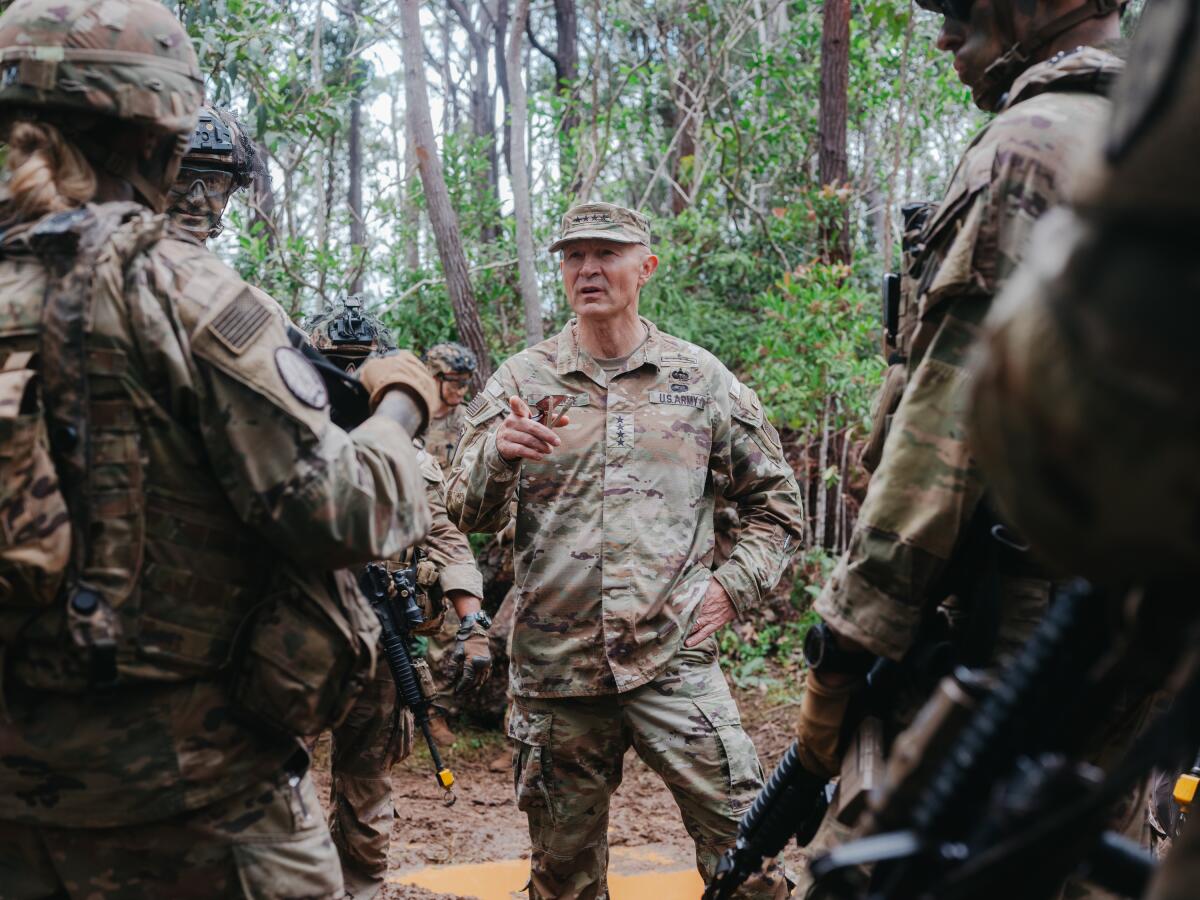
General Randy George, US Army chief of staff, speaks with soldiers during training exercises

Gen. Randy George, U.S. Army chief of staff, speaks with soldiers during training exercises at Lightning Academy at Schofield Barracks in Honolulu on Nov. 10, 2025.

(Christopher Lee/Bloomberg via Getty Images)

It is a purge that Republican lawmakers on Capitol Hill fear could have tangible, detrimental effects on the war effort. Sens. Roger Wicker of Mississippi, Tom Cotton of Arkansas and Joni Ernst of Iowa, all members of the Senate Armed Services Committee, have expressed private concerns over George’s firing, a second U.S. official said.

Forcing out Army leadership responsible for training and equipping its soldiers, and for ensuring weapons stockpiles continue to meet demand, risks bureaucratic chaos and despair in the ranks at a time when the Trump administration is openly considering a ground operation in Iran.

Others in the Pentagon have raised concern over the U.S. military stockpile, including Air Force Secretary Troy Meink, who last month warned at a defense conference that munitions shortages were a concern even before the war began.

“It was something that we were concerned about even before the operation,” Meink said. “It has just been the fact that we couldn’t see the threat evolving and what we’re facing. So we definitely have to improve on that.”

Trump has denied that the United States faces weapons shortages, even after meeting with the nation’s top contractors last month in a push for them to increase — and on some products, quadruple — their output.

“What interceptors we have for Iran is because of Randy George,” the first U.S. official countered. “He continued to work that problem set up through [Thursday]. It’s a problem set he was working in real time.”

Jerry McGinn, director of the Center for the Industrial Base at the Center for Strategic and International Studies, said U.S. forces have reached a stage in the war where they can pivot away from standoff weapons systems. With Iran’s air defenses largely degraded, they can instead rely on weapons such as laser-guided bombs, helping ease pressure on stockpiles.

But Iran’s downing of two U.S. aircraft on Friday suggests that longer-range weapons may still be necessary.

“When the stockpile is stressed, as it was after Ukraine and then now with Iran, any surge in need leads to a backlog as they try to replenish,” McGinn said.

“The three things they’ve been using a whole lot of are Tomahawks, [Terminal High Altitude Area Defense] and Patriots, and those inventories were already somewhat depleted after Midnight Hammer last summer,” McGinn added. “You can’t crank those out very fast.”

Beyond his role tending to the nation’s “magazine depth” — making sure the military isn’t firing more weapons than it is able to replenish — George also led the Pentagon’s effort to set up a joint task force last year aimed at speeding up the U.S. military’s ability to counter small unmanned aircraft systems, or drones.

The program has proved critical in the war effort. Tehran now relies heavily on its Shahed drones, with its missile production and launch capacity severely diminished.

Acknowledging the Pentagon expulsions, Iran’s embassy in South Africa posted photos on social media Friday x-ing out portraits of several top U.S. military officials fired in recent months.

“Regime change happened successfully,” the Iranians wrote.
Source link

How Congress became an afterthought in the war with Iran

Secretary of State Marco Rubio had some explaining to do when he arrived on Capitol Hill for a classified briefing with lawmakers in early March.

Members of Congress wanted to know why, two days earlier on Feb. 28, the United States and Israel had attacked Iran and killed its supreme leader — without notifying them first. After the briefing, Rubio told reporters the U.S. preemptively struck Iran to get ahead of an Israeli attack. A day later, he tried to clarify his remarks.

“The bottom line is this: The president determined we were not going to get hit first,” Rubio said. “It’s that simple, guys.”

For members of Congress, the moment underscored how marginal a role Congress has been able to play in a war that, two weeks in, has spread into more than a dozen neighboring countries, led to the deaths of at least 13 American service members and cost billions of dollars.

In the two weeks since the war began, Congress has largely been sidelined. Lawmakers have cycled through classified briefings, TV interviews and hallway scrums with reporters, but have taken little formal action related to Trump’s war efforts — just two unsuccessful votes aimed at limiting the conflict.

Most of the debate has taken place online, where some GOP lawmakers have drawn rebukes from colleagues for saying America “needs more Islamophobia” and other Islamophobic rhetoric about Iran and its people.

At the same time, Trump has pressed Congress to focus instead on a controversial voting law, signaling to the Republican-led Congress that he wants their focus on the election rather than a historic moment abroad. The president, meanwhile, has offered shifting explanations on how much longer he intends to be at war in the Middle East, telling Fox News’ Brian Kilmeade on Friday that he will conclude the hostilities when “I feel it in my bones.”

Taking Trump’s statements at face value, Democrats and some Republicans have begun to worry that more American troops could be deployed inside Iran to complete the mission — and lawmakers are still trying to understand the war’s threat to the global energy markets as fighting encroaches on the Strait of Hormuz and Americans face soaring gas prices.

The Republican majorities have for the most part rallied behind President Trump, and have blocked measures in both the House and Senate that would have halted the war against Iran and forced him to seek congressional approval for additional hostilities.

House Speaker Mike Johnson (R-La.) likened efforts to rein in Trump’s war efforts to siding “with the enemy.” Sen. Lindsey Graham (R-S.C.) was even more effusive, arguing there is a precedent for presidents using military force without congressional authority.

“The norm in this country is not to declare war by Congress, but for the military to be used by the commander in chief. Sometimes authorization from the Congress is requested, sometimes it is not,” Graham said during a Senate floor speech. “More than not, it is not requested.”

Presidents have frequently used military force without a formal declaration of war — including in Korea, Vietnam and Iraq — but experts argue there is a difference between bypassing a formal declaration and sidelining Congress altogether.

Former Defense Secretary Leon Panetta, who served under President Obama, pointed to the 2011 raid that killed Osama Bin Laden, the mastermind behind the Sept. 11, 2001, attacks, as an example of how the process once worked.

Even though it was a covert Special Forces operation, Panetta said, he personally briefed key congressional leaders before Bin Laden’s killing took place.

That kind of consultation, he said, no longer happens. Instead, lawmakers learn about military operations the same way ordinary Americans do — by watching the news — and then demand to be briefed, he said.

“By that time, the country is pretty much committed to war,” Panetta said.

Presidents of both parties have expanded their power to wage war unilaterally, but Panetta said he believes Trump has crossed a new threshold by dispensing not just with congressional approval but with the courtesy of a briefing.

“It’s not good for our democracy. It’s not a good process,” he said. “It’s not what our forefathers would have wanted.”

Rubio, however, has argued the administration has kept congressional leaders apprised. He told reporters there is no legal requirement to notify all members of Congress and that he briefed the Gang of Eight — a group made up of the top Republicans and Democrats in the House and Senate, as well as the leaders of the respective intelligence committees — within 48 hours of the attack against Iran.

“We notified congressional leadership,” Rubio said. “The law says we have to notify them 48 hours after beginning hostilities. We’ve done that.”

In the statement issued Friday, the White House defended the president’s approach to the war in relation to how its involved Congress, adding that Trump and administration officials “continue to keep bipartisan lawmakers in Congress apprised of the operation as the United States continues to dominate.”

“Past presidents have talked about this for 47 years — but only President Trump has had the courage to do something about it,” White House spokesperson Olivia Wales said.

Democrats say they’re ‘flying blind’

Democratic lawmakers, including some who have been included in classified briefings, have accused administration officials of keeping them “in the dark” and are beginning to demand public congressional hearings.

“I want this administration to testify in public, under oath, regarding a bunch of questions we have in order for the American people to see for themselves,” said Rep. Jimmy Gomez (D-Los Angeles). “I do believe this administration has lied to the American public and Congress.”

Gomez, a member of the House Permanent Select Committee on Intelligence, said he never expected that he would have to spend so much time trying to discern if the administration is lying to lawmakers.

“I think it’s that’s what makes the job harder,” he said.

Democrats, who are in the minority, have limited power to call those briefings, but have continued to put pressure on the administration in a public way.

Senate Democrats last week sent a letter to Defense Secretary Pete Hegseth, demanding answers by Wednesday about reports that a U.S. airstrike hit an Iranian elementary school.

Iranian officials said the explosion killed at least 175 people, most of them children. The U.S. has not taken responsibility for the attack, and Hegseth has said the matter is under investigation. Trump, without providing evidence, has claimed Iran was responsible for the attack.

Seeking answers has been a common theme among Democrats since the start of the war. Sen. Richard Blumenthal (D-Conn.), for instance, said after a classified briefing last week that he had “left with more questions than answers” and a real concern about the possibility of deploying American troops to Iran.

Power of the purse

If the war continues, Congress still retains some leverage.

Under the War Powers Resolution passed by Congress in 1973, unauthorized deployments into hostile situations must end after 60 days unless Congress votes to declare war or passes legislation authorizing the use of the military.

Rep. Brad Sherman (D-Sherman Oaks), who sits on the House Foreign Affairs Committee, said he has told Hegseth and Rubio that if they violate that provision it will be like “stealing money” for actions that are not approved by Congress and warned they could be held civilly liable.

The 60-day deadline will be a key moment for Congress to step in, Sherman said; otherwise there will be growing concern about Trump having “unchecked power.”

So far, he thinks Republicans in control view their job as “butler to the president,” and that the Constitution already gives Trump “too much power over the military.”

“If Congress is controlled by people who want to be servants to the president, it’s going to do an incredibly bad job of being a check on the president,” he said.

Beyond the War Powers Resolution, lawmakers also have power over the appropriations process and could deny the administration’s request to boost military funding.

“The Congress can stop military action by cutting off funding. If you don’t like the war in Iran, say we won’t pay for it. We have the constitutional power of the purse,” Graham said in a Senate floor speech early in March.

The Trump administration’s war with Iran cost $11.3 billion during its first six days, according to the Associated Press.

But Rep. Mike Levin (D-San Diego), who sits on the House Appropriations Committee, says he is aware of the figure only because of news reports — not because the Pentagon has been transparent.

“We are flying blind in the sense that we just don’t know. We don’t know how much is being spent or what it’s being spent on,” Levin said.

Levin says the military will probably need to bolster its munitions stockpile at the rate the conflict is going.

If the Pentagon does request more money, Levin said, he would try to ensure that “not one more dollar goes toward any of this without clear answers and a clear plan.”

Source link