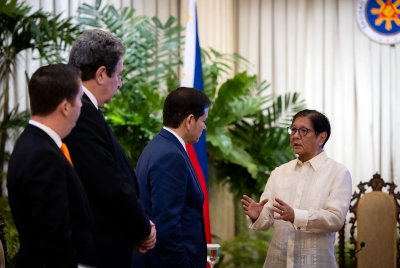
Rubio meets with Philippines president, discusses South China Sea

July 22 (UPI) — U.S. Secretary of State Marco Rubio, in Manila on Wednesday for a meeting of the Association of Southeast Asia Nations, met with Philippines President Ferdinand Marcos Jr. and his counterpart in China, Foreign Minister Wang Yi.
Meanwhile, police clashed with protesters outside who criticized the United States’ involvement in area conflicts and blamed the Trump administration for fueling tension in the region. Some protestors held up signs that said, “U.S. out of everywhere!” and “War criminals not welcome! Ban Rubio! Ban Trump!”
Rubio spokesman Tommy Pigott said the secretary of state met with Marco “to reaffirm our ironclad alliance and our shared commitment to a free and open Indo-Pacific.”
The two men confirmed that “there is no legal basis for China’s expansive maritime claims in the South China Sea” and discussed other matters, Pigott said.
Tensions between the Philippines and China have been high lately over the disputed South China Sea. On Monday, the Philippine military accused Chinese coast guard personnel of striking and injuring a Philippine sailor. China said the Philippine officers instigated the conflict.
China claims most of the South China Sea, including areas that hold the exclusive economic zones of other countries including the Philippines.
In person at the ASEAN conference, Rubio behaved politely toward his Chinese counterpart, saying he appreciated China withholding support for Iran and opposing a toll in the Strait of Hormuz. He also said the countries were taking steps to establish boards of investment and trade.
He did not mention recent claims by U.S. President Donald Trump that China interfered in the 2020 U.S. presidential election.
“Look, these are the two most powerful countries in the world,” Rubio told reporters Wednesday. “It would frankly be reckless and irresponsible for the U.S. and China not to have a relationship.”
Chinese President Xi Jinping is expected to visit the United States in September.
In contrast to his remarks Wednesday, Rubio’s words in an opinion column that the U.S. State Department placed in Philippine newspapers this week were somewhat less measured when it came to the conflict over the South China Sea.
“If those waters fall under the control of a power willing to use commerce as a geopolitical weapon, both the United States and the ASEAN states would face dire new threats to their sovereignty, security and economic futures,” he wrote.