The tourist reportedly admitted that he walked from a villa in the Ubud area because his stay there had come to an end and he’d been unable to find a driver to take him to a new accommodation
Karl Adolf Amrhein was reportedly confronted by officers in the village of Sukawati(Image: Gianyar Police Department)
A tourist was detained while out on a walk on holiday.
The American citizen, Karl Adolf Amrhein, was detained at 7.15 am on March 19 while walking with bags along Jalan Raya Sukawati in Gianyar Regency, Bali, Indonesia’s police force said in a press statement.
The Pecalang officers patrolling the area discovered the foreign national traveling on foot.
“After initial communication failed, he was escorted to the Sukawati Police Station for clarification,” said Superintendent Chandra Citra Kesuma, the Chief of Gianyar Sub-regional Police.
According to Antara News, the tourist admitted that he walked from a villa in the Ubud area because his stay there had come to an end and he’d been unable to find a driver to take him to a new accommodation.
“Upon receiving this acknowledgement, Sukawati Police personnel, assisted by the Pecalang of Sukawati Traditional Village, explained that currently there is a Nyepi celebration on the island of Bali, where there is no activity for one day,” said Superintendent Chandra.
Mr Amrhein was told that all activities in Bali were temporarily suspended for Nyepi Day, it was reported. He was offered the opportunity to rest at the Sukawati Police Headquarters until the next day, but he reportedly asked for accommodation in a holiday villa, which was granted.
A mandatory stay-at-home order is in place across Bali during the Nyepi Day of Silence celebrations, during which all outdoor activities and public transport are banned.
The celebrations mark the start of the new year. However, unlike in other parts of the world, Balinese Hindus don’t mark the new year by having a huge booze-soaked party or letting off fireworks. Instead, they embrace the silence.
From 6am on March 11 until the same time the following day, adherents switch off their electrical devices, fast, meditate, and stay home with their families. Outside a group of specialist security officers patrol the street, ensuring that no one is outside causing a ruckus.
Although 8% of Bali’s population is not Hindu, the entire island is impacted by the holiday, which sees the roads completely cleared of vehicles aside from the occasional ambulance and all tourist attractions closed. Hotels do not check anyone in or out during the period. If you do find yourself on the island over the holiday, then you’ll be treated to an experience like no other.
The day before Nyepi is Ngrupuk, which is essentially a time to get all of the noise out of your system. Children parade effigies of evil spirits made out of papier-mâché around the streets before torching them, while men launch burning coconuts at one another. Carrying torches while yelling and spitting spice into the corner of homes is another common custom on the day.
Many hotels such as the Viceroy Bali do not allow customers to book in over Nyepi. Those who are already checked-in cannot leave the hotel grounds but are able to use the pool, spa and gym there. The Wi-Fi is also kept on.
“We respect our culture, but we also respect our guests. They are not the same religion as us, so that means our hotel is still operating normally,” resort manager Jero Mangku Tindih told CNN. On Ngrupuk guests of the hotel can head on an arranged trip to a nearby village to watch the flaming coconut battle and masked parade.
Chief Chandra urged all international visitors to respect Balinese customary laws to maintain communal harmony during high-level cultural observances.
Most people think you can’t walk without an Achilles tendon. Jo Giese begs to differ, especially since she hikes without one.
The L.A. hiker, journalist and community activist shares her journey of recovery in her new 240-page book, “You’ll Never Walk Alone: A Hiker’s Memoir of Adventure, Tragedy, and Defying the Odds” (Amplify Publishing). Giese outlines how one fall down the stairs led to eight surgeries and a relentless search for answers for how she could return to the trails she loved.
“The reason I wrote the book is to inspire others,” Giese said, “that if you’re given a grim diagnosis — and it certainly doesn’t have to be your left Achilles — you do not have to accept it.”
You are reading The Wild newsletter
Sign up to get expert tips on the best of Southern California’s beaches, trails, parks, deserts, forests and mountains in your inbox every Thursday
By continuing, you agree to our Terms of Service, which include arbitration and a class action waiver. You agree that we and our third-party vendors may collect and use your information, including through cookies, pixels and similar technologies, for the purposes set forth in our Privacy Policy such as personalizing your experience and ads.
Like many of us, Giese’s love of the outdoors started early. At age 5, she regularly took walks alone from her family’s home on Lake Washington Boulevard in Seattle. Wearing a frilly pinafore dress and Mary Jane shoes, she’d walk a few blocks to Seward Park, pausing at the playground, where she’d persuade someone to push her on the swing. That wasn’t the main goal of the trip, though.
“There is a path that leads up into the middle of the peninsula in this old growth forest. The canopies of the trees are two and three stories high. You’re just walking in this green wonderland,” Giese said. “And then after I finished walking all the way up as far as I wanted to go, I’d come back, and I’d walk back along [the route] and go home.”
The cover of “You’ll Never Walk Alone”; and a photo of author Jo Giese.
(Amplify Publishing; Dan Fineman)
Giese has been a walker and hiker ever since, falling in love with waterfall hikes in particular. Giese and her husband, Ed, split time between their house near L.A. and a home in Bozeman, Mont. They hike in the Santa Monica Mountains when they are home in Southern California, but Giese isn’t picky.
“I mainly hike anywhere I am,” Giese said.
That includes an epic vacation “jumping out of helicopters in New Zealand … in my late 60s,” she said. But neither that adventure nor any other is how Giese got injured.
It was a rainy night in late November in L.A. Giese was upstairs when her friend Lana arrived, and not wanting her friend to get drenched, Giese raced down the stairs to open the front door.
“I miss the bottom two steps, and I literally go flying horizontally,” Giese said. “My husband heard the crash. He came running, and I said, ‘Go let in Lana. She’s getting wet!’”
The trio immediately rushed to a nearby urgent care, where an X-ray showed a complete rupture of Giese’s left Achilles tendon, a thick band of tissue that attaches a person’s calf muscle to their heel bone.
Giese quickly called an orthopedist whom she’d seen for a simple knee procedure. He told her to come to his office the following day at 8 a.m. At the appointment, the doctor said, “‘I can do this. I did [an]
Hikers dressed in Dodger Blue gather for a group photo midway through a hike at Griffith Park on March 24, 2024.
(Brian van der Brug / Los Angeles Times)
Achilles repair 20 or 30 years ago. I can do this,’” Giese recalled.
Giese at Point Dume.
(Jo Giese)
In hindsight, it’s clear she should have found someone who’d done an Achilles repair “20 or 30 minutes ago,” she said. But the relief of not having to wait for surgery mixed with the shock of the moment made Giese and her husband impulsive.
“We were so frightened then — I’m in a wheelchair, and I’m all black and blue and bruised. I cannot walk. And there is someone in front of me who says he can do this,” Giese said. “And that should be a lesson to anybody.”
After the surgery to reattach her Achilles, her doctor left for a two-week vacation while Giese was at home recuperating, studiously following the doctor’s after-care guidelines. At her follow-up appointment, the nurse was unwrapping the bandage when the doctor observed, “That’s necrotic.” At the time, Giese didn’t know that word essentially meant “dead.”
The doctor immediately blamed her, saying it was from an ice burn. Both she and her husband knew that wasn’t true. Another doctor would later suggest that the surgeon introduced the infection during that first surgery.
“I don’t think I’d been so scared since my encounter with a bear,” Giese wrote in her book.
Exactly 49 days from her accident, Giese was scheduled for another surgery (with a different doctor) to debride the wound and reattach her Achilles. It was supposed to take several hours. But less than an hour into surgery, her physician told Ed that Giese’s Achilles had died. Soon, he asked Giese if she wanted to see what was left of the largest and strongest tendon in the body.
It looked like “a nasty little caterpillar that had turned fetal, curled in on itself, and died in a sea of black-and-green muck,” Giese wrote.
Next, Giese needed a skin graft to cover the wound from the previous surgeries. After that, she returned to her doctor’s office — 114 days after her accident — where her doctor removed the bandages from that third surgery and suggested something revelatory: that Giese should put her left foot down, putting her whole weight on it.
“My naked left foot — heel and five toes — made intimate contact with a floor, a cold linoleum floor, for the first time since this medical journey had begun four months earlier,” Giese wrote. From here, she walked her first 20 steps.
But recovery would come in fits and spurts. About a month later, Giese wanted to attend a festival while in Austin, Texas, only to find the 10 blocks of booths and vendors too daunting. She went back to the hotel and screamed, “I cannot walk!”
From here, she demanded better care. Giese was tired of hearing medical professionals say they’d never encountered someone without an Achilles. She wanted to find someone who was experienced with complex muscle injuries.
Her search ended 274 days after her accident when she learned about the Center for Restorative Exercise in Northridge. Giese felt dubious about another physical therapist, though. She’d already been to three physical therapy clinics, and “those had been a waste of time, energy and hope,” she wrote. But here, she was met with science and intentionality.
Taylor-Kevin Isaacs, the clinic’s co-founder, told Giese that she had other muscles still intact that could help her walk again, and she luckily hadn’t suffered any nerve damage, Giese wrote in the book. She spent the next 2½ years working with the center’s staff, which included receiving acupuncture, shockwave therapy and scar tissue massage, which was so painful “you could have heard me screaming from where you are,” Giese said.
After she completed care at the center, Isaacs nominated Giese for an award she won — an Oboz Footwear “Local Hero” award in 2024.
On the photo shoot for the award, Giese hiked with a photographer along a trail to Ousel Falls, a 50-foot waterfall in Big Sky, Mont.
It had been five years since her accident, and Giese thought back to a medical appointment in Montana the first summer after her fall. A physical therapist that Giese had been working with for about a month asked her to walk about 50 feet across the room.
“I hate to be a Debbie Downer,” the therapist said, “but you’re going to be compromised for the rest of your life.”
At that point, Giese told me, all she had was hope — that she’d get better, that she’d walk again.
Here at the waterfall, Giese told the photographer they should take the steps down to the splashdown area for a better shot. She was ready, navigating black ice like she’d done many times before the accident.
“My thought was, ‘If only that person could see me now,’” she said. “This person who said, ‘You’re going to be compromised the rest of your life, and you have to accept it.’ I thought, ‘No, I don’t.’”
3 things to do
Hikers dressed in Dodger Blue gather for a group photo midway through a hike through Griffith Park on March 24, 2024.
(Brian van der Brug / Los Angeles Times)
1. Have a home run of a hike in L.A. The Dodgers Blue Hiking Crew will host an intermediate hike at 6:30 a.m. Sunday at Griffith Park. Participants are required to wear hiking or trail shoes or boots. The group’s hikes are usually six miles and last about three hours. Register at facebook.com.
2. Clear the trail near Ojai Los Padres Forest Assn. will host a workday from 8 a.m. to 3 p.m. Saturday along the Potrero John Trail. Volunteers will meet at the Cozy Dell Trailhead before carpooling to the work site. The trail features jagged rock formations, a perennial creek and bigcone Douglas fir. Register at lpforest.salsalabs.org.
3. Wander through nature’s wonders in Whittier The California Native Plants Society San Gabriel Mountains chapter will host an easy hike from 9 to 11 a.m. Sunday through Sycamore Canyon in the Puente Hills. Cris Sarabia, conservation director for the Palos Verdes Peninsula Land Conservancy, will educate hikers on plants along the trail, both native and nonnative species. Participants should wear long pants to protect against poison oak. Register at eventbrite.com.
The must-read
Sturtevant Falls, a 55-foot waterfall, in Big Santa Anita Canyon in the San Gabriel Mountains.
(Jaclyn Cosgrove / Los Angeles Times)
Perhaps you’re reading this from a dark room, blinds drawn, fan blowing, praying for a return to spring. That’s definitely the scene where I’m writing to you! Whenever L.A. experiences an intense heat wave, I feel a little trapped. That’s why this week I updated our list of the best hikes around L.A. that will offer you shade and, in most cases, streams and rivers where you can cool down.
Please take good care, though. Hike before 11 a.m., stay hydrated and only cross creeks when you feel safe doing so.
Happy adventuring,
P.S.
Our recent weather pattern — heavy rains followed by intense heat waves — has meant wildflower season came earlier than expected in several regions of Southern California. Times contributor Jessie Schiewe outlines in this guide the hiking areas where you’ll most likely find recent blooms. For example, Towsley Canyon in Newhall, an area I have yet to visit, is likely a spot where you’ll find bright orange poppies. Want to learn a quick hack that I use to better ensure I will see blooms? Search iNaturalist, a citizen science app, for the flower you’d like to see, using the filter option to only view posts from the last two weeks. If users have recently posted, for example, about spotting poppies, your chances are higher that you will too. Keep on reading The Wild, and I promise I will keep giving you my secrets of outdoors reporting!
For the Record: Last week’s edition of The Wild said decentralized seed banks would be built by procuring seeds from L.A. County nature centers. A decentralized seed bank will be developed to procure seeds for and by L.A. County nature centers.
For more insider tips on Southern California’s beaches, trails and parks, check out past editions of The Wild. And to view this newsletter in your browser, click here.
This countryside spot is steeped in folklore about a monstrous Barghest that legends claim crushed victims – making for an atmospheric hiking spot
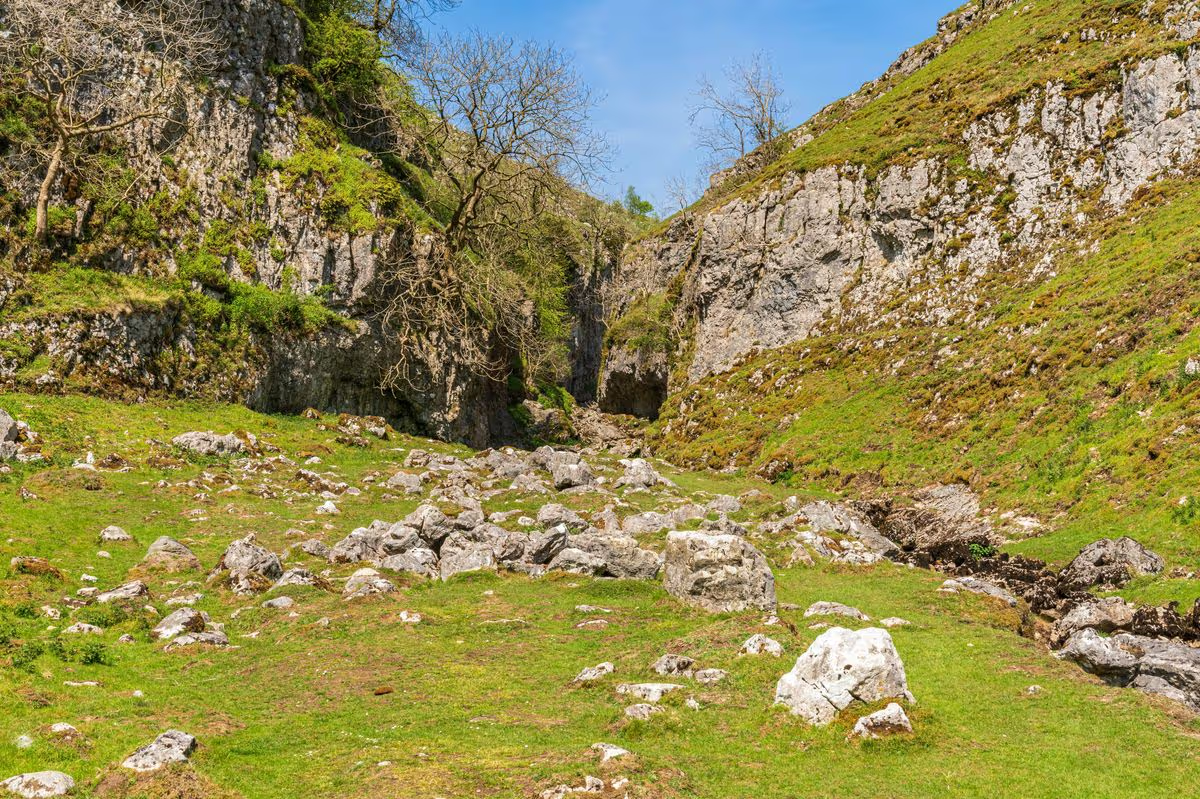
The hidden gorge is thought to house an evil being (Image: BerndBrueggemann via Getty Images)
Nestled within an abandoned mining region, hidden away in the Wharfedale valley of the Yorkshire Dales, lies a collapsed limestone ravine, brimming with historical tales, folklore and even a potentially terrifying resident.
Unless you’re aware of its existence, the enigmatic cavern is virtually invisible from view, concealed just off the roadside, making it a genuine secret treasure for ramblers.
Troller’s Gill is a legendary location beloved by keen walkers who venture to the region hoping to witness its splendour, as it packs considerable natural beauty into a compact trail.
The difficulty level for the path is fairly moderate, largely due to a handful of sections requiring scrambling, with a total distance of 2.6 km. It’s a trek that typically takes around one hour and can therefore be combined with any other walking or exploration activities you’ve planned during your stay in the Dales.
Save on the best holiday cottages in Yorkshire
This article contains affiliate links, we will receive a commission on any sales we generate from it. Learn more
Famous for its dramatic landscapes, historic cities, hearty food, and rich cultural heritage Yorkshire is just waiting to be explored. Sykes Cottages has a large number of properties to choose from with prices from £31 per night.
To access this captivating destination, you can leave your vehicle on New Road, where parking is free, before discovering this luminous green treasure.
Upon arrival, you’ll understand why it’s such a frequently discussed location and observe its rocky brook, which seems to emerge from nowhere.
Approximately a 15-minute stroll from where you’ve parked, you’ll spot a disused mine, the former operations of Gill Heads Mine, which has remained dormant since the early 1980s.
The entrance features a substantial gate with rockfall partially obstructing it, and visitors are strongly advised against entering the mine itself due to potential hazards, including potholes and collapse risks.
Legends and myths
Since its existence began, Trollers Gill has been cloaked in mystery but there’s one talethat particularly stands out from the rest. The location is thought to have been haunted by a Barghest, a massive hound with large luminous eyes.
According to ancient folklore, encountering the creature was far from fortunate but rather a harbinger of death, as those who crossed paths with the fearsome beast were frequently crushed to death or ripped apart, tales suggest.
One legend recounts the story of a man, John Lambert of Skirethorns, who bragged in a local pub about what he’d do to the enormous hound, which involved ‘giving it a good thrashing’ if he were to ever come across it. However, legend has it, he encountered the dog on his journey home, and it fatally crushed him.
John Henry Dixon from Grassington may have been the first individual to document such tales when he contributed a poem to a book published in 1827, William Hone’s Table Book.
In the ballad he describes a courageous man who ventures out to visit the Gill hoping to summon the mighty Barghest.
As he entered the gorge, he sensed the spirit of the stream warning him to turn back, but he disregarded it. He drew a protective magic circle around himself “with charms unblest”.
In his brief tale, the stream swelled and thundered, accompanied by a powerful wind, sweeping down the valley. He glimpsed the enormous shadow of the growling dog, its eyes illuminating the gorge walls.
The ferocious creature launched itself at the man and seized him as its next victim, dragging him to the valley floor, where his remains were subsequently discovered.
Various mythical creatures and supernatural entities have been reported inhabiting the ravine, which quite literally takes its name from trolls. It’s believed that Trollers’ Gill originates from ‘Troll’s Valley’, drawing from the Scandinavian tongue of those who made this area their home.
Their traditions and legends indicate that the term ‘troll’ encompasses any supernatural creatures, ranging from hulking giants to goblins, and naturally ‘trolls dwelling beneath the bridge’.
Meanwhile, the term ‘trolldom’ was understood to signify witchcraft and therefore implies the name stems from the notion of the valley being cursed, enchanted or inhabited by otherworldly beings.
No. 1-ranked St. John Bosco began Trinity League baseball play on Tuesday the same way it has done early in the season — with more good pitching.
Julian Garcia struck out seven, walked one and gave up three hits in five innings of a 6-0 win over JSerra. It was the fourth shutout in five games this season for the Braves (5-0). Jhett Ohira had three hits and Jaden Jackson and Noah Everly added two hits apiece.
Bishop Alemany 6, Harvard-Westlake 5: The Warriors handed Harvard-Westlake its first Mission League loss. Alex Noble had two hits for Alemany (8-2, 3-0).
Sherman Oaks Notre Dame 13, Chaminade 2: Unbeaten Notre Dame (7-0) was led by Benett Pace, who hit two home runs and finished with four RBIs. Jacob Madrid added two hits and two RBIs. Beckett Berg struck out six and gave up one hit in five innings.
St. Francis 6, Loyola 2: Lucas Becerra contributed three hits in the Mission League win. Donovan Udell threw two scoreless innings of relief.
Sierra Canyon 3, Crespi 1: Armando Solorio threw a complete game with six strikeouts and no walks.
Florida Stoneman Douglas 7, Santa Margarita 6: The Eagles couldn’t hold on after opening a 6-1 lead. Warren Gravely III had a home run.
Servite 6, Aliso Niguel 2: The Friars received scoreless innings of relief from Wyatt Karges, Eli Rubel and Isaiah Camacho.
Los Alamitos 5, Edison 3: Will McCullough had three hits for Los Alamitos.
Arcadia 18, Hoover 2: Matt Manzo had four RBIs and Jordan Vogel had three hits.
La Mirada 4, Etiwanda 2: Ian Nunez had a three-run home run for La Mirada.
Huntington Beach 6, Marina 1: Jared Grindlinger struck out four with no walks in four innings. Ely Mason had a double and single.
Cypress 5, Villa Park 3: Tate Belfanti struck out eight in 3 2/3 innings for Cypress.
Newport Harbor 5, Corona del Mar 1: Ryan Williams homered and Gavin Guy picked up the win.
Softball
Murrieta Mesa 12, Temecula Valley 0: Macy Clark hit two home runs in the five-inning win for No. 1-ranked Murrieta Mesa.
JSerra 8, Aliso Niguel 2: Zena Edwards hit a two-run home run and Margenta De Arte had a two-run double for JSerra.
Garden Grove Pacifica 6, Eastvale Roosevelt 5: The Mariners got a walk-off single in the bottom of the seventh from Jenna Valladares.
Harvard-Westlake 11, Louisville 7: Izzy Whelan drove in three runs in the loss.
Downey 21, Sherman Oaks Notre Dame 6: The Vikings (10-2) routed Notre Dame behind Hazel Renteria. Delilah Navarro and Kayla Gutierrez each had four hits.
Two top City Section baseball teams, El Camino Real and San Fernando, faced off Friday in a pitcher’s duel that went eight innings.
Senior Ray Pelayo of San Fernando kept throwing strikes, keeping El Camino Real off balance for 7⅔ scoreless innings with eight strikeouts and one walk. But then came a balk that scored the winning run in El Camino Real’s 1-0 victory.
Hudson December threw six scoreless innings for El Camino Real and Andrew Katzman struck out three in two scoreless innings.
South Torrance 4, El Segundo 3: In a battle of unbeaten Pioneer League teams, South Torrance (6-0) received a walk-off single from Owen Rhodes in the bottom of the seventh. El Segundo tied it 3-3 in the top of the seventh on a two-out, three-run home run by Chase Mattoon. Issac Orozco struck out nine in five innings and also homered for the Spartans.
Crespi 3, Saugus 2: Justin Kim had two RBIs for the Celts.
Sylmar 7, Legacy 1: Rickee Luevano threw a two-hitter with nine strikeouts.
Sierra Canyon 12, West Ranch 1: Isaias Tirado hit a three-run home run and four pitchers combined to give up five hits.
Mater Dei 15, Rockwall-Heath (Texas) 1: Ezekiel Lara had three hits and five RBIs in Texas. Earlier, the Monarchs gave up seven runs in the third inning of an 8-1 loss to Rockwall-Heath.
St. John Bosco 1, Gahr 0: Star closer Jack Champlin got a strikeout to end the game, finishing two shutout innings of relief. Champlin drove in the game’s only run with an RBI double in the sixth inning. Julian Garcia struck out six with no walks in five innings for St. John Bosco.
San Juan Hills 11, Cypress 0: Garrett Gandolfo threw five scoreless innings with seven strikeouts and Clay Riggs contributed three RBIs for San Juan Hills.
Santa Margarita 1, Damien 0: Warren Gravely IV had the only RBI in the Eagles’ win. Tyler Unter struck out six in five shutout innings.
Garfield 9, Cleveland 7: Omar Martinez had three hits and Victor Alvarez drove in three runs for Garfield. Joshua Pearlstein finished with three hits for Cleveland.
Palos Verdes 8, West Torrance 0: Kai Van Scoyoc struck out nine in five innings and Asher Friedman had a home run and a double for Palos Verdes.
Valencia 12, Chatsworth 0: An eight-run second inning helped lead the Vikings to a five-inning win.
Bishop Amat 13, Gardena Serra 2: Joaquin Ortiz finished with three hits and four RBIs.
Corona Centennial 19, Eastvale Roosevelt 3: Devin Bishop and Emiliano Castaneda each hit home runs for Centennial. Ethan Miller had a double and triple.
Servite 6, Anaheim Canyon 1: Mickey Cabral went three for four and Cole Grothues struck out three in 2⅓ innings of scoreless relief.
Corona Santiago 5, Crean Lutheran 4: Jonathan Thorton delivered three hits and two RBIs for the Sharks.
Fullerton 1, Chaparral 0: Garrett Wrightman threw four innings of scoreless relief and Caleb Brown had an RBI double in the third inning for Fullerton.
Edison 11, Tesoro 7: Ben Wilson hit a grand slam and finished with five RBIs for Edison.
El Dorado 10, Granada Hills 4: Lorenzo Favela hit a three-run home run to lead El Dorado.
Ayala 7, San Dimas 1: Caleb Trugman struck out nine with zero walks in a complete game.
Loyola 14, Venice 1: Wyatt Clougherty had three hits and Luca Marucci contributed three RBIs for Loyola.
Softball
JSerra 2, Norco 0: In Arizona, the Lions knocked off No. 1-ranked Norco behind Liliana Escobar, who struck out 13 in six innings.
Norco 5, Torrance 0: Coral Williams struck out 10 in six innings. Leighton Gray and Rae Logue hit home runs.
Garden Grove Pacifica 4, Anaheim Canyon 2: Natalia Amezquita had a two-run single for Pacifica, which later defeated Orange Lutheran 6-2.
Orange Lutheran 7, Perry 1: Mia Scott had four RBIs for the Lancers.
Sherman Oaks Notre Dame 15, Culver City 0: Ellayne Tellez-Perez had three hits and five RBIs.
PHOENIX — For 24-year-old Alex Freeland, the time is now.
After the switch-hitting middle infielder enjoyed a cup of coffee in the big leagues last season, he’s trying to break camp with the Dodgers and get increased playing time at second base with veteran Tommy Edman expected to be on the injured list as he works his way back from right ankle surgery.
Freeland, who played 29 games with the Dodgers last season, and second-year utility man Hyeseong Kim, who played 71 games and was on the postseason roster, are among those vying for playing time at the start of the season, with veteran Miguel Rojas and and nonroster invite Santiago Espinal also in the mix.
Kim, who started Cactus League games at second base and center field, recently departed for the World Baseball Classic as he competes for Team South Korea, opening a door for Freeland to get more reps in the heart of the Cactus League season.
“Opportunity is present, so I’m trying to make the most of it,” Freeland said. “It sucks that Tommy’s not ready and he won’t be ready for the beginning of the season. He’s a big part of this team, so I wish him a super speedy recovery and I hope that he gets out there as quickly as possible. But yeah, with Hyeseong being gone, I am getting more reps at second and short, so I’m just trying to make the most of them.”
Freeland entered last season as MLB Pipeline’s No. 45 overall prospect. Though he posted a .190/.292/.310 slash line at the big league level, prospect analyst Jim Callis still has high hopes for Freeland.
“Freeland doesn’t have a wow tool but he does a lot of things well,” Callis said. “His best attribute is probably his defense at shortstop and versatility to play other positions. He’s a switch-hitter who draws a lot of walks and has some sneaky pop. He’s just an average runner, but his instincts allow him to play quicker than that.”
As a switch-hitter, Freeland has had more success from the left side than the right. He worked on his swing from both sides of the plate over the offseason and feels he’s in a good place.
“My right-handed hitting could be better,” Freeland said. “I mean, part of my game is walking, so I felt like I wasn’t patient at the right times last year. Sometimes I was too patient, just taking pitches down the middle. Walking is a big part of my game, so I’m looking to walk, and I feel like I’ve done that this spring training.”
Freeland has drawn eight walks in 24 plate appearances in Cactus League play, and Dodgers manager Dave Roberts has been impressed with what he has seen this spring.
“Maturity,” Roberts said. “Playing both sides of the baseball really well. The bat, right-handed looks really good. Lefty is typically his strong side, but I like the right-handed at-bats. Just playing with a lot of real confidence.”
If it weren’t for the Dodgers’ star-studded roster, Callis believes Freeland’s chances at playing time would be better.
“On a lot of teams, Freeland would be getting a chance to compete for the starting shortstop job, but he’s blocked on the Dodgers,” Callis said. “He’s probably looking at more of a utility role than starting in Los Angeles, and he could be attractive to other clubs in trade talks too.”
Freeland, however, is embracing his role and hopes to earn his stripes. He’s tried to soak up as much as he can from the veteran stars he’s been able to spend time with.
“Miggy Ro has always got something good to say. Muncy, Freddie, I mean they’ve been around so long, they’ve seen so many different things, so it’s like whatever I have a question about, like I can easily go and talk to one of them, and they’ve got an answer for me,” Freeland said of Rojas, Max Muncy and Freddie Freeman. “And it’s great to have guys like that in the clubhouse.”
Freeland grew up an Atlanta Braves fan and admired Freeman for years. Freeland never imagined he one day would share a locker room with the nine-time All-Star first baseman, who spent the first 12 years of his career in Atlanta.
“I watched Freddie growing up and Mookie,” Freeland said of Freeman and Betts. “So, I mean, it’s kind of like a full-circle moment, like I watched Freddie a lot when he was with the Braves, coming up, because I lived in Georgia, so like I’d go and watch minor league games and see him in Gwinett.”
At the outset, Richard Baines says: “You don’t need binoculars.” This is not what I expect to hear on a walk where the main focus is birds. The sun has yet to rise, but we can see our way across muddy ground crunchy with ice. That is the next surprise in a day that will be full of them: we are still in February but Richard points out that ornithological spring is well under way. “Birds are starting to sing,” he says. “Some, like the crossbill, might already have laid eggs.”
We follow a path up to an open ridge, but bird sounds are conspicuously absent. Richard turns back and heads down into a sheltered wooded valley. We have driven up from Pickering to the North York Moors, an area he has been exploring for more than 40 years, his experiences charted in recent memoir The Rarity Garden. As a 14-year-old budding ornithologist he decided to learn bird songs and calls. “I had spent too many woodland walks being disappointed by not seeing any birds, but I could hear a great deal,” he says. “When I started to prioritise sound above sight, the trees came alive and I have never had a bad woodland walk since.” Our walk today aims to land that message for me.
Forests in the north of England are a stronghold for goshawks. Photograph: wonderful-earth.net/Alamy
As we drop down into a wooded glade, a large bird flits out of the trees, turns and is gone. “Great start!” says Richard. “Male goshawk.”
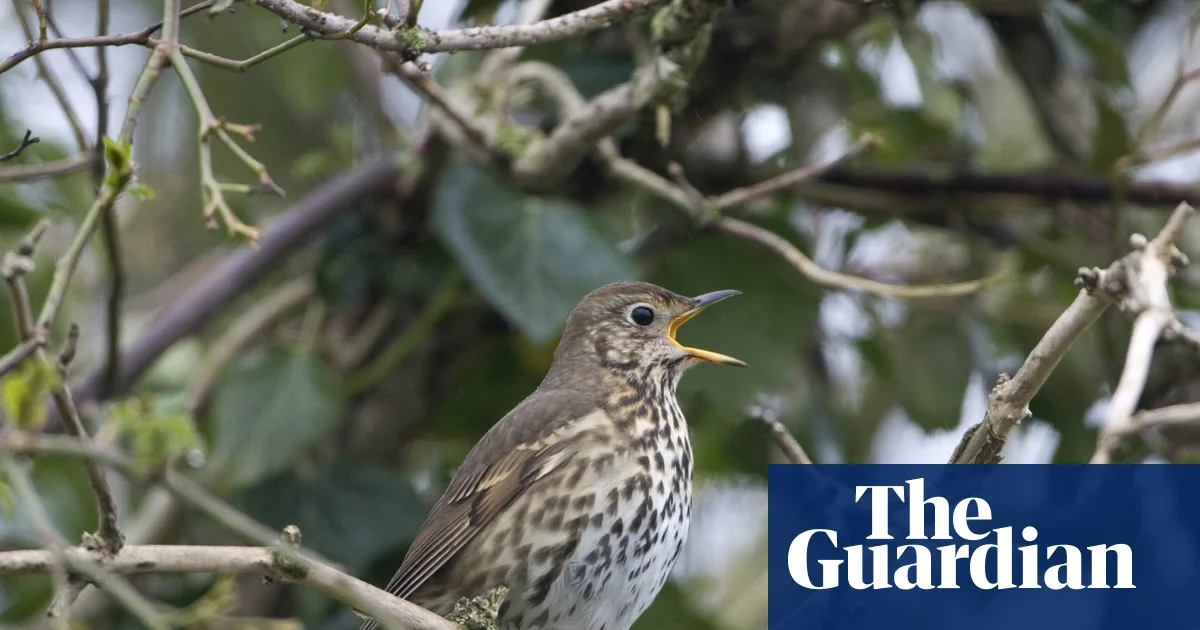
Now we stop in front of a small stand of alder and hazel. A bird is singing, so I get out my phone and load Merlin, the app that has revolutionised my ability to identify birds. “Yes, let’s see what you get,” says Richard with a twinkle in his eye.I glance down and see three bird names quickly ping on to the screen. Song thrush, chaffinch and blackbird. I look up. Something is not quite right: all the sounds are emanating from the same place. And then it happens: an unmistakable mewling cry, coming from the top of the alder, where all the other sounds have originated. Merlin duly obliges: “Buzzard.”
Richard is chuckling. “Any thoughts?”
“That thrush just did something incredible.”
We listen a little longer, then Richard explains how a lifetime of learning bird sounds took an unexpected turn in 2014 when Cornell University brought out its gamechanging app, Merlin, a bird-sound identifier that now has more than 10 million users worldwide.
“It’s a brilliant tool for learning birdsong, but it’s also revealing lots of unexpected information,” he says.
One such moment came on a walk in May 2025. Richard was leading a group looking for nightjars in clear-felled areas of plantation woodland near where we are walking. A participant who had lagged behind suddenly came running back to the group with the news that Merlin had picked up a nightingale’s song. Richard immediately turned the group around and went back. “Nightingales are rarely sighted north of Cambridgeshire, never in the North York Moors,” he says. “It would have been momentous.”
Instead, they found a song thrush.
“It may have learned the song on its spring migration, maybe even in the Mediterranean. Merlin is teaching a lot, but it’s also revealing gaps in our knowledge.”
The song thrush is not the only bird playing tricks. As the bottom of the valley flattens out, I spot a great tit landing in the willows by the stream, then singing like no great tit I’ve heard before.
Pink-footed geese migrate to the UK from Iceland in autumn. Photograph: Jon Sparks/Alamy
“It’s mimicking a marsh tit,” says Richard. By the time I get Merlin going, a song thrush has started singing. This time, with the sun risen, we can see it clearly, and Richard whispers: “It’s doing a nuthatch.”
Merlin pops up with: “Coot.”
We both stare at the screen, then replay the recording. Sure enough, there is a snippet of low quacks. This time, even Richard is staggered. “That is a first. There definitely isn’t a coot within 10 miles of here.”
Standing in a puddle of icy water, I am suddenly aware that I may have just witnessed a small addition to human knowledge. Significantly, I have not once thought about taking a picture.
For Richard, these reactions are what make the walks special. “Being thrilled by bird sound really frees people up, especially if you’ve got used to the idea that success is a good photograph.”
He has brought people with sight loss on the walks. “They are often much more sensitive to sound and so it’s fascinating to get their skills involved.”
Richard Baines out on a bird walk in North York Moors national park. Photograph: Kevin Rushby
We carry on and, with Richard’s guidance, a whole new sonic world opens up for me, including, far away, the honking of pink-footed geese arriving from Iceland. They are so high I can’t see them, but Richard thinks he knows where they might land, so we quickly transfer to the nearby flooded fields of Ryedale. Extreme cold in eastern Europe has sent thousands of geese towards the UK, and now we see hundreds of pink-footed geese coming down to land and, among them, the black barred chests of Russian white-fronted geese (“white-fronted” refers to the bird’s forehead, not chest). In a normal year, Yorkshire might welcome a couple of dozen of these, but now we are witnessing several hundred in one place. “A once in a 25-year event,” says Richard.
Having already flown about 3,000 miles from their Siberian breeding grounds to the Dutch coast, these birds have decided that an extra few hundred miles across the North Sea is a good idea. That seems like magic, but there is more. Next day, Richard phones. “I’ve been looking at the photos of those geese and there was something even more unusual among them: another Siberian visitor, a single tundra bean goose.”
I like that. Despite my new interest in sound, I’ll hang on to my camera.
Yorkshire Coast Nature offers various nature walks, including Bird Sound Safaris, from £40
Two people took the Bakerloo line on one of London’s shortest Tube journeys while another walked between the stations – with surprising results showing walking was faster
Some trips on the London Underground last less than a minute (stock image)(Image: Jan Woitas/picture-alliance/dpa/AP Images)
While the London Underground is undeniably handy most of the time, there are some journeys that seem barely worth the hassle. By the time you’ve reached the station, scanned your ticket or Oyster card, gone down the stairs or escalator, waited for your train, then made the return journey back to street level and scanned back out, you could probably have walked the distance just as quickly.
The people at secret.london decided to put this theory to the test, with two people tackling one of the capital’s briefest Tube journeys, whilst another made the same trip on foot to determine who’d arrive first.
The journey from Marylebone Station to Baker Street on the Bakerloo line lasts just 57 seconds – however, the time spent getting to and from the platforms, plus waiting for the train, will bump this up. The stations sit just 0.2 miles apart, with the walk between them taking around six minutes, according to Google Maps.
Kicking off the video, narrator Tom said: “This has got to be the most pointless Tube journey in London.” He continued: “Today we’re racing between Marylebone and Baker Street, with Google predicting a six minute walk versus a one minute Tube ride, who’s going to get there first?”
The footage then shows Tom and two female colleagues at Marylebone Station simultaneously starting timers on their phones, before he heads off on foot whilst the women dart into the station, reports MyLondon. The footage captures the women striding quickly – but not running – through the station, while navigating the ticket barrier and commuters blocking the escalator.
Tom, meanwhile, is filmed making his way through the streets, remarking: “Of course we’re doing it in such terrible weather. You’ve got to be prepared for everything, so I have come with a brolly.”
He continues: “I’m feeling good about this. Those guys have got to get onto the platform (and) find a tube that’s hopefully on time.”
The women are then spotted reaching the platform, with the next service due in two minutes, while Tom encounters his “first obstacle” – a set of traffic lights. “A fun fact about Baker Street Station: it’s the oldest Tube station in the world,” he says. “It was created on January 10 in 1863.
“But was it built to be the fastest? I don’t know.”
The women are subsequently shown getting on the train, their timers displaying four minutes and 20 seconds, and counting. “It’s not our fault we’re tiny and petite and he’s big and lanky and long,” one remarks.
Content cannot be displayed without consent
They’re then filmed getting off the train and moving swiftly towards the exit. Tom, by contrast, stands across the road from the station entrance.
“I can see the entrance to the station and they’re not outside it, so I think I’ve got a good chance” he says. After a frantic dash up the escalator and a tussle with a stubborn ticket barrier, the women display the timer, reading six minutes and 26 seconds, as they reach the station entrance – only to find Tom already there.
Tom finished the journey in six minutes and 16 seconds, remarking: “So for this one, you probably should walk it.”
Wood Lane – Shepherds Bush 55 secs (Circle and Hammersmith & City lines)
Goodge Street – Tottenham Court Road 56 secs (Norther line)
Baker Street – Marylebone 57 secs (Bakerloo line)
Bond Street – Oxford Circus 57 secs (Central line)
Marylebone – Edgware Road 57 secs (Bakerloo line)
Ensure our latest headlines always appear at the top of your Google Search by making us a Preferred Source. Click here to activate or add us as your Preferred Source in your Google search settings.