California’s statewide minimum wage is set to rise next year.
Starting on Jan. 1, 2027, the statewide minimum wage will rise to $17.40 an hour, an increase Gov. Gavin Newsom boasted about on Friday.
Newsom — who has been eyeing a 2028 presidential run — said in a statement that California’s fiscal policies helped turn the state into “one of the strongest economies in the world” while the Trump administration and the Republican-led Congress fail to address “everyday cost pressures for working families.” The federal minimum wage has remained at $7.25 per hour since 2009.
“For years, Donald Trump and Republicans have blocked efforts to raise the federal minimum wage while handing tax breaks to billionaires and big corporations,” Newsom said. “California has chosen a different path — one that rewards work, grows the economy, and puts working families first.”
Not everyone agreed. Republican gubernatorial candidate Steve Hilton took to social media on Friday to decry the minimum wage increase as an “attack on workers” that will “crush small businesses.”
The current minimum wage in California for all employers is $16.90 an hour, though some workers must be paid more to comply with city and county rules and other state laws.
California’s minimum wage automatically increases each year to keep pace with inflation. The current system was established in 2016, when then-Gov. Jerry Brown signed into law a first-in-the-nation plan to gradually boost the state’s hourly minimum wage to $15 an hour, then adjust the wage annually based on inflation starting in 2024.
“This is about economic justice, it’s about people,” Brown said during the bill signing.
The specific amount of the minimum wage increase is tied to inflation — as measured by the federal consumer price index — and capped at 3.5%, according to state law. The state director of finance is responsible for calculating the adjusted minimum wage on or before Aug. 1 each year.
California has the highest minimum wage out of all 50 states, according to the governor’s office. (Only Washington, D.C.’s, minimum wage ranks higher, at $18.40.)
Researchers have been split on the economic impacts of the pay increase for fast-food workers, which chains like Pizza Hut and Cinnabon have fought. (Earlier this year, a major Carl’s Jr. franchisee cited the $20 fast-food minimum wage when he applied for bankruptcy protection.)
California also has higher minimum wages for healthcare workers at large facilities as a result of a union-backed bill Newsom signed in 2023. Under the legislation, many healthcare workers’ minimum wages in July rose from $24 an hour to $25 an hour.
Some cities in California, including Emeryville and West Hollywood, have opted to impose even higher city minimum wages exceeding $20 per hour.
Most states have minimum wages above the federal minimum. Five Republican-led states — Alabama, Louisiana, Mississippi, South Carolina and Tennessee — do not have an independent state minimum wage and default to the federal minimum.
While a 2019 Pew Research Center poll found that two-thirds of Americans support raising the federal minimum wage to $15 an hour, a deep partisan split over the issue remains.
Employers are bracing for what could be the highest rise in health insurance premiums in 16 years in 2027, driving up the average cost of family coverage in California to more than $30,000 — the price of a new compact car.
Health insurance companies expect the cost of medical services and prescription drugs to soar by 9% in 2027, according to a new survey by PwC, the highest rise the researchers have found since 2011. Insurers use those expected medical costs to calculate the price of premiums in the coming year. Many employers require workers to pay part of that cost.
Experts say the escalating costs of employers’ premiums are reducing workers’ wages and take-home pay, while raising the prices of goods and services in California and across the country.
“It’s going to erode the standard of living for lots of California families,” said Glenn Melnick, a USC professor of healthcare finance.
Melnick said when employers are forced to spend more on health insurance, there is less money available for wages. The skyrocketing premiums, he said, are like a hidden pay cut for working families.
The higher cost also has small-business owners wondering whether they can continue paying for their workers’ health insurance.
Co-owner Camden Avery makes a sale at the Booksmith in San Francisco.
(Josh Edelson / For The Times)
This year, premiums for staff at the Booksmith, an independent bookstore on Haight Street in San Francisco, leaped by 17%, said Christin Evans, the store’s owner. Next year could bring even more pain. The monthly premium for four employees is $3,250.
To try to cope, Evans said, she has reduced staff hours by closing the store earlier.
“We have to absorb it,” she said. “We’re not paying the wages we want to pay or delivering the customer service we’d like to deliver.”
Seventeen million Californians receive health benefits from an employer. Those premiums have been rising faster in California than the national average.
Between 2022 and 2025, the average family premium for employers in the state rose by 24% to $28,397, according to a survey by KFF and the California Healthcare Foundation. That was nearly double the 12.2% increase in consumer prices during those years.
Hospital, pharmaceutical and other medical costs escalated even faster after 2025.
PwC’s annual survey of insurers last year found an expected rise of 8.5% in 2026, which its researchers later revised to 9%.
A key driver of the rising medical costs, according to experts, is prices charged by hospitals. In recent years, some health systems, including UCLA and Cedars-Sinai, have grown larger by buying nearby hospitals and expanding their clinics, becoming more dominant in the community and reducing competition.
Melnick said the expansion of some health systems into giant organizations means that they can “tell insurance companies what the price will be.”
A Cedars-Sinai spokesperson pointed to a 2022 paper that found that for-profit health system prices had escalated faster than those at nonprofit systems like Cedars. The paper was partly funded by Cedars.
“Cedars-Sinai Health System’s growth in recent years has expanded access to the highest levels of patient care and medical innovation across the Los Angeles region,” the spokesperson said.
UCLA did not respond to requests for comment.
Another factor is the rising cost of prescription drugs. Spending on cancer drugs, the most costly category, reached $143 billion in 2025, an annual increase of 12%, the PwC survey found.
The nation’s spending on obesity medicines, including GLP-1 drugs such as Ozempic and Wegovy, soared by 81% last year, PwC said. A 30-day supply of the drugs lists for more than $1,000.
The obesity drug manufacturers say the medicines can reduce medical expenses by preventing other costly conditions such as diabetes and heart disease, but data don’t yet show such reductions, PwC said.
Researchers at the California Healthcare Foundation say a large part of the problem is that hospital operating costs, prescription drug prices and doctor fees have been allowed to grow unchecked for decades.
The foundation estimated in a report last year that 25 cents of every dollar spent in California — more than $73 billion each year — does nothing to help patients. Instead it goes to excessive profits for providers, administrative red tape and other waste, the foundation found.
California employer premiums are expected to rise next year for another reason: Gov. Gavin Newsom and lawmakers agreed in June to raise taxes on the private plans to help pay for the cost of Medi-Cal, which covers the medical costs for the poor, and to help balance the state budget.
The California Assn. of Health Plans said insurers will add the tax to next year’s premiums. The trade group estimates the higher tax will cost each insured person $100 next year or $400 for a family of four.
The higher tax must still be approved by the Trump administration. Republicans in the state Assembly wrote a letter to the administration this month, asking officials to deny the request.
Researchers also expect a jump in premiums for families without employer insurance who purchase policies on state marketplaces such as Covered California. Some of those families faced double-digit increases this year because of rising medical costs and the end of enhanced federal subsidies that Congress had approved as a temporary measure during the pandemic. Almost 400,000 Californians dropped their Obamacare plans this year as prices soared.
To deal with the higher premiums, some employers are changing the design of their health plans to shift more of the cost to workers by raising deductibles and co-pays.
Those higher out-of-pocket costs are just the beginning of the fallout. Twenty-two percent of chief financial officers surveyed by Mercer in February said the high price of health benefits had forced them to stop hiring or led to layoffs. Thirty-six percent of those executives said the rising premium costs have harmed workers’ wages and raises.
Candice Elliott, a human resources consultant in Santa Cruz, said smaller businesses such as restaurants struggle to find ways to cover the higher costs.
Many restaurants, Elliott said, already have a slim margin between their revenues and expenses. When premiums rise, she said, some restaurants have added a fee to the customer bill to help cover workers’ health costs. Others have hiked menu prices.
“That impacts affordability for the consumer,” Elliott said. “It makes inflation greater.”
Some small businesses have moved from so-called silver plans to the lower-priced bronze plans, she said, which cover less of the employee’s monthly premium. “It’s effectively a decrease in pay for the employee,” she said.
Others are hiring employees overseas, Elliott said. “You can pay someone in the global south half of what you pay an American and still afford them a good standard of living and benefits that are unaffordable in the U.S.,” she said.
Melnick, the USC professor, said many workers don’t realize how much they are losing as their employers’ premiums rise. He tells people to look at their W-2 tax form from last year, where employers are required to report the cost of the employee’s premium in box 12, under “Code DD.”
He said USC’s premium for his family of four is $45,000.
“The base is so high that even a small increase has a big impact,” he said. The continuing annual increases, he said, are “bad news for everybody.”
The Writers Guild of America sued Paramount on Tuesday, alleging that the company’s planned $111-billion acquisition of Warner Bros. Discovery violates federal antitrust law. The union said that with fewer competitors, the merged Paramount-Warner Bros. Discovery business would be able to lower costs by reducing writers’ wages and work.
“Writers will be paid less and have fewer employment opportunities,” the WGA said in its lawsuit.
The move comes a day after California Atty. Gen. Rob Bonta led a coalition of 12 Democratic state attorneys general who filed a federal lawsuit to block Paramount Skydance’s $111-billion merger with Warner Bros. Discovery.
Bonta has separately asked a judge in San Francisco for a temporary restraining order to hold up the deal while his case is pending in court.
“We feel we have a very strong case,” Bonta said Tuesday during a town hall meeting. “This proposed merger will raise prices. It will lower quality. It will reduce output. It will hurt the American people, and it’ll hurt the the economy and competition.”
The writers guild’s missive creates a second line of attack against tech scion David Ellison’s industry-reshaping deal.
Ellison’s proposed merger has been moving closer to the finish line after securing approvals from the U.S. Justice Department and numerous other foreign governments. President Trump, an ally of Ellison’s billionaire father Larry Ellison, favors the deal.
David Ellison wants to close the deal by September to avoid a higher payout to Warner Bros. Discovery shareholders.
A Paramount spokeswoman said the company is reviewing the lawsuit.
The proposed merger has sparked fears in Hollywood that it would bring thousands of job losses — similar to past consolidations, including Walt Disney Co.’s 2019 takeover of Fox entertainment properties.
“The Writers Guild of America will not stand idly by as Paramount attempts to violate our country’s antitrust laws and deepen the contraction entertainment workers already feel,” said Writers Guild of America East President Tom Fontana in a statement. “This proposed combined entity would be the largest employer of writers, with tremendous power to suppress our wages, eliminate opportunities for emerging writers, cut jobs across the industry, and produce less programming, affecting the range of storytelling. This merger is not inevitable and we are fighting to stop it.”
June 17 (UPI) — Oklahoma voters have rejected raising the state’s nation-lowest minimum wage as several states held primaries on Tuesday.
The Sooner State sets its minimum at $7.25, the federal minimum wage floor, tying it with 19 other mostly Republican-led or -leaning states for the nation’s lowest. Oklahoma raised its minimum wage to $7.25 in 2009 to comply with federal law.
Voters were asked in State Question 832 whether Oklahoma employers must pay employees at least $15 per hour by 2029, putting the state above the median of $11.63 an hour but still below the highest-wage states.
However, voters rejected the move. Unofficial state results show that with 1,984 precincts reporting, 55.3% of voters said “no” to State Question 832, compared to 44.6% in favor of raising the minimum wage.
“Oklahomans sent a clear message: We can grow our economy, create opportunities and keep life affordable without one-size-fits-all mandates that make it harder for businesses to hire and grow,” Chad Warmington, State Chamber of Oklahoma president and CEO, said in a press release.
The initiative was championed by Raise the Wage Oklahoma, which had argued that raising the state’s minimum wage would ensure tens of thousands of workers are better paid while helping wages keep up with rising costs.
“But the fight doesn’t end here. Because a better Oklahoma is worth fighting for.”
Oklahoma voters also heavily backed Rep. Kevin Hern for the Republican nomination for the Senate seat held by Markwayne Mullin until March, when he was sworn in as secretary of Homeland Security, replacing Kristi Noem.
“Oklahomans deserve strong conservative leadership and a senator who will fight for your values,” he said on social media Tuesday night.
“I look forward to earning your support again in November and serving as your next United States senator!”
Unofficial state results show he secured 69.7% of the vote, with only one other candidate — Gary England — netting a double-digit vote share with 13.5%.
Hern will face the winner of the Aug. 25 Democratic runoff between N’Kiyla “Jasmine” Thomas and Jim Priest.
Meanwhile, the GOP gubernatorial primary appears to be heading to a runoff.
Nine Republican candidates vied for the governorship, but none surpassed the 50% threshold. Gentner Drummond had secured the highest number of votes with 26.26% of the vote share, followed by Mike Mazzei with nearly 26%. No other candidate broke 20%.
Samsung Electronics Co.’s unionized workers voted to approve a wage agreement, the union said Wednesday. This photo, taken Wednesday, shows Samsung headquarters in Suwon. Photo by Yonhap
Samsung Electronics Co.’s unionized workers voted to approve a wage agreement that includes a substantial bonus package for chip workers, the union said Wednesday, easing concerns over potential disruptions to the global supply chain.
In the six-day vote, 73.7 percent of the 62,616 members of the tech giant’s two largest unions approved the tentative deal. The agreement was finalized after a majority of eligible voters took part in the vote and a majority voted in favor of the proposal.
Later in the day, the two sides signed the wage agreement, with management pledging to strengthen the company’s global competitiveness.
“Starting with the conclusion of this wage agreement, labor and management will work together as one to strengthen our global competitiveness,” Yeo Myeong-gu, head of the company’s Device Solutions division’s People Team, said in a press release.
The labor union and management reached the agreement just an hour before an 18-day strike was set to begin at the world’s top memory chipmaker last Thursday.
Labor and management had been deadlocked since late last year over performance-based bonuses tied to earnings from the company’s artificial intelligence (AI)-related semiconductor business amid the ongoing global memory chip boom.
Under the deal, Samsung will allocate a special semiconductor performance bonus equivalent to 10.5 percent of business performance earnings, without a cap.
The special bonuses will be paid in company stock over at least 10 years, based on targets for the chip division to achieve more than 200 trillion won (US$132 billion) in annual operating profit from 2026 to 2028 and 100 trillion won from 2029 to 2035.
Of the total bonus pool, 40 percent will be allocated to the division as a whole, while 60 percent will be distributed to individual business units.
Based on forecasts that Samsung’s operating profit could reach 300 trillion won this year, the agreement could translate into bonus payouts of up to 600 million won for each of the 28,000 employees in the company’s profitable chip division.
Following the signing, the company announced it will create a 5 trillion-won fund over the next five years to invest in future talent development and build an ecosystem supporting its suppliers and underprivileged groups.
“Over the next five years, we will raise a total of 5 trillion won to invest in win-win cooperation and building a healthy ecosystem, as well as nurturing future talent,” according to the statement attributed by company executives.
The move is widely seen as an effort to counter criticism that the company has been distributing massive profits from the semiconductor supercycle as excessive employee bonuses.
Copyright (c) Yonhap News Agency prohibits its content from being redistributed or reprinted without consent, and forbids the content from being learned and used by artificial intelligence systems.
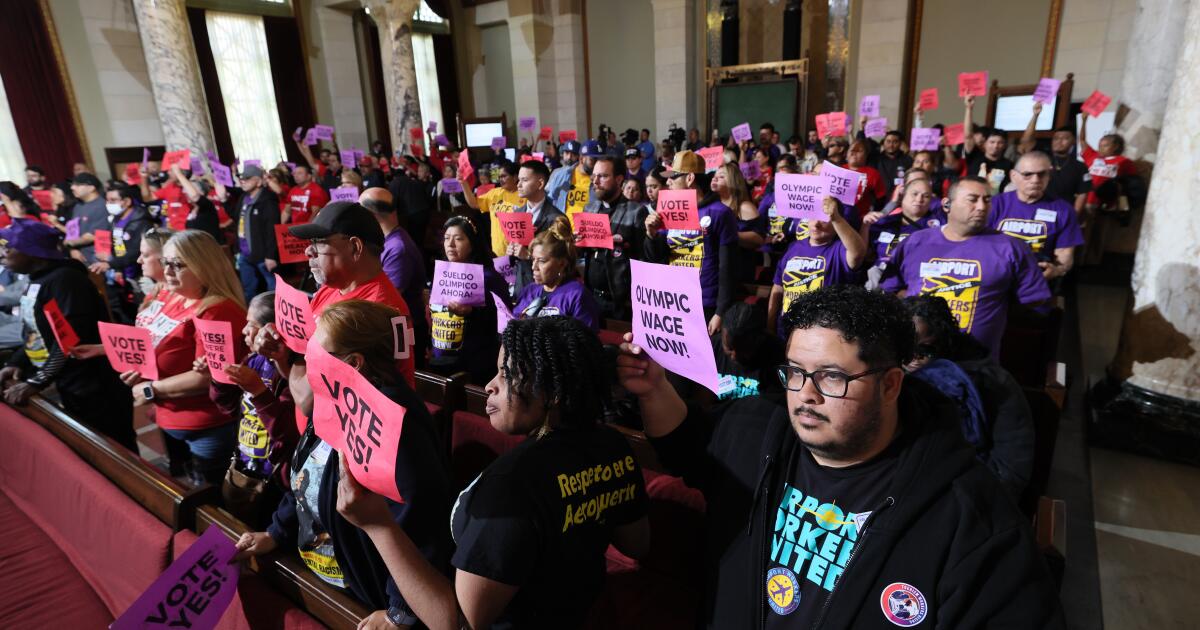
A $30 minimum wage for hotel and airport workers will be delayed after Los Angeles elected officials persuaded a group of business leaders to drop a ballot measure that would have devastated the city budget.
On Tuesday, the City Council approved the 18-month delay, which will postpone the wage increase until after the 2028 Olympics and fend off the business-backed initiative to eliminate the gross receipts tax, which is the city’s second-largest revenue stream.
The minimum wage will still increase to $25 in July and continue in increments until reaching $30 in January 2030.
Because the 11 to 4 vote was not unanimous, the new pay schedule will head to a second vote next week. Councilmembers Eunisses Hernandez, Ysabel Jurado, Nithya Raman and Hugo Soto-Martínez cast the “no” votes.
In May 2025, the council approved a proposal that would have increased the minimum wage to $30 in July 2028 and also raised an hourly payment for healthcare coverage.
In response, a coalition of airline and hotel businesses gathered enough signatures to place a measure on the Nov. 3 ballot that took aim at the city’s gross receipts tax, which is imposed on a vast array of businesses, including entertainment companies, child-care providers, law firms, accountants, healthcare businesses, nightclubs and many others.
If approved by voters, the measure would have stripped $740 million from the city’s general fund over the first year, according to city officials, and over five years would have amounted to a $860 million loss annually on average.
City officials, hotel and airport businesses and labor unions had been in continuous negotiations since last Wednesday, when the council narrowly approved an initial postponement of the wage increase to allow time to reach an agreement. The business coalition agreed to withdraw the measure if the council permanently approved the delay.
In addition to delaying the $30 minimum wage, the council on Tuesday pushed back the hourly healthcare payment to start at $8.15 an hour for airport workers in July 2027 and $4.25 for hotel workers July 1 of this year.
The council also voted to set up a committee to study possible changes to the business tax structure.
“Imposing wages and benefits without bringing business to the table is not reasonable,” said Nella McOsker, president and CEO of the downtown business group Central City Assn., at the council meeting. “It is reasonable to ask us to partner together to be on the other side of the table and negotiate, but it is not OK to do so without that process.”
Kurt Petersen, president of Unite Here Local 11, which represents the hotel workers, accused city officials of giving “into blackmail.”
“They now have a playbook. The next time workers win something, they’ll threaten to blow up the city,” Petersen said of the business coalition. “It’s a bad day for workers.”
Council President Marqueece Harris-Dawson described the process as painful but nearing a conclusion.
“I think we walked away from the negotiating table, like many negotiating tables, where no one was happy about the outcome, but everybody came away better than when we started off,” he said.
Shortly before the council vote, Mayor Karen Bass issued a statement that said she was called in by both business and labor leaders to close the deal.
She called the proposed repeal of the gross receipts tax “an existential threat to the city budget and the services it supports,” including street repairs, public safety and efforts to clean the city.
“This agreement ensures workers are paid fairly and that businesses that create jobs can continue serving LA and hiring Angelenos,” Bass said.
On Tuesday, the council chamber was filled with union workers in red, purple and yellow shirts.
Laura Esquivel, a janitor at Los Angeles International Airport, expressed frustration that council members were not standing by their earlier commitment.
“We’re sick and tired of being exploited. Some members of the council that are here, now we know, do not stand with workers,” Esquivel said. “We are not giving up, we will continue to fight and we’ll be back here in 2028.”
Before voting against the delay, Soto-Martínez, a former Unite Here organizer, called it sad and enraging.
“I cannot support anything that is going to take away money from workers,” he said.
Councilmember Imelda Padilla, who spoke in Spanish, was critical of the way the negotiations unfolded.
“If this thing about the gross tax receipts passes, we don’t have a city,” Padilla said. “The business community has us by our necks.”
She said workers deserve the wage increase, though she voted for the delay.
“Next time, let’s negotiate, and let’s negotiate well,” she said.
Times staff writer Suhauna Hussain contributed to this report.
Choi Seung-ho, head of Samsung Electronics Co.’s largest labor union, meets the press at a district court in Suwon, South Korea, 13 May 2026. He spoke after attending a court session over an injunction request sought by Samsung to prevent the union from launching a planned strike. Photo by YONHAP / EPA
May 17 (Asia Today) — Samsung Electronics management and labor representatives will return to the negotiating table Sunday for what industry officials describe as a critical final attempt to avoid a large-scale strike.
The talks are scheduled to take place Monday at South Korea’s Central Labor Relations Commission in Sejong, three days before the union’s planned walkout.
The negotiations come after talks collapsed Tuesday over disagreements surrounding the company’s bonus system.
Union officials have demanded that Samsung institutionalize a performance bonus formula based on 15% of operating profit and remove bonus caps. Management and labor have struggled to narrow differences over how bonuses should be calculated and disclosed.
The dispute has drawn national attention because of Samsung’s central role in South Korea’s economy and semiconductor industry.
Samsung Chairman Lee Jae-yong publicly called for renewed dialogue Friday while returning from an overseas business trip.
“We are one body, one family,” Lee said in a message to employees and union members. “This is the time to wisely combine our strength and move in the same direction.”
The union had previously insisted it would not resume talks before launching the strike, but changed course after Lee’s appeal and calls from the government for continued negotiations.
Samsung also replaced its lead management negotiator at the union’s request.
According to labor officials, the new representative, Yeo Myung-gu, head of the Device Solutions division’s people team, recently met with union leaders and urged cooperation for labor-management coexistence.
Business groups say both sides may need to compromise to prevent further disruption.
Industry officials say Samsung could improve transparency by more clearly disclosing how bonuses are calculated and funded, while the union may need to consider alternatives short of tying bonuses directly to operating profit.
One business official said the union’s demand reflects broader distrust over the transparency and predictability of Samsung’s current compensation system.
“If management can present an alternative that improves transparency and predictability, the union may need to remain open to compromise,” the official said.
Financial sector jobs grew in April, but a record wage gap challenges the industry’s recovery.
There might be a light at the end of the tunnel for job safety in commercial banking — or it could be the light of an oncoming train.
After more than 12 months of continuous job losses, commercial banks may be turning the corner. The ADP National Employment report for April 2026 noted that the financial activities sector grew by 9,000 positions, 5,000 more than the previous month.
The sector added the fourth-most jobs, behind education and health services (61,000); trade, transportation, and utilities (25,000); and construction (10,000). Only professional and business services saw a decline, with 8,000 jobs lost in April.
Meanwhile, the Bureau of Labor Statistics (BLS) is both more bullish and bearish compared to the ADP findings. The BLS calculated that the economy added 115,000 non-farm payroll jobs in April, while ADP saw private sector employment increase by 109,000 jobs, based on the anonymized weekly payroll data of more than 26 million private-sector employees.
On the other hand, BLS noted that employment in financial activities “showed little change over the month.”
AI Warning
The slight upswing seen by ADP could be a reversal of monthly job losses in commercial banking from February 2025, according to research by KBRA Financial Intelligence (KFI). But there’s a catch.
“Recent declines have been markedly narrower than those recorded in 2023 and 2024, suggesting that a consolidation of the commercial banking workforce could be slowing, but the ongoing implementation of AI within the industry could continue to shrink headcount at some banks,” according to a KFI Insight report.
Growth Spurt
So, where’s the greatest job growth? At the smallest and largest organizations.
The micro/small (1-19 employees) and large enterprises (more than 500 employees) led in job growth, with 43,000 and 42,000 positions, respectively. Only companies at the upper end of the mid-sized enterprise range (250-499 employees) cut, jettisoning 3,000 jobs in April.
“Small and large employers are hiring, but we’re seeing softness in the middle,” said Dr. Nela Richardson, chief economist at ADP. “Large companies have resources to deploy, and small ones are the most nimble, both important advantages in a complex labor environment.”
Wage Worries
It’s not all good news. According to Bank of America Institute, which bases its numbers on aggregated and anonymized bank transaction data, unemployment payments continued to slow, but a large K-shape in wage growth continued into April.
“In April, higher-income households saw their after-tax wage growth rise to 6.0% year-on-year (YoY) — the highest rate we’ve observed since August 2021,” wrote the authors of the April 2026 Employment Report from the Institute.
“In fact, even within this cohort, there is a divergence, with after-tax wage growth for the highest 5% of households by income stronger than that of the rest of the higher-income cohort,” the authors noted.
“Middle- and lower-income households also saw increases in their after-tax wage growth in April, to 2.3% YoY and 1.5% YoY, respectively,” the researchers found. “But the gap between these cohorts and higher-income households remains at its widest level since our data series began in 2015.”
The International Alliance of Theatrical Stage Employees is striking against “CoComelon: The Melon Patch” in protest over wages and working conditions.
The union representing crew members working on the live-action YouTube series said the workers are being overworked and that the production is understaffed.
The crew, which consists of 22 workers, recently signed cards seeking the International Alliance of Theatrical Stage Employees, or IATSE, to represent them in collective bargaining. The production’s management refused to bargain, according to the workers.
“The crew on this project experienced firsthand what working conditions can be like on a non-union production and organized for fair wages and industry-standard benefits after they started the second season,” IATSE said in a statement to The Times.
The strike began on Wednesday, halfway through the series’ shoot. The workers are currently picketing outside the Stage This studio in Sun Valley.
Moonbug Entertainment, the company behind the “CoComelon” franchise, declined to comment on the matter.
Several previous “CoComelon” productions have successfully been unionized and covered by IATSE’s contract, including the Netflix series.
Chris Roberts worked as an art director on the first season, but says he was initially offered a lower rate for season two. Though the project is non-union, he said it’s ironic to have to picket a company that makes kids’ content, as he’s unable to support his own family.
“It’s a little disheartening to be offered less money than we were paid in the first season and then have less staff, a heavier workload, and not be able to provide for my kids,” said Roberts, who has been a member of IATSE since 2016.
Samsung Electronics union members hold a large banner during a protest outside the company’s semiconductor plant in Pyeongtaek, South Korea, 23 April 2026. The union has announced plans to launch an 18-day general strike from 21 May to 07 June, which could result in losses for the company of up to 30 trillion won (US $20.3 billion). Photo by HAN MYUNG-GU / EPA
May 4 (Asia Today) — A rift among Samsung Electronics labor unions is widening after a union representing many workers in the company’s device business withdrew from a joint wage negotiation front.
Industry officials said Monday that Samsung Electronics Union Donghaeng, led mainly by workers in the Device eXperience division, sent an official letter to two other unions announcing its withdrawal from the 2026 joint wage bargaining group.
The unions had formed a joint bargaining team in November for wage and collective agreement talks. After negotiations with management stalled, they reorganized the group as a joint struggle headquarters.
The Donghaeng union said it decided to break away because of failed communication and damaged trust among the unions.
“Even when we proposed agenda items for the rights and interests of all union members rather than a specific department, the two unions showed no response or willingness to discuss them,” the union said in the letter.
The union also said it had repeatedly been disparaged and labeled a “company-friendly union,” making it impossible to maintain a cooperative bargaining relationship.
The Donghaeng union has about 2,300 members, with about 70% from the Device eXperience division, which oversees Samsung’s TV, home appliance and smartphone businesses. The union plans to notify management Wednesday of its withdrawal and request separate negotiations.
It also plans to pursue independent activities, including sending letters to executives and staging one-person protests.
The split is expected to deepen tensions among Samsung Electronics unions. Internal criticism has grown that the Samsung Electronics branch of the Super-Enterprise Labor Union, which recently became the company’s majority union, has focused too heavily on performance bonus demands for the Device Solutions division, Samsung’s semiconductor business.
Membership in the Super-Enterprise Labor Union branch has fallen from more than 76,000 to the 74,000 range, and some employees have called for a new union representing only Device eXperience workers.
The joint struggle headquarters, now without the Donghaeng union, still plans to begin procedures for a full strike May 21. Participation by Donghaeng union members is expected to be decided individually.