China’s Cargo Drones Keep Getting Bigger With New W8000
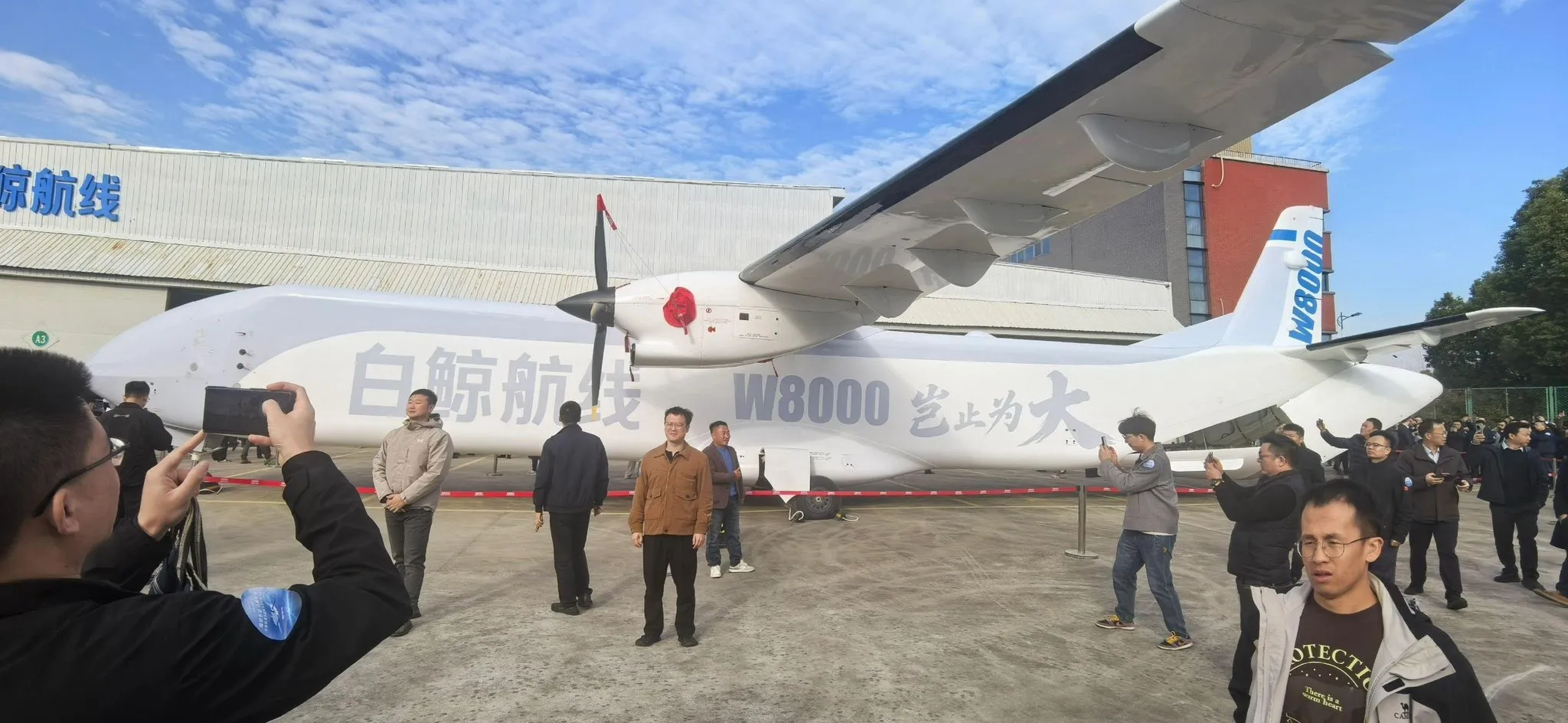
China’s ambitions to field increasingly large, uncrewed cargo aircraft are growing, with Air White Whale unveiling its W8000, a cargo UAV reportedly designed to carry up to eight metric tons — a little less than 18,000 pounds. The aircraft represents a significant expansion of the company’s plans for autonomous freight aviation, coming just as its smaller W5000 has begun flight testing.


The W8000 appeared in Zhuhai, ahead of the China International Aviation & Aerospace Exhibition, commonly known as Airshow China. Before that event opens its doors on December 7, we have gotten an early look at a platform intended to push uncrewed cargo capacity into a class now limited to conventional, crewed transport aircraft. Its reported eight-ton payload would put it substantially above the W5000, which is designed to carry up to five metric tons (11,000 pounds). Like the W5000, the W8000 can be loaded and unloaded via a rear ramp.

For now, however, the twin-turboprop W8000 remains a developmental concept. Its payload figure is a design target, and details about its range, maximum takeoff weight, and operational requirements are still unclear. For purposes of comparison, an eight-metric-ton payload would put the W8000 in much the same category as the DHC-5 Buffalo twin-engine turboprop STOL transport.
Regardless, the unveiling highlights Air White Whale’s ambitions to develop a family of large uncrewed cargo aircraft, targeting regional freight, remote-area logistics, and potentially military transportation missions where autonomous aircraft could offer advantages over conventional cargo operations.


An Even Bigger Uncrewed Transport
The W8000’s payload capacity would allow it to transport large equipment, palletized freight, industrial supplies, and other bulky cargo.
In a commercial context, large autonomous cargo aircraft could be particularly useful on routes where road or rail infrastructure is limited, or where conventional air transport is too expensive to operate frequently. Although eliminating onboard flight crews, the aircraft would still require maintenance personnel, ground handling, cargo-loading infrastructure, and a supporting operational network. Ultimately, the aircraft could also be cleared to operate inside controlled airspace, displacing crewed feeder cargo operations, but that use case is still some way off in the future.
Inevitably, the aircraft’s development also points toward the potential military relevance of large cargo UAVs.

The W8000 could offer the People’s Liberation Army (PLA) a substantial additional airlift option for sustaining forces operating from remote, isolated, or infrastructure-poor locations. This is particularly relevant in the Indo-Pacific, where China’s expanding network of military facilities and island outposts is already creating demand for frequent resupply flights. In the South China Sea, for example, large cargo UAVs could potentially transport equipment, medical supplies, spare parts, and other necessities to remote installations without requiring a crewed transport aircraft for every mission. They could also support operations in western China, including remote and high-altitude regions where road infrastructure is limited and conventional air transport can face additional challenges.
There are also potential applications in a conflict, where conventional logistics infrastructure could be damaged or otherwise unavailable. Uncrewed transports would remove the risk to aircrews during routine resupply missions through contested airspace, although the aircraft themselves would remain vulnerable. They would also remove the need for combat search and rescue (CSAR) capabilities, which might be impossible to provide in at least some scenarios. Their usefulness would also depend, at least in some cases, on reliable communications, autonomous navigation, and the ability to operate without continuous access to satellite navigation.

W5000 Has Already Begun Flight Testing
The W8000’s unveiling comes as Air White Whale’s smaller W5000 has reached a significant development milestone, completing its maiden flight on November 14.
The five-ton cargo UAV reportedly conducted a roughly 30-minute test flight after taking off within approximately 600 meters (1,969 feet). During the flight, it reportedly conducted maneuvers and tested autonomous flight functions, datalink communications, propulsion, and flight-control systems before landing.
The W5000 is designed to carry up to five metric tons of cargo, with a reported maximum range of 2,600 kilometers (1,616 miles), maximum takeoff weight of 10.8 tons (21,600 pounds), and cargo compartment volume exceeding 65 cubic meters (2,295 cubic feet). The aircraft is powered by twin turboprop engines.
Chinese sources claim that Air White Whale has received 835 orders or prospective commitments from domestic logistics companies for the W5000, although the nature of those commitments and how many represent firm purchase contracts remain unclear. Commercial operations are currently planned to begin by the end of 2027, subject to further testing and certification.
The W5000’s flight provides an indication of the company’s progress toward developing large uncrewed cargo aircraft, but the W8000 is a considerably more ambitious undertaking.
Several other companies are also pursuing increasingly ambitious uncrewed transport aircraft. These include Tengden’s four-engine TB-001D Scorpion D, which first flew in October 2022 and is designed to carry up to 1.5 metric tons (3,307 pounds) of cargo, as well as the Star UAV System-developed AT200, another 1.5-ton-class cargo drone.

Other designs include the state-owned Aviation Industry Corporation of China’s HH-100, with a reported payload capacity of around 700 kilograms (1,543 pounds), and the China Aerospace Science and Technology Corporation’s CH-YH1000, designed to carry approximately one metric ton (2,205 pounds). While these aircraft vary considerably in size, configuration, and intended missions, their development highlights China’s broader push to establish uncrewed cargo aviation as a viable logistics capability.

Outside of China, there is some other notable activity in this sector.
The United States is also pursuing large uncrewed cargo aircraft for military logistics. As we reported, Textron Aviation and autonomy specialist Merlin recently unveiled the Cessna SkyCourier UX, a concept based on the twin-engine Cessna 408 SkyCourier. The proposed aircraft would use Merlin’s autonomous flight system and could carry approximately 6,000 pounds of cargo. Its designers are exploring a cockpit-less configuration with a hydraulically opening nose section for direct cargo loading, as well as kneeling landing gear and integrated loading systems to simplify operations at austere locations. With a reported range of around 900 nautical miles, the SkyCourier UX is intended to support distributed military forces, including across the Pacific, where it could move supplies between larger logistics hubs and smaller, remote operating locations.

Introducing SkyCourier UX
The U.S. Air Force has also experimented with autonomous Cessna Caravan aircraft through Joby Aviation and its former Xwing autonomy team, including logistics demonstrations across the Pacific.
Better known for land vehicles, Oshkosh Defense also recently announced a partnership with Silicon Valley startup Grid Aero, with the aim of building large military cargo drones. These would draw upon Grid Aero’s experience developing the Lifter family, an autonomous aircraft series with modular payload capacity that the company describes as a “pickup truck of the skies.” The Lifter is planned to carry somewhere between 1,000 and 8,000 pounds over a distance of approximately 1,500 miles.

While the United States is moving slower than China in this space, there is arguably an even stronger operational case for such capabilities in the U.S. military, given the expeditionary nature of a potential conflict across the vast distances of the Indo-Pacific. Sustaining forces spread across widely separated islands, remote airfields, and austere forward operating locations would place enormous demands on conventional airlift and sealift networks.
China Targets A New Class Of Cargo Aviation
Overall, the development of the W5000 and W8000 highlights China’s growing interest in cargo UAVs capable of moving freight measured in metric tons rather than kilograms. While smaller delivery drones are increasingly being explored for last-mile transportation, aircraft such as the W8000 are aimed at moving substantial loads between logistics hubs without requiring an onboard crew.
If the W8000 progresses, it could eventually offer a heavier transport option alongside the W5000, allowing Air White Whale to target different cargo requirements and routes.

For now, the W8000 points to where Air White Whale wants to take its cargo UAV program. The W5000’s flight-test program will be an important step in establishing whether the company can turn its designs into operational aircraft and start to offer a new class of uncrewed airlift.
Contact the author: thomas@thewarzone.com