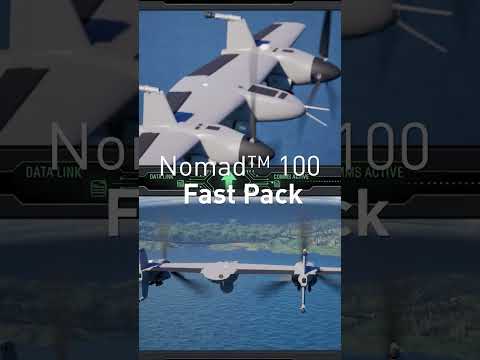
Sikorsky has unveiled a concept for a containerized deployment package for its Nomad 100 vertical takeoff and landing uncrewed aircraft system (VTOL UAS), combining four aircraft and their support equipment inside a single 20-foot shipping container. The company is pitching the Nomad 100 Fast Pack as a way to rapidly establish autonomous air capabilities at locations without runways or other conventional support infrastructure.
Meet the Nomad™ 100 Fast Pack
The concept was unveiled on October 12 at the Association of the U.S. Army’s (AUSA) main annual convention in Washington, D.C., where TWZ is in attendance. It comes as the U.S. military seeks to expand its inventory of uncrewed systems and distribute capabilities across more dispersed operating locations, particularly in preparation for a potential large-scale conflict with China in the Indo-Pacific.
Rendering of the Nomad 100 Fast Pack in action. Courtesy of Sikorsky, a Lockheed Martin company Rendering courtesy of Sikorsky, a Lockheed Martin company
“Military commanders are asking for capability that enables them to deploy worldwide into austere environments,” said Ramsey Bentley, director of Sikorsky Advanced Concepts, speaking at AUSA. They want greater situational awareness, the ability to conduct targeting and deliver effects at range, and the capacity to control multiple assets simultaneously, he added.
A rendering of soldiers preparing Nomads for launch in a typical Indo-Pacific operating environment. Sikorsky screencap
The Nomad 100 Fast Pack is built around a standard 20-foot ISO container housing four aircraft, mission-command equipment, communications, power systems, and sustainment supplies. The aim is to deliver a self-contained package that can be transported to a forward location, brought into operation, and moved again quickly. A promotional video shows the Fast Pack being transported into a combat theater by one of the company’s Black Hawk helicopters as a slung load.
Sikorsky says two Nomad 100s can be prepared for flight “out of the box” in less than 15 minutes and that the other two aircraft — stored on the upper shelf of the container — can be made available within four to six hours.
The package is designed to support runway-independent operations from locations including naval vessels, tactical vehicle staging areas, and improvised landing zones.
“We no longer require a ground control station,” explained Sikorsky Vice President and General Manager Rich Benton. “We no longer require a large group of soldiers or operators.”
Beyond the containerized package, Bentley said Nomad can be transported by truck or trailer, or potentially self-deploy in a smaller package. Sikorsky is also developing containerized deployment concepts for larger members of the Nomad family.
As we have discussed in the past, the Nomad 100 combines vertical takeoff and landing with the ability to transition to fixed-wing flight, bringing airplane-like range and endurance to a compact, runway-independent package that can operate from confined locations.
Introducing the Nomad™ Family of Rotor Blown Wing Drones
“What is very unique about this aircraft is it’s able to roll over on its wing and also fly like an airplane,” Bentley said. “So you’re getting the vertical takeoff and landing capability, along with the endurance, range, and speed of a fixed-wing aircraft.”
Sikorsky cites an endurance of 10 to 14 hours, depending on payload, a range exceeding 800 nautical miles, and a cruising speed of 70 miles per hour, with a dash speed of 90 miles per hour.
Its hybrid-electric drivetrain uses combustion engines to drive a generator that supplies power to the aircraft’s rotors and mission systems. Nomad is designed to operate on multiple fuels, including JP-8, JP-4, and Jet A.
“Ten gallons of fuel provides over 10 plus hours of operation, so it’s a very efficient system,” Bentley said. He added that the hybrid-electric design reduces maintenance requirements, emphasizing line-replaceable units over more extensive traditional aviation maintenance.
The aircraft can carry a 60-pound mission payload, including supplies such as medical equipment. Bentley said its modular center fuselage can be configured as a cargo bay or adapted for other mission equipment.
Sikorsky says the Fast Pack can support intelligence, surveillance, reconnaissance and targeting (ISR-T), light attack, and contested logistics missions, depending on customer configuration.
On display at AUSA is a Nomad configured with a forward-looking infrared (FLIR) sensor turret with laser designation capability and four small Northrop Grumman Hatchet glide munitions.
Other potential payloads include electro-optical and infrared sensors, synthetic aperture radar, launched effects, and electronic warfare systems for jamming.
A launched effect is released from a Nomad drone in an earlier Sikorsky rendering. Sikorsky screencap
The combination of a small logistical footprint and long-range flight could be particularly useful for supporting expeditionary forces. The aircraft could deliver supplies without relying on a runway or crewed helicopter, while sensor-equipped variants could provide reconnaissance and target designation. Other configurations could carry weapons or deploy additional uncrewed systems.
The Fast Pack also relies on Sikorsky’s MATRIX autonomy technology to reduce operator workload. Rather than continuously piloting each aircraft, an operator can assign a mission through a tablet-based interface and let the aircraft execute it autonomously.
A drone operator uses a tablet to control a Nomad. Sikorsky screencap
“Now, Matrix autonomy is a very mature autonomy capability. We’ve had over 1,000 flight hours on Matrix,” Bentley said.
An operator selects a mission, designates a location on a map, and initiates the flight. MATRIX then manages engine start, preflight checks, launch, navigation, and mission execution.
“For the operator, very simply, he pulls up the display. He selects a mission, say reconnaissance, and then the operator would select a point on the map where he wants that reconnaissance to occur, and then he hits start,” Bentley explained. “The aircraft Matrix autonomy takes care of everything else along the flight.”
Bentley said the system can adapt to changing environmental and tactical conditions, using onboard sensors to navigate and avoid obstacles, including hazards around landing areas.
“Our whole approach here with the advanced Matrix autonomy is: How do we take the workload off the operator?” he said. “This is not remotely piloted, although you could do that. Our approach here is that this is fully autonomous.”
Communications are designed to be network-agnostic. Bentley identified Starlink or Starshield for beyond-line-of-sight connectivity in the current configuration, alongside tactical mobile ad-hoc networking (MANET) equipment for line-of-sight communications.
MATRIX is also used in other Sikorsky autonomy efforts, including the fully uncrewed U-Hawk drone, seen in the video below, and the company’s optionally piloted Black Hawk concept. A common tablet interface could help operators manage different autonomous aircraft without needing a separate control system for each.
H-60 U-Hawk uncrewed cargo helicopter walk-around tour
Nomad 100 originated under DARPA’s EVADE program, which sought to develop a vertical-lift uncrewed aircraft capability. Bentley said two customers associated with the program had placed initial orders, with additional interest from domestic and international customers.
Sikorsky has a contract for three Nomad 100s under EVADE. The company announced in July that the first had been delivered to the customer, while a second was entering flight testing at the time of the interview. The U.S. Marine Corps is also buying two Nomad 100s, Bentley toldArmy Times.
Sikorsky is developing the larger Nomad 500, which will offer greater payload capacity, longer range, and increased power output. One Nomad 500 can fit in a 20-foot container, while three can be transported in a 40-foot container, according to Bentley. The largest member of the family, the Nomad 1000, requires a 40-foot container for a single aircraft.
A rendering shows how the Nomad family of VTOL drones can be scaled for a variety of sea- and land-based missions. Sikorsky
The Fast Pack concept reflects a broader effort to make autonomous aircraft easier to deploy and sustain as military forces disperse across larger operating areas. Its appeal lies not just in the Nomad 100’s combination of vertical takeoff and long-range flight, but in packaging multiple aircraft and their supporting equipment into a single, relocatable system. That could be especially valuable in the Indo-Pacific, where long distances, limited infrastructure, and the vulnerability of fixed operating bases pose major challenges.
Shield AI says it is on track to roll out the first prototypes of its X-BAT jet-powered stealth ‘fighter’ drone by the end of this month. Flight testing of this uncrewed aircraft, which is designed to take off and land vertically from a tail-sitting position, is still scheduled to kick off before the end of the year. X-BAT’s core concept was already highly ambitious, but an extremely aggressive timeline to reach some degree of operational capability through the U.S. Navy’s Runway Independent Maritime Expeditionary Strike (RIMES) program has now been disclosed.
TWZ got an update on X-BAT, which we were first to report on in-depth last year, in an interview yesterday with Shield AI’s Armor Harris, Senior Vice President and General Manager of the company’s aircraft division. This came ahead of today’s announcement that the company has received an additional $150 million in funding from the Office of the Under Secretary of War for Acquisition and Sustainment through its Defense Exportability Features program via the Navy. This is on top of the $50 million investment the Navy, in cooperation with the Pentagon’s Defense Innovation Unit, made in X-BAT’s development earlier this year as part of the RIMES effort. Shield AI has committed an equivalent amount of internal funding, for a combined total of $400 million.
Jamie Hunter
“In broad strokes, the last year has been a bunch of collaborative risk reduction with the Navy. So, wind tunnel testing, engine testing, thermal testing, all kinds of stuff to basically take the major risks in the program, [and] burn them down, so we can move confidently into the production design,” Shield AI’s Harris told us. “The last culmination of the risk reduction is the flight testing of the two full-scale prototypes. The first one of those will be done at the end of October.”
“That’s a full-scale vehicle,” he continued. “It’s got the outer mold line, it’s got the F110 engine, the full propulsion path, everything in it.”
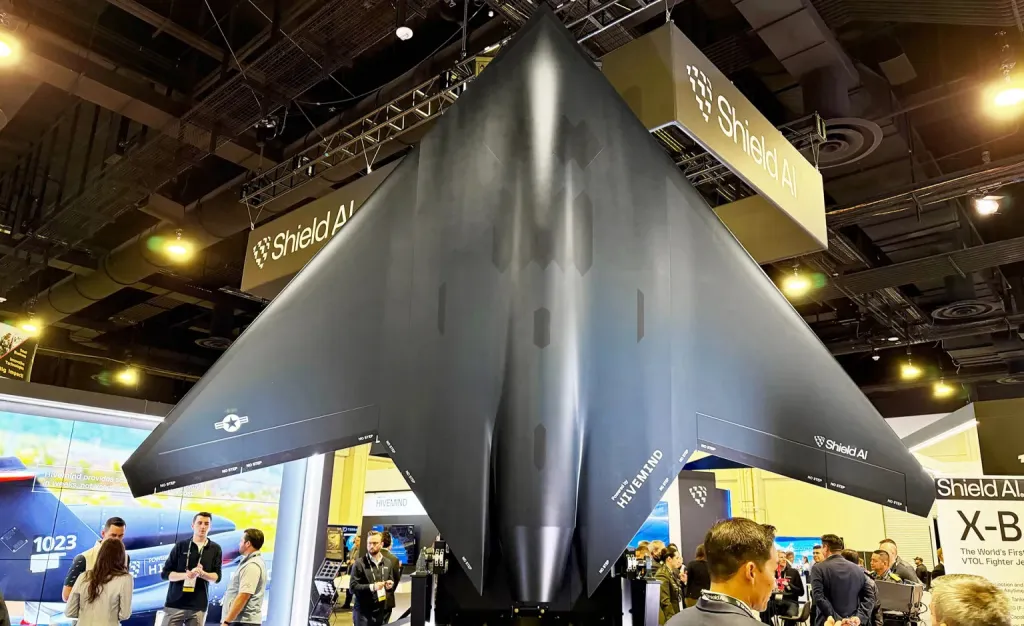
To date, Shield AI has only shown models of the X-BAT publicly. A new one displayed at the Navy League’s Sea-Air-Space 2026 exposition in April revealed major changes to the core design. This included a complete reworking of the planform from a ‘cranked kite’ type arrangement to one with a distinctly different arrowhead-shaped profile featuring a straight leading edge with a more dramatic sweep.
The video below includes clips showing the original X-BAT design and the current one.
X-BAT is on the way.
The aforementioned “propulsion path,” testing of which has already been conducted on the ground, primarily consists of the General Electric F110 paired with an Axisymmetric Vectoring Exhaust Nozzle (AVEN). The nozzle was originally developed in the 1990s for an experimental thrust-vectoring F-16 fighter. Shield AI is using the original AVEN, which had been in storage for decades, to support development of X-BAT. The nozzle will provide pitch and yaw control, with roll control for the drone coming from bleed air routed through thrusters in the drone’s wings.
No runway, no problem.
Shield AI and @GE_Aerospace just cleared a critical path to vertical flight, completing engine light-off testing of the Axisymmetric Vectoring Exhaust Nozzle (AVEN) for X-BAT.
Shield AI has previously said that the roughly fighter-sized X-BAT will have a maximum range of 2,000 nautical miles and a service ceiling of around 50,000 feet. The company has also said in the past it is targeting an effective combat radius roughly twice that of the F-35, or around 1,340 nautical miles, but also that it could be closer to 1,000 nautical miles. Space has been made within the X-BAT design for a potential in-flight refueling capability, but there is no active work yet to integrate that feature.
In terms of payload, X-BAT’s design includes internal weapons bays roughly the same size as those on the F-35, as well as two external hardpoints under the wings. Those hardpoints are plumbed, meaning that range-extending drop tanks, or even buddy refueling stores to allow the drone to act as a tanker, could be carried. Baked-in modularity and open-architecture mission systems are intended to make it easier to fit various sensors, data links, and other capabilities down the line.
A rendering highlighting X-BAT’s stores carrying capabilities. Two AGM-154 Joint Stand-Off Weapon (JSOW) glide bombs are depicted here in the internal bays. The silhouette of an AGM-158C Long Range Anti-Ship Missile (LRASM) cruise missile is shown under the wing. Shield AI
“X-BAT’s really designed to be a multi-role capability, and, if you look out at the 10-20 year time horizon, it’s hard to predict what the future fight is going to look like,” Shield AI’s Harris noted. “We fundamentally believe that multi-role capabilities are critically important. And, so, X-BAT, the reason why it’s sized to where it is is [sic] to be able to carry serious strike weapons internally and externally, in addition to being able to do air-to-air [combat], electronic warfare, and other mission sets.
“You could think of it as like X-35 versus F-35,” he also said yesterday when asked about any expectations now for further changes between the initial pair of prototypes and the final production design.
Lockheed Martin’s X-35 demonstrators are, in very broad strokes, similar to, but distinct from any of the resulting variants of the Joint Strike Fighter. Shield AI has notably already talked in the past about integrating more low-observable (stealthy) attributes to the exhaust end of the design down the line.
A side-by-side look at an X-35 demonstrator, at left, and a production F-35A, at right. USAF
“Then we’ll get into flight testing around the end of this year,” Harris added. “We’ll be doing vertical takeoff and landing testing with that [the initial prototypes] to actually prove out and develop the VTOL [vertical takeoff and landing] technology for X-BAT.”
Shield AI’s X-Forge 2 facility at the Newton City-County Airport in Kansas is set to be the main flight testing hub for X-BAT, as well as the focal point for sustainment of the drones. A production facility, X-Forge 3, is also being built in Des Moines, Washington. The company’s original site, X-Forge 1, is in Frisco, Texas.
A rendering of the X-Forge 2 facility. Shield AI
In terms of the actual flight test campaign, “you remember the X-BAT system has the air vehicle and the launch and recovery vehicle, which is the trailer that it launches and lands from,” Harris said. “Basically, the way the testing works is, we start with the vehicle horizontal, sitting on that launch and recovery vehicle, running the engine. Then we bring it up vertical, run the engine vertically, run the vehicle vertically.”
“Then we have one of the biggest cranes in the world that’s getting set up at our test site in Kansas right now, and we hang the vehicle suspended from that crane and do a bunch of testing while it’s hanging from the crane in free flight,” he continued. “Then we take the crane away, and then we do the actual untethered flights.”
Shield AI’s goal is to fly a fully missionized X-BAT in 2028 and start series production the following year.
A rendering of the X-Forge 3 production facility being built in Des Moines, Washington. Shield AI
On top of that, “the way that the [RIMES] program has been structured is getting to an early operational capability in 2029 is the end goal,” Shield AI’s Harris said.
When asked if this meant that RIMES is aiming “to eventually arrive at not just a demonstration of capability, but a real operationalized capability,” he said that was “correct.”
We will come back to this more later on, but suffice it to say up front, the prospect of X-BAT reaching an operational level of maturity within three years is extraordinarily ambitious, to say the least.
In the meantime, Shield AI has already been testing the mechanisms to “latch and unlatch” X-BAT to the launch and recovery system using an unpowered “battleship” test article, according to Harris. The design of the launch and recovery system has also evolved, and it is now self-propelled, at least to a degree, rather than just being a towed trailer.
“The launch and recovery vehicle is actually critical to the operation of the X-BAT weapon system because it enables survivability on the ground. So when you’re operating in a land-based environment, it enables basically shoot-and-scoot tactics,” Harris also noted. “Enemy transporter-erector-launchers [for missiles] are like pretty hard to find because they’re constantly moving around. Just like X-BAT, when it’s mated onto the launch and recovery vehicle, [it] is always moving around, makes it hard to track, hard to find, hard to destroy.”
A rendering of an X-BAT on a launch and recovery trailer in the fully erected position. Shield AI
The plan now is to “build the one-to-one launch and recovery vehicles to air vehicles. So the air vehicle is always on the trailer. It never comes off of it,” he continued. “Even maintenance to the air vehicle is done while it’s sitting on that launch and recovery vehicle.”
“In fact, we’re actually planning on building more than one-to-one of the launch and recovery vehicles, so that way you can preposition them around different islands, different places in the theater, and have multiple places the aircraft can lily pad from,” he added. “But you’re never putting multiple aircraft onto one launcher and launching them or something like that.”
“When you typically operate a jet, there’s a whole bunch of ground carts and stuff that you bring, like the ground power cart, the ground cooling cart, the air start cart, etc,” Harris further elaborated. “So we’ve moved a lot of those systems onto [the] launch and recovery vehicles, so you don’t have all these separate carts, which is pretty critical when you’re trying to do expeditionary operations.”
“The model for land-based operations is kind of a hub-and-spoke type model. So the squadrons are based at air bases. All the fuel and the weapons are generally based at the air bases, as well. But then you can distribute the aircraft all over the airfield,” he continued. “So, you think about what the enemy’s doing, they’re targeting the runways, they’re targeting the tarmacs, but you can disperse the aircraft around the perimeter of the airfield. You can launch them from the golf course. You can launch them from empty space in the taxiway, etc.”
A graphic highlighting various options for deploying X-BATs on land and at sea. Shield AI
Harris said that another “spoke” could be X-BATs operating from forward arming and refueling points (FARP). All of this is part of larger concepts of operations for the drone that Shield has been envisioning, and that are not at all limited to deployments at locations on land. Harris noted during the interview that the self-propelled nature of the current launch and recovery system would also help with moving the drones around on virtually any ship with sufficient deck space. This is where the RIMES program, which is separate and distinct from the U.S. Navy’s carrier-based Collaborative Combat Aircraft (CCA) drone ambitions, really comes in.
“I’ll say the fundamental value proposition of RIMES is that if you have a carrier-based CCA, you’re fundamentally constrained by the square footage of the deck of the aircraft carrier,” Harris explained. “So if you are taking an F-18 or an F-35 off, you better be replacing it with better capability per square foot of deck space than the thing that you’re taking off.”
“So, F/A-XX [the Navy’s sixth-generation carrier-based fighter, now to be built by Boeing] is a huge leap in capability, right? Which is why that program makes a lot of sense,” he continued. “The challenge with CCA is: Does it really make sense to take a manned aircraft off of an aircraft carrier and replace it with an unmanned aircraft?”
Shield AI’s argument here is that X-BAT disrupts this core equation by opening the door to a CCA-like capability, or even something more capable, that can be employed in a ship-based mode without sacrificing any crewed aircraft capacity on an aircraft carrier. Shield AI envisions dozens of X-BATs being employed from amphibious assault ships, as well as other kinds of amphibious warfare ships, including expeditionary sea base type vessels, as seen at the top of this story.
A rendering depicting X-BAT drones on the deck of the US Navy’s future America class amphibious assault ship USS Bougainville. Shield AI
“So when you think about the number of carrier air wings that the Navy has to deploy, deploying X-BAT across all these other ships basically significantly increases the number of carrier air wings,” Harris said.
As already mentioned, the current structure of the RIMES includes a target for an early operational capability in 2029, according to Harris. “We have a program defined to get there, and there’s basically milestone-based payments along the way, so as Shield performs and hits milestones, then the Navy kicks in additional funding,” he added.
“I don’t want to get ahead of the Navy, and give you a specific number, but like hundreds to low thousands,” he also said when asked if there was even a very rough planning figure for the eventual size of the RIMES drone fleet.
Many questions remain about X-BAT, which still has to demonstrate the viability of its vertical takeoff and landing capability, which underpins everything else. As we noted in our original in-depth report on this design, the core concept here is not new, and there have been many unsuccessful attempts to operationalize it in the past. There has been skepticism that Shield AI’s effort will succeed where others have failed. The company is of the view that groundwork has now been more firmly laid, including through its own work with its much smaller internal combustion-engine-powered V-BAT tail-sitting VTOL drone, to truly realize a design of this kind.
V-BAT: Deep Recce-Strike for GPS and Comms Denied Battlefields
The performance and capabilities that Shield AI expects from X-BAT once it is flying at all are also ambitious. A high degree of autonomy is also part of the full planned package, which will leverage the company’s already extensive work in this domain with its Hivemind software.
Shield AI flies Hivemind AI Pilot on 6th Aircraft
There are also questions about the Navy’s exact plans for RIMES, as well as its broader future drone fleets. Just this year, the service has issued several contracting notices pointing to rapidly evolving views about future carrier-based strike drones and other uncrewed aircraft. New requirements that Naval Air Systems Command (NAVAIR) released in August ostensibly for future CCA-type drones notably pointed more toward something that sounded very much like an advanced uncrewed combat air vehicle (UCAV), as you can read more about here.
Whether the 2029 operational timeframe the Navy is said to be aiming for under RIMES is firm, or even realistic in any way, remains to be seen. The actual definition of what constitutes an “early operational capability” could be very flexible, as well. It is also worth noting here that Shield AI is not the only company currently conducting work under RIMES. Whether the Navy might be planning to acquire more than one design through this program is unclear. We have reached out to the service for more information.
Other services could be interested in any operational capability produced through the RIMES effort, too. TWZ regularly highlights how runway-independent drones would be particularly well-suited to the U.S. Marine Corps’ new expeditionary and distributed concepts of operations. That service is already in the process of acquiring MQ-58B Valkyrie drones from Kratos that will be able to operate from conventional runways. They will also be capable of runway-independent launches, though they will still have to land conventionally. The baseline Valkyrie design lands via parachute.
A rendering of a landing gear-equipped version of the Valkyrie in line with what the Marines are now acquiring. Kratos
In general, runway independence is of growing interest elsewhere across the U.S. military as threats to large, established bases continue to expand in scale and scope. The proliferation of various tiers of weaponized drones is a particularly significant factor in this, asTWZ just examined in detail this week in the context of the recent withdrawal of B-1 bombers from RAF Fairford in the United Kingdom. Ever more capable cruise, ballistic, and hypersonic missiles are also part of the full threat picture.
The conflict with Iran has also underscored the limits of what can be gained survivability-wise by dispersing traditional fixed-wing aircraft, especially within an existing airbase. As highlighted earlier, X-BAT could be dispersed very differently to nearly anywhere within a facility that can handle the thrust from the F110 engine in hover.
As it stands now, we are set to get our first view of a full-sized X-BAT prototype within the next few weeks as Shield AI continues to gear up for the start of actual flight testing before the end of the year.