voting

S. Korea kicks off 2-day early voting for June 3 local elections

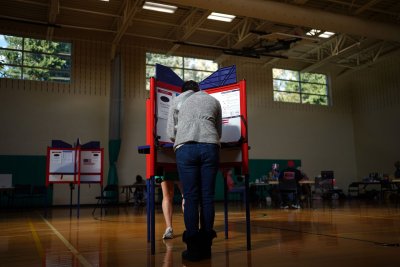
Voters cast ballots on the first day of early voting for nationwide local elections at a polling station in the Eulji Nuri Center in Seoul on Friday. Photo by Yonhap

Many South Koreans headed to the polls Friday in early voting for next week’s local elections and parliamentary by-elections, widely seen as a referendum on President Lee Jae Myung’s first year in office.

Eligible voters can cast ballots at 3,571 polling stations nationwide from 6 a.m. to 6 p.m. until Saturday, according to the National Election Commission (NEC).

As of 11 a.m., turnout for the local elections came to 3.81 percent, according to the NEC. The rate was higher than the 3.59 percent recorded at the same time on the first day of early voting for the 2022 local elections.

More than 44.6 million people are eligible to vote in this year’s local elections.

Up for grabs are 16 mayoral and gubernatorial posts, along with 227 heads of local governments and some 4,000 members of local councils.

Eyes are also on the parliamentary by-elections that will fill 14 vacant Assembly seats, with political heavyweights, such as Han Dong-hoon, former leader of the main opposition People Power Party (PPP), vying for seats.

In a poll released by the NEC last Thursday, 73.6 percent of respondents said they will definitely vote in the upcoming elections. Of them, 39.4 percent said they intended to cast ballots during the early voting period.

The upcoming elections are widely viewed as the first major nationwide vote for the Lee administration since it took office last June after former President Yoon Suk Yeol was ousted over his failed martial law bid.

Both the ruling Democratic Party (DP) and the PPP have been rallying voters to hit the polls this week, with the former urging the public to make a stern judgment on what it calls the “remnants” of Yoon’s insurrectionist forces.

Recent polls, however, indicate that races are tightening in more regions than earlier expected, despite the DP’s hopes for a landslide victory.

While the DP, which controls a majority in the National Assembly, seeks to extend the momentum for the Lee administration to push forward with its key policies, the PPP hopes to gain the footing needed to rebuild the conservative bloc amid deepening internal rifts in the aftermath of the martial law declaration.

Both parties view the capital area, where half of the country’s population resides, as a key battleground.

The Seoul mayoral election has shaped up to be a fierce two-horse race between incumbent Oh Se-hoon of the PPP and ruling party candidate Chong Won-o.

A Hankook Research poll released Monday showed Chong leading with 42 percent against Oh’s 36 percent.

Also closely watched is the parliamentary by-election in the Buk-A constituency in the southeastern city of Busan, where Ha Jung-woo, former presidential secretary for artificial intelligence policy and future planning, is competing against independent Han Dong-hoon and former PPP lawmaker Park Min-shik

Copyright (c) Yonhap News Agency prohibits its content from being redistributed or reprinted without consent, and forbids the content from being learned and used by artificial intelligence systems.

Source link

Judge refuses to block Trump order to limit mail voting

A federal judge has declined to halt President Trump’s executive order creating a federal voter list and limiting mail voting, clearing the way for potential sweeping changes in how American elections are run shortly before this year’s midterm elections.

U.S. District Judge Carl Nichols, a Trump appointee in Washington, late Wednesday rejected the request by Democrats and civil rights groups that had argued Trump’s order would likely be found unconstitutional because the states and Congress, not the president, have the power to set election rules. Nichols agreed with the Republican Trump administration’s contention that it was too early to block the order because it has yet to be implemented.

Nichols’ ruling leaves the door open for further challenges when the Trump administration moves to implement the president’s directive. A separate lawsuit seeking to block the executive order is underway in Boston. No matter how rapidly the administration acts, no voting changes are expected during primary elections, which continue into next month.

“The Court recognizes that the Postal Service may ultimately issue a final rule that directly affects Plaintiffs or their members, or that the Government may develop State Citizenship Lists that omit specific individuals due to particularized flaws,” Nichols wrote. “Plaintiffs may, of course, renew their motions if and when those future actions occur. Until then, however, Plaintiffs cannot show that preliminary injunctive relief is warranted.”

The Trump administration has yet to formally issue lists of eligible voters, and those who filed the initial request for a temporary halt said they’d be back if the administration moves in that direction.

“We are ready to resume the fight if and when the administration takes those next steps,” said Juan Proaño, chief executive officer of the League of United Latin American Citizens, one of the organizations that sought the stay from Nichols.

Trump issued the order in March after a bill he supported to overhaul voting stalled in Congress. The order would have had the federal government create a list of eligible voters and then directed the U.S. Postal Service to deliver mail ballots only to those on the list. Election officials argued it was ripe for abuse and could cause chaos, and the postal union has objected to the idea of mail carriers policing ballots.

Since his 2020 presidential election loss to Democrat Joe Biden, Trump has groundlessly claimed mail voting is rife with fraud and has launched a federal investigation into that year’s vote, even though repeated audits and investigations, including ones run by Republicans, found it was free of widespread fraud. Trump also has said he wants to “take over” election administration in Democratic areas.

Democrats and civil rights groups argued it was urgent that Nichols issue a restraining order in the midst of primary season and with states already gearing up for the fall midterm elections.

This was Trump’s second executive order seeking to overhaul elections and voting. His initial election executive order, issued just months after he took office in his second term, has been blocked by multiplefederal judges. That order sought to require documentary proof of citizenship to register to vote, among other changes.

Riccardi writes for the Associated Press.

Source link

Voting: Beating up Smarty Pants

Ross G. Brown is a television and screenwriter who lives in Westlake Village

Everything I need to know about the current presidential election, I learned in fourth grade. Back then, I was the smartest kid in my class. I knew it, and I wanted everyone else to know it too. Math, science, history–I had all the answers. The minute the teacher asked a question, my hand flew up and I panted, “Oooh, oooh, I know, I know.”

I was not very popular with my classmates. In fact, I got beat up a lot after school. I suspect Al Gore did too.

As I watched Gore during the debates, I saw a bright, hard-working, dedicated guy with an impressive command of the pertinent information and an astounding ability to synthesize this knowledge into concrete proposals on domestic and foreign affairs. Unfortunately, I also saw myself in grade school–too smart for my own good.

Gore studied hard and was thoroughly prepared for the televised civics and government quizzes each debate provided. A teacher might have given him an A. But much of the rest of the class just wanted to punch Mr. Smarty Pants in the nose.

The rap on George W. Bush is that he doesn’t know what he’s talking about, that he offers only vague generalities and sound-bite platitudes. This may be so, but I learned an important life lesson at the hands of several of my beefier, if intellectually less gifted, fourth-grade classmates: People may poke fun at a Know-Nothing, but they can’t stand a Know-It-All.

I’m a liberal Democrat and I’m voting for Gore. I thought Gore “won” the debates, meaning I found his arguments far more detailed and persuasive.

But the vast majority of people who vote based on issues, such as taxes, education and abortion, chose sides long ago. The election is now in the hands of others, those who put off doing their homework until the last minute. These folks don’t evaluate candidates in a purely analytical fashion. They don’t grade on a point system. It’s strictly pass/fail, based on gut reaction, and the plain truth is Gore fails with too many of these voters. For them, his superior intellect isn’t an asset, it’s an irritant. He just rubs them the wrong way. They may not beat him up, but they surely won’t vote for him, and that means trouble for Gore when the final exam comes on Nov. 7.

The intellectual part of me cries out, “This isn’t fair.” I want the principal to step in and acknowledge that Al Gore is far more qualified than George W. Bush. But this is a democracy, not a meritocracy. The best and brightest student doesn’t always get to be class president. The most popular one does.

Source link

NAACP calls for boycott of Southern college sports programs over voting rights

The NAACP is calling on Black athletes and fans to boycott the athletic programs of public universities in states that are taking steps that the nation’s oldest civil rights group says are restricting Black voting rights.

Launched on Tuesday, the “Out of Bounds” campaign urges prospective Black athletes, their families, alumni and fans to “withhold athletic and financial support” from major public universities in states that “have moved to limit, weaken or erase Black voting representation.”

If Black athletes participate in the boycott, it could deplete rosters for powerhouse football and basketball programs across the Southeastern Conference and Atlantic Coast Conference.

The NAACP is among groups responding to a wave of gerrymandering in the aftermath of a Supreme Court ruling that winnowed a key provision of the Voting Rights Act of 1965.

The boycott comes as civil rights activists have mobilized across the South to protest redistricting plans by Republican state legislatures that eliminate majority-Black congressional districts after the high court’s ruling. Activists have looked for pressure points to dissuade GOP-led states from redistricting maps, including calls for mass protests and economic boycotts.

“Across the South, Black athletes have helped build some of the most profitable college athletic programs in America,” said NAACP President Derrick Johnson. Johnson noted that the programs “generate hundreds of millions of dollars in annual revenue, national television value, alumni donations, merchandising sales, ticket sales, and brand equity — much of it powered by Black football and basketball talent.”

The NAACP’s campaign calls out Alabama, Florida, Georgia, Louisiana, Mississippi, Texas and South Carolina as states to boycott, arguing that the athletic programs of those states’ flagship universities are especially reliant on Black athletic talent and should protect Black political interests.

“Black athletes should not be asked to generate wealth, prestige, and power for state institutions while those same states strip political power from Black communities,” said Johnson.

Black lawmakers themselves are also putting pressure on athletic leagues to take action against Republican-led states that may redistrict longtime Black members of Congress.

The Congressional Black Caucus on Monday sent a letter to the commissioners of the SEC and ACC athletic conferences, as well as NCAA President Charlie Baker, that its members will oppose the SCORE Act, a bill to standardize athletes’ contracting rights across the country, unless conference leaders oppose GOP-led redistricting efforts in states that include major conference members.

“The Congressional Black Caucus believes institutions that profit from Black talent and Black communities have a responsibility to stand with those communities when their fundamental rights are under attack,” the CBC said in a Monday statement. “Silence in the face of injustice is not neutrality — it is complicity.”

Brown writes for the Associated Press.
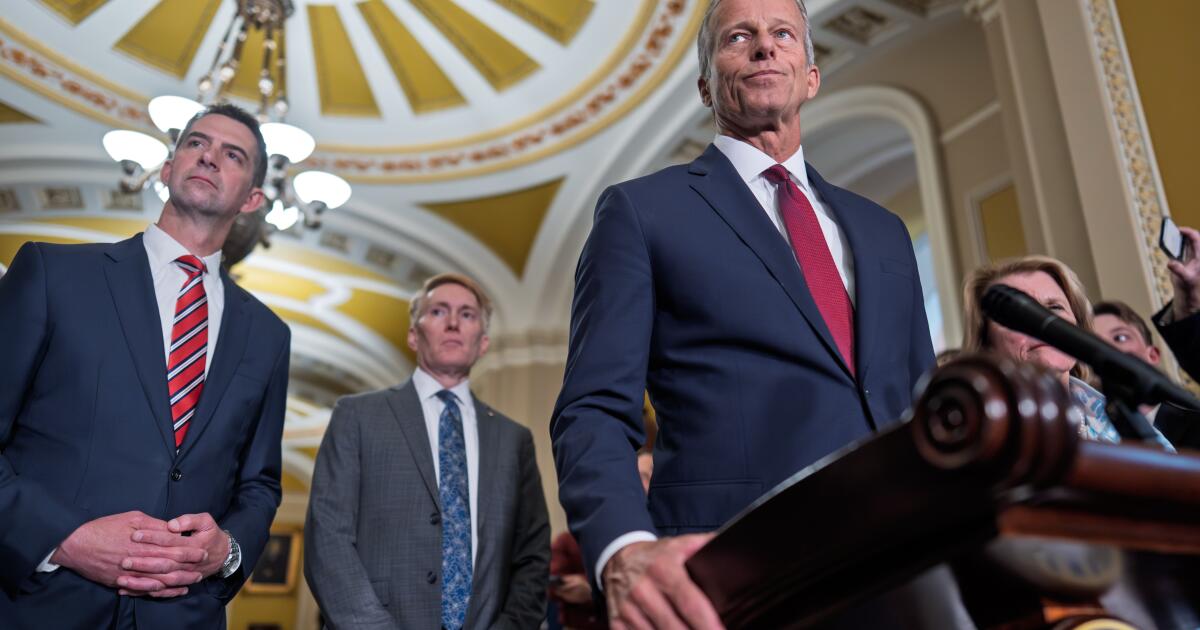
Source link

In Montgomery, thousands rally to defend voting rights

Thousands of people rallied Saturday in the cradle of the modern civil rights movement to mobilize a new voting rights era as conservative states dismantle congressional districts that helped secure Black political representation.

U.S. Sen. Cory Booker of New Jersey called Montgomery “sacred soil” in the fight for civil rights.

“If we in our generation do not now do our duty, we will lose the gains and the rights and the liberties that our ancestors afforded us,” Booker said in the Alabama capital.

The crowd was led in chants of “we won’t go back” and “we fight.”

“We are not going down without a fight. We are not going down to Jim Crow maps,” Shalela Dowdy, a plaintiff in the Alabama redistricting case said, alluding to racial gerrymandering in several states that has followed the recent Supreme Court decision to roll back the Voting Rights Act.

A crowd of thousands gathered in front of the city’s historic Alabama Capitol, where the Confederacy was formed in 1861 and where the Rev. Martin Luther King Jr. spoke in 1965 at the end of the Selma-to-Montgomery voting rights march. The stage, set in front of the Capitol, was flanked from behind by statues of Confederate President Jefferson Davis and civil rights icon Rosa Parks — dueling tributes erected nearly 90 years apart.

Speakers said the spot was once the temple of the Confederacy and transformed into holy ground of the civil rights movement.

Some in the crowd said the effort to redraw lines has echoes of the past.

“We lived through the ’60s. It takes you back. When you think that Alabama’s moving forward, it takes two steps back,” said Camellia A. Hooks, a 70-year-old Montgomery resident.

The rally began in Selma, where a violent clash between law enforcement and voting rights activists in 1965 galvanized support for passage of the Voting Rights Act. It then moved to the state Capitol, where King gave his “How Long, Not Long” speech the same year.

The Supreme Court ruling involving Louisiana hollowed out a tenet of the Voting Rights Act that was already weakened by a separate high court decision in 2013 and then narrowed further over the years. That helped clear the way for stricter voter ID laws, registration restrictions and limits on early voting and polling place changes, including in states that once needed federal pre-clearance before they could change voting laws because of their historical discrimination against Black voters.

Veterans of the civil rights movement are alarmed by the speed of the rollbacks, noting that protections won through generations of sacrifice have been weakened in little more than a decade.

Kirk Carrington, 75, was a teen in 1965 when law enforcement officers attacked marchers in Selma on what became known as Bloody Sunday. A white man on a horse wielding a stick chased Carrington through the streets on that day, he said.

“It’s really just appalling to me and all the young people that marched during the ’60s, fought hard to get voting rights, equal rights and civil rights,” Carrington said. “It’s sad that it’s continuing after 60-plus-odd years that we are still fighting for the same thing we fought for back then.”

The effect in Montgomery

Montgomery is home to one of the congressional districts that is being altered in the wake of the Supreme Court ruling.

A federal court in 2023 redrew Alabama’s 2nd Congressional District after ruling that the state intentionally diluted the voting power of Black residents, who make up about 27% of its population. The court said there should be a district where Black people are a majority or near-majority and have an opportunity to elect their candidate of choice.

But the Supreme Court cleared the way for a different map that could let the GOP reclaim the seat. While the matter remains under litigation, the state plans special primaries Aug. 11 under the new map.

Democratic Rep. Shomari Figures, who won election in the district in 2024, said the dispute is not about him but rather people’s opportunity to have representation.

“When Republicans are literally turning back the clock on what representation, what the faces of representation look like, what the opportunities, legitimate opportunities for representation look like across this country, then I think it starts to resonate with people in a little bit of a different way,” Figures said.

Alabama House Speaker Nathaniel Ledbetter, a Republican, said the Louisiana ruling provided an opportunity to revisit a map that was forced on the state by the federal court.

“People tend to forget what happened. When this thing went to court, the Republican Party had that seat, congressional seat 2,” Ledbetter said last week. “There’s been a push through the courts to try to overtake some of these red state seats, and that’s certainly what happened in that one.”

Evan Milligan, the lead plaintiff in the Alabama redistricting case, said there is grief over the dismantling of the Voting Rights Act, but it is crucial that people recommit to the fight.

“We have to accept that this is the new reality, whether we like it or not,” Milligan said. “We don’t have to accept that this will be the reality for the next 10 years or two years or forever.”

Chandler writes for the Associated Press.

Source link

Supreme Court turns away Virginia Democrats seeking to reinstate new voting map

The U.S. Supreme Court on Friday turned down an appeal from Virginia Democrats whose new voter-approved state election map was canceled by the state’s Supreme Court.

The justices made no comment, and the legal outcome came as no surprise.

The U.S. Supreme Court has no authority to review or reverse rulings by state judges interpreting their state’s constitution — unless the decision turned on federal law or the U.S. Constitution.

But the Virginia ruling came as a political shock, particularly after 3 million voters had cast ballots and narrowly approved a new election map that would favor Democrats in 10 of its 11 congressional districts.

That would have represented an increase of four seats for Democrats in the House of Representatives.

Even worse for Democrats, the court setback in Virginia came a week after the Supreme Court’s ruling in a Louisiana case had bolstered Republicans.

In a 6-3 decision, the justices reinterpreted the Voting Rights Act and freed Republican-controlled states in the South to dismantle districts that were drawn to favor Black Democrats.

In the two weeks since then, the GOP has flipped seven districts in Tennessee, Alabama, Louisiana and Florida.

The Virginia Supreme Court decision pointed to a procedural flaw which turned on the definition of an “election.”

To amend the state Constitution, Virginia lawmakers must adopt the proposal twice — once before a “general election” and a second time after the election. It is then submitted to the voters.

Last fall, Democrats proposed to amend the state Constitution to permit a mid-decade redistricting.

However, by a 4-3 vote, the state justices said the General Assembly flubbed the first approval because it took place on Oct. 31 of last year, just five days before the election.

By then, they said, about 40% of the voters had cast early ballots.

In defense of the Legislature, the state’s attorneys said the proposed amendment was approved before election day, which complies with the state Constitution.

But the majority explained “the noun ‘election’ must be distinguished from the noun phrase ‘election day’.”

It reasoned that because early voters had already cast ballots before the constitutional amendment was first adopted, the proposal was not approved before the election.

The dissenters said the election took place on “election day” and the proposal had been adopted prior to that time.

The state’s lawyers adopted that view in their appeal and argued that under federal law, the election takes place on election day.
But the Supreme Court turned away the appeal with no comment.

The result is that a state amendment that won approval twice before both houses of the Legislature and in a statewide vote was judged to have failed.

The state says it will use the current map, which had elected Democrats to the House in six districts and Republicans in five.

Source link

Supreme Court voting rights ruling fuels a new push to defend Black representation

Same fight. New generation.

That’s the mantra of a multiracial group of civil rights leaders and activists organizing opposition to a mostly white conservative alliance dismantling the Voting Rights Act and political districts that allowed Black and other nonwhite voters to choose more of their elected leaders for the last half-century.

“We have to respond as quickly as possible,” NAACP President Derrick Johnson said in an interview. “The real question,” Johnson told the Associated Press, “is how do we as a country really address the effort to shrink us backwards into a 1950s reality?”

Johnson’s 117-year-old association, which was at the forefront of legal and legislative fights for Black political rights in the 20th century, is among scores of groups coming together Saturday in Alabama for a rally and tribute to the Civil Rights Movement that helped bring about the 1965 Voting Rights Act. They plan events in Selma, where voting rights advocates were attacked by white law enforcement officers on Bloody Sunday, and Montgomery, where a rescheduled march concluded two weeks later.

Unlike 61 years ago, the Alabama events are not the pinnacle of a protracted movement. Instead, civil rights activists hope they serve as a catalyst for a renewed crusade after the U.S. Supreme Court, two weeks ago, further weakened the VRA by no longer allowing race to be considered in how congressional and other districts are drawn.

They acknowledge difficulty in countering a white-dominated conservative network entrenched in the White House, Capitol Hill, federal courts and many state legislatures of the Old Confederacy, where a majority of Black Americans still live.

The VRA “was the foundational nucleus of the Civil Rights Movement,” said Jared Evans of the Louisiana-based Power Coalition for Equity and Justice. “They’ve taken that from us,” he said, with the recent Louisiana v. Callais decision on congressional districts and the earlier Shelby v. Holder decision in 2013 that rolled back federal oversight of election procedures in states and localities with a history of discrimination.

Georgia Sen. Raphael Warnock, who is senior pastor of Atlanta’s Ebenezer Baptist Church, where the Rev. Martin Luther King Jr. once preached, said from his pulpit that the result is “Jim Crow in new clothes.”

Warnock pointed to King and the last voting rights movement. “We need political power. We need economic power. We need personal power,” he said, assuring parishioners that “your adversaries know that your voice matters” because they’re “bending over backwards” to diminish it.

Evans reached further back into history to say what must happen next.

“Our response must be and will be a second Reconstruction period,” Evans said.

Some Democrats want an answer from Congress

The ultimate goal, organizers said, is to win more elections, sway policy fights and protect diverse political representation at all levels.

U.S. Rep. Terri Sewell, a Black lawmaker who represents Selma, Alabama, said an immediate priority is to “reform and reintroduce” Democrats’ flagship voting bill, the John R. Lewis Voting Rights Act.

Sewell, whose seat ultimately could be threatened under redistricting, said Democrats want to “completely” eliminate partisan gerrymandering.

She also said the legislation would “bring back pre-clearance,” the requirement for certain federal approvals that the court struck down in Shelby.

“We need to come up with a modern-day formula for showing just how egregious the behavior of these state actors is,” Sewell said.

The Supreme Court ruled in Callais that states do not have to draw majority nonwhite districts under the Voting Rights Act and, in fact, should not consider race at all when drawing boundaries. By arguing that the law’s remedies to combat discrimination had themselves become racist, the decision allows states to redraw heavily Black districts that have historically elected Democrats while arguing that the designs are based on party interests, not race.

President Trump praised the decision as “a BIG WIN for Equal Protection under the Law, as it returns the Voting Rights Act to its Original Intent, which was to protect against intentional Racial Discrimination.”

Groups mobilized for redistricting sessions

Many of the same groups who’ll be in Alabama on Saturday have already gone to Southern statehouses, where white Republican lawmakers moved swiftly to redraw congressional districts after Callais.

Alabama and Louisiana lawmakers reverted to a single majority-Black district, each scrapping a second district that had been ordered by lower federal courts under now-reversed VRA interpretations. Tennessee lawmakers gutted a majority Black district by splitting greater Memphis into three different sprawling districts — itself an obvious racial gerrymander the court had previously forbidden, Evans said.

Anticipating the Callais outcome, Florida and Texas proceeded with redistricting before it came down. Georgia Gov. Brian Kemp, a term-limited Republican, has called a June session to redraw congressional lines for the 2028 cycle. Mississippi and South Carolina have delayed the matter for now.

South Carolina state Senate Majority Leader Shane Massey was among the few white Republicans who pushed back against GOP redistricting plans. He said that not even pressure from Trump could sell him on disenfranchising Black South Carolinians instead of doing what’s best for his state.

Other white conservatives are still talking openly about ousting Reps. Jim Clyburn and Bennie Thompson, the only Black U.S. House members from South Carolina and Mississippi, respectively.

Evans, the Louisiana activist, predicted the fight ahead won’t just be about congressional representation.

“Look for them to go after state house and state senate seats — and then it will be the local level,” he said, adding that “it’s going to be an entire erasure of Black representation.”

The issue is more than a partisan Washington fight

Heavily minority districts drawn under the VRA before Callais nearly always elect Democrats. Black Americans have overwhelmingly aligned with the party since President Lyndon B. Johnson signed the Civil Rights Act and Voting Rights Act, sparking a decades-long migration of most white Southern politicians to the Republicans. Latino and Hispanic voters still lean Democratic in most places as well.

The immediate fight shapes the midterm campaign scramble for control of the U.S. House during the final years of Trump’s presidency. Trump initially pushed Republican-run states to redistrict to protect the party’s fragile House majority.

But Johnson, the NAACP leader, said all voters should see more than partisan warfare or a regional battle over race.

Beyond party allegiance, Johnson argued, white conservatives want to curtail a range of rights “depending on how you pray, depending on who you love,” while also pushing economic policies that punish workers across racial and ethnic lines. From legislation to the confirmation of federal judges who decide constitutional questions, those policy outcomes start with election results.

“It’s not a Black problem,” Johnson said. “That’s an American problem.”

There is no singular movement or leader yet

Evans, Johnson and others acknowledged the complexity in harnessing disparate organizations and galvanizing voters on issues like redistricting and gerrymandering. But they insist the brazen nature of Republicans’ course has spurred engagement.

Johnson said he was on an organizing call in Mississippi this week that had 8,000 participants. Evans pointed to packed hallways in the state Capitols in Baton Rouge and Nashville, respectively.

The NAACP and allies have challenged new maps in multiple states, despite Callais. Many groups want to spur midterm turnout among Black voters, and others are disenchanted with white conservatives’ maneuvers in racially diverse places.

Johnson stressed the need for perseverance.

The 1954 Brown v. Board of Education decision was seismic, with a unanimous court declaring segregated public schools unconstitutional and reversing 19th-century precedents denying Black Americans’ fundamental rights.

But it took 17 years — and many more court battles — for it to be implemented in most Southern school districts. Fights over mandated student busing continued beyond the South. It was a decade after Brown before Congress and Johnson enacted the movement’s seminal laws.

There’s no clear leader of a modern movement.

Johnson said it’s worth remembering that even with King at the helm before his assassination, “there was tension around strategy” in the 1950s and 1960s.

But even “through that tension, through many episodes, we were able to get directly in the right place.”

Barrow and Brown write for the Associated Press.

Source link

Grammys 2027: When the ceremony happens, deadlines and voting dates

The 69th Grammy Awards will take place Feb. 7 at Crypto.com Arena in downtown Los Angeles, organizers said Tuesday during Disney’s annual upfront presentation to advertisers. The show will be the first to air on Disney’s ABC network (and stream on its Hulu and Disney+ platforms) since the Recording Academy ended its half-century-long partnership with Paramount’s CBS.

Nominations for the 2027 ceremony — which will recognize recordings released between Aug. 31, 2025 and Aug. 28, 2026 — are set to be announced Nov. 16. Final Grammys voting will open Dec. 10 and close Jan. 7.

A host for the show hasn’t been announced. Trevor Noah, who began hosting the Grammys in 2021, said his gig at February’s 68th ceremony would be his last.

Big winners at the 2026 Grammys included Bad Bunny, whose “Debí Tirar Más Fotos” was named album of the year; Kendrick Lamar and SZA, who won record of the year with “Luther”; Billie Eilish and her brother, Finneas O’Connell, whose “Wildflower” took song of the year; and Olivia Dean, who was named best new artist.

Among the albums and songs already thought to be in contention for high-level nods next year are Taylor Swift’s “The Life of a Showgirl,” Noah Kahan’s “The Great Divide,” Bruno Mars’ “The Romantic,” Rosalía’s “Lux,” Ella Langley’s “Choosin’ Texas” and Sienna Spiro’s “Die on This Hill.”

Source link