Israeli Prime Minister Benjamin Netanyahu has given voters an election ultimatum: Vote for him or vote for Palestine. And Israelis mark three years in the Jewish calendar since the October 7th attacks.
California voters will decide whether to establish a $7.5-billion state scientific research arm — similar to the National Institutes of Health — after Gov. Gavin Newsom signed a bill that will put the proposal on the March 2028 ballot.
The new state fund would aim to blunt federal research cuts by the Trump administration and ensure state and private institutions — including the University of California and California State University — can continue to produce scientific breakthroughs.
If voters approve the measure, $7.5 billion in bonds would fund California scientific and medical research into diseases such as cancer, Parkinson’s and ALS. Other research areas include reducing wildfire risk and fighting pandemics and climate change.
“This is a research and science bond that does the opposite of what Donald Trump is doing that will allow us to double down on what makes this state great — what makes America great,” Newsom said Wednesday during a bill signing atop the Golden Gate Bridge. “We are the tentpole of the U.S. economy because we invest in the future so that we can all do well there.”
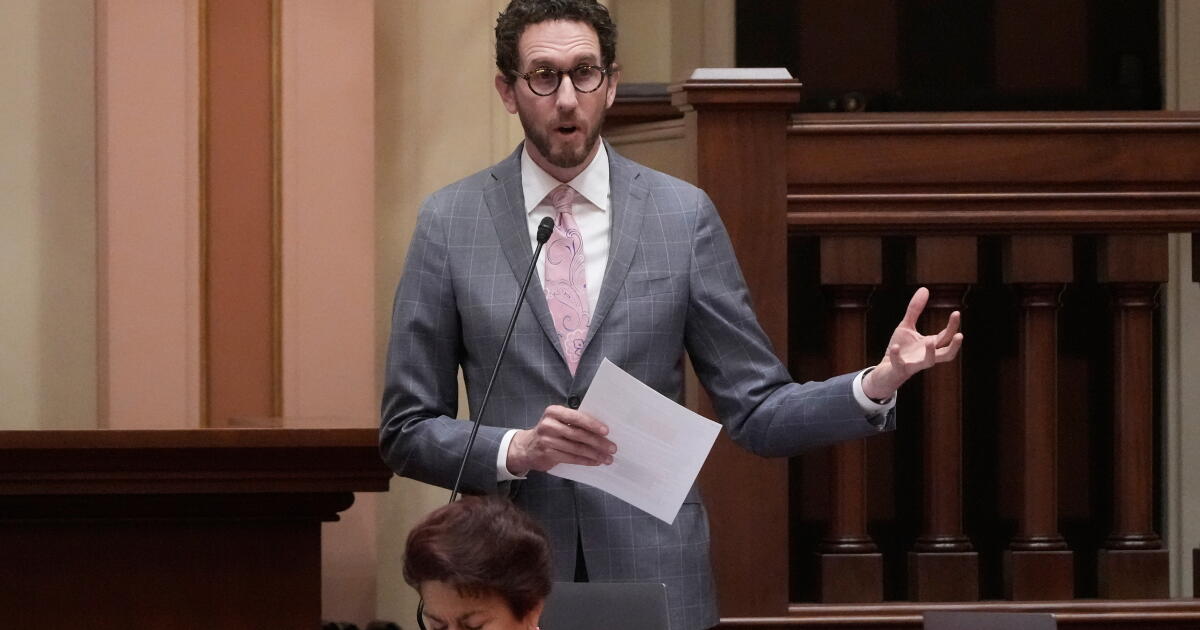
The legislation to establish the bond measure, state Senate Bill 895, was authored by Sen. Scott Wiener (D-San Francisco), who in a statement called it a “bold step to protect science, improve lives, and continue California’s global leadership on innovation for many years to come.”
The bill was sponsored by the Union of American Physicians and the University of California, as well as the United Auto Workers Local 4811, which represents some 60,000 UC academic workers.
The bond measure represents a pullback from what Wiener and supporters first proposed.
Originally conceived as a $23-billion bond measure that the Legislature would approve to go before voters in November, it was whittled down to $12 billion. But lawmakers then did not approve it in time for the November ballot.
Wiener said legislative leaders and the governor’s office then worked out a compromise, deciding on a $7.5-billion bond measure for 2028.
The measure also calls for the new state fund to establish regulations that would allow it to recoup part of its investments while not damaging innovation.
“This is a major achievement, made possible by an extraordinary coalition of people who understand the importance of investing in scientific research,” UC President James B. Milliken said in a statement.
Federal investigators have sent Los Angeles County elections officials at least five grand jury subpoenas for individual voter records as part of a criminal investigation into illegal voting, according to partially redacted records reviewed by The Times.
The subpoenas — released in response to a public records request — appear related to a nationwide effort by the Trump administration to identify noncitizens who have illegally cast ballots in U.S. elections.
The subpoenas were issued in the U.S. District Court for the Central District of California. They were sent to L.A. County Registrar-Recorder/County Clerk Dean Logan’s office at the request of prosecutors in the office of First Assistant U.S. Atty. Bill Essayli.
“The enclosed subpoena has been issued in connection with an official criminal investigation being conducted by the Department of Homeland Security, Homeland Security Investigations,” Assistant. U.S. Atty. Michael Wheat — based out of the district’s Orange County office — wrote in a letter accompanying a Sept. 10 subpoena.
Wheat wrote that a custodian of records from Logan’s office must either appear before the grand jury to present the records or deliver the materials to a special agent from Homeland Security Investigations.
Four of the subpoenas — one issued on July 13 and three on Sept. 10 — request “any and all original and non-redacted voter records” from Jan. 1, 2020, to the present for a list of individual voters stretching across two pages. The lists were redacted by Los Angeles County officials, and it is unclear how many individuals each list contained.
Each of those subpoenas notes that records to be produced include information on individual voters, such as their “registration file” and “addresses listed, history and method of voting, [and] any and all attestation regarding citizenship status.”
A fifth subpoena, issued July 31, appears to request similar information for a single voter, and notes that the voter’s “ballot content or vote selections” should not be included.
Ciaran McEvoy, a spokesman for Essayli’s office, declined to comment on the investigations Monday.
The Times first reported the existence of the subpoenas, but not details from the records themselves, last week, after Logan confirmed that his office was complying with the federal inquiry despite having concerns that investigators may be using incorrect or outdated information to produce their lists of voters to investigate.
“We’re responding appropriately as directed through a subpoena, but that doesn’t afford the dialogue for us to get the background on what they’re looking for and how they came up with the names that they did,” Logan said. “There’s really no information being provided to us on that.”
President Trump has alleged for years that illegal voting by noncitizens is widespread, though experts say the problem — which they acknowledge occurs — is exceedingly rare. Homeland Security officials have been leading a campaign in recent months to identify such fraud nationwide, and the subpoenas received by L.A. County appear to match others received by elections officials elsewhere in the country.
Essayli — a Trump loyalist who has not been confirmed to lead the Los Angeles prosecutor’s office by the U.S. Senate and whose de facto leadership has been contested in court — has been vocal about his office’s pursuit of voter fraud, including by noncitizens.
His office has announced two voter fraud cases in recent weeks, including one involving the arrest of 30-year-old Honduran national on two felony charges of falsely claiming U.S. citizenship and fraudulently registering to vote. That man, Darwin Jonathan Rivera-Flores, has pleaded not guilty and is out on bond pending trial.
Rivera-Flores and his attorney declined to comment.
The Justice Department also recently announced it had charged 16 noncitizens in six other states with illegal voting and other election-related crimes.
Homeland Security Secretary Markwayne Mullin publicly claimed in July — without providing evidence — that there may be more than 190,000 such voters on California rolls, a claim California officials dismissed as baseless.
Three of the five subpoenas received by Logan’s office ask that the voter information be shared with Al Rossi, the acting assistant head of Homeland Security Investigations in Los Angeles.
Reached by phone, Rossi referred questions to an agency spokesperson, who did not respond to a request for comment.
Wheat had asked that the subpoenas be kept secret, so as not to impede an open investigation. Logan’s office released the records in accordance with California public records law, but redacted the names of voters on the grounds that doing so “protects those individuals from undue attention, harassment, intimidation, or possible harm” and “protects the integrity” of the investigation.
The U.S. Supreme Court on Friday upheld Trump’s expanded use of government data to search for noncitizens who are registered to vote. A lower court order had blocked use of the data over concerns — shared by the Supreme Court’s liberal wing — that the data are error-prone.
Voting rights experts have expressed concern that misuse of the data could lead to legitimate voters being purged from rolls.
States across the country, including California, have successfully fought off lawsuits from the Trump administration demanding the states’ complete voter rolls.
It is unclear why a subpoena for a single voter’s information would come between subpoenas for information on longer lists of voters. But it lines up with the case against Rivera-Flores.
In an affidavit filed with a criminal complaint against Rivera-Flores, Special Agent Christopher Kuzma — the same agent listed on the July 31 subpoena requesting a single voter’s information — said he received a series of texts he believed were from Rivera-Flores, who had previously been issued a misdemeanor citation on suspicion of disrupting immigration law enforcement operations at the federal building in Camarillo.
One text sent in April 2026 stated, “Your not the good guy I can’t wait until the mid terms you dont have qualified immunity then we can start and indict all you guys one bye one.”
Kuzma said in his affidavit that he took the message to mean Rivera-Flores “has both an interest in the voting process and an intent to participate in the election process.”
According to the affidavit, Kuzma said he conducted several record checks through public databases, including on the California secretary of state’s website, which “disclosed an online voter registration record” for a “Darwin Rivera” at Rivera-Flores’ address.
In July 2026, Kuzma said in the affidavit, he reviewed records from California Secretary of State Shirley Weber’s office for “Darwin J Rivera,” which showed the applicant had checked a box stating he was a U.S. citizen.
Kuzma’s affidavit said in August 2026 he received certified voter registration records from Los Angeles County.
The spokesman for the U.S. attorney’s office did not respond to a question about whether Kuzma’s July 31 subpoena was specific to Rivera-Flores, but the office has previously said Wheat is prosecuting the case.
When Rivera-Flores’ arrest was announced, Essayli said it was “the first of many to come.”
DOTHAN, Ala. — People crowded shoulder to shoulder upstairs in a south Alabama coffee shop, in a region sometimes called the reddest in the heavily conservative state.
They were there to hear Doug Jones, the Democratic nominee for governor and the last Democrat to hold statewide office in Alabama.
“Alabama has been under Republican control for almost two decades. We’re not getting any better,” said Jeff Scroggins, 61, a government contractor from Slocomb who was part of the crowd that came to Mural City Coffee Company and said he is voting for the Democrat.
Scroggins, who usually votes Democratic, called himself the “black sheep of the family” in supporting Jones this fall against Republican U.S. Sen. Tommy Tuberville, but said there are more Democrats and “stubborn independents” in the state than people realize.
Jones and other Democrats running in Alabama and neighboring states are banking on it.
“People want change,” Jones said after an hour of talking with people who came to see him. “That is the real key. People are not satisfied with their government of Alabama.”
Democrats sense a shift among voters
Deep South Democrats, largely absent from statewide offices, are aiming for a comeback this year. They are seeking to mobilize Black voters who are angered about the Republican moves to dismantle minority congressional districts, as well as voters who are frustrated with high gas prices, the Iran war, data centers and other issues.
Jones is trying to win a rematch with Tuberville after the Republican ousted him in a 2020 Senate race. Jones would be the first Democrat since 1998 to win an Alabama governor’s race.
In Mississippi, prosecutor Scott Colom is trying to unseat Republican Cindy Hyde-Smith and become the state’s first newly elected U.S. senator since 1946. In Georgia, former Atlanta Mayor Keisha Lance Bottoms is trying to reverse a losing streak in races for governor that began for Democrats in 2002. Elsewhere, Democrats are trying to pull off U.S. Senate upsets in Louisiana and South Carolina.
In Alabama, Jones’ town halls have attracted hopeful Democrats, some independents and even a few Republicans. Their concerns mirror those of voters nationwide: the rising cost of living, worries over data centers and the affordability of healthcare, issues they say have gone unaddressed by the Republicans who control the state.
Some said state policies, including an abortion ban that makes no exemption for rape, have been too extreme. Others said some comments by Tuberville, such as calling Islam “a cult,” are embarrassing to the state.
Still, the math across the Deep South has been difficult for Democrats. Other than Jones’ victory in the special U.S. Senate election, the last Democrat holding statewide office in Alabama was defeated in 2012. Statewide Democratic candidates have hit a ceiling of around 40% of the vote in recent elections.
The results are similar in most other Deep South states. In Georgia, U.S. Sens. Raphael Warnock and Jon Ossoff, who is seeking reelection this year, offer a bright spot for Democrats.
Jones noted that Alabama saw a surge in the number of people voting in the Democratic primary. While about 58% of primary voters were Republican, the Democratic primary vote doubled since 2022. Some counties, including a tech hub in north Alabama, saw more Democratic votes than Republican.
Optimistic about their chances, Democrats are running candidates in all major state races for the first time in years.
“The numbers are there,” Jones said. “It’s a question of getting those voters out.”
Republican gerrymandering creates a backlash
In nearby Troy, a crowd gathered on the campus of Troy University to hear Jones speak alongside Shomari Figures, one of Alabama’s two Black U.S. House members. The district was substantially redrawn by Republicans after the U.S. Supreme Court earlier this year gutted the Voting Rights Act.
Figures said there is an excitement he has not felt since Jones’ 2017 Senate victory. Figures won election two years ago after a federal court ruled that Alabama had been illegally diluting the voting power of Black Alabamians and ordered new district lines. The Supreme Court’s reversal this year allowed state Republicans to reshape the district and substantially reduce the percentage of Black voters who align with Democrats.
Figures said the goal of the redraw was obvious: to reduce Black representation.
“But we are going to win it in November,” he said.
Figures has often emphasized the economic needs of the district at a time when affordability is one of the main topics of the midterms. He noted that the individual median income in Alabama is $34,000.
“Let that sink in — $34,000 before taxes, before rent, before water, before lights, before gas, before cellphone, before health insurance, before car insurance, before childcare, before food,” he said.
Alabama is one of 10 states that did not expand Medicaid under the Affordable Care Act, a decision that Jones and Figures said leaves thousands of working people without access to healthcare coverage.
Figures faces Trump-endorsed Republican Rhett Marques, a state lawmaker. Marques framed the race as “common sense” versus “craziness.” Both have raised about $1.3 million so far.
In Mississippi, Colom looks to make history
Colom echoes many of Jones’ and Figures’ arguments in his bid against Hyde-Smith.
“We’ve been gifted an opportunity,” he said, pointing to Mississippi’s large base of Black Democratic voters, Hyde-Smith’s relatively low profile in her first full Senate term and voters’ frustrations over the economy.
With the largest share of Black voters of any state, Mississippi’s general elections have been closer for years than its immediate Southern neighbors. Trump won by double digits in each of his three presidential contests, but in 2023 Republican Gov. Tate Reeves managed to win reelection by a margin of just 3 percentage points.
Colom insists he can close the gap by increasing Black turnout and peeling off enough disenchanted white voters from Republicans. It is the same kind of electoral math that propelled Ossoff and Warnock in Georgia.
“For me, it can’t be just about getting a Senate majority,” Colom said. “It’s got to be about having a party that represents rural America again, suburban America, urban America — a party that makes sure we actually deliver for voters in ways that make their lives better, and we don’t come up with excuses as to why we can’t do it.”
Republicans say they aren’t worried
Alabama’s Republican Party chairman, Scott Stadthagen, said Democratic priorities, in his opinion, “are far outside the views of conservative Alabamians.” He said there has been previous chatter of a Democratic resurgence, and “each election cycle, we remain the brightest red state in the decidedly conservative southeastern United States.”
Tuberville has declined Jones’ challenge to debate. Expressing confidence about November, Tuberville said he is running “against an ideology that’s not very compatible with the people of Alabama.” He will appear with Trump at a rally in Mobile next week.
“I’ve been representing Alabama for six years, and we’ll turn it over to the voters here in about six, seven weeks and see what they say,” Tuberville told reporters.
As the November election draws closer, Democratic candidates are attracting impressive crowds.
To Sam Phillips, who attended the rallies in Dothan and Troy, the crowds and energy felt different from previous election years.
“It doesn’t get any redder than here, and there was a whole lot of excitement in both places,” the 67-year-old said. “So I feel optimistic.”
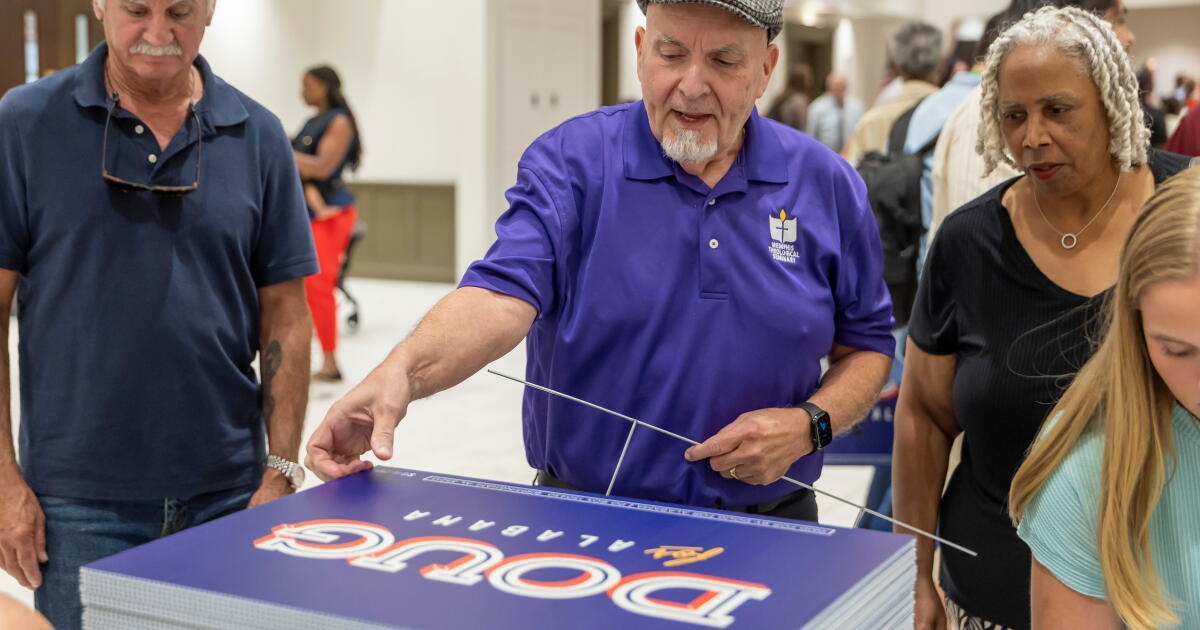
Gwendolyn Davis, a 67-year-old retired special education teacher, left the town hall in Troy with an armful of yard signs for Figures and Jones. She said she is determined to reach people who have been sitting out elections.
“If we don’t get people out to vote, it will be kind of heartbreaking,” she said.
Chandler and Barrow write for the Associated Press. Barrow reported from Atlanta.
Political polls are like weather forecasts. They’re worth passing consideration, maybe, but you’d have to be a fool to bet your house on their accuracy.
And yet there’s something that rings true about the recent poll suggesting that L.A. Mayor Karen Bass is in deep trouble among likely voters as she tries to hold on to a job that Councilmember Nithya Raman is trying to snatch away from her.
Here are the numbers, as compiled by the UC Berkeley Institute of Governmental Studies and co-sponsored by The Times:
Raman: 39%.
Bass: 28%.
Undecided: 33%.
Bass has naturally tried to debunk the poll. What else could she do, when her supporters are outnumbered by people who can’t make up their minds? Bass would need to dominate the undecided vote to have a chance, but given her high unfavorability rating, that’ll be hard to do.
On the other hand, Raman certainly hasn’t put things out of reach, despite the fact that Bass carries the baggage of the Palisades fire and has made only minimal progress on her signature issue — homelessness. Election day is less than two months away, and Raman has failed to convince anywhere near a majority that she’s the answer.
So what do Raman and Bass need to do between now and Nov. 3?
We need both candidates to be bolder, more creative, more convincing, and to tell us things we haven’t heard before.
All the recent L.A. mayors I’ve known had their faults and failures, whether the task was filling potholes, building out transit or addressing the high cost of housing. But among their best qualities, Dick Riordan was arrogantly confident, Jim Hahn had a steady hand on the tiller, Antonio Villaraigosa was tireless and passionate, Eric Garcetti was a long-range thinker on earthquakes, water and energy.
L.A. needs a mayor with all of those qualities. A cheerleader. A task master. A ball buster.
Running the second-largest city in the country is no easy task, because many of the problems at street level begin well beyond local control, related in part to an economy that leaves too many people behind.
But if you want to lead a world-class city, you need to have world-class answers on the big stuff like housing and homelessness and on the basics, too, like fractured sidewalks and neglected parks. Most voters don’t give a hoot about which candidate is more of a socialist or a moderate. City Hall is broken, and they want to know who can fix it.
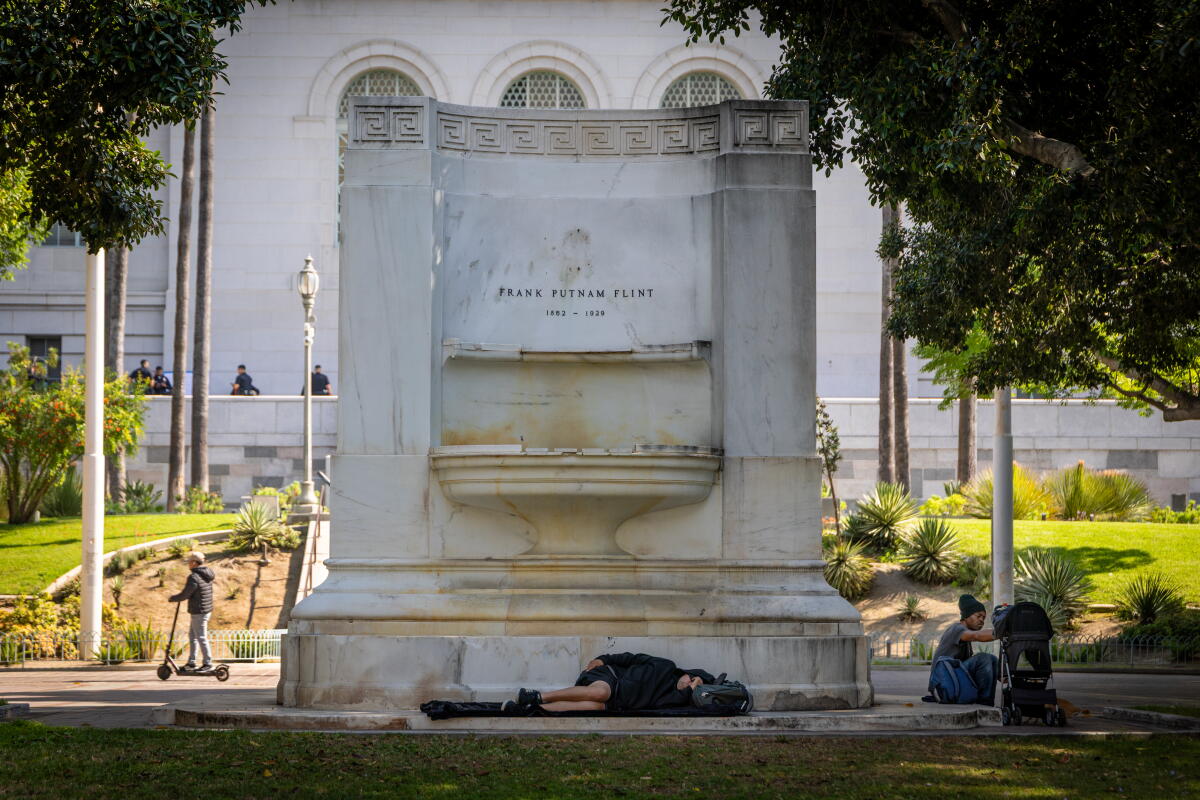
On Wednesday, I checked the same sadly neglected area around City Hall that I wrote about in April and found only minimal improvements. Graffiti has been washed from the Frank Putnam Flint fountain, but it remains a broken-down monument to neglect, as it has for most of the past 60 years. And all around it, most of the little placards identifying native plants are broken or missing.
People rest on the Frank Putnam Flint fountain outside City Hall, a sadly neglected area.
(Allen J. Schaben / Los Angeles Times)
The L.A. Mall is still a largely abandoned wreck, with broken planter boxes and weeds at street level. A woman with two shopping carts told me she’s been homeless for 5½ years. The restaurant next to the nearby police department is shuttered; the restaurant across the street from it is long dead, and the once-vibrant downtown — which generated revenue that benefited every neighborhood of the city — is gasping.
I drove down Hope Street, south of 12th Street, because a reader who lives in that area and has told me about repeated fires at abandoned properties. A tractor was clearing debris from a recent blaze.
I drove west on Olympic toward Alvarado, an area I visit regularly to see a friend. Streets are strewn with trash. They’re always strewn with trash. At Olympic and South Lake, where encampments line the street and a fire once spread into a church parking lot, destroying vehicles, there’s a concrete triangle that was heaped with trash. It’s always heaped with trash, like a municipal dump on a busy thoroughfare.
Next I headed west on Wilshire to the RFK Memorial I wrote about 10 months ago, near the site of the 1968 Bobby Kennedy assassination. It remainsfenced-off, with trash and graffitiand with overgrown vines covering tributes to Kennedy. The city was going to help the school district clean things up. Then the school district took on the task.
It’s still a mess. Actually, it’s more than that. It’s an indictment. And so is the fact that in Studio City, where frustrated neighbors complained for five years that an abandoned property had been taken over by squatters, it took a recent fire to get City Hall’s attention.
The property, since cleared, is in Raman’s district, and she and Bass traded accusations about who had dropped the ball.
“As far as homelessness goes, I don’t see either candidate really showing a clear vision to solve this,” said Kayt Miranda, whose home was damaged by the fire at the abandoned property. “I mean, it’s a tall order, and I wouldn’t want to be in charge of that. But I’m not hearing anything from either of them that sounds like it will work or hasn’t been tried already.”
To be fair, Bass and Raman have each had lots of success on homelessness, with thousands of people being brought indoors. That job is not easy, especially given the number of people with mental illness and addiction issues. I know this from personal experience, having spent a year trying to steer a friend in from homelessness.
But the pace is too slow and the cost too high. As my colleague David Zahniser reported earlier this year, $300 million had been spent on the mayor’s Inside Safe program since December 2022, and as of last December, 40% of the 5,800 people who had been housed were back on the street.
And that was with an estimated annual cost per person of $82,000. Raman, who had supported the program, became a critic of it and touted a less expensive strategy that itself has been criticized for its slow pace, as Times City Hall reporter Noah Goldberg wrote in August.
Not long ago, a homelessness policy expert suggested to me that if we could figure out a way to double the nearly $1,000 Social Security Disability subsidy many homeless people get, it would open some doors in a housing market they’re now priced out of. Too expensive? It’s cheaper than what we’re doing.
I’d like to hear the candidates rethink the playbook like that, double down on what works and drop what doesn’t.
I’d like to hear from a candidate with a realistic plan to get L.A. out of the cellar in park rankings nationally, to break up the 10-year logjam for a sidewalk repair and the two-year wait to fix a street light.
All those undecided voters know exactly what they want.
A mayor who says fix the busted fountain by the end of the week, or else.
The slate of statewide measures on the Nov. 3 ballot provides voters two opportunities to tax the rich, which in past years has proved tantalizing to California’s left-leaning electorate.
Only one of those measures has strong voter support, however, and it’s not the proposition that’s attracted nationwide attention, ignited a nearly quarter-billion-dollar political slugfest and created a rift among top leaders in the Democratic Party.
Likely voters expressed middling support for Proposition 40, a one-time 5% tax on billionaires’ assets intended to compensate for an impending $100 billion in federal healthcare funding cuts. They were far more likely to back Proposition 3, a ballot measure that would make permanent a tax increase on the wealthy that funds schools and healthcare, according to a poll released Friday by UC Berkeley’s Institute of Governmental Studies that is co-sponsored by The Times.
Proposition 3 appears to be a much less controversial endeavor, which may explain why it has more voter support. The ballot measure would extend a tax enacted in 2012 on individuals who earn at least $360,000 a year that is set to expire in 2031. Proposition 40 proposes a brand-new tax on billionaires and is opposed by Gov. Gavin Newsom, who fears that it could hurt the state’s finances in the long run.
“When you’re going about taxing the billionaires’ assets, I mean that’s something kind of new and different, and it’s risky, and the governor’s against it, and you know a lot of people are expressing caution about it,” said Mark DiCamillo, director of the poll.
Voters are deeply concerned about income disparity but also skeptical about the unusual approach of the billionaire tax.
Proposition 40 has drawn the greatest attention and campaign spending of the 14 ballot measures voters will decide on Nov. 3.
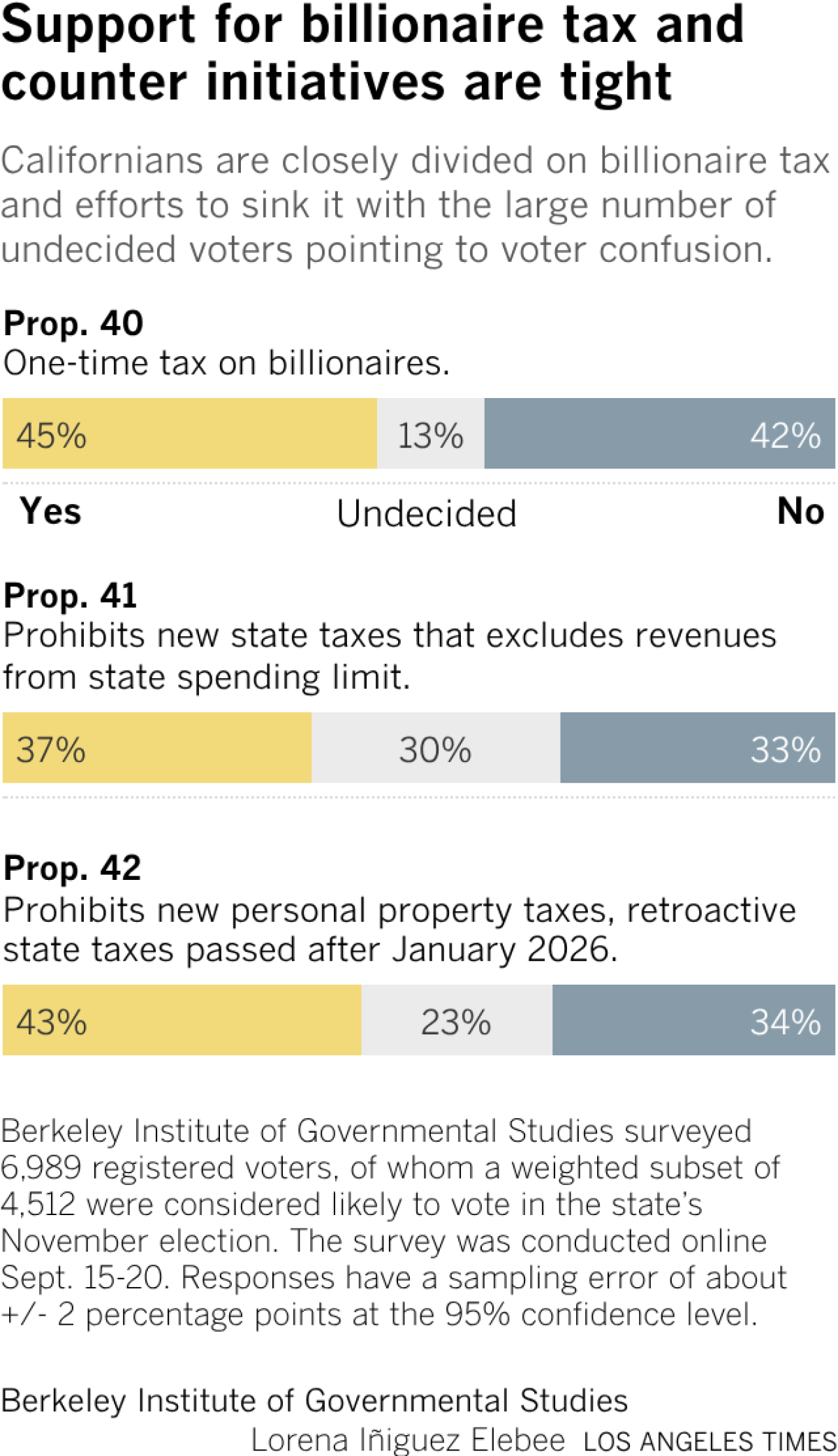
In the poll, 45% of likely voters support the proposal, while 42% oppose it and 13% are undecided. That’s a decline in support compared with six weeks ago, when 48% of likely voters supported it while 41% opposed it, and comes after nearly $100 million of spending on television ads, social media messages and mailers, largely from opponents.
The billionaire tax was crafted by a healthcare union in response to legislation passed by congressional Republicans and signed by President Trump last year that could result in millions of Californians losing Medi-Cal coverage, rural hospitals shuttering and other healthcare services being slashed unless a new funding source is found.
The proposal would retroactively apply to billionaires who lived in California as of Jan. 1, prompting some to preemptively move out of the state. Ninety percent of the revenue would fund healthcare programs, and the remaining funds would be spent on education programs and food assistance.
There are two counterproposals on the ballot that would nullify the wealth tax if either receives more votes than Proposition 40, and they have raised $144 million. Voters are torn about Proposition 41, which would prohibit any new state taxes from being excluded from a voter-approved cap that restricts how much tax revenue the state can spend each year. The billionaire tax would have such an exclusion. Voters also are divided on Proposition 42, which would prohibit new taxes on personal property, intellectual property, retirement accounts and other assets and would limit situations in which a ballot measure or state lawmakers can impose or raise taxes retroactively — both of which are essential parts of the billionaire tax initiative.
Proposition 42 has greater support, with 43% backing it, 34% opposing it and the remainder undecided, according to the poll. Even more voters were uncertain about Proposition 41: 3 in 10 said they were undecided, while 37% said they supported it and 33% said they planned to vote against it.
The large number of undecided voters this close to the election points to voters being overwhelmed by the sheer number of statewide ballot measures, DiCamillo said.
“It’s confusion,” he said, adding that many voters may make a decision once they receive more ballot information.
That said, the fact that none of these proposals has the support of more than 50% of likely voters doesn’t bode well for their prospects, DiCamillo said.
Ballots will begin arriving in the mailboxes of the state’s 23.2 million voters in days.
Democratic voters outnumber Republicans by nearly 2 to 1 in California, but the party’s leaders are deeply divided about the billionaire tax, given the volatile state budget’s reliance on the wealthy. Newsom, who is pondering a 2028 presidential campaign, and the two men vying to replace him — Democrat Xavier Becerra and Republican Steve Hilton — oppose it. Rep. Ro Khanna (D-Fremont), a potential 2028 White House contender, supports it, as does the California Democratic Party.
Additionally, Dave Regan, president of Service Employees International Union-United Healthcare Workers West and architect of the ballot measure, has come under scrutiny. Regan has been accused of threatening and intimidating women who worked for the union’s parent organization, and of physically assaulting one, according to reporting by The Times. He was also accused of trying to extort SEIU’s state council, suggesting that it could face an investigation over “governance issues” if it did not support Proposition 40, according to an investigation commissioned by SEIU.
Regan has denied these claims, describing them as a “smear” campaign orchestrated by Proposition 40 opponents.
Much less attention has been paid to Proposition 3. Californians who earn more than $360,000 now are subject to a 10.3% tax, while those who earn more than $721,000 face a 12.3% levy. The vast majority of the billions raised through this tax go to K-12 schools, while the remainder is spent on community colleges and healthcare.
The other ballot measure that is receiving national attention is Proposition 39, which would require voters to present a government-issued identification document to cast a ballot or provide a PIN or the last four digits of their Social Security number when submitting mail-in ballots.
The measure also would require the California secretary of state and county election officials to verify that registered voters are U.S. citizens by “using government data,” which according to supporters could include information in the federal Social Security Administration database, jury summons information and other government records.
The proposal comes as Trump has continued to make claims that elections, notably in California, are being rigged by Democrats. Americans are increasingly alarmed about the security and sanctity of voting, and growing fears about intimidation efforts at polling places in the midterm elections.
Fifty-two percent of likely California voters oppose the voter ID proposal, while 39% support it and 9% are undecided, according to the poll.
“It doesn’t look like it’s in a strong position,” DiCamillo said, noting that while voters have opposed it in prior polls, the opposition has grown.
Nearly one-third of voters were undecided about two other propositions:
Likely voters were evenly split about Proposition 4, which would repeal a ban on public funding of campaigns, with 35% supporting it and 35% opposing it, and the remainder undecided.
Four out of 10 likely voters opposed Proposition 43, which would increase the threshold necessary to pass local taxes from a simple majority to two-thirds, while 31% supported measure and 29% were undecided.
Voters will also face questions about environmental policy, housing, recall elections and other matters, as well as statewide, congressional and local elections. Californians are fatigued by the length of the ballot.
The Berkeley IGS/Times poll findings are based on an online survey in English and Spanish of 6,989 registered California voters, 4,512 of whom are considered likely voters, on Sept. 15-20. The results are estimated to have a margin of error of about 2 percentage points in either direction in the overall sample, and larger numbers for subgroups.
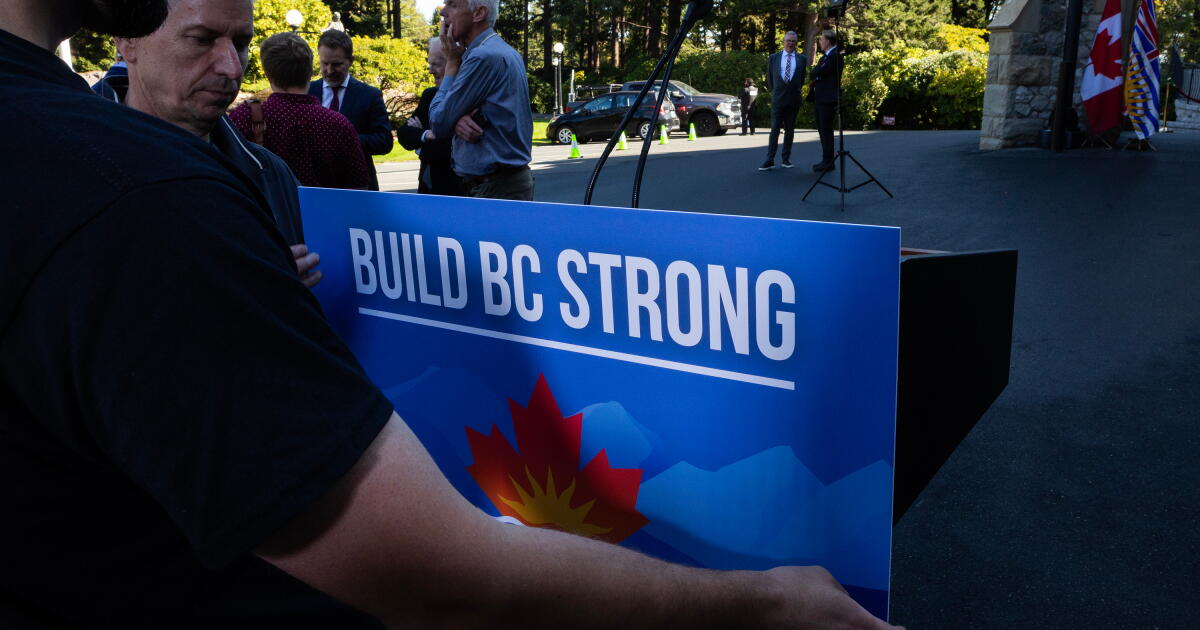
VICTORIA, British Columbia — A Canadian provincial premier called a snap election Tuesday, saying President Trump’s attacks on Canada are threatening jobs, businesses and the country’s ability to determine its own future.
The provincial election comes after U.S.-Canada trade talks broke down, deepening a dispute that has brought steep tariffs. British Columbia Premier David Eby effectively put Trump on the ballot, arguing the election offers British Columbians a choice between his government’s efforts to resist U.S. economic pressure and opponents he accused of embracing “MAGA-style politics.”
“Join us saying hell no to Trump and to his politics,” Eby said in announcing the Oct. 24 election.
Eby said Trump’s trade war and threats against Canada have changed conditions in British Columbia enough to justify an election two years early.
“Donald Trump is attacking our workers, he’s targeting our businesses, and he is threatening our sovereignty,” Eby said. “He’s threatening our ability to make decisions for ourselves.”
The left-leaning New Democratic Party leader said British Columbia needs to build a “firebreak” against Trump’s economic policies by protecting workers and businesses, reducing its dependence on the United States and finding new markets for Canadian products.
“This isn’t just a trade dispute,” Eby said. “It’s about the life that you and your family are building.”
Eby said British Columbia’s exports to the United States have fallen 4% while exports to other markets have risen 16%.
He also vowed to keep American alcohol off provincial shelves, saying “not one drop of Jack Daniels” would return until Canada gets a fair deal with the United States.
The New Democrats won a narrow majority in the 2024 provincial election, giving Eby enough seats to govern without relying on another party, and he was not required to call another election until 2028.
The election call also comes amid turmoil among the opposition British Columbia Conservatives. Kerry-Lynne Findlay resigned as party leader Sunday following a wave of defections and expulsions from her caucus. Lorne Doerkson was named interim leader.
The former vice president joins Abdul El-Sayed on the campaign trail in Detroit to bolster Democratic unity in a key swing state.
Published On 22 Sep 202622 Sep 2026
Democratic Senate candidate for the US state of Michigan Abdul El-Sayed says he wants former Vice President Kamala Harris’s campaign stop in Detroit to unify Democrats in the key swing state ahead of the final sprint to lock down a victory in November’s midterm elections.
The visit comes as the Democratic Party works to bridge deep internal factions that were glaringly evident during a hotly contested primary last month between El-Sayed and four-term Democratic congresswoman Haley Stevens, who had overwhelming support from the Democratic Party establishment and pro-Israel political action committees.
Recommended Stories
list of 3 itemsend of list
“We’re building an electoral coalition here,” El-Sayed said on Tuesday, speaking about the economy hours ahead of a planned appearance with the former vice president. He added that her presence in Michigan, “speaking to communities that were really empowered by her voice throughout her political career”, will serve to further unite and strengthen the Democratic Party.
Black voters could prove especially paramount for El-Sayed, who faces pressure among white Jewish voters who typically back Democrats. The joint appearance targets Wayne County, the state’s largest Democratic stronghold and home to Detroit’s predominantly Black electorate, which El-Sayed failed to carry during the August Democratic primary.
The move follows Harris’s 2024 electoral defeat to US President Donald Trump in Michigan, a state heavily influenced by its critical Arab-American voting bloc. As a result of her pro-Israel policies, many Arab Americans in Michigan, who had voted reliably blue for years, ditched the party altogether, refusing to support Harris in her presidential bid.
El-Sayed also issued a call for solidarity ahead of the midterms, affirming that the 2024 presidential election “ended where it did because we could not find the places of agreement to be able to bring people together or move in the direction that we need to move”, emphasising that he and Harris both want to focus on helping voters who are struggling economically.
At the time, many advocates had argued that as long as Harris maintained her pledge to continue to arm Israel and refused to distance herself from former President Joe Biden’s unconditional support for the US ally, nothing would help her standing with Arab and Muslim voters.
All eyes are on November’s consequential race where El-Sayed will go head to head with former Representative Mike Rogers, the Trump-backed Republican Senate nominee, who ran unopposed in the Republican primary.
Rogers’ campaign framed Harris’s visit as a sign of weakness for both Democrats.
El-Sayed rejected the criticism at the Detroit event, emphasising that assembling a winning coalition requires confronting past differences directly rather than avoiding them.
“We don’t have to agree on everything to understand what is at stake,” El-Sayed said, urging voters to rally around shared economic priorities. “The only way forward is by doing the hard work of bringing people into the same room and moving together.”
EDINBURG, Texas — Quinten Martinez, pumping gas under a hot south Texas sun, remembers a time when fueling up didn’t require difficult decisions.
“Is it going to be groceries this week?” said the 28-year-old Amazon delivery driver as he watched the numbers tick higher. “Is it gonna be getting gas in our tank to go to work?”
He shook his head when asked about President Trump’s assertion last week that higher gas prices are a small price to pay for the war with Iran.
“I don’t feel like it’s a good trade-off,” Martinez said. “I don’t feel like this is good for anyone.”
Voters across the country, and across the political spectrum, tend to agree.
Interviews with voters in several states, along with a fresh round of national polling, reveal an overwhelming sense of frustration that skyrocketing gas prices — a direct result of Trump’s war — are creating serious and sustained financial hardships for America’s working class.
The acute concerns are adding to a bad political environment that may be worsening for Trump and his Republican Party as early voting gets underway in the November midterm elections.
Historically, the party holding the White House has suffered major losses in midterms. About seven weeks before election day, Republican candidates at all levels are struggling with the additional burden of Trump’s weak approval ratings, an unpopular war and an affordability crisis that Trump and his congressional allies had promised to fix.
But when Trump campaigned in North Carolina on Wednesday, he played down the effect of surging gas prices.
“You have a little higher. It’s a very inexpensive price to pay for what we’ve done,” Trump said of the war, which he describes as necessary to prevent Iran from obtaining a nuclear weapon. “Remember that. It’s a little more. Frankly, even if it was a lot more.”
‘Gas prices matter’
Despite what Trump says, there are few things that may matter more this election year than the price of a gallon of gasoline, according to political operatives in both parties.
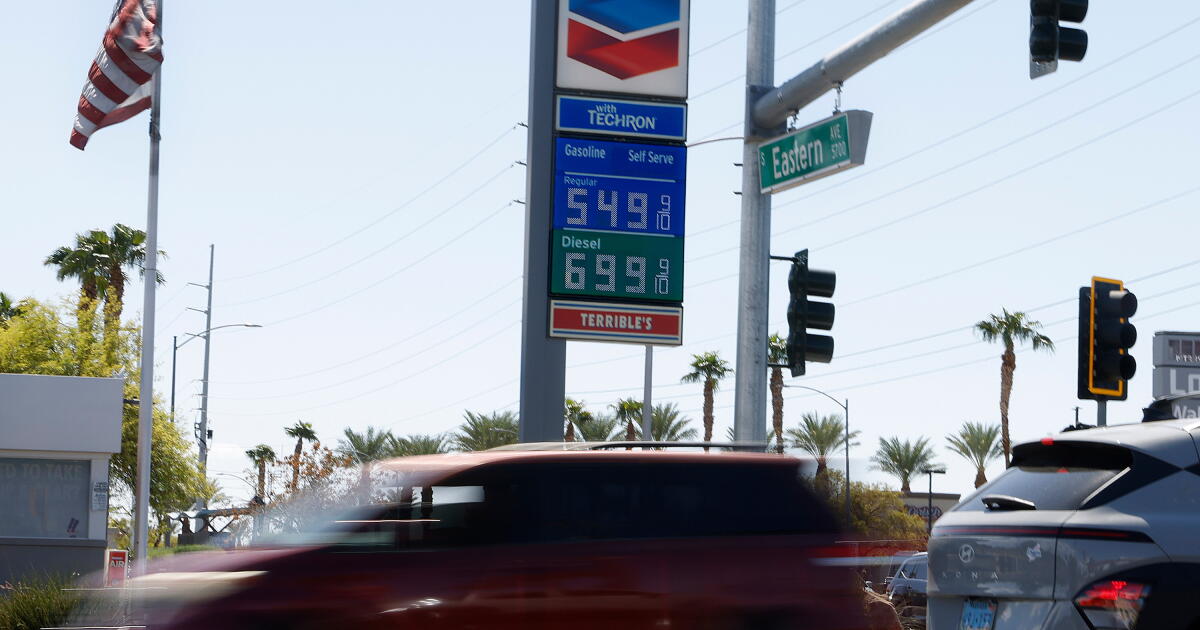
Gas prices are moving sharply in the wrong direction at a time of year when drivers typically get some relief. The national average for a gallon of gas reached $4.48 on Friday, according to the American Automobile Assn., up roughly 17 cents over the last week, 40 cents in a month and $1.27 from a year ago.
“Gas prices matter because they’re one of the few economic indicators voters experience and see in real time,” said veteran Republican strategist Chris Wilson. “The price is literally staring them in the face several times a week. So I wouldn’t minimize the frustration we’re seeing, particularly among working- and middle-class voters.”
Interviews with voters last week found bipartisan frustration and disappointment.
Democrats and unaffiliated voters were especially motivated to punish Republicans at the ballot box for their economic hardship, while some of Trump’s working-class supporters pledged to support Republicans this fall, even if they weren’t happy with the president’s leadership on the economy.
Some Republicans say they’re disappointed
Dan Lloyd, who voted for Trump, lamented the president’s leadership as the 63-year-old carpenter paid $4.39 a gallon to fill up his pickup truck in Mesa, Ariz.
“He hurt himself stepping into this,” Lloyd said of Trump. “Where’s all this oil from Venezuela? I thought we were flush with gas and everything, but no. The American people eat it every time, whether it’s interest rates, food, gasoline.”
Still, he expects to vote Republican in the midterms.
“I think the Democratic Party has lost its way,” Lloyd said. “I just feel like the whole system’s on the verge of collapse.”
In sweltering Edinburg, Texas, 52-year-old Kristin Jimenez shrugged off the rising price of gas after filling up her Mercedes.
“We’ve paid the same price under Republican presidents, we’ve paid this price under Democrat presidents,” said Jimenez, a mother who runs a small business. She plans to vote for a Republican because they’re the “lesser of two evils.”
She said gas prices aren’t part of her calculation.
“We don’t mind paying $8 for a cup of coffee at Starbucks, but we have a problem paying four bucks at the pump?” she said. “Make it make sense.”
More than 1,500 miles to the north in central Michigan, 35-year-old Garth Johnson is trying to make ends meet running a deep-cleaning business with several gas-powered vehicles and one machine fueled by diesel, which was $6.79 a gallon as he filled up his SUV.
Johnson voted for Trump, but doesn’t know what he’s going to do in November. He said he doesn’t feel qualified to second-guess the president’s evaluation of the war, but he’s feeling financial pressure in his own life.
“I like a lot of the things he’s done,” Johnson said, but added, “I’m a little guy and I’ve got to live my life.”
Other voters are less forgiving
Midterm voting was already underway Friday in Virginia, where Alan Johnson said Trump seems to have “no empathy” for Americans who are struggling financially.
“With the gas prices being what they are and continuing to grow, we’ve got to do something. Hopefully the Democrats can get into office and turn the ship around,” said the 60-year-old engineer, who cast ballots in the morning for Democrats for the U.S. Senate and House.
In Raleigh, N.C., teacher Brittney Bivins sees surging gas prices as evidence that Trump and his Republican Party aren’t dealing with the issues that matter most to people like her.
“He really doesn’t care about everyday people,” the 45-year-old said. “He can afford the gas, but most of us can’t. So it feels like he’s not even connected to his own people.”
Bivins, who described herself as an independent, said she’s eager to support Democrats this fall — especially the party’s emerging democratic socialist wing.
At a gas station in Lansing, Mich., Rina Risper spent $50 on eight gallons of premium gas.
“When I rolled up I was in shock, actually, and said, well, maybe I should drink water instead of having that $4.99 bottle of whatever it was I was gonna get,” Risper said. She thinks Trump’s tariffs will make affordability even worse.
“We’re not in Miami. We’re in Lansing, Michigan,” she said. “It’s really going to impact our people.”
Polls reflect economic distress
Nationwide, more than three times as many voters say they are falling behind financially as getting ahead, according to a Fox News survey released Wednesday. By a 15-point margin, Democrats are considered the party that would better handle inflation and prices at a time when the cost of living and the economy are voters’ top concerns.
The Fox poll found that 61% of voters say gas prices are a major problem for their household, compared with 48% two years ago, while 52% say the same for healthcare costs, compared with 44% in 2024. Majorities also view housing costs and grocery prices as major problems, although neither has increased.
Overall, nearly two-thirds of voters (63%) say the administration has made the economy worse, compared with 52% in September 2025, including one-quarter of Republicans. Only 46% of Republicans say the administration has improved the economy, while about one-quarter don’t see an impact.
Back in rural south Texas, an area where Trump’s GOP made gains in recent elections, Martinez, the Amazon delivery driver, could not contain his frustration.
Trump “likes to tout that we are the best economy in the world,” said Martinez, but in rural towns, “you don’t see any of the winning, you don’t see any of the ups that he’s talking about.”
“You just see struggles for day-to-day life,” he said.
Peoples, Bedayn and Cooper write for the Associated Press. Peoples reported from New York and Cooper from Mesa. AP writers Allen G. Breed in Raleigh, Jacqueline GaNun in Lansing, Sarah Rankin in Richmond and Nicholas Riccardi in Mason, Mich., contributed to this report.
Israeli politicians reacted to sanctions by states including the United Kingdom, France, and Canada on the country’s illegal settlements in the occupied West Bank with self-righteous anger. But what is the latest example of Israel’s international isolation brought on by its treatment of the Palestinian people has not been influential in swaying the electorate in the run-up to October’s elections, analysts tell Al Jazeera.
Responding to the UK Foreign Minister Ed Miliband’s accusation that Israelis were ethnically cleansing the occupied West Bank, Israel’s Gideon Saar accused his counterpart of spreading “outrageous lies” and attempting to interfere in the election through foreign pressure.
Recommended Stories
list of 4 itemsend of list
Israeli President Isaac Herzog also condemned the measures, branding them a “gross interference in the democratic elections” of Israel.
But, in reality, the majority of Jewish Israelis have supported their country’s genocidal war in Gaza and the occupation of the West Bank.
A poll from August, published as the death toll for Palestinians killed in the West Bank had already reached 76 this year, showed that more than half of Jewish Israelis supported retaining the illegal settlements as part of any future agreement on a Palestinian state, while nearly 40 percent supported annexing the territory in defiance of international law.
“People just don’t care that settlements are illegal,” Israeli political analyst Ori Goldberg said.
”Ed Miliband expressed a number of laudable sentiments when announcing the measures,” Goldberg said, referencing the UK foreign secretary’s references to his own Jewish heritage when announcing the cessation of trade with Israel’s illegal outposts. “But we’re at the stage where Israelis aren’t even interested in the truth so much as they are the sentiment.”
Little political impact
Israeli Prime Minister Benjamin Netanyahu goes into the elections at serious risk of losing, with many polls predicting that a coalition of parties opposed to him could win the majority in Israel’s parliament.
But it will not be issues like the settlement-related sanctions that will lose him votes, analysts said.
Public backing for the “government and opposition blocs are pretty hardened, and nobody is going to switch from one side to the other over sanctions arising from [the settlements],” Michael Koplow, chief policy officer at the Israeli Policy Forum, said. He added that the sanctions were unlikely to weigh as heavily with the electorate as “this government’s record and the related feelings people have about Netanyahu”.
“When people were asked what would determine their vote, security came first,” Israeli sociologist Yehouda Shenhav-Shahrabani said.
“I think there are several mechanisms operating simultaneously,” he added.
First, he said, is the normalisation of the settlements. In Israeli public discourse, the occupied West Bank is increasingly referred to by the biblical name “Judea and Samaria” – a shift he said was becoming institutionalised.
“Second, external sanctions don’t necessarily translate into domestic political costs,” Shenhav-Shahrabani said. “And perhaps most importantly, politically foreign pressure can be absorbed into an existing Israeli narrative [of anti-Semitism] rather than [changing how the issue itself is understood].”
No criticism of the voters
None of Israel’s most prominent politicians has criticised the government for its support of the settlements in defiance of international condemnation. Yair Lapid, a former prime minister and one of Netanyahu’s leading opponents, has, instead, focused his ire on the countries condemning Israel. “Imposing boycotts and sanctions on Israel is a grave mistake,” he said. “This is a wrong and dangerous policy, at the wrong time and for the wrong reasons.”
Another of Netanyahu’s principal rivals, Gadi Eisenkot – whose Yashar Party manifesto does not mention either the West Bank or Gaza – has declined to speak on the sanctions directly. Netanyahu has also yet to comment on the sanctions publicly, despite his Likud party having championed settlement expansion for decades.
“The sanctions haven’t particularly hurt Netanyahu, at least not as far as we can see in terms of direct influence on … polling,” said Dahlia Scheindlin, a pollster and public opinion researcher based in Tel Aviv.
Instead, the focus has been on other elements of an eventful electoral cycle, including the emergence of new challengers to Netanyahu on the right.
“We aren’t seeing any real backlash from the sanctions,” Scheindlin said. “Instead, it’s just getting filtered through what people already think of him – his critics dislike him even more, and his supporters basically say, ‘Well, the world hates us no matter what.’”
YOUNGSTOWN, Ohio — In the wood-paneled basement of a union hall, retirees sat in folding chairs last week as they recalled how miles of steel mills and plentiful jobs had slowly disappeared.
“We told our children to get your education, get out, and don’t come back,” said Al Antonelli, who has been a member of Ohio Laborers’ International Union of North America Local 125 for nearly 50 years. “Because there’s no future here, especially blue collar.”
Versions of Youngstown’s story played out across the industrial Midwest, where disappearing jobs and frustration in longtime Democratic strongholds helped fuel Donald Trump’s political rise. When Trump visited as president in 2017, he promised the jobs that had left Ohio were “all coming back.”
“Don’t sell your house,” one of the retirees recalled Trump saying during his Youngstown visit.
Nearly a decade later, the old industrial economy Trump promised to revive has not returned, and Democrats hope the political tide is shifting again. Two years after Democrat Sherrod Brown lost his Senate seat, he’s attempting a comeback by trying to win back some of the same voters who turned on his party. Brown wants to harness dissatisfaction with the economy, the war in Iran and the expansion of artificial intelligence data centers to dislodge Republican Sen. Jon Husted in November.
Brown’s chances of returning to Washington depend largely on whether he can win again in parts of the state that have spent years drifting away from Democrats. His race is also part of a much broader challenge for Democrats, who need to make inroads in Republican-leaning states like Ohio, Iowa, Alaska and Texas if they are to win control of the chamber in November.
Brown outlasted Democrats’ decline in Ohio — until he couldn’t
For years, Brown was able to outrun the Democratic Party’s decline in Ohio. His pro-labor populism resonated with enough swing voters to deliver decades of victories from the statehouse to Congress.
Trump carried Ohio by 8 points in 2016, four years after Barack Obama won it. Yet Brown won his third term in the Senate two years later, in part by continuing to perform well in places like Mahoning County, anchored by Youngstown.
By 2024, even Brown could no longer hold on, losing his reelection campaign to Republican Bernie Moreno by 3.5 percentage points.
Trump carried Mahoning by more than 10,000 votes, a remarkable reversal in a previously loyal Democratic county that Obama had won by nearly 30 percentage points just 12 years earlier. With Trump’s endorsement, Moreno won the county by just 220 votes.
The transformation extends across the Mahoning Valley. Neighboring Trumbull County went from backing Obama by 23 points in 2012 to Trump by nearly 17 points in 2024.
“The Mahoning Valley has struggled with deindustrialization, job loss for years, and the politicians in power have seemed to understand that, but it doesn’t seem like they were doing enough about that,” said Cryshanna Jackson Leftwich, a politics professor at Youngstown State University. “So at some point, 20, 30 years of supporting the candidates, people are gonna say, well, look, this has never worked for us, right?”
Trump and other Republicans offered voters something different, Leftwich said.
“Did they keep their promises? Not at all. Is the county still poor? Absolutely,” she said. “But they at least said they were going to do something different.”
Brown faces a much different environment this year
Democrats’ bid to flip the Senate requires them to net four seats, including by competing deep in Republican territory.
Two months from the end of midterm campaigns, high gas prices stemming from the war in Iran have compounded discontent with the economy.
Trump has also escalated a trade war with neighboring Canada, a fight with particular implications for Ohio. The state exported $17.5 billion in goods to Canada in 2025, or nearly a third of the state’s total exports, according to federal statistics.
Tension from the economic strain is visible in Parma, a working-class Cleveland suburb that split its ticket in 2024, backing both Trump and Brown. At a watch party for the Republican midterm convention in Dallas, supporters who stayed late into the evening cheered Trump but acknowledged that other issues would most likely determine the midterms.
“The real thing that’ll move the needle is going to be economics. Gas prices, grocery prices,” said Parma City Councilor Kevin Kussmaul. “That’s really what’s going to help.”
Parma Republican Party President Doris Peters said similarly that “everyone’s concerned about the high gas prices.”
“It’s all about the economy,” she added. “People remember how much money’s in their wallet and how much is not in their wallet.”
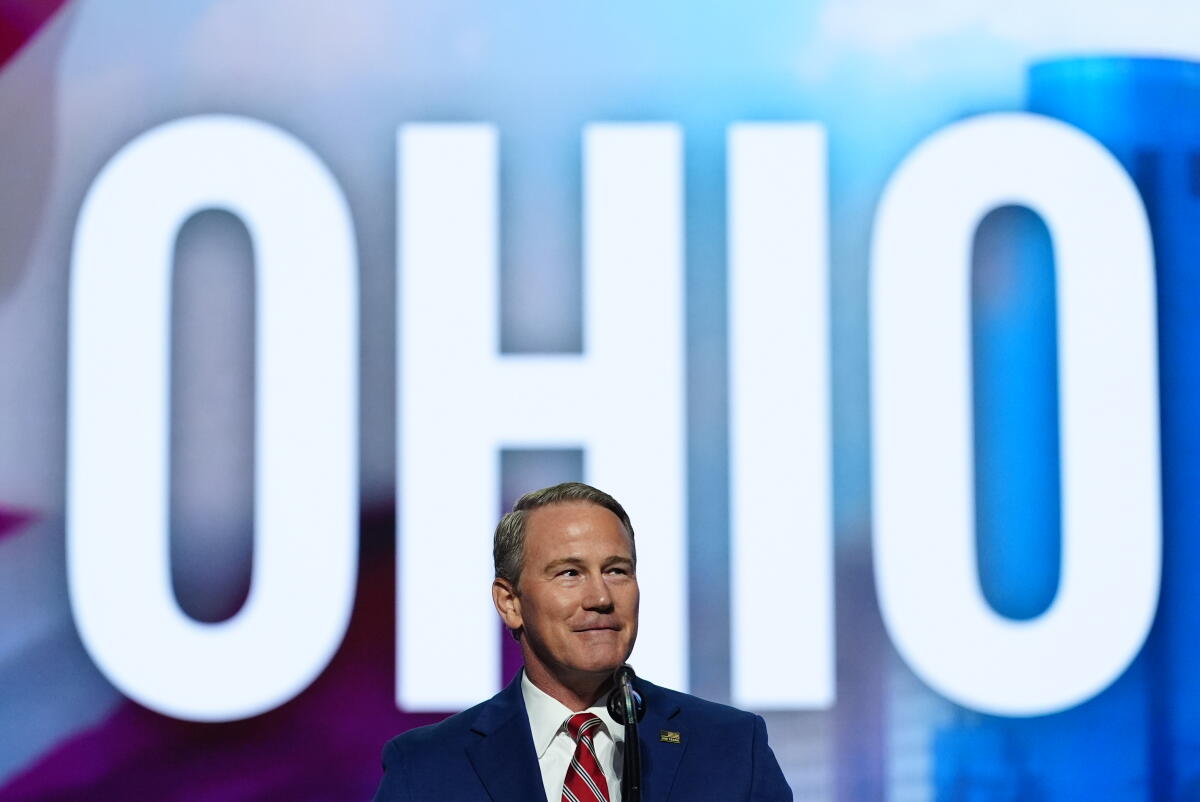
Sen. Jon Husted (R-Ohio) speaks at the Republican convention in Dallas.
(Julia Demaree Nikhinson / Ap Photo/julia Demaree Nikhinson)
The limits of a Democratic rebound in Ohio
Husted presents a different opponent than the one Brown faced two years ago. His restrained demeanor contrasts with Moreno, the brash former car dealer who entered politics as an outsider. Husted spent nearly 25 years in Ohio politics, as a state lawmaker, House speaker, secretary of state and lieutenant governor, before being tapped to fill Vance’s Senate seat.
But Husted may not need to generate much enthusiasm of his own. Except for Brown and candidates for the Ohio Supreme Court, a Democrat hasn’t won a statewide race for state office in Ohio since 2008.
Adam Radogna, 37, who hosted the watch party Wednesday for Parma Republicans at his Italian restaurant, has attended more than 80 Trump rallies and remains an ardent Trump supporter. But Husted is not someone he’s followed closely.
“I don’t know him at all,” Radogna said of Husted. “But I mean, I will vote for him.”
Brown faces enthusiasm problems of his own as he asks voters to return to a 73-year-old former senator whom they rejected just two years ago.
Ellen Zban, 67, a longtime Youngstown resident who said she leans Democratic but has voted for Republicans, said she won’t support Husted because she doesn’t believe he has listened enough to the community.
“I really don’t think he’s done anything for us,” she said. “We never hear from him.”
But Brown isn’t necessarily the candidate she wishes Democrats were offering either.
“He’s my best option,” Zban said. “But I’d like to see younger people running.”
The race is being flooded with money as both sides try to drum up enthusiasm and define the choice for voters. Husted and allied Republican groups have already spent more than $80 million with $86 million more reserved through Election Day, according to AdImpact. Brown and Democratic groups have spent $69 million, with $67 million reserved.
Elon Musk has also waded into the race through his America PAC, which is running online and streaming ads attacking Brown over transgender issues.
“Billionaires are lying to try and bail out their ‘Golden Boy’ because Jon Husted has always put special interests ahead of Ohio,” Brown’s campaign manager, Patrick Eisenhauer, said in a statement.
Brown has attempted to make data centers central to the race, an issue that has seen bipartisan outrage in communities across the country. Brown’s allies have called Husted the face of Ohio’s data center boom, blaming the massive facilities for contributing to rising electricity costs. Husted helped promote Ohio as a destination for data centers while serving as lieutenant governor.
The ads and backlash have generated enough concern among Republicans that an internal party memo described data centers as an “anchor” around Husted in the race.
“Thirty-two years in Washington turned Sherrod Brown into a liar,” Amy Natoce, a spokesperson for Husted, said in a statement. “Jon Husted is fighting to lower costs and help Ohioans keep more of what they earn. Sen. Husted introduced legislation requiring data center companies to pay for the power they use and return excess electricity to the grid.”
The state’s politics could shift again
In Youngstown, the union retirees who watched the Mahoning Valley shift toward Republicans aren’t convinced the movement is permanent.
Rich Troisi, business manager of Laborers’ Local 127, said Republican candidates in recent elections could win support in the area largely by aligning themselves with Trump. This year, he said, that dynamic may not hold.
“I don’t think Donald Trump’s endorsement is going to be what it was,” he said.
Antonelli, the longtime union worker, pointed to independent voters, who he said tend to move with their economic circumstances.
“My dad used to say, it depends on how tight your shoes are. Tight meaning, how’s the money?” he said. “Right now, the shoes are pretty tight, no matter who you are.”
Cappelletti writes for the Associated Press. AP reporter Julie Carr Smyth contributed to this report from Columbus, Ohio.
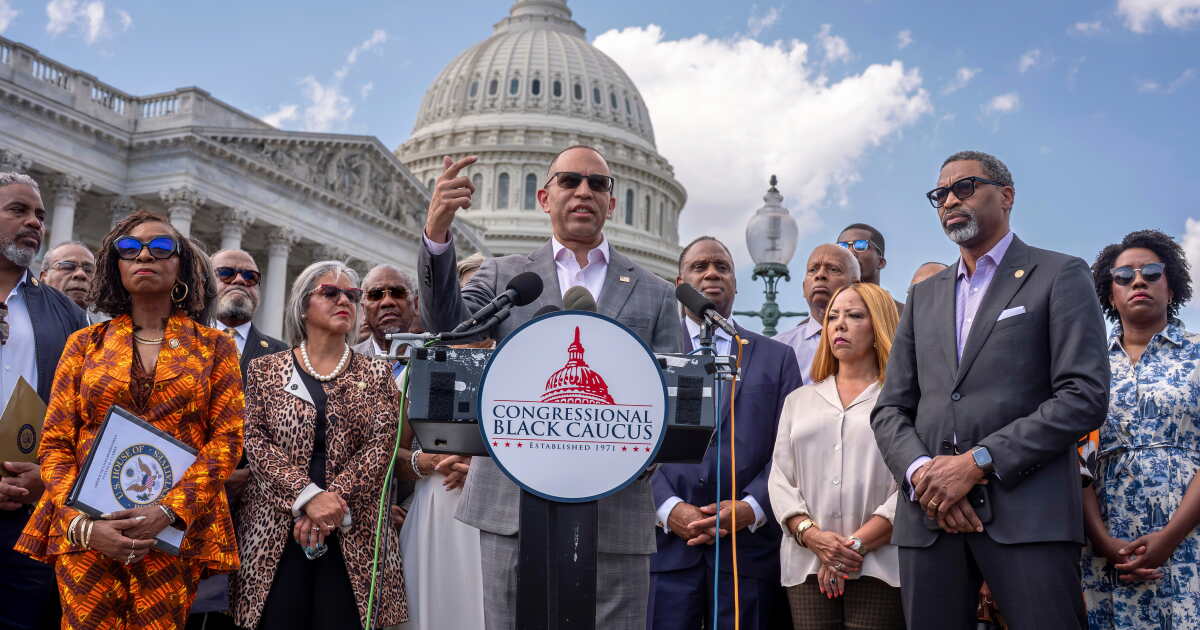
WASHINGTON — A nonprofit run by Black federal lawmakers launched a multimillion-dollar effort Tuesday to engage lower-propensity voters in key districts in the midterm elections, following years of dissatisfaction over traditional efforts to reach such voters.
The Congressional Black Caucus Institute’s “SO VOTE” campaign will seek to register and mobilize young voters, as well as voters in majority-Black and rural communities, across the South, Midwest and West. The campaign involves partnerships with dozens of local organizations, the institute said, with in-person and online outreach to voters often sidestepped by major political campaigns.
“For decades, as far as I can remember, there are those of us who have always complained about the fact that neither party spends the significant and requisite time with Black and brown and poor and rural communities,” said Marcia Fudge, a former Democratic congresswoman from Ohio who served as the secretary of Housing and Urban Development during the Biden administration.
“So we finally decided to take it upon ourselves to do something that we didn’t think anybody else in the industry was doing,” said Fudge, who is spearheading the new effort alongside former Black Caucus colleagues.
Effort blends old tactics with new technologies to boost turnout
Voter engagement efforts will cover outreach across Georgia and Mississippi, as well as target voters in 16 congressional districts that are likely to determine control of the House.
Instead of traditional television advertising, the campaign will convene local civic groups and houses of worship, as well as fraternities and sororities. The effort will also use some now-widespread techniques in political campaigns, such as geotargeting online ads and partnerships with local content creators for audiences who mainly receive their news online.
While the voter engagement efforts are officially nonpartisan, the Black Caucus’ targeted races are in many regions where Black voter turnout could prove key to whether a Democratic candidate prevails in closely divided House districts. Cedric Richmond, a former Louisiana Democratic congressman who served as a senior adviser to President Joe Biden, said the effort would focus on repeatedly engaging voters in rural communities who feel alienated from Democratic campaigns.
“If you’re not happy with the way things are going, then voting is part of the solution, but it takes constant communication,” Richmond said.
The Black Caucus’ institute has raised about $1 million for the campaign, primarily from individual donors, and plans to spend at least $4.5 million in the midterm election cycle.
Campaign responds to GOP redistricting and disappointing turnout in the past
The new outreach effort follows years of disappointment and frustration among some in the Black Caucus at the broader Democratic Party’s efforts to court Black, rural and younger voters.
Rep. Jim Clyburn, an influential South Carolina Democrat who decried the lackluster voter turnout in the 2024 election, said the campaign “allows us to put to practice that which we have been proposing, and we have never had the resources to do it. But this year we do.”
The effort is also a response to Republican-led redistricting efforts in multiple states, said Rep. Bennie Thompson, a Mississippi Democrat.
“These Southern states are trying to minimize Black political participation and ultimately Black political strength,” he said. “So what we have to do is take that low-propensity voter and elevate their participation so they become an additional voice to be reckoned with.”
They “are feeling very pessimistic,” said Mark Baldassare, PPIC’s statewide survey director. “You know that comes out not just in the questions we ask about the economy, but generally about the direction of the state and the nation. This just indicates the level of negativity that people have going into this final stage before people cast their ballots this November.”
More than half of the state’s likely voters believe that California is headed in the wrong direction, and 73% predict sour economic times in the state next year. Less than a quarter of likely voters believe the nation is headed in the right direction.
President Trump has an approval rating of 27% of likely voters, but that’s better than Congress, which has a 16% approval rating. Majorities do not have confidence in either major political party’s ability to solve problems.
Ballots will begin arriving in 23.2 million voters’ mailboxes in a little over two weeks. Nearly 80% of likely voters are frustrated by the length of the ballot, which includes 14 propositions as well as statewide, congressional and local elections. This a rare consensus among Democratic, Republican and independent voters.
“This year, there are more propositions on the ballot than we’ve seen for a decade,” Baldassare said. “Overwhelming majorities of Californians say that there are too many propositions on the ballot, too many things for them to decide. And many Californians feel that the wording of ballot initiatives makes it very hard for them to understand what happens if one passes.”
The proposal to tax the assets of billionaires to make up for federal government healthcare cuts, Proposition 40, has a slim lead in the poll, with 52% of likely voters saying they support the one-time 5% levy.
However, there are two ballot measures, Propositions 41 and 42, that would nullify the wealth tax if one is approved and gets more votes than Proposition 40. Narrow majorities support both of these proposals, creating a quandary for wealth tax supporters: ensuring their proposal receives the support of a majority of voters while also tamping down support for the competing efforts.
Findings about the proposal to require showing government-issued identification to vote and the governor’s race show less competitive contests that break along predictable partisan lines in a state where registered Democratic voters outnumber Republicans nearly 2 to 1.
The voter ID measure is opposed by 55% of likely voters. In the race to succeed termed-out Gov. Gavin Newsom, 60% of likely voters support Democrat Xavier Becerra, and 38% support Republican Steve Hilton. The other 2% were undecided or do not plan to vote on the race.
The poll of 1,745 adult Californians was conducted Sept. 4-10, and has a margin of error of about 3 percentage points in either direction, and 3.8 percentage points among the 1,103 likely voters.
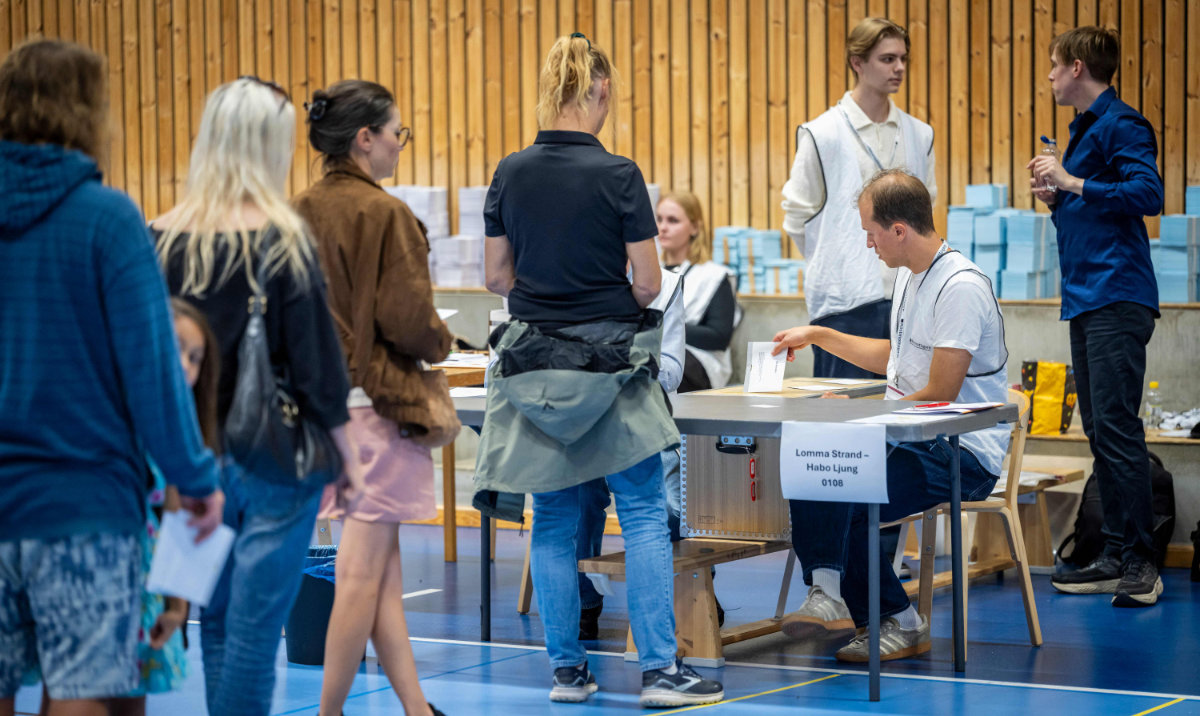
STOCKHOLM: Sweden’s national election results showed a dead heat on Sunday, with a partial count by the election authority indicating a one-seat majority for the opposition center-left bloc that could halt the Nordic nation’s drift away from its liberal heritage.
The bloc, headed by the Social Democrats’ party leader Magdalena Andersson, was expected to win 175 seats in the 349-seat parliament, the Riksdag, based on votes from 4,853 of Sweden’s 6,312 election districts, the election authority said.
The right-wing governing bloc of Prime Minister Ulf Kristersson was seen winning 174 seats, with ballot-counting continuing.
The election, while unlikely to change the course of Sweden’s pro-Western and pro-Ukraine stance, will decide whether Kristersson’s push toward a hard-right clampdown on migration continues.
Given the closeness of the race, the winner may not be known for several days, after all overseas ballots have been counted.
In a pre-election pledge, Kristersson broke a longstanding taboo and said he would bring into government the Sweden Democrats, a far-right party with roots in the Nazi fringe, as he aims to create a majority-right coalition.
Many voters on the right say a win would amount to an endorsement of policies that have helped to curb gang violence and cut immigration dramatically.
But some Swedes have expressed wariness, saying Kristersson’s invitation to the far right was a step too far.
“I think it will be a long night,” said Maria Malmer Stenergard, minister for foreign affairs and a member of Kristersson’s Moderate Party. “Maybe we won’t even have the results until Wednesday when the votes that have been cast abroad arrive.”
Kristersson, who has trailed in opinion polls throughout his four years in office, had been catching up in the final weeks of campaigning, with Andersson and her Social Democrats losing ground.
Critics say the Kristersson government’s immigration policies, whose incentives and penalties press migrants either to conform more closely to Swedish cultural norms or leave the country, are undermining civil liberties.
Electoral success for the Sweden Democrats would be welcomed by Europe’s ascendant far-right parties, which were bolstered by the anti-immigrant Alternative for Germany’s win in a German state election last week.
The far right hopes for gains in upcoming elections across Europe, with the National Rally’s bid for the French presidency next year potentially its biggest prize.
‘DOESN’T LOOK LIKE SWEDEN’
While voting on Saturday in Rinkeby, near Stockholm, the Sweden Democrats’ longstanding leader Jimmie Akesson said the suburb, home to one of the country’s biggest Swedish-Somali populations, “doesn’t look like Sweden.”
Sweden was long one of Europe’s most welcoming countries for immigrants until Kristersson came to power four years ago. His government abolished permanent residency for refugees, tightened welfare rules and stepped up expulsions of those without a right to stay.
The Sweden Democrats acknowledge that their party was founded in part by neo-Nazis and white supremacists in the 1980s, but say they have eliminated such extremists from their ranks and have apologized for their past.
Cheers broke out at the Sweden Democrats’ election party after an updated projection from Swedish broadcaster SVT showed a much narrower gap than an initial exit poll, which had put the center-left opposition ahead with 51 percent of the vote.
“You cannot imagine how nervous I am right now. It feels like my life’s work is hanging in the balance,” said Ludvig Aspling, a member of parliament and immigration spokesperson for the Sweden Democrats. “It is going to be super tight. We still have a chance,” he said.
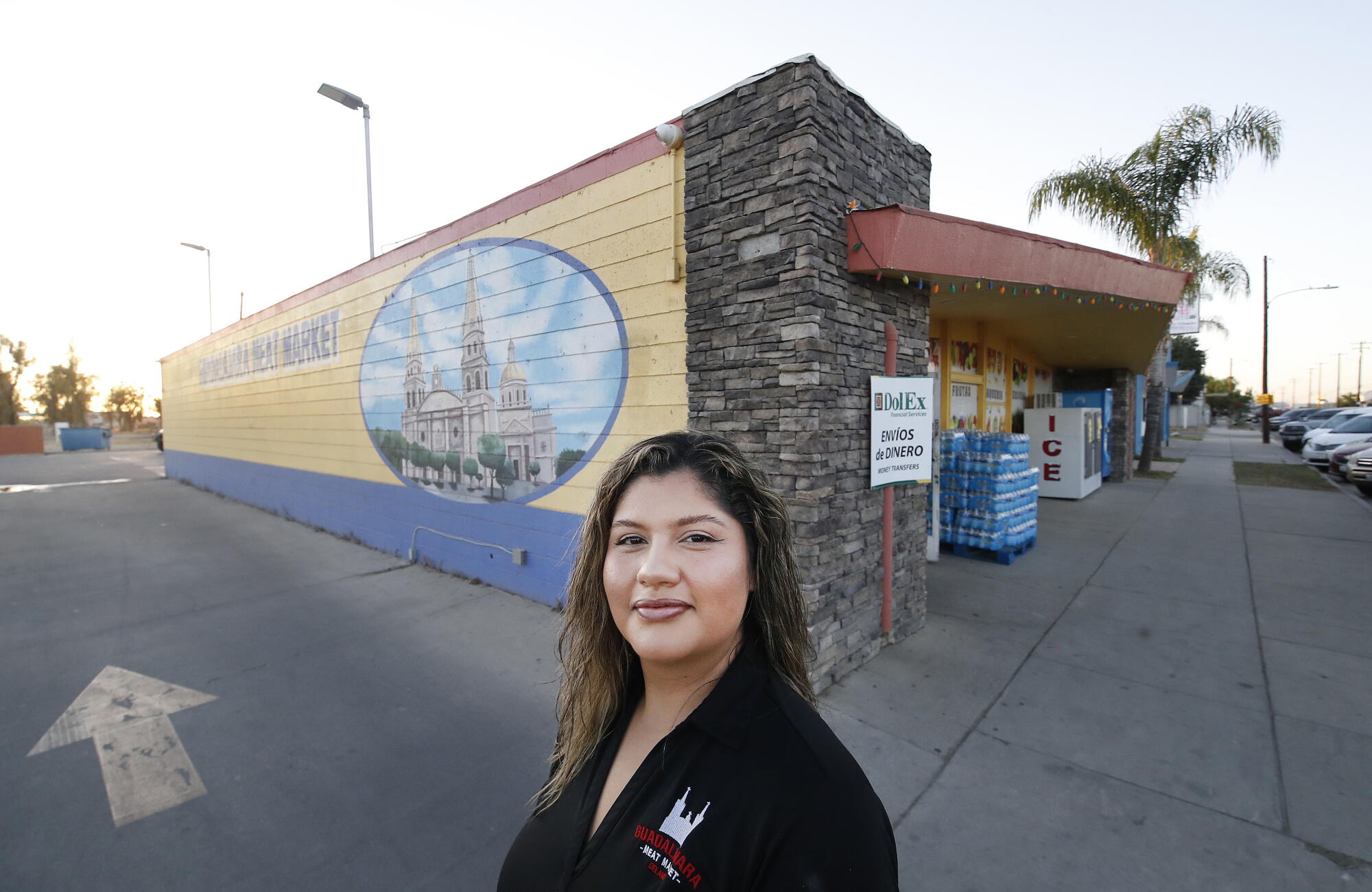
DELANO, Calif. — The rows of candies and nuts at the Guadalajara Meat Market — tamarindo con chile, seasoned pistachios, spicy paletas — sat mostly untouched as customers filtered through this carniceria in the late afternoon heat.
“You see a lot of people consuming the minimum, what they need to get by through the week,” said owner Carina Murillo, 31, as she checked out customers on a recent weekday. “Instead of buying six items, they’re buying three items.”
While customers bypass extras, like the snacks at the front counter, Murillo’s costs have gone up. Imported goods from Mexico and Canada have become more difficult to source and sometimes carry tariffs, she said. Transportation fees have risen as diesel prices respond to the war in Iran. The market’s insurance costs have risen by about a third. All of it has forced Murillo to increase prices.
“You see a lot of people consuming the minimum,” says Carina Murillo, owner of Guadalajara Meat Market. “Instead of buying six items, they’re buying three items.”
As the area struggles, Murillo, a college graduate who years ago felt motivated enough to door-knock for political causes, is among those who have become disillusioned. Those in Washington, she said, don’t understand the lives of the working people who keep the country running.
There have been “years where I feel completely overpowered to the point where I’m not motivated to take part,” said Murillo, who didn’t vote in 2024 but plans to do so in November. “That’s what happens when you feel discouraged or like nothing’s going to change.”
The economic strife plaguing Americans is clear in this rural, majority-Latino Central Valley congressional district, home to the state’smost competitive House race, the closely watched contest between Republican Rep. David Valadao and Democrat Randy Villegas.
Democrats hope the national economic angst will translate into big turnout in the midterm elections, but some in this region worry that years of financial struggle may depress voters’ desire to participate rather than motivate them.
Rep. David Valadao (R-Hanford) presides over a congressional hearing in March. The Republican is in a race against Democrat Randy Villegas that is considered a toss-up.
(Allison Robbert / Associated Press)
And Republicans, who rely on their party turnout beating that of Democrats in rural areas, also face the risk that frustration with the current political climate could dampen enthusiasm.
“Before they can think about Valadao, before Trump or Gavin Newsom or who’s going to run, families are concerned with the immediate: paying the rent, having the food on the table,” said Eliseo Gamiño, who heads the Central Valley Leadership Round Table, a coalition of Latino community leaders and elected officials. “You can’t be thinking about voting when your kids are hungry.”
Few voters who spoke to The Times in this swing district were decided on which party to support in November — or whether to vote at all. Such undecided voters will likely decide the election outcome, and persuading them is the key challenge for both parties as November nears.
Alexa Lopez sweeps up at closing time on a slower than usual Friday that saw one dress sold at Christina’s Fashion in Delano.
In a district that is the third-youngest in population in the country, the simmering uncertainty among Gen Z and millennial voters in particular could affect turnout or results.
Thirty-one percent of its voting-age population is 29 or younger, according to the Tufts University research center CIRCLE, which tracks youth civic engagement, making it among the top swath of House races in which young people could swing the outcome.
California’s swingiest district
The 22nd District, carved from the state’s agricultural epicenter, is one of fewer than two dozen toss-up races nationwide that will likely determine which party controls the U.S. House in the second half of President Trump’s current term. It is also among several high-stakes races nationwide that will test progressive candidates.
Valadao’s seat has long been considered a vulnerable one; Democrats added about 100,000 Fresno residents to the district under Proposition 50’s new map in a bid to help their chances. The boundaries include swaths of Kern, Kings and Tulare counties, along with a very small piece of Madera County.
“It’s going to be crucial in an area that is more purple, more bipartisan, where it’s very clear it can go either way … that these candidates make an effort to get those voters on their team,” said Brittany Martinez, a California-based Republican strategist.
Valadao, 49, who comes from a dairy farming family, is well known in the district and has repeatedly secured victory in close races, retaking the seat in 2020 after losing it in 2018’s blue wave. He saw a close race in 2022, then won by nearly seven percentage points in 2024, outperforming Trump.
His biggest vulnerability this time around may be his vote for the One Big Beautiful Bill Act, which included steep cuts to Medicaid. Local hospitals are bracing for funding cuts, though a carve-out may keep many valley residents from losing coverage. The district has the highest proportion of Medi-Cal recipients of any in the state, with 67% of residents enrolled as of 2025, according to the California Health Care Foundation.
Valadao spent part of the August recess touring the Central Valley for private meetings with local entities including a hospital, a housing program, a sawmill and a school district, and held a telephone town hall last week. Democrats have criticized him for not holding face-to-face voter events, including public town halls.
Democratic candidate Randy Villegas chats with residents during an August town hall in Hanford.
Villegas, 31, a professor and school board member who was endorsed by Sen. Bernie Sanders (I-Vt.) and is aligned with the Working Families Party, bested a Democrat backed by the party’s House campaign arm to win the nomination.
Villegas has banked on a more public-facing approach to win over swing voters — recently handing out popsicles from a pushcart he wheeled around a Labor Day event in Bakersfield, for instance — a strategy his campaign calls “going everywhere.” Republicans have criticized his record as too far left for the moderate district.
Both candidates have attempted to lean away from partisan narratives. Valadao rarely mentions Trump on social media and did not attend the president’s Republican convention in Dallas last week; Villegas has worked to frame the progressive issues he champions as an effort to help Central Valley voters rather than an ideology.
Trump carried the district as drawn now by less than 2 percentage points in 2024. Since then, residents say they have felt squeezed by housing, gas and grocery prices. The war in Iranhas pinched Central Valley farmers — already struggling withwater supply and other issues — by driving up fertilizer prices.
Ailyn Flores, center, picks up balloons for a party at Big Delano Discount store.
Tyler Stidham, 28, and her husband recently moved back to Lemoore from San José with their 1-year-old in order to live with family because they could no longer afford their own place.
“Rent got too high and having a family is expensive,” she said as the couple waited for their order from a food truck at the Hanford farmers market on a recent Thursday evening. They have cut out family trips and started meal-planning and budgeting to save money.
Stidham said she is planning to vote and hoping government leaders can make life more affordable. Her husband recalled a favorable impression of Valadao after once meeting him. Stidham isn’t sure who she’ll be casting her vote for.
“I haven’t done my research [yet],” she said.
Young voters said they felt frustrated waiting for a better economy that has yet to materialize.
“I feel like the government is playing in our face. I feel like everything is a show,” said Emma Woodward, 23, of Hanford.
The Sierra movie theater has closed down in Delano, Calif.
(Gary Kazanjian / For The Times)
A store manager at a coffee chain, Woodward bought a house last year to avoid throwing money at increasingly high rent payments, but it has been “hard to survive.” She got a roommate to help with costs, but the two of them sometimes find themselves using food drives for groceries. She has cut out “fun spending,” including concerts and travel.
Woodward said she wanted to vote in order to send the message to Congress that the economy needs improvement. She, too, wanted to research the candidates further; she leaned toward Villegas but was not yet convinced.
‘Whatever happens happens’
Valadao and Villegas must also battle to reach apathetic voters — those who may sit the election out or who are fed up with both parties. In one indication of voter fatigue, local organizers have found it a challenge to register new voters this year.
Dresses on display at Christina’s Fashion store after closing time on a quiet Friday night in Delano, Calif.
People who are unregistered often express mistrust in the government and the feeling that “nothing’s going to change,” said Biviana Camacho, 23, civic engagement program manager for Loud for Tomorrow, a youth organizing group based in Delano that runs voter registration events.
“A lot of folks have been in survival mode for such a long time,” she added, as the group worked on planning a fall event series on a recent afternoon. Their goal: 20 to 25 new registrations per event.
The group’s head of membership, Rosanai Paniagua, 28, agreed. “Here, there’s not a lot of hope because people haven’t seen what good policy could do for them,” she said. “A lot of apathy, for sure, because change hasn’t really happened here.”
Marco Estrada, 20, taking a break outside the Main Street barbershop where he works in Delano, said he wasn’t sure he could imagine anything Congress could do for him. He’s never voted and doesn’t plan to in November. His two co-workers said the same.
“Whatever happens happens,” Estrada said.
Valeria Valdez, a College of the Sequoias freshman, said she was planning to vote in her first election and said the government should help lower gas prices. The 18-year-old wasn’t sure, though, whether she would make a decision in the House race.
“It feels pretty far away from me, to be honest,” she said. “I just want to do what I can for our community and not focus on how corrupt the government is.”
That sentiment is part of what Villegas is aiming to target as he meets voters.
“It’s easy to feel cynical and apathetic in a moment where so many things seem stacked against us,” Villegas said in an interview. “But I tell people that … their vote and their voices do matter, otherwise we wouldn’t have billionaires and corporations spending millions of dollars trying to influence these election outcomes.”
A spokesperson for Valadao did not respond to a request for comment. Valadao said on a Washington Sun podcast in January that he “absolutely” worries about Republican voter enthusiasm, but noted it was a problem on both sides of the aisle. Earlier this month, he conveyed confidence about his race.
“I’ve won in these types of races. I can win again,” he told the Associated Press. “I think we should be fine.”
Inside Murillo’s market, business picked up as 5 o’clock neared. Murillo rang up tortillas, cuts of meat, and three-liter Mexican soda bottles. She advised a customer about treating a bug bite, helped a man wire money and cajoled a city worker about getting a sidewalk repair.
Congress should “definitely” be helping communities like hers, she said. She plans to research her voting options so she can participate in November. But trusting political candidates, she mused, can feel like a risk for voters.
“Whether they execute what they promise or not,” she said, “that’s shown with time.”
There was also no small amount of political opportunism at play.
The recall gave Newsom’s critics, mainly on the right, a chance to try to chase the Democrat from an office that Republicans, under normal circumstances, stood little chance of winning.
In the end, the recall effort amounted to scarcely more than a partisan tantrum. The result — 61.9% voting no, 38.1% voting yes — matched the outcome of the 2018 gubernatorial race down to the decimal. All that money and effort wasted on an election in which voters said pretty much, yep, we meant what we said. Not too long after, they gave Newsom a second term.
The plebiscite, and its pointlessness, underscored the many flaws inherent in California’s recall system. In November, voters will get a chance to remedy at least one of them, eliminating the chance a candidate could take office with just marginal support from voters.
You’re reading the L.A. Times Politics newsletter
Expert columnists cover the insights, legislation, players and politics you need to know.
By continuing, you agree to our Terms of Service, which include arbitration and a class action waiver. You agree that we and our third-party vendors may collect and use your information, including through cookies, pixels and similar technologies, for the purposes set forth in our Privacy Policy such as personalizing your experience and ads.
Trigger warning: What follows is a somewhat wonky explanation of election rules and procedures.
One choice, not two
Currently, a recall election is conducted in two parts. Voters are asked whether a lawmaker should be removed and, if so, who their replacement should be. If the incumbent is ousted, whoever gets the most votes takes their place, even if they fall well shy of attaining majority support. (Which is not out of the question in a large multi-candidate field; in 2003, 135 people were on the ballot, vying to replace Gov. Gray Davis.)
Among its provisions, Proposition 5 would amend the state Constitution so that voters would be asked a simple yes-or-no question: Do you wish to recall the incumbent? If so, the lieutenant governor would serve as governor for the rest of the ousted executive’s term — unless the recall occurred during the first two years a governor was in office and before the filing deadline for the next statewide election.
In that case, a special election would be held on the same date as the next primary and a candidate receiving a majority of votes would serve out the governor’s term. If no candidate received a majority, the top-two finishers would face each other in a November runoff, with the winner taking over as governor.
Still there?
Proposition 5 has two benefits. It would save taxpayer dollars by consolidating elections and it would enhance the legitimacy and political standing of a replacement governor by ensuring he or she assumed office with at least 50% support.
California makes it way too easy to qualify a gubernatorial recall measure.
Of the 19 states that allow their governor to be booted, California is by far the most permissive. Forcing an election requires signatures reflecting just 12% of the ballots cast in the prior gubernatorial contest. In Newsom’s case, proponents needed just under 1.5 million signatures in a state with more than 22 million voters and nearly 40 million residents.
Not exactly a thundering roar.
The threshold should be higher and the reasons for kicking a governor out of office should be more serious, such as corruption, official malfeasance or conviction for a serious crime. Not just because a governor is a member of the opposite party, or people on the losing end of an election are unhappy with the result.
“The system in its current form offers bad actors an incentive to target an elected official with whom they disagree and to have the official replaced by someone who otherwise would not enjoy the support of a majority of voters,” Josh Newman of Fullerton and Isaac Bryan of Los Angeles said in advocating change. The two Democratic lawmakers authored the constitutional amendment, which was placed on November’s ballot by the Legislature.
If you think overhauling the process is simply about protecting partisan interests, consider: Should Republican Steve Hilton pull off an epic upset and become California’s next governor, is there any doubt a recall effort would be underway before he and Mrs. Hilton even had the chance to start boxing their belongings for the move to Sacramento?
The recall is a vestige of the Progressive-era good-government movement. But the process needs to be revamped to reflect today’s bad-faith political environment.
The Little Hoover Commission, California’s independent oversight agency, has recommended several changes, including raising the signature requirement and prohibiting recalls undertaken during the first 90 days and the last six months of an officeholder’s term.
Elections, it’s said, have consequences. They also have — or should have — end dates and final results that are respected, not re-litigated until the losing side gets its way.
Proposition 5 is a step in the right direction. More should follow.