voter id

California’s proposed billionaire tax gains majority support in new poll, with a partisan split on voter ID

A new poll shows California voters are sharply divided over two brewing statewide ballot measures stirring up the nation’s partisan and economic divides: a one-time tax on billionaires to pay for mostly healthcare and a voter ID mandate that includes citizenship verification.

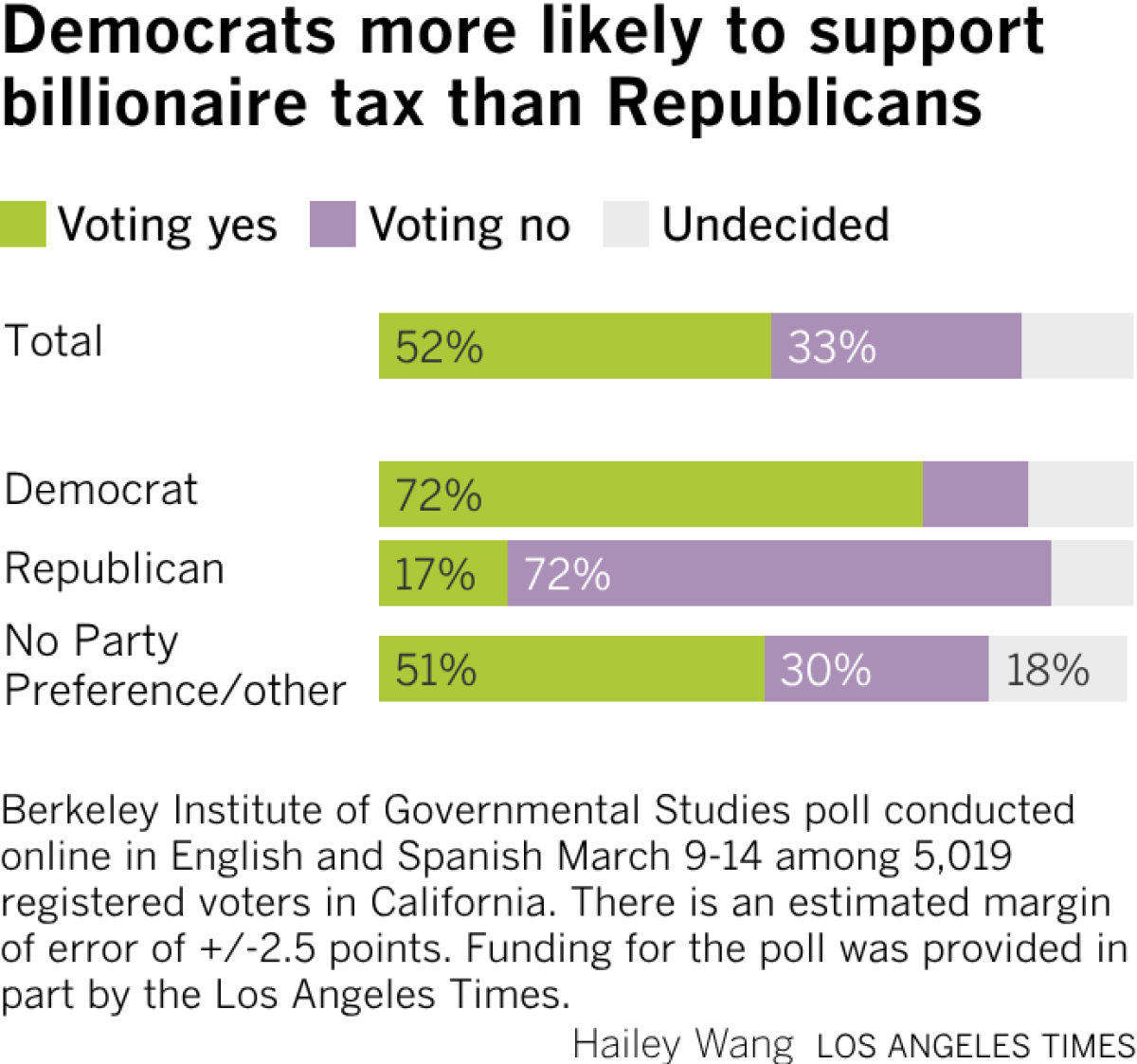
The survey conducted by UC Berkeley’s Institute of Governmental Studies and co-sponsored by The Times showed 52% of registered voters supported the billionaire’s tax, while 33% said they opposed it. Fifteen percent were undecided.

Support for the voter ID measure was more evenly split, with 44% of voters in support, 45% opposed and the remainder undecided.

The pair of statewide proposals, which have yet to qualify for California’s November ballot, emanated from opposite sides of California’s political spectrum. Organized labor and progressives are pushing hard for a new wealth tax in response to Republican cuts to federal healthcare programs, and the GOP-led call for additional voter restrictions comes in the wake of President Trump’s baseless claims that the 2020 election was stolen from him.

Poll director Mark DiCamillo said he “was a little surprised” by the results given how much attention each measure has already received.

“Just from reading the press accounts of these initiatives, I thought they would both be well ahead. There’s been a lot of discussion about them and advocates seem to be very confident in their chances of passage, but the polls seem to indicate otherwise,” he said.

The divisions over each measure fell largely along partisan and ideological lines.

On the billionaire’s tax initiative, 72% of Democratic voters said they would support the measure if the election were held today — and the same percentage of Republicans oppose it. A slim majority — 51% — of voters who are unaffiliated or registered with another party support the wealth tax, while 30% said they oppose it, with the remainder undecided.

Republican voters overwhelmingly support the voter ID initiative, with 91% saying they would vote for it. More than two-thirds of Democratic voters, 68%, said they would oppose the measure. No party preference voters appeared evenly split.

Neither ballot measure has officially qualified for the November ballot thus far, though proponents of the voter ID measure said this month that they turned in 1.3 million voter signatures to elections officials, well above the 875,000 required to qualify. Proponents of the new tax on billionaires have until June 24 to submit signatures to elections officials.

The billionaire tax has generated national news coverage and widespread debate over whether it would benefit low-income Californians or end up hurting the state’s tax base as billionaires move out of the state to avoid paying it.

The proposal is backed by the Service Employees International Union-United Healthcare Workers West, which represents 120,000 workers in California. Union leaders say that the tax would raise $100 billion to backfill steep cuts to federal healthcare programs under a sweeping tax and spending bill approved by the Republican-controlled Congress and signed in the summer by Trump.

The measure would impose a one-time 5% tax on the assets of California residents who are worth $1 billion or more, with options to pay it over multiple years.

According to SEIU-UHW, the new tax would apply to around 200 people in the state, though several wealthy tech leaders have made moves to change their residences and avoid paying the tax should it pass. In recent months, Meta Chief Executive Mark Zuckerberg, Google co-founders Larry Page and Sergey Brin and others have bought up lavish beachfront estates and new commercial office spaces in South Florida.

Some of those billionaires are also ponying up to defeat the measure. Brin, who according to Forbes is the world’s third-richest person, has contributed $45 million to a new ballot measure committee called Building a Better California, which is pushing an alternative statewide ballot measure that could scrap the billionaire’s tax.

Brandon Castillo, a veteran ballot measure campaign strategist who is not working on either of the two measures, said even though it’s currently polling above 50%, the billionaire’s tax is starting out “in a really shaky position.”

“This is not a very strong place to start,” he said. “That’s not to say they can’t keep this thing over 50%, but when you’re starting just barely above 50% and you have a tsunami of money and a huge campaign against you, it’s really hard to keep yourself at that level.”

Though previous public opinion polls at the state and national levels have shown broad support for requiring proof of citizenship to vote in elections, even among Democrats, the new Berkeley poll showed liberal voters are skeptical of the measure.

Proponents of voter ID contend that such laws prevent election fraud and, along with proof of citizenship mandates, prevent noncitizens from voting. Opponents say ID requirements threaten the fundamental constitutional rights of Americans who do not have the documentation readily available, and that the restrictions are unnecessary given that voting by noncitizens is rare and already outlawed in the U.S.

Under current law, Californians are not required to show or provide identification when casting a ballot in person or by mail. They are required to provide identification when registering to vote, and must swear under penalty of perjury, a felony, that they are eligible to vote and a U.S. citizen.

The poll showed that slim majorities of predominantly Spanish-speaking voters, voters who were born in another country and first-generation immigrants support the voter ID measure. A plurality of Latino voters also favor it, with 44% in support and 41% opposed.

But DiCamillo cautioned against reading too much into those numbers, noting that awareness of the measure is still relatively low.

“I’ve always seen in my history of measuring Latino voters’ support that they are relatively late deciders on most ballot measures,” he said. “How they break will be critical. I would say we’ll have to look at how they feel when we do our final preelection poll.”

Voter ID laws are also a top priority of Trump, who has pressured the Senate into taking up the SAVE Act, which would impose nationwide requirements for proof of citizenship to vote and already has passed the House of Representatives.

Castillo said Trump’s support could sway Democratic and liberal-leaning independents to vote against the measure.

Both DiCamillo and Castillo noted that with the November election still seven months away, voters are not paying much attention and those on either side of each ballot measure have not launched major campaigns yet.

“I suspect by the time election day comes around, these awareness numbers on the billionaire’s tax certainly are going to be much higher,” Castillo said. “You’re going to see 80-90% of voters familiar with it, just because they’re going to be inundated with advertising and earned media between now and November.”

The Berkeley IGS/Times poll surveyed 5,019 registered California voters online in English and Spanish from March 9 to 14. The results are estimated to have a margin of error of 2.5 percentage points in either direction in the overall sample, and larger numbers for subgroups.
Source link

Voter ID appears headed for California’s November ballot. What you should know

A proposed initiative to require Californians to show identification every time they vote, and election officials to verify registered voters are U.S. citizens, appears to have enough support to qualify for the November ballot.

Proponents say they have collected more than 1.3 million voter signatures on petitions supporting the ballot measure, far more than required under California law, and plan to submit them to county elections officials Monday for verification.

The Republican-led push for the voter ID initiative comes at a time of growing distrust in the integrity of the electoral process nationwide, a wariness intensified by President Trump’s baseless claims that the 2020 election was stolen from him and false assertions that droves of undocumented immigrants are swaying elections with illegal votes.

Proponents of voter ID contend that such laws prevent election fraud and, along with proof of citizenship mandates, prevent noncitizens from voting. Opponents say ID mandates threaten the fundamental constitutional rights of Americans who do not have the mandated documentation readily available, and that the restrictions are unnecessary given that voting by noncitizens is rare and already outlawed in the U.S.

The partisan divide over whether voters must provide proof of U.S. citizenship when registering to vote, one of Trump’s top priorities, continues to consume Washington. House Republicans passed the mandate in early February but the legislation — known as the SAVE Act — has bogged down in the Senate.

Democrats say that under the SAVE Act, many state driver’s licenses would not be adequate documentation to prove U.S. citizenship, forcing people to produce a passport or birth certificate — which many voters do not have. According to a 2023 survey by the Brennan Center for Justice and others, 9% of U.S. adult citizens do not have proof of their citizenship that’s readily available. The survey found that 11% of adult citizens of color were unable to readily access those documents, compared with 8% for white American adults. They accused Republicans of trying to prevent millions of Americans from voting in the next election in order to keep Congress under GOP control.

UC Berkeley Law School Dean Erwin Chemerinsky said that both the SAVE Act and proposed ballot measure in California are not only unnecessary, but harmful to democracy.

“Both are aimed at solving problems that don’t exist,” Chemerinsky said. “There is no evidence of a problem of non-citizens voting. Nor is there evidence of significant fraud with voters casting votes under false names. But both would limit who can vote. As for the SAVE Act, many people don’t have a birth certificate or passport.”

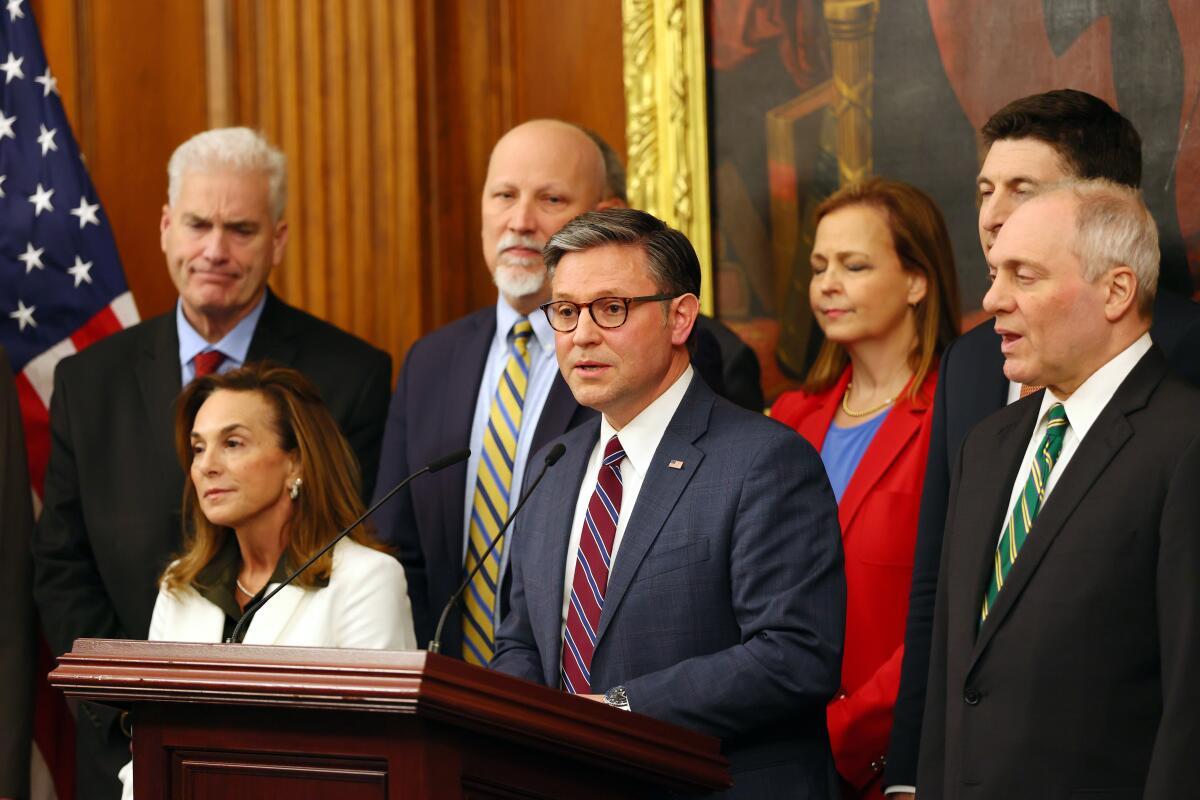
 U.S. House Speaker Mike Johnson (R-La.) speaks during a news conference.

U.S. House Speaker Mike Johnson (R-La.) speaks during a news conference on Feb. 11 at the U.S. Capitol. Johnson was joined by Republicans to speak about the passage of the SAVE America Act, an election bill backed by President Donald Trump that would require proof of citizenship to register to vote and require photo identification at the ballot box.

(Michael M. Santiago / Getty Images)

Rep. Ken Calvert (R-Corona), who supports and voted for the SAVE Act, said it is a simple way to restore voter confidence in elections. But he said the bill’s fate appears grim.

“I don’t think they have the votes,” Calvert said Friday.

Which is why, Calvert says, California must join other states and enact commonsense voter ID and citizenship requirements that can attract bipartisan support. The longtime Republican congressman said he does not believe there has been widespread voter fraud in the U.S., or a that a flood of noncitizens has been voting, but that does not mean those have not happened to some degree and would sway both tightly contested local elections and congressional races.

“I’ve always said it’s probably a small amount, but it’s enough to change an outcome of elections, and could change the numbers we have in Congress,” Calvert said.

The California ballot measure

The petitions being submitted for the California Voter ID Initiative will be reviewed by county election officials, who must verify that the people who signed are registered voters in the state and that the proponents collected at least the 874,641 valid signatures required to qualify for the November ballot.

The ballot measure will make significant changes to how Californians vote, and enact new mandates on county elections officials. Among the top changes being proposed:

  • Every time a voter casts a ballot in person in any election in California, they must present government-issued identification.
  • Californians voting by mail will be required to list on the ballot envelope the last four digits of a “unique identifying number from a government issued identification” — essentially a pin number like people use at an ATM — that matches the one the voter designated when they registered to vote.
  • The California secretary of state and county election officials will be required to verify that registered voters are U.S. citizens by “using government data,” which according to supporters could include information in the federal Social Security Administration database, jury summons information and other government records.
  • The secretary of state and county election officials must maintain accurate voter registration lists.
  • If requested, the state would be required to a provide eligible voters with free voter identification cards for use during elections.

“We’re creating the legal obligation that in California, when we do voting, we want our election officers to actually give a damn about whether someone’s a citizen,” said Assemblymember Carl DeMaio (R-San Diego), one of the main forces behind the proposed ballot measure. “That’s what we’re asking. That’s why voters support this, because it’s not a burden on the voter. It really is a burden on the election officers to do their job.”

Republican Assemblymember Carl DeMaio speaks at a press conference.

Republican Assemblymember Carl DeMaio of San Diego speaks at a press conference in July to announce a campaign to require voter identification in California.

(Tran Nguyen / Associated Press)

But Jenny Farrell, executive director of the League of Women Voters of California, called the proposed ballot measure an underhanded attempt by Trump and Republicans to make it even harder for people in the state to vote — which they see as a political advantage. The Californians who will suffer the most are “communities of color, people with disabilities, elderly folks, folks who move around a lot, folks who have recently experienced a name change.”

“California elections are already secure. This initiative isn’t really about election integrity. It’s part of this broader national playbook from President Trump and the current federal administration to make voting harder and to create doubts in the minds of the public and to really sow chaos on election day,” Farrell said. “The measure would create new strict barriers for eligible voters. It could wrongfully flag naturalized citizens, and it will create new ways to challenge results.”

Noncitizens who vote in California risk being charged with a felony and deported, she said.

Farrell’s organization has joined with the ACLU of Northern and Southern California, Common Cause, Disability Rights California and other groups to oppose the proposed measure.

The nonpartisan Legislative Analysts Office estimates the new requirements under the proposed ballot measure could potentially cost state and local governments “tens of millions of dollars to the low hundreds of millions of dollars” annually.

What’s the law now in California?

Currently, 36 states require or request that voters provide identification at the time they cast a ballot, and 10 states have strict laws requiring people to produce government-issued photo IDs, according to the National Conference of State Legislatures.

Under current law, Californians are not required to show or provide identification when casting a ballot in person or by mail. They are required to provide identification when registering to vote, and must swear under penalty of perjury, a felony, that they are eligible to vote and a U.S. citizen.

To register to vote, Californians must provide their driver’s license number or state identification card number and the last four digits of their Social Security number, along with other information. The state is required to validate the information using relevant databases, including records at the state Department of Motor Vehicles and Social Security Administration.

Along with a driver’s license, U.S. passport or state identification card, acceptable identification also can include photo identification cards issued by a school, a credit card company, a gym, an insurance company, an employer or a public housing agency. Californians have the option of providing certain other documents, as long as they contain the person’s name and address, including: utility bills, bank statements, government checks, rental statements or government-issued bus passes.

First-time voters who did not present identification when they registered to vote must present ID the first time they cast a ballot in a federal election.

When ballots are sent by mail, election officials are required to verify a voter’s signature on the ballot by comparing it with the signature on the official voter registration records on file.

Source link