Four hours before Sienna Spiro is due to launch her first U.S. headlining tour, the 20-year-old singer and songwriter from London sits upstairs in the Troubadour’s empty balcony, peering down as several crew members wheel a grand piano onstage.
“The fact that I’m 11-and-a-half hours from home and that this room is gonna be filled with people that have never met me and that I’ve never seen before — that’s just crazy,” she says. “I’m kind of scared.”
The song that brought Spiro to West Hollywood this past Tuesday is “Die on This Hill,” a showstopping pop-soul ballad about staying in a toxic relationship — “I’ll take my pride, stand here for you,” she sings, “I’m not blind, just seeing it through” — that’s been streamed more than 300 million times on YouTube and Spotify since it came out in October. Built around tolling piano chords and Spiro’s titanic vocal, the song hit No. 9 in the U.K. and broke into the Top 20 of Billboard’s Hot 100; last month, Spiro — whose famous admirers include SZA, Mark Ronson and Alex Warren — was nominated for the Critics’ Choice prize at England’s annual BRIT Awards.
With its unabashed emotion and its throwback feel, “Die on This Hill” can be heard as the latest in a long line of melodramatic ballads by young Brits such as Amy Winehouse, Duffy, Lewis Capaldi and Olivia Dean, the last of whom was just named best new artist at the Grammys. Yet Spiro’s voice stands out: Rich and pulpy, with a crack she knows how to deploy for maximum heartbreak, it might be the most impressive instrument to come out of England since Adele emerged nearly two decades ago.
“Sienna is a true artist with the voice of a generation,” says Sam Smith, one more English singer (and former best new artist winner) with a flair for ugly-cry theatrics. Late last year, Smith, who identifies as nonbinary, invited Spiro to join them onstage in New York for a performance of Smith’s song “Lay Me Down.” Spiro, Smith recalls, “blew the room away” — one reason they brought her out again Wednesday night at San Francisco’s Castro Theatre, this time to sing “Die on This Hill” together.
Says Smith of the younger artist: “The world is at her feet.”
At the Troubadour, where she’ll follow Tuesday’s sold-out concert with an encore appearance Friday night, Spiro describes singing as a life calling. “I’ve known what I wanted to do since — honestly, since I’ve been a conscious human being,” she says. Dressed in a black-and-white-striped turtleneck, she has her legs folded beneath her on a wooden bench; her dark hair hangs loose around her face, yet to be styled into the ’60s-inspired do she’ll wear come showtime.
“I always felt a bit invisible,” she adds, whether at school with friends or at home as a middle child. “Not in a victimized way. But I always struggled with that existentialism. Music is the only thing that’s made me feel real.”
Are we to believe that one of pop’s bright new stars was once … kind of a bummer?
“In my own way, yeah,” she says with a laugh. “It’s OK. It happened. Character building.”
Spiro grew up privileged in London, one of four children of Glenn Spiro, a prominent jeweler who counts Jay-Z as a client and pal. Her dad turned her onto Frank Sinatra and Nina Simone and the Italian film “Profumo di donna” when she was little; by age 10 she’d written her first song (“Lady in the Mirror,” it was called) and played her first gig (at a pub not far from Heathrow Airport).
At 16 she enrolled at East London Arts and Music, a performing arts academy she describes as “the up-and-coming version” of London’s prestigious BRIT School, whose alumni include Adele and Winehouse. Her academic career didn’t last long, though: On her first day of classes she posted a TikTok of herself covering Finneas’ song “Break My Heart Again” that triggered a wave of interest from various record-industry types; soon she dropped out and began regularly traveling to Los Angeles to work on music.
Today Spiro says she has a “love-hate relationship” with the town where she estimates she spends half her time. “I’m very English, and I think something about English people is our honesty — you don’t really have to guess what people are saying. What was shocking to me when I came here was that people didn’t say what they meant.
“I was very, very lonely, and it was hard to make music when you feel that,” she adds. “I make sad music, but it’s hard to be a teenager and be away from your family and your friends and be in a place where you kind of have to play pretend being an adult.”
Did suffering among the two-faced liars of L.A. ever lead her to question her commitment to music?
“No. It just made me question how I was doing it. And not everyone’s a two-faced liar. There are some good ones out there.”
Was she ever at risk of becoming a two-faced liar herself?
“Oh, I’m too English for that,” she says. “If I did that, I’d get a slap.”
Sienna Spiro performs this week at the Troubadour in West Hollywood.
(Ariana Drehsler / For The Times)
Spiro started releasing singles in 2024 and quickly signed a deal with Capitol Records; last year she opened for Teddy Swims on the road and turned heads with “You Stole the Show,” a luxuriously gloomy slow jam with echoes of Adele’s “Skyfall.”
For “Die on This Hill,” which she wrote with Michael Pollack and Omer Fedi (both of whom went on to produce the song with Blake Slatkin), Spiro wanted to capture the feeling of “when you go above and beyond just to feel something reciprocated back from someone,” she says. But if the writing came quickly, the recording didn’t: Spiro jokes that she cut “900 different versions” of the song, including one she says sounded like Silk Sonic and another that sounded like Lauryn Hill.
“I was desperate for something up-tempo,” she says, given that virtually everything she’d dropped so far had been a ballad. Yet Fedi pushed her to cut the tune live with just her on vocals and Pollack on piano. They did four takes, according to the producer, one of which forms the basis of the record that eventually came out.
“Very old-school, very human,” Fedi says of the process. “Maybe I’m corny but with Sienna, less is really more. Her voice is so special, so big and upfront, that you just want to put a giant flashlight on it and let it shine.”
In early January, Spiro gave a bravura performance of “Die on This Hill” on Jimmy Fallon’s late-night show; one clip on TikTok has been viewed more than 70 million times. For that appearance, she wore a retro mini dress printed with an old photo of Johnny Carson behind his desk; for a recent performance in the BBC’s Live Lounge, she wore a different dress showing the faces of the four Beatles.
On stage at the Troubadour, her dress features images of the Chateau Marmont and the Capitol Records tower — a bit of setup, she says, for her next single, “The Visitor,” which is due March 13. Spiro has been slowly assembling her debut album for the past two years, but with headlining concerts to play, she’s reaching back for some of her oldies from 2024.
Some, not all.
“To be real with you, some of my early stuff wasn’t the most authentic,” she says as her drummer starts thwacking a snare during sound check . “I was trying to be someone else because I really wasn’t comfortable with myself.”
Can she point to an example?
“‘Back to Blonde,’” she says, referring to a vaguely Lana Del Rey-ish number about a woman who dyes her hair after killing a no-good lover. “I put it out for all the wrong reasons. It was a mistake — an inauthentic move that I regret making.”
What were the wrong reasons?
“It’s a long story, and it’s not very interesting. I didn’t do it because I loved the song — that’s what I’ll say. But at the end of the day it’s my name and I have to stand by it.”
Which is why she’s taking her time on the LP. Some artists her age don’t care much about the album format but Spiro is a true believer. Among her faves: Sinatra’s “In the Wee Small Hours,” Stevie Wonder’s “Songs in the Key of Life,” Adele’s “21” — “a perfect album,” she says — and Billie Eilish’s “Hit Me Hard and Soft.”
“I love an album where you don’t ever question why a song’s on there,” she says. “Where everything feels intentional.”
She doesn’t want to divulge too much about the work in progress. “The problem with me is I have a huge mouth and I give everything away,” she says, which — hey, great.
“No, I know it is for you,” she adds with a laugh. “But not for me, because then when I actually want to do the big reveal, I’ve got nothing because I’ve said it all.”
She will allow one detail: “It won’t be 12 ballads, I’ll tell you that.” She looks toward the ceiling, jiggling her head slightly, as though she’s doing some mental math regarding the track list.
“I mean, there’s a lot of ballads,” she says. “I just love a ballad — I can’t help it.”
The House of Pies, a Los Feliz institution, is bustling on a chilly January morning.
It wouldn’t be shocking if some of the patrons here for breakfast were casually chit-chatting about the cultural behemoth that “KPop Demon Hunters” has become. After all, the 2025 animated saga about three music stars fighting otherworldly foes is now the most-watched movie ever on Netflix; “Golden,” its showstopping track, has since become the first Korean pop song to ever win a Grammy.
But for Danya Jimenez, 29, who sits across from me sipping coffee, the reception to the movie she began writing on back in 2020 isn’t entirely surprising, but certainly delayed.
“When we first started working on it, I was like, ‘People are going to be obsessed with this. It’s going to be the best thing ever,’” she recalls. But as several years passed, and she and her writing partner and best friend Hannah McMechan, 30, moved on to other projects. They weren’t sure if “KPop” would ever see the light of day. Production for animation takes time.
It wasn’t until she learned that her Mexican parents were organically aware of the movie that Jimenez considered it could actually live up to the potential she initially had hoped for.
“Without me saying anything, my parents were like, ‘People are talking about this’ — like my dad’s co-workers or my aunt’s friends — that’s when I started to realize, ‘This might be something big,’” she says.
“But never in my life did I think it would be at this scale.”
“KPop Demon Hunters” is now nominated for two Academy Awards: animated feature and original song. And that’s on top of how ubiquitous the characters — Rumi, Mira and Zoey — already are.
“Everyone sends me photos of knockoff ‘KPop Demon Hunters’ dolls from across the border,” Jimenez says laughing. “My friend got me a shirt from Mexicali with the three girls, but they do not look anything like themselves. She even got my name on it, which was awesome.”
After graduating from Loyola Marymount University in 2018, Jimenez and McMechan quickly found their footing in the industry, as well as representation. But it was their still unproduced screenplay, “Luna Likes,” about a Mexican American teenage girl obsessed with the late chef and author Anthony Bourdain, that tangentially put them on the “KPop” path.
“Luna Likes” earned the pair a spot at the prestigious Sundance Screenwriters Lab, where Nicole Perlman, who co-wrote “Guardians of the Galaxy,” served as one of their advisors. Perlman, credited as a production consultant on “KPop,” thought they would be a good fit.
Jimenez didn’t see the connection between her R-rated comedy about a moody Mexican American teen and a PG animated feature set in the world of K-pop music, but the duo still pitched. Their idea more closely resembled an indie dramedy than an epic action flick.
“If [our version of ‘KPop’] were live-action, it would’ve been a million-dollar budget. It was the smallest movie ever. Our big finale was a pool party,” Jimenez says. “We had all of the girls and the boys with instruments, which obviously is not a thing in K-pop, and everyone was making out.”
Even though their original pitch wouldn’t work for the film, Maggie Kang, the co-director and also a co-writer, believed their voices as two young women who were best friends, roommates and creative collaborators could help the movie’s heroines feel more authentic.
“Maggie had already interviewed all of the more established writers, especially older men,” Jimenez says. “She knows the culture. She knew K-pop, she’s an animator. She just needed the girls’ voices to come through, so I think that’s why we got hired.”
Kang confirms this via email: “It’s always great to collaborate with writers who are the actual age of your characters! Hannah and Danya were exactly that,” she says. “They were very helpful in bringing a fresh, young voice to HUNTR/X.”
Neither Jimenez nor McMechan were K-pop fans at the time. As part of their research, they both started watching K-pop videos, but it was McMechan who got “sucked into the K-hole” first. Still, it didn’t take long until the video for BTS’ “Life Goes On” entranced Jimenez.
“K-pop is a river that you fall into, and it just takes you,” Jimenez says. BTS and Got7 are her favorite groups. For McMechan, the ensemble that captivates her most is Stray Kids.
In writing the trio of demon hunters, the co-writers modeled them after themselves. The characters’ propensity for ugly faces, silliness and a bit of grossness too, stems from the portrayals of girlhood and young womanhood that appeal to them. Jimenez, who says she was an angsty teen, most closely identifies with the rebellious Mira.
“I have a monotone vibe,” says Jimenez. “People always think that I’m a bitch just because I have a resting bitch face,” she says. “But as you can see in the movie, Mira cares so much about having everyone be really close. I feel like that’s how I’m with all my friends.”
Characters with strong personalities that are not simplistically likable feel the truest to Jimenez. In “Luna Likes,” the prickly protagonist is directly inspired by her experiences growing up, as well as the bond she shared with her dad over Bourdain’s “Parts Unknown” show.
“There’s a pressure to show that Mexicans are nice people and we’re hard workers. I was like, ‘Let’s make her kind of bitchy and very flawed,’” Jimenez says about Luna. “She’s a teenager in America and she should be given all the same opportunities — and also the forgiveness for being an ass— and [as] selfish at that age as anybody else.”
Hannah McMechan, left, and Danya Jimenez, co-writers of “KPop Demon Hunters,” met in college.
(Carlin Stiehl / For The Times)
Though their upbringings were markedly different, it was their shared comedic sensibilities that connected Jimenez and McMechan when they met in college. The two were close long before deciding to pen stories together. “Having a writing partner is the best. I feel bad for people who don’t have a writing partner, no offense to them,” says Jimenez.
McMechan explains that their writing partnership works because it’s grounded on true friendship. And she believes they would not have gotten this far without each other. While McMechan’s strong suit is looking at the bigger picture, Jimenez finds humor in the details.
“Danya is definitely funnier than me,” says McMechan. “It’s really hard to write comedy in dialogue versus comedy in a situation because if you’re putting the comedy in the dialogue, it can sound so forced and cringey. But she’s really good at making it sound natural but still really funny.”
Though she had been writing stories for herself as a teen, Jimenez didn’t consider it a career path until as a high schooler she watched the romantic comedy “No Strings Attached,” in which Ashton Kutcher plays a production assistant for a TV series.
“He is having a horrible time. But I was so obsessed with movies and TV, and I was like, ‘That looks incredible. I want to be doing what he’s doing,’” she recalls. “And my dad was like, ‘That’s a job.’”
Danya Jimenez grew up in Orange County.
(Carlin Stiehl / For The Times)
As an infant, Jimenez spent some time living in Tijuana, where her parents are from, until the family settled back in San Diego, where she was born. And when she was around 5 years old, Jimenez, an only child, and her parents relocated to Orange County. Until then, Jimenez mostly spoke Spanish, which made for a tricky transition when starting school.
“I knew English, but it just wasn’t a habit,” she recalls. “I would raise my hand and accidentally speak Spanish in class. My teachers would be like, ‘We’re worried about her vocabulary.’ That was always an issue, so it’s really funny that I turned out to be a writer.”
As she points out in her professional bio, it was movies and TV that helped with her English vocabulary, especially the Disney sitcom “Lizzie McGuire.”
Jimenez describes growing up in Orange County with few Latinos around outside of her family as an alienating experience. She admits to feeling great shame for some of her behaviors as a teenager afraid of being treated differently and desperate to fit in.
“I would speak Spanish to my mom like in a corner because I didn’t want everyone else to hear me speak Spanish,” Jimenez confesses. “If my mom pulled up to school to drop me off playing Spanish hits from the ‘80s or banda, I was like, ‘Can you turn it down please?’”
Like a lot of young Latinos, she’s now taking steps to connect with her heritage, and, in a way, atone for those moments where she let what others might think rob her of her pride.
“During the pandemic I cornered my grandma to make all of her recipes again so I could write them down,” she recalls. “Now I have them all written down on a website. Or if my mom corrects me for something that I’m saying in Spanish, I now listen.”
At the risk of angering her, Jimenez describes her mother as a “cool mom,” and compares her to Amy Poehler’s character in “Mean Girls.” Raised in a household without financial struggles, Jimenez doesn’t often relate to stories about Latinos in the U.S. that make it to film and TV. Her hope is to expand Latino storytelling beyond the tropes.
“That’s very important to me, to just tell Latino stories or Mexican stories in a way that’s just authentic to me and hopefully someone else is like, ‘Yes, that’s me,’” she says. “A lot of people have certain expectations for Latino stories that I’m not willing to compromise on.”
Though they still would like to make “Luna Likes” if given the chance, for now, Jimenez and McMechan will continue their rapid ascent.
They’re “goin’ up, up, up” because it is their “moment.” They recently wrapped the Apple TV show “Brothers” starring Matthew McConaughey and Woody Harrelson that filmed in Texas. They are also writing the feature “Attack of the Fifty Foot Woman” for Tim Burton to direct, with Margot Robbie in talks to star.
“I feel like I’ve just been operating in a state of shock for the past, I don’t know how many months since June,” says Jimenez in her signature deadpan affect. “But if I think about it too much, I’d be a nervous wreck.”
Venezuelan authorities have offered no explanation on the withdrawn statement. (Anadolu Agency)
Mérida, March 2, 2026 (venezuelanalysis.com) – Venezuelan popular movements condemned the recent US and Israeli attacks against Iran and expressed support and solidarity with the West Asian nation.
On Saturday, February 28, the International Platform for Solidarity with the Palestinian Cause and the Alexis Vive Patriotic Force were among the organizations issuing statements rejecting Washington and Tel Aviv’s military actions.
The organizations decried the bombings of Iranian territory, including against civilian targets, and described the operations as serious violations of international law. The International Platform for Solidarity with the Palestinian Cause expressed “deep outrage” over the bombing of a girls’ school in Minab that killed over 175 people.
“This infamous act will not crush the heroic resistance of the Iranian people, in their example of dignity in the face of imperialist and zionist aggression,” the platform’s communiqué read.
For its part, the Alexis Vive Patriotic Force emphasized that the latest attacks are not an isolated incident, but rather “another attempt to impose regime change and undermine Iran’s self-determination.”
“These actions seek to reconfigure the political map of Western Asia in favor of the strategic interests of Washington and Tel Aviv,” the organization, a driving force in El Panal Commune in Caracas, added in its statement.
The Venezuelan chapter of Alba Movimientos, a continental alliance of social movements, likewise issued a statement declaring “unrestricted solidarity” with Iran and calling on multilateral organizations to deter the US and Israel’s “warmongering.”
Venezuelan grassroots organizations scheduled a rally on Tuesday in front of the Iranian embassy in Caracas to reiterate their support and condemnation of the foreign aggression against the country.
West Asia has been thrown into open conflict after the US and Israel launched operations “Epic Fury” and “Lion’s Roar,” respectively, on Saturday, with widespread bombings against Iran and targeted assassinations against the country’s leadership. Ayatollah Ali Khamenei, Iran’s supreme leader, was killed along with several relatives by an Israeli strike.
Washington and Tel Aviv justified the systematic bombing of Tehran and other cities as a “preemptive strike,” with officials from both countries claiming without evidence that Iran was working toward nuclear weapons.
In response, Iranian forces launched defensive maneuvers and retaliatory attacks against US military assets in the region, striking bases and other targets in countries including Bahrain, the United Arab Emirates, Qatar, Iraq, and Jordan. Iran has also launched multiple waves of missiles against Israel and vowed to implement a strategic blockade in the Strait of Hormuz.
Caracas withdraws statement, expresses solidarity with Qatar
The Venezuelan government issued a statement on Saturday expressing its “condemnation and deep regret” that the “military option was chosen” with attacks against Iran while diplomatic talks were ongoing. However, Caracas did not name the US and Israel as the perpetrators.
The communiqué went on to condemn Iran’s retaliatory actions as “inappropriate and reprehensible military reprisals against targets in various countries in the region.” The document ended with a call for a return to negotiations between all parties.
The government’s position drew widespread criticism on social media and was removed from the Foreign Ministry’s official accounts, as well as from Foreign Minister Yván Gil’s Telegram and X platforms, on Saturday evening.
Venezuelan leaders, including Acting President Delcy Rodríguez, have offered no explanation for the statement’s publication and deletion. On Monday, Rodríguez reported a phone conversation with Qatari Emir Tamim bin Hamad Al Thani in which she expressed “solidarity” amidst the “violence and instability” in the region.
“I expressed my condolences and deep concern over the loss of civilian lives due to the ongoing conflict, reiterating our call to respect international law and preserve peace,” the acting president wrote.
Caracas’ latest stance contrasts with its previous fierce condemnations of US and Israeli actions in West Asia, including the genocide in Gaza, attacks against Lebanon, and the assassination of Hezbollah leader Hassan Nasrallah.
Venezuela had likewise firmly backed Iran, one of its strongest allies in the past quarter century, against foreign attacks, including during the June 2026 war against Israel.
During Hugo Chávez’s presidency (1999-2013), Caracas and Tehran consolidated a multidimensional strategic alliance based on opposition to US expansion and a commitment to building a multipolar world. During this period, more than 270 bilateral agreements were signed in sectors such as energy, housing, agriculture, and technology.
The close ties, described by both governments as a “revolutionary brotherhood,” also provided key lifelines as both countries faced US-led economic sanctions. Venezuela benefited from Iranian technology transfers in areas such as drone manufacturing, cement, and vehicle assembly.
Iran provided key fuel shipments in 2020, defying US threats, as the Venezuelan economy reeled under US coercive measures.
Park Young-jae (C), head of the National Court Administration, and justices salute the national flag during a meeting with chiefs of district and appellate courts nationwide at the top court in Seoul, South Korea, 25 February 2026. Park said that the opinions of the judiciary should be reflected in deliberations for controversial judicial reform bills pushed by the ruling Democratic Party (DP), after three DP-led bills were met by strong opposition from the judiciary. Photo by YONHAP / EPA
Feb. 25 (Asia Today) — Senior judges from courts across South Korea expressed “serious regret” Tuesday over a package of judicial reform bills advanced by the ruling party, warning of potential side effects and calling for broader consultation.
At an extraordinary meeting held at the Supreme Court in Seoul, court presidents reviewed the so-called three judicial reform bills – which include creating a new offense of “distortion of law,” introducing a constitutional complaint system against court rulings and expanding the number of Supreme Court justices.
The meeting was led by Court Administration Chief Park Young-jae and attended by chief judges from courts nationwide.
In a joint statement, the judges said fundamental changes to the judicial system could produce irreversible and significant consequences and should be subject to in-depth discussion through a consultative body that includes multiple institutions and experts.
Regarding the proposed “distortion of law” offense, the judges said the elements of the crime remain abstract even under a revised draft and warned that the scope of punishment could be overly broad. They cautioned that the measure could lead to a surge in complaints and accusations against judges, potentially undermining the swift administration of justice and the protection of citizens’ fundamental rights.
On the proposed constitutional complaint system against court rulings, the court presidents said it could delay the finality of judgments and subject litigants to repeated proceedings.
While acknowledging the need to increase the number of justices at the Supreme Court of Korea, the judges said adding a large number in a short period could weaken trial quality. They suggested first expanding the bench by four justices and reviewing the impact before considering further increases.
In opening remarks, Park said the bills would significantly affect the judiciary’s core role in safeguarding constitutional order and citizens’ rights and stressed that the courts’ views should be reflected in the legislative process.
That was the toughest thing to watch. That was what seared into the mind. That’s what made you want to fire Mick Cronin on the spot.
It was a look of embarrassment. It was a look of confusion. It was the look of a young man who had just been cruelly pushed around by someone with more power.
Mick Cronin is a classic bully, and the fact that UCLA continues to empower him with new contracts and no questions is misguided malfeasance.
So, he wins games. He doesn’t win enough to compensate for incidents like Tuesday night in East Lansing, Mich., where Cronin became perhaps the first college coach in history to eject his own player from the game and order him to the locker room in the middle of the game.
Yes, Cronin holds players accountable. That’s fine, as long as he also holds himself accountable, but that didn’t happen when, after his team was beaten by 23 points by Michigan State in a second consecutive humiliating loss, he publicly criticized Jamerson for the hard foul that led to the ejection incident and then wrongly assailed a reporter for allegedly raising his voice during postgame questioning.
Cronin has become a walking viral video. He has become a nightly uncomfortable wince. He has become an embarrassment to a university athletic department that prides itself on winning with class.
Mick Cronin is light years from the aura of Coach, and if UCLA cared a whit about the legacy of its legend, it would care that his flame has been completely snuffed by this unworthy keeper.
Wooden’s home is now decorated with a pyramid of poop, and one wonders how many humiliations will be required to convince administrators to clean things up.
UCLA coach Mick Cronin extends his arms and complains while watching the Bruins lose to Michigan State Tuesday in East Lansing, Mich.
(Rey Del Rio / Getty Images)
Cronin quietly signed a new five-year contract last summer that includes a $22,5 million buyout if he is fired this spring. That figure drops to $18 million, then $13.5 million, then $9 million, then $4.5 million in coming years. No wonder the Bruins didn’t publicize the deal at the time. It was another Martin Jarmond mistake, and now the entire university is going to pay the price.
It’s hard to see UCLA canning Cronin in the next couple of years because of those buyouts, which means this mess of a program is going to be increasingly hard to watch.
What happened Tuesday should scare away any of the remaining top prospects who would want to play for this berating blowhard. His usual postgame rants don’t compare to what happened on that Michigan State court, where he picked on the wrong kid in the worst possible fashion.
By all accounts, Jamerson is a dream player, one filled with resilience and gratitude. The former Crespi High star initially wanted to play for Michigan State, but he couldn’t make the team, even as a walk-on, so he tried to become a student manager, and failed at that, too. After spending a year there as a student, he transferred to University of San Diego, where he spent three seasons strengthening his game before eventually transferring to UCLA. This season he has spent most of his time on the bench, playing about 11 minutes per game for the Bruins while supplying rebounding and defense and energy.
It was this fire that led him to give chase to Michigan State’s Carson Cooper in the final five minutes of a game that UCLA currently trailed by 27. Cooper went up for a fast break dunk and Jamerson knocked him to the floor. It was ruled a Flagrant 1 excessive foul, but not a dangerous Flagrant 2 foul, so Jamerson was not ejected from the game.
At least, that’s what he thought.
Moments later Cronin was grabbing the kid’s shirt and leading him to the baseline, where he ordered an assistant coach to remove him from the court area and banish him to the locker room.
Jamerson’s dreams of a solid return to a school that snubbed him were shattered. His night ended amid a storm of laughing students and obscene gestures.
UCLA coach Mick Cronin shouts toward the bench while sending Steven Jamerson II to the locker room after the player was called for a foul Tuesday at Michigan State.
(Rey Del Rio / Getty Images)
It was just awful, and so avoidable. Why couldn’t Cronin have just sent Jamerson to the end of the bench? Considering it wasn’t a Flagrant 2, why did he even have to take him out of the game? Why did he have to make an example of a player who was understandably overeager on what could have been one of the triumphant nights of his life?
“Steve’s a good kid. He made a bad decision. But if you want to be a tough guy, you need to do it during the game, for a blockout, for a rebound,” said Cronin afterward.
“So, I was thoroughly disappointed; the guy was defenseless in the air. I know Steve was trying to block the shot, but the game’s a 25-point game. You don’t do that.”
That point could have been made without humiliation. But Cronin wasn’t done, later admonishing a reporter for what he considered a dumb question, then scolding the reporter for allegedly raising his voice at him.
The question was about the student section’s harassment of former Spartan Xavier Booker, which seemed like a legitimate query considering Booker had a terrible game. But what was really baffling was Cronin’s claim that the questioner was raising his voice.
Listen to the video. No voices were raised. It was just Cronin once again being a bully. You want a raised voice? Here, I’ll raise my voice in words that Cronin will hopefully understand.
CHILL OUT! SHOW RESPECT! HONOR WOODEN!
If the coach doesn’t grow up and the program doesn’t rapidly improve — for a third straight year they’re barely a tournament team — there needs to be another ejection.
It would be the most expensive firing in UCLA history. It would be worth every penny.
The Rev. Jesse Jackson, a child of Southern segregation who rose to national prominence as a powerful voice for Black economic and racial equality, has died.
Jackson, who had battled the neurodegenerative condition progressive supranuclear palsy for more than a decade, died at home surrounded by family. His daughter, Santita Jackson, confirmed his death with the Associated Press. He was 84. Jackson was originally diagnosed with Parkinson’s disease in 2017 before the PSP diagnosis was confirmed in April.
Handsome and dynamic, an orator with a flair for memorable rhyme, Jackson was the first Black candidate for president to attract a major following, declaring in 1984 that “our time has come” and drawing about 3.5 million votes in Democratic primaries — roughly 1 in 5 of those cast.
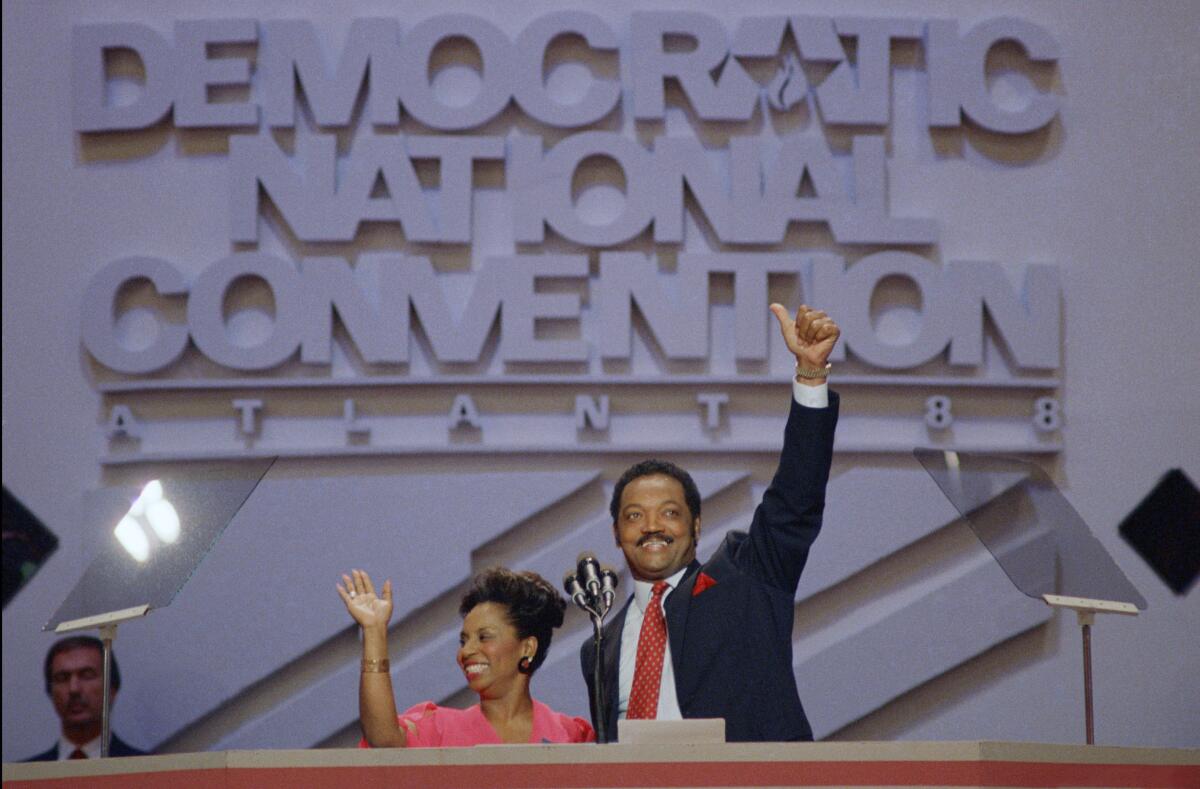
Four years later, using the slogan “Keep hope alive,” he ran again, winning 7 million votes, second only to the eventual nominee, Massachusetts Gov. Michael S. Dukakis. His hourlong speech at the 1988 Democratic National Convention brought many delegates to tears and provided the gathering’s emotional high point.
Rev. Jesse Jackson and his wife, Jacqueline, acknowledge the cheers of delegates and supporters before his emotional speech to the Democratic National Convention in Atlanta on July 20, 1988.
(John Duricka / Associated Press)
“Every one of these funny labels they put on you, those of you who are watching this broadcast tonight in the projects, on the corners — I understand,” he said. “Call you outcast, low down, you can’t make it, you’re nothing, you’re from nobody, subclass, underclass; when you see Jesse Jackson, when my name goes in nomination, your name goes in nomination.”
For nearly a generation, from the 1970s into the 1990s, that ability to absorb the insults and rejection suffered by Black Americans and transmute them into a defiant rhetoric of success made Jackson the most prominent Black figure in the country. Both beneficiary and victim of white America’s longstanding insistence on having one media-anointed leader serve as the spokesman for tens of millions of Black citizens, he drew adulation and jeers but consistently held the spotlight.
Supporters greeted his speeches with chants of “Run, Jesse, run.” Opponents tracked every misstep, from audits of his grants in the 1970s to his use of the anti-Jewish slur “Hymietown” to refer to New York City during the 1984 campaign, to the disclosure, in 2001, that he had fathered a daughter in an extramarital affair.
As he dominated center stage, the thundering chorus of his speeches — “I am … somebody” — inspired his followers even as it sometimes sounded like a painful plea.
Jackson’s thirst for attention began in childhood. Born out of wedlock on Oct. 8, 1941, he often stood at the gate of his father’s home in Greenville, S.C., watching with envy as his half-brothers played, before returning to the home he shared with his mother, Helen Burns, and grandmother, Mathilda.
During high school, his father, Noah Robinson, a former professional boxer, would sometimes go to the football field to watch Jesse play. If he played well, Noah would sometimes tell others, “That’s one of mine.” For the most part, however, until Jesse was famous, he shunned his son, who was later adopted by the man his mother married, Charles Jackson.
It was his grandmother, known as Tibby, who encouraged Jackson’s ambition. A domestic in stringently segregated Greenville, Tibby brought home books and magazines, such as National Geographic, that her white employers’ children had discarded.
“Couldn’t read a word herself but she’d bring them back for me, you know, these cultural things used by the wealthy and refined,” Jackson once said. “All she knew was, their sons read those books. So I ought to read them too. She never stopped dreaming for me.”
Her dreams propelled Jackson toward college — as did a need to avenge the childhood taunts that echoed in his head. An honors student, he turned down a contract to pitch for the Chicago White Sox to accept a football scholarship to the University of Illinois.
At Christmas break, he came home with a list of books. A librarian at the McBee Avenue Colored Branch referred him to the white library downtown and called ahead to clear the way. When he entered the main library, two police officers stood at the loan desk. A librarian told him it would take at least six days to get the books from the shelves. When he offered to get them himself, the officers told him to leave.
“I just stared up at that ‘Greenville Public Library’ and tears came to my eyes,” Jackson told a biographer, Marshall Frady.
That summer, 1960, Jackson came home and led a sit-in at the library, his arrest a first taste of civil disobedience. In the fall, he transferred to North Carolina A&T State University in Greensboro. There he became the star quarterback and participated in the beginnings of the sit-ins that became a signature part of the civil rights movement led by the Rev. Martin Luther King Jr.
“It wasn’t a matter of Gandhi or Dr. King then,” he said of the library sit-in, “it was just my own private pride and self-respect.”
With his height and his oratorical flourishes, Jackson was a charismatic figure who led protests in Greensboro. Once, during a demonstration outside a cafeteria, as police were about to arrest the demonstrators, Jackson suggested they kneel and recite the Lord’s Prayer.
“Police all took off their caps and bowed their heads,” he said. “Can’t arrest folks prayin’.”
Then he led the demonstrators in “The Star-Spangled Banner.”
“They stopped, put their hands over their heart,” Jackson said. “Can’t arrest folks singing the national anthem.”
After half an hour, he recalled, “we got tired and let ’em arrest us.”
Elected student body president, Jackson graduated in 1963. A grant from the Rockefeller Fund for Theological Education brought him to the Chicago Theological Seminary, where he hoped to find a venue for social activism.
That summer, Jackson traveled to Washington, where he heard King deliver his famous “I Have a Dream” speech. Two years later, he and a group of college buddies piled into vans to drive south for King’s Selma-to-Montgomery march. He met King there, and early the next year, King asked Jackson to head his Southern Christian Leadership Conference’s Operation Breadbasket in Chicago. The goal was to win economic gains for Black people with a combination of consumer boycotts and negotiated settlements.
At 24, Jackson was the youngest of King’s aides. Operating out of a hole-in-the-wall office at SCLC’s South Side headquarters, he began by organizing preachers, arranging for them to urge their congregations on Easter to boycott products made by a local dairy that employed no Black workers.
During the following week, Country Delight lost more than half a million dollars in revenue. Within days, the company offered a deal: 44 jobs for Black workers. Without waiting for a boycott, other dairy companies called with offers, too.
King soon asked Jackson to be the national director of Operation Breadbasket. Jackson hesitated — the job required him to leave the seminary six months short of graduation. Jackson recounted in his autobiography that King told him, “Come with me full time and you’ll learn more theology in six months than you would in six years at the seminary.” He earned his ordination several years later.
In 1968, Jesse Jackson stands to the left of the Rev. Martin Luther King Jr. on the balcony of the Lorraine Motel in Memphis, Tenn., where King was assassinated the next day.
(Charles Kelly / Associated Press )
In April 1968, Jackson joined King in Memphis, where the civil rights leader had decided to stand with striking Black sanitation workers. Few of King’s staff supported the effort, worrying that the strike — and the planned Poor People’s Campaign in Washington — distracted from the main goal of attaining voting and political rights for Black Americans.
During a planning meeting, King blew up at his aides, including Jackson. “If you’re so interested in doing your own thing, that you can’t do what this organization is structured to do, if you want to carve out your own niche in society, go ahead,” King yelled at Jackson, according to the latter’s account. “But for God’s sake, don’t bother me!”
The next day, standing below the balcony of the Lorraine Motel where the team was staying in Memphis, King yelled down at Jackson in joviality, as if to mitigate the outburst, inviting him to dinner.
Within moments, shots rang out. Jackson later said he ran upstairs and caught King’s head as he lay dying. Andrew Young, a King aide who later became U.S. ambassador to the United Nations, told Frady that he doubted Jackson had cradled King’s head, but that they all had rushed to the scene and all had gotten blood on their clothes.
But if all of them were touched by King’s blood, only Jackson wore his gore-stained olive turtleneck for days, sleeping and grieving in it, wearing it on NBC’s “Today Show” and before the Chicago City Council. In dramatizing the moment to his own benefit, Jackson provoked hostility from King’s widow and others in the movement’s leadership that lasted decades.
Richard Hatcher, the first Black mayor of Gary, Ind., and a Jackson supporter, recalled that once Jackson decided to run for president, the campaign thought it had the backing of the Black leadership.
“Big mistake. Big mistake,” Hatcher said. “Over the following months, every time things seemed to get going, here would come a statement from Atlanta, from Andy [Young] or Joe Lowery or Mrs. King, ‘We don’t think this is a good idea at all.’“
As Jackson’s media prominence grew — including a cover photo on Time magazine in 1970 — tensions erupted between Jackson and SCLC, in part because of the sloppy bookkeeping that became a Jackson characteristic. In late 1971, SCLC’s board suspended Jackson for “administrative impropriety” and “repeated violation of organization discipline.” Jackson resigned, saying, “I need air. I must have room to grow.”
Rev. Jesse Jackson raises a clenched fist from a police van after he and 11 others from Operation Breadbasket were arrested during a sit-in at the Atlantic and Pacific Tea Co., offices in New York City on Feb. 2, 1971. The organization, part of the Southern Christian Leadership Conference, has been protesting A&P’s alleged discrimination against blacks.
(MARTY LEDERHANDLER / Associated Press)
Calling a dozen Black celebrities to New York’s Commodore Hotel, Jackson formed his own organization. Originally called People United to Save Humanity — the presumptuous title was soon changed to People United to Serve Humanity — PUSH became his pulpit. Like Operation Breadbasket, its goal was to boost minority employment and ownership.
Jackson traveled the country preaching self-esteem and self-discipline. Thousands of youngsters took pledges to say no to drugs, turn off their television sets, study. They became the core of his voter registration drives, the inspiration for the “I am somebody” chant that would define his public ministry.
As with Operation Breadbasket, Jackson used PUSH to hold corporate America to account. In 1982, for example, he launched a boycott of Anheuser-Busch with the slogan “this Bud’s a dud.”
“We spend approximately $800 million with them [annually]. Yet, out of 950 wholesale distributorships, only one is Black-owned,” Jackson said.
Shortly thereafter, Anheuser-Busch contributed $10,000 to Jackson’s Citizenship Education Fund, contributed more than $500,000 to the Rainbow PUSH coalition, and established a $10-million fund to help minorities buy distributorships.
In 1998, 16 years later, the River North beer distributorship in Chicago was purchased by two of Jackson’s sons, Yusef and Jonathan. (Jackson’s eldest son, Jesse Jackson Jr., won election to Congress from Chicago in 1995, but resigned and was convicted of fraud in 2013 for misuse of campaign funds. Jackson and his wife, Jacqueline, also had two daughters, Jacqueline and Santita. A third daughter, Ashley Laverne Jackson, was the child of his relationship with a PUSH staff member, Karin Stanford.)
Critics called the PUSH campaigns elaborate shakedowns. Others, like Jeffrey Campbell, president of Burger King when Jackson opened negotiations in 1983, found the encounter with Jackson and his rhetoric of economic empowerment inspiring.
“Before they came in, my view was that we ought to fight them, that this guy Jackson was a monster, and I had the backing of my bosses to walk out if necessary,” Campbell told the Los Angeles Times in 1987. But Campbell said he quickly changed his mind.
“He got to me very quickly, without me realizing it, when he started talking about fairness. He would say: What is fair? Blacks give you 15% of your business — isn’t it fair that you give 15% of your business, your jobs, your purchases back to the Black community, the Black businesses?
“That little seed began to grow in the back of my mind,” Campbell said. “It was the right question to ask me.”
How Jackson handled money gave critics additional openings. Between 1972 and 1988, PUSH and its affiliates attracted more than $17 million in federal grants and private contributions. After many audits, the Justice Department sought $1.2 million in repayments, citing poor recordkeeping and a lack of documentation.
Jackson gave little thought to such issues. “I am a tree-shaker, not a jelly-maker,” he would often say.
Management held little interest for him. But politics was a different matter.
From the moment he began urging and registering Black Americans to vote, Jackson found his milieu. He used PUSH resources to staff get-out-the-vote drives that helped elect Hatcher in Gary, Kenneth Gibson in Newark, N.J., and Carl Stokes in Cleveland.
In those days, he also advocated participating in both parties, what he called “a balance of power.” In 1972, he claimed he had registered 40,000 Black voters to support Illinois’ white Republican senator, Charles Percy.
That same year, at the Democratic convention in Miami, Jackson unseated Chicago Mayor Richard Daley’s 58-member Illinois delegation and replaced it with a “rainbow” of his own, even though he had never voted in a Democratic primary. Liberal Democrats who despised Daley as a corrupt big-city boss hailed Jackson as a hero.
In the decade to come, Jackson basked in celebrity and international travel, including a controversial meeting with Yasser Arafat. Jackson met the then-leader of the Palestine Liberation Organization in 1979 when he traveled to Syria to free U.S. pilot Robert Goodman, who’d been shot down while on a bombing mission. By the time Jackson declared his 1984 presidential campaign, he had burnished his foreign policy credentials.
At the convention that year in San Francisco, he predicted that in an era of Reaganomics, a Rainbow Coalition of ethnic and religious identities could retake the White House.
“We must leave the racial battleground and come to economic common ground and moral higher ground,” he said in a memorable speech.
“America, our time has come. We come from disgrace to amazing grace. Our time has come,” he said. “Give me your tired, give me your poor, your huddled masses who yearn to breathe free and come November, there will be a change, because our time has come.” Delegates roared to their feet.
The Rev. Jesse Jackson, a candidate for the democratic nomination for President, works the crowd from onstage following a speech at the Cincinnati Convention center, Friday, April 13, 1984.
(Al Behrman / Associated Press)
But they did not nominate him. Nor did the convention of 1988. Addressing Black ministers in Los Angeles in 1995, the hurt still showed as Jackson railed at the injustice of beating Al Gore in the presidential primaries, only to watch as he was tapped by Bill Clinton to be his running mate in 1992.
“In 1988, I beat him in Iowa, a state 98% white; he said it was ’cause of liberals and farmers. So I beat him in New Hampshire; he said it was ’cause he was off campaigning in the South. So I beat him in the South on Super Tuesday; he said Dukakis had split his support. I beat him then in Illinois, in Michigan; he said he wasn’t really trying. I beat him then in New York; said he ran out of money. But now, here I am this afternoon, talking to y’all in this church in South Central L.A. — and he’s vice president of the United States.”
To many of his Democratic opponents, however, Jackson’s “rainbow coalition” symbolized not common ground, but the party’s devolution into a collection of identity caucuses whose narrow causes doomed them to defeat. In 1992, many of those critics gathered around Clinton as he formulated his “New Democrat” campaign. Clinton soon used Jackson as a foil.
The occasion came when Jackson invited rap singer and activist Sister Souljah to a political event featuring the Arkansas governor. In an interview, Souljah had wondered why after all the animus of white people toward Black people, it was unacceptable for Black people to kill whites. Clinton, instead of delivering the usual liberal-candidate-seeks-Black-votes hominy, lashed out at her words.
The moment bought Clinton a priceless image of willingness to speak truth to the party’s interest groups but came at the price of Jackson’s rage.
“I can maybe work with him, but I know now who he is, what he is. There’s nothin’ he won’t do,” Jackson said to Frady. “He’s immune to shame.”
By then, however, Jackson’s prominence had already begun to wane. Indeed, the role of race leader, itself, had started to disappear. The civil rights revolution in which Jackson had figured so prominently had allowed a new and more diverse generation of Black elected officials, corporate executives and public figures to flourish. Their success eroded his singular platform.
Democratic presidential hopeful Sen. Barack Obama, D-Ill., right, laughs after saying goodbye to Rev. Jesse Jackson, reflected left, after Obama addressed the Rainbow PUSH Coalition’s annual conference breakfast in Rosemont, Ill. on June 4, 2007
(harles Rex Arbogast / Associated Press)
Jackson continued to travel, agitate, protest, but the spotlight had moved on. He dreamed that Jesse Jr. might one day win the office he had pursued. When, instead, another Black Democrat from Chicago, Barack Obama, headed toward the Democratic nomination in 2008, Jackson’s frustration spilled into public with a vulgar criticism of Obama caught on microphone.
In Obama’s White House, he suffered what for him might have been the severest penalty — being ignored.
Yet to those who had seen him in his prime, his image remained indelible.
“When they write the history of this campaign,” then-New York Gov. Mario Cuomo said after the 1984 contest, “the longest chapter will be on Jackson. The man didn’t have two cents. He didn’t have one television or radio ad. And look what he did.”
Jackson is survived by his wife, Jacqueline, and six children, Jesse Jr., Yusef, Jonathan, Jacqueline, Santita and Ashley.
the Rev. Jesse Jackson speaks at the League of United Latin American Citizens convention Friday, June 30, 2006, in Milwaukee. (AP Photo/Morry Gash)
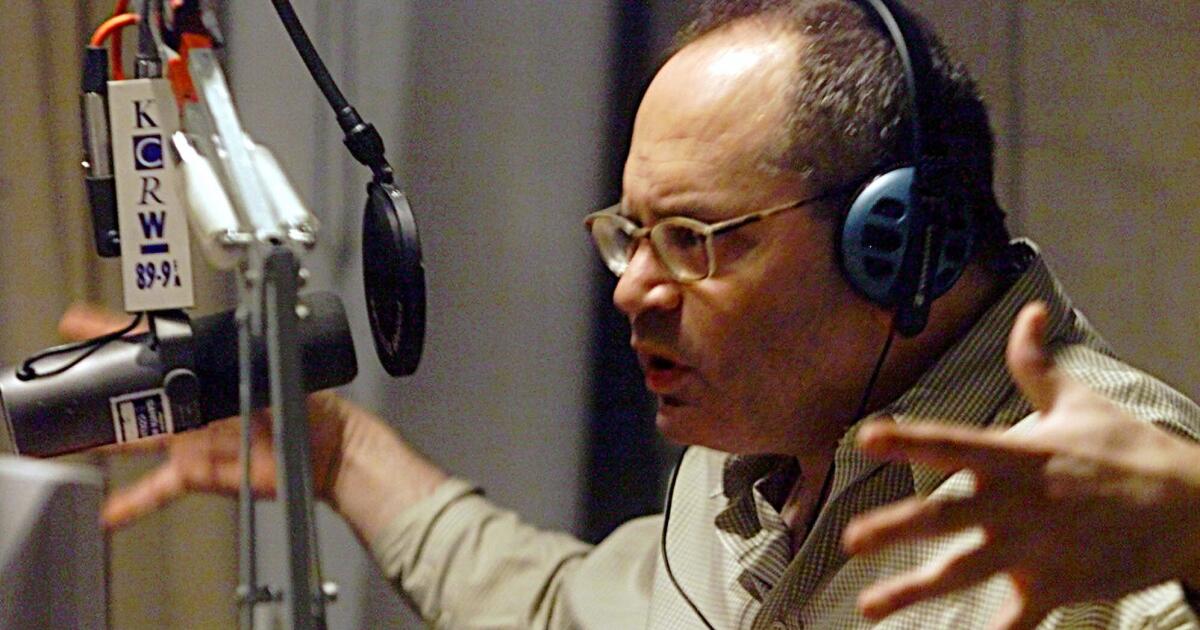
Michael Silverblatt, the longtime host of the KCRW radio show “Bookworm” — known for interviews of authors so in depth that they sometimes left his subjects astounded at his breadth of knowledge of their work — has died. He was 73.
Silverblatt died Saturday at home after a protracted illness, a close friend confirmed.
Although Silverblatt’s 30-minute show, which ran from 1989 to 2022 and was nationally syndicated, included interviews with celebrated authors including Gore Vidal, Kazuo Ishiguro, David Foster Wallace, Susan Orlean, Joan Didion and Zadie Smith, the real star of the show was the host himself, the nasal-voiced radio personality who more than once in life was told he did not have a voice for his medium.
His show represents one of the most significant archives of conversations with major literary powerhouses from the late 20th and early 21st centuries.
But Silverblatt knew that he was as much a character as the people he interviewed.
“I’m as fantastical a creature as anything in Oz or in Wonderland,” he said during a talk in front of the Cornell University English department in 2010. “I like it if people can say, ‘I never met anyone like him,’ and by that they should mean that it wasn’t an unpleasant experience.”
Born in 1952, the Brooklyn native learned to love reading as a child when he was introduced to “Alice’s Adventures in Wonderland.” Neighbors would see him walking the streets of Brooklyn with his head in a book and would sometimes call his parents out of fear he might get hurt.
But until he left home for the University at Buffalo, State University of New York, at the age of 16, Silverblatt has said, he had never met an author.
His college, however, was filled with such famous authors as Michel Foucault, John Barth, Donald Barthelme and J.M. Coetzee, who were all working as professors.
Silverblatt was shy and too embarrassed to speak during class because of his inability to clearly pronounce the letter “L,” which appears three times in his own name. Yet he considered the authors to be his friends, even if they did not know it yet, he said during the Cornell talk.
He would approach them after class to speak about their work.
Despite his interest in literature, Silverblatt’s parents wanted him to become a mail carrier, he said. The summer after his freshman year, Silverblatt worked a New York City mail route, delivering letters to the mayor’s mansion on an Upper East Side route that took him past numerous old bookstores and used-books shops. During that job, he said in the Cornell talk, he purchased the complete works of Charles Dickens.
Silverblatt moved to Los Angeles after college in the mid-1970s and worked in Hollywood in public relations and script development.
Like many young writers in Los Angeles, he wrote a script that never got made.
It was in Los Angeles that Silverblatt met Ruth Seymour, the longtime head of KCRW.
Seymour had just returned to the United States from Russia and was at a dinner party where everyone was discussing Hollywood. There, she and Silverblatt became immersed in a one-on-one discussion of Russian poetry.
“He’s a great raconteur and so the rest of the world just vanished,” Seymour told Times columnist Lynell George in 1997. “Afterward I just turned and asked him: ‘Have you ever thought about doing radio?’”
For the next 33 years, that’s exactly what he thought about.
“Michael was a genius. He could be mesmerizing and always, always, always brilliant,” said Alan Howard, who edited “Bookworm” for 31 years.
“It’s an extraordinary archive that exists, and I don’t think anyone else has ever created such an archive of intelligent, interesting people being asked about their work,” Howard said. “Michael was very proud of the show. He devoted his life to the show.”
Silverblatt once dreamed of being on the other side of the microphone, as a writer in his own right, Howard said. But he faced bouts of writer’s block through his 20s and gave up writing.
“Eventually, he came to find peace with the reality of that,” Howard said.
Instead of writing, he became an accumulator of a vast amount of other writers’ work — in his library as well as the repository in his head. He had an incredible memory for the books he read.
Silverblatt converted the apartment next to his Fairfax apartment into a library where he kept thousands of books, Howard said.
“It was heaven,” he said. “It was a fabulous library.”
“He was such a singular person,” said Jennifer Ferro, now the president of KCRW. “He had a voice you would never expect would be on radio.”
Alan Felsenthal, a poet who considered Silverblatt a mentor, called Silverblatt’s voice “sensitive and tender.”
Felsenthal said the show was about creating a space of “infinite compassion,” where writers could share things they might not share in everyday conversation.
“Michael was one of a kind, truly singular. And his voice is too,” Felsenthal said.
One of the most important tenets of Silverblatt’s approach was that he not only read the book he was discussing on his show that day, but also read the entire oeuvre of the authors he interviewed.
“A significant writer would come in and be bowled over by Michael’s depth of vision of the work at hand,” Howard said.
David Foster Wallace, in one interview, said he wanted Silverblatt to adopt him.
Silverblatt said he strove to read an author’s entire body of work, but he never claimed to have read it all if he hadn’t.
“In general I try to read the author’s complete work. … That’s not always true, and I never say it if it isn’t true. But more often than not, I have, at least, read the majority of the work. And sometimes it’s a superhuman challenge,” he said in the 1997 Times column.
The voracious reader said that the best books, those that brought him happiness, were not the ones that ease our way in this strange and difficult world.
“The books I love the most made it harder for me to live,” he said.
Silverblatt is survived by his sister, Joan Bykofsky.