vitriol

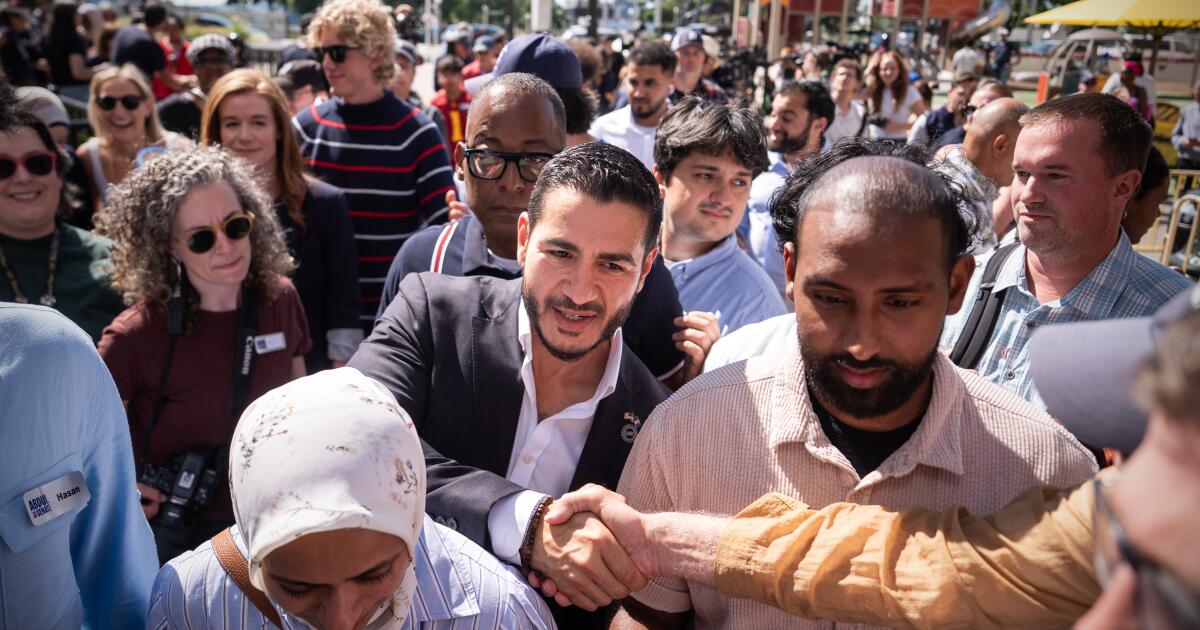
As Abdul El-Sayed breaks a barrier, anti-Muslim vitriol surges on multiple fronts

Abdul El-Sayed made history this month in Michigan by becoming the first Muslim nominated by the Democratic Party to run for the U.S. Senate. But elation among many of his fellow Muslim Americans was tempered by awareness of persisting and widespread anti-Muslim sentiment across much of the nation.

Some Republicans, including President Trump, swiftly began referring to the nominee by his full name, Abdulrahman Mohamed El-Sayed, while depicting him as a danger to America. “Every single Muslim holding public office in America is a Trojan horse, and a threat to both national security and our republic,’’ said U.S. Rep. Nancy Mace, R-S.C., in a post on X.

El-Sayed says such attacks betray a weakness in those who launch them.

“We all pray for the same things. … We want what’s good for our kids and our families,” he told MS NOW after his primary victory. “They’re going to use Islamophobia, because their ideas are tired.”

The vitriol extends far beyond the political class. Tensions related to anti-Muslim sentiment have heightened in several communities around the country, where some residents have bitterly opposed proposals to build new mosques.

“American Muslims have made incredible political and societal progress in recent years,” said Edward Ahmed Mitchell, national deputy director of the Council on American-Islamic Relations, or CAIR. He cited increased visibility in entertainment and sports and the election of Democrat Zohran Mamdani as New York City’s first Muslim mayor.

“But there also is a very concerted backlash to this progress,” Mitchell said. “You’ve seen this in the resurgence of anti-Muslim hate and rhetoric, the targeting of mosques.”

A Dallas suburb is a flashpoint

McKinney, Texas, a large suburb in the Dallas-Fort Worth area, is one of the flashpoints. Despite angry anti-Islam remarks at a heated city council meeting on Aug. 4, the council voted unanimously to approve a site plan for the McKinney Islamic Association’s proposed new mosque, classroom building and gym.

Among those urging the council to give the plan fair treatment was George Fuller, a former mayor of McKinney, a nonpartisan position. Opponents of the mosque project booed him, and some shouted “traitor” as he left the council chamber. One woman could be seen on video physically accosting him.

“I have never witnessed so much hate, anger and lack of humanity in our beautiful community gathered in one place as I did today at City Hall,” Fuller later wrote on Facebook.

During the hearing, which lasted more than four hours, the speakers included U.S. Rep. Keith Self, a Republican whose district includes McKinney. To loud applause, he urged the council to reject the mosque proposal.

“I know you’re in the accommodation phase, but the intimidation phase follows quickly,” Self said. “Child marriage. Honor killings. Don’t tell me it can’t happen here.”

Fuller also went to the microphone, evoking the broader phenomenon of divisive political rhetoric.

“Sadly, we live in a time when some have discovered that the easiest way to gain attention or win elections is not by offering solutions but by manufacturing fear, dividing communities, demonizing neighbors and turning misinformation into a political strategy,” he said.

In North Carolina, anger flares over approval for a new mosque

The scenario was similar in Mooresville, North Carolina, when town commissioners held a public comment session on Aug. 3 about a proposed mosque that had already been approved, with early phases of construction underway.

Angry residents at the meeting voiced hostility to Islam and assailed the commissioners for not being more forthcoming about the project as it took shape over previous months. One speaker cited violence in Nigeria by Islamist extremists as a reason for concern in Mooresville. Another depicted Islam as “a political regime with the ultimate goal of takeover in regions and nations.”

CAIR’s regional manager, Al Rieder, issued a statement denouncing “the hateful and conspiratorial anti-Muslim rhetoric” that surfaced at the meeting and expressed concern about the safety of Muslims in the area about 25 miles north of Charlotte.

“Muslims are your neighbors, your doctors, your teachers, your local politicians, your police,” he said.

A few hours after the public meeting, the town commissioners released a summary of the mosque project, which calls for a two-building Islamic center on a parcel acquired in 2019 by a local Muslim organization.

The commissioners said that the parcel is in an area zoned to allow religious assembly and that the mosque proposal was handled the same way as a proposal for a new church.

“All decisions must be based on adopted ordinances, objective standards and legal requirements, which do not allow for different rules for different religious groups,” the commissioners said. “We encourage all members of our community to remain respectful in their discussions and interactions as this project moves through the appropriate processes.”

In Oklahoma, Muslim leaders fight against the rebuff of a new mosque

A mosque controversy has been raging for many months in Broken Arrow, Oklahoma, Tulsa’s largest suburb.

Back in January, at a stormy meeting attended by hundreds of people, the city council voted 4-1 to reject a rezoning proposal by the region’s Islamic Society to build Broken Arrow’s first mosque. Before the vote, dozens of residents voiced anti-Muslim views while opposing the project.

Council members who rejected the mosque had raised concerns about its potential impact on infrastructure such as roads, sewers and flood plain management.

But the Islamic Society is persisting with its quest. On Aug. 3, it filed a lawsuit against the mayor and four councilors, alleging that the vote reflected “a wave of bigoted opposition from members of the community and local politicians.” The lawsuit contends that the council violated state and federal laws governing religious land use, treating the mosque proposal differently from other comparable rezoning requests.

“They did not want a mosque in their city. They did not want Muslims here,” said Meghan Murphy, an attorney with CAIR’s Legal Defense Fund, at a news conference announcing the lawsuit. ”So they made up a reason, and in doing so they violated the law.”

Some see a terrorism threat while others see baseless scaremongering

Opposition to mosque construction isn’t a new phenomenon: In Murfreesboro, Tennessee, an effort launched in 2010 to block a mosque project dragged on for more than three years. The mosque was built anyway as the case moved through the courts, but members of the Muslim community faced public protests, vandalism, arson and a bomb threat during that span.

The latest anti-mosque campaigns coincide with a broad wave of anti-Muslim rhetoric from Republican officeholders over the past year. In Congress, several bills were introduced targeting sharia, the moral and spiritual framework that guides Muslims in prayer and ethical conduct. Some Republicans say they’re concerned about growing Muslim populations in major cities and potential ties to terrorism — fears that CAIR and other civil rights groups say are unfounded and being exploited for political purposes.

Republican governors in Texas and Florida have endorsed efforts to shut down CAIR, saying it has ties to terrorism. CAIR has denied the allegations and filed lawsuits calling the governors’ efforts unconstitutional.

Muslim American leaders view the vitriol as political scaremongering.

“Every election year, we expect a rise in anti-Muslim hate,” said CAIR’s Mitchell. “It’s been worse this year than it has been in years.”

Crary writes for the Associated Press.

Source link

Why the vitriol for Dodgers’ Kyle Tucker was so thick at Wrigley Field

The boo birds were active at Wrigley Field this week, as the Dodgers were swept by the Cubs in a three-game series.

The vitriol for the World Series favorites, days after they traded for the best player available at the deadline (two-time CY Young winner Tarik Skubal) touched almost every player in the Dodgers lineup. But Cubs fans’ boos were by far the most enthusiastic for the right fielder who’d departed their team in free agency this past winter.

Kyle Tucker, for his part, dodged the first question that mentioned the hostile reception he received in his first series back at Wrigley Field since signing a four-year, $240 million contract with the Dodgers over the offseason.

“I liked playing here last year,” Tucker said after the game Monday. “There were some really great guys over there, and they have a good team. So it’s nice being back and playing here. I liked it.”

When pressed on whether he understood the boos, Tucker said: “I don’t know. I tried my hardest last year. I tried playing through a hand fracture and calf thing, just trying to get back to the playoffs for them and trying to do what I could to help out the team last year with them. Hit really well in the first half, and second half didn’t go as great, and kind of didn’t end up great at the end of the year. But I had a good run.”

Let’s unpack that.

This year, Dodgers fans have mostly seen a version of Tucker who’s on pace for one of the worst offensive seasons in the four-time All-Star’s career. But when the Cubs landed Tucker in a blockbuster trade with the Astros before the 2025 season, hoping he’d elevate their offense, he did just that for the first three months of the season.

His best month was June (.982), when, unbeknownst to the public, he was playing through a small fracture in his right hand.

Not being able to grip the bat properly eventually took a toll on his swing mechanics, sending him into an extended slump. When he finally seemed to be coming out of it in late August, a left calf injury sidelined him in early September.

When the injury lingered far longer than initially expected, hoping to return in time to contribute in the postseason, Tucker made the unorthodox decision to travel to Tampa to work with the physical therapy group that helped him recover from a fractured shin the year before.

Unable to completely eradicate the symptoms of his strained calf, Tucker returned to the Cubs lineup as the designated hitter the last weekend of the regular season and through the playoffs, where he went 7-for-27 with a home run in Game 4 of the NLDS.

Through the ups and downs of the season, Tucker still came out of it with a 2025 Silver Slugger award. He had the second-highest OPS on the team (.841) among players with at least 100 plate appearances, behind former Dodger Michael Busch (.866).

In response to Tucker’s comments Monday, Cubs fans on social media said they were upset with Tucker for playing through his hand injury, and for leaving the team to address his calf injury — which seemed to set up a no-win situation for his relationship with the fan base.

Tucker’s union with the Cubs was always expected to be short term. That was always the case from the moment they acquired him one season away from what was projected to be a lucrative free agency. Nothing had changed by the last out of the team’s 2025 season, as they fell one win shy of meeting the Dodgers in the National League Championship Series.

With the Dodgers, Tucker has yet to put together a real hot streak at the plate. He’s hit far better in away games (.828 OPS) than at home (.601) this year.

On the road again, Tucker went 5-for-11 in three games against the Cubs this week — perhaps a sign of good things to come, in a season full of false starts.

“Just working every single day, just trying to be consistent with my work and what I do in the cage and everything and trying to translate it out onto the field,” he said Monday. “Felt pretty good today. Had good at-bats the past couple days and stuff. So just trying to continue that moving forward into tomorrow’s game and so forth.”

His biggest moment of the series came Tuesday. In his first at-bat of the game, he lifted a solo home run into the left-field bleachers and trotted around the bases to a chorus of boos.

It was the Dodgers’ only run of the game.

Source link

How transgender athlete AB Hernandez beat vitriol stoked by Trump

Jurupa Valley senior AB Hernandez stood on a hillside overlooking Veterans Memorial Stadium, a booklet of encouraging letters tucked under one arm and two gold medals hanging from her neck.

She rolled the medals between her fingers.

“I still feel like I’m gonna be here next year,” she said. “I guess I’ll process it overnight maybe, then tomorrow, I’m going to Disneyland.”

For most high school seniors, a state championship marks the end of a season.

For Hernandez, it marks the end of three years spent competing as a transgender athlete under a spotlight few teenagers could imagine.

On Saturday, she won state titles in the high jump and triple jump, capping her career as a four-time state champion. Days earlier, she had graduated from high school.

AB Hernandez leaps in the air during the CIF state track and field championship finals in Clovis on Saturday.

AB Hernandez leaps in the air during the CIF state track and field championship finals in Clovis on Saturday.

(Tomas Ovalle/For The Times)

Away from the spotlight, Hernandez likes swimming, spending time with friends and working on her makeup routine. During the past two years, politicians and activists stoked by President Trump have turned her into a symbol in the national fight over transgender athletes’ right to participate in girls’ sports.

“I feel like I’m always going to be in the public eye,” Hernandez said. “It’s never going to go away and that’s weird. But maybe someday it’ll be for something else.”

At the state championships, that fight was visible everywhere except where Hernandez seemed most comfortable: among the athletes competing in the stadium.

At the end of Friday’s preliminary competition, Hernandez and five other high jump contenders sprawled on their stomachs beneath the high jump tent, cheering on West Ranch junior Avery Prestridge and La Jolla junior Anastasia Volkov in a jump-off for the final qualifying spot.

AB Hernandez laughs with other athletes while standing on the state track and field championship podium.

AB Hernandez, second from right, laughs while standing on the first place podium alongside Monta Vista’s Leilani Laruelle after the CIF state track and field high-jump finals on Saturday.

(Tomas Ovalle/For The Times)

When Prestridge secured the berth, she and Hernandez exchanged a high-five and a smile.

“That’s what will stick with me,” Hernandez said. “Laying on the field, cheering for other girls, everyone being sweet.”

It was a stark contrast to the image detractors tried to paint earlier in the day.

While Hernandez warmed up on the track, anti-trans activists and politicians gathered across the street in an area marked by a CIF sign reading “free speech area.”

There, organizers who have protested women’s athletic events involving transgender participants across California delivered speeches demanding that the CIF prohibit Hernandez and other transgender athletes from competing. They were unmoved by CIF’s policy requiring that any transgender athlete who advances in track and field playoffs or places in competition be joined by the next cisgender girl in the rankings, with both advancing or receiving the same medal.

“The message being sent to female athletes is clear — your opportunities, your records, your placement and your hard work comes second to males,” former NCAA soccer player Sophia Lorey said during the rally.

California Republican gubernatorial candidate Steve Hilton spoke alongside the protesters.

“The first thing we have to do is overturn the law that set all this in motion, AB 1266, that was passed in 2013, that’s why we’ve been living with this for so long,” Hilton said to Fox News. “That law violates the California state Constitution. … I will immediately suspend the law while we begin legal proceedings to overturn it.”

Republican gubernatorial candidate Steve Hilton held a news conference outside the state track meet.

Republican gubernatorial candidate Steve Hilton held a news conference outside the state track and field championships in Clovis denouncing CIF for allowing transgender athletes to compete alongside girls.

(Tomas Ovalle/For The Times)

Earlier in the day, Democratic gubernatorial candidate Tom Steyer posted a video on X with Hernandez.

“I’m so proud of you for what you’re doing,” Steyer told Hernandez. “So proud of you for succeeding. So proud of you for competing. That’s really the point. … And I’m going to hope like heck that you don’t just make state but you do really well there. Deal?”

Last year, Trump wrote on his social media platform, Truth Social, that, “As a Male, he was a less than average competitor. As a Female, this transitioned person is practically unbeatable.”

He also threatened to withhold federal funding from California if the CIF allowed Hernandez to compete. That came after he enacted an executive order in February 2025 barring transgender women and girls from participating in sports according to their gender identity.

Transgender participation in sports has become a central Republican talking point in recent years and it is impossible to separate Hernandez’s story from that political context.

Focus on the Family, Family Research Council and California Family Council have invested years and millions of dollars into messaging, advocacy and legal efforts surrounding the issue. According to ProPublica and public filings, those organizations collectively reported hundreds of millions of dollars in revenue in 2024.

Transgender athlete AB Hernandez with other athletes at the CIF state track and field championships in Clovis.

Transgender athlete AB Hernandez, center, poses with other athletes at the CIF state track and field championships in Clovis on Saturday.

(Tomas Ovalle/For The Times)

As a result, a California athlete who confirmed her transgender status became the focus of a national political fight.

“The voice of the kid who’s been targeted gets lost,” said activist Daisy Gardner, who spoke at a news conference supporting Hernandez before Saturday’s meet. “We’re up against a million[-dollar] machine on the other side who has launched the ‘Protect Girls’ Sports’ campaign, and we need to have a little ray of sunshine pushing through the darkness.”

The Trump administration’s Executive Order 14201, titled “Keeping Men Out of Women’s Sports,” was issued on Feb. 5, 2025, and was followed the next day by an NCAA ban on transgender athletes participating in women’s sports.

AB is not sure whether she will find a way to continue competing in college.

“I don’t think any child should have to go through this,” AB’s mother Nereyda Hernandez said. “These are adults willingly doing this to a minor child. This is a kid, a breathing human, a child. It’s not what people are making this out to be.”

For the first time during Friday’s preliminary competition, the clouds broke and the Clovis sun beat down on the field.

AB, who had posted the top regional mark, needed only one jump to qualify for the next day’s finals. She went last in the second flight.

As she prepared for her attempt, the public address announcer’s voice echoed through the stadium.

“In girls’ long jump, here comes AB Hernandez.”

A ripple of applause spread through the crowd from those who recognized the name. Nereyda and family friend Trevor Norcross were among the loudest.

Transgender athlete AB Hernandez leaps over the high jump bar during the state track and field championships in Clovis.

Transgender athlete AB Hernandez won the high jump title during the state track and field championships in Clovis.

(Tomas Ovalle/For The Times)

Two hours later, after completing her triple jump qualifying leaps, Hernandez headed to the high jump, where she again found herself among the final competitors remaining.

During the long wait between events, Nereyda was interviewed by ABC30. At the same moment, AB was preparing for a high jump attempt.

Gardner, the activist, hurried over, tapped Nereyda on the shoulder and pointed toward the pit.

Nereyda quickly turned her phone sideways and hit record.

“Let’s go AB!”

The night before qualifying, AB, Nereyda and friends sat in a hotel room making bracelets. At first, they strung rainbow-colored beads. AB shook her head. Her colors were pink and gold.

“I know what looks good on me,” she said. “I want something that represents me. People see a flag, and that’s not me in my entirety. I want something that is me personally, me entirely.”

While Nereyda felt the familiar butterflies about what the next day might bring, AB focused on what mattered to her. She decided how she wanted to wear her hair and prepared the custom-made letterman jacket she got last year with money donated by supporters.

Transgender athlete AB Hernandez wears a letterman jacket funded by her supporters and waves during the state track meet

Transgender athlete AB Hernandez wears a letterman jacket funded by her supporters and waves during the CIF state track and field championships in Clovis.

(Tomas Ovalle/For The Times)

AB Hernandez's mom, Nereyda, shows a friendship bracelet she made that reads "I stand with AB."

AB Hernandez’s mom, Nereyda, shows a friendship bracelet she made alongside supporters of her daughter that reads “I stand with AB.”

(Tomas Ovalle/For The Times)

“She said, ‘I want my letterman jacket,’ and I was like, OK,” Nereyda said. “And she said, ‘I want that to be a reminder every time I wear it, I want it to be a reminder of the people who supported me,’ and that’s what she did.

“It was a daily reminder that she wasn’t alone.”

Those are the memories Nereyda says will stay with her more than the vitriol she and her daughter have faced during the past two years. AB is a reluctant transgender athlete pioneer who prefers to be known for so much more than just her gender identity, but the prospect of hiding because she was relentlessly attacked didn’t feel right, either.

“I’m always going to think about how hard she tried to be here,” she said. “She didn’t quit. Despite all the pressure, you can’t change my kid.”

The night before AB’s final competition, Nereyda felt sick. She suspected it was stress over what the next day might bring.

But Saturday passed with minimal disruption.

AB’s long jump did not meet her usual standard. She finished third with a mark of 20 feet, 2 1/4 inches, a result she described as “bittersweet.”

“It was a little nerve-wracking,” Nereyda said. “I could see it was a different vibe when she got into the high jump and triple jump.”

In those events, Hernandez delivered the top performances of the day to repeat as a state champion.

She leaped 42-8 3/4 in the triple jump, comfortably ahead of Los Altos senior Daniela Hughes, who finished at 41-1 before sharing the podium. Standing together atop the first-place position, the two posed for photos with Hughes’ arm draped around Hernandez.

“I’m just happy with my performance,” Hughes said when asked about sharing a podium. “I wanted to win a championship.”

Transgender athlete AB Hernandez clinches her fists and reacts after completing a high jump during the state track meet.

Transgender athlete AB Hernandez clinches her fists and reacts after completing a high jump during the CIF state track and field meet in Clovis.

(Tomas Ovalle/For The Times)

About 30 minutes after the high jump medal ceremony, AB walked toward her mother.

Nereyda spotted her and threw her hands into the air.

“My baby!”

The two embraced, away from the crowd, the cameras and the ire.

“She did it,” Nereyda said. “With everything else, it didn’t matter, she did it.”

Source link