Haphazard pesticide enforcement puts farmworkers in California at risk
In California’s Sacramento Valley, a grower was cited for multiple pesticide safety violations in a stone fruit orchard.
In the sweeping farmlands near the Central Coast, a seed supplier that cultivates peppers, vegetables and fruit was hit with more than two dozen pesticide safety violations, some of them serious offenses that caused health or environmental hazards.
And in the San Joaquin Valley, an agricultural retailer with a history of pesticide safety violations was cited for failing to provide protective equipment for workers and post emergency medical information in the fields.
In all, nearly 18,000 regulatory actions were taken by county pesticide safety inspectors across California from the start of 2020 through June 2025. Fewer than 30% resulted in fines, though, according to state enforcement records.
When regulators did levy penalties, they were often as low as $50 to $250, and they varied widely from county to county for the same violations, according to an analysis of more than 40,000 state enforcement records obtained through public records requests.
The regulatory system designed to protect farmworkers from pesticides is enforced haphazardly across California. Even in cases where regulators found that companies endangered workers or committed multiple violations, few were penalized for all their citations. Instead, they received warnings or notices to correct problems for cases in which they were not penalized, an investigation by Capital & Main has found.
In interviews, dozens of farmworkers reported suffering from nausea, burning eyes or irritated throats due to chemical-laced fields. Most said they didn’t report the problems because they feared retaliation or lacked confidence in the regulatory system.
“Yes, there are laws,” said Jesus, his face wrinkled from years of harvesting garlic, pruning grape vines and picking blackberries in the sun-baked San Joaquin Valley.
“But unfortunately, at times the law favors the powerful — it sides with the wealthy,” he added, asking that his last name not be used for fear of reprisal from his bosses.


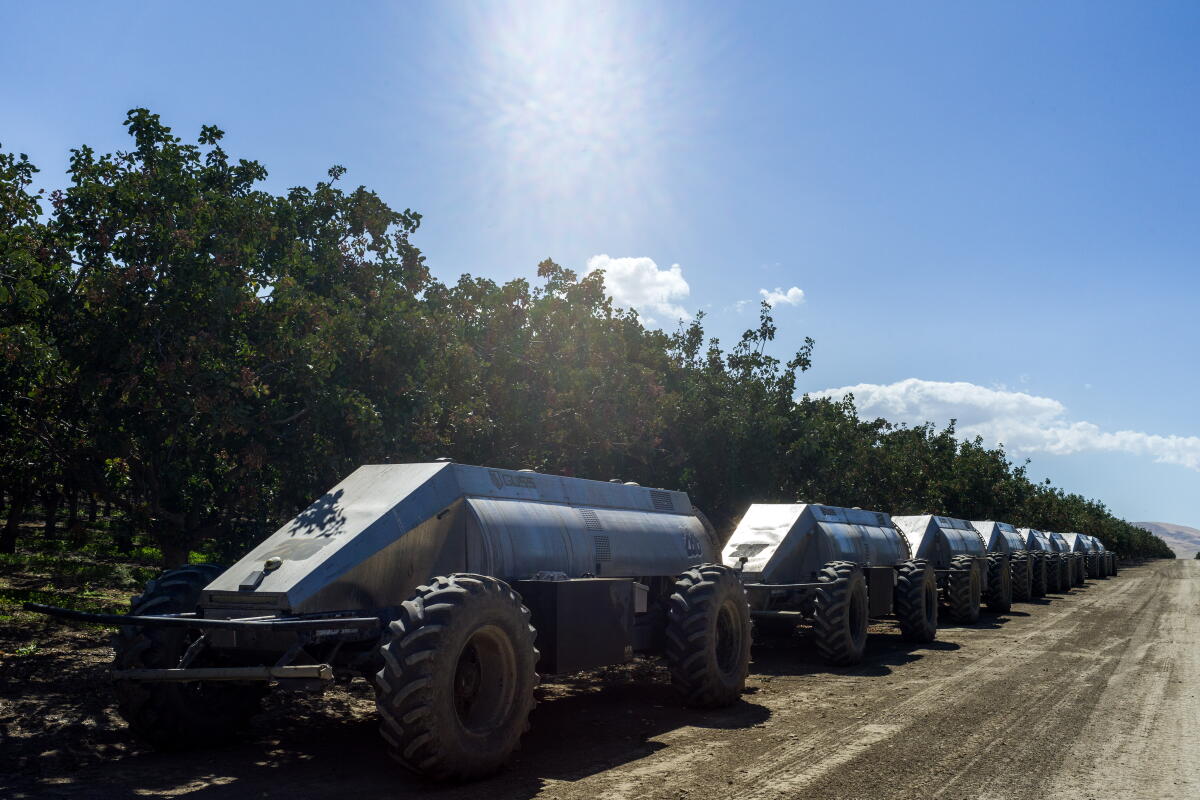
Autonomous tractors, which are used to apply pesticides, line a field in Fresno County. The machines are operated remotely and spray crops including pistachio and almond trees. A scarecrow overlooks a field of corn at La Huerta de Cantua Creek.
Labor and community activists who track pesticide safety issues contend that lenient penalties, as well as warning letters and written notices, fail to deter violators, especially repeat offenders and larger businesses that can absorb the costs of fines.
State records show that warning letters and written notices were issued more than twice as often as penalties, “[raising] serious questions about accountability and deterrence,” said Bianca Lopez, co-founder and project director at Valley Improvement Projects, which monitors pesticide safety in the northern San Joaquin Valley.
The findings come as state officials are proposing to overhaul decades-old pesticide regulations to toughen enforcement and standardize penalties. Those proposals are strongly opposed by groups representing growers, retailers and providers of agricultural services.
Current regulations are enforced by county agricultural commissioners, who police pesticides in their jurisdictions and also promote California’s $61-billion agricultural industry.
In a statement, the California Department of Pesticide Regulation acknowledged the need to improve regulation and ensure it is applied consistently in every county.
Department spokesperson Amy MacPherson said officials are also proposing new regulations that would increase fines for violations that affect people’s health. This can include cases in which toxic chemicals drift into neighboring fields or communities and sicken people.
MacPherson said county agricultural commissioners have discretion in deciding which enforcement tools — warning letters, written notices, fines — to use in a given situation, depending on the “nature and severity of the violation.”

Paola Lopez, who has harvested raisins in the central San Joaquin Valley, supports stronger regulations.
On a Saturday in late September 2025, the 40-year-old mother of four was loading crates of grapes onto a forklift in a Fresno County field. A tractor pulling a pesticide sprayer passed by on a street just a few yards away. She remembers a loud blast — then a toxic spray covered her face and arms.
“It was a little hard for me to breathe, and my eyes started burning a lot,” she said in Spanish, recounting the incident to a reporter. “I could hardly see.”
Disoriented, she called local activist Nayamin Martinez, executive director of the Central California Environmental Justice Network. Lopez had received pesticide safety training from the organization.
Martinez told Lopez to go to a hospital and said she would file a complaint with the Fresno County agricultural commissioner’s office.
“She started vomiting and became dizzy,” the local activist wrote of Lopez in the complaint.

Paola Lopez, 40, harvests raisins in the San Joaquin Valley and cares for her four children when she is not working in the fields. In September 2025, she was exposed to toxic pesticides and required emergency medical treatment. The county agricultural commissioner investigated the incident and found multiple state pesticide safety violations. Above, Lopez at home with two of her children on April 4.
A reporter reviewed copies of safety notices required by federal law that detail the hazardous chemicals that were mixed into the pesticide load that sprayed Lopez.
“Harmful if inhaled,” one notice says. “Causes skin irritation.”
“Danger … Causes serious eye irritation,” a second document adds.
“May cause cancer,” it warns.
California, unlike other states, has a split system of pesticide oversight. The Department of Pesticide Regulation is charged with statewide enforcement and provides guidance and training for 55 county agricultural commissioners, who police their jurisdictions.
State officials do not supervise the agricultural commissioners, who are appointed by and report to their elected boards of supervisors.
In interviews, commissioners lauded California’s enforcement system, saying they think it’s important to have discretion when applying regulations because crops, growing seasons and pesticide use vary from county to county. They said their work has improved safety in the fields.
The flexibility “gives us the ability to closely work with growers and … keep our communities safe,” said Juan Hidalgo, agricultural commissioner for Monterey County, one of the top farming counties in the nation with a gross agricultural production value of $4.8 billion in 2025.
Last year, a Capital & Main investigation found that companies with violations in multiple counties across California were not fined for hundreds of those offenses — many involving worker safety.
In 2023, a federal audit flagged serious pesticide incidents in half a dozen counties and uncovered patchwork oversight by agricultural commissioners. The county regulators interpret pesticide safety laws differently, are not required to justify fines and are not mandated to check a company’s statewide compliance history, the audit found.
The Department of Pesticide Regulation in late 2025 unveiled searchable county and statewide data breakdowns for regulatory actions taken by agricultural commissioners from the start of 2020 through the end of June 2025.
During that period, commissioners took 17,742 regulatory actions for pesticide violations of all types, but only 4,885 resulted in fines or referrals to district attorneys for possible prosecution, according to the data.
The treatment of violators, including repeat offenders and companies cited for serious infractions, varied depending on the county, according to the analysis by Capital & Main, which examined 40,150 state enforcement records detailing investigations, violations and civil penalties from 2018 through early 2024.
In one county, for instance, an agricultural commissioner fined a farmer $2,000 for failing to provide safety training for workers who applied pesticides in fields. In another county, a grower was fined $200 for the same violation.


1. A farmworker, 43, who is not identified for her safety, picks grapes that will be sold as raisins in southwest Fresno County on Sept. 3. She works from 6 a.m. to 3 p.m. and is paid 36 cents for each paper sheet she fills. 2. A grape farm in Fresno County.
Failure to provide pesticide safety training for workers who handle pesticides is one of the most common violations in California, according to state regulators. Such training is crucial for all field workers because pesticides have different safety requirements and can pose serious health risks.
Many farmworkers who were interviewed, including Lopez, who was sprayed in the raisin field, said employers did not provide pesticide safety training.
According to the analysis, more than 240 businesses were cited for at least 1,268 violations in multiple counties across California, but they paid no fines for nearly half of these citations — many involving worker safety.
Labor advocates who have studied pesticide regulation say the oversight gaps and failures to impose stiffer fines underscore the need for more vigilant enforcement. They note that rural and predominantly Latino communities are disproportionately affected.
“We need much stronger and more consistent enforcement to protect workers and communities,” said Anne Katten, director of the Pesticide & Work Health & Safety Project for the California Rural Legal Assistance Foundation.
In June, the Department of Pesticide Regulation unveiled proposed changes to state pesticide regulations. The approval process will take months and has involved public comment; revised rules are expected to be adopted next year, officials said.
To address uneven enforcement, the new rules would require agricultural commissioners to check whether companies were cited for violations in other counties, officials said. Commissioners would also have increased reporting requirements when they don’t impose fines. Minimum levels for penalties would be raised and stiffer fines would be imposed for repeat offenders.
But individual farmers as well as more than a dozen associations that represent growers, agricultural retailers and firms that spray pesticides have voiced opposition to the changes. They argue that current regulations are effective, that agricultural commissioners need flexibility to investigate violations and that more training is needed to help growers understand the rules, according to written comments obtained through California Public Records Act requests.
“A one-size-fits-all enforcement approach fails to account for California’s agricultural diversity,” said a letter sent to state officials in December that was signed by groups such as the California Strawberry Commission and California Agricultural Aircraft Assn.
“Maintaining county-level discretion,” the letter says, “ensures that enforcement decisions reflect on-the-ground realities and local expertise.”
Some supporting the overhaul say it doesn’t go far enough to protect workers and communities.
Violations of reporting requirements, including those involving pesticide spraying near schools, would trigger only minor, optional fines, said Yanely Martinez, an organizer with Safe Ag Safe Schools, which monitors pesticide safety in the Salinas and Pajaro valleys.
In early June, the investigation into the pesticide exposure case involving Paola Lopez was closed.
Officials found five violations, including failure to have an emergency medical plan for workers, failure to protect people and wildlife from pesticide drift and failure to have pesticide safety records on file, according to a copy of the investigative report obtained through a public records request.
The agricultural commissioner’s office referred the case in June to the Fresno County District Attorney’s Office for possible criminal prosecution. As of mid-September, the case was still under review and there was no timeline for a decision regarding potential criminal charges, said Taylor P. Long, spokesperson for the district attorney.


1. Crates stacked at a grape farm in Fresno County. 2. Crates of raisins dry in the sun in Caruthers in Fresno County. 3. Sweet Harvest Church is surrounded by agricultural fields in an area of Fresno where many low-income families live and work.
If prosecutors reject the case, it would go back to the agricultural commissioner’s office, which would determine the severity of the violations and how much the fines would be, said Mario Reeves, Fresno County’s assistant agricultural commissioner.
Lopez was at her apartment in the prosperous farmland known as the “Raisin Capital of the World” when a reporter told her about the investigation’s findings and the timeframe for penalties.
She expressed frustration that months would pass before anyone is held accountable.
“How many more people will be exposed? … How many more people will get injured?” she said.
Lopez’s medical bills are covered by workers’ compensation insurance, but her health has worsened and her doctor has referred her to specialists who deal with respiratory and nervous system disorders, she said.
She had gone back to the raisin fields days after she was exposed, even though her throat was sore and she was coughing, because she needed the money. “We cannot afford the luxury of just walking away from a job,” she said.
She lasted less than two days before becoming too sick to work. She has not returned.
Lopez is an independent journalist and fellow at the McGraw Center for Business Journalism. Data journalist Cherry Salazar analyzed state pesticide records for this report.