In the footsteps of the Victorians on the Isle of Man | Isle of Man
On the shores of Douglas Bay, I could barely see the sand. Crammed on to the beach, on every available inch, were tourists bustling for the best spot. Luckily, I wasn’t there at the same time. I was looking at a black and white photograph taken some 135 years earlier, displayed in the Manx Museum in Douglas, the Isle of Man’s capital. When I’d stepped off the ferry earlier that day, the crescent-shaped beach was still there – but the crowds weren’t.
The self-governing British Crown dependency in the Irish Sea has always been a haven for outsiders. From the early hunter-gatherers who ventured here in 6500BC, to the Irish Celts (who brought over Christianity in the fifth century) and Vikings who established Tynwald (one of the oldest continuous parliaments in the world) to the Victorian tourists who transformed it into a popular holiday destination.
Tourism boomed after the advent of steamboats in the 1830s, bringing hundreds of thousands to the island. Visitor numbers rose from 60,000 a year in 1863 to 350,000 by 1887. Last year, there were 329,613 visitors.
I’d come here to try out Inntravel’s new self-guided walking holiday, a four-night, single-centre package with a booklet full of hikes to try each day and a Go Explore Heritage Pass, which offers unlimited public transport and entry to many attractions. It promises a car-free adventure using footpaths and heritage railways to explore more than just the coast.
Arriving in Douglas by ferry from Heysham, Lancashire, early on a Sunday morning, the capital was barely stirring. Along the promenade, black guillemots and herring gulls outnumbered people. Grand Victorian hotels, painted in bold blues, greens and yellows, lined the waterfront. The Tower of Refuge sat on its tiny islet, illuminated by a sliver of sunlight cutting through the cloud.
I climbed aboard the island’s 150-year-old horse-drawn tramway. Tourists shared benches with local people carrying shopping bags as children squealed with delight as the horse trotted along the seafront.
Swapping literal horsepower for electricity, I boarded the narrow-gauge railway towards Groudle Glen. Taking Inntravel’s advice, rather than heading there directly, I hopped off at a request stop near Garwick Beach, a woodland-backed pebbled cove on the Raad ny Foillan (the Way of the Gull), a 100-mile coastal path that circles the island and is well-known to long-distance hikers.
The variation on this walk was that the trail led inland through Ballannette nature reserve, where wrens loudly trilled from the brush and greylag geese bobbed across the lakes. The path then diverted to the ruins of St Adamnan’s church with its Celtic crosses dated from between the seventh and 10th centuries. Finally, I reached the fairytale setting of Groudle Glen, where the wheel at the watermill churns and the sunlight spools through the tree canopy of beech, birch and larch.
That evening I settled into the Halvard hotel, a 20-room boutique property in the heart of town, dining at its restaurant, which makes pub grub (burgers, pasta, stew) with local Manx ingredients, served with views of the sea.
The next day I headed west on another Victorian legacy: the island’s steam railway. At the Level, a request stop so short only passengers in the last carriage can disembark, Gore-Tex-clad hikers stepped off the train clutching walking poles. But with my insider guide in hand, I continued to Port Erin and rejoined the Raad ny Foillan. Purple spring squill and bright yellow gorse lined the path as it climbed and fell in a rollercoaster of colour, rabbits darting at my feet.
Soon I reached one of the island’s highlights: the Calf Sound, where the Calf of Man, a small island separated from the mainland by half a mile of sea is home to a colony of grey seals, accessed by boat trip.
My route continued along the water but then diverted inland to Cregneash, one of the last strongholds of the Manx language – a type of Gaelic – and the oldest open-air folk museum in the British Isles (founded in 1938). Here, costumed guides explain traditional crofting life while rare four-horned Manx Loaghtan sheep graze nearby and prehistoric stones stand in a circle above the village – things I would have missed had it not been for my recommended detour.
Rejoining the coast, I reached the Chasms, where the remains of an 1898 tourist cafe – which had to run with no water or electricity – cling dramatically to the cliffs. Though it closed in the 1960s, walkers and climbers still come to peer down into the sea-carved fissures below. I finished the day with the daily catch and chips in Port Erin before catching the bus back to Douglas, stomach and heart full.
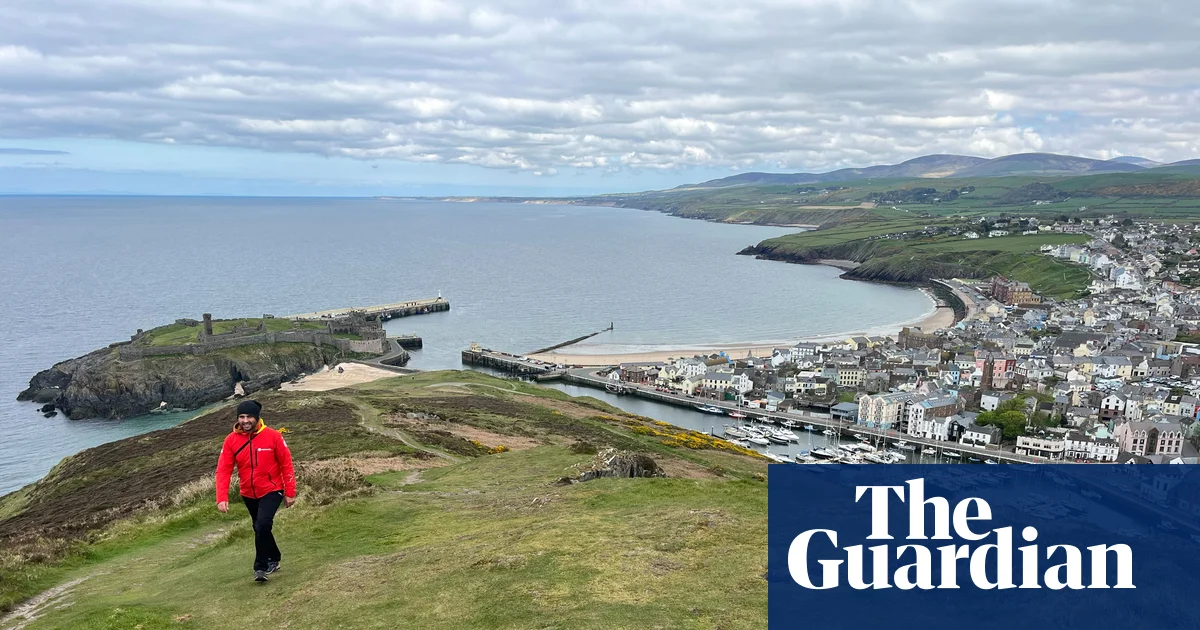
For my last full day I placed my trust in the Inntravel guide again and headed to Peel, the island’s medieval capital, where the remains of Peel Castle dominate St Patrick’s Isle, connected to the mainland by an artificial causeway. Wandering amid ruins, I listened to tales of former residents – including monks, kings, the military and the Moddey Dhoo (the legendary black dog said to haunt the castle’s ramparts) on an audio guide, included with the Go Pass.
Lunch was a paper tray of queenies – locally caught scallops simply pan-fried in butter – from the Fish Bar stall at the harbour before I climbed to Corrin’s Folly, built in 1806 by a wealthy landowner. Once more my guidebook took me away from the well-known coast and inland, to Knockaloe, site of one of the largest first world war internment camps in the British Isles – now just fields. More than 23,000 internees passed through its once barbed-wire perimeter, including Joseph Pilates, who developed his eponymous exercise system while interned here. I followed directions to a bus stop to head home, wandering through pretty woodlands and along the banks of a stream.
Back in Douglas that evening, sampling locally brewed beer at Wine Down, it was easy to imagine those black-and-white photographs filling with colour once more. But perhaps the Isle of Man’s greatest success will not be resurrecting its Victorian heyday, but rather offering the chance for travellers to explore without ever turning an ignition key. Given the climate crisis and rising carbon emissions, that makes this place feel less like a throwback and more of a glimpse into the future of sustainable travel.
The trip was provided by Inntravel. The new Highlights of the Isle of Man four-night self-guided walking break costs from £621pp, including B&B, return transfers and public transport pass