Victor Glover

Artemis II enters moon’s sphere of influence ahead of lunar flyby

April 6 (UPI) — The four crew members of the Artemis II mission entered the moon’s sphere of influence early Monday, marking the start of their lunar flyby.

The Orion spacecraft reached what is called the lunar sphere of influence at about 12:41 a.m. ET Monday, meaning the moon’s gravitational forces on the capsule were greater than those of Earth.

The mission launched Wednesday from Florida, and it took the spacecraft four days, six hours, two minutes and 54 seconds to cross the important gravitational milestone, the first crewed mission to enter the moon’s sphere of influence since Apollo 17 in 1972.

About 13 hours later, at 1:56 p.m., the four-person crew of NASA astronauts Reid Wiseman, Victor Glover and Cristina Koch, and Canadian Space Agency astronaut Jeremy Hansen will have surpassed the record for the farthest humans have traveled from Earth, which was previously set by Apollo 13 in 1970.

The spacecraft is expected to start its flyby of the moon at about 2:45 p.m. Monday, when a seven-hour lunar observation period will begin.

NASA said the crew will see both the near and far sides of the moon during this period. As window space is limited, the crew will be divided into pairs that will conduct between 55- and 85-minute observation shifts, it said.

Mission control sent the crew the final list of lunar surface features to be observed and photographed during the flyby early Sunday, according to NASA.

The astronauts will be tasked with observing about 30 targets, including the Orientale basin, a nearly 600-mile-wide crater that spans the boundary between the moon’s near and far sides, NASA said.

“The crew will study Orientale’s features up close and from multiple angles as they pass by,” the space agency said in a Sunday evening blog post.

Orion is expected to reach its closest approach to the moon at 4,070 miles at 7:02 p.m. only to reach its maximum distance from Earth during the mission minutes later.

The lunar observation period is expected to come to an end at 9:20 p.m.

At about 1:25 p.m. Tuesday, Orion will have exited the lunar sphere of influence en route home.

The 10-day moon flyby mission is to conclude with a splashdown off the coast of San Diego at about 8:07 p.m. Friday.

Source link

Artemis II leaves Earth orbit for first time in 50 yeas en route to moon

April 3 (UPI) — NASA’s Artemis II crew left Earth orbit Thursday evening en route for the moon, marking a milestone not reached in more than 50 years.

The Orion spacecraft began a scheduled 5-minute, 50-second burn at 7:49 p.m. EDT, successfully propelling it and its four-person crew out of Earth orbit.

“Nominal translunar injection burn complete. The Artemis II crew is officially on the way to the moon,” NASA Administrator Jared Isaacman announced on social media.

“America is back in the business of sending astronauts to the moon. This time, farther than ever before.”

The crew of NASA astronauts Reid Wiseman, Victor Glover, Christina Koch and Canadian Space Agency astronaut Jeremy Hansen launched Wednesday evening from Florida’s Kennedy Space Center.

It is the first crewed mission to travel farther than low-Earth orbit since Apollo 17 in 1972.

The long-awaited exit from Earth orbit signaled that humankind is now on a trajectory to its closest celestial body, the moon at an average of 238,855 miles away.

“I got to tell you, there is nothing normal about this: sending four humans 250,000 miles away is a Herculean effort, and we are just realizing the gravity of that,” Reid said in a press conference after exiting orbit.

Asked what they are most excited about when they near the moon, Koch simply said it was views.

“Having just experienced incredible views of planet Earth and seeing the entire planet out the window in one pane, knowing that we’re about to have some similar views of the moon in that same way is definitely getting me more excited for it,” she said.

“I knew that that is what we would see, but there is nothing that prepares you for the breathtaking aspect of seeing your home planet both lit up bright as day and also the moon glow on it at night with the beautiful beam of the sunset and knowing we are going to get similar views of the moon, I’m just really excited for that.”

The Orion spacecraft is now on its way to the moon where the crew will perform a flyby, during which they will take high-resolution photographs and provide personal observations of the lunar surface, including the far side of the moon, NASA said.

After the flyby is completed, the four-person crew will begin their return to Earth, completing their 10-day deep-space journey with a splashdown in the Pacific Ocean on April 10.

The mission, in essence, is a crewed rehearsal for a future lunar landing, targeted for early 2028.


Source link

Artemis II astronauts complete first burn, head back to sleep

April 2 (UPI) — The Artemis II astronauts have completed their perigee raise burn as part of a planned orbital adjustment and are headed back into a four-hour rest period, NASA said.

After an earlier rest period, the astronauts were awakened at 7:06 a.m. EDT for the perigee burn. NASA played the song “Sleepyhead” by Young and Sick to wake them up.

In the perigee burn, the spacecraft lit its main engine for 43 seconds, which raised the lowest point of its orbit. This helps prevent the craft from re-entering the Earth’s atmosphere. It also refines the trajectory of the craft as it circles Earth. It put Orion into a stable high-Earth orbit, which aligns with its path to the moon.

The crew will now have another four-and-a-half-hour rest period, then they will be awakened to start their first full day in space.

Later today, the mission management team will have its first meeting of the mission to assess the spacecraft’s systems and will give its approval for the upcoming translunar injection burn. That burn will send astronauts out of Earth’s orbit and toward the Moon for the first time in 50 years. It will last just over six minutes and will speed the craft to escape Earth’s gravitational pull.

The launch on Wednesday evening began at 6:35 p.m. EDT from the Kennedy Space Center in Florida.

Soon after launch, Wiseman told operators on the ground, “We have a beautiful moonrise, we’re headed right at it.”

There was a small glitch in the craft’s space toilet, Space.com reported.

“The toilet fan is reported to be jammed,” NASA spokesperson Gary Jordan said during live mission commentary. “Now the ground teams are coming up with instructions on how to get into the fan and clear that area to revive the toilet for the mission.”

NASA Director of Flight Operations Norm Knight told reporters that the problem was a controller issue on the toilet in urine collection. The astronauts were able to use a backup system until the engineers fixed the problem before their first rest period.

About 9 minutes after the launch, the crew entered Earth’s orbit, traveling about 15,000 mph. They are expected to enter the moon’s orbit in about six days, travel around it and then return to Earth.

The four-person crew are: NASA’s Commander Reid Wiseman, Victor Glover and Christina Koch, and Canadian Space Agency’s Jeremy Hansen.

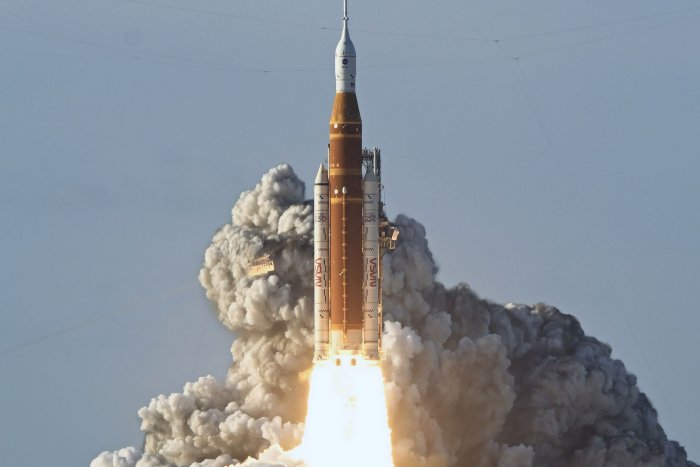
NASA’s Space Launch System rocket carrying the Artemis II crew is launched from Complex 39B at Kennedy Space Center in Florida on April 1, 2026. Photo by Joe Marino/UPI | License Photo

Source link

Artemis II lifts off for first crewed journey to moon in more than 50 years

April 1 (UPI) — NASA launched its most powerful rocket yet, the Space Launch System, on Wednesday to send the crewed Artemis II mission to the moon, the first in more than five decades.

The mission had liftoff around 6:35 p.m. EDT from the Kennedy Space Center in Florida.

Within minutes of liftoff, Artemis II commander Reid Wiseman told operators on the ground, “we have a beautiful moonrise, we’re headed right at it.”

The four-person crew — which also includes NASA’s Victor Glover and Christina Koch, and Canadian Space Agency’s Jeremy Hansen — is expected to enter the moon’s orbit in about six days. The spacecraft won’t land on the moon, but will orbit around it before returning to Earth.

The 2-hour launch window for Artemis II began around 6:24 p.m., and most of the pre-flight checks were successfully.

Shortly after the crew members boarded the craft, though, NASA officials had to address a pair of issues.

Derrol Nail, of NASA, said officials fixed a problem with the Space Launch System rocket’s flight termination system.

Later, there was a problem with the battery on the launch abort system on Orion. This system ejects the capsule away from the rocket in case there’s a problem with the rocket during flight. NASA detected issues with temperature readings on the battery but had resolved the issue before schedule launch.

The 10-day trip will be the first crewed flight to the moon in more than 50 years and the farthest distance from Earth traveled by humans.

About 9 minutes after the launch, the Artemis crew entered orbit, traveling about 15,000 mph. During Earth orbit, the crew has a series of tasks to complete before they’re able to make their way to the moon.

The Artemis I mission in 2022 flew around the moon but didn’t have a crew aboard.

Children race to push colored eggs across the grass during the annual Easter Egg Roll event on the South Lawn of the White House in Washington on April 21, 2025. Easter this year takes place on April 5. Photo by Samuel Corum/UPI | License Photo

Source link

NASA starts countdown clock for Artemis II launch

March 30 (UPI) — NASA officials on Monday started the two-day countdown to the Artemis II mission launch, which will send a crew of four around the moon as they test the Space Launch System rocket and Orion spacecraft.

After canceling a launch attempt in February because of a helium valve concern, officials said that the only thing they are worried about ahead of Wednesday’s launch is the weather — and the forecast offers an 80% chance for the right conditions.

The 10-day mission, which will take the crew farther from Earth than any human before, is the next step in the agency’s goal of returning humans to the surface of the moon and establishing a permanent presence there.

With mission engineers starting the clock, the crew — Mission Specialist Jeremy Hansen, Mission Specialist Christina Koch, Commander Reid Wiseman and Pilot Victor Glover — are getting some rest and spending time with their families before starting their own pre-launch activities, officials said.

“The team concluded that everything continues to look good and there are no issues preventing us from pressing ahead,” NASA’s Associate Administrator Amit Kshatriya said during a media briefing from Kennedy Space Center in Florida.

“At this point, as we enter the pre-launch phase, we are in a strong posture and the mission remains on track,” he said.

Countdown to launch

The Artemis II launch window starts at 6:24 p.m. EDT on Wednesday, giving NASA two hours if the cumulus cloud cover is too heavy, which mission engineers said is the only thing about the weather forecast they are worried about.

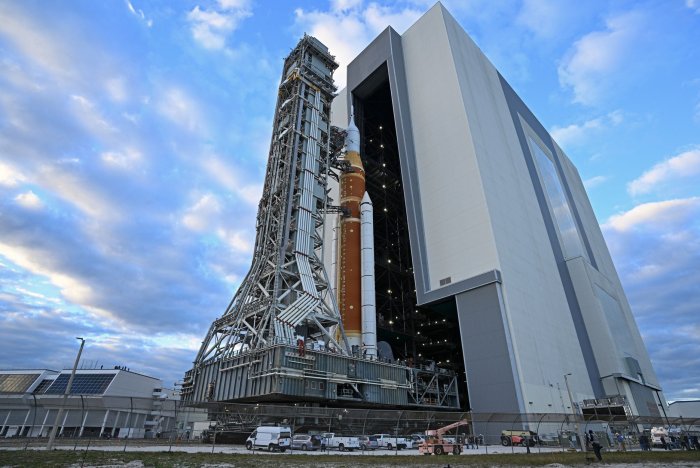
The SLS and Orion was initially rolled out to the launch pad in February but engineers discovered an issue with a helium valve during a wet dress rehearsal and decided to bring the rock back to the Vehicle Assembly Building to check it out.

After replacing the valve, and checking on other systems, the rocket was rolled back out on March 19.

Monday’s mission management team meeting is similar to the flight readiness review but is a faster rundown than that comprehensive effort as each group updates others on their pre-launch progress.

Charlie Blackwell-Thompson, launch director for the mission, said the launch countdown officially started at 4:44 p.m. EDT on Monday, which corresponds with NASA starting to configure ground facilities at the launch pad.

She noted that, while most people are familiar with a 30-minute or 10-minute countdown, launch countdowns are generally linked to the preparation needed for launch — shuttle countdowns started three days before launch, while commercial launches may often need a countdown of one day or less.

Crew awaits launch

The Artemis crew arrived in Cape Canaveral “on Friday, getting an opportunity for some rest before we work them very hard,” Emily Nelson, the mission’s chief flight director, said of the foursome, which has been in quarantine already for a couple of weeks.

Like many crews of astronauts before them, the Artemis crew has been staying at The Astronaut Beach House, which NASA has owned since 1963 and where space mission crews have spent time ahead of launches for decades.

Before the start of their final meetings and prep for launch, the crew was expected to eat dinner and spend time with their families, all of whom also have been required to comply with some sort of quarantine before getting there.

On launch day, after fuel tanking and last-minute items by a closeout crew around 1:00 p.m. EDT, the crew will board the Orion at 2:00 p.m. EDT to conduct communication system checks, configure the crew module and run the countdown to a 10-minute hold for about 30 minutes, Blackwell-Thompson said.

During that 30-minute hold, mission engineers will run through one more system-by-system before starting the final countdown to NASA’s first crewed mission to the moon in more than 50 years.

NASA’s Space Launch System rocket emerges on Saturday morning from the Vehicle Assembly Building to start its journey to Launch Complex 39B at the Kennedy Space Center in Florida. Photo by Joe Marino/UPI | License Photo

Source link