‘Unsolved Mysteries’ ventures into a new realm: video podcasts
It’s been nearly 40 years since the dread-filled tones of the “Unsolved Mysteries” theme song first hit network TV airwaves.
In that time, the celebrated documentary series has been through nearly every iteration of the TV business — and is about to embark on a new one.
Next week, “Unsolved Mysteries” will launch a video podcast in partnership with the audio and entertainment firm Audacy. The weekly podcast, which will be available on YouTube and on all podcast platforms, will release new episodes starting Oct. 29 that explore cases such as mysterious deaths and unexplained disappearances.
The podcast will be hosted by actor and TV host Jordan Murphy and will include interviews with the people involved in the case, “Unsolved Mysteries” co-creator Terry Dunn Meurer told me in a recent interview.
“We’re still trying to expand the brand and pivot,” she said. “It just feels like that’s where the industry is heading. The YouTube audience is the biggest audience out there, and we are looking for the biggest audience because we’re trying to help solve these cases. So the more viewers we can get with these episodes, the better.”
“Unsolved Mysteries” isn’t the only Hollywood player to bet on video podcasts. Spotify has bet big on video podcasts, and Netflix has added them to its platform, both of which are attempts to compete with YouTube, diversify their offerings and keep consumers tuned in.
For “Unsolved Mysteries,” the move is just the latest way the show has tried to evolve with the TV industry’s ups and downs.
The show debuted in 1987 as a series of specials NBC used to fill holes in its lineup, Dunn Meurer said. That kind of pinch-hitting meant there was no marketing or publicity to get audiences excited about the show, but viewers started tuning in anyway.
Eventually, the specials became a weekly show that aired on NBC for nine seasons before moving to CBS. “Unsolved Mysteries” also had a syndication run on cable channels Lifetime and Spike TV.
Throughout its TV lifetime, the show would highlight stories of mysterious disappearances, escaped fugitives, lost connections and even the occasional paranormal story. “Unsolved Mysteries” made appeals to viewers, urging them that someone out there “knows the truth” and encouraged them to write in with tips or new suggestions for investigation, which has resulted in tens of thousands of submissions over the years.
More recently, “Unsolved Mysteries” was revived on Netflix for three seasons, with a format focused on a single story. The series also previously had an audio-only podcast.
In addition to the video podcast, “Unsolved Mysteries” also recently produced a full-length documentary on new evidence surrounding the so-called Tylenol Killer, a 1982 case in which seven people died after unknowingly taking cyanide-filled pill capsules.
Though the method of delivery has changed, Dunn Meurer said the show’s mission remains the same. Over the years, the series has helped to directly solve more than 260 cases, she said, though many are so-called lost love cases of missed connections, as well as fugitive whereabouts and some murders.
“There’s so many mysteries out there that need attention, cases that have gone cold,” she said. “For me personally, it’s hard to not keep putting those stories out there and helping these families and law enforcement that need the help to solve these cases.”
‘Musk’ advertising controversy
In notable media news, the TikTok ad account for Bleecker Street’s documentary “Musk” was “permanently suspended” Friday, the day the film opened nationwide, a spokesperson for the indie studio confirmed.
But on Sunday, a spokesperson for TikTok said the account was restored “after an error.”
The documentary, directed by Alex Gibney, follows billionaire Elon Musk and the effect he has had on politics and his support for the GOP and President Trump.
The ban raised suspicions in Hollywood as TikTok is now partially owned by Oracle, which was co-founded by billionaire Larry Ellison. Ellison, who still serves as executive chairman of the tech company, is briefly mentioned in the documentary when he offers to help Musk finance his acquisition of Twitter, according to the Hollywood Reporter.
The documentary will make its streaming debut on HBO Max, which is owned by Ellison’s son, David.
In its second weekend in theaters, “Musk” grossed about $306,700 across 472 screens in the U.S. and Canada, for a $650 per-screen average. The film has notched a 97% critics rating on aggregator Rotten Tomatoes.
Stuff We Wrote
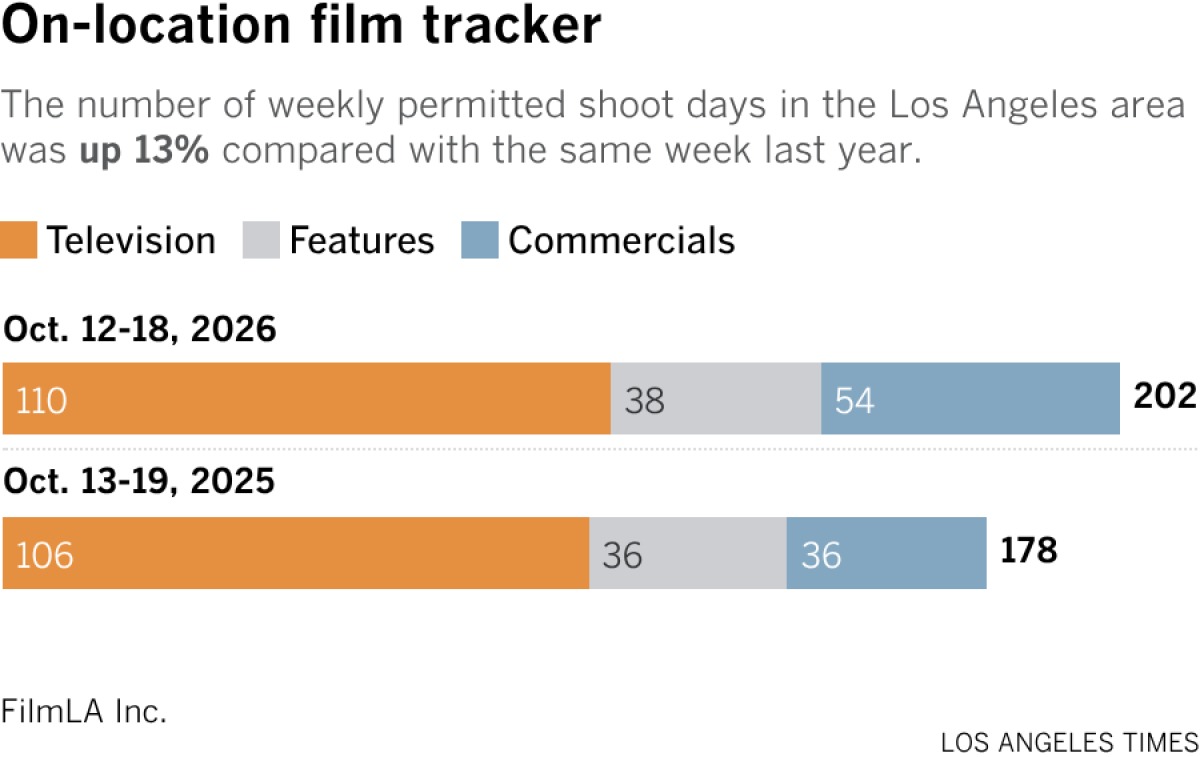
Film shoots

Number of the week

A24’s “You Can See Everything” brought in $15 million at the domestic box office over the weekend, a huge feat for the nearly three-hour documentary that delves into the life of disgraced Theranos founder Elizabeth Holmes shortly before she reported to federal prison for defrauding investors.
The documentary, directed by deadpan comic Nathan Fielder and “Primetime” filmmaker Lance Oppenheim, got a ton of buzz after its surprise debut at the Telluride Film Festival last month. The $15-million opening is even more impressive given that it was available only on 855 screens.
That was good enough for second place at the weekend box office. In first was Skydance-owned Paramount Pictures’ “Street Fighter,” which scored $31 million domestically for a worldwide gross of $51.1 million.
What I’m watching
During a busy (news) week like last week, sometimes you just need a comfort watch. For me, that’s HGTV.
There’s nothing more calming than watching people try to redo their houses into the home of their dreams. But because it’s spooky season, I ended up watching “Scariest House in America,” a hilarious home makeover competition hosted by “Parks and Recreation” comedian Retta, where homeowners show off their creepy, strange or wildly dilapidated houses in hopes of winning a renovation. After watching the travails of people who chose to live in a former jail or a self-constructed giant gingerbread house with a rickety single-person elevator, I was oddly soothed.