China Lifts The Veil On Its GJ-11 Mysterious Dragon Stealth UCAV
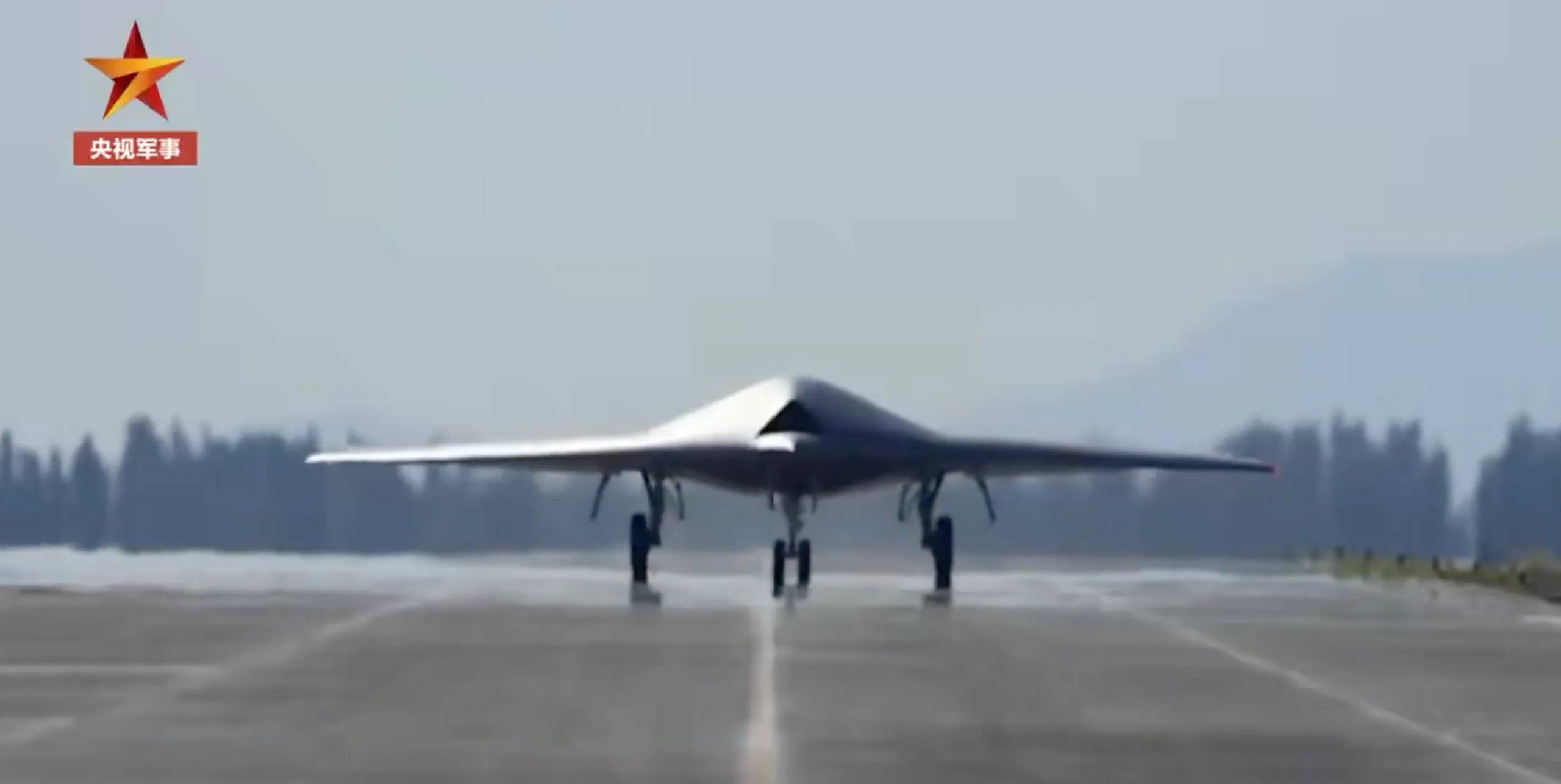
China has provided us with the clearest look yet at its GJ-11 stealth uncrewed combat aerial vehicle (UCAV), with new official footage revealing previously unseen details of the flying-wing drone, including its internal weapons bays, landing gear, nose-mounted sensor installation, and distinctive exhaust arrangement.
The release also comes alongside a claim from the People’s Liberation Army Air Force (PLAAF) that the GJ-11 has completed its first live-fire strike mission, scoring a hit. This is somewhat puzzling, since the UCAV has racked up test sorties for years already, including at forward operating locations, and it seems almost inconceivable that a live weapons delivery would not have been conducted before now. Perhaps this is a case of something being lost in translation, such as the use of a new internal sensor or a new type of weapon delivery.

The footage, broadcast by Chinese state television’s CCTV yesterday, comes two days ahead of the 77th anniversary of the founding of the PLAAF. Accompanying reporting provides additional details about the aircraft’s intended mission set, including airstrikes and suppression of enemy air defenses (SEAD), as well as its integration into manned-unmanned teaming (MUM-T) operations with crewed fighters.
The new disclosures offer the most comprehensive public look yet at the GJ-11’s configuration and provide further insight into how China intends to employ the stealthy flying-wing aircraft, which is named Xuanlong — Chinese for Mystery Dragon.

A closer look at the GJ-11
One of the most revealing views shows the underside of the GJ-11, clearly exposing its two internal weapons bays. Located within the aircraft’s blended wing-body, the ventral bays have separate sets of doors with distinctive serrated edges — a common feature on low-observable aircraft. The internal arrangement and dimensions of the bays remain unclear, as does the precise range of weapons the aircraft can accommodate. However, it would appear likely that each bay can accommodate at least a 1,000-pound-class and likely a 2,000-pound-class weapon.
According to CCTV, the two bays can carry a variety of air-to-ground/surface munitions. The weapons bay configuration had previously been revealed in a model of the GJ-11 displayed by the Aviation Industry Corporation of China (AVIC) at Airshow China in 2021, but the new footage provides a much better look at the actual aircraft.

Internal weapons carriage is central to the GJ-11’s low-observable design, allowing it to carry munitions without the radar signature (and aerodynamic) penalties associated with external pylons and stores.
Previous footage released in November 2025 showed the GJ-11 in flight with its landing gear remaining extended. However, one of the new sequences shows the aircraft taking off, with subsequent side and rear views capturing its landing gear retracting after liftoff. The landing gear itself is notably robust, including a heavy-duty twin-wheel nose unit. With that in mind, it may be the same landing gear as used in the GJ-21, a naval variant capable of operating from aircraft carriers and big-deck assault ships.

The new imagery also offers a closer look at a trapezoidal glazed fairing beneath the nose. This appears consistent with an electro-optical/infrared (EO/IR) sensor installation. Its precise configuration and capabilities have not been disclosed, but it’s worth noting that similar-looking installations also appear on the crewed J-20 and J-35 fighters, with these systems apparently being analogous to the electro-optical targeting system, or EOTS, found on the F-35. If the sensor on the GJ-11 works like an EOTS, it would provide the drone with precision targeting and identification, lasing, as well as a secondary infrared search-and-track emulation function.

Perhaps the most distinctive external feature remains the GJ-11’s exhaust arrangement, for what is reported to be a WS-13 turbofan engine. A close-up of the rear of the aircraft shows the flattened exhaust outlet, shielded and integrated into the upper rear portion of the flying-wing airframe. Combined with the dorsal air intake and the absence of conventional exposed engine nozzles, this configuration is intended to reduce the aircraft’s radar and infrared signatures, especially from the most critical view aspects. The GJ-11’s tailless, blended-wing configuration is by now a defining feature of low-observable UCAV designs.

At least some of the GJ-11s shown have an air data boom on the nose. While normally associated with early flight testing, the GJ-11 is now far beyond that. The booms could still be fitted for some envelope expansion and other flight test work, although it may also simply involve earlier footage.
Airstrikes and suppression of enemy air defenses
Beyond the new imagery, one of the more interesting aspects of the CCTV coverage is its description of the GJ-11’s intended operational role.
The broadcaster identified airstrikes and SEAD among the aircraft’s mission sets. The latter is particularly significant, as penetrating or operating within heavily defended airspace to locate and suppress or destroy enemy air defense systems is the most dangerous mission for a crewed combat aircraft.
A stealthy uncrewed aircraft could contribute to these operations by carrying precision-guided weapons into more contested areas, providing additional sensing and targeting capacity, or forcing an adversary to expend valuable air defense resources.
The two internal weapons bays provide the means to carry air-to-surface munitions while retaining the aircraft’s low-observable configuration. However, we don’t know which specific weapons have been integrated, their quantities, or whether the GJ-11 can employ dedicated anti-radiation weapons for SEAD missions. Alternative SEAD/DEAD loads could include multiple Small Diameter Bomb (SDB) equivalents, including those that are networked, as we have seen in previous concept videos. Many other types of standoff weapons could also be carried, with the platform itself using onboard sensors for fixing the target or acquiring targeting information from other sources via a tactical data network.

First live-fire strike claim
According to CCTV, the GJ-11 has completed its first live-fire strike mission, with two members of the PLAAF’s initial batch of female drone operators participating in the operation.
One of the operators, Shi Xiaoran, described encountering cloud cover that initially obscured the target. After circling once more, she located it and released the weapon, scoring a hit.

One aspect that remains unclear is the extent to which the aircraft can independently identify and engage targets. A successful strike would demonstrate weapons employment, but not necessarily autonomous targeting or engagement.

Manned-unmanned teaming with J-16 and J-20 fighters
Perhaps the most strategically important aspect of the new coverage is its emphasis on manned-unmanned teaming.
The CCTV footage showed mission planning involving a GJ-11 operating alongside J-16 Flanker multirole fighters and, in a separate sequence, J-20 fifth-generation stealth fighters.
This provides a more explicit indication of the role China envisions for the GJ-11 within its broader combat aviation ecosystem.
The J-16 provides a powerful multirole platform for strike and electronic warfare-related missions, while the J-20 offers a stealthy crewed counterpart for operations in highly contested airspace. An uncrewed aircraft operating alongside either type could extend the formation’s sensor coverage, carry additional weapons, conduct reconnaissance, or undertake particularly hazardous missions.

As a loyal wingman, the GJ-11’s role would extend beyond simply carrying weapons, with the UCAV able to act as an additional airborne sensor and strike platform, allowing crewed aircraft to distribute tasks across a larger formation.
At the same time, the footage does not establish how the UCAVs communicate with their crewed counterparts, how targeting information is shared, or the level of autonomy available to the GJ-11. The new footage shows the drone being flown under man-in-the-loop (MITL) direct control, but it likely features, or will feature, semi-autonomous control modes, especially for teaming applications, which will require a high degree of onboard autonomy.
We do know that China expects the UCAV to be controlled by crewed aircraft, as part of its basic concept. The PLAAF has at least trialed crewed aircraft as drone controllers, and this is one mission set that has frequently been ascribed to the two-seat J-20S.

From prototype to operational platform
After years of development involving the experimental Sharp Sword design, the much more evolved GJ-11 platform was publicly unveiled during China’s National Day military parade in Beijing in October 2019. Its development is associated with Hongdu Aviation Industry Group, part of the broader AVIC aviation-industrial structure.

A model displayed by AVIC at Airshow China in 2021 provided an early indication of the aircraft’s internal weapons-carrying arrangement.
In November 2025, as we reported at the time, the PLAAF released footage of the GJ-11 flying alongside a J-20 and a J-16D electronic warfare aircraft, suggesting that it may have entered service or was at least being integrated into the service’s broader air combat architecture.

Development and testing of the GJ-11 have been underway for years, with notable activity at China’s secretive Malan test facility in Xinjiang. Satellite imagery reviewed by TWZ has documented repeated, and at times near-daily, GJ-11 activity there, including multiple aircraft operating together. The deployment of three GJ-11s to Shigatse in Tibet between August and September 2025 provided an additional indication that the program was moving beyond test work toward operational evaluation.

Another image circulating on Chinese social media shows three additional GJ-11s parked alongside another example of the same type.


According to Andreas Rupprecht, an expert on Chinese aviation and contributor to TWZ, numbers that can be seen on the drones themselves likely point to these aircraft being low-rate initial production (LRIP) examples.
The new releases come less than a month after China announced that the GJ-21 naval derivative, October 2026, had completed its first launch and recovery aboard the new Type 076 amphibious assault ship Sichuan, which is equipped with an electromagnetic catapult and arresting gear. The milestone would pave the way for the PLA Navy to field a shipborne stealth UCAV for strike and reconnaissance missions. However, China has yet to release actual footage of the claimed operation, leaving it independently unverified.

The broader significance of the GJ-11 lies in the fact that it’s a genuine UCAV, not simply a loyal wingman designed to accompany a crewed fighter. Free of the endurance limitations imposed by a human crew, a platform of this class could likely offer at least twice the combat radius of a comparable crewed fighter. More importantly, it is intended to have the autonomy to conduct tactical missions independently, as well as operate alongside crewed aircraft. That opens up the possibility of extending China’s strike and reconnaissance reach considerably beyond what its existing low-observable crewed combat aircraft can achieve.
The GJ-11’s flying-wing configuration, internal weapons bays, and emphasis on signature reduction suggest a platform approaching the very-low-observable (VLO) category. At the same time, China is now openly fielding a capability that the United States has conspicuously failed to bring into public operational service.
In the late 2000s and early 2010s, the United States appeared to be leading the way in stealth UCAV development, with programs such as the Boeing Phantom Ray, X-45, and X-47B demonstrating the potential of autonomous, long-range penetrating aircraft. Yet those ambitions effectively disappeared from the publicly acknowledged force-development agenda. The Pentagon has instead concentrated on lower-end and less capable Collaborative Combat Aircraft (CCA), generally designed to operate in conjunction with crewed fighters.

As we argued in our earlier examinations of the American UCAV gap, the absence of a publicly acknowledged, sizeable force of independent, long-range stealth combat drones remains a significant weakness in U.S. airpower planning. Classified programs may exist, and the U.S. military certainly operates highly sophisticated stealthy uncrewed reconnaissance platforms, but even a small clandestine combat capability would be unlikely to make a decisive difference in a major, sustained conflict. China, meanwhile, is moving towards making this class of aircraft a central part of its military inventory.
Important questions about the GJ-11 remain, particularly regarding its actual weapons load, various specifications, its degree of autonomy, and its ability to operate in coordination with crewed fighters. However, the latest official coverage provides the clearest indication yet of how China intends to employ its stealth UCAV in a future conflict, and sheds a little more light on the Mystery Dragon.
Contact the author: thomas@thewarzone.com