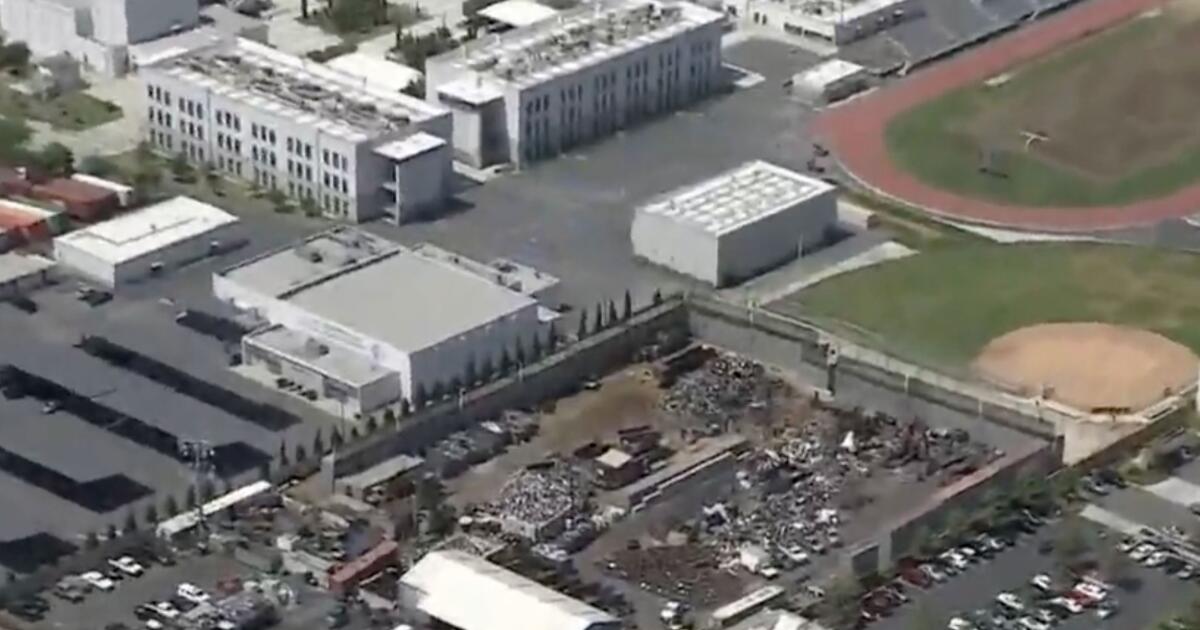
Toxic vapors beneath shuttered Watts scrap yard may be threatening a nearby high school
When a Los Angeles County judge ordered a notorious Watts scrap metal yard to permanently halt its operations last year, many residents and environmental advocates thought it might finally bring an end to the facility’s dangerous pollution. Instead, the shutdown may have only marked the beginning of what could be a lengthy process to erase decades of environmental degradation.
For nearly 75 years, S&W Atlas Iron & Metal had crushed car parts, shredded aluminum cans and processed an assortment of recyclable metals. Over that time, the facility and its owners racked up dozens of environmental violations and were eventually criminally convicted of crimes that endangered students next door at Jordan High School and residents of Watts.
Since Atlas’ court-ordered closure, the towering piles of scrap metal have largely disappeared from the 3-acre recycling facility. Jordan High’s campus hasn’t been rocked by explosions, pelted with shrapnel or blanketed in layers of toxic, metallic dust.
But one of the most serious, and remaining, threats has gone unnoticed until recently.
A contractor hired by Atlas recently measured a witch’s brew of toxic chemicals percolating in the soil and groundwater beneath the site at orders of magnitude above California’s standards, according to court documents. Around five feet underground, a soil probe detected the highest reading of vinyl chloride — just one of the several carcinogens at the site — more than 1.3 million times higher than the state benchmark.
“What they found were astronomical levels of these contaminants,” said Danielle Hoague, director of research for the Better Watts Initiative.
“I think it’s definitely a hidden danger. I don’t think that the community has been informed of what underlies Atlas. But I would assume that people are experiencing the health effects of this.”
State regulators are still hashing out the scope of the cleanup at the shuttered industrial site. But, more concerning, Watts residents and school district officials fear these contaminants may be migrating with groundwater, posing a risk to neighboring Jordan High School and Jordan Downs housing complex. If that is the case, the question is who will foot the bill to clean up this pollution?
“The cleanup of the Atlas site has been slow, and Atlas is proceeding with a lack of executed urgency,” an L.A. Unified School District spokesperson said in a statement.
Atlas “has failed to advise Los Angeles Unified promptly of contamination found just feet away from the school campus and the adjacent Jordan Downs Housing Development,” the spokesperson added.
Shutting down a source of pollution is only the first step in campaigns for cleaner air. It’s often equally burdensome, time-consuming and expensive to hold polluters accountable for cleaning up the legacy contamination at their own property. And it’s even more difficult to compel companies to decontaminate nearby properties that may have been affected by their operations.
In Lincoln Heights, decades passed after the closure of a massive dry-cleaning operation before residents learned of underground contamination spreading off-site, potentially threatening nearby homes and an elementary school. In Newport Beach, a sprawling aerospace and defense hub was converted into luxury homes three decades ago, and homeowners were only recently informed about residual toxic pollution. In Jurupa Valley, residents were alarmed to learn about toxic vapors seeping into their homes after contaminated groundwater migrated several miles from a former hazardous waste dump uphill.
In Watts, many residents were already aware of the danger posed by toxic metals produced by Atlas’ operations. At times, metallic dust left parts of Jordan High’s campus covered in an iridescent sheen, and the school district has in the past removed contaminated soil from the campus.
But it was far more difficult to predict that pollution could be spreading underground. Many of the chemicals found beneath Atlas evaporate at room temperature and sneak into buildings through cracks in foundations, floor drains or other gaps — a process known as vapor intrusion.
Over the past year, an LAUSD consultant conducted two rounds of air sampling at Jordan High. The levels of airborne chemicals the detected in gym’s basement suggest toxic vapors are infiltrating the building. However, the consultant has said more air sampling is necessary to determine whether it constitutes an unacceptable health risk.
So far, the district says the concentrations have not warranted closing school buildings yet.
In the meantime, the school district is pleading with the state regulators to get Atlas to commit to cleaning up the toxic fallout.
A Los Angeles County judge recently ordered an audit of Atlas’ finances, raising doubts about the company’s ability to pay potential damages.
But community leaders, like Timothy Watkins, president of the Watts Labor Community Action Committee, won’t be satisfied until the case moves from courtroom to cleanup.
“There’s no champion for us. So we have to find a way — with very, very limited resources — to get our story out in a way that begins to raise some kind of alarm and awareness of the danger here.”
More recent air news
New research suggests some air pollutants can significantly alter insect behavior, science journalist Gennaro Tomma writes in National Geographic. Smog-forming emissions can interfere with insect communication by breaking down pheromones, causing ant colonies to exhibit aggression toward their own members and neglect their larvae.
The Trump administration reversed a Biden-era rule limiting brain-damaging mercury emissions from coal plants, arguing compliance costs threatened energy reliability, Guardian environmental reporter Oliver Milman writes. The rollback allows some of the coal plants to avoid expensive upgrades, sparking debate over the trade-off between economic concerns and public health risks.
The California Air Resources Board set an Aug. 10 deadline for some of the nation’s largest companies to disclose their greenhouse gas emissions, according to the Sacramento Bee’s climate reporter Chaewon Chung. A pair of state laws enacted in 2023 required companies with more than $1 billion in annual revenue to adhere to the reporting requirements.
In other climate news
As Western states brace for deep cuts to their allotments of Colorado River water, one California water agency may be in a position to help. San Diego County Water Authority’s board recently voted to consider selling a portion of its water to Arizona and Nevada, reports Ian James for the LA. Times. The San Diego area is home to the nation’s largest desalination plant, allowing the agency to rely less on unpredictable reservoirs.
The escalating war in the Middle East has triggered the biggest oil and gas market disruption since 2022, driving a surge in energy prices and forcing a re-evaluation of energy security, Bloomberg reports. While high prices could bolster the case for deploying renewable energy, experts warn that worsening inflation — from higher energy costs — could ironically hamper the shift to clean energy.
A Southern California architect is challenging the notion that wildfire-resistant designs can’t also be visually stunning. L.A. Times wildfire reporter Noah Haggerty interviewed a Palisades fire survivor who is so confident about the design of his newly constructed Spanish-revival home, he asked the fire department if he could spark a controlled fire on his property.
This is the latest edition of Boiling Point, a newsletter about climate change and the environment in the American West. Sign up here to get it in your inbox. And listen to our Boiling Point podcast here.
For more air quality news, follow Tony Briscoe on X and LinkedIn.