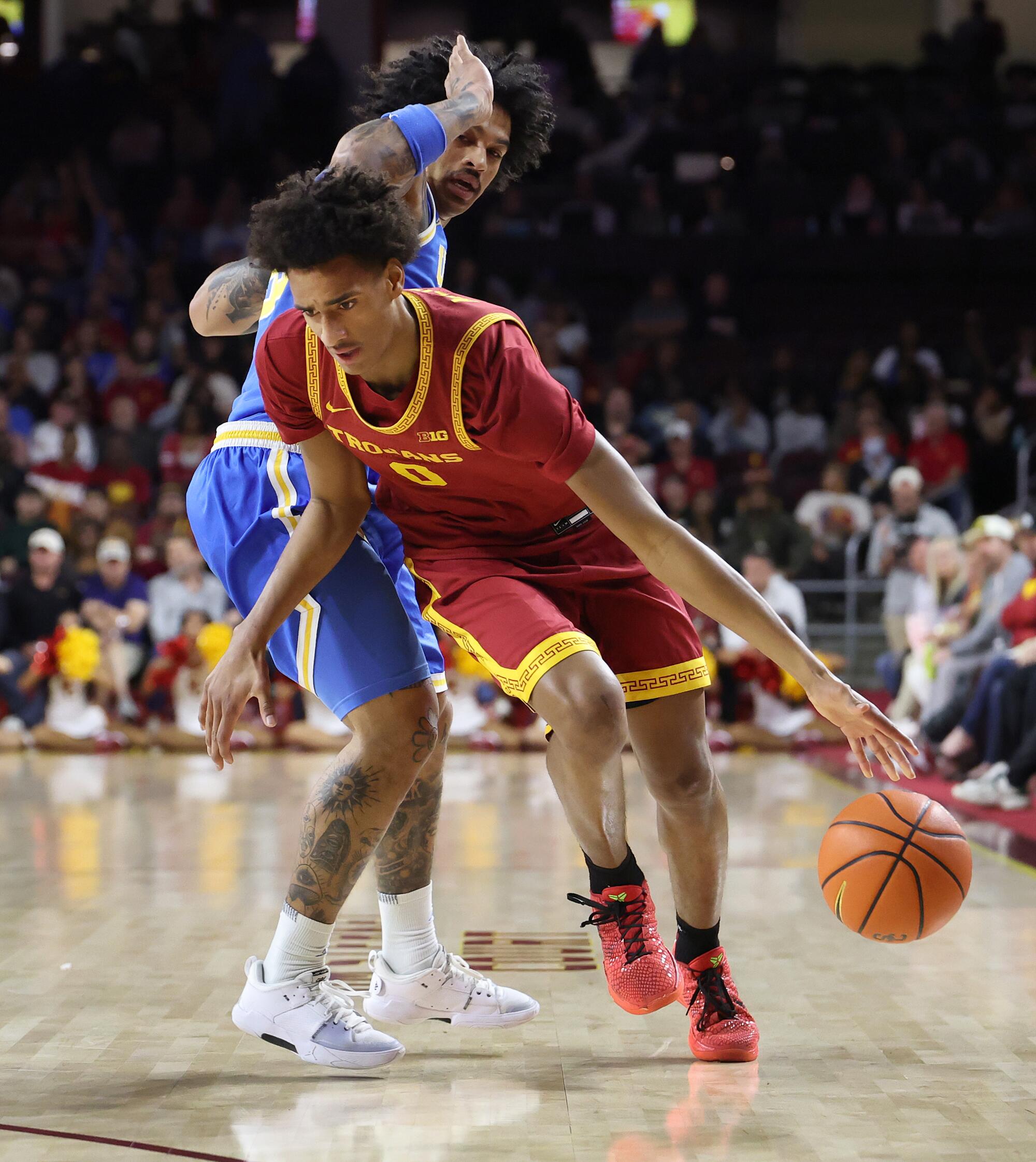
USCs

USC’s Jazzy Davidson is the best freshman in college basketball. Here’s why.

Welcome back to the Times of Troy newsletter, where I have emerged from my Hawaiian vacation and probably should be stopped before I buy a Maui timeshare. Please send help.

All jokes (and future debt) aside, we’re ready to roll after a weeklong break on the beach, just in time for the home stretch of the college basketball regular season. Both USC teams are still on the bubble midway through February, albeit one much more comfortably than the other.

Fight on! Are you a true Trojans fan?

The Trojan men’s March hopes are the more tenuous of the two. The sudden ascent to stardom of freshman Alijah Arenas has injected new hope into a hard-luck season. There’s still a ways to go: USC must face Illinois and Nebraska, not to mention UCLA twice, and could still use a couple more Quad 1 wins to bolster its resume. But the talent is there for USC to do some damage in the tournament … if it can make it to March.

The Trojan women are on much steadier ground, slotted at 22nd in the NCAA’s NET rankings. They’ve yet to lose a non-Quad 1 game this season and haven’t lost a game at all since Jan. 25. If the tournament started today, they’d be firmly in the field.

Lindsay Gottlieb has found a means to make it work over the last month, in spite of some shortcomings in a lineup that lost not just JuJu Watkins, but also all the other stars who might’ve lined up to play with her this season. Still, USC has weathered 25 games with a Watkins-sized hole in its lineup, a limited frontcourt and inconsistent play at point guard.

Gottlieb, as coach, deserves a lot of credit for that. As does Kara Dunn, the Trojans’ sharp-shooting grad transfer, who is shooting 51% and averaging 21 points, six rebounds and three assists over her past 11 games.

But USC could not have come this far this season if not for the best freshman in college basketball.

Jazzy Davidson has been every bit the difference-maker in her debut season that she was advertised to be as the top recruit in the 2025 class. She has been an elite defender, a dynamic and varied scorer, a poised and determined leader. She’s delivered in the clutch. She’s dragged USC out of deficits. She leads the Trojans in every statistical category: points (17.2), rebounds (6.3), assists (4.4), steals (1.9) and blocks (2.2).

The numbers only really tell part of the story. When Davidson signed with USC, she expected to play her first season with Watkins. Instead, Watkins injured her knee. The rest of USC’s Elite Eight lineup left. And Davidson suddenly found herself the centerpiece of the team’s hopes. As a freshman.

Those expectations would have weighed heavily on most first-year players, even before considering Watkins’ shadow looming over all the proceedings. But in this case, they haven’t seemed to faze the star freshman in the slightest. She’s been a picture of poise through a season that asked her to be just that. It’s an impossible thing to ask of most 18-year-olds.

And yet, in Davidson’s case, it’s working.

“You talk about overdelivering, to be a freshman and carry the load for us,” Gottlieb said, “she’s just capable of doing almost anything on a basketball court. She’s unique. I know there are several good freshmen in the country. We know how good she is. We see it every day, and we think there’s no one better.”

Someone in SEC country will surely make the case that Vanderbilt point guard Aubrey Galvan has been the nation’s top freshman. Advanced metrics, for one, will tell you that Galvan is worth 3.3 win shares compared to 3.1 for Davidson. She’s certainly been special on the offensive end, pairing up with national player of the year candidate Mikayla Blakes to make the most lethal 1-2 punch in women’s college basketball.

But Galvan is the No. 2 in that attack. That’s the role Davidson was supposed to play as a freshman. Instead, Davidson has been the focal point of opposing team’s game plans from the start, and yet still managed to adjust to the college game on the fly. Her usage rate (28.8%), which measures how often a possession ends with the ball in one’s hands, is higher than any freshman in the country. And she’s only getting better with the ball in her hands.

USC’s hopes this March hinge on Davidson continuing that ascent. It wasn’t supposed to be that way. But here we are. And in some strange, roundabout way, the experience might wind up making USC and its star freshman much better in the long run.

Because next year, USC will welcome not only Watkins back from injury, but also the No. 1 recruit in the nation, Saniyah Hall, as well as 6-foot-4 Aussie forward Sitaya Fagan, who’s redshirting this season. That lineup might be the most talented in USC history.

How it fits together will be the story of next season. But in this one, Davidson has proven she can be whatever USC needs her to be.

Not only the best freshman in college basketball, but the glue that’s kept this Trojans season together.

Mater Dei wide receiver Kayden Dixon-Wyatt pulls in a long reception to score against St John Bosco.

Mater Dei wide receiver Kayden Dixon-Wyatt pulls in a long reception to score against St John Bosco.

(Gina Ferazzi / Los Angeles Times)

—One last thing about Jazzy. She could stand to be more efficient from the three-point line, where she has made just nine of her last 52 attempts (17%). USC, as a team, has really struggled from behind the arc, which is not something you want in March.

—Chad Baker-Mazara should be back this week. It’s not clear if he’ll be ready for Wednesday’s big matchup. When USC welcomes No. 8 Illinois to Galen Center, it will have been more than two weeks since Baker-Mazara sprained his medial collateral ligament against Indiana. A Grade I sprain usually requires sitting out a week or two, so the timeline is pretty normal. USC is going to need its full arsenal, Baker-Mazara included, to hold its own against the Illini. But if not Wednesday, the sixth-year senior will definitely be back by Saturday against Oregon.

—Chad Bowden wasn’t subtle about his expectations for next season. USC’s general manager told reporters that he was “on a warpath” heading into 2026. He made clear that success next season is “black and white. You’re either in the playoffs or you’re not,” he said. He added that fans “should be unhappy” with a nine-win season and that he was “sick to his stomach” about it. Strong words from someone whose opinion matters a lot within Heritage Hall. Chalk it up as more evidence that a Playoff appearance is the baseline of expectations for Lincoln Riley next season.

—Blue-chip pass-catching prospects Kayden Dixon-Wyatt and Mark Bowman both took less money to sign with USC. That’s a good sign. Bowden said USC hadn’t talked to Kayden Dixon-Wyatt in three or four months while the top-50 receiver recruit was committed to Ohio State. But Dixon-Wyatt decided out of the blue that he was coming to USC, to stay home and play in front of family, even if it meant taking less money than he would’ve gotten in Columbus. He wasn’t the only one. On signing day, Lane Kiffin and LSU swooped in to offer Dixon-Wyatt’s Mater Dei teammate, tight end Mark Bowman, “significantly more” than the deal he had with USC, Bowden said. Bowman made Bowden wait most of the day before reassuring he was always bound for USC. We might look back on that decision as a pretty consequential one, if Bowman lives up to his billing from Bowden as “one of the best players in the country.”

USC is putting a lot of faith in its linebacker room for 2026. Bowden says he thinks the room will “take the biggest leap” of any position next season, but for the moment, that would require quite a bit of projection. Riley pointed to the progress from Desman Stephens down the stretch of last season, as well as the late emergence of Jadyn Walker, as reasons why USC didn’t feel the need to add more in the transfer portal. USC did add Deven Bryant, who the front office viewed as a quality run defender, and welcomes a freshman in Talanoa Ili who could be involved right away.

—The Big Ten is still pushing the 24-team Playoff – *shakes head* – but its plan isn’t all bad. I am not a fan in the slightest of doubling the size of the Playoff. That would significantly devalue the regular season, while lining the coffers of college football’s ruling class. The Big Ten has dominated the last three years of the 12-team Playoff, and yet it wants to open the field up more? It doesn’t make sense. What does sound logical to me, amid an otherwise insane plan, is the elimination of the conference championship games. Not only would that cut a full week out of the calendar, which needs to happen, it would do away with any questions about whether teams can hurt their resume just by playing another game. Go to 16 teams, do away with conference championship games and please — I beg you — stop tweaking the system.

—USC baseball’s season opened with a combined no-hitter. After beating Pepperdine in its season opener, the Trojans went one step further in their Saturday matchup, serving up the school’s first no-hitter in eight years. Sophomore right-hander Grant Govel went seven innings and struck out 10 batters while walking just one, and freshman Cameron Fausset closed the door with another hitless inning before Andrew Lamb hit a two-run homer to invoke the 10-run rule. Hard to imagine a better start to USC’s first season back on campus.

Olympic sports spotlight

After winning its first indoor NCAA title in 53 years last season, the future of USC men’s track has looked strong this indoor season.

Jack Stadlman, a Temecula native, set the indoor 400-meter freshman record at USC, finishing in second with a 45.51 on Day 1 of the Don Kirby Elite Invite on Friday. Stadlman actually didn’t start running track until his junior year at Temecula Valley High and didn’t start running the 400 until last spring. Now already he’s run the fastest indoor time ever for a freshman at USC and the fourth-fastest time in the NCAA in the event this season. That should set Stadlman up nicely for next month’s NCAA indoor championships.

Freshman Cordial Vann also made a strong impression, tying the indoor freshman record at USC with a 6.60 in the 60-meter sprint. The NCAA best so far this year is a 6.49.

In case you missed it

USC coach Lincoln Riley completes staff featuring new defensive blood, continuity

‘She’s unique.’ Jazzy Davidson helps USC climb out of early hole and win fifth in a row

USC men come up a bit short against Ohio State

What I’m watching this week

Timothee Chalamet in "Marty Supreme."

Timothée Chalamet in “Marty Supreme.”

I finally had the chance this past weekend to watch “Marty Supreme,” the best picture nominee starring Timothée Chalamet and directed by Josh Safdie. And boy was it worth the wait.

Let me start by saying that I generally dislike sports movies. There are exceptions to this rule, of course. But as someone who spends a lot of time thinking about the beauty and romance and drama inherent to sports, I am a documented hater of the genre.

“Marty Supreme,” though, was no ordinary sports movie. This was a propulsive, anxiety-inducing roller coaster ride as we follow Marty Mauser, played by Chalamet, as he tries to become the face of the emerging sport of table tennis in a post-World War II America. Those plans, as you might imagine, unravel along the way, and in the process, Chalamet gives one of the best performances of the year.

I’m still partial to “One Battle After Another” if we’re talking best picture in next month’s Academy Awards, but “Marty Supreme” is no doubt one of the best movies of the last year.

Until next time …

That concludes today’s newsletter. If you have any feedback, ideas for improvement or things you’d like to see, email me at ryan.kartje@latimes.com, and follow me on X at @Ryan_Kartje. To get this newsletter in your inbox, click here.

Source link

What will USC’s defense look like under Gary Patterson?

Welcome back to the Times of Troy newsletter. When you read this, I will hopefully be lying on a beach somewhere on Maui. Which means the Times of Troy will be taking a brief break next week. A tanner — read: redder — version of me will be back and recharged the following Monday. With the whole family coming and three kids under three in the mix, though, hopes of reaching peak relaxation may be slim!

But before I’m off, let’s dive a little deeper into the defense that the Trojans’ new defensive coordinator, Gary Patterson, plans to bring with him to USC.

Fight on! Are you a true Trojans fan?

In the 1997 edition of the American Football Coaches Assn.’s annual Summer Manual, Patterson, then just 37 and in his second year as New Mexico’s defensive coordinator, laid out his vision for the scheme that later became his calling card.

The 4-2-5, at that time, was unique in college football. The spread offense was just starting to take root, and Patterson wanted a scheme built to stop it. What he designed, it turns out, would still stand up almost three decades later.

That’s primarily because Patterson’s defense was built specifically to be adaptable, year to year, week to week, even play to play.

“Defenses must have enough flexibility in their scheme to limit offenses in their play selection, but be simple enough to be good at what they do,” Patterson wrote in 1997. “During a game we must look like we do a lot, but only do enough to take away what offenses do best.”

Patterson’s scheme has evolved plenty since then. But the principles remain the same. At its most basic level, the scheme uses four down linemen, two linebackers and a “five-spoke secondary” that utilizes three safeties (strong, weak and free). The safeties, in Patterson’s defense, are the glue that binds the scheme together. At any point, two of the three can walk up — to defend the run, for instance — and the look becomes more of a 4-4 defense. Or one can move up for a 4-3 look. It all depends on the offense’s personnel and tendencies.

“He’s going to scout you until his eyeballs come out,” former Texas coach Tom Herman said back in 2018.

The ability of Patterson’s defense to adapt on the fly to fit the situation makes it difficult to exploit. The idea, as Patterson sees it, is to confuse the offense as much as possible, both at the line of scrimmage and in the defensive backfield.

That’s not a revolutionary concept. What makes his approach especially distinctive is that every play includes two separate calls on defense, one for the front six and another for the secondary. The secondary is actually split into two as well, allowing Patterson to have each side playing different coverages, if he so desired. Meaning on any given play, one cornerback might be in man coverage while the other is in zone.

Sounds complicated, right? Well, that’s the idea.

“At first, I thought, ‘Man, it’s gonna be hard,’” said David Bailiff, who was Patterson’s first defensive coordinator at Texas Christian. “But it’s like algebra. When you get it, it’s a piece of cake. And he’s a great teacher of it, too.”

How his defense might look at USC is still to be determined. As of last week, Patterson was still learning his new players’ names, let alone understanding how to use their skillsets. But he said last week that he expects to “add to what we do” at USC now that he can get bigger, faster and stronger athletes on the field than he had at TCU.

He’d initially conceived of the 4-2-5 to account for a talent disparity at New Mexico and TCU, where Patterson only cracked the top 20 in recruiting class rankings once in two decades as coach. At USC, though, that won’t be a problem. Which begs the question: What might Patterson’s defense look like with a host of four- and five-stars at his disposal?

“The better the athlete we have, the more an offense must contend with our individual ability, plus the multiplicity of the scheme,” Patterson wrote in 1997. “We want offenses to guess what they should spend most of their time working on. Our job is to find out what their answer is.”

Patterson hasn’t led a defense since 2021. But as he sets out to install his scheme in the coming months at USC, the hope is that it’s the answer to what’s been missing through four years of Lincoln Riley.

Way-too-early game-by-game prediction for 2026

The Big Ten rolled out its schedule for 2026, and USC’s slate is just as challenging as we expected. There are way too many questions still to be answered to have any real idea how the season might shake out for the Trojans. But as a thought exercise, why not give it a go, anyway?

Aug. 29 vs. TBD: USC hasn’t finalized who will fit into this slot (more on that below), but whoever it winds up being won’t stand a chance of upending the Trojans in their season opener.

Sept. 5 vs. Fresno State: The Bulldogs were no pushover in Year 1 under Matt Entz, who traded his post as USC’s linebackers coach for Fresno. But USC has too much firepower.

Sept. 12 vs. Louisiana: The Ragin’ Cajuns have one of the best nicknames in college football. And that’s where their advantages over USC stop.

Sept. 19 at Rutgers: Traveling as far east as possible for a Big Ten opener isn’t ideal, and I could see USC opening a bit rusty. The Trojans still roll.

Sept. 26 vs. Oregon: Here’s where things get interesting. It will have been almost a decade since USC last beat the Ducks when they meet this fall in the Trojans’ conference home opener. Dante Moore is back, but I think this game will be more evenly matched in 2026. My instinct says it’s a loss, but I reserve the right to change later.

Oct. 3 vs. Washington: This is a tricky one, especially right after the Oregon matchup. Husky quarterback Demond Williams is the real deal, even if he did try to bail for LSU in the offseason. That shouldn’t be an issue when he hits the field. Especially since the defense backing him up could be among the best in the nation. USC barely escapes with a win in this first simulation.

Oct. 10 at Penn State: Woof. USC travels to State College at the end of a three-game gauntlet that could decide its season. We don’t know much about the Nittany Lions yet, but I believe in Matt Campbell, and playing at Beaver Stadium — and probably in a White Out game — is no joke. Another toss-up, but if USC’s beat-up at all by this point, it could struggle.

Oct. 24 at Wisconsin: Camp Randall is one of college football’s best venues, but the Badgers won’t be able to keep up with USC.

Oct. 31 vs. Ohio State:Halloween at the Coliseum delivers USC’s most frightening matchup of 2026. My guess — and I’m going out on a limb here — the Buckeyes will be dominant again. If USC can score a win here, making the Playoff should be a foregone conclusion.

Nov. 14 at Indiana: The defending champs may look a lot different next season, but I still trust Curt Cignetti to get it done. Especially at home. USC starts 3-4 in the Big Ten.

Nov. 21 vs. Maryland: The loss to Maryland two years ago was one of the worst in my tenure on the USC beat. The Terps are better now, but I don’t see USC slipping up again.

Nov. 28 at UCLA: It’s impossible to say what UCLA will look like in the fall, but I wouldn’t be surprised if Bob Chesney has them competing right away. For now, I’ll stick with USC as my crosstown winner.

Final record: 8-4.

USC will need to reach 10 wins to make the College Football Playoff. But it might be an uphill climb just to reach nine. USC will need to win at least one of its matchups against Oregon, Indiana and Ohio State, then also survive toss-up games against Penn State and Washington.

Southern California wide receiver Zachariah Branch (1) runs toward the end zone.

Zachariah Branch helped USC defeat San Jose State 56-28 in 2023.

(Jae C. Hong / Associated Press)

—USC has just 11 games scheduled for 2026. What’s going on with that 12th game? With Notre Dame and USC unable to reach a deal to extend their rivalry, USC still has one slot left to fill in its 2026 non-conference slate. That open game will be played at the Coliseum, during Week Zero on Aug. 29 because by opting to play in Week Zero, USC will get the privilege of a second bye during the season, where other Big Ten schools only have one. The problem is playing that early requires an exemption from the NCAA. So if USC intends to play the game at home, that means its only path to playing in Week Zero is to find a team that’s also playing at Hawaii. Any team playing Hawaii is allowed an exemption to play a 13th game in its season. Very few teams fit that criteria and still have an opening in Week Zero. But one makes the most sense, and it’s an opponent that USC opened the season against not that long ago: San Jose State. Don’t be surprised to see the Spartans come to the Coliseum again for the season opener in August 2026.

—Gary Patterson is bringing at least one defensive assistant of his choice to USC. Paul Gonzales, who spent last season as Baylor’s defensive pass-game coordinator, will be the Trojans’ defensive backs coach, taking the place of Doug Belk. Gonzales worked closely with Patterson from 2013 through his 2021 exit at Texas Christian, where he worked with cornerbacks and safeties. USC already has a cornerbacks coach in Trovon Reed. So we can assume that Gonzales will work with the safeties, which are critical in Patterson’s scheme.

—Defensive line coach Shaun Nua and offensive line coach Zach Hanson are staying put. Both had opportunities to leave USC after the season and ultimately opted to stay. Keeping Hanson is especially significant. The Trojans’ standout offensive line coach was in the mix to become an offensive coordinator at his alma mater, Kansas State, where his close friend, Collin Klein, is now the head coach. Yet Hanson still opted to stay, which I think is telling.

—The USC women’s win over No. 8 Iowa might have saved the season. Hopes of a postseason run were looking a bit bleak for USC before last Thursday night’s impressive home upset of the Hawkeyes. But the Trojans are now up to 20th in the NET rankings, with three Quad 1 wins, while a softer part of the schedule approaches. USC still can’t afford to drop too many of its nine remaining games, but the Iowa win is a sigh of relief on that front.

—New Dedeaux Field is still under construction. And will be when USC’s baseball season opens against Pepperdine on Feb. 13. That shouldn’t be a problem when it comes to playing actual baseball games. But the baseball offices, press box and concession stands aren’t finished yet (though, there will be temporary options). As such, baseball games will be free to fans this season. But USC not being able to deliver on the amenities that were promised by the time the stadium opens is a big miss for a baseball program that deserves more respect and could’ve used a boost in fan support. USC chose to prioritize finishing the football facility. Most schools probably would have done the same. For what it’s worth, Andy Stankiewicz, who just led the Trojans to their first NCAA tournament in a decade, has been very understanding of the whole situation.

Olympic sports spotlight

Freshman Max Exsted has been with USC’s men’s tennis program for just a few weeks, but he’s already made quite an impression. The mid-year addition from Minnesota has already won Big Ten Freshman of the Week twice in the first three weeks of the season.

That’s a great sign for a men’s tennis program that must replace an ITA All-American and All-Big Ten player in Peter Makk. The Trojans are 4-3 to start this season under seventh-year coach Brett Masi, whose contract was extended through 2028 in October as part of USC’s wider efforts to lock up its reliable Olympic sports coaches long term.

USC has made the NCAA tournament in four of six seasons under Masi. The expectation should be that that continues this year.

Times of Troy survey results

We asked,”How do you feel about the Gary Patterson hire?”

The results, after 414 votes

Cautiously optimistic it could work, 69.6%
Thrilled! We got a Hall of Famer!, 16.8%
Mildly concerned it will fail, 8.9%
Convinced this will be a disaster, 4.7%

In case you missed it

Ezra Ausar helps USC hold on for a win over struggling Rutgers

Kennedy Smith and USC women stun No. 8 Iowa in a huge statement win

New USC defensive coordinator Gary Patterson outlines his vision for the Trojans’ defense

USC faces brutal Big Ten football slate in 2026

What I’m watching this week

Jon Bernthal and Tessa Thompson in "His & Hers."

Jon Bernthal and Tessa Thompson in “His & Hers.”

(Courtesy of Netflix)

The mystery thriller genre has really hit a stride recently, with shows like “All Her Fault,” “Beast in Me” and “Task” all getting mentions in this space over the last several months. I don’t think “His & Hers” belongs in that group of standouts, but I’m willing to see it through.

That’s mostly on account of the always-charming Tessa Thompson, who plays a former TV anchor drawn back into an investigation when a murder takes place in her small Georgia hometown. Her estranged husband, played by Jon Bernthal, just happens to be the detective assigned to the case. Both are under serious suspicion right from the jump.

There’s high off-the-rails potential here, as tends to be the case with Netflix thrillers. But it’s also an easy binge, and now that I’ve watched a few episodes, I need to know where this mystery goes.

Until next time …

That concludes today’s newsletter. If you have any feedback, ideas for improvement or things you’d like to see, email me at ryan.kartje@latimes.com, and follow me on X at @Ryan_Kartje. To get this newsletter in your inbox, click here.

Source link