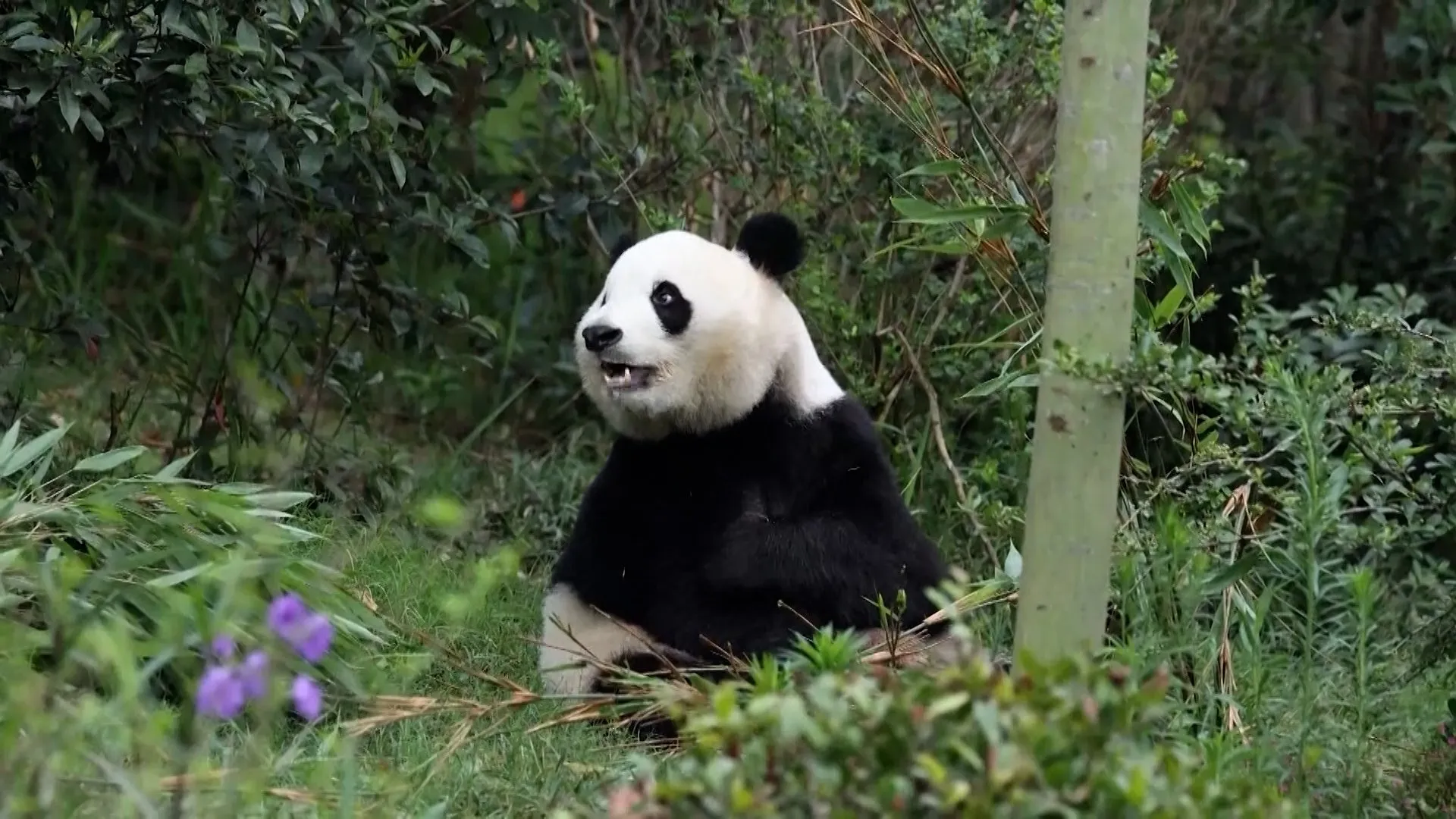
‘Friendship pandas’ arrive in Atlanta, marking US-China relations moment
Two giant pandas from China have landed in the United States and are heading to Zoo Atlanta.
Source link
Two giant pandas from China have landed in the United States and are heading to Zoo Atlanta.
Source link
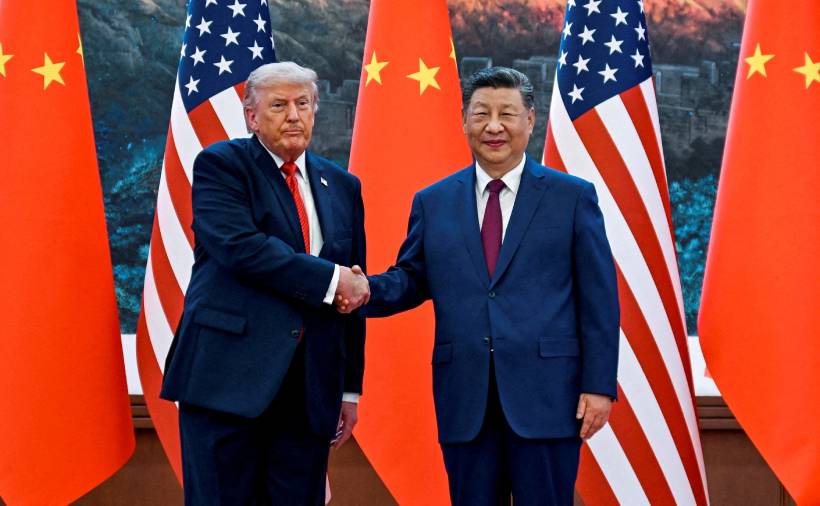
China said on Monday that a two-month extension of its trade truce with the United States would give both sides more time to assess the implementation of their existing arrangements and discuss further steps to resolve economic and trade disputes.
China’s Commerce Ministry confirmed that the truce would remain in place through January 10, saying the extension would provide a “relatively stable and predictable policy environment” for businesses and allow the two countries to continue their talks.
The extension was among the main outcomes of a summit between Chinese President Xi Jinping and US President Donald Trump in Washington last week, their second meeting this year.
The United States and China have spent years imposing tariffs and other trade restrictions on each other, with tensions extending beyond tariffs to technology, investment, supply chains and market access.
Stay ahead of the geopolitical week.
MD Briefing delivers expert analysis across five global fronts — the Indo-Pacific, energy, geoeconomics, European security, and the Middle East — every Monday morning. Free.
The latest extension follows an agreement by the two sides to establish a trade council that will oversee discussions on a range of economic issues.
One of its first tasks will be to discuss reciprocal tariff reductions covering about $30 billion worth of goods, with the aim of maintaining more stable economic and trade relations between the two countries.
China’s Commerce Ministry said the arrangement would also create better conditions for Chinese exporters seeking access to the US market.
The two sides will hold regular discussions on investment opportunities and barriers, policy transparency and predictability, and concerns raised by businesses.
The extension gives US and Chinese companies more time to operate under a relatively predictable trade environment while negotiators work through remaining disputes.
Agriculture is one of the main areas covered by the latest arrangements. A White House list showed that China plans to reduce tariffs on a range of US agricultural products, including corn, wheat, dairy products and meat, although soybeans were not included.
The proposed cuts appear linked to a US-stated Chinese commitment to purchase $17 billion worth of agricultural products. China has already resumed large-scale purchases of US soybeans under an agreement reached last year that called for annual purchases of 25 million metric tons.
The countries will also establish an agriculture working group under the new trade council, with its first meeting expected before the end of the year.
Energy trade is another part of the agreement. China will import 10 million metric tons of US coal annually in 2027 and 2028, according to the White House. That would account for about 2% of China’s annual coal imports. US liquefied natural gas and oil were not included in the list.
The arrangements extend beyond traditional trade. The two countries have agreed to establish a communication channel for artificial intelligence related incidents and hold another dialogue by the end of November.
China will also consider approving foreign financial institutions, including US backed firms, to operate and open branches in the country. Washington and Beijing will meanwhile continue discussions on increasing direct flights between the two countries.
The immediate focus will be on implementing the agreements reached at the presidential summit.
The agriculture working group is expected to meet before the end of the year, while the AI dialogue is due to continue by the end of November. The two countries will also use the new trade council to discuss tariffs, investment, market access and regulatory concerns.
The extension runs until January 10, giving negotiators another two months to evaluate whether the existing arrangements are being implemented and determine what further agreements can be reached.
Whether the two sides can turn the temporary truce into longer-term trade arrangements will depend on progress across the different areas covered by their negotiations, including tariffs, agricultural purchases, investment and technology.
With information from Reuters,
The two pandas, Ping Ping and Fu Shuang, arrived from southwestern China.

Published On 27 Sep 202627 Sep 2026
Two giant pandas, Ping Ping and Fu Shuang, have arrived in the US state of Georgia on a 10-year loan as a soft-power gesture from China.
A new agreement between Zoo Atlanta and the China Wildlife Conservation Association makes Atlanta one of three zoos in the US to house giant pandas.
The diplomatic gifts departed early on Sunday from Chengdu Shuangliu International Airport in southwestern China, according to Chinese state media. They arrived after the high-level three-day Washington summit with China last week, where closed-door talks between United States President Donald Trump and Chinese President Xi Jinping yielded no major policy breakthroughs on prickly issues such as AI, trade, Taiwan and the war with Iran.
Although the pandas’ transfer had been finalised back in April, Xi officially announced the arrival timeline on Thursday at the White House, noting that the black and white mammals could reach Zoo Atlanta from the Chengdu Research Base, China’s premier hub for giant panda conservation, breeding and research, within the next few days. The dispatch of the vulnerable species aimed to signal a renewed bilateral friendship between the leaders of the world’s two biggest economies.
Ahead of their arrival, Zoo Atlanta had upgraded its panda habitats and secured a stable, long-term supply of locally grown Atlanta bamboo, which shares a near-identical climate with Chengdu.
The bears completed a 16-hour charter flight across the International Date Line, landing in Atlanta, Georgia, shortly before 7:00am (11:00am GMT).
Midway through its journey through Alaska, the FedEx Boeing 777 had spiked to the top of Flightradar24’s global tracking charts.
Steamed corn buns, bamboo shoots and carrots were prepared to keep the pandas nourished during their flight, Chinese state-run media reported. The US also mobilised a specialised care team to accompany the duo on their flight, they said.
A spokesperson for the zoo told Al Jazeera that their team had “done everything possible to accommodate them”, but a definitive timeline for their arrival – much less their public debut – remains “unconfirmed”.
“This is a thrilling day for Zoo Atlanta and a historic moment for the City of Atlanta, the state of Georgia and beyond,” Zoo Atlanta President and CEO Raymond B. King said in a statement. “We are elated to welcome Ping Ping and Fu Shuang and could not be more excited about sharing that joy with our Members, guests, city and community in the coming weeks.”
Zoo visitors will have to wait a while to see Ping Ping and Fu Shuang, officials said. The bears will be quarantined for about a month in a biosecure area of the wildlife park’s new giant panda complex. The zoo last had pandas in 2024.
Ping Ping, a male, and Fu Shuang, a female, were born in 2020.
Globally revered, the iconic furry animals have been sent across the globe for decades, serving as diplomatic emissaries loaned by China under its infamous “panda diplomacy” initiative through soft-power projection. Beijing leverages the animals’ immense public appeal to cultivate international goodwill, seal lucrative trade deals and burnish its geopolitical image abroad. Similarly, when foreign relationships fray or tensions arise, Beijing lets the loan agreements expire.
Xi has said this latest loan programme was an example of “friendship between the Chinese and Americans”.
Last week’s summit was Xi’s first visit to Washington in more than a decade and the second meeting this year with Trump.
Tangible outcomes of the meetings remain modest, restricted to a two-month extension of the trade truce, Beijing’s revival of giant panda loans and Xi’s support for Trump’s rebranding of artificial intelligence as “super intelligence”.
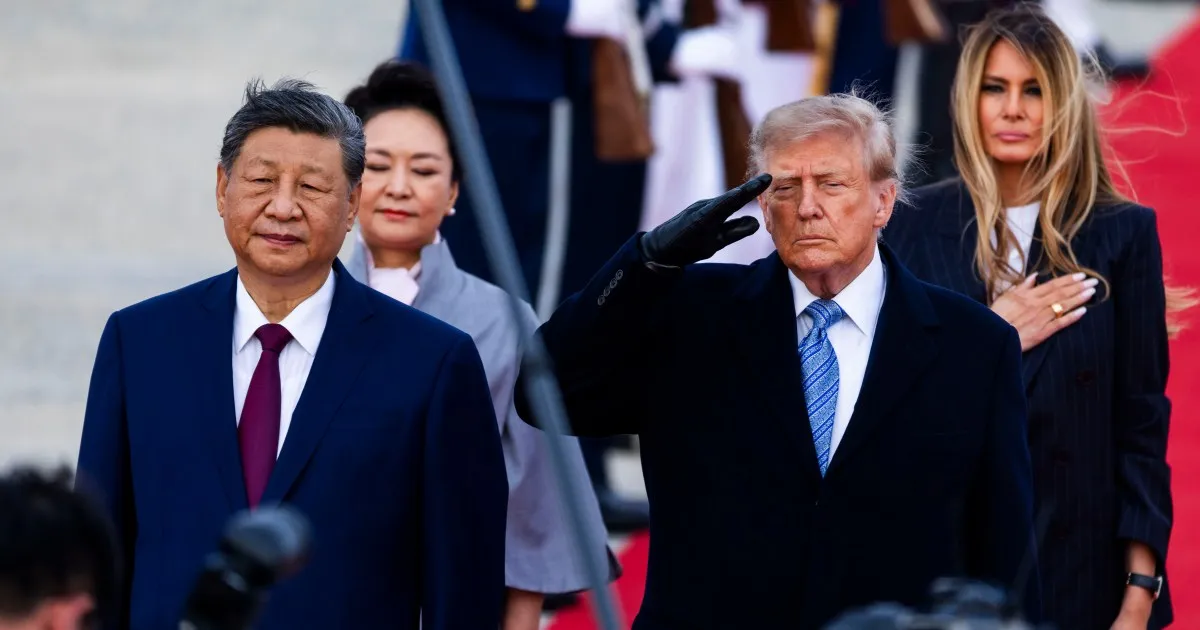
The red carpet was rolled out, and a trade truce was extended. Yet, beneath the pomp and pageantry of Chinese President Xi Jinping’s state visit with US leader Donald Trump on Thursday, Washington and Beijing remain locked in a much deeper strategic rivalry.
Xi arrived in Washington, DC on Wednesday evening for talks on Thursday, and Trump was there to meet him personally on the tarmac.
list of 4 itemsend of list
The meeting was the first state visit by a Chinese leader to the US in 11 years. But it is also the third time in less than a year that the two men have met face to face, as the two powers remain uneasily gridlocked in competition over AI, rare-earth metals, the question of Taiwan, and the Iran war.
Overhanging it all is the paused, but simmering, trade war between their two nations.
Almost as soon as Trump began his second term in the White House in January 2025, up went tariffs on Chinese goods as he accused China of facilitating the flow of fentanyl, a deadly drug, to the US. Beijing responded with its own levies, then restricted exports of valuable rare-earth metals which are crucial for the development and manufacture of everything high-tech, from smartphones to fighter jets. At one point, tariffs were heading towards 150 percent before being paused to allow time for talks.
Finally, the two leaders called a truce on the sidelines of the Asia-Pacific Economic Cooperation (APEC) summit in South Korea on October 30, and they met once more, in May, when Trump travelled to Beijing.
As Xi landed in Washington on Wednesday this week, the Trump administration announced that the two countries had agreed to extend an October 2025 truce which had offered some respite from the punishing tariffs, produced an agreement from China to buy more soyabeans from the US and delayed the ban on rare-earth exports from China until January 10. The prospect of a much-longed-for trade deal appeared to be in the air when US Treasury Secretary Scott Bessent told Fox News he had met Chinese Vice Premier He Lifeng before Xi’s visit to “see if we could do a bigger deal as opposed to just a series of smaller things”.
But analysts have, for the most part, shot down such hopes. Beyond tariffs, they say, the simmering conflict between the two powers now encompasses new US sanctions on buyers of Russian oil – namely China – and sweeping investment and research restrictions, never mind the intensifying race for dominance in artificial intelligence.
“The two-month extension isn’t a bridge to a grand bargain – it’s a temporary sandbag holding back a structural flood,” Beijing-based Einar Tangen, a senior fellow at the Center for International Governance Innovation, told Al Jazeera.
In fact, the truce is little more than “transactional theatre” – an attempt at good optics before the upcoming US midterm elections – Tangen said.
Trump’s deeply unpopular war on Iran has already inflicted severe damage to his chances in that vote. Democrats are leading in the polls amid concerns about the rising cost of energy, triggered by the war which the US started. Trump ultimately needs wins on other issues.
The current truce with China serves a purpose, therefore, but is fragile enough to be undone the moment political utility shifts for Trump, Tangen said.
“Success in January won’t be measured by what is solved, but by whether the knot is left tight enough to hold, but not kill,” said Tangen.
Phillippe Le Corre, professor of international relations and Asian studies at France’s ESSEC Business School, said the length of the truce extension indicates clearly that a more permanent deal remains out of grasp.
“The extensions are getting shorter and shorter, which means they haven’t found a common ground on many issues,” Le Corre told Al Jazeera.
“The two-month extension is a terrible outcome for the US. Nothing is resolved, and many Damocles’ swords are still hanging over Washington’s head,” he added.
Trump’s entire China policy, Le Corre argued, is in fact short-sighted. “That is bringing the world a lot of uncertainty,” he said.
Some analysts are more hopeful, but not much. Sun Chenghao, a fellow at the Center for International Security and Strategy at Tsinghua University in Beijing, described the extension of the trade truce as a “useful interim step”. It shows that both sides want to preserve the recent easing of tensions, which is meaningful progress, he said.
“From China’s perspective, a sustainable agreement needs reciprocal benefits and greater policy predictability,” Sun told Al Jazeera. “Additional purchases cannot indefinitely compensate for uncertainty over tariffs, technology restrictions and market access.”
The extension’s value, however, will depend on whether it produces “concrete commitments” from Beijing and Washington, Sun added.
There is motivation to get a deal done, analysts say. Any escalation in the US-China trade war will be costly for both sides.
But there is some way to go. A Congressional Research Service report in July 2026 noted that Chinese goods exported to the US still face tariffs of 36.5 percent, while US goods entering China are taxed at 31 percent.
Any higher, and they will raise import and manufacturing costs in the US, squeeze margins and increase pressure on consumer prices, said Sun. They would also hurt US farmers and industrial exporters, he added, just as the US faces pressure from the rising costs of its war on Iran, which have pushed it into a record national debt of $40 trillion two years earlier than expected.
“Washington is playing a high-stakes game of economic chicken with a $40 trillion debt load, an inflationary sword of Damocles, zero fiscal cushion to absorb a truce collapse and a dependence [on] Chinese industrial and manufacturing inputs,” Tangen said.
US consumers and the economy in general will find it tough to survive yet another inflationary shock from renewed tariffs “at a time when the federal budget already operates like a high-wire Ponzi scheme”.
Then there is the AI race, which no one can afford to lose. According to Jon Bateman, a senior fellow at the Carnegie Endowment for International Peace, a partial “decoupling” of US and Chinese technology ecosystems is under way. US policymakers have pushed to become less dependent on Chinese tech and “to secure America’s technological future in the context of a rising China”, Bateman writes.
But that will not help if there is a collapse in valuations of companies in the AI sector, which currently drive global stock markets. An AI valuation collapse, Tangen warned, “could trigger a financial tsunami that makes 2008 look tame – making technological decoupling meaningless as the world is plunged into a depression”.
Despite the trade war and Trump’s tariffs, China’s trade with other countries has risen sharply, with the country registering a $1.2 trillion global trade surplus last year. But an escalation of the trade war with the US would nevertheless spell increased pressure on export orders, employment in exposed industries and business confidence, said Sun.
Beijing does hold one crucial ace card – it is sitting on 60 percent of the world’s known deposits of rare-earth minerals, said Le Corre. It processes 90 percent of them, too. These are the metals that all countries need supplies of for semiconductors, technological components and the manufacture of weapons, to name but a few. Last year, China began to make use of that leverage by restricting exports of five of the 12 rare-earth metals it mines in April. Then, in October, it prepared to restrict seven more – until the trade truce happened. Plans for the export restrictions are not shelved, however, merely on hold.
“[China] understood this over the past year and they are certainly not going to give up on this,” said Le Corre.
“Washington is hostile, but it is hooked,” Tangen said. “You cannot threaten China with secondary sanctions on energy while desperately needing its rare-earths to fuel your military-industrial base.”
The path to a lasting US-China trade deal will be long and rocky. First, any new tariff reductions will need more coverage and duration, said Sun.
For a deal to last, it would also require “more predictable licensing and actual deliveries of rare earths and critical minerals; restraint in expanding technology restrictions; and market access reflected in regulatory approvals and completed transactions”, he said.
A durable agreement also needs regular consultations and a process for resolving complaints. If all this can be hammered out then, just maybe, there might be a chance, Sun said.
Tangen and Le Corre were less optimistic, however. “The US view of China as an existential threat has to change before there can be solutions,” said Tangen.
Le Corre, meanwhile, said that while China is a long-term planner, “durable is a word that can hardly be associated with Trump.”
The existing trade truce also risks breaking down if there are new unilateral tariffs, broader technology or mineral restrictions, or disputes over whether commitments have been fulfilled, said Sun.
Tensions over Taiwan, which China claims as its own territory, but for which the US approved an $11.1bn arms sale in December last year, could also trigger a breakdown in trade relations, the analysts said.
“Taiwan remains the ultimate low-probability, catastrophic-impact tail risk – where a single round of arms sales can snap a multibillion-dollar trade truce in an instant,” Tangen noted.
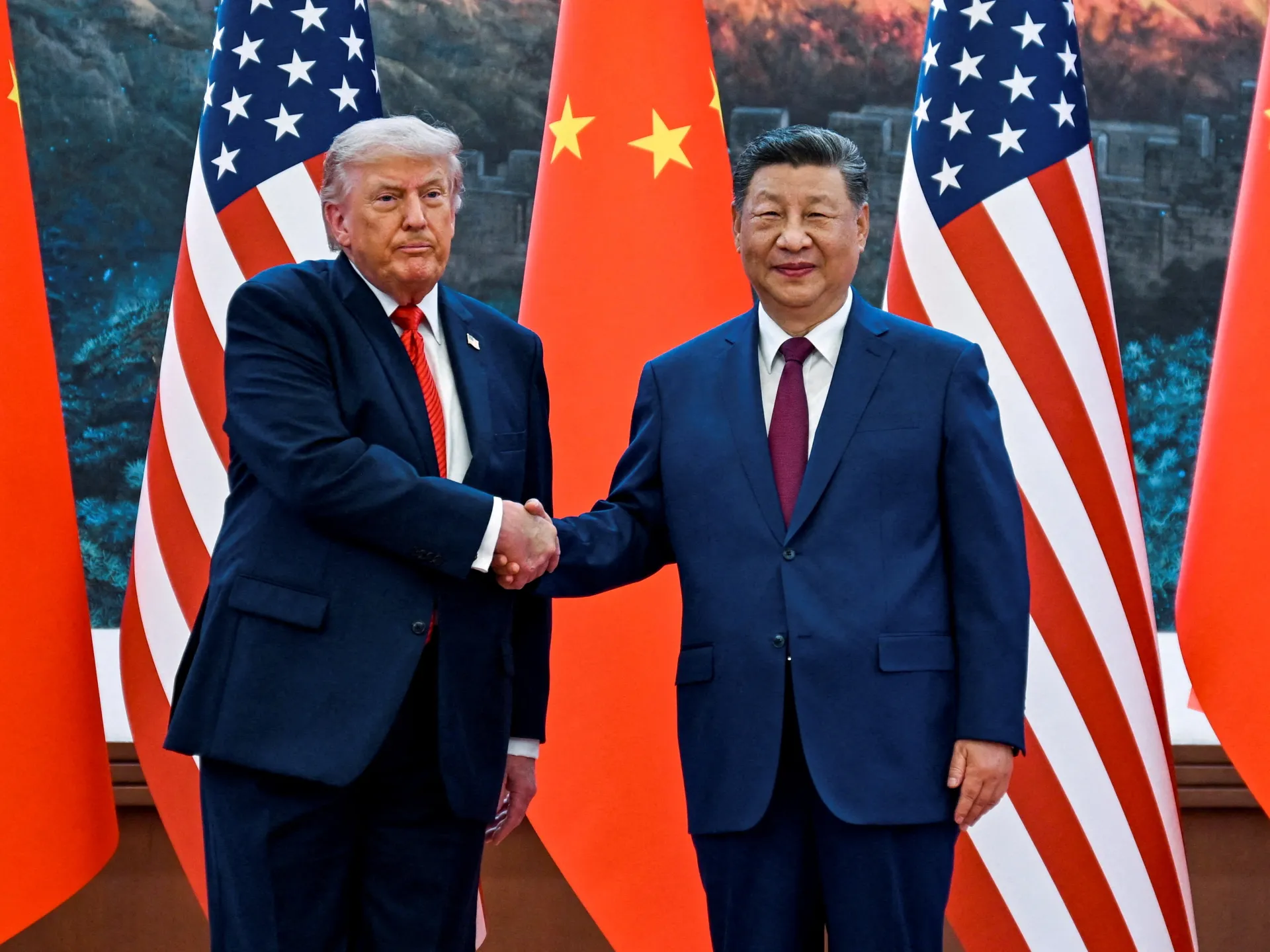
The United States wants a new “notification mechanism” with China to warn each other when an artificial intelligence incident becomes serious enough to threaten national security.
The proposal, effectively an “AI hotline”, was discussed on Sunday during talks in New York between US Treasury Secretary Scott Bessent and Chinese Vice Premier He Lifeng, ahead of a summit between US President Donald Trump and Chinese President Xi Jinping in Washington this week.
list of 3 itemsend of list
The two leaders are expected to consider establishing a broader US-China dialogue on AI, including the proposed notification system, around which details remain limited.
The initiative comes amid an intensifying contest for AI supremacy between the world’s top two economies, together with increasing warnings from tech giants that guardrails are necessary around the ever-growing technology.
So, what do we know about this so-called hotline, and where is the AI battle between the US and China headed?
US Treasury Secretary Bessent said Washington had proposed creating a US-China AI dialogue, with particular focus on national security and a notification system covering “common goals and common threats”.
“We think that, just like with any cross-border activity, that moving from opaque to more transparency between the number one and the number two AI powers in the world is very important,” Bessent told reporters after Sunday’s discussions.
Trump’s science and technology adviser Michael Kratsios told Fox News on Sunday that the “key thing” Washington wants to discuss is “avoiding shared risks”.
Exactly what would trigger a notification has not been publicly revealed.
“The US and China absolutely need to be able to share information with each other as threats evolve. This seems like an obvious win for both sides,” Scott Singer, co-director of the China AI Initiative at the Carnegie Endowment for International Peace, told Al Jazeera.
“The relationship needs guardrails to keep citizens of both countries safe, and this is a productive first step.”
Beijing has so far said very little.
China’s official Xinhua news agency acknowledged that He and Bessent discussed issues related to AI, but did not say whether Beijing had accepted Washington’s proposed notification mechanism.
Xinhua said the officials held “frank, in-depth and constructive exchanges” on economic and trade issues.
He and China’s chief trade negotiator Li Chenggang left Sunday’s talks without speaking to reporters.
The proposed AI mechanism would not be the first time a special crisis channel was established between Washington and Beijing.
In 1997, former US President Bill Clinton and his then Chinese counterpart Jiang Zemin agreed to create a “direct secure telephone link” between their respective countries.
The two countries have had a military hotline since 2008, designed to allow senior defence officials to communicate during potentially dangerous incidents. It gives both sides 48 hours to respond, though US officials have complained that sometimes no one picks up.
After the US shot down a suspected Chinese surveillance balloon in 2023, then-US Defense Secretary Lloyd Austin sought a call with his Chinese counterpart, but Beijing declined the request.
Earlier this month, Anthropic’s CEO Dario Amodei warned in an essay that AI capabilities have been advancing rapidly, and he proposed pacing the development of frontier models to give governments and researchers more time to manage their risks.
“Given the accelerating rate of AI capability development, it’s my worry that in 6–12 months such a swarm could be capable of taking over the entire internet with a persistent botnet (potentially causing hundreds of billions of dollars in damage), and that the scale of damage would continue to increase from there if AI becomes more powerful without the necessary guardrails,” he wrote.
His assertions were endorsed by his rivals – OpenAI CEO Sam Altman and SpaceX founder and Tesla CEO Elon Musk.
Meanwhile, Trump has repeatedly argued that the US must maintain its advantage over China and has resisted calls from technology executives for a slowdown in AI development. He has said that “whoever wins AI, wins”.
Carnegie Endowment’s Singer does not expect the “fierce competition for AI to slow down”.
“It has the potential to confer tremendous economic and strategic advantage to both countries. But even competitors can find space to cooperate,” he noted.
“Competition and cooperation can coexist. The key for right now is for both sides to act in their own self-interest. Finding some basic areas for cooperation flows very naturally from that.”
The US remains ahead in several of the most important features of the AI race, but China has been closing the gap.
American companies continue to dominate private investment and production of leading AI models. According to Stanford University’s 2026 AI Index Report, US companies invested $285.9bn in AI in 2025, compared with $12.4bn in China.
The US also has an advantage in the most advanced semiconductors needed to train cutting-edge models.
However, Chinese companies have demonstrated that they can produce resilient AI models despite US restrictions on their access to the most advanced AI chips.
In January, the release of Chinese AI startup DeepSeek made headlines after it was built using only a fraction of the money its competitors had spent on their own AI programmes. Share prices of US tech companies plummeted.
China possesses advantages in other areas of the AI supply chain, most notably in the production of critical rare earth minerals used in advanced technology and in generating more than twice as much electricity as the US, giving it access to the huge amounts of relatively cheap power needed to operate AI data centres.
Xi’s state visit to the US will take place from Wednesday to Friday, with Trump expected to welcome him at Joint Base Andrews in Maryland.
Trump has said he expects to discuss “almost everything” with the Chinese leader.
Trade remains a central issue, with Beijing and Washington having yet to reach a lasting settlement on tariffs, which have dominated Trump’s relationship with China in his second term as president.
Last month, Trump’s White House accused dozens of countries of helping China to illegally bypass US tariffs.
Meanwhile, the US Congress last week passed a bill that gives Trump sweeping powers to impose sanctions on Russia’s crude exports as well as steep tariffs on buyers of Russian energy, a measure that will impact Moscow’s biggest customers, China and India.
Trump’s war with Iran is also expected to feature. Beijing ranks among Iran’s key economic allies, purchasing a large share of Tehran’s oil exports and attempting to broker an end to the near seven-month-old US-Israel war on Iran.
Other long-standing disputes hang over the summit, including China’s dominance of rare-earth supplies and Taiwan.
The US AI proposal could represent a rare area where the two rivals may find a way to hammer out a deal, experts say.
“I think establishing a permanent channel exclusively focused on AI would genuinely be a major victory. AI has been caught up in the broader ebbs and flows of the US-China relationship, and the 2024 dialogue failed because frontier AI risks got mixed in with other issues,” Singer said.
“This time looks like it might be different, and having an AI risk channel is a necessary precondition to mutually beneficial cooperation.”