US & Canada

World Cup 2026 opening day takeaways: Red cards, VAR and hydration breaks | World Cup 2026 News

Five goals, four water breaks, three red cards and a glittering opening ceremony.

The World Cup 2026 opening day delivered everything you could ask for.

Recommended Stories

list of 3 itemsend of list

From an early thunder strike to a late winning goal, Thursday was filled with drama, stretching from Mexico City to Zapopan.

Al Jazeera breaks down the key takeaways from the 2026 FIFA World Cup’s day 1:

Is this going to be the World Cup with the most red cards?

The three red cards brandished to Yaya Sithole, Themba Zwame and Cesar Montes during Mexico’s 2-0 win over South Africa were an unusual sight at a World Cup.

In the last two editions, Qatar 2022 and Russia 2018, only four red cards were handed out during the entire tournament. This year’s World Cup opening game nearly matched that singlehandedly.

With officiating at the start of the tournament usually setting the tone for the rest of the campaign, the sequence of sending offs at Estadio Azteca could be repeated several times during the 39-day, 104-match spectacle in North America.

Thursday’s three reds fell just one short of the record of four at a World Cup 2006 game, nicknamed the “Battle of Nuremberg”, between Portugal and the Netherlands.

The record for the most red cards – 28 – was also set at the same tournament in Germany.

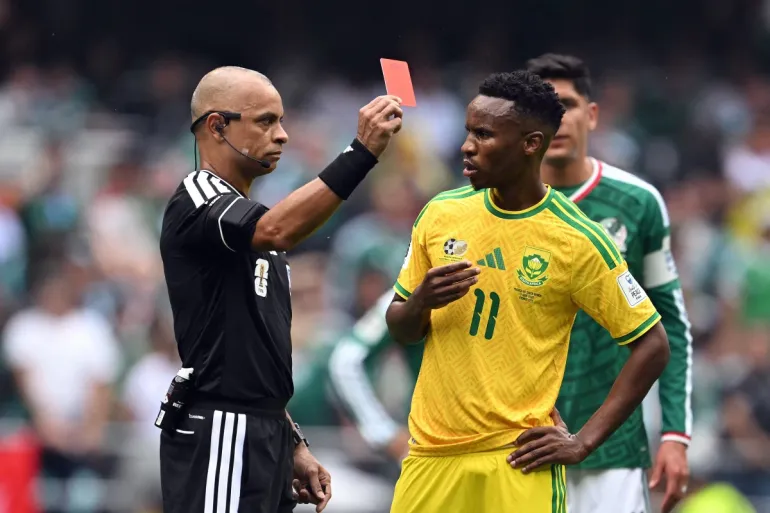
Brazilian referee Wilton Sampaio shows a red card to South Africa's midfielder #11 Themba Zwane during the 2026 World Cup Group A football match between Mexico and South Africa
Brazilian referee Wilton Sampaio shows a red card to South Africa’s midfielder Themba Zwane [Yuri Cortez/AFP]

Controversial VAR at the centre of debate again

The look of confusion and disbelief among South African players after Zwane was sent off for flinging an arm into Mexico’s Roberto Alvarado’s face prompted the debate: Is Video Assistant Referee (VAR) playing spoilsport again?

Referee Wilton Sampaio did not initially pull out the red card, but after being sent to the pitchside monitor by VAR, Sampaio decided to send Zwane off.

While the replays were unclear, it seemed Zwane was trying to move past Alvarado, but his hand caught the Mexican’s face in the process.

Zwane was ultimately booked for “violent conduct”, a controversial decision, which seemed harsh given it was not an obvious call. South Africa coach Hugo Broos was not convinced by it, either.

“The second red card, I think the Mexican player blocked my player,” Broos said in the post-match media conference.

“It’s the position of the referee, and we have to accept it also, but I don’t think [it was a red], it was too soft to give that as a red card.”

Hydration breaks or momentum killers?

The introduction of fixed hydration breaks – one in each half – came into effect for the first time at the World Cup on Thursday, and attracted early criticism from viewers and coaches alike.

While some broadcasters stuck with the live feed featuring players, others cut to commercials, disrupting the match-viewing experience for fans watching on TV.

Viewers in the United States were frustrated after broadcaster Fox cut away to full-screen commercials and they missed some live action during the second half of the Mexico vs South Africa opening match.

US head coach Mauricio Pochettino had a mixed opinion over the three-minute breaks, which are held regardless of weather conditions and introduced by FIFA to prioritise player welfare.

“I don’t like it. I only like it when the conditions are very extreme, but when the conditions are good, it is not necessary to have water breaks,” he said during a news conference on Thursday.

“For me, it’s 50-50. For coaches and staff, it’s a chance to make some changes or fix problems. But it’s part of the game, and we accept that.

“I don’t agree with it, but it’s not a big issue and won’t have a big effect on the games,” he said, adding that he did not watch the opening game.

Son Heung-min misfires, but South Korea prevail

Son Heung-min has often been the hero of the South Korea national team on the biggest stage, but on Thursday, even though the talisman got the lion’s share of the chances, he failed to score in their 2-1 win over Czechia.

Son worked seamlessly with the impressive Lee Kang-in and Lee Jae-sung to create a host of first-half chances, with the trio combining darting runs through the middle with a succession of dangerous pass-and-go moves that they just could not finish.

But Oh Hyeon-gyu and Hwang In-beom stepped up to the occasion, bagging a goal each to steer the Koreans to a dramatic late comeback win over Czechia.

Soccer Football - FIFA World Cup 2026 - Group A - South Korea v Czech Republic - Estadio Guadalajara, Guadalajara, Mexico - June 11, 2026 South Korea's Son Heung-min reacts after missing a chance to score REUTERS/Daniel Becerril
South Korea’s Son Heung-min reacts after missing a chance to score in their World Cup opener against Czechia [Daniel Becerril/Reuters]

South Korea vs Czechia: A clash of styles

Even though both teams opted for a 3-4-3 formation, there was a stark difference in their systems and approach.

South Korea played a fluid, possession-based style of football, while Czechia were heavily reliant on dead balls, opting for a rugged, route-one tactic.

Although the Czechs broke forward first with direct, physical play, the Koreans – buoyed by a largely Mexican crowd rooting for them – bounced back with their dominance of possession and stylish play, getting the better of their set-piece specialist opponents.

Source link

Stock markets surge as Trump calls off strikes on Iran, touts peace deal | Financial Markets

Wall Street and Asian markets rally on hopes for an end to the US-Israel war on Iran.

Stock markets have surged following US President Donald Trump’s announcement that he called off planned strikes against Iran and a peace deal with Tehran is imminent.

Wall Street’s benchmark S&P500 index finished nearly 1.8 percent higher on Thursday, ending a three-day streak of losses for the biggest single-day gain since April.

Recommended Stories

list of 4 itemsend of list

The tech-focused Nasdaq Composite jumped 2.5 percent, while the older, blue-chip Dow Jones Industrial Average gained about 1.9 percent.

The rally continued in the Asia Pacific on Friday, with markets in Japan, South Korea, Taiwan, Hong Kong, and Australia racking up gains.

South Korea’s Kospi, the best-performing major index this year, surged more than 8 percent in morning trading, while Japan’s benchmark Nikkei 225 rose as much as 4 percent.

Taiwan’s TAIEX gained about 2.4 percent, and Australia’s ASX 200 rose about 1.8 percent.

In Hong Kong, the Hang Seng Index was up more than 1 percent.

Brent crude, the primary international benchmark for oil prices, fell about 1 percent to below $89.50 a barrel on hopes for a return to normality in the Strait of Hormuz, which in peacetime carries about one-fifth of global energy supplies.

The market rebound came after Trump on Thursday suggested that a deal to end the war on Iran could be signed as soon as this weekend.

“We just made a great settlement of the war with Iran… subject to finalisation of documents,” Trump told reporters in the Oval Office of the White House.

Iran has not publicly confirmed Trump’s claims, but a Ministry of Foreign Affairs spokesman told reporters a memorandum of understanding with the US is “under consideration”.

“For the rally to be sustained, investors will want to not only see the actual deal being signed, but a complete reopening of the Strait of Hormuz,” Khoon Goh, head of Asia research for ANZ Bank, told Al Jazeera.

“Only then will we see the gains extend.”

Fabien Yip, a market analyst at the online broker IG Group in Sydney, Australia, said the rally reflected a “meaningful easing of geopolitical risk”, as well as anticipation over Friday’s market debut of SpaceX, set to be the largest of its kind in history.

“The broader read on today’s Asian follow-through is that dip-buying interest remains genuine,” Yip told Al Jazeera.

“That matters for how you characterise what’s happened over the past week.

“This looks less like a structural break in the bull market and more like a healthy reset after a rapid, near-straight-line advance, the kind of consolidation that can potentially extend a rally’s longevity.”

Source link

US releases video of warship firing missiles in strikes on Iran | Weapons

NewsFeed

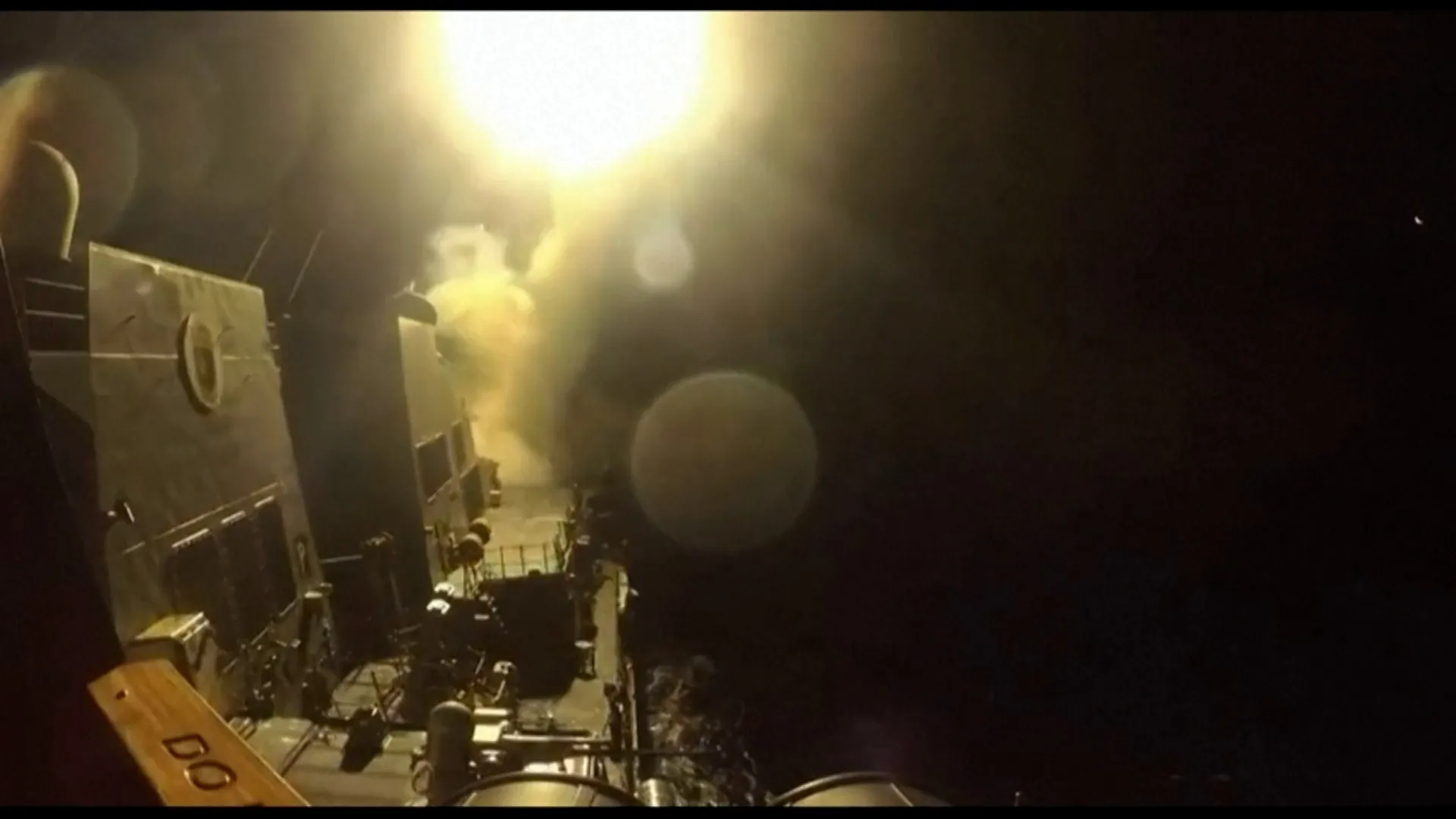
Video released by US Central Command shows what the military says are ‘self-defence’ strikes on Iranian military surveillance capabilities, communications systems and air defence sites. The footage accompanied a statement that US forces had completed the latest wave of attacks.

Source link

Which World Cup teams, players and officials were denied US visas, entry? | World Cup 2026 News

The United States government has faced sharp criticism from immigration and human rights experts due to the ongoing visa-related complications and entry denials for athletes and officials participating in the FIFA World Cup.

The censure of US President Donald Trump’s administration grew after top Somali football referee Omar Artan, who was set to officiate in World Cup games, was denied entry into the country this week.

Recommended Stories

list of 4 itemsend of list

“Human rights organisations and advocacy groups have repeatedly raised concerns regarding immigration enforcement practices and treatment of migrant communities in the US,” international sports lawyer Khayran Noor told Al Jazeera last month.

Noor said that while these debates are “independent” of football, they inevitably become relevant when a country hosts one of the world’s largest international gatherings.

“The challenge is that major sporting events rely not only on logistics and security but also on atmosphere and perception.”


UN High Commissioner for Human Rights Volker Turk called for a “massive rethink” of US immigration policies, saying that he hoped issues around “racial profiling, around surveillance, around immigration enforcement are not going to affect this World Cup in the way that they have already done”.

Although Artan returned home on Wednesday to a hero’s welcome and sporting a positive attitude, the incident rehashed the conversation on geopolitics and racism being cloaked by US visa denials ahead of the 48-nation, 39-day tournament starting on Thursday.

Fans from several countries, including Morocco and Scotland, who spent thousands of dollars on flights, hotels and tickets for the most expensive World Cup in history, have also reported having their travel documents denied or revoked just days before they were due to travel.

Here’s a look at the athletes, officials and fans affected by US visa complications:

Omar Artan: Somalia

Artan, 34, was set to make history as the first Somali referee to officiate at a World Cup, but his dream debut ended at Miami airport where he was denied entry into the country and flown back to Istanbul, despite having a valid US visa and all required documents.

The US Department of Homeland Security (DHS) confirmed to Al Jazeera on Monday that Artan was “determined to be inadmissible” to the country “due to vetting concerns”, despite having been listed as one of FIFA’s 52 World Cup referees.

Trump has targeted both Somalia and the Somali-American community with inflammatory rhetoric, at one time calling the community “garbage”, and has put Somalia on the US travel ban list.

Iranian World Cup squad and officials

Until last week, there was uncertainty over whether Iran’s football team would be granted visas by the US due to the ongoing US-Israel war on Iran, which has brought geopolitical tensions into the sports sphere.

The US awarded visas to all the players on Friday, just ⁠10 days before their first match, but several members of the ⁠support squad were denied visas, including “key managerial and administrative members,” according to the Iranian football federation.

Iran’s team, whose base camp was to originally be in Arizona, will be based in Tijuana, in neighbouring Mexico, throughout the tournament, despite playing their entire group stage on the US West Coast.

The team will be able to enter the US the day before each of their three World Cup matches, the DHS said on Tuesday.

Media reports over the weekend quoted the Iranian ambassador to Mexico, Abolfazl Pasandideh, as saying that Iran’s team would have to enter and leave the US on the same day as they were playing, raising questions about logistics and whether it would affect team performance.

Aymen Hussein: Iraq

Iraq striker Aymen Hussein was detained for nearly seven hours and his phone inspected at Chicago’s O’Hare airport before he was eventually allowed into the country.

“Why is America hosting the World Cup if it is so hostile to foreign nationals?” the 30-year-old said after the incident.

Meanwhile, national team photographer Talal Salah was held for more than 10 hours, underwent similar phone checks, and was ultimately denied entry into the US.

Woodensky Pierre: Haiti

Woodensky Pierre, the only member of Haiti’s national football team who lives in the Caribbean country, was granted a late visa by the US government to play in the World Cup.

Pierre had been training with local players in an upscale area of Haiti’s capital, Port-au-Prince, as he awaited the visa, which was a “great moment for him, a moment of happiness”, an official of the Haitian Football Federation had said.

The midfielder from Cite Soleil was unable to play in a friendly against New Zealand because his visa was not approved by US authorities until it was too late. He landed at Miami airport around half-time with Haitian football officials and hoped to catch the last part of the game.

Breel Embolo: Switzerland

Swiss forward Breel Embolo was unable to travel with his team due to a flagged visa, but eventually caught up with them after being cleared to enter the US.

The snag was linked to a previous conviction over an altercation in Basel in 2018. Embolo had been convicted of making threats five years later, which he chose not to appeal, but it left his fate to be decided at a meeting at the US Embassy in Bern, where he made his case and was cleared for travel.

Is FIFA obligated to ensure visas?

FIFA’s bidding rules in 2017 for nations wanting to host this World Cup stated that visa processing “must be applied in a non-discriminatory manner”, with the caveat it must not “adversely affect the national immigration and security standards”.

Sports lawyer Noor explained that states understandably retain sovereign responsibilities regarding border control and national security, but global sporting events often require exceptional frameworks.

“This is not about requiring states to abandon immigration laws or surrender sovereignty.

“Rather, it is about asking whether hosting the world’s largest sporting events also carries responsibilities around meaningful inclusion and access,” Noor said.

FIFA president Gianni Infantino has fended off concerns and criticism, saying the global football body’s executives are not “kings of the world” and cannot override government decisions.

Infantino, facing questions from the media on the eve of the World Cup on Wednesday, said that FIFA ⁠is focused on being a “sports organisation” and will not intervene in helping the US determine approvals for entry into the country.

“We try always to find solutions – always,” Infantino said at a news ⁠conference in Mexico City. “But then we need to respect that we are not the kings of the world who can rule over governments and police forces and I don’t know what. We are a sports organisation; we try to do our best ⁠with the means that we have.”

Source link

US bombs Iran after Trump threat, Tehran closes Hormuz Strait to all ships | US-Israel war on Iran News

DEVELOPING STORY,

Explosions hit Qeshm Island, ports along Strait of Hormuz after Trump threatens to hit Iran ‘very hard’.

The United States has launched fresh strikes against “multiple targets” in Iran at President Donald Trump’s direction, in a fresh escalation that prompted Tehran to declare the Strait of Hormuz closed to “all types of vessels”.

The US military said the strikes late on Wednesday were “in response to Iran’s unwarranted and continued aggression”, as Iranian state media reported explosions on Qeshm Island and in the cities of Bandar Abbas and Sirik along the Strait of Hormuz.

Recommended Stories

list of 4 itemsend of list

Blasts also hit the southern city of Kargan, wounding at least two people.

Iran’s Islamic Revolutionary Guard Corps accused the US of “repeated violations” of their April ceasefire, and said the Strait of Hormuz was “closed until further notice”.

It said all traffic in the vital waterway, including oil tankers and commercial vessels, would be affected, and firmly rejected the US’s previous claims that it had helped ships pass through the strait.

The IRGC subsequently added that “two oil tankers attempting to illegally pass through the strait were hit”.

The escalation comes a day after the US and Iran exchanged tit-for-tat strikes over the downing of a US Apache helicopter in the Strait of Hormuz.

Earlier, Trump said the US would hit Iran “very hard”.

“We’ll see what happens with the deal. We were really close to a deal. But they keep stringing us along. They keep playing us for suckers because you know what? They dealt with some very stupid presidents. I have to say that I’m embarrassed to say it,” he told reporters at the White House.

Iran’s President Masoud Pezeshkian slammed Trump’s threat in a post on X.

“Critical infrastructures are the lifeblood of the people. Threats to target them – from transportation networks to the electricity and water industries – are not a show of strength but a sign of desperation in the face of a nation’s will,” he wrote.

“Iran, relying on the knowledge and capabilities of its specialists, national unity, and solidarity, will stand firm against any pressure or threat,” he added.

Source link

Trump directs interim US intelligence chief Bill Pulte to downsize agency | Donald Trump News

Interim ODNI chief Bill Pulte has been slammed by Democrats as a Trump loyalist with no intelligence background.

United States President Donald Trump has directed Bill Pulte to cut staff at the Office of the Director of National Intelligence (ODNI) as soon as he takes up his role as acting intelligence chief.

The order came in a Truth Social post on Wednesday, in which Trump doubled down on his choice of Pulte, a controversial pick.

Recommended Stories

list of 3 itemsend of list

“I have named William Pulte to be Acting Director of National Intelligence, who will take over on June 19th, and have asked him to execute the immediate and needed downsizing of the office, reverting staff to their home agencies,” Trump wrote.

Pulte’s appointment has sparked bipartisan pushback, with Democrats especially questioning his qualifications.

A businessman with ties to construction and private equity, Pulte has no intelligence or military background, and critics see him as a Trump loyalist who has attacked the president’s critics.

In Wednesday’s post, Trump did emphasise he was already searching for Pulte’s successor. “I am looking for a permanent ODNI Nominee with experience in National Security,” he wrote.

But Pulte’s short-term appointment has become a flashpoint in Congress, with Democrats refusing to renew a controversial surveillance measure until a permanent pick is selected.

When he takes up his interim role next week, Pulte will succeed former Director of National Intelligence Tulsi Gabbard, who stepped down last month after her husband was diagnosed with cancer.

But Congress members like Democrat Mark Warner, a key figure on the Senate Select Committee on Intelligence, have decried Pulte as “grossly unqualified”.

Warner and other leaders have also warned that Pulte’s appointment would complicate negotiations to renew Section 702 of the Foreign Intelligence Surveillance Act (FISA), which allows warrantless surveillance of communications involving foreigners.

That measure is divisive on both sides of the aisle, as it has also resulted in the surveillance of US citizens. It allows intelligence agencies to collect emails, texts and phone data without warrants, if the communications in question are believed to involve individuals outside the US.

Warner said naming Pulte to head the ODNI was like “throwing a live hand grenade” into Congress’s efforts to reauthorise Section 702.

Last week, all but one Senate Democrat and seven Republicans voted against a three-year extension of Section 702, citing concerns about Pulte. Pennsylvania’s John Fetterman was the only Democrat to break party ranks in that 52-47 vote.

But Trump has called on Congress to pass a temporary extension of Section 702, denouncing Democrats for blocking the bill.

“Just like they did on Border Funding, the Radical Left Dumocrats [sic] are trying to take our National Security hostage because of unrelated issues,” Trump wrote on Wednesday. “They should stop playing politics with the safety of our Great Country.”

Still, Trump has faced backlash from within his Republican Party, with congressional leaders calling on the president to select a permanent intelligence chief to put the matter to bed.

“We don’t need a weaponised DNI [director of national intelligence],” Senate Majority Leader John Thune told reporters. “We need professionals here.”

Critics have questioned whether Pulte would use US intelligence capabilities to persecute Trump’s perceived political enemies.

Currently, the 38-year-old Pulte serves as the head of the Federal Housing Finance Agency.

In that position, Pulte has accused several of Trump’s adversaries of mortgage fraud. They include  Federal Reserve Governor Lisa Cook, New York Attorney General Letitia James and Democratic Senator Adam Schiff, all of whom Trump has personally attacked.

Democrats have accused the 38-year-old Pulte of weaponising his government role for political aims.

Source link

US resumes attacks on Iran for second night in a row | US-Israel war on Iran News

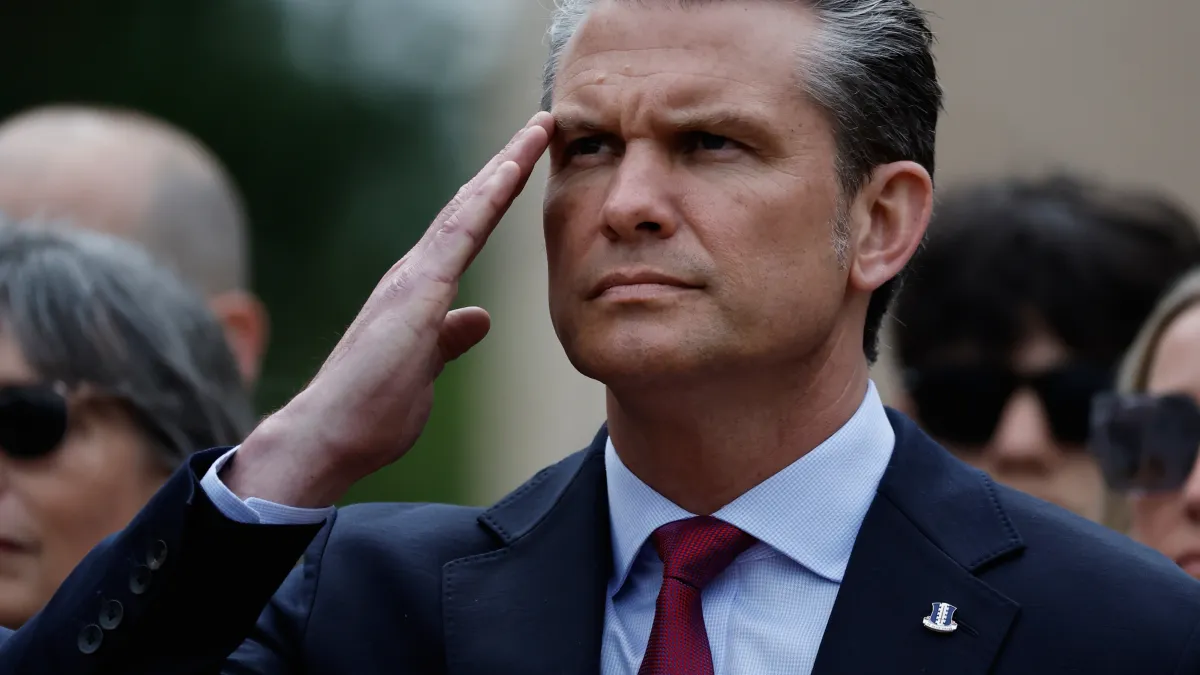
Defence Secretary Pete Hegseth has confirmed that the United States is launching strikes on “key facilities” in Iran, framing the attacks as part of the ongoing negotiations for a permanent ceasefire.

Hegseth spoke to reporters on Wednesday in Tampa, Florida, as he left the headquarters for the US Central Command (CENTCOM), the military apparatus that oversees operations in the Middle East and parts of Asia.

Recommended Stories

list of 3 itemsend of list

His remarks echoed the escalating rhetoric of Republican President Donald Trump, who warned earlier that Iran would “have to pay the price” for taking too long with the negotiations.

“ CENTCOM — Central Command — will be busy tonight because President Trump said we will be hitting Iran hard, and we will be,” Hegseth said.

He explained that he had just reviewed the plans for Wednesday night’s attack with Admiral Bradley Cooper, CENTCOM’s commander.

“ Those strikes that’ll happen tonight will be strong. They will be clear,” said Hegseth, who then suggested they may continue into a second day. “If they have to happen tomorrow night, they will be strong, and they will be clear.”

CENTCOM followed Hegseth’s comments with a social media post, announcing “additional self-defence strikes” at 5:15pm US Eastern time (21:00 GMT).

“The strikes are in response to Iran’s unwarranted and continued aggression,” it wrote.

Within minutes of those comments, Iran’s IRNA media outlet reported explosions in Bandar Abbas, Qeshm, Gorgan and Hengam.

Wednesday’s attack will mark the second straight day of US attacks against Iran, fracturing the fragile truce struck on April 8.

The US has been at war with Iran since February 28, when the Trump administration joined Israel in an unprovoked attack on the country.

Both Israel and the US have argued that the attack was necessary to prevent Iran from obtaining a nuclear weapon, though Tehran has long denied seeking one.

But the Trump administration has offered contradicting rationales for the war in the months since it began.

At one point, US Secretary of State Marco Rubio suggested that the US acted “pre-emptively” because it “knew that there was going to be an Israeli action” and it wanted to head off retaliation. Rubio has since walked back those remarks.

Hegseth on Wednesday credited the upcoming strikes to frustration with Iran’s negotiating tactics.

“ As President Trump said, they’ve been tap-tap-tapping. You can see when someone’s trying to tap-tap-tap on a deal,” he said. “Instead, they’re going to have tap, tap, tap bombs dropping on key facilities in Iran from the United States of America.”

Since a temporary ceasefire was announced on April 8, much of the most intense fighting between the US and Iran has been paused.

But this week’s escalation began when an AH-64 Apache helicopter was downed near the Strait of Hormuz overnight on Monday.

Trump on Tuesday blamed Iran for the helicopter’s crash. Though no US service members were hurt, he said the US “must, of necessity, respond to this attack”.

In announcing a second round of attacks, Hegseth denied that the US sought to resume full-scale fighting. He instead framed the offensive as a means of kick-starting the stalled negotiations with Iran.

“That’s not because we want to restart anything we don’t have to restart,” Hegseth said of Wednesday night’s attack. “It’s because the War Department is prepared to set the terms to ensure that we get the kind of deal President Trump expects.”

The two sides have differed over issues like the fate of Iran’s nuclear programme and whether Iran would receive sanctions relief.

Trump has repeatedly threatened to attack Iran’s bridges and energy infrastructure, at one point warning that “a whole civilization will die” as a result of US attacks.

Those comments have prompted human rights concerns. Intentionally targeting civilian infrastructure can be considered a war crime, and critics compared Trump’s threats against Iranian “civilisation” to genocidal remarks.

Reporters confronted Hegseth with those concerns on Wednesday.

“You just mentioned you’re going to plan to hit them and strike them hard tonight,” one reporter asked. “If the response is in hitting bridges, electrical infrastructure, how would that not be a war crime, potentially targeting civilian infrastructure?”

Hegseth dismissed the question as “disingenuous” and accused the reporter of “impugning the motives” of the US military. But he did not rule out that civilian infrastructure would be struck as part of Wednesday’s attacks.

Source link

US bombs Iran’s water facilities: Why that’s so significant | US-Israel war on Iran News

The United States and Iran engaged in some of the most intense fighting overnight since all-out hostilities in the ongoing US‑Israeli war on Iran were halted with a Pakistan‑mediated temporary ceasefire on April 8.

A comprehensive peace agreement remains elusive as Iran and the US have exchanged a series of proposals and counterproposals in the weeks since that pause. After a string of smaller escalations, however, the US struck targets in Iran following the downing of a US Apache helicopter close to the Strait of Hormuz on Tuesday, and Iran retaliated by hitting US military bases in the Gulf.

The US military said it targeted communications and radar facilities. Iranian officials, however, said civilian infrastructure was also damaged, including two water reservoirs.

If correct, this is the first reported strike on civilian infrastructure in Iran in several weeks, but it comes at a time when Iran is facing a severe water shortage.

Which targets have been hit in Iran?

The US launched waves of attacks starting late on Tuesday following the downing of the helicopter in the Strait of Hormuz. The US described the attacks as “self-defence strikes” and a “proportional response to unjustified Iranian aggression”.

While an official US inquiry into what caused the helicopter to crash has yet to conclude, US President Donald Trump quickly blamed Iran, which he said had deliberately shot it down.

“I have just been informed by our Great Military that last night the Iranians shot down one of our highly sophisticated Apache Helicopters while patrolling over the Strait of Hormuz. There were two pilots involved, both are safe and uninjured,” Trump wrote on social media.

“Nevertheless, the United States must, of necessity, respond to this attack.”

Iran’s Islamic Revolutionary Guard Corps (IRGC) said US strikes, which hit targets including Sirik, Jask, Minab, Qeshm Island and the port of Bandar Abbas, had caused major damage to a telecommunications tower in the town of Sirik and destroyed two water reservoirs there.

Iran’s West Asia News Agency (WANA) news outlet reported on Wednesday, citing “available reports”, that two concrete water storage reservoirs in the Bamani district in the Sirik County of Hormozgan Province, in southern Iran, 1,012km (629 miles) from the capital, Tehran, had been hit in the US attacks.

The IRGC claimed attacks on US military bases in Bahrain, Kuwait and Jordan in retaliation.

Has the US hit Iran’s water infrastructure before?

Yes. On March 7, while missiles were flying across the region in an all-out war between Iran and the US-Israel, Iranian Foreign Minister Abbas Araghchi accused the US of striking a desalination plant on Qeshm Island off the coast of Iran in the Strait of Hormuz. The strike reportedly cut off the water supply to 30 villages.

“Water supply in 30 villages has been impacted. Attacking Iran’s infrastructure is a dangerous move with grave consequences. The US set this precedent, not Iran,” Araghchi wrote in an X post.

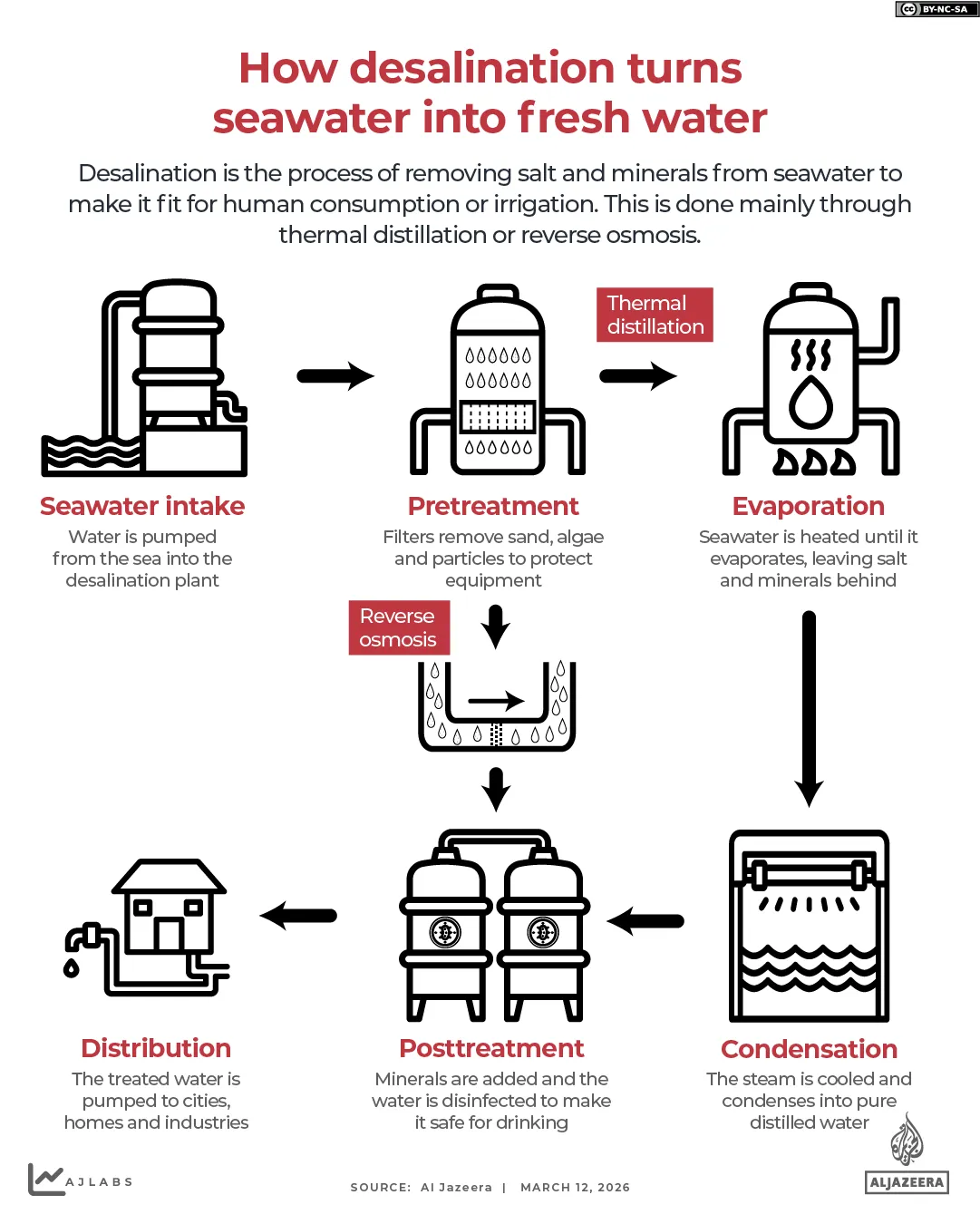
A desalination plant converts seawater into water suitable for drinking, irrigation and industrial use. These facilities are particularly critical in areas such as the Gulf, where freshwater is scarce.

INTERACTIVE - How seawater is turned into drinking water-1773312051
[Al Jazeera]

Why is this significant?

The reservoirs that were struck provide drinking water to more than 20,000 residents in the city of Kouhestak and 10 surrounding villages. WANA reported initial estimates for damages amounting to $780,000 to $830,000.

Iran was already facing a multiyear drought and decline in precipitation before the US-Israeli war on Iran started. After years of poor agricultural practices and mismanagement, Iran’s main water supplies, including its reservoirs, rivers and groundwater reserves, continued to run dry.

According to Aqueduct data from the World Resources Institute, which tracks global water risk, Iran’s baseline water stress is classified as “extremely high” – meaning the country uses more than 80 percent of its renewable water resources in a typical year.

Last year marked Iran’s fifth consecutive year of drought. In November 2025, the water crisis was so dire that Tehran’s Amir Kabir Dam only held 8 percent of its capacity, while across the country, 19 major dams had run dry.

INTERACTIVE-Iran water deficit-1780980357
[Al Jazeera]

Is this a war crime?

Isa Bozorgzadeh, spokesman for Iran’s water industry, claimed the US strike on the water reservoirs is a war crime, WANA reported.

International humanitarian law classifies water infrastructure, including drinking water installations, treatment plants and pipelines, as civilian property which is not deemed a legitimate target during war.

The Berlin Rules on Water Resources, drafted by the International Law Association (ILA) and adopted in 2004, are a set of non‑binding international legal principles about how countries should use, share and protect water.

The Berlin Rules prohibit countries at war from destroying water installations “if such actions would cause disproportionate suffering to civilians”.

Source link

Eight red cards shown to Brazil in fiery friendly against US women | Football News

Four Brazilian players and four members of their coaching staff were sent off during a dramatic encounter in Fortaleza.

Brazil were shown eight red cards during a chaotic 1-0 defeat to the United States women’s national team in a friendly in Fortaleza.

Brazilian coach Arthur Elias and three of his assistant coaches were sent off, while Bia Zaneratto and Tarciane were also dismissed. Two other players were shown red cards after the full-time whistle on Tuesday evening.

Recommended Stories

list of 3 itemsend of list

Sophia Wilson’s shot deflected off Isabela and snuck past Brazilian goalkeeper Lorena in the 63rd minute for the lone goal of the game before a crowd of more than 55,000 fans in northern Brazil. The hosts had no shots on goal, while the US had six.

Brazil manager Elias and several assistants were dismissed from the technical area during the second half.

Brazil then went down to nine in stoppage time after attacker Zaneratto was dismissed after picking up a second yellow card for pushing Emily Sonnett.

Moments later, her teammate, Tarciane, was shown a straight red for elbowing Wilson.

The chaos continued after the full-time whistle, with Brazil’s Kerolin and Ludmila both shown red cards for dissent.

Sophia Smith of United States celebrates with teammates
Sophia Smith celebrates with teammates after the opening goal during the international friendly match between Brazil and the US [Brad Smith/Getty Images]

It was the second of two matches in Brazil for the Americans, with the US losing 2-1 in the opener on Saturday in Sao Paulo.

Marta, a six-time FIFA World Player of the Year, was subbed into the match in the 80th minute, making her 212th appearance for Brazil.

Dudinha appeared to hurt her right knee in a collision with Sonnett in the 30th minute and was stretchered off the field in obvious pain. The 20-year-old forward, who plays for the San Diego Wave in the National Women’s Soccer League, returned to the bench in the second half on crutches.

The matches in Sao Paulo and Fortaleza were played at stadiums that will be used next June and July for the Women’s World Cup. The US will start their qualification campaign in November.

Source link

Trita Parsi: Iran is pursuing a doctrine of swift retaliation | US-Israel war on Iran

NewsFeed

Trita Parsi tells Al Jazeera that Iran has abandoned strategic patience for a new doctrine: swift, severe retaliation against any US attack. Parsi added that Iran aims to deny Washington the ability to strike with impunity, viewing immediate escalation as vital to its deterrence.

Source link

Air Canada pilot accused of flying for 17 years without proper licence | Aviation News

Former airline captain charged with fraud after allegedly commanding more than 900 flights without required credentials.

A former airline pilot in Canada has been arrested for allegedly flying hundreds of flights without a proper licence for nearly 17 years.

Police in Peel, Ontario, said on Tuesday that they had charged former Air Canada captain Geoffrey Wall with fraud and other charges following a four-month investigation.

Recommended Stories

list of 4 itemsend of list

The Peel Regional Police said Wall, 59, had used fraudulent pilot licences to command more than 900 domestic and international flights between 2009 and 2025.

Police said they obtained evidence to suggest that Wall had deceived both Air Canada and civil aviation authorities about his credentials before his retirement in 2025.

While Wall did hold a valid commercial pilot licence, he did not have an airline transport pilot licence, the highest level of pilot certification required to captain commercial aircraft, police said.

Wall faces one count of fraud, two counts of uttering forged documents, three counts of possessing a counterfeit trademark, and one count of public mischief.

Al Jazeera was unable to locate Wall’s legal representatives for comment.

“This case is deeply concerning and strikes at the heart of public trust and safety, as the accused is alleged to have put hundreds of thousands of passengers at risk across more than 900 domestic and international flights,” Peel Regional Police Chief Nishan Duraiappah said in a statement.

Air Canada said that while it viewed the pilot’s alleged actions with “utmost seriousness”, passenger safety had not been compromised, as all pilots undergo mandatory training every six months to assess their competency, in addition to an annual flight check with a certified pilot.

The airline said that Wall had “successfully met or exceeded” his training requirements and demonstrated “a high level of competency to safely operate large aircraft”.

The Canadian flag carrier also said it had found no other instances of non-compliance with licensing requirements following an audit of its pilots.

“Immediately upon Air Canada’s discovery of this, the individual was removed from active duty, and the company voluntarily reported the matter to Transport Canada,” the airline said in a statement.

Hassan Shahidi, a licensed pilot who heads the US-based Flight Safety Foundation nonprofit, described the charges against Wall as an “exceptionally rare case”.

“If the allegations are proven, the key issue isn’t that an untrained person was flying airliners, but that this pilot bypassed a fundamental regulatory requirement for many years,” Shahidi told Al Jazeera.

“The case could point to weaknesses in licence verification and oversight processes, particularly if fraudulent credentials were able to evade detection for so long.”

Shahidi said that Wall’s alleged actions did not appear to have exposed passengers to the same level of risk that they would have faced if an untrained pilot were at the controls.

“The larger concern is the apparent failure of a regulatory safeguard that is supposed to ensure trust in the system,” he said.

Source link

US judge halts execution by nitrogen gas, ruling it unconstitutional | Death Penalty News

Judge Emily Marks had previously allowed the execution to proceed, arguing that no execution is entirely without pain.

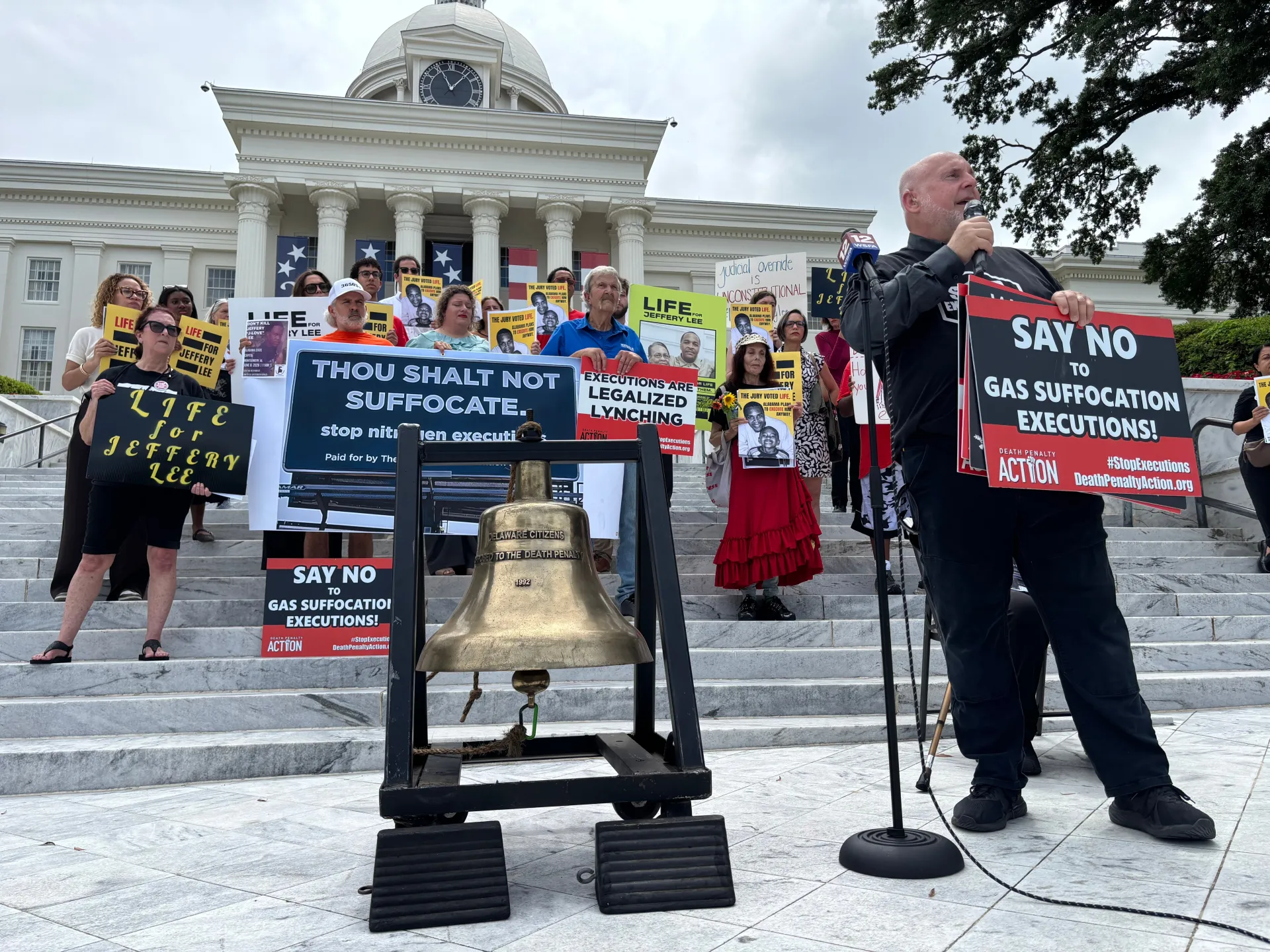
A federal judge in the United States has permanently blocked Alabama from executing an inmate with nitrogen gas, after declaring that the method violates the ban on cruel and unusual punishment.

On Tuesday, US District Judge Emily C Marks permanently enjoined the state from executing Jeffery Lee by nitrogen gas. Lee was scheduled to be executed Thursday at an Alabama prison.

Recommended Stories

list of 3 itemsend of list

Her decision came a day after an appeals court reversed her earlier ruling that the method is constitutional.

The case centres on how to interpret the US Constitution’s Eighth Amendment, which bars the government from inflicting “cruel and unusual punishments”.

A spokesman for Alabama Attorney General Steve Marshall said the state is reviewing the decision and considering next steps, including an appeal. The case will likely end up before the US Supreme Court, which has previously let nitrogen executions proceed.

A spokeswoman for Lee’s legal team said they did not have an immediate comment.

In her 26-page ruling, Marks said litigation is a constant in death penalty cases.

“Were Alabama to adopt firing squad as a method of execution, that method would likely be challenged as well. Indeed, there is likely no method — no matter how humane — that would be immune to constitutional challenge,” Marks wrote.

“But the Constitution does not guarantee a painless death, and human life cannot be purposefully extinguished without some risk of pain. The Court, the condemned, and the State must all confront that sobering reality.”

Marks noted that the state has two other authorised execution methods: lethal injection and the electric chair. She said Lee is “not entitled to an injunction barring the State from executing him using one of those methods”.

Marks also ruled that the state could switch to Lee’s preferred method, a firing squad. Inmates challenging execution methods are required to suggest an alternative method.

“The State can readily obtain rifles, ammunition, and other materials necessary to carry out a firing squad execution,” Marks wrote.

“Additionally, the State would be able to modify space at Holman to carry out executions by firing squad. The State is also able to source and train volunteers willing to carry out such an execution.”

Lee is currently housed at Holman Correctional Facility in Atmore.

Source link

NASA announces astronauts for Artemis III spaceflight, scheduled for 2027 | Space News

The National Aeronautics and Space Administration, better known as NASA, has unveiled the crew for its upcoming Artemis III spaceflight, a preparatory mission as the United States plans to return to the Moon.

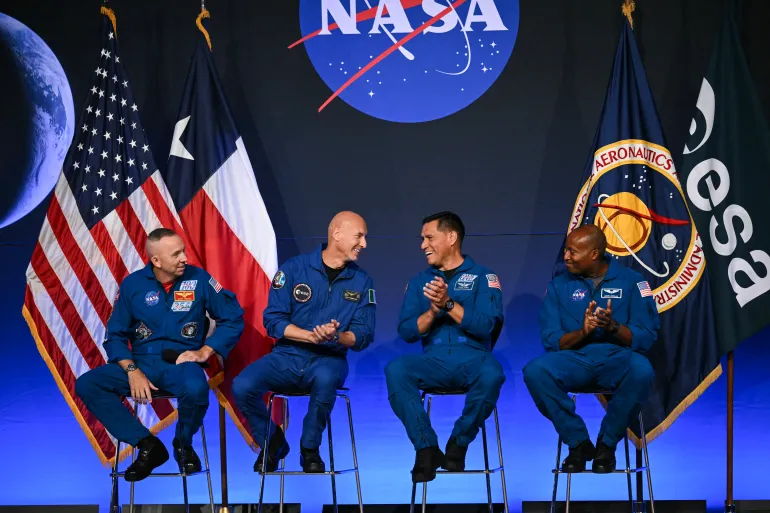
On Tuesday, it was revealed that astronauts Andre Douglas, Frank Rubio, Luca Parmitano and Randy Bresnik will be leading the flight. Serving as a backup is veteran test pilot Bob Heintz, who is able to substitute into any role.

Recommended Stories

list of 3 itemsend of list

Their two-week mission will focus on collecting research and practising in-space docking procedures in preparation for a future Moon landing.

While no women were named to the Artemis III flight, the newly announced crew represents a range of experiences and backgrounds.

Making his first spaceflight is Florida-born engineer Douglas, 40, who was a backup crew member for NASA’s last major spaceflight, Artemis II, which flew a loop around the Moon.

Douglas will serve as mission specialist on Artemis III, and his presence on the flight will make him one of roughly two dozen African American people to travel to space, out of a population of hundreds of space travellers so far.

Also serving as mission specialist will be Rubio, a 50-year-old Salvadoran American physician who used to pilot Black Hawk helicopters for the US Army. He currently holds the record for the longest single-duration spaceflight by a US astronaut, at 371 days.

The oldest member of the four-man crew is its 58-year-old commander, Bresnik. A former US Navy test pilot and Marine, Bresnik is the only Artemis III crew member to have participated in a space shuttle mission, back in 2009. That programme has since been retired.

More recently, in 2017, Bresnik served as the commander for the International Space Station.

The fourth and final member of the Artemis III mission is its pilot, Parmitano, 49. He will be the only astronaut on the mission who is not a US citizen.

Born in Paterno, Italy, Parmitano has a background in his country’s air force. In 2019, he too served as commander on board the International Space Station, becoming the first Italian to do so.

“ Each of you possess a unique background,” said NASA administrator Jared Isaacman, who introduced the astronauts. “Your vast experience and unwavering dedication to NASA’s mission enables you to help make us and take this next great step in space exploration.”

The Artemis III mission will be a public-private partnership. Three rockets will blast off as part of the initiative.

One will carry the four-man crew into orbit around Earth in an Orion spacecraft. Another two rockets will bear aloft Moon lander models from Blue Origin and SpaceX, private firms owned respectively by tech entrepreneurs Jeff Bezos and Elon Musk.

The Orion spacecraft will then practice rendezvous procedures with each of the two landers, in preparation for similar manoeuvres during future Moon missions. The Artemis III flight is set to take off before the end of 2027.

“Artemis III will be an extraordinary demonstration of what is possible when the greatest aerospace companies across the United States, alongside our European partners, come together to showcase the technological might and ambition of the free world,” said Isaacman, a Trump appointee who has experience commanding private space flights for SpaceX.

(L/R) NASA astronaut commander Randy Bresnik, ESA (European Space Agency) astronaut pilot Luca Parmitano, NASA astronaut mission specialist Frank Rubio, and NASA astronaut mission specialist Andre Douglas speak during a press conference announcing the crew for the Artemis III mission at NASA's Johnson Space Center in Houston, Texas, on June 9, 2026.
From left: Randy Bresnik, Luca Parmitano, Frank Rubio, and Andre Douglas speak during a news conference at NASA’s Johnson Space Center, on June 9, in Houston, Texas [AFP]

Explosion prompts concern

The mood at Tuesday’s unveiling ceremony was celebratory, as each newly announced astronaut took the stage to soaring music and standing ovations.

But looming over the event were concerns related to the explosion of an uncrewed Blue Origin New Glenn rocket in Florida on May 28.

That blast sent a mushroom cloud billowing above the city of Cape Canaveral, and it caused severe damage to a launchpad complex where the takeoff was scheduled.

Representatives from both NASA and Blue Origin, however, took the stage to wave aside any concerns.

“While we recognise there are questions about how Blue Origin’s recent anomaly impacts our plans, setbacks are a learning opportunity,” said Jeremy Parsons, NASA’s acting deputy administrator.

He added that NASA was taking an “active role” with its partners to “ensure the right outcomes are achieved”. The private firms, in turn, were granted “unparalleled access” to NASA experts, technology and test facilities.

“We are confident that New Glenn will be ready for Artemis III, together with Blue Origin,” Parsons said.

John Couluris, a representative for Blue Origin, likewise described the May 28 explosion as an “anomaly”.

“We’ve redoubled our efforts and are moving forward,” Couluris said, describing Blue Origin’s factories as “running around-the-clock shifts” to be ready for the Artemis III launch.

“We will measure ourselves not only by our successes but how we respond to setbacks.”

FILE - In this image provided by NASA, The Artemis II crew captured this view of an Earthset on April 6, 2026, as they flew around the Moon. (NASA via AP, File)
The Artemis II mission in April made a loop around the Moon, capturing images of Earth [File: NASA via AP Photo]

Race to the Moon

The race to beat China’s space programme was another theme that cropped up during Monday’s ceremony.

Several speakers alluded to China’s growing lunar landing programme, a rival to NASA’s efforts.

Earlier this year, the China Manned Space Agency announced its intentions to place a person on the Moon by 2030. Already, in 2024, China became the first country to retrieve soil samples from the far side of the Moon using robotics.

But lunar missions have been a point of pride for the US, which holds the distinction of completing the first crewed mission to the Moon in 1969.

Last April, the Artemis II flight marked the US’s return to lunar travel. For the first time since 1972, a crewed capsule flew beyond low Earth orbit, and it broke records for the farthest crewed flight into space.

Next year’s Artemis III mission is set to build on that effort. The administration of US President Donald Trump has signalled it would like to see astronauts land on the Moon before the Republican leader’s term ends in January 2029.

NASA officials have also described the Artemis programme as a stepping stone to establishing a permanent base on the Moon. Various speakers on Monday highlighted that vision.

Couluris, the Blue Origin representative, called the Moon an “eighth continent” for humans to explore.

NASA scientist Nicky Fox, meanwhile, described the Artemis III mission as part of the preparatory work that would enable the US “to plant astronaut boots back on the lunar surface — to stay”.

But the US’s lunar programme has faced numerous setbacks, as NASA engineers work to address technical issues that could otherwise cause life-threatening situations in deep space.

Originally, Artemis III was supposed to mark the US’s return to the Moon, bearing a crew to the lunar surface. But in February, that plan was scrapped in favour of the present-day project, which focuses on conducting practice drills in low Earth orbit.

“We will use this mission to reduce risk for our future crewed Moon missions with lander test articles from both Blue Origin and SpaceX, to ensure we will beat China back to the Moon,” Parsons said on Tuesday.

“This mission is deliberately designed to take calculated risks so that future crews will be safer and ultimately successful when we put boots on the lunar surface.”

Still, officials applauded Artemis III as a major step towards human beings reaching the Moon once more.

In a recorded statement, Senator Ted Cruz suggested that the Artemis III mission would also put the US a step ahead of China.

“At a time of growing competition with China in space, this mission will strengthen America’s leadership, expand our economy, and help secure a lasting American lunar presence,” he said.

“When America commits to a mission, we lead and we succeed.”

Source link

Iran conflict: Why has oil stayed near $100 a barrel? | US-Israel war on Iran

The worst-case oil scenario has been avoided, but inflation and slower growth continue to weigh on the global economy.

More than 100 days into the Iran conflict, 20 percent of the world’s energy flows remain disrupted, with the scenario described as the biggest supply shock in history.

For now, the nightmare scenario has been avoided. Oil prices are still at approximately $100 a barrel.

Many analysts have warned that a prolonged disruption to the Strait of Hormuz could send oil above $200 a barrel, triggering a global economic crisis.

Various countries have released their strategic reserves, exporters have found alternative routes and weaker demand has helped contain prices. But the buffers are thinning.

The Organisation for Economic Co-operation and Development (OECD) warns the economic impact could linger well into 2027, even if the conflict ends tomorrow.

Source link

Trump courts boos at historic New York NBA Finals appearance | Donald Trump News

Donald Trump’s appearance courtside at Madison Square Garden was supposed to be a historic moment, as, for the first time, a sitting president of the United States was attending an NBA Finals game.

Instead, his arrival became part of the story, drawing boos from sections of the crowd and triggering a massive security operation that reshaped the atmosphere around the storied New York arena on Monday night.

Trump watched from an executive suite as the New York Knicks hosted the San Antonio Spurs in a series that gripped the city and revived memories of the Knicks’ glory years.

When his image flashed up on the big screen during the national anthem, many fans jeered, underlining how sharply divided the country remains even in a space usually reserved for shared celebration.

Outside, Manhattan’s streets were locked down. Metal fencing, airport-style screening and a heavy Secret Service and police presence kept ticketless fans blocks away.

Long queues formed as supporters queued early, while others gathered at public viewing areas across the city.

Inside, however, the spectacle went on. Hollywood actors, musicians, former players and New York fixtures filled the front rows, turning the event into a star-studded night out.

Between the celebrity sightings, the political undertones and a tense 115-111 Spurs win, this was a New York basketball night unlike any other – on and off the court.

Source link

US lists China’s BYD, Alibaba, Baidu as ‘Chinese military companies’ | Military News

Chinese embassy in Washington, DC, condemns designation, calling it ‘discriminatory’.

The United States has designated Chinese corporate giants Alibaba, BYD and Baidu as companies that support China’s military, expanding its blacklist to some of the country’s best-known commercial brands.

The Pentagon included the firms in an update on Monday that is likely to complicate the fragile detente under way between Washington and Beijing after years of rocky relations.

Recommended Stories

list of 4 itemsend of list

China’s embassy in Washington, DC, condemned the listing as “discriminatory” and an example of the US government “overstretching” the concept of national security.

“Chinese companies that do business overseas have been strictly observing laws and regulations of their host countries,” an embassy spokesperson said.

“The US should stop its wrong practice and create a fair, just and non-discriminatory environment for Chinese companies.”

Alibaba, BYD and Baidu did not immediately respond to requests for comment.

The Pentagon’s list of “Chinese military companies,” which is updated annually, now includes 188 firms, up from 134 in 2025.

Firms included on the list, which was created in 2021, will be barred from consideration for US defence contracts from later this month.

The Pentagon defines “Chinese military companies” as entities owned or controlled by the Chinese military, or that contribute to China’s “military civil fusion”, referring to Beijing’s strategy of melding civilian and defence-related research and innovation.

Companies must also carry out some of their operations in the US to be designated.

The expansion of the blacklist comes less than a month after US President Donald Trump met Chinese leader Xi Jinping in Beijing for a two-day summit aimed at lowering the temperature in their countries’ years-long trade war and tech rivalry.

Alibaba, Baidu, and BYD are among China’s most prominent brands, claiming the top spots in the e-commerce, internet search and electric vehicle markets, respectively.

The addition of several household brands not normally associated with the defence sector mirrors last year’s designation of tech firm Tencent, the owner of the ubiquitous messaging app WeChat.

Other additions to the list include RoboSense Technology, an AI and robotics company with headquarters in Shenzhen, and Hangzhou-based Unitree Robotics.

RoboSense Technology and Unitree Robotics did not immediately respond to requests for comment.

Dennis Wilder, a national security expert who worked on China at the CIA and the White House’s National Security Council, expressed scepticism about the feasibility of implementing such a “broad-brush” blacklist.

“Although it may make some US firms wary of engaging with the labelled entities, in fact, many US firms already have deep relationships with these entities, that they are not going to give up unless there are real penalties attached to working commercial deals with them,” Wilder told Al Jazeera.

“Sanctions that range this widely are sanctions that don’t work. Unless the US is willing to decouple from the Chinese economy altogether, these sanctions are simply performative,” Wilder said.

Source link

Trump warns Netanyahu: ‘You’ll be on your own’ if attacks on Iran continue | US-Israel war on Iran News

United States President Donald Trump has warned Israeli Prime Minister Benjamin Netanyahu that he might find himself fighting on his own if Israel returns to war with Iran.

The warning on Monday came as Israel and Iran said they would pause attacks following their most serious escalation since a ceasefire took effect in April.

Recommended Stories

list of 3 itemsend of list

Trump, who has reportedly grown increasingly exasperated with Netanyahu, demanded that both sides stop “shooting” in a post on his Truth Social platform and said that “final negotiations” towards peace would proceed “subject to ignorance or stupidity getting in its way”.

He also called Netanyahu and told him to stop the strikes, according to media reports.

In an interview with Axios, Trump said he had warned Netanyahu about the consequences of continuing the war.

“I said, ‘Bibi, you better be careful, or you will be on your own very soon’,” Trump said.

The flare-up began on Sunday, triggered by Israel’s deadly bombardment of Lebanon’s capital, Beirut. Iran – which has long said any peace deal with the US depends in part on an end to the fighting in Lebanon – responded with a wave of missiles at northern Israel.

Trump reportedly called Netanyahu on Sunday evening and asked him not to retaliate, but Israel launched attacks on Iran early on Monday.

Israeli forces struck Iranian air defence systems and a petrochemical plant, while Iran retaliated by hitting a similar facility in Haifa and targeting two Israeli airbases. Many of the missiles were intercepted over the occupied West Bank.

No deaths were reported on either side.

Israel plays down tensions

The exchanges complicated Trump’s push to end a war that the US and Israel launched on February 28. A ceasefire announced on April 8 paused all-out warfare. But flare-ups in the Gulf have continued.

For his part, Netanyahu said in a televised statement that he had told Trump that “Israel has a full right to self-defence, and we are exercising it as required”.

“Right now, the fire at the front is contained, because after we hit the terrorist regime in Tehran, it stopped attacking us,” he said.

Netanyahu also warned that should Iran “make the mistake of resuming attacks against us, we will respond with full force”.

Israel’s ambassador to Washington, Yechiel Leiter, downplayed reports of tension between the US and Israeli leaders, telling Fox News that “sometimes, lovers have a spat”.

He said that while Netanyahu had “decided” to “lower the temperature” at Trump’s request, the US president understands “full well” that Israel cannot “absorb ballistic missiles into our country without responding.”

Iran’s Ministry of Foreign Affairs spokesperson, Esmaeil Baghaei, blamed Washington for the escalation.

“The US is directly responsible,” he said. “They are party to the ceasefire negotiations. Therefore, any act in violation of the ceasefire, be it through the interception of vessels [in the Strait of Hormuz], the targeting of southern Lebanon by Israel, or any other event, will cause the United States to be directly responsible for the escalation in the region.”

Iran’s First Vice President Mohammad Reza Aref said the operation against Israel, dubbed “Nasr” or victory, showcased “a new level of deterrence from mighty Iran” and that Israel had been “forced to beg once again” for a ceasefire.

Behind the scenes, diplomatic efforts continue.

Iranian President Masoud Pezeshkian posted on X that Tehran was still “at the negotiating table”, while Iran’s ambassador to the United Nations, Amir Saeid Iravani, said that Washington and Tehran, through Pakistan as an intermediary, are “presenting and exchanging views” towards an agreement.

Iravani told The Associated Press news agency he was hopeful that “very soon” the two sides would reach “a conclusion”.

Pakistan’s Prime Minister Shehbaz Sharif said efforts for a peaceful diplomatic solution was ongoing “earnestly and painstakingly” and called for restraint, “especially when the final objective is just about to be achieved”.

He also said Israel and Iran’s exchange of fire was a “reminder of the dangers associated with a tenuous ceasefire and the unbearable consequences it may lead to”.

Attacks on Lebanon continue

The escalation on Monday also drew in Yemen’s Houthi rebels.

The group fired missiles at Israel early in the morning and declared a complete ban on Israeli maritime navigation in the Red Sea, warning that all Israeli movements would be considered “legitimate military targets”.

Later on Monday, air raid sirens sounded in the Israeli port city of Eilat, with the military saying a suspected aerial target was launched from Yemen.

Violence has also continued in southern Lebanon.

An Israeli strike killed five people in the city of Tyre, while another, in the Nabatieh district, left seven dead. A third strike in Marwanieh killed two people, the Lebanese Ministry of Health said.

Phyllis Bennis, a fellow at the Institute for Policy Studies, said Trump was trying to give an impression that he was tougher on Israel than he actually is.

“The words could be significant if they were matched by actions,” she told Al Jazeera.

“As long as they’re sending billions of dollars directly to the Israeli military, and as long as they’re protecting Israel from being held accountable in the International Court of Justice or the International Criminal Court, as long as those actions don’t change, the words just don’t mean very much,” she added.

Source link

Maine’s Platner faces test as four US states hold midterm primary votes | US Midterm Elections 2026 News

Four states are set to hold their primary votes, further solidifying the battle lines for the United States midterm elections in November.

On Tuesday, citizens in Maine, South Carolina, North Dakota and Nevada are set to cast their ballots in party primaries, designed to select which Democratic and Republican candidates advance to the final round of voting.

Recommended Stories

list of 3 itemsend of list

But Maine has emerged as one of the most heated primary battlegrounds. With Democrats desperate to flip four seats in the US Senate, all eyes are on Republican Senator Susan Collins’s re-election campaign.

Democrats are hoping to defeat her in November, but the party has fractured over controversies related to its leading candidate, Graham Platner. The race has become one of the most closely watched of the primary season.

At stake in November is control of Congress, and each party is angling to put forward the strongest contender.

Currently, the Republican Party holds slender majorities in both the Senate and the House of Representatives, but Democrats hope to wrest back control, in what would represent a major rebuke to President Donald Trump.

State-level races are also in play during Tuesday’s primaries. Several in key swing states like Nevada could have outsized influence over election administration in the years ahead.

Here are some of the key races to watch.

Key Senate race in Maine to be decided

The Democratic Party’s long-shot hope of retaking the Senate hinges on Maine, a lushly forested northeastern state largely bordered by Canada and the Atlantic Ocean.

The primary vote on Tuesday is widely expected to result in Platner advancing as the Democratic champion for November’s midterms. If so, he will take on the longtime incumbent, Republican Senator Collins, who is considered vulnerable to defeat.

Polls have consistently shown the 41-year-old progressive narrowly defeating Collins in the midterm in November.

Platner has appealed to left-wing voters with his positions in favour of universal healthcare and ending US support for Israel. But a slate of recent reports about his past relationships has threatened to chill the enthusiasm for his campaign.

An oyster farmer and former US Marine, Platner has faced accusations of “unsettling” behaviour towards women, including an alleged incident where he twisted one romantic partner’s arm. Platner has denied that allegation.

He has also permanently removed a skull-and-bones tattoo that critics likened to a Nazi symbol, saying he did not know its source.

Still, in Tuesday’s primary, Platner is expected to handily beat his closest Democratic rivals: environmental consultant David Costello and Governor Janet Mills, who will remain on the ballot despite announcing her withdrawal from the race.

Contests for Maine’s House and governor seats

But Maine boasts other nationally significant races, too. That includes the contest for the House seat left open after Democratic Representative Jared Golden announced he would not run for re-election.

Golden has represented Maine’s 2nd congressional district since 2019, and he has proven adept at retaining support, even though his coastal district leans conservative.

If Republicans pick up his seat, it would be a boon to the party’s effort to maintain control of the House. Former Republican Governor Paul LePage is running uncontested in his party’s primary to replace Golden.

Four Democrats, meanwhile, are competing in their party primary to take him on.

They include state Senator Joe Baldacci, state auditor Matthew Dunlap, social worker Paige Loud, and congressional staffer Jordan Wood. All four have charted a more leftward course than the outgoing lawmaker.

Maine’s governor’s race is also open, with Mills, a Democrat, leaving her post at the end of the year due to term limits.

The chance to win the governor’s mansion in November has attracted a crowded field to both party primaries. Each race features notable political scions.

On the left, there is Angus King III, whose father currently represents the state in the US Senate, as well as Hannah Pingree, the daughter of a current member of Congress. Running on the right is healthcare executive Jonathan Bush, a cousin of former President George W Bush.

Election administration looms large in Nevada

Nevada has remained a deeply purple state in recent years, leaning neither left nor right.

Democratic presidential contenders have narrowly won the state from 2008 to 2020, but President Donald Trump broke the streak in 2024, carrying just over 50 percent of the vote.

A staggering 45 percent of Nevada’s voters are registered as independents. That means they hold outsized sway in November’s midterm vote, but they will not be able to cast a ballot in Tuesday’s closed primaries, which are limited to party members only.

The sprawling western state is home to about 3.2 million residents. In the middle of its desert landscape sits Las Vegas, a global gambling and entertainment destination.

But the state has become a political football, in part because of its narrow partisan divide.

Trump and his allies have targeted the state by spreading false claims of election fraud in the wake of the Republican leader’s 2020 election defeat. Those assertions led him to clash with state Attorney General Aaron Ford, who pledged to defend his state’s election integrity.

Now, Ford is currently leading a crowded Democratic field to take on Republican incumbent Joe Lambardo for the governor’s mansion. Polls have shown Washoe County Commissioner Alexis Hill as his top challenger in the Democratic primary.

Lombardo — who has broken state records for his use of vetoes — also faces a deep bench of Republican challengers, but he is expected to skate to an easy victory on Tuesday.

Another key state position is up for grabs this November: Nevada’s secretary of state.

Like Ford, the role’s current occupant, Francisco Aguilar, is a vocal critic of Trump’s efforts to assert more federal control over election administration.

He is running unopposed on the Democratic side, so he automatically advances to November’s general election.

Four Republicans are running to challenge Aguilar, including Jim Marchant, a former state assemblyman who supported Trump’s unfounded claims that the 2020 election was stolen.

Another top primary contender is lawyer Shirley Folkins-Roberts, who has been endorsed by the state’s Republican governor.

On the national level, Nevada has four total seats in the House of Representatives. Three are currently held by Democrats, and one by a Republican.

On Tuesday, Republicans will select their challengers in a bid to unseat the Democratic incumbents, all of whom are running for re-election.

Meanwhile, the retirement of Republican Representative Mark Amodei has sparked hope that Democrats might, for the first time ever, win the state’s 2nd congressional district.

Eight Democrats are vying to be their party’s champion, while 13 candidates are running on the Republican side.

Democrats eye long-shot flip in South Carolina

Since last year, the Trump administration has led a controversial redistricting drive, pushing Republican-led states to redraw their congressional districts to better favour the party.

But last month, lawmakers in South Carolina chose not to pursue a redistricting plan — at least, not yet. Part of the reason came down to Tuesday’s primaries.

Thousands of voters cast their ballots last month as part of an early-voting campaign encouraged by Democrats. Any last-minute redistricting would have required throwing out those votes.

That has, for now, protected the majority Black district of longtime Representative Jim Clyburn, the only Democrat representing South Carolina in the House.

South Carolina, a southern, coastal state home to 5.5 million people, is considered rightward-leaning. But Democrats are seeking to defend their House seat in November’s midterms — and maybe pick up a second.

In Tuesday’s primaries, the 85-year-old Clyburn is expected to sail to victory against a long-shot Democratic challenger. He is all but assured to win in November as well, given his district’s reputation as a Democratic stronghold.

Democrats have also set their sights on flipping South Carolina’s 1st district, with Republican Nancy Mace vacating her seat to run for governor. Seven candidates are running in the Democratic primary race for the coastal district, while 10 Republicans will compete in their party primary.

One Senate seat will also be on Tuesday’s primary ballot: the one held by Republican Lindsey Graham. Despite several challengers, polls show the incumbent with a commanding lead.

Graham, a close Trump ally and a notable war hawk, has been one of Congress’s most vocal supporters of the US-Israel war on Iran.

This year, due to term limits, Governor Henry McMaster is unable to run for re-election. Given that South Carolina is a solidly red state overall, whoever wins Tuesday’s Republican primary is expected to coast to victory in November.

Recent polls have shown a tight race. Trump has endorsed Lieutenant Governor Pamela Evette, but surveys show her neck and neck with state Attorney General Alan Wilson and Congresswoman Mace, who has at times broken with Trump over issues like the Iran war.

North Dakota’s lone congressional district

Primary day in the Great Plains state of North Dakota is expected to make few waves nationally.

Neither the governor nor the state’s two senators are up for re-election.

Political observers are expecting few surprises. North Dakota has been a Republican stronghold since the late 1960s.

The 435 seats in the US House are distributed among states based on their population size. But since North Dakota has only about 800,000 people, it has just one congressional district.

During Tuesday’s Republican primary, incumbent Representative Julie Fedorchak will seek to ward off a challenge from former State Department project manager Alex Balazs.

Democrat Trygve Hammer, meanwhile, is running unopposed in his party’s primary.
Source link

UN human rights leader calls for Cuba sanctions to be ‘lifted immediately’ | United Nations News

Volker Turk, the high commissioner for human rights at the United Nations, has issued some of his harshest criticism yet of the recent sanctions the United States has imposed on Cuba.

On Monday, Turk drew a line between the increasing restrictions on the Cuban economy and reports of heightened death rates, particularly among children.

Recommended Stories

list of 3 itemsend of list

“The fuel restrictions imposed since early 2026 and recent tightening of extraterritorial sanctions, taken together, are directly harming Cubans, especially the most vulnerable,” Turk said in a statement.

“Children are dying because doctors lack access to essential medical supplies and medicines. This is unacceptable.”

Such “severe sanctions”, he added, run contrary to the “basic principles of international human rights law”. He called for them to be “lifted immediately”.

Turk’s comments are a direct response to the suite of actions taken under US President Donald Trump to tighten pressure on Cuba, a Caribbean island that has already weathered a decades-long US trade embargo.

Starting in January, the Trump administration moved to cut off Cuba’s foreign oil supply, a linchpin for its ageing energy grid.

First, it severed supplies of oil and funds from Venezuela. Then, on January 29, Trump issued an executive order declaring Cuba to be an “unusual and extraordinary threat” to US national security. As such, he said, any country that supplied it with oil would be subject to steep tariffs.

In the months since, the Trump administration has continued to layer sanctions on Cuba. In May, for instance, penalties were announced against Cuba’s Interior Ministry, its National Police and its Directorate of Intelligence.

Those were followed this month by sanctions targeting Cuba’s president, Miguel Diaz-Canel, as well as members of his family.

The sanctions are designed to penalise those “responsible for repression” in Cuba, an island whose communist government has been accused of stifling dissent, as well as imprisoning and torturing activists.

Turk on Monday acknowledged Cuba’s human rights record and called on the country to “release all those arbitrarily detained”.

But he also pointed to the mounting death toll associated with the US sanctions, which have isolated the island country from much of the world.

The sanctions freeze any US-based assets the target may have, but they also prohibit entities from conducting business with the sanctioned parties. That can result in difficulties accessing global financial systems and other international platforms.

The de facto oil blockade has also resulted in the increasing frequency of power outages, and essential services like public transportation and medical care have faced reductions. Turk pointed to those downstream effects in his remarks.

“Cuba faces increasing isolation,” he said. “Companies are leaving. Fewer airlines fly to the country. It is almost disconnected from international payment systems.”

Turk’s office has also highlighted the human costs of the sanctions. According to the statistics it cited, infant death rates have doubled, reaching 9.9 for every 1,000 births. The survival rate for childhood cancer, meanwhile, has declined from 85 to 65 percent.

In March, the Cuban government also warned of medical needs going unanswered as a result of the energy shortage. It estimated that there was a backlog of 96,387 people awaiting surgery, 11,193 of whom were minors.

It also underscored that 16,000 patients needed radiotherapy, and another 2,888 required dialysis, two treatments that depend on steady electrical supplies.

Turk’s remarks also pointed to the risks posed by the Atlantic hurricane season and other natural disasters. Within hours of his remarks, western Cuba was rattled by a powerful 6.1-magnitude earthquake. Summer heat alone could cost lives, he explained.

“Rising summer temperatures risk increasing the spread of vector borne and waterborne diseases,” Turk said.

“The hurricane season further increases exposure. This creates a perfect storm for social and economic deterioration and suffering for the Cuban people.”

Trump has repeatedly suggested that he is considering military action in Cuba to remove its leadership after the US-Israel war on Iran reaches an end.

Since January, only one Russian oil tanker has been allowed to reach the island, leaving its foreign fuel supplies largely depleted.

Source link