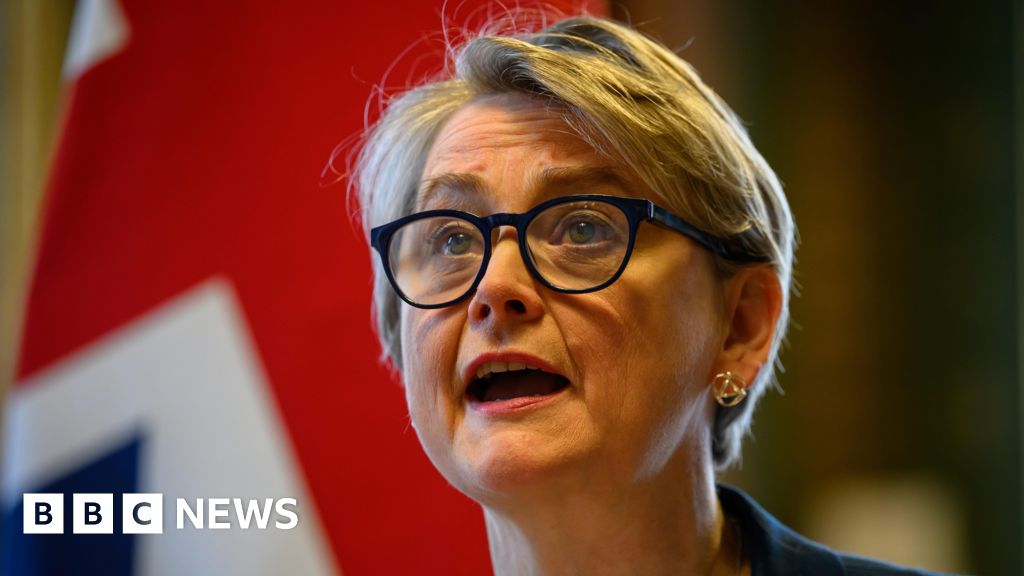
Cooper to urge full and toll-free reopening of Strait of Hormuz
Foreign Secretary Yvette Cooper will call for shipping in the Strait of Hormuz to be toll-free and unhindered.
Source link
Foreign Secretary Yvette Cooper will call for shipping in the Strait of Hormuz to be toll-free and unhindered.
Source link
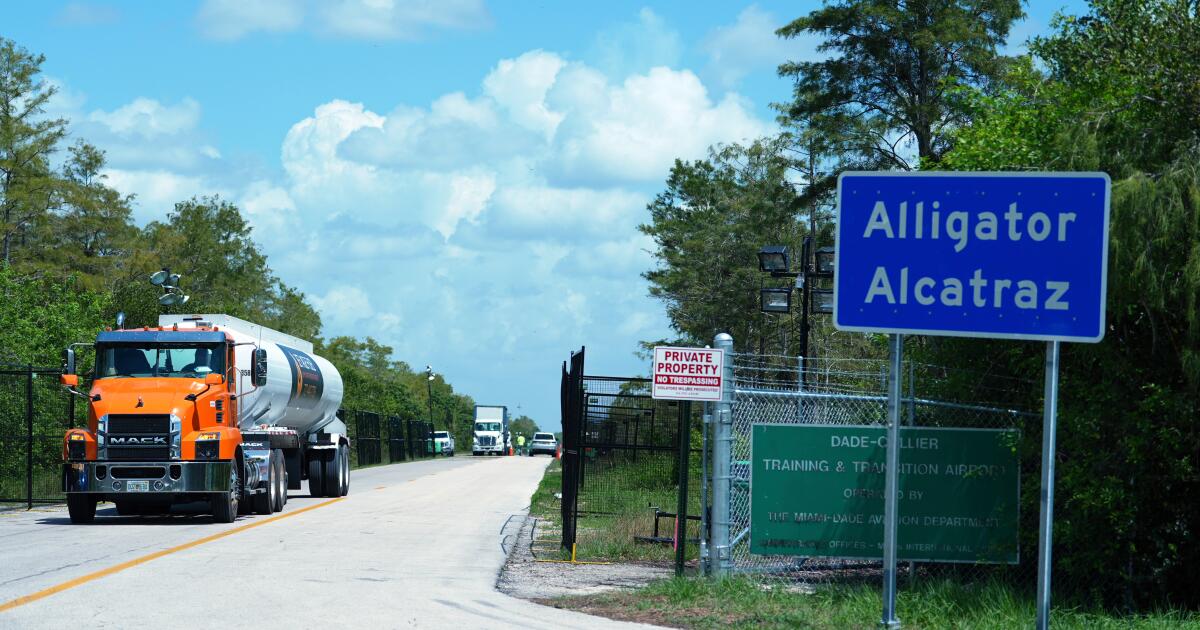
ORLANDO, Fla. — Environmental groups on Tuesday asked a federal appellate court panel to drop its temporary halt of a lower court’s order instructing state officials to close an immigration detention center in the heart of the Florida Everglades known as “Alligator Alcatraz.”
The Everglades facility remains open, still holding detainees, because the appellate court in early September relied on arguments by Florida and the Trump administration that the state had not yet applied for federal reimbursement, and therefore wasn’t required to follow federal environmental law. State officials opened the detention center last summer to support President Trump’s immigration crackdown.
Questions by the three appellate judges during oral arguments in a Miami courtroom focused on how much control the federal government had over the state-built facility and under what circumstances an environmental review was required to be in compliance with federal law. The judges did not indicate when they would rule.
Jesse Panuccio, an attorney for the Florida Department of Emergency Management, told the judges federal funding and federal control of the facility were the two criteria for determining if the federal environmental law would apply and the federal agencies had no control over the state-run detention center.
Florida was notified in late September that FEMA had approved $608 million in federal funding to support the center’s construction and operation.
“You need both,” Panuccio said. “Even with funding, I don’t think that would follow because they don’t have federal control.”
An attorney for the environmental groups said the law requiring a review applied to the facility because the Department of Homeland Security had authorized the funding and immigration was a responsibility of the federal government, not the state.
“What is different about this property is that immigration is constitutionally a federal function,” said Paul Schwiep,” an attorney representing the Friends of the Everglades and the Center for Biological Diversity. “The state has no role.”
The federal district judge in Miami in mid-August ordered the facility to wind down operations over two months because officials had failed to do a review of the detention center’s environmental impact according to federal law. That judge concluded that a reimbursement decision already had been made. The appellate court halted the order on an appeal.
The environmental lawsuit was one of three federal court challenges to the Everglades facility since it opened. In the others, a detainee said Florida agencies and private contractors hired by the state had no authority to operate the center under federal law. The challenge ended after the immigrant detainee who filed the lawsuit agreed to be removed from the United States.
In the third lawsuit, a federal judge in Fort Myers, Fla., ruled the Everglades facility must provide detainees there with better access to their attorneys, as well as confidential, unmonitored, unrecorded outgoing legal calls.
Schneider writes for the Associated Press.

A workers’ union at the World Cup venue has asked FIFA to keep ICE agents away from the venue to alleviate their fears.
Published On 7 Apr 20267 Apr 2026
A union representing about 2,000 food service workers at the Los Angeles Stadium has asked FIFA to keep United States Immigration and Customs Enforcement (ICE) away from World Cup operations in the city and warned workers could strike if their concerns are not addressed.
Unite Here Local 11, which represents cooks, servers and bartenders at the Inglewood venue, said on Monday that the workers remain without a labour contract as the World Cup approaches.
list of 4 itemsend of list
The union laid out three main demands to FIFA and stadium owner Kroenke Sports & Entertainment: A public commitment that ICE and Border Patrol will play no role in the tournament, protections for union jobs and working conditions, and support for affordable housing for hospitality workers.
Acting director of ICE, Todd Lyons, has said ICE would play a “key part” in the World Cup, a prospect the union said threatened worker and guest safety in Los Angeles.
Local 11 said it also wanted assurances that artificial intelligence and automation would not be used during the tournament to eliminate union jobs.
The union linked its labour demands to broader concerns over housing costs in the Los Angeles area, particularly in Inglewood, and called for support for a workforce housing fund, restrictions on short-term rentals and tax measures aimed at funding affordable housing and immigrant family protections.
“FIFA and its corporate sponsors will pocket billions from Los Angeles while refusing to even acknowledge the cooks, servers, and stand attendants who make this event possible,” Kurt Petersen, co-president of Local 11, said in a statement.
The union said it had repeatedly sought meetings with FIFA since Los Angeles was chosen as a host city, but had been ignored.
The venue is known as the SoFi Stadium, but has been rebranded to the Los Angeles Stadium for the World Cup due to sponsor clashes.
Los Angeles is set to host eight World Cup matches at the stadium, the first being the US against Paraguay on June 12.
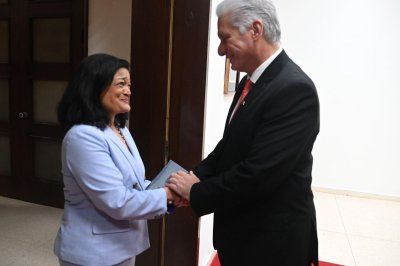

April 6 (UPI) — Two Democratic lawmakers concluded a trip to Cuba on Monday by calling for the United States and Cuba to begin “real negotiations” and denouncing the Trump administration’s “economic bombing” of Havana.
Democratic Reps. Pramila Jayapal, of Washington, and Jonathan Jackson, of Illinois, returned to the United States following a five-day visit to Cuba. They said they spoke with officials and witnessed the effects of President Donald Trump‘s monthslong de facto oil blockade of the island nation.
The lawmakers said they saw premature babies in incubators put at risk due to Cuba’s energy crisis, children out of school because teachers have no fuel to travel to school and cancer patients being denied treatment because of a lack of medicine.
“This is cruel collective punishment — effectively an economic bombing of the infrastructure of the country — that has produced permanent damage,” the lawmakers said in a joint statement.
“It must stop immediately.”
The Trump administration has been enforcing a monthslong policy of choking off oil supplies to Cuba, plunging the socialist nation into a worsening energy and humanitarian crisis. On Jan. 29, President Donald Trump declared a national emergency with respect to Cuba and created a process to penalize countries that provide it with oil. According to a recent U.N. system action plan, citing Cuban authorities, no fuel imports have been recorded since Dec. 13.
“This disruption has triggered a severe energy shock, characterized by a critical fuel shortage affecting electricity generation, transportation and essential logistics across the country,” the U.N. report published last week said.
Widespread blackouts, fuel rationing and electricity shortages have been reported, it said.
The two Democratic lawmakers said they met with Cuba leaders in religion, civi society and the government, as well as dissidents, and all agreed that the blockade — which they called illegal — must end.
“We do not believe that the majority of Americans would want this kind of cruelty and inhumanity to continue in our name,” they said.
The pair met with President Miguel Diaz-Canel Bermudez, who said in a statement that he denounced to them the “energy siege decreed by the current U.S. government” and reiterated “the willingness of our Government to sustain a serious and responsible dialogue and to find solutions to the existing differences.”
Foreign Minister Bruno Rodriguez of Cuba said in a statement that he also told the lawmakers about the situation facing his country and their “willingness for serious and responsible dialogue to try to find solutions to bilateral problems.”
The Democrats said the Cuba government has sent signals that the country is ready for reform, pointing to its pardoning last week of more than 2,000 prisoners and efforts to liberalize its economy, while arguing the remaining obstacles to its progress is U.S. policy, which they called “outdated” from the Cold War-era.
“True reform will only come from charting a new course,” they said.
Trump has turned his attention to Cuba after detaining Venezuela’s authoritarian leader, Nicolas Maduro, in early January in a clandestine military operation.
He has said it is “a failing nation” and described it as on the precipice of collapse.
“As we achieve a historic transformation in Venezuela, we’re also looking forward to the great change that will soon be coming to Cuba,” he said on March 7 during the Shield of the Americas Summit.
“Cuba’s at the end of the line.”
UN experts say Israel ’emboldened by impunity’ for previous journalist killings in Lebanon, Gaza and the West Bank.

Published On 2 Apr 20262 Apr 2026
Three United Nations experts have called for an independent and thorough investigation into Israel’s recent killing of three journalists in Lebanon, denouncing the deadly incident as “another egregious attack on press freedom by Israeli forces”.
UN special rapporteurs Irene Khan, Morris Tidball-Binz and Ben Saul on Thursday noted that “journalists carrying out their professional duties in armed conflict are civilians and must not be targeted or made the object of attack”.
list of 3 itemsend of list
“The deliberate killing of journalists not directly participating in hostilities constitutes a serious violation of international human rights and humanitarian law and a war crime,” they said in a statement.
The Israeli military killed Al Mayadeen journalist Fatima Ftouni, her brother, freelance photojournalist Mohamad Ftouni, and Al-Manar’s Ali Shoaib in a targeted strike on their car in southern Lebanon on March 28.
Al Mayadeen and Al-Manar are pro-Hezbollah media outlets, and Israel accused Shoaib – without presenting any evidence – of being a fighter with the Lebanese armed group.
That claim was rejected by Shoaib’s colleagues as well as by the UN experts, who on Thursday also stressed that working for media outlets affiliated with an armed group does not mean journalists are directly participating in hostilities under international law.
“Israeli officials know this, yet they choose to ignore it – emboldened by impunity for their previous killings of journalists in Lebanon, Gaza and the West Bank,” they said.
In February, the Committee to Protect Journalists (CPJ) reported that Israel was responsible for two-thirds of all killings of journalists in 2024 and 2025.
More than 60 percent of the 86 members of the press killed by Israeli fire last year were Palestinian journalists reporting from the Gaza Strip amid Israel’s genocidal war in the coastal enclave, the advocacy group found.
After the killings in southern Lebanon last week, CPJ’s Middle East director Sara Qudah also warned that Lebanon is becoming “an increasingly deadly zone for journalists, despite their status as civilians who must not be targeted”.
“We have seen a disturbing pattern in this war and in the decades prior of Israel accusing journalists of being active combatants and terrorists without providing credible evidence,” Qudah said in a statement.
“Journalists are not legitimate targets, regardless of the outlet they work for.”
The UN experts also warned that Israel’s killing of Lebanese journalists is part of “an abominable push … to silence reporting on Israel’s current military action in Lebanon, and shut down news coverage of war crimes committed, just as it did in Gaza”.
At least 1,345 people have been killed and 4,040 wounded in intensified Israeli attacks across Lebanon since early March, according to the Lebanese Ministry of Health.
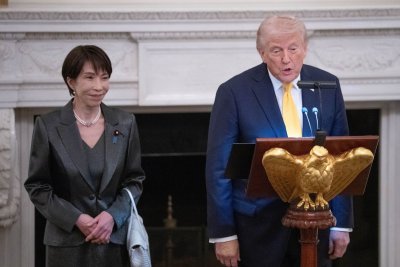

March 22 (Asia Today) — South Korea should maintain “strategic ambiguity” in responding to U.S. pressure over the Middle East crisis, experts said, as tensions surrounding Iran and the Strait of Hormuz intensify.
The call comes after Donald Trump urged allies including South Korea, Japan and European partners to play a greater role following U.S. and Israeli strikes on Iran, raising concerns in Seoul about balancing its alliance with Washington and broader diplomatic interests.
South Korean officials said they are taking a cautious approach and have not received formal requests from the United States regarding potential military deployment to the Strait of Hormuz.
The government is focusing on assessing the intent behind Trump’s remarks while weighing the risks of deeper involvement in the region.
The Strait of Hormuz, a critical global energy shipping route, has long been vulnerable to disruption. Analysts say any effort to secure maritime traffic would likely require multinational coordination rather than unilateral action.
Foreign ministers from the Group of Seven nations recently condemned Iran’s attacks on civilian infrastructure and said they are prepared to take steps to support global energy supplies, though the timing of any direct action remains unclear.
A Foreign Ministry official said stability in Middle Eastern shipping lanes is vital for South Korea and other major economies, noting that ensuring safe passage is a challenge that cannot be addressed by a single country.
Experts pointed to Japan’s approach under Sanae Takaichi as a potential model. Tokyo has prioritized its alliance with the United States while limiting direct military involvement, balancing energy security, international law and domestic public opinion.
Lee Ki-tae, a senior researcher at the Sejong Institute, said South Korea should similarly avoid automatic military intervention and instead preserve flexibility.
“Maintaining strategic ambiguity allows South Korea to uphold its alliance while avoiding immediate alignment with any one side,” he said.
Park Won-gon, a professor at Ewha Womans University, said logistical and political constraints also support a cautious stance. He noted that deploying naval forces would require parliamentary approval, a process that could take about two months.
He added that evolving and sometimes inconsistent messaging from Washington further underscores the need for careful deliberation.
— Reported by Asia Today; translated by UPI
© Asia Today. Unauthorized reproduction or redistribution prohibited.
Original Korean report: https://www.asiatoday.co.kr/kn/view.php?key=20260323010006558
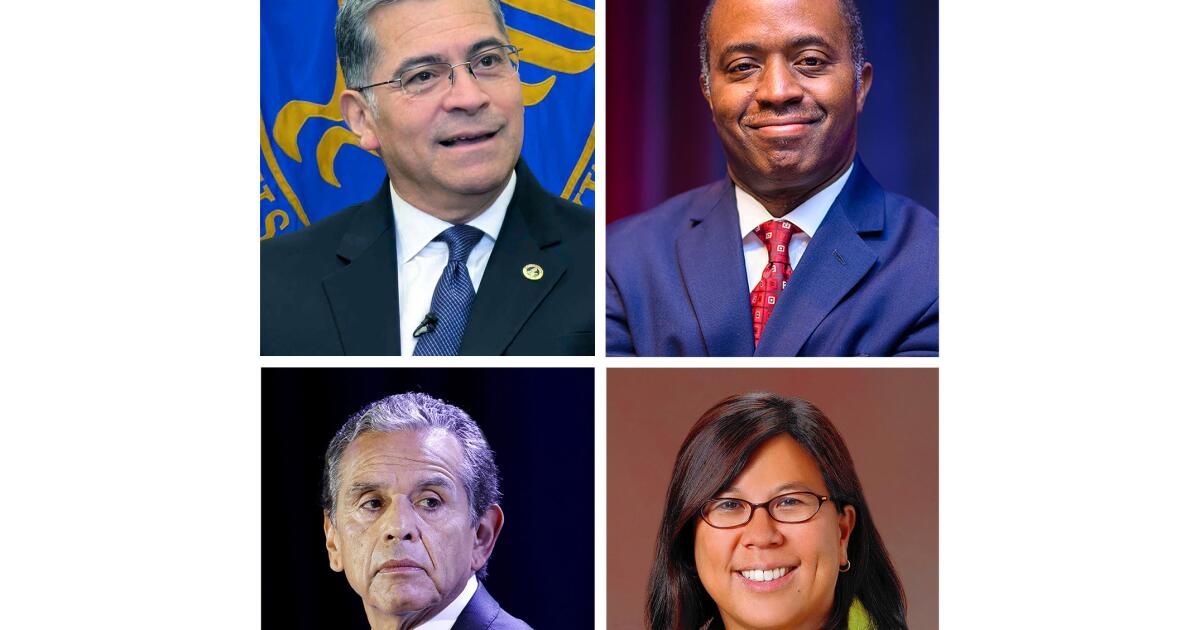
Four Democrats running for governor called on their fellow candidates to boycott an upcoming debate at USC, reiterating concerns that the criteria used to determine who was invited to participate resulted in every prominent candidate of color being excluded from the forum.
“We ask each and every candidate who is in this race to recognize that if we can’t have a fair process for a debate, then we should all not participate,” said Xavier Becerra, the former U.S. Health and Human Services secretary. “We call on them to withdraw from this biased forum.”
Becerra’s call was echoed by former Los Angeles Mayor Antonio Villaraigosa, state Supt. of Public Instruction Tony Thurmond and former state Controller Betty Yee during a Friday afternoon news conference.
The candidate’s request comes a week after some of them raised concerns about the criteria for Tuesday’s debate, arguing that it was engineered to allow the inclusion of San José Mayor Matt Mahan, who entered the race in late January and quickly raised millions of dollars from Silicon Valley executives.
“The rules initially were polling and money. Matt Mahan is [polling] lower than some of us, period,” Villaraigosa said, adding that the debate organizers “then added time in the race,” which resulted in Mahan’s invitation.
Mahan’s campaign did not respond to a request for comment on Friday, but when Becerra raised such concerns last week, Mahan said the former Biden administration official ought to be included in the debate.
The matter is further complicated by Mahan supporters who have notable ties to the university.
Mike Murphy, a co-director of the USC center hosting the debate, has been voluntarily advising an independent expenditure committee backing Mahan. The veteran GOP strategist said last week that he had nothing to do with organizing the debate and that he has asked for unpaid leave at the university through the June 2 primary if he takes a paid role in the campaign.
USC has also received tens of millions of dollars in donations from billionaire real estate developer Rick Caruso and his wife. Caruso, a USC alumnus who served as a trustee for years, is also a Mahan supporter.
A representative for Caruso did not respond to a request for comment.
The debate, hosted by the USC Dornsife Center for the Political Future, KABC-TV Los Angeles and Univision, is scheduled to take place on campus at 5 p.m. Tuesday — less than two months before ballots begin arriving in voters’ mailboxes. The forum will be streamed and broadcast on ABC and Univision affiliates across the state.
USC and the television stations put out a joint statement Friday morning, prior to the candidates’ news conference, justifying the criteria used to determine who was invited to participate and saying none of the debate partners had any influence on the methodology.
“We want to be clear that we categorically, unequivocally deny any allegations that the debate criteria was in any way biased in favor or against any candidate and want to clarify the facts,” they said in a statement, adding that Christian Grose, a USC political science professor, was asked to develop “data-driven” benchmarks to determine which candidates were invited.
“The methodology was based on well-established metrics consistent with formulas widely used to set debate participation nationwide — a combination of polling and fundraising — and developed without regard to any particular candidate.”
After the Democratic candidates called for their competitors to not participate, USC and KABC declined to comment further. Univision did not respond to a request for comment.
Grose defended the methodology he crafted as “objective” in an interview Friday, and said he met with Becerra as well as the staff of other candidates to explain it.
“The idea that it was biased or designed to create some sort of outcome to disfavor the candidates who spoke at the press conference is just not correct,” Grose said, adding that attacks on the methodology have a “chilling effect” on universities and media outlets who sponsor debates.
“I’m not worried about the optics,” he said. “The optics are we are having a debate at USC to inform voters and educate students.”
Jarred Cuellar, a political science assistant professor at Cal Poly Pomona, described Grose’s methodology as “thoughtful” and “empirically grounded,” and characterized the concerns raised by candidates not included in the debate as unfounded and not credible.
“The formula is methodologically sound and represents a clear improvement over how debate participation has often been determined,” he said. “Rather than relying on a single metric such as polling, it takes a multidimensional approach to evaluating candidate viability. That approach better reflects how political scientists measure complex phenomena like electoral competitiveness.”
But the controversy has caused consternation among USC professors past and present.
“It seems like an unforced error that is casting the entire event in a bad light,” said a current USC professor who closely follows politics but is not involved in the debate, and who asked for anonymity to speak candidly. “It’s super important that if the debate happens, it happens correctly.”
Darry Sragow, a veteran Democratic strategist who taught election and environmental law at USC for 19 years, said that while he believes the large field of Democratic candidates needs to be winnowed, that’s not the job of a university or media outlets.
“Every one of these eight [Democratic candidates] is capable of running the state of California,” he said. “ It would certainly be my advice to USC and to Univision and to ABC to allow all the candidates to take part, or to cancel the debate.”
The four Democratic candidates not invited to the debate argued that voters are just starting to pay attention to the thus-far sleepy race and that diverse candidates should be represented.
“We are a minority-majority state, and the idea that the four candidates of color are not going to be on the stage to bring those perspectives, to really speak to those communities, is really not doing right by the voters,” Yee said.
Becerra said some of the candidates had requested to speak with top university leadership, including President Beong-Soo Kim. In other conversations, he said university officials raised the possibility of “either canceling this debate or incorporating more of the candidates in it. Evidently they could not agree to do that. … I think they recognize that there were problems with the way this debate had been organized.”
Becerra said he reviewed the formula and has “never seen” debate criteria like it before during his decades of serving in elected office.
“Your fundraising numbers are divided by the number of days you’ve been out there campaigning in front of voters,” he said. “So you could have raised millions of dollars, but if you’ve been in longer than someone else who just raised millions of dollars very quickly, you get penalized.”
Campaigns for the invited candidates — Democrats Rep. Eric Swalwell of Dublin, former Orange County Rep. Katie Porter, climate activist Tom Steyer and Mahan; as well as Republicans Chad Bianco, the sheriff of Riverside County, and former Fox News host Steve Hilton — did not respond to requests for comment on the call to boycott the debate.
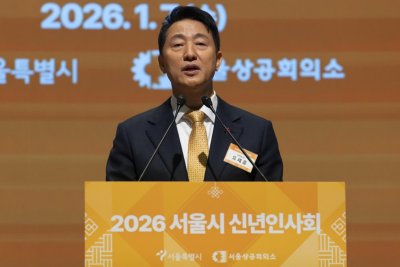

Seoul Mayor Oh Se-hoon speaks during a New Year’s greeting event at the headquarters of the Korea Chamber of Commerce and Industry in Seoul, South Korea, 07 January 2026. Photo by YONHAP / EPA
March 13 (Asia Today) — Several candidates from South Korea’s conservative People Power Party publicly urged Seoul Mayor Oh Se-hoon on Friday to apply for the party’s nomination for the upcoming local elections, as his refusal to do so has prolonged internal tensions.
Oh has delayed submitting his candidacy application while calling for broader party reforms, prompting criticism from party members who say the standoff is deepening divisions ahead of the June 3 local elections.
Incheon Mayor Yoo Jeong-bok, who has secured the party’s nomination for his reelection bid, visited the party’s headquarters in Seoul and called on Oh to move forward with the nomination process.
“The party is in confusion,” Yoo said. “I hope Mayor Oh will quickly apply for the nomination and confidently join the party’s path forward.”
Yoo also urged former nomination committee chairman Lee Jung-hyun – who abruptly resigned earlier in the day – to reconsider his decision and return to the role.
“I ask Chairman Lee to withdraw his resignation and fulfill his responsibility to ensure a successful nomination process,” Yoo said, while also calling on party leader Jang Dong-hyuk to strengthen unity within the party.
South Chungcheong Province Gov. Kim Tae-heum also called on Oh to demonstrate leadership as a senior party figure.
“I understand Mayor Oh’s position,” Kim said. “But as a senior member of the party, I hope he will show dedication to keeping the party united.”
Kim had previously delayed submitting his own nomination application alongside Oh but completed the process Thursday after discussions with party leadership.
Some party figures have issued sharper criticism.
Lee Sang-kyu, a People Power Party candidate for Seoul mayor, accused Oh of creating unnecessary pressure within the party while insisting on the creation of an “innovation campaign committee.”
Another mayoral hopeful, Yoon Hee-sook, wrote on social media that it is not the time for internal disputes over candidate registration.
“Primary candidates must unite and focus on confronting the Lee Jae-myung administration while working toward party reform,” she said.
Criticism has also emerged within the party leadership over Oh’s proposal to launch a reform-oriented campaign committee.
Park Jun-tae, chief of staff to the party leader, questioned whether the proposal effectively amounted to a demand for Jang to step down.
“If the proposal implies that the party leader should resign, it would be difficult for the party to accept,” Park said.
Senior lawmaker Na Kyung-won also criticized Oh’s position in a social media post Thursday, urging him to stop escalating tensions within the party.
— Reported by Asia Today; translated by UPI
© Asia Today. Unauthorized reproduction or redistribution prohibited.
Original Korean report: https://www.asiatoday.co.kr/kn/view.php?key=20260313010004055