FANCY a pint? This new heritage pub is set to become a popular spot for a post or pre-train journey tipple.
The boozer has just opened as part of an enormous multi-million pound refurb at Carlisle Station.
Sign up for the Travel newsletter
Thank you!
The new pub called The Scott & Brassey has opened on Platform 4 inside Carlisle StationCredit: Avanti West CoastThe booth seating is behind the ‘First Class Carriage’ signageCredit: Avanti West Coast
Called The Scott & Brassey, the new pub officially opened on 25 February inside Carlisle Station at Platform 4.
It was formerly used as a First Class waiting room and at one stage even welcomedQueen Victoria.
The Grade-II listed space has been used as various different outlets over the years and was a cafe for decades – but has just opened as a pretty pub operated by Lancaster Brewery.
It has undergone a £400,000 renovation delivered by Network Rail, backed by Avanti West Coast and the Railway Heritage Trust.
Its name ‘The Scott & Brassey’ comes from novelist Sir Walter Scott and Victorian railway pioneer Thomas Brassey.
Inside, the pub has period features like a large fireplace, and vaulted beam ceilings.
The walls are a mix of deep blue and bright yellow, in the corner are cosy booths with low lampshades.
Upstairs on the mezzanine level is additional seating at smaller tables.
The bar area is sleek and modern with a wooden top and dark grey tiled front along with lots of greenery on shelves and of course, drinks offerings.
It will have seven cask ales on hand pull, five from Lancaster Brewery and two from local cask brewers, and one cask cider – there will also be eight keg lines.
The pub said it aims to spotlight ‘regional and national producers with one of the largest selections in Cumbria‘.
On Facebook reviews, one visitor to the new pub wrote: “Had a great afternoon with my mum and sister today! lovely staff and a fabulous asset to Carlisle.”
Another said: “What a fab job you’ve done. Stunning renovation and fantastic atmosphere.”
The pub is open every day from 11am until 10pm Sunday-Thursday and 11pm Friday-Saturday.
It’s dog-friendly too.
The heritage railway pub is operated by Lancaster BreweryCredit: Avanti West CoastThe Grade-II listed building was previously a waiting room and cafeCredit: John Huggon / Network Rail
The new pub is inside Carlisle Station which is around 179 years old, and is in the middle of a huge overhaul.
Carlisle Station cost just £53,000 to build at the time, which in today’s money is around £4.6million.
I MIGHT be biased when I say my seaside town is the best in the UK – but this year is set to be an exciting one for it.
From restored funiculars to new beach saunas, there are lots of new openings to be excited about.
Sign up for the Travel newsletter
Thank you!
Plans to transform Bouverie Square bus station in Folkestone into new park will be completed this yearCredit: Folkestone & Hythe District CouncilIt is part of the town’s £20million makeoverCredit: Folkestone & Hythe District Council
Folkestone West train station is also one of the fastest growing in the South East, welcoming more than 970,000 passengers from 2024/2025 – compared to 678,000 the previous year.
Fountains, bike stands and a small playground are also part of the plans.
Councillor Clive Goddard (Con) said: “To me, this is the up-and-coming part of Folkestone.
“Yards to the left, you’ve got Guildhall Street, with all the fine development happening down there. This seems to give the businesses a new lease of life.”
One of the largest free playparks in the region, the £750,000 project will see a huge new wooden climbing structure.
More seating, bike and buggy parking and landscaping are part of the plans, while the original pirate ship and sand diggers will remain.
It hopes to be complete in time for the summerholidays this year.
Cllr Connor McConville, Cabinet Member for Assets and Local Government Reorganisation, said: “We wanted something that would make people sit back and go ‘wow’ – this incredibly impressive design with fun equipment certainly does that.”
And opening next month is the Sea Scrub sauna – the largest beach sauna in the country.
Opening from March 14, guests will be able to book sauna sessions in the seaside pods.
The Lower Leas Coastal Park will be upgraded after 25 yearsCredit: Folkestone & Hythe district CouncilThe Leas Cliff Funicular Railway is reopening this summer tooCredit: Folkestone Leas LiftThe funicular closed back in 2017 with new plans including a cafe and terraceCredit: Folkestone Leas Lift
It joins their current beach saunas in Margate, Faversham and Whitstable.
Guests can book an hour session for £20 at either the Scandinavian Sauna or Shepherds Hut Sauna.
TWO major UK train stations are shutting down for 22 days over the summer.
Southern Eastern Railway will carry out engineering works which will affect journey time for 10,000 commuters.
Sign up for the Travel newsletter
Thank you!
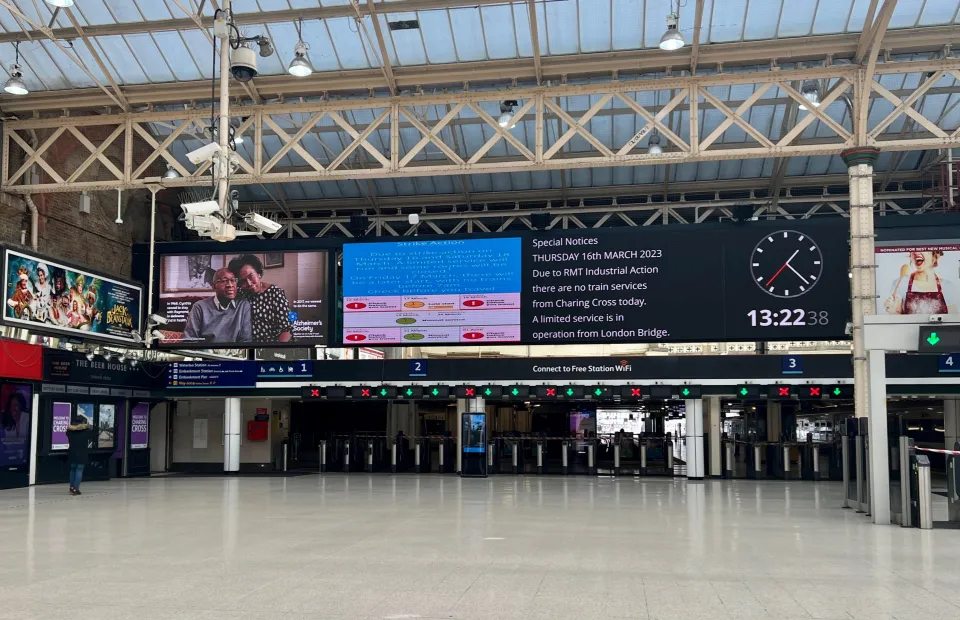
Charing Cross station will shut down for 22 days in summerCredit: Ray CollinsSouth Eastern Railway is carrying out essential engineering works during the shutdownCredit: Alamy
From Sunday 26 July to Sunday 16 August, Charing Cross and Waterloo East stations will be closed for essential track and bridge repairs.
Officials say the closures are part of a £20 million overhaul that’ll see nearly 1,800 metres of old, worn-out track ripped up and replaced between Waterloo East and Charing Cross.
Customers have been advised that their journeys might be different and take longer.
Routes to London will remain open but will instead be diverted to other stations.
Southeastern services into Charing Cross will be redirected to Victoria, Cannon Street and Blackfriars stations.
Some trains will be terminating at London Bridge while tickets will be accepted on alternative rail routes, London Underground and buses.
The ageing track, which was last replaced more than 35 years ago, has caused repeated faults on the approaches to Charing Cross.
This has led to hundreds of hours of delays, leaving frustrated commuters stuck on platforms or stranded on packed trains.
As well as ripping up and replacing worn-out track, engineers will tackle drainage upgrades at Waterloo East and carry out vital structural repairs to Hungerford Bridge.
The three-week closure is expected to prevent future shutdowns during bank holidays and weekends and will deliver more reliable service.
Scott Brightwell, Director of Operations and Safety, South Eastern Railway, said: “We know closing Charing Cross and Waterloo East for 22 days is a significant change and we’re sorry for the disruption it will cause.
“This is not a decision we’ve taken lightly. We’ve looked long and hard at every possible option and although none of them are without impact, a single summer closure is the least disruptive and most efficient way to carry out this vital work.”
Weekly insights and analysis on the latest developments in military technology, strategy, and foreign policy.
Private adversary air company Top Aces has now begun flying its F-16 Vipers, the only ones currently in the hands of a private operator, with the ubiquitous military data link capability known as Link-16. The addition of Link-16 completes a vision started years ago for an adversary aircraft that truly represents the current 4th-generation-plus fighter threat. Equipped with Top Aces’ open architecture Advanced Aggressor Mission System (AAMS), these aircraft can now replicate the high-end threats that U.S. military pilots may soon face in the Pacific and elsewhere.
The War Zone was on hand as the newly integrated aircraft (N854TA) performed adversary missions with other Top Aces F-16s during a large force exercise known as Sentry South 26.1. The private aggressor support firm actually led the entire ‘red air’ operation for the exercise, which is a unique arrangement that puts immense trust on an entity that exists outside of the Department of War.
U.S. Air Force F-22 Raptors assigned to the 1st Fighter Wing, Joint Base Langley-Eustis, Virginia, and F-35 Lightning II’s assigned to the 33rd Fighter Wing, Eglin Air Force Base, Florida, sit on the flightline of the Georgia Combat Readiness Training Center (CRTC) during exercise Sentry South 26.1 at the Savannah Air National Guard Base, Georgia, Jan. 23, 2026. Sentry South 26.1 in Savannah is an Air National Guard-led counterair exercise held at the Georgia CRTC, also known as the Air Dominance Center, that trains hundreds of participants annually in offensive and defensive counterair missions with 4th- and 5th-generation aircraft to enhance combat readiness and joint integration. (U.S. Air National Guard photo by Staff Sgt. Josiah Meece). Staff Sgt. Josiah Meece
Sentry South 26.1 and the Air Dominance Center (ADC), which acts as a hub for the exercise, were created to help Air National Guard (ANG) pilots have the best fighter training available. Located in Savannah, Georgia, at the southern end of the Savannah/Hilton Head International Airport, the ADC’s footprint is small, but its training impact is huge for both ANG pilots and their active-duty counterparts. The exercise was developed by fighter pilots to provide 5th-generation fighter integration through a focused, tailored, cost-effective approach. The airspace they have, just 30 miles off the coast, runs 200 miles north to south and 120 miles east to west. That box is among the best military flying areas anywhere in the country, and it’s ideally suited for fighter training.
This iteration of Sentry South involved over 75 aircraft from the Air Force, Navy, and Marines. It was a mix of both 4th and 5th-generation fighters. Over 700 sorties were flown over the two-week exercise, focusing on both offensive and defensive counter-air missions. For many of the pilots, it was their capstone exercise for their initial training on the F-22. It is a multi-day, high-intensity scenario designed to test trainees or validate operational concepts in simulated, contested environments. Its goal is to validate the combat readiness of student pilots while improving their tactical decision making.
A Top Aces pilot about to launch from Savannah, Georgia, on a Red Air mission over the Atlantic. Note the Scorpion HMD monocle over his right eye. (JAMES DEBOER)
Matthew ‘Bang’ Belle is the adversary air program manager for Top Aces. He is in charge of all Top Aces operations in the United States, as well as for any foreign partners trained here on U.S. soil. He has been with the company for about 18 months after retiring from the USAF, where he flew the F-16 as an aggressor, accumulating over 2,000 hours during his career.
Belle told The War Zone, “We got some great reviews from all of the forces that participated in Sentry South 26.1. They really enjoyed having us take over the red air lead and run the mission commander spot from the aggressor side. It was the culmination of everything we have been doing to the aircraft over the last few years. The exercise is all about challenging blue air’s thinking in the air-to-air domain. It is meant to complicate things that they do not see at their home station.”
“The vision when we first started was that we were going to be the legacy bearers from the aggressors. Russ ‘Puck’ Quinn (former Top Aces president) saw a niche that needed to be filled. He knew there were a bunch of 3rd-generation fighters throughout the market and believed there was a place for 4th-generation fighters. So he made that happen, and so we got this 1978 jet (early block F-16A/B), and we saw that we could provide the Air Force and allies a good representation of what our adversaries are doing right now. It’s not just a jet with wings and a cool motor that makes it go really fast and really high. These current 4th-generation fighters are fully integrated, so they have near-5th-generation avionics but in a 4th-generation body. Puck saw that is where we needed to go.”
Top Aces F-16A and Draken Mirage F-1, different contractors flying different generation fighters in the adversary mission. (JAMES DEBOER)
The AAMS and the AESA radar, along with the Scorpion helmet and Link-16, have really upped the game in terms of quality adversary support in a crowded adversary air services provider (ADAIR) market. The Scorpion helmet allows the pilot to avoid turning the aircraft’s nose towards the enemy aircraft to target it when employing certain weapons and sensors. This is especially true when employing simulated heat-seeking missile shots. The helmet also displays basic flight and navigational data and can also project objects from the aircraft’s new Link 16 datalink system out into the visual space all around the aircraft. In other words, if a friendly is 30 miles away at 10 o’clock high, it can shoot that in augmented reality to the pilot.
Top Aces is also using the Air Force’s AN/ALQ-188 jamming pod. The AN/ALQ-188 is a common sight at U.S. air combat exercises and can simulate certain types of hostile electronic countermeasures systems. Top Aces F-16s have controls inside their aircraft that allow the pilots to scale the electronic attack to whatever the blue air wants, whether it be just a nuisance or a full scale ‘melt your face off’ EW attack. Top Aces is also the only ADAIR company that is authorized to refuel from USAF KC-135 tankers, which helps them stay in the fight longer and provides more presentations for blue forces.
Top Aces F-16A with an AN/ALQ-188 on its centerline station. (JAMES DEBOER)
Belle states, “The key that has unlocked everything in the past month was that our engineering section here at Top Aces and our chief test pilot were able to get a provisional approval (from the Federal Aviation Administration) to operate Link-16 on our AAMS aircraft. That was the missing key we now have that ties it all together, so we can present this integrated solution that we think closely resembles a 4th-gen-plus adversary aircraft. It’s a real game-changer. The fact that I can be well outside of normal influence ranges on blue air, have them on my scope with Link-16, where they don’t know that I have that situational awareness (SA), and then transition that SA to the IRST pod, and they still don’t know they are being targeted. So they are making decisions like they are not targeted and not vulnerable. As they get closer, I have all of my weapon solutions cued up and ready to shoot with the AESA radar. Link-16 enables all of that to happen.”
“It also allows us to fly red air tactics with the F-35. It is just like we are one of them. We are replicating 5th and 4th gen packages. It gives blue air not just reps in the gym for blocking and tackling, it affects training outcomes completely and that is what we are really excited about. Link-16 ties it all together.”
What the pilot sees on his center pedestal display showing the Link 16 data is also totally customizable, which is critical for achieving highly-tailored training goals. For instance, the system can easily filter out information that would give the red air team too big of advantage or that would not accurately reflect the capabilities of an enemy. This scalability based on the training objectives makes it far more than just a datalink system for the red air force, it can dramatically boost the fidelity of the threat being presented.
Private aggressors of a very different flavor on the ramp in Savannah. One replicated 4.5 and 5th generation fighter threats, the other simulates long-range one-way attack drones like the Shahed-136. Click on the photo to learn more about these planes in our recent feature. (JAMES DEBOER)
Chris ‘Bluce’ Wee is Top Aces chief test pilot and flew several missions with the upgraded jet during Sentry South 26.1. Wee was a former test pilot in the USAF and was in charge of a host of modernization projects for both the F-16 and all variants of the F-15, including the F-15EX.
Wee told The War Zone, “I’ve been doing modernization and development, making fighters better for the better part of the past 12 or 13 years, and so it was really cool to jump in at Top Aces and look at what we’ve got and look at where we wanted to be and find things that we can improve on. A couple of things that I jumped into right away was really the optimization of our systems together. The idea that we could take old Israeli airplanes and make them high-end aggressors was really fascinating to me.”
“I first learned of Top Aces sometime in 2022. I was out at Black Flag at the 442 (422nd Test and Evaluation Squadron), the OT test organization out there at Nellis, when I came around the corner and saw some old pilots I knew from my aggressor days. I had no idea what they were doing, but when I got talking to them, I was amazed. There is nothing as maneuverable as this airplane (the F-16A, the agility of which you can read about here), and then you stack on top of that modern equipment, it’s amazing. There are limitations; no company in the world is, from a regulatory standpoint or even a monetary standpoint, able to go out there and buy an APG-83 or APG-82 (AESA radar) or any frontline fighter radar or some of, you know, ‘exquisite’ technologies that are protected by classified information. The fact that we’re doing that to the best of our ability was really intriguing to me.”
Wee was able to jump into the chief test pilot position and immediately review the systems and begin providing recommendations to improve integration.
Wee added, “We were able to tweak some things here in the software and really go out and develop that to the point where you know it’s really optimized. You get in this airplane and you know the between the helmet, the Link-16, the AESA radar, the IRST, you just have all these tools available to you to do this really important mission that is training the next generation of fighter pilots that are going to be out there, you know, protecting the nation for the rest of my life, at least, which is [a] pretty neat thing to be a part of.”
A pair of Top Aces F-16As launch for a red air sortie. One is equipped with the full AAMS suite, including the IRST pod, the other packs the AN/ALQ-188 electronic countermeasures pod. Top Aces often flies their F-16s without fuel tanks for maximum performance. (JAMES DEBOER)
During Sentry South 26.1, Wee flew four missions in the updated AAMS jet, accumulating over 10 hours, and conducted several aerial refuelings from KC-135s.
Speaking about the new Link-16 capability, Wee explained:
“Datalink, from a very basic standpoint, is when you can look at the picture in your jet and immediately see what everyone’s doing and where they are; you don’t have to be looking outside necessarily to do that. In fact, I would really prefer my wingman to be like miles away from me because we’re probably not gonna hit each other if he’s miles away from me, and I don’t have to worry about him as much. I can just look at my screen, and I know where my wingman is, and what he’s doing. I can see that he’s targeting something because I can see data being passed between our airplanes, which is really helpful to know, not only within our own airplanes but also with the joint force airplanes. We were flying with Marines, F-35s, and guard F-16s. Being able to see where people are and what they’re doing and if they’re doing what I’ve told them to do, just by looking at the link, is a huge capability.”
Top Aces flew twice a day for four days during the exercise. During the first and last day, they focused on defensive-counter-air missions. Blue air students were tasked with defending the target area during a 90-minute vulnerability period (vul), and so they wanted to maximize the number of red forces across the ‘lane,’ so they could challenge their ability to defend a geographical area.
Top Aces led the aggressors for Sentry South, a huge achievement for a private contractor facing off against the best the USAF has to offer. (JAMES DEBOER)
Wee explained, “As red air, we were trying to get in and protect the strikers. We were using the T-38 as strikers and were trying to help them get into the target area. If we could get to the target band, that would drive the debrief focus points on why the blue forces did not properly protect the lane for the period of time required. Were they allocating their radars to the right spot, and were they looking with the right modes on their radars? We were operating as MiG-1 (lead aggressor) for all sorties, which was really cool for us because we were able to lead the red package in all eight vuls we supported. We were able to manage our forces to align with the blue forces’ learning objectives. We worked very closely with the mission commanders as to what kind of threat they wanted and when they wanted to see it.”
On Wednesday and Thursday, the roles reversed to offensive counter air (OCA), and blue forces were trying to fight their way into the target band and hit targets on land and then fight their way out. Wee led a red force presentation that fought the blue air on the way in, then regenerated from pretend airfields to fight the blue forces on the way out of the target area.
A Top Aces pilot prepares to launch on Sentry South sortie in his F-16A. (James Deboer) JAMES DEBOER
Lt. Col. Joseph ‘Stone’ Walz, who flew F-16s and F-35s and is now part of the Georgia Air National Guard, is the exercise director for Sentry South. Speaking about the value of having aircraft like Top Aces F-16s in his exercise, he told us, “I had the opportunity to bring in Top Aces to Sentry South 26.1. They normally support the 33rd Fighter Wing at Eglin. I like to build something that represents what pilots would expect if they were to go out and fly an operational plan. It’s about honing and shaping our pilots into the most combat-ready force we could be if we had to go to war. How Top Aces factors into that is if we get real aircraft and actual fighter jets that can prosecute errors and punish errors in the training environment, and now when my pilots have those errors, they get shot and can now go into the debrief and learn those lessons in a training environment so they don’t make the same mistakes in war. We can do that with other aircraft, but every aircraft I bring here, if I have to put them as red air, that is one less person who can fly blue air. Red air is a tax we all have to pay, but having these guys gets us more training, and you never know the lesson that someone will learn that will save their life someday.”
Being asked to lead red air forces as ‘MiG-1’ during Sentry South 26.1, Top Aces is proving that experience matters, which is their motto.
Belle explained, “We are mostly all former aggressor pilots who have done the really big exercises at Nellis and in Alaska. We have handled 100 aircraft LFEs (large force exercises) and know how to build scenarios that really stress blue air’s weak points. We know where their change-outs are going to be, so we are a thinking adversary that brings in all the other red air like the F-35s and F-22s and puts it all together and says what would the Chinese do? We replicate that. We put the 4th and 5th-gen packages together, led by an experienced aggressor who knows how to exploit weaknesses. I can tell you from being on the blue side that when your bulletproof game plan is completely exploited and torn apart, you leave humbled, knowing you have to up your game. We are not there just to win, we are there to teach. We are there to have you leave the debrief with an outcome that says, I have to go back to the drawing board because what I thought works against my normal red air at Langley or Eglin didn’t work today. Why not?”
A Top Aces F-16A recovers after a Sentry South sortie. (JAMES DEBOER)
Top Aces has recently done much more software development to optimize what’s presented to the pilot and how the pilot interacts with the radar, the link, and the IRST pod, along with the helmet. It is all about placing information in the right place to make the pilot safer and more effective. Looking at human factors optimization, Top Aces is looking to make an even more threatening aggressor.
The IRST system that Top Aces flew during Sentry South 26.1 consists of a Northrop Grumman OpenPod, a modular, open-architecture design, equipped with Leonardo’s SkyWard, a long-wave IRST sensor. It is a scannable IRST pod, which means it has the ability to identify multiple contacts inside of a very large search area.
Wee explained, “IRST is difficult for everyone. It is very susceptible to the conditions of the day whether it be humidity or clouds. We have some longer-range goals to improve our IRST system and achieve more accurate tracks through exquisite means. Right now, we only have one pod but we are actively seeking more. You can imagine having azimuth and elevation from one pod is pretty good, but having azimuth and elevation from more than one pod makes the solutions get better, especially if you leverage Link-16 and are able to pass some of that data between airplanes (triangulating range). These are all things we want to do to better replicate the threat.”
The SkyWard IRST pod mounted on the F-16A’s centerline station. (JAMES DEBOER)
Another major training capability that Top Aces Link-16-enabled aircraft are now providing is called Constructive Wingman. This gives the upgraded aircraft the ability to lay out synthetic tracks of non-existent aircraft.
Belle explained, “When the blue air looks at us, no longer do they see just one contact. They may now see two or three contacts and that is just complicating the training and driving better outcomes for their learning. The pilot pushes a few buttons to place an aircraft on my right at two miles and one on my left at two miles. I have a series of 10 commands that I can give it. I can tell it to go 50 miles from blue air and then reform behind me at 20 miles. Or better yet, I am going to turn around as the live fighter and these two contacts will continue going so blue air now thinks he has a bigger problem. But really, he/she is concentrating on synthetic tracks.”
This capability will help new F-35 student pilots as they will now see a more complicated tactical picture during their training. Currently, Top Aces provides aggressor training through the Air Force’s Combat Air Force Contracted Air Support (CAFCAS) program to F-35 pilots going through Formal Training Units (FTUs) at both Eglin Air Force Base in Florida and at Luke AFB in Arizona. The basic course lasts eight months and provides pilots with the training to accomplish a variety of missions.
The last few months have been extremely busy for Top Aces. Last summer, they went to Nellis AFB to participate in a large-force exercise at the end of weapons school, called Weapons School Integration (WSINT). WSINT is a series of complex, large-force employment missions that serve as the capstone portion of Weapons School classes. With their ability to air refuel, they participated in three- to four- hour missions. They also participated in Sentry North at Volk Field before flying to Mountain Home AFB to support training for the Dutch F-35As and the resident F-15E Strike Eagles.
We will be sure to keep you updated as Top Aces continues to add new capabilities to its unique AAMS F-16s.
Portobello Road Market, found in the Notting Hill area, features a lot of antique shops, restaurants and independent boutiques.
And the market is one of the most famous and historic in the world, dating back over 160 years.
Visitors can explore hundreds of stalls, full of different curiosities, bric-a-brac, jewellery, antiques, clothing and more.
On Fridays and Saturdays – which tend to be the busiest days – the market stalls actually stretch over a mile long from start to finish.
And then on Sundays, there are less stalls, but still plenty to explore and the shops remain open as well.
One recent visitor said: “Lots of interesting stuff, the vintage market section was the best, but the main road itself was insane with people even early in the morning.
“Worth a visit at least once.”
Another added: “Portobello Road and its market is fun to experience.
“It is located in the charming residential neighborhood of Notting Hill.
Work on the market is expected to begin in January 2027Credit: Getty
“Interesting mix of touristy and local shops, eateries, and temporary booths/stalls. Highly recommended!”
A third said: “The market is full of life, colours, and unique finds.
“I especially enjoyed browsing the small stalls with handmade and vintage jewellery — I found some truly beautiful and one-of-a-kind pieces.
“A must-visit spot in London if you enjoy local art, antiques, and something different from the usual shops.”
Portobello has also featured in a number of films, perhaps most notably Notting Hill, starring Hugh Grant and Julia Roberts.
And you can actually visit the bookshop that inspired the bookshop in the film.
Called the Notting Hill Bookshop in real life, the store features the same façade and interiors today that the original shop did which was used in Notting Hill as The Travel Book Co.
Nearby, you can also visit Notting Hill Bookshop which was used in the Notting Hill filmCredit: Alamy
There is a lot to do in the surrounding area as well.
For example, you could head to the Museum of Brands to see how household products have changed their look over the years.
It costs £11.50 per person to visit.
Or perhaps wander to Kensington, where you can explore Kensington Palace and Gardens, which costs from £20.60 per person to visit.
PLANS have been revealed to rescue a historic English seaside venue and return it to its former glory.
The Margate Winter Gardens in Kent – where stars such as The Beatles and The Rolling Stones have performed – is set to be restored and reopened.
Sign up for the Travel newsletter
Thank you!
Margate Winter Gardens in Kent is due to get a £8million upgradeCredit: Lee Evans Partnership LLPThe venue opened over 100-years-ago and has hosted stars such as The BeatlesCredit: Lee Evans Partnership LLP
Dating back to 1910, the venue has previously had a number of different areas including the Main Hall, Queen’s Hall, two side wings and an open-air amphitheatre.
As part of the Thanet District Council’s plans, the seafront venue will reopen with a new rooftop bar and restaurant, a drama school and a 100-place nursery.
As part of the plans, the Main Hall and Queen’s Hall will be made fully accessible and reopened.
There are also plans to create two mezzanine pods, similar to those found in Peckham Library.
The restaurant will then be located above the Main Hall, with both indoor seating and an outdoor terrace.
As for the nursery, that will be in the upper part of the site and will feature separate areas for babies, toddlers and pre-schoolers.
The new drama school will be held in the smaller Queen’s Hall and have classrooms and dance studio spaces.
In all, the project is expected to cost around £8million to complete.
According to the plans, the vision for Margate Winter Gardens “marries both history and opulence, creating a visually stunning seafront icon with nods to its luxurious past as well as futureproofing the building for years to come”.
The aim is to reopen the Main Hall by late 2026, then other parts of the venue will open in phases from 2027.
Margate Winter Gardens, which closed two years ago, sits on a site known as Fort Crescent and looks over Margate Main Sands and the English Channel.
When the venue opened, it featured a Concert Hall, four entrance halls, two side wings and one open-air amphitheatre.
During the 1920s and 1930s, the Winter Gardens was a much-loved entertainment venue with performances including cabaret and tea dances.
Under the new plans, there will be two mezzanine pods similar to the pods found in Peckham library (pictured)Credit: WikipediaThere will also be a rooftop bar and restaurant with sea viewsCredit: Lee Evans Partnership LLPThe Main Hall will be made fully accessible as wellCredit: Lee Evans Partnership LLP
Then, during World War II, the venue was used initially as the Dunkirk evacuee reception before later being turned into an ARP shelter and food depot.
In 1946 the building was partially rebuilt after bomb damage.
After the war, Winter Gardens was once again used as an entertainment venue with performances by Laurel and Hardy, The Beatles, The Rolling Stones and Dame Vera Lynn.
However, over the decades visitor numbers declined and in 2022, the Winter Gardens closed for a while to assess concerns over the building’s condition.