unpaid

Unpaid household care for South Korean children valued at $75B

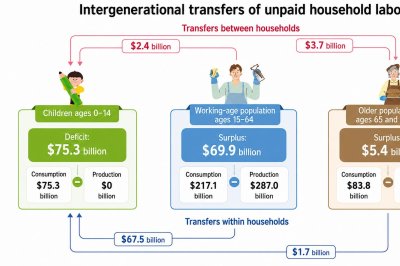
A chart illustrates how the estimated value of unpaid household labor is transferred among children, working-age adults and older people in South Korea. Information from Ministry of Data and Statistics. Infographic by Asia Today and translated by UPI

June 23 (Asia Today) — The estimated value of unpaid household services consumed by South Korean children totaled 116.6 trillion won ($75.3 billion) in 2024, with parents and grandparents providing much of the work, government data showed Tuesday.

The Ministry of Data and Statistics published the findings in South Korea’s 2024 National Time Transfer Accounts, which measure how unpaid household work is produced, consumed and transferred among age groups.

The account covers services that are generally excluded from gross domestic product, including cooking, cleaning, household management, caregiving and volunteer work.

The figure does not represent money that families paid for child care. It estimates the market value of unpaid services by using the time spent on household work, population figures and the wages that would be required to hire someone to perform similar tasks.

Children ages 14 and younger recorded a household-work lifecycle deficit of 116.6 trillion won because they consumed unpaid services but did not produce them.

A lifecycle deficit occurs when the value of household services consumed by an age group exceeds the value it produces.

About 107.3 trillion won ($69.3 billion), or 92% of the children’s deficit, was covered through transfers within the same household. This category largely represents time and labor provided by parents and other family members living with the children.

An additional 9.4 trillion won ($6.1 billion) came through transfers between households, which can include care provided by relatives living separately.

Working-age people between 15 and 64 produced unpaid household services valued at 444.4 trillion won ($287 billion) and consumed services worth 336.1 trillion won ($217 billion).

That left the group with a surplus of 108.3 trillion won ($69.9 billion).

The working-age population transferred a net 104.6 trillion won ($67.5 billion) in unpaid services to other members of the same households, primarily children.

The data show that people in their 30s and 40s, who are often raising young or school-age children, were at the center of the transfer system.

On a per-person basis, the household-work surplus reached its highest level at age 39, at 10.35 million won ($6,700).

Older South Koreans also made a net contribution.

People ages 65 and older produced household services valued at 138 trillion won ($89.1 billion) while consuming 129.7 trillion won ($83.8 billion), leaving a surplus of 8.3 trillion won ($5.4 billion).

They transferred a net 5.7 trillion won ($3.7 billion) in services between households. The ministry said the pattern reflects contributions such as grandparents caring for grandchildren who live in separate households.

Per-person household production peaked at age 40, declined and then increased again after retirement, producing what the ministry described as an M-shaped pattern.

Unpaid housework and care for grandchildren contributed to the later increase.

The lifecycle deficit was highest at birth, reaching 37 million won ($23,900) per person.

The balance shifted into a surplus at age 28, reached its peak at age 39 and returned to a deficit at age 82.

Those ages do not indicate when income begins to exceed personal spending. They show when the estimated value of unpaid household services a person produces becomes greater or smaller than the value of services the person consumes.

Household-service consumption was highest at birth and lowest at age 19, forming an L-shaped pattern.

Compared with 2019, the total deficit for children declined by 7.5 trillion won ($4.8 billion). Surpluses among working-age and older people also decreased.

The results provide a broader measure of the economic contributions made inside families, including work performed by parents and grandparents that does not appear in conventional income or production statistics.

— Reported by Asia Today; translated by UPI

© Asia Today. Unauthorized reproduction or redistribution prohibited.

Original Korean report: https://www.asiatoday.co.kr/kn/view.php?key=20260623010008145

Source link

‘Money’ Mayweather faces felony theft charges over unpaid Swiss watch

Floyd Mayweather Jr.’s Christmas Day purchase of an exclusive Audemars Piguet watch has landed the billionaire boxer in court facing two felony charges alleging theft and intent to defraud, according to Clark County, Nev., court records.

Mayweather wrote a check for $200,000 to Las Vegas high-end consignment store Gold and Beyond for the timepiece on Dec. 25, 2024. Prosecutors filed a criminal complaint on April 27 of this year and the court ordered Mayweather to appear before a judge. His lawyer did so at a preliminary hearing Monday.

The charges are theft with a value of $100,000 or greater and passing a check of $1,200 or greater with intent to defraud. Mayweather did so “knowing that the check would not be paid when presented,” according to the complaint.

Mayweather, 49, could face a prison term of one to 20 years and $15,000 in fines if found guilty of felony theft. The fraud charge carries a sentence of one to four years in prison and a $5,000 fine plus restitution.

Audemars Piguet, which has operated in the quaint Swiss village of Le Brassus for 150 years, is considered a more luxurious and prestigious brand than Rolex, belonging to the “Holy Trinity” of Swiss watchmaking alongside Patek Philippe and Vacheron Constantin.

Luxury watch expert Prestige Time explains why a watch enthusiast would become enamored by the brand: “Buy an Audemars Piguet if you enjoy complications, the kind you find in a really high-end mechanical watch. We’re talking about tourbillons, perpetual calendars, moon phase, retrograde, minute repeaters, chronographs, dual time zone/GMT’s, and more mechanical features that offer more function than just to tell you the time.”

Now the man nicknamed “Money” is on the clock to resolve a high-dollar dispute that could result in a criminal conviction. Mayweather’s next court appearance is Sept. 17. Meanwhile, lawyers representing both sides made their cases in court filings and to the judge.

Mayweather has had a longstanding business relationship with Gold and Beyond, his attorney Adrian Lobo told ESPN in a statement on Tuesday night. Lobo appeared perturbed that the shop’s owner brought the claim to the Clark County District Attorney instead of filing a civil suit.

“This matter does not belong in the criminal courts,” Lobo wrote in the statement. “And Mr. Mayweather looks forward to being vindicated through the court proceedings.”

Gold and Beyond attorney Marc Cook said his client exhibited patience with Mayweather, giving him ample time to pay for the watch. The complaint was filed with the Clark County District Attorney’s office in February.

“The reason for the delay is that my guy trusted Mayweather and was trying to give him every opportunity to make good on that,” Cook said in a statement to ESPN. “And it got to the point where he wasn’t getting responses and wasn’t getting money for a watch that Mayweather had for well over a year.”

Given Mayweather’s reported wealth, bouncing a check might seem perplexing. He is considered the richest boxer of all time, with roughly $1.1 billion in career earnings and an estimated net worth of $400 million.

He owns three of the top-five largest payouts in boxing history, making $275 million for an exhibition with UFC fighter Conor McGregor in 2017, $250 million for the “Fight of the Century” against Manny Pacquiao in 2025, and a then-record $80 million payout for a bout with Canelo Alvarez in 2013.

Mayweather, whose career record is 50-0, reportedly has increased his net worth since last fighting nine years ago. He represents some of the world’s top boxers through Mayweather Promotions and owns roughly 75 gyms around the country along with real estate holdings.

However, Mayweather is reportedly beset by financial woes as well. He filed a $340 million lawsuit against former broadcast partner Showtime, alleging the television network concealed and diverted his earnings. Also pending is a $175 million lawsuit against former associates, claiming they defrauded him and misappropriated his funds, jewelry, and private jet.

Mayweather is scheduled to face kickboxer Mike Zambidis in a full-contact exhibition June 27 in Athens, Greece, and a rematch with Pacquiao is set for September in Las Vegas. However, an exhibition against Mike Tyson scheduled for last April was canceled because Mayweather was notified by the IRS that it intended to revoke his passport over a delinquent tax debt of $7.3 million, according to Ring Magazine.

Source link