Unmasking

Who Speaks for Palestinian Women? Unmasking the Politics of ‘Saving’ in Gaza”

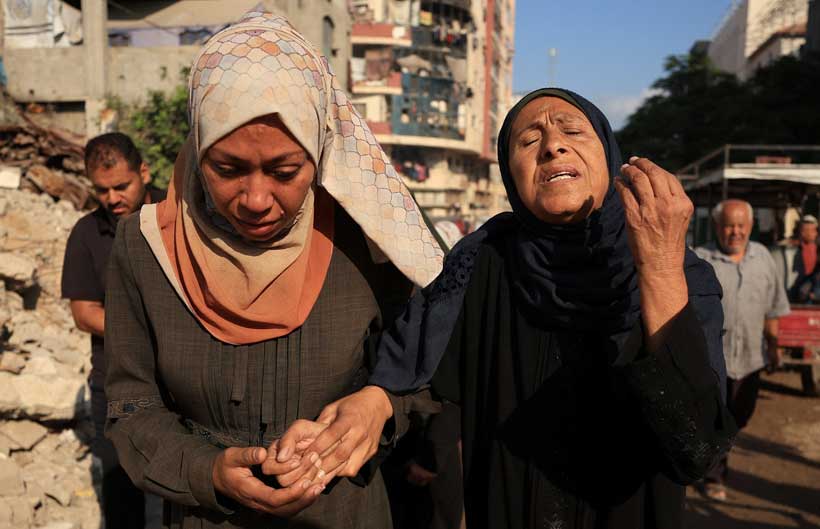
In the midst of the escalation of the Gaza conflict that has been going on since 2023, the world is once again witnessing the heartbreaking reality of women crying among the ruins of their homes and the burning of property, mothers who have lost children, and families separated by military attacks. Global media were quick to point to this event as a symbol of the suffering of civil society. But behind the empathy shown, there is also a question that is rarely asked: how exactly can Palestinian women be represented, and who can shape that narrative?

For decades, women in conflict zones, such as the Middle East, have often been portrayed in the same framework, as passive victims who need to be rescued and protected. In the context of Gaza, this pattern has resurfaced. Global media coverage often only highlights women’s plight without giving enough space for their voices, perspectives, and agency in conflict. This narrative does look humanistic, but it also contains an element of simplification that makes the world unaware of the more complex reality behind it.

This is where postcolonial feminism offers a sharper critique and helps us to look further at this issue as a form of epistemic violence. This perspective emphasizes that in understanding women’s experiences, it cannot be separated from considerations about the history of colonialism and global power relations. In the context of the Gaza conflict, this means that violence is experienced by women. Not only a patriarchal problem but also supported by aspects of colonialism, militarization, and inequality politics (Enloe, 2014).

This phenomenon cannot be separated from the thoughts of Lila Abu-Lughod, who mentioned “politics of saving” in her work entitled Do Muslim Women Need Saving? Abu-Lughod (2013) criticized how the Western world portrays Muslim women as an oppressed group in need of rescue. This narrative is not only a form of simplifying women’s representation but can also be used as a legitimacy for political, cultural, and even military intervention from external actors. Such as the concept of militarization of daily life raised by Enloe (2014), who explains that militarization does not only occur on the battlefield but also enters into the reality of daily life, including in how the media frames conflicts. Where in this context the representation of Palestinian women as passive victims is used to affirm certain narratives about war, security, and the legitimacy of power.

The term “security politics” in the Gaza conflict appears in a more subtle form. Palestinian women are positioned as a universal form of suffering but are rarely seen as political subjects with diverse experiences and aspirations. The suffering they experience in conflict becomes a global consumption, while structural contexts, such as colonialism and power inequality, are often ignored.

An important question then arises: who really has the right to speak on behalf of Palestinian women? This is where Spivak’s (2009) thoughts on the concept of the subaltern become relevant. Spivak himself argues that the subaltern group is a group that is in a marginalized position so that its voice is not heard in the dominant discourse. Even when they are “represented,” their voices are often mediated or even filtered by stronger actors.

In many news narratives about Gaza, Palestinian women rarely appear as the main narrator of their own experiences. Brand awareness is often told by foreign journalists and international organizations. Or humanitarian institutions as “representatives.” As a result, the narrative that is born is not a complete reflection of the reality they face, but rather a form of representation that has been framed according to the logic and direction of global media reporting.

This issue becomes more complex when we look at how the media tends to ignore the agency dimension. Palestinian women not only live in the shadow of conflict but also have active agency in various forms of resistance, both as activists, journalists, medical personnel, and community leaders. They have the capacity to build solidarity and even contribute to political struggles as well as peace. However, aspect II rarely gets the same spotlight as the narrative of suffering.

This disregard of agency can create an imbalance of representation. Palestinian women are only seen as passive victims, which makes them look like they also have no capacity as active actors. This inequality is not only a question of representation but also a question of power regarding who has the right to define reality for a particular purpose.

In the digital era, this is certainly starting to change. Social media provides a space for Palestinian women to be able to speak directly to a global audience. Through various social media platforms, they can share experiences and aspirations that are often not featured in the mainstream media. This ultimately opens up the possibility of a more authentic and diverse counternarrative.

However, the digital space is still full of limitations. Certain narratives can easily go viral, while others sink and disappear without a trace. In other words, while social media can offer opportunities, the space is not completely free from the influence of broader power structures.

Rereading the narrative of Palestinian women in the era of the Gaza conflict is a form of recognition that representation is not neutral. It is always related to interests, ideologies, and power relations. The narrative of “rescue” may seem like a form of concern from the surface, but if you look further, it can also be a form of control over the other party’s representation. Looking at the Gaza conflict through the lens of feminism is to question basic assumptions in global reporting. Do we really see them as individuals? Do we really hear their voices, or just voices about them?

Therefore, it is important to change our perspective. Instead of seeing Palestinian women as victims who need to be saved, we need to recognize them as subjects who have the capacity to speak, form agencies, and share their experiences in the form of real reality. This is not to ignore the real suffering but to place Palestinian women’s experiences in armed conflict in a broader, fairer, and closer context to reality. As Abu-Lughod (2013) reminds us, the more important question that arises is not how to save Muslim women, but how to understand the conditions and realities that shape their life experiences.

Ultimately, the lens of feminism, particularly postcolonial feminism, invites us to not only have empathy but also to be more critical. By looking further at how the narrative is formed, who can benefit, and which voices are ignored.

Perhaps the more relevant question is not whether Palestinian women need protection and rescue, but whether the world is ready to hear and see them as subjects who have the capacity to speak and move. Because what needs to change is not them, but the way we understand them.
Source link

Unmasking of Banksy has angered some fans, but not dealers

Years before the rise of Instagram, Banksy figured out that the key to real influence lay in not being famous, exactly, but in being anonymous.

The mystery of his identity has long been part of the value of his art, which for decades and across continents defied authority from public walls and self-shredded on the auction block. Now, Banksy’s apparent unmasking by the Reuters news agency has generated talk about whether the works themselves retain their cultural and financial value.

It also raises the question: Why pop the balloon of his mystique in the first place? Many Banksy fans mourned the loss of the mystery and lashed out at the news outlet. One said it was like being told without warning that Santa Claus doesn’t exist.

“I feel like they are telling me how a magic trick is done,” said Thomas Evans, a Denver-based artist on Instagram. “Sometimes I just want to enjoy the magic trick.”

But some art experts say the murals and the message will survive Banksy’s naming because his appeal wasn’t driven solely by his anonymity. He and his works — dark and mischievous — stand as witnesses to injustice, oppression and inequality around the world, from the artist’s native England to walled-off Bethlehem in the occupied West Bank and war-ravaged Ukraine. Subtract his anonymity, they say, and the work still inspires reflection and discussion.

“People buy his works because they absolutely love it,” said Acoris Andipa, director of the Andipa gallery in London. “The main feedback that I get is that they really, frankly, don’t care if they know who he is.”

Naming the ghost — and the backlash — is engagement, too

Banksy, long thought to have been born Robin Gunningham around 1972, grew out of a tradition of street artists who viewed the undercover act of posting their art in public as a subversive form of expression. The postindustrial landscape of his native Bristol was his canvas and gallery. The walls of London, New York and elsewhere gave him a global stage just before the rise of social media.

Banksy’s apparent identity has been an open secret among protective fellow artists, and long been easy to find online for those who wanted to know. The Daily Mail reported in 2008 “compelling evidence suggesting” that was the artist’s birth name. It has been published by other news outlets, including the Associated Press in 2016, as part of their coverage of the detective work.

Reuters reported recently that after the Daily Mail’s story, Banksy changed his legal name to David Jones — the second most-popular name in Britain. It’s also the given name of the late David Bowie, whose Ziggy Stardust rock ‘n’ roll avatar inspired a 2012 Banksy painting of Queen Elizabeth II.

Bansky’s lawyer didn’t respond to a request for comment, and the artist’s spokeswoman declined to participate in this story.

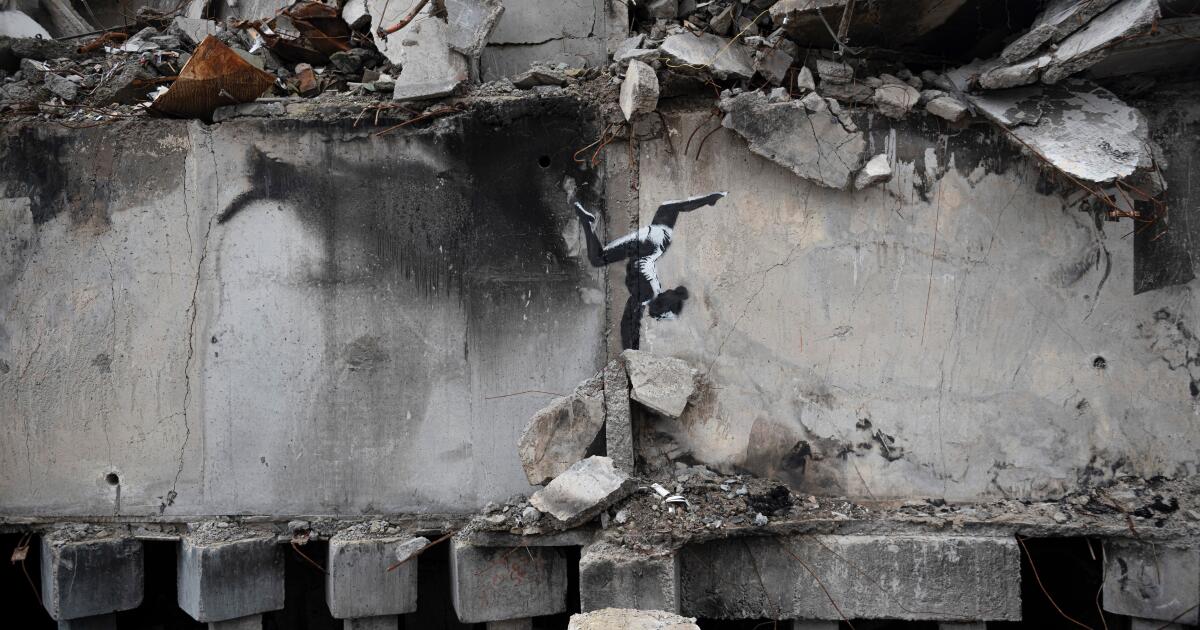
Reuters pieced together that a David Jones traveled to Ukraine with a well-known associate of Banksy’s in late 2022 — just before the artist’s work began appearing on buildings that had been bombed by Russia. Banksy later confirmed that he’d created seven murals in the war zone, including one of a child flipping over a grown man who is wearing a black belt. Russian President Vladimir Putin practices judo.

There’s evidence that even some in the establishment he was protesting have accepted Banksy. They didn’t arrest him, for example, after the Royal Courts of Justice removed a Banksy stencil depicting a judge in a traditional wig and gown beating an unarmed protester with a gavel. Some street artists groused that they might be arrested for creating such graffiti — but when it’s a Banksy, it’s art.

The artist wasn’t always so elusive

On Sept. 17, 2000, a Robin Gunningham was arrested for defacing a Marc Jacobs billboard atop a building on Hudson Street in New York.

In a handwritten signed confession, he described the work on the night in question: “I had been out drinking at a nightclub with friends when I decided to make a humorous adjustment to a billboard on top of the property,” he wrote in court records unearthed by Reuters and confirmed by the AP. “I painted eyeshadow a new mouth and a speach bubble” on the photo of a male model. He was charged with a misdemeanor.

The artist doesn’t need an alleged naming to make news. He created multiple works in London in 2025, and grabbed headlines elsewhere for having his art sold or auctioned for millions. But Banksy has courted a public image centered around morality, justice and guerrilla tactics — he’s often likened to Robin Hood or Batman.

“Banksy woz ere,” he wrote with his animal murals at the London Zoo, which were removed in 2024.

Still, along with the sadness, there’s ample speculation in the art world and on social media that the artist himself orchestrated this round of naming. He didn’t deny the Reuters story.

That “would be very much in line with his practice of stunts and satire,” observed Madeleine White, the senior sales and acquisitions consultant at London’s Hang-Up Gallery. “As they say, ‘All publicity is good publicity.’”

She noted, however, that the backlash is directed at the media — not the artist, or the potency of his work. Reuters says it opted to publish some, but not all, of the information its reporters uncovered about Banksy’s identity, because he is a public figure, whatever his name — and he’s had an outsize influence on public events and discourse. What’s more, much of his work has been done on other people’s property.

Connected to world events

Named or not, Banksy’s stardom lives, art experts say.

It endures in the wonder of his ability to erect new art under the noses of authorities well into the age of social media and ubiquitous surveillance cameras. It appeals because his spectacle and wit draw people in and the settings — the hulk of bombed buildings, for example, or Israel’s towering wall at the border of the West Bank — invite them to reflect. Now, fans are on the lookout for how and whether he’ll respond to the news of Robin Gunningham and David Jones.

Joe Syer, a Banksy expert and founder of MyArtBroker, said that the artist has always responded to world events. “And that’s where the real relevance, and value, sits,” he said.

“If anything, Banksy’s anonymity has functioned less as a celebrity device and more as a way to keep the work universally accessible, detached from personality, ego, or biography,” Syer said in an email. “It allows the work to sit in public space, politically and culturally, without being anchored to an individual in the way the mainstream press often frames it.”

Christopher Banks, founder of the New York-based Objects of Affection Collection, reads Banksy’s naming “not as a biographical event, but as a structural stress test” of the artist’s system of managing his absence.

“Banksy’s best works carry their meaning without the author. He was there,” Banks wrote, citing the artist’s murals in Ukraine and his solidarity with the war’s victims.

“The name matters less than the presence. The presence was always what the work was about.”

Kellman writes for the Associated Press. AP writer Michael Sisak in New York contributed to this report.


Source link