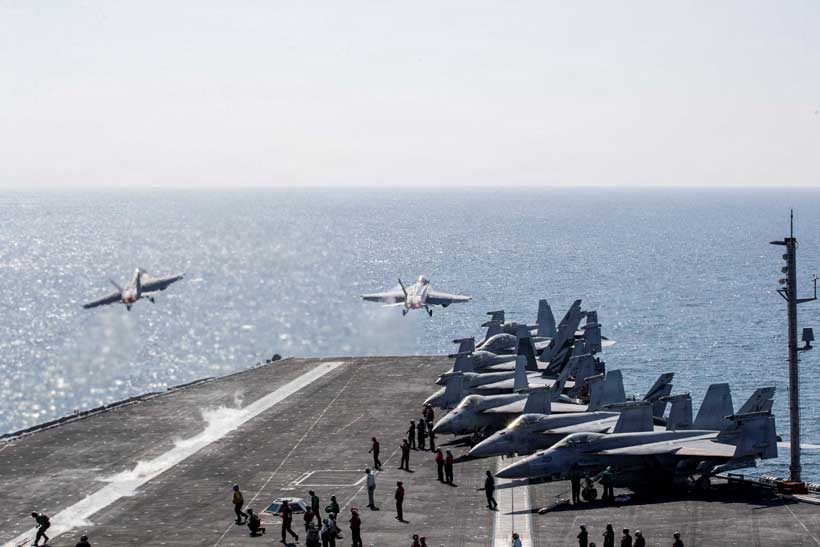
Known Unknowns and Unknown Unknowns: The US-Israeli War on Iran
Modern wars are fought not only with weapons but with assumptions—and the most dangerous assumptions are often invisible to those making them. Donald Rumsfeld’s distinction between known unknowns (questions we recognize but cannot answer) and unknown unknowns (risks we have not even framed as questions) captures something essential about the current confrontation between the United States, Israel, and Iran.
The Nuclear Material Problem
The June 2025 12-day war struck several of Iran’s nuclear facilities but left the most consequential question unanswered: where is the material? The March 2026 campaign has struck deeper, targeting hardened and dispersed sites that June’s operations left intact. Yet the fundamental uncertainty has not resolved—it has compounded. Iran reportedly retains roughly 400 kilograms of uranium enriched to 60%, approaching weapons-grade, and the precise location of that stockpile is now more opaque than before. On March 2, the International Atomic Energy Agency (IAEA) reported the entrance buildings of Iran’s underground Natanz enrichment plant had been bombed, but without inspection access, the agency cannot reconstruct a monitoring baseline.
The strategic paradox is acute. Any Iranian government—this one or a successor—must now confront a nuclear-armed Israel and a United States willing to strike Iranian territory twice in nine months. Under those conditions, nuclear capability looks less like a provocation and more like a rational insurance policy. The war may have permanently entrenched the very incentive it was designed to dismantle. A further risk of escaping conventional arms-control frameworks is if Iranian institutions fragment, specialized nuclear expertise disperses internationally, potentially becoming available to states or non-state actors.
Regime Change and What Follows
The war’s stated objective rests on uncertain ground. Intelligence assessments before the conflict reportedly concluded that even a large-scale assault was unlikely to produce regime collapse—yet the campaign proceeded anyway. The Iranian state has shown remarkable institutional resilience, with no visible defections among senior leadership, a government operating under its constitutional framework, and a regime that has absorbed the Iran-Iraq War, the Green Movement, and decades of sanctions.
War has accelerated the succession question around Ali Khamenei. One trajectory involves Mojtaba Khamenei, whose rise would mean dynastic continuity rather than transformation; another sees the IRGC consolidating power—equally misaligned with Western hopes. The question of what comes after was not answered before the bombs fell.
Retaliation, Major-Power Shadows, and Strategic Incoherence
Iran’s retaliation has demonstrated its asymmetric reach. The IRGC claims attacks on at least 27 bases hosting American troops across the region, alongside Israeli military facilities. Tehran appears to be pacing its response, sustaining an attrition campaign designed to exhaust interceptor stocks rather than overwhelm them in a single strike.
The major power dimensions compound this. Russia has reportedly been providing intelligence on American naval deployments; Chinese-linked entities have allegedly tracked US forces via satellite. Meanwhile, strategic incoherence in Washington compounds every other risk. Vice President J.D. Vance and Secretary of Defense Pete Hegseth have framed this as a limited campaign against nuclear infrastructure; Trump has simultaneously floated regime change on social media.
The Munitions Race
The deepest structural vulnerability may not lie on the battlefield but in the arithmetic of an industrial system never designed to fight this kind of war. The first 36 hours consumed more than 3,000 precision-guided munitions and interceptors. Joint Chiefs Chairman General Dan Caine had warned that stockpiles were already significantly depleted before the first strike. Secretary Marco Rubio subsequently acknowledged that Iran produces an estimated 100 missiles a month versus roughly six or seven high-end interceptors that American industry can manufacture in the same period.
That deficit has a history. The US likely expended 100 to 150 THAAD interceptors and 80 SM-3s supporting Israel during June’s Twelve-Day War. Those stocks were never fully replenished. The bottlenecks are physical as well as financial. Lockheed Martin’s plan to raise PAC-3 MSE production to 2,000 units per year addresses a six-to-seven-year horizon, not the current emergency.
The drone dimension adds a layer officials have been slow to acknowledge. Hegseth and Caine admitted in a closed-door briefing that Iran’s Shahed drones present a challenge US air defenses cannot fully meet. The Shahed flies low and slow—hard to detect and poorly matched to the high-end interceptors THAAD and SM-3 are optimized to defeat. Intercepting a drone can cost roughly five times what it costs to manufacture one.
This crystallizes the war’s most consequential known unknown: how much of Iran’s arsenal reflects genuine capability, and how much reflects deliberate restraint? The IDF assessed Iran possessed roughly 2,500 ballistic missiles on February 11.
The search for emergency solutions has produced one remarkable geopolitical inversion. The Pentagon has approached Ukraine about purchasing drone interceptors. They are low-cost systems Ukrainian manufacturers developed specifically to hunt Shaheds, built from years of adapting to exactly the threat now confounding American air defenses in the Gulf. The US is buying drone killers from a country it recently all but abandoned! The implications extend to the Indo-Pacific. Every interceptor fired over the Gulf of Bahrain is one fewer available in the Taiwan Strait.
The Energy Shock
The Strait of Hormuz has moved from a textbook chokepoint to a live emergency. Tanker traffic has come to a near standstill. War-risk insurance premiums have made commercial passage unviable even where it remains physically possible. At least five tankers have been struck across the Gulf, the Gulf of Oman, and nearby waters. Approximately 20 million barrels of oil per day—a fifth of global consumption—normally transit the strait, alongside roughly 20% of global LNG trade. Traders are warning that oil prices could surge past $100 a barrel if the conflict in Iran continues to escalate. Goldman Sachs Research estimates that a full one-month closure would add $15 per barrel, assuming no compensating measures like spare pipeline utilization or releases from strategic petroleum reserves. Bank of America sees tail risk far higher, estimating a prolonged shutdown could add $40–$80 per barrel above current prices.
The LNG dimension may prove more immediately damaging than oil. QatarEnergy has halted production at Ras Laffan, the world’s largest LNG facility, after Iranian drone attacks. This has already caused European natural gas futures to spike. If global LNG tightens, Europe must compete with Asian buyers on price. That competition may, in turn, force Europe back toward Russian gas, quietly reversing one of the most consequential geopolitical achievements of the post-Ukraine sanctions era.
The exposure is global and unevenly distributed. China, India, Japan, and South Korea account for roughly 75% of Hormuz crude exports and 59% of its LNG flows. South Korea has warned it could exhaust LNG reserves within nine days and has announced a 100 trillion won stabilization fund. India is pivoting toward Russian crude. These developments structurally benefit Moscow regardless of the war’s outcome.
The fertilizer dimension compounds the energy shock with a slower fuse. Nitrogen fertilizers are manufactured from natural gas; roughly a third of globally traded urea transits Hormuz. QatarEnergy’s halt removes fertilizer output simultaneously with LNG. Urea prices have already surged $60 to $80 per ton at New Orleans, with the spring planting window closing. The food-price consequences will not appear in grocery stores for months. But they are already locked in.
The Gulf Security Paradox
For decades the Gulf states managed their rivalry with Iran below the threshold of open confrontation, relying on the American security umbrella while avoiding direct entanglement. The war has collapsed that strategy. The Gulf states did not arrive at this crisis as Iran’s adversaries but rather as reluctant bystanders who had invested enormous diplomatic capital in preventing it. They gave ironclad assurances to Tehran, both before the war and up to its eve, that their territories would not serve as launchpads. That Iran responded by striking these same neighbors is a strategic miscalculation of historic proportions and a moral failure that may poison relations for a generation.
This has opened a structural debate now conducted in public. Is American military presence a protective shield or a magnet for retaliation? Citizens and analysts are asking why Gulf states should bear the risk of hosting US forces when Washington appears unable to protect them. Undoubtedly, Tehran understands this dynamic. Drone strikes on UAE-based data centers targeted Gulf publics’ confidence in the connectivity model as much as American commercial interests. The UAE and Saudi Arabia have staked their post-oil futures on projecting stability and attracting mobile capital. Intercepting most of the incoming fire is not sufficient when global firms are deciding where to invest next decade.
The crisis confronts the Gulf Cooperation Council with a strategic fork. One path leads toward deeper collective security, featuring integrated missile defense, expanded intelligence sharing, and coordinated maritime protection that could reduce dependence on any single external patron. The other leads toward renewed fragmentation as internal rivalries re-emerge.
Former Qatari prime minister Hamad bin Jassim bin Jaber Al Thani warned that the Gulf “must not be dragged into a direct confrontation with Iran,” arguing that such a clash would “deplete the resources of both sides and provide an opportunity for outside forces to control us under the pretext of helping us escape the crisis.” Yet the same crisis that could finally catalyze genuine Gulf collective security could just as easily deepen the divisions that have historically prevented it.
The Mediator’s Dilemma and the Meta-Unknown
The conflict has also damaged the diplomatic architecture that previously helped manage US-Iran tensions. Oman and Qatar built genuine credibility as intermediaries through years of patient back-channel work. Effective mediation requires neutrality. When conflict spreads into the territory of potential mediators, that credibility erodes. Iran’s decision to strike the very states whose neutrality made diplomacy possible may have burned the bridges needed to end the war—which is perhaps the most consequential unknown unknown in the entire conflict, second only to the US twice striking Iran in the span of nine months while negotiations were still ongoing.
At the deepest level lies a question no intelligence assessment can answer: whether the strategic logic of the war is coherent at all. Negotiations failed because each side demanded outcomes the other could not accept. The same incompatibility that made diplomacy impossible may make military victory equally elusive. Iran cannot surrender unconditionally without ceasing to be the Islamic Republic. And the conditions that make nuclear deterrence attractive to any Iranian government—this one or a successor—have not been removed by the strikes; they have been reinforced.
Conclusion
In sum, the US-Israeli campaign against Iran has illuminated the limits of military certainty. Known unknowns—munition shortages, asymmetric retaliation, and energy vulnerabilities—interact with unknown unknowns—nuclear dispersal, regime succession, and Gulf fragmentation—to create a conflict whose trajectory is inherently unpredictable. Rather than eliminating threats, the strikes may have entrenched incentives for nuclear retention, incentivized strategic caution, and stressed regional and global systems. The coherence of the war itself is in question, as military action and diplomacy pull in contradictory directions. Ultimately, the conflict underscores that modern warfare is as much about managing uncertainties as it is about destroying targets.