Unions

Hollywood unions split: DGA, IATSE seek settlement while WGA fights to block Paramount-Warner merger

Citing Hollywood’s already struggling production economy, two influential industry unions have jointly called on Paramount Skydance Chairman David Ellison and California Atty. Gen. Rob Bonta to settle their antitrust fight.

The Directors Guild of America and the International Alliance of Theatrical Stage Employees — which represent a combined 200,000 union members — are turning up the political pressure to try to resolve the clash over the Paramount-Warner Bros. merger, which has already carved deep divisions throughout the industry.

The DGA and IATSE’s unusual missive comes as Paramount has been trying to drum up support for the deal and while
development projects reportedly are being put on hold. Paramount executives and others have decried the delay in deciding whether the deal moves forward. Bonta and Paramount are now poised to slug it out in an Oakland courtroom next spring.

“Our collective members are concerned about their futures, and the future of the industry,” DGA Executive Director Russell Hollander and IATSE President Matthew D. Loeb wrote Thursday in their three-page letter to Ellison and Bonta.

“We are aware of productions that have been put on hold or canceled altogether, leading to further reductions in available work for our members and other industry workers,” the letter reads in part.

The effort adds heat to a growing campaign urging Bonta to bend in his fight to block the industry- reshaping deal that would combine the Warner Bros. and Paramount film and television studios, HBO, CBS, CNN, HGTV and Comedy Central.

Earlier this week, California’s Democratic gubernatorial nominee, Xavier Becerra, said he favored a settlement. Republican Steve Hilton has decried the antitrust lawsuit as being politically motivated.

Gov. Gavin Newsom, who leaves office next year, has stayed above the fray.

Paramount and Bonta’s office didn’t immediately comment.

The Writers Guild of America last month joined Bonta’s coalition of state attorneys general in filing lawsuits to upend the $111-billion transaction, saying the Paramount-Warner combination violates U.S. antitrust laws and would decimate the entertainment industry by erasing jobs and reducing pay.

At issue is the $81 billion in debt that Ellison would have to take on to pay Warner Bros. Discovery shareholders for the keys to the studios and HBO.

WGA leaders and others have warned that level of debt would choke the two historic studios, creating a more devastating sequel to 2019‘s combination of the Disney and Fox studios, and the 2022 takeover of Warner Bros. by Discovery.

The union leaders conceded they weren’t merger fans, and they stopped well short of asking Bonta to throw in the towel.

Instead, they listed nine conditions — including requiring Paramount to maintain its operations in Hollywood and a commitment to make film and television shows in the U.S. — as part of any settlement.

The unions want Ellison to make an enforceable commitment that Paramount and Warner Bros. studios each release 15 films into theaters a year. They also want a 45-day theatrical window so that cinema chains can continue their rebound.

Some of the DGA and IATSE terms may be difficult for Ellison to swallow. Already, Paramount is looking to shave expenses to come up with the $81 billion promised to Warner Bros. shareholders. Sources have said Ellison’s suggestion to move Paramount from its picturesque Hollywood campus is designed, in part, to attract financial incentives from another state, such as Tennessee, eager to help with a relocation.

Among the conditions, the DGA and IATSE asked that Paramount’s and Warner Bros.’ motion picture units be kept as “as separate studios, with each studio maintaining its own production, distribution, marketing and exhibition groups as distinct divisions.”

One of the goals of the merger is to shave costs by consolidating overlapping business divisions and back-office functions.

The union leaders also want Warner Bros. television studio to operate independent from the Paramount and CBS production arms. They called on HBO to remain a linear television channel and available on third-party platforms, including Amazon.

Loeb and Hollander’s requests are designed to keep production jobs in the U.S.

They asked Ellison to commit to producing films and TV shows in the U.S. “at no less than the average percentage produced in the United States during the last five years” excluding 2020, the pandemic year, and 2023, when two strikes idled production.

“Our goal, with respect to the proposed merger, has always been to achieve an outcome that ensures a vibrant, competitive marketplace for the production, distribution, and licensing of film and television programming that serves the interests of consumers and filmmakers alike,” Hollander and Loeb wrote.

“We believe that these conditions, if secured through a binding agreement, will largely serve this purpose,” the said.

Bonta previously has said his preference would be structural remedies — divesting key business units — rather than “behavioral” compromises that could evaporate soon after the merger closed.

Should the two sides fail to hash out a settlement with conditions, Loeb and Hollander asked Ellison and Bonta to seek an earlier trial date for the legal showdown.

A federal judge set a March 2 date — despite Paramount’s request to hold the proceedings in November.

Source link

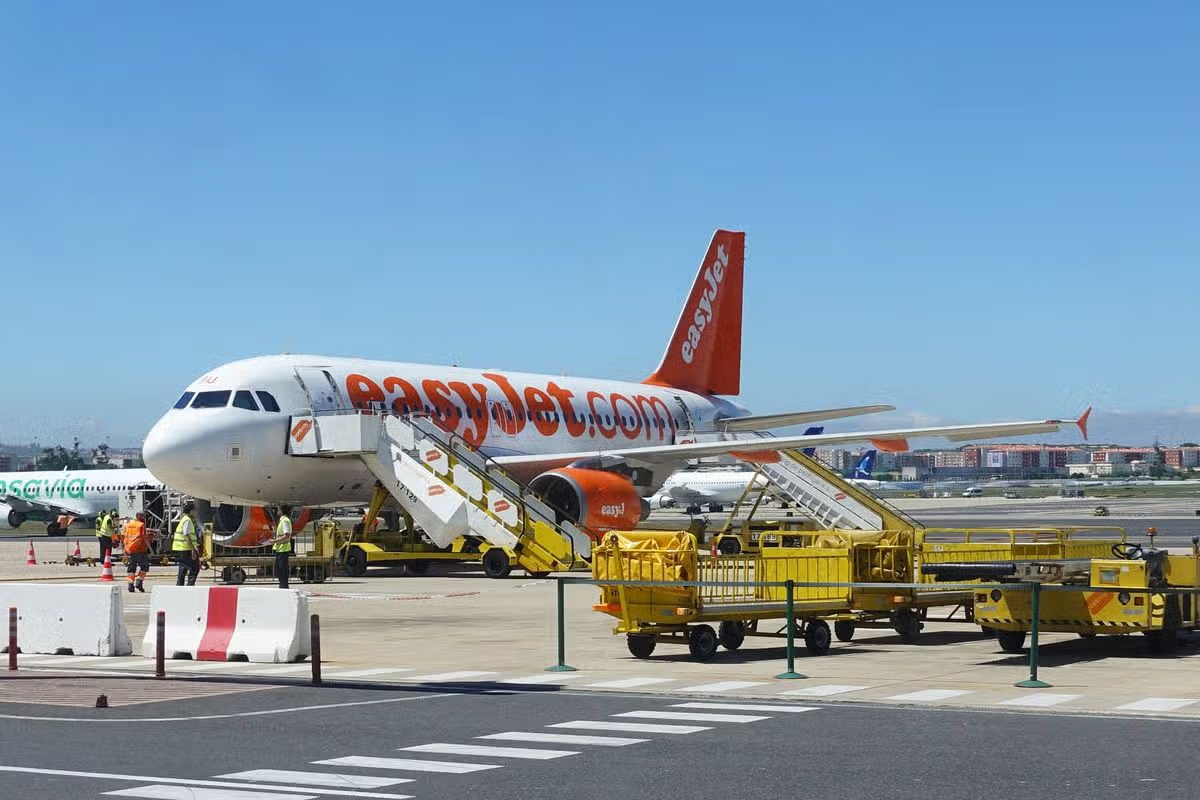
EasyJet 26 day strike action plan affecting 5 key airports in UK holiday hotspot

More than 3 million Brits travel there every year

UK travellers should be prepared for the risk of strike action over the next few weeks in a popular holiday hotspot. Millions of UK holidaymakers will be travelling abroad in the weeks ahead.

And France is one spot that will be popular with Brits. More than 17 million UK people travel there every year, according to the UK Foreign Office.

Now the new threat of industrial action has broken out – and it runs throughout the remainder of the summer holiday period. EasyJet cabin crew in France could walk out in strike action expected to run until September 2. Flight attendants there have complained about rota arrangements and working conditions.

French media report that three unions representing cabin crew at EasyJet France have issued strike notice covering the period from 7 August to 2 September. They have complained of a “continuing deterioration” in working conditions, according to a joint statement released this week.

What should you do if your flight is cancelled? For those planning to travel with the airline in the coming weeks, passengers whose flights are disrupted by cancellations or delays will be given 48 hours’ notice. Simply head to the ‘Booking’ tab in the EasyJet app to access the relevant information.

Should your flight be cancelled, you can request either a refund or a ticket change directly from the airline. If the replacement departure is scheduled for the following day, EasyJet may foot the bill for a hotel and a taxi to the airport.

The airports facing strike action include Lyon, Nice, Paris Orly, Bordeaux and Paris Charles de Gaulle. A spokesperson for ⁠easyJet said the company was disappointed and had made an offer of changes to tackle their concerns. ⁠They said: “Given we have planned negotiations in September, we call on the unions to call off this ⁠counterproductive action at this important time of the year for our customers”.

French news site RTL reports that workers are denouncing what they describe as “a vicious circle that has been going on for a year now”, with the SNPNC-FO, UNAC-CFE-CGC and UNPNC-CFDT trade unions condemning “the chronic instability of timetables, last-minute changes, imposed ‘trippings’ (a series of flights over several days, ed.), particularly gruelling rotas and a total lack of protective measures”.

“The notice period has been deliberately left open to cover the entire period,” the trade unions stress, adding that “key dates” for industrial action will be confirmed “48 hours in advance”.

The unions have accused management, whom they claim to have been warning “for nearly a year”, of failing to provide “concrete and binding” solutions to their concerns. Luckily for travellers, a previous strike call at EasyJet on Easter Monday in April had only a minimal impact on air traffic.

Local media say that as France’s second-largest airline by passenger numbers after Air France, British carrier EasyJet predominantly operates short- and medium-haul routes. The airline employs several thousand staff in France, a considerable proportion of whom work as cabin crew.

Gaël Leloup, a union representative for the Union of Civil Aviation Cabin Crew (UNAC), told RTL that “scheduling instability” has gradually become “the company’s normal way of operating”: “It’s normal to change people’s schedules once, twice, three or four times in the same day. And dozens of times a month, too. You might be moved from morning to evening shifts, or sent to another base in Europe for three or four days.”

The union representatives say they are fully aware of the disruption this strike action will cause to passengers’ travel plans, with another hectic weekend of holiday traffic on the horizon. “The sad thing is that it’s our passengers who will bear the brunt of it,” laments Gaël Leloup.

But with talks between staff and management having ground to a halt, workers feel they have been left with little choice: “After a year of discussions and still no solution, we have no option but to take major industrial action.”

For its part, EasyJet’s management said this week it is urging trade unions to withdraw the strike notice. The trade unions say they remain “open to negotiation” to call off the strike notice, provided that management “puts forward clear, concrete and binding solutions”.

Source link

Samsung Electronics unions deepen split over worker bonuses

Union members of Samsung Electronics Co. hold a rally protesting against gaps in bonuses in front of its branch in Suwon, south of Seoul, South Korea, 16 July 2026. Photo by YONHAP / EPA

July 16 (Asia Today) — Divisions among Samsung Electronics labor unions are widening as unions representing different business units pursue separate compensation demands and bargaining strategies.

The Samsung Electronics Donghaeng Union, which primarily represents employees in the Device eXperience division, staged a rally Thursday demanding compensation equivalent to about 1,000 company shares per employee.

Meanwhile, the Samsung Electronics branch of the Samsung Group Super-Enterprise Union, whose membership is concentrated in the Device Solutions division, held its first policy committee meeting for the semiconductor business.

The divisions developed from a dispute over performance bonuses and have continued despite the conclusion of companywide wage negotiations.

The Donghaeng union held its rally near the main entrance of Samsung Electronics’ Suwon campus in Gyeonggi Province.

“We strongly condemn management for unilaterally excluding the DX division and reaching a closed-door agreement without transparency,” the union said.

More than 7,000 people were reported to have attended, more than twice the approximately 3,000 participants initially expected by organizers.

Participants wore black and carried signs reading “Same company, same rights,” “Rest in peace, DX” and “Discrimination off, fairness on.”

“Behind the company’s remarkable achievements are the dedication and hard work of DX employees,” the union said. “However, management created an extreme compensation gap between business divisions during the latest negotiations, leaving DX employees feeling excluded and relatively deprived.”

The union called on Samsung Electronics to immediately offer each DX employee compensation equivalent to about 1,000 company shares.

It also demanded that the company secure funding in advance for companywide employee compensation in 2027 and disclose the amount transparently.

The Donghaeng union said it would hold another rally in Seoul’s Seocho District unless the company takes additional action.

Lee Ho-seok, head of the Suwon branch of the National Samsung Electronics Union, attended Thursday’s rally and suggested his union could join forces with Donghaeng over what union leaders described as management’s exclusion of DX employees.

“To create one Samsung Electronics, rights, respect and compensation must be provided equally,” Lee said. “Management must answer our questions.”

The Super-Enterprise Union, meanwhile, held the kickoff meeting of its DS Division Policy Committee on Thursday.

The committee discussed its operating rules, plans for the 2027 wage and collective bargaining negotiations and its response to the company’s Mega Project initiative.

The union said the committee would meet monthly and hold regular consultations with management.

The union is also preparing to request separate bargaining units that would allow employees in the DS and DX divisions to negotiate independently with management.

Choi Seung-ho, chairman of the Super-Enterprise Union’s Samsung Electronics branch, said he intends to secure the change this year.

“The Super-Enterprise Union will responsibly lead the 2027 wage and collective bargaining negotiations rather than participate in joint negotiations,” Choi said. “With about four months remaining before negotiations begin in early December, we will use the policy committee to develop a thorough set of demands.”

The unions began moving separately after Samsung Electronics introduced a special performance bonus for the DS division in May.

As unions increasingly organized along business-unit lines, disputes among them intensified.

As of Thursday, the Super-Enterprise Union had 54,286 members, the Donghaeng union had 28,877 and the National Samsung Electronics Union had 22,826.

The Super-Enterprise Union previously represented a majority of Samsung Electronics’ unionized workforce. Its membership declined after large numbers of DX employees left, while membership in the Donghaeng union and the National Samsung Electronics Union increased.

— Reported by Asia Today; translated by UPI

© Asia Today. Unauthorized reproduction or redistribution prohibited.

Original Korean report: https://www.asiatoday.co.kr/kn/view.php?key=20260716010006332

Source link

Labor unions of Home Plus, Korea Zinc blast MBK Partners

Union members of Korea Zinc and Home Plus hold a joint press conference in Seoul on Tuesday to criticize MBK Partners’ management of Home Plus and its takeover bid for Korea Zinc. Photo by Tae-gyu Kim/UPI

SEOUL, June 30 (UPI) — The labor unions of Home Plus and Korea Zinc on Tuesday blasted MBK Partners, one of Asia’s leading private equity funds, over its troubled ownership of the former and the attempt to take over the latter.

“Although we are workers from different workplaces, we are all suffering in the face of the same capital greed. Korea Zinc and Home Plus are no different,” Home Plus union leader Ahn Soo-yong told a joint press conference in Seoul.

“Home Plus has now entered rehabilitation proceedings and stands on the brink of liquidation. But throughout this entire process, MBK, which should be held accountable, is evading responsibility,” she added.

MBK Partners acquired Home Plus from Tesco in a $5 billion deal in 2015. However, the discount chain entered a court-led rehabilitation program in early 2025 after years of mounting losses. MBK tried to sell Home Plus for more than a year with little success.

Against this backdrop, Home Plus has steadily reduced its store network in recent years. The retailer operated more than 140 hypermarkets across the country at its peak in the mid-2010s, but now has just 67 remaining.

“The hardship facing Home Plus is by no means a problem unique to Home Plus,” Korea Zinc union head Lee Eun-seon said.

“If MBK succeeds in taking control of Korea Zinc, the job insecurity and workplace destruction now being experienced by Home Plus workers will inevitably become the grim reality for Korea Zinc employees as well,” he said.

Korea Zinc has been locked in a prolonged control battle with MBK, which teamed up with zinc manufacturer Young Poong early last year to pursue a takeover bid. The two sides clashed at shareholders’ meetings in 2025 and 2026 in a series of heated proxy battles.

The share price of Korea Zinc fell 4% on the Seoul bourse on Tuesday, while the broad KOSPI rose 0.97%. Neither MBK nor Home Plus is publicly listed.

Source link

Medicaid cuts reignite clash between health worker unions, hospitals

The looming impact of federal Medicaid cuts has reignited a long-simmering, costly battle between California’s medical industry and one of its largest health worker unions.

SEIU-United Healthcare Workers West, with about 120,000 members, has put forward two ballot initiatives to cap the pay of medical executives and require community clinics to spend the bulk of their revenues on patient care.

The California Hospital Assn. has responded with its own ballot proposal that would make it tougher for unions to spend money on political initiatives in the future. It would require approval by a union’s rank-and-file membership for any spending of $1 million or more on statewide measures, or $100,000 or more on local ones.

The competing measures, which have drawn enough verified signatures to qualify for the November ballot, come at a time when the rising cost of healthcare is emerging as a top voter concern.

The Service Employees International Union affiliate has seized upon affordability angst to resurrect a proposal for a cap on healthcare executive compensation, which it has failed to achieve multiple times before. The proposed measure garnered more than 1 million petition signatures.

“This initiative reflects the serious crisis we face and that affordability is a real thing,” said Vikas Saini, president of the Lown Institute, a Massachusetts-based healthcare think tank. “I think it also reflects grassroots anger and a desire to do something.”

Mikey Vaughn, a certified nursing assistant at Cedars-Sinai Medical Center, said the hospital often lacks supplies and staffing levels that he and his colleagues need in order to do their jobs effectively and without undue stress, despite its reputation as the go-to place for the rich and famous.

“The executive pay initiative would, I hope, be used to hire staff and to actually provide better resources for our patients,” he said. Vaughn is also a member of SEIU-UHW’s executive board and political committee.

Thomas Priselac, then-president and CEO of Cedars-Sinai Medical Center, made $8.8 million in fiscal year 2024, according to the organization’s most recent available federal tax filing. Kaiser Permanente’s CEO, Gregory Adams, made nearly $13 million in 2024. Warner Thomas, head of Sutter Health, made just under $12 million.

Cedars-Sinai spokesperson Duke Helfand said the hospital would be unable to recruit and retain physicians, nurses, and specialists if the measure passed, dramatically impairing its ability to provide healthcare.

“Such a scenario would be disastrous not only for Cedars-Sinai but for hospitals across Los Angeles and California,” Helfand said.

The union wants to cap compensation at $450,000 a year for senior hospital and medical group executives, as well as other administrative and managerial staff. However, the initiative does not stipulate how dollars diverted from payroll must be spent.

The union has dubbed the latest proposal the Health Care Executive Compensation Act of 2026. A coalition of medical industry heavyweights opposing it — hospitals, physicians, and clinics, among others — has rebranded it the Health Care Endangerment Act.

Carmela Coyle, CEO of the hospital association, called the measure a cynical political ploy.

“It’s bad policy and it’s going to have bad consequences across California,” she said.

Glenn Melnick, a healthcare economist at the University of Southern California, said even if the initiative were fully implemented and pay cuts enacted, he doubts it would reduce the cost of healthcare for patients.

SEIU-UHW does not have an estimated total amount the initiative would claw back from pay packages that exceed the limit.

Opponents of the initiative note that it doesn’t just target executive pay; it would affect medical practitioners who are also managers. That could include chief medical officers and chief nursing officers, as well as heads of surgery, emergency rooms, oncology, obstetrics, cardiology and other specialties, they say.

It would be up to each hospital, health system and physician group to report which staff members exceed the cap and by how much.

Ultimately, who is subject to the pay cap “probably will have to be battled out in court,” Coyle said . “That’s why we are throwing everything we can at it.”

The second SEIU-UHW ballot initiative, on community clinics, is already in court. The California Primary Care Assn., which represents clinics, filed a federal lawsuit in April seeking to invalidate it before it reaches the November ballot.

The proposed measure would require federally designated community clinics to spend at least 90% of their revenues on activities directly related to their mission of providing care for low-income populations. If it were to pass, more than 90% of those clinic organizations would be on the hook for penalties totaling $1.7 billion in the first year alone and “would face similarly crippling penalties every year,” according to a report commissioned by the primary care association and conducted by the Berkeley Research Group, an international consulting company.

Louise McCarthy, president and CEO of the Community Clinic Assn. of Los Angeles County, said many pivotal services the clinics provide — such as translation and transportation — would likely not be counted toward the spending requirement.

“They are targeting a group of what they see as employers and we see as the safety net,” she said.

The lawsuit cites the harm to clinics and claims the proposed spending requirement would interfere with federal authority.

Renée Saldaña, a spokesperson for SEIU-UHW, characterized the lawsuit against the initiative as “a really desperate attempt by the clinic industry to try and avoid accountability.”

SEIU-UHW, proud of its political activism, is also behind a controversial billionaire tax proposal that would impose a one-time 5% levy on California residents with fortunes over $1 billion to backfill the funding gap created by federal cuts coming down the pike under Republicans’ One Big Beautiful Bill Act. The law, passed last July and signed by President Trump, is projected to squeeze nearly $1 trillion from the Medicaid health coverage program for low-income people by 2034, including as much as $30 billion annually in California.

The hospital association, the community clinic group and the California Medical Assn., which represents physicians, are neutral on the wealth tax proposal thus far. But Saldaña said all three of the union’s ballot proposals tie into an overarching strategy to counter the widening healthcare disparities caused by the federal law.

“We believe the primary concern of healthcare providers, including executives, should be to serve the community, heal patients, and not be in healthcare just to enrich themselves,” she said on the proposed pay cap.

Over the years, the union has submitted dozens of local and statewide ballot initiatives, including ones to cap the pay of hospital executives, regulate dialysis clinics, and raise the minimum wage of healthcare workers.

The hospital association calculates that SEIU-UHW has spent nearly $125 million on local and statewide initiatives since 2012. But healthcare industry groups have spent far more opposing them. The hospital association data shows that the union spent nearly $36 million on three ballot proposals to regulate the dialysis industry, but dialysis companies poured in $302 million to defeat them, according to state campaign finance records.

The union’s ongoing political efforts “threaten patient access to quality health care,” according to the hospital association’s ballot initiative, which could limit how much unions spend on future ballot measures.

Saldaña hinted at a possible lawsuit should that measure pass, saying “we don’t see the legal viability” of it. The proposal, she said, is an attempt “to silence the front-line healthcare workers.”

Ultimately, a ballot initiative won’t cure the ills that plague healthcare in the United States, said the Lown Institute’s Saini. What’s needed, he said, is “an evaluation and reimagination of healthcare.”

Wolfson writes for KFF Health News, a national newsroom that produces in-depth journalism about health issues and is one of the core operating programs at KFF — an independent source of health policy research, polling, and journalism.

Source link

Huge disruption in Portugal on Wednesday, June 3 as 658 flights cancelled

Hundreds of flights have been cancelled, official data from June 3 indicates

A UK tourist hotspot has been rocked by disruption today. Officials in Portugal say 44.7% of flights scheduled to Portuguese airports on the day of a general strike today, Wednesday, June 3, were cancelled.

Portuguese media reports say that out of 1,472 flights scheduled across the country, at least 658 were cancelled, officials say. Of the 658 flights scheduled for Lisbon Airport, 408 have been cancelled, equivalent to 62%.

EasyJet had said in advance that its passengers would be affected. It said on the eve of the strike: “Due to a national strike in Portugal on 3 June, like all airlines operating to and from the country we can expect some disruption to our flying programme. We will be doing all we can to minimise the impact of the strike action and will contact customers directly with their options if their flights are affected.

“While this is outside of our control we are sorry for any inconvenience this strike action may cause.” Ryanair said it would not be affected.

Sapo reports that the second-highest percentage of cancelled flights is in Ponta Delgada, where 41% of the 118 scheduled flights will not take place, according to ANA information. In Porto and Faro, nearly a third of flights will be cancelled.

In Madeira, 23% of the 102 scheduled flights were cancelled. Almost all flights were reportedly cancelled in advance. This enabled notifying passengers and rescheduling flights, local media reports said.

The National Union of Civil Aviation Flight Personnel (SNPAC) said that of the 508 scheduled flights, “329 flights have already been cancelled, that is, 65% of the operations planned for June 3”.

The strikes, which also affected public transport and other services in the country, were the second in six month called over proposed government labour reforms.

Source link

EasyJet and Ryanair flights latest as UK holiday spot faces big strike on Wednesday, June 3

Official orders have spelt out what flights must be provided

EasyJet and Ryanair travellers have been issued with an official update as a UK holiday spot prepares for a major strike. Portugal will see a general strike on Wednesday, June 3.

It has previously been reported that around 500 flights from different airlines could be affected. EasyJet has said there could be some disruption for passengers on the day.

TAP Air Portugal says it is planning to operate at least 79 flights. The airline is also reportedly rebooking travel options for affected passengers.

Air Europa has reportedly cancelled all flights between Madrid and Lisbon and Porto. Tram services in Porto are also set to be affected.

Ryanair has said it will operate as normal. It will be the second time the nation has been hit by a general strike in recent months in protest at labour reforms the Portuguese government is planning. The disruption is likely to affect many areas of the country.

Portuguese media reports say that for those providing essential social services, minimum service levels have been established. Information has been reported in local media, based on official documents, about what minimum services are therefore expected for some airlines.

EasyJet ‘minimum services in Portugal on June 3’

Local media reports say that some flights involving major national carrier TAP will go ahead. Sapo reports that a deal has been reached between easyJet and the trade unions, providing for the following minimum services:

  • two flights from Lisbon to Funchal;
  • one flight from Porto to Funchal;
  • one flight from Lisbon to Basel; one Lisbon-Nice flight;
  • one Porto-Paris flight;
  • one Porto-Geneva flight;
  • one Porto-Luxembourg flight;
  • one Lisbon-Luxembourg flight;
  • and one Lisbon-London flight.

That information emerged in reports published by the Directorate-General for Employment and Labour Relations (DGERT). It stated that the National Union of Civil Aviation Flight Crew also warns that, “if striking staff are replaced by crew from other bases, the conditions for future agreements will no longer exist”.

Full list of ‘Ryanair minimum services on June 3’

Sapo also reports that in the case of Ryanair, minimum services have been set by order of the Minister for Infrastructure and Housing. These reportedly state that, on the day of the strike, staff must report for duty to ensure the following connections:

  • two Lisbon–Funchal–Lisbon connecting flights;
  • one Lisbon–London–Lisbon connecting flight;
  • one Lisbon–Luxembourg–Lisbon connecting flight;
  • one Porto–London–Porto connecting flight;
  • one Porto–Luxembourg–Porto connecting flight;
  • one Porto–Paris–Porto connecting flight;
  • and one Faro–London–Faro connecting flight.

“The staff required to ensure minimum services shall be designated by the trade unions that have called the strike no later than 24 hours before the start of each of the declared strike days or, if they fail to do so, the companies must make such a designation,” the order states.

EasyJet told the Sun: “Due to a national strike in Portugal on 3 June, like all airlines operating to and from the country we can expect some disruption to our flying programme. We will be doing all we can to minimise the impact of the strike action and will contact customers directly with their options if their flights are affected.

“While this is outside of our control we are sorry for any inconvenience this strike action may cause.”

Source link

‘Flights will be cancelled’ warning as dates set for 2 strikes in UK holiday hotspot locations

In a new update two massive walkouts are planned – with passengers to two European countries hit

Holidaymakers have been warned holiday flights are set to be hit after a massive strike was joined. Portugese media have today reported that cancellations will result after cabin crew and ground staff decided to walk out.

EasyJet has warned of flight disruptions, whilst TAP and SATA are allowing free rebooking. The general strike on June 3 against the labour reform is expected to have a major impact on airport services in Portugal. Reports suggest up to 500 flights could be scrapped, while trains, ferries, city metros and buses are all expected to face disruption.

It comes as holidaymakers heading to Italy were warned to brace for major disruption as a nationwide transport strike threatens chaos across the country. The 24-hour walkout is expected to hit rail services, airports, metro systems, buses and regional transport networks from 9pm on Thursday, May 28, until 9pm on Friday, May 29.

Several unions have confirmed industrial action involving major rail operators including Trenitalia, Trenord and Italo, sparking fears of cancellations and delays on some of Italy’s busiest routes. Long-distance rail services connecting major cities including Rome, Milan, Venice, Florence, Bologna and Naples are expected to be among the worst affected outside protected operating periods.

Italy’s Ministry of Transport has published lists of “guaranteed” services that must continue operating during protected commuter windows between 6am and 9am, and again between 6pm and 9pm. Italy’s Civil Aviation Authority, ENAC, confirmed flights are legally protected during guaranteed operating periods between 7am and 10am and 6pm and 9pm.

In Portugal TAP and the SATA group are even allowing their passengers to rebook flights scheduled for that date at no extra cost. The airlines have already posted notices on social media and are contacting passengers.

Unions in the sector were this week negotiating with the Directorate-General for Employment and Labour Relations regarding minimum services, and only then will it be known exactly how many flights will be cancelled. It is already certain, however, that there will be flight cancellations, not least because air traffic controllers will also be joining the strike.

READ MORE: EasyJet warning ahead of major national transport strike starting tomorrowREAD MORE: Portugal travel warning as up to 500 flights could be cancelled in June

“Like all airlines operating to and from the country, easyJet may experience some disruption to its flights. The airline is currently assessing the potential impact of this situation, and customers will be contacted directly if their flights are affected. easyJet assures us that it is doing everything in its power to minimise the impact of this strike,” an official source told Expresso.

The Civil Aviation Pilots’ Union (SPAC), unlike during the last general strike on December 11, will not be taking part this time. “We have decided to stand aside from this process for now,” said Hélder Santinhos, speaking to Lusa.

“The first general strike was timely. We took a stand, both pilots and workers across the country, against the labour package,” the SPAC president began by saying. Now, he said that next week’s strike “does not seem to be at the most appropriate time”, although he reserves the right to take further industrial action. This is because, he argued, “unfortunately, the changes made to the labour package do not seem sufficient for us to agree to them”.

This stance differs from that of the members of the National Union of Civil Aviation Flight Crew (SNPVAC), who approved participation in the general strike on May 19. Sitava, the largest union for ground staff and handling personnel, has also joined the strike.

The CGTP has served notice of a general strike for June 3 against the changes to the labour law, after negotiations with the Government ended without agreement.

The hospitality sector is deeply concerned about this strike. The Portuguese Hotel and Restaurant Association (AHRESP) stated on Tuesday that the general strike will exacerbate the sector’s losses, which are already being affected by the situation at border controls.

The association argues, as reported by Lusa, that “national airports are showing signs of operational collapse” and that the general strike on June 3 “could further exacerbate the losses”. It also calls for the European Union’s Entry/Exit System at border controls to be suspended with urgency until the end of September.

AHRESP said in a statement: “Portugal invests in international promotion as a destination of excellence, yet allows the visitor’s first experience to be hours spent queuing, a missed connection, a negative reaction on social media or a booking that is not repeated.”

On Tuesday, AHRESP called for the suspension of the EES (European Union Entry/Exit System) as a matter of urgency and until the end of September, which “would speed up passenger checks and reduce waiting times at airports”.

The association also calls for “negotiation and a sense of responsibility among all parties involved, in order to avoid a strike in aviation and airport services, which, were it to take place, would result in further damage to sectors that continue to face severe economic pressures”.

The Federation of Transport and Communications Unions has announced its support for the general strike. The strike notices cover workers at Lisbon Metro, Carris, Transtejo/Soflusa, Fertagus, Mondego Metro, Porto Metro, STCP and CP.

Unions representing teachers, architects, doctors, nurses and journalists have also announced their support for the protest, which promises to bring the country to a standstill.

Source link

Portugal holiday warning as ‘500 flights’ may be affected

Travel plans could be set for major disruption

Around 500 flights could be thrown into disarray due to a general strike set to take place in Portugal.

Portuguese news sources are reporting that the industrial action is expected to trigger major disruption across the transport network. The CGTP (General Confederation of Portuguese Workers) has called the strike, with Sic Noticias suggesting that growing numbers of workers’ representatives are backing the campaign.

The National Union of Civil Aviation Flight Personnel (SNPVAC) has predicted that “around 500 flights” could be affected by the walkout on June 3, with the potential for travel chaos to also extend to the days surrounding that date. According to an internal document seen by Notícias ao Minuto and shared with union members, the SNPVAC has also warned that the general strike may impact “the days before and after”.

ECO has stated that the cabin crew strike will chiefly hit operations for TAP, Portugália and SATA. Idealista, along with several other Portuguese media outlets, indicates there may also be knock-on disruption to flights run by other airlines with Portuguese bases.

The outlet highlights this could potentially encompass easyJet and Ryanair, as the industrial action involves cabin crew operating from Portuguese bases.

This comes after comparable action last December which caused widespread chaos across the nation. Rail services ground to a halt across Portugal on December 11 last year. Hundreds of flights were cancelled simultaneously in protest against the very same proposed labour reforms that remain at the heart of this ongoing dispute.

Members of the National Union of Airline Workers voted in favour of the latest industrial action on Tuesday, in opposition to the planned labour reforms.

The CGTP filed a formal pre-strike notice for June 3 in protest against amendments to employment legislation, following fruitless talks with the Government.

The proposed changes to labour law were rubber-stamped by the Government in the Council of Ministers last week and are now due to go before Parliament for debate.

Minister of Labour, Solidarity and Social Security, Rosário Palma Ramalho, confirmed the development at a press conference, a week after Government negotiations on employment law changes ended without agreement in the Social Dialogue.

What could be affected by the strike in Portugal?

Portuguese media reports indicate that urban passenger transport across the country, as well as airports, are likely to face significant disruption. The CGTP has called on all workers to join the industrial action.

The Federation of Transport and Communications Unions has thrown its weight behind the strike. Transport operators expected to be caught up in the action include Lisbon Metro, Carris, Transtejo/Soflusa, Fertagus, Porto Metro, STCP and CP – Comboios de Portugal. The National Union of Civil Aviation Flight Personnel has also confirmed its involvement in the strike, alongside the Union of Aviation and Airport Workers, with the decisions expected to cause widespread disruption across several airlines.

The retail workers’ trade union and the two organisations representing doctors and teachers had previously confirmed they would be taking part in the industrial action, with the Nurses’ Union also verifying its participation.

Meanwhile, Portuguese media is reporting that extra police will be deployed to the country’s airports to manage lengthy queues caused by the new EES border policy. The system affects non-EU nationals travelling for short stays whenever they cross the external borders of most European countries, including Portugal, Spain, Italy and France.

According to Sic Noticias, significant queues have been building in recent days at Portugal’s Schengen Area entry and exit checkpoints. The system is intended to replace manual passport stamping for non-EU nationals, including British citizens, entering the Schengen Area for short-term visits. It captures biometric data – fingerprints and photographs – at border control points, and applies to 90-day, visa-free, or short-stay visa travel.

There have been reports of queues stretching to three and four hours for some British travellers abroad, with a number of passengers even missing their flights altogether due to the lengthy delays. Portugal’s Public Security Police (PSP) is set to strengthen the country’s airports with an additional 360 officers in July, in a bid to cut waiting times for passengers arriving from outside the Schengen Area, according to an official PSP source.

PSP spokesman Sérgio Soares confirmed that the 360 officers are among 560 new recruits who will finish their training on May 28 before immediately embarking on a four-week border guard course. The 360 newly qualified officers are due to begin their airport duties in early July, forming a central part of the PSP’s summer contingency plan.

Police sources have revealed to Lusa that of the 360 new personnel, 150 will be posted to Lisbon airport, 90 to Porto, 70 to Faro, 30 to the Azores, and 20 to Madeira.

Source link