Unions

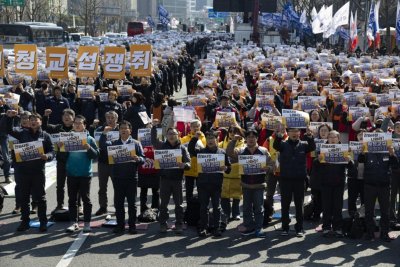
L.A. unions urged to lead policy debate

Los Angeles unions enjoy a decided “brand advantage” over corporations among city voters, and the labor movement should use that popularity to advance “union-led solutions” to key public policy issues in 2007, a memo written by top labor strategists says.

The two-page memo, which was obtained by The Times, argues for broader, more straightforward engagement on policy issues than many unions have undertaken in the past. Some labor leaders prefer to focus on their own contract issues, and even those who are active in politics often soft-pedal the “union” label.

The document demonstrates labor’s confidence as it heads into a new year of big battles over politics, contracts and organizing.

Labor is preparing to fight a referendum, which was qualified by the business community, to block an expansion of the city’s living wage ordinance. Civilian city employees, grocery store workers, security officers and teachers are seeking new union contracts, and hotel workers near the airport and truck drivers near the port are engaged in organizing drives.

The memo relies heavily on public opinion research conducted by a Democratic pollster, David Binder, including a survey of 800 city voters last fall. The document was written by three veteran strategists, John Hein, Bob Cherry and Don Attore, all of whom have retired from the political operation of the California Teachers Assn. The three work closely with Working Californians, a nonprofit research and advocacy group.

“There is a significant opportunity for organized labor in Los Angeles,” the memo says. “In particular, we’d highlight these factors: unions’ fundamentally positive image and ‘brand advantage’ over business corporations; the overlap between union priorities and the key concerns of voters across the electorate in L.A., and the opportunity to expand public understanding of the connection between local government and the full range of quality-of-life issues.”

Gary Toebben, president and chief executive of the Los Angeles Area Chamber of Commerce, said that unions, to the extent that they engage in policy issues, “are copying the Chamber of Commerce…. For other groups to want to be involved in efforts to build a better community, I say we welcome them to the cause that we have been championing.”

Toebben and other leaders of Los Angeles’ business community are focusing on a referendum to block a new law, which is heavily backed by labor, to expand the city’s living wage ordinance to cover workers at airport-area hotels. The success of the referendum, which probably will appear on the ballot in May, is crucial to persuading businesses to come to Los Angeles, expand and create jobs, he said.

Asked at a news conference last week about whether the referendum was wise given labor’s growing strength in the city, Toebben said it would be wrong to “just let the bulldozer run over you.”

Binder’s poll found that unions have more public support in Los Angeles than in other areas of the state and country. Among city voters surveyed, 55% agreed that “without unions, there would be no middle-class left in America.”

Reflecting the labor movement’s influence in city politics, the memo argues for talking up local government’s ability to deal with issues such as the economy, healthcare and the environment, which generally are considered federal and state matters.

The memo calls “for a public education campaign focused on union-led solutions to the quality-of-life issues that Los Angeles voters regard as most important.” The memo suggests that such a campaign be conducted before 2008, when state and national election campaigns will probably consume union energy.

“Los Angeles, against its own history, is a labor town now,” said Cherry, one of the strategists, who was a key figure in the successful effort to defeat Gov. Arnold Schwarzenegger’s slate of ballot initiatives in 2005. “One of the things that comes through in the poll is that people really see the potential of unions to take up the cause of ordinary people on quality-of-life issues.”

Nelson Lichtenstein, a labor historian and UC Santa Barbara professor, said he had “a certain admiration” for unions involving themselves more in policy issues, though he wonders if the public may prove skeptical.

In the long term, “this is the way that unions will make a breakthrough — when people see that solutions to society-wide questions are part of a labor agenda,” he said.

Binder’s polling suggests that any attempts by business to challenge union priorities will not be easy. Seventy-three percent of those surveyed agreed with the statement: “Big corporations are taking advantage of people like you.” Sixty-one percent of the Angelenos surveyed believe that oil companies are manipulating oil prices, including reducing prices during election times to keep supportive politicians in office.

Maria Elena Durazo, the leader of the Los Angeles County Federation of Labor, was briefed on the polling. She said in an interview that in 2007, she wanted to continue to organize workers while looking for opportunities to take on “the greediness of the corporations, which is pretty clear and pretty blatant.”

“Strategically, we just don’t take on everything that’s out there,” she said. “We’ve tried to put our resources in places where they make a difference.”

Dan Schnur, a Republican political consultant who teaches at USC, said that a public education campaign might be particularly effective this year, when no state or federal elections are scheduled.

“The best time to reach the voters with any type of argument is when their guard is down,” Schnur said. “The closer you get to an election, the more difficult it is to get through to people, but having this discussion in an off-year makes it much easier to get your message through.”

*

joe.mathews@latimes.com

Source link

Inside the unusual world of the Soviet Union’s beautiful and mad bus stops

Kazakhstan, Turkmenistan, Uzbekistan, Kyrgyzstan and Tajikistan, Ukraine, Moldova, Armenia, Abkhazia, Georgia, Lithuania, Latvia, Estonia and Belarus have some seriously interesting bus stops

Find yourself at a bus stop in the UK, and there’s a decent chance you’ll share it with some wads of chewing gum and a bit of scrawled graffiti, sat on an uncomfortable bench designed to stop unhoused people from lying down.

In terms of artistic flair, the most creativity you’re likely to see is a traffic cone balanced on the roof.

The same cannot be said for former Soviet Union countries, where the world’s most striking and strange bus stops are scattered across the rural landscape. From Kazakhstan, Turkmenistan, Uzbekistan, Kyrgyzstan and Tajikistan, to Ukraine, Moldova, Armenia, Abkhazia, Georgia, Lithuania, Latvia, Estonia and Belarus, the Eastern Bloc nations are adorned with a reminder of the Empire in the form of public transport infrastructure, 30 years after it collapsed.

Do you have a story to share? Email webtravel@reachplc.com

READ MORE: One of the UK’s ‘worst seaside towns’ is getting a huge £37.5million revampREAD MORE: I couldn’t survive on my pension so I moved to country with £240 a month rent

The Mirror’s Jonathan Reynolds found himself enchanted by the unusual shelters during a recent trip to Moldova, a country of 2.2 million that is the poorest in Europe. What it is rich in, Jonathan discovered, is bus stops.

“For Christmas a couple of years ago, my brother had bought me the book Soviet Bus Stops volume 1, and in it was a section of Moldova and pictures of these amazing bus stops that had been designed and built with such creativity and care. Often, it includes intricate mosaic designs in a structure created to provide shelter and comfort for the local commuters,” he explained.

“So, I woke up early, before the sun came up, picked up my hire car at 6am and headed out into the Moldovan countryside to find as many bus stops I could. I wasn’t disappointed.”

One particularly striking bus stop has large, intricately designed mosaic stars running along the wall, beneath a ski-chalet style roof. Another is a long, dry-stone wall with a corrugated roof lolling over the top of a small bench, providing protection from the elements, while echoing the style of contemporary British artist Andy Goldsworthy.

The creator of Soviet Bus Stops volume 1 is Canadian photographer Christopher Herwig, who has spent years travelling more than 30,000 km by car, bike, bus and taxi across 14 former Soviet countries to document the unexpected treasures of modern art.

He started the project in 2002 during a trip from St Petersburg to Sweden, on which he pledged to take a photo of something every hour. “I was trying to get out of that mindset that I needed to find a stunning National Geographic monument. I wanted to make ordinary things look cool or interesting. Bus stops, clothes lines, power lines, whatever you’d find on these farm roads.”

When he got to the Baltic countries, he started coming across the bus stops. “They were much more individualist, unique, minimalistic. They were beautiful pieces of architecture and design.”

In the two decades since, Christopher has returned to the Bloc multiple times, to take more photos and to unravel the history of the bus stops.

“I spoke to architects and designers to find why these curious things are on the side of the road. They’re quite unexpected, in that it’s a bus stop, on a rural road, but also, in that it was the Soviet Union. I had a different impression, growing up in Canada, of what the Soviet Union was like in terms of creativity and art. I thought a lot of things were standardised and controlled, without a great scope for freedom of expression, but these bus stops went against that,” he said.

“I could not find any evidence that it was a centralised plan from Moscow. But it was not something that was discouraged either. Bus stops were classified as something called a small architectural form, which didn’t have the same stringent rules and necessity to be approved or ideologically controlled as other monuments or bigger buildings.”

One of the key architects behind the bus stops was George Chakhava, whose unusual work decorates Georgia’s Black Sea coast.

“He created some of the wildest bus stops I could find. He was working in concrete and mosaics. George had a lot that went over different animal themes. An octopus, an elephant, a fish, a wave. One of his has a big concrete crown with a large gap in the roof. It gives no protection from the elements.”

This intriguing tension between form and function is replicated in Kyrgyzstan, where a plump bird forms the main structure of the bus stop. Its wings are too small to offer any protection to passengers from the wind or rain. Another is, simply, a large hat.

“The bus stop showed a lot of regional and national pride, more so than communist ideals. The Kyrgyzstan hat is a traditional hat, for example. There are some, however, that are blatantly propaganda and have hammers and sickles.”

While Christopher did meet people who loved their bus stops, such as a group of Estonian factory workers who took great pride in designing their very own, others saw them as eyesores.

“They are not something that’s treasured. They are seen by a lot of people as something that should be taken down. People tend to go to the bathroom there or throw their rubbish there. I’ve had people approach me asking why I’m taking photos of this yucky scene,” the photographer explained.

Copes of Christopher’s book are available online. His Instagram page is herwig_photo.


Source link