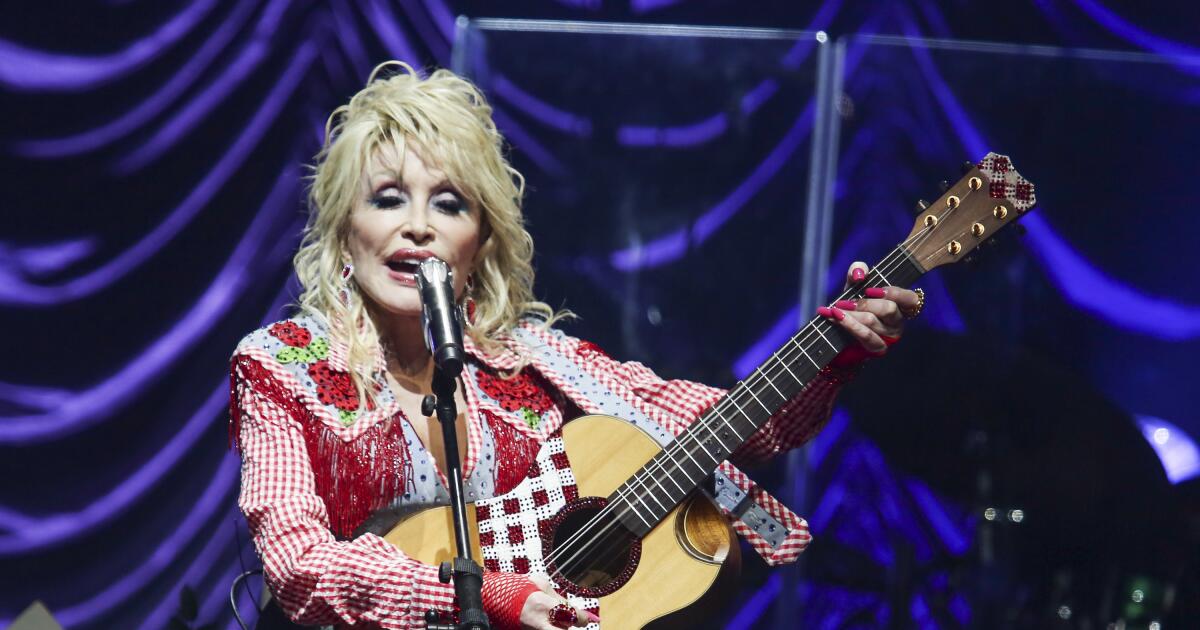
Dolly Parton was a supreme and unifying talent across generations
In death as in life, Parton left us one of the few spaces where Americans can still unite under a single banner. The banner of Dolly.
Flags are flying at half-mast to honor singer Dolly Parton, who died Tuesday at the age of 80.
There are few artists, let alone individuals of any stripe, whose loss compels a national day of mourning. Especially now, when it can appear there is little to agree upon and everything to debate.
But in death as in life, Parton left us one of the few spaces where Americans can still unite under a single banner: The banner of Dolly.
Her music was borderless, disarming and genuine. Simply put, it was a reflection of the woman who wrote and performed the songs. Her outsized personality, warmth, compassion and charm made her more than a country music star. Parton was an icon whose music, philanthropy and authenticity superseded genre, class, sexuality, color and politics.
She ingratiated herself to the public in bigger-than-big wigs, “trashy” outfits (her words) and with an unfailing sense of humor about herself. When I interviewed Parton in 2001 upon release of her album “Little Sparrow,” she expounded on her fashion sense.
“Just ‘cause I’m singing about a farmer doesn’t mean I have to come out in overalls,” she said. “Or just ‘cause I’m singing about a woman having a baby doesn’t mean I have to wear a maternity smock. But if I did, I’d put rhinestones on it.”
Parton’s self-effacing jokes made her immense talent less threatening in an entertainment industry that often reserved the title of “genius songwriter” for men. And women’s contributions were often minimized by putting the focus elsewhere.
In 1977, when she appeared on “The Tonight Show Starring Johnny Carson,” the most powerful man on television asked what her ample bustline would have been called back home. “Healthy,” he joked? She laughed it off. He then said he would give a year’s pay to “peek under there.” She was quick with a comeback, “I paid good money for these.”
Parton was a master at meeting wisecracks about her shapely figure with her own one-liners. When Carson’s successor Jay Leno asked if her breasts were real, Parton replied, “They’re real big!”
The boob jokes were predictable during her frequent appearances on talk and variety shows. But the of-its-time sexism was neutralized when she’d pull out her acoustic guitar and perform a song as comfortably as if she were sitting on the porch of her childhood home in Appalachia. The audience was then reminded that it was her indelible songs like “Coat of Many Colors” or “Jolene,” and the home-spun beauty of Parton’s voice, that made her a star.
The fourth of 12 children born to a poor sharecropper in a one-room cabin on the banks of the Little Pigeon River in Pittman Center, Tenn., Parton over six decades sold more than 100 million records to become one of the bestselling music artists of all time. She expanded her audience when in 1980 she played an overworked, underappreciated secretary alongside Jane Fonda and Lily Tomlin in “9 to 5.” The title track she wrote and performed for the film is an enduring work anthem, no matter the generation.
Despite Parton’s huge pop successes, which also included “Here You Come Again” and “Islands in the Stream,” she always came back to her roots. “When I came out of the Smoky Mountains, I tried to make a living doing [mountain music], but I couldn’t,” she said back in 2001. “I had to prostitute myself in certain ways musically in order to make a living. It’s almost like I had to get rich in order to sing like I was poor again.”
But it was largely what Parton did and said outside the recording studio and film set that made her such an inspiring and beloved figure, especially in communities that had been overlooked, marginalized or demonized.
She spent her lifetime giving back to Appalachia and other regions of her home state, sponsoring literacy programs and building the Dollywood theme park to attract tourism and create jobs. She covered tuition and related college expenses should Dollywood employees enroll in higher education. It was also reported that Parton had anonymously paid for the band uniforms for a number of Tennessee high schools for years.
When Whitney Houston popularized the country singer’s song “I Will Always Love You,” Parton used her songwriting royalties to buy property in a historically Black Nashville neighborhood, and moved her own business offices into the complex rather than in the city’s corporate or music-row districts. Functioning as a local commercial building and office space, it allowed her to invest directly in the surrounding community. Parton referred to the property as “the house that Whitney built.”
Parton was also known for her long history of openly supporting the gay community. She raised money for HIV-related charities, and her production company, Sandollar Productions, co-produced the Oscar-winning documentary “Common Threads: Stories From the Quilt,” which honored people lost to AIDS. She also publicly came out in support of same-sex marriage in 2009 and voiced her support for the trans community after several anti-trans measures came into law in Tennessee in 2023.
Communities across the political and cultural spectrum, and countries overseas, are now remembering and honoring Parton with drag parades, New Orleans brass band tributes and even a King’s Guard rendition of “9 to 5” outside Buckingham Palace.
Parton’s acts weren’t political. They were empathetic. And unifying. Even in death.