Clayton Kershaw’s ‘perfect’ ending has one final chapter in WBC
SCOTTSDALE, Ariz. — How do you improve on the perfect ending?
Clayton Kershaw stood in the desert heat Monday, wearing a far darker shade of blue than the Dodgers do. He does not need a medal, or a chance to fail. His election to the Hall of Fame will be a formality.
In his farewell year, the Dodgers won the World Series, becoming baseball’s first back-to-back champions in 25 years. He secured a critical out. He bathed in adoration at the championship rally, and he told the fans he would be one of them this year.
“I’m going to watch,” he hollered that day, “just like all of you.”
Four months later, he was back in uniform.
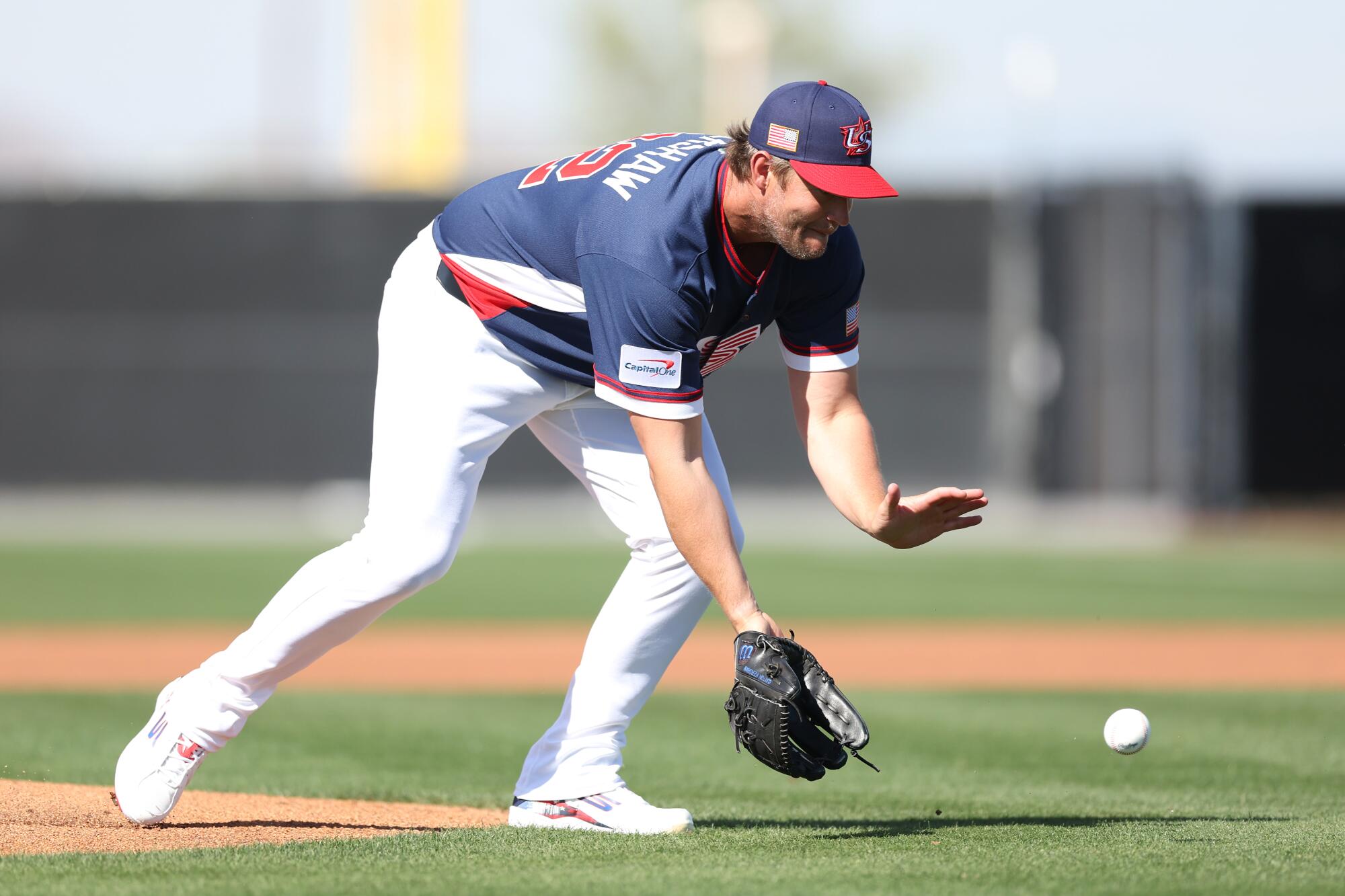
He wore a dark blue jersey with red-and-white piping. As Team USA ran through its first World Baseball Classic workout, Kershaw participated in pitchers’ fielding practice and shagged fly balls during batting practice. He could have been home with his five kids, and instead he was rushing off the mound to take a throw at first base.
That November night in Toronto, as it turned out, was not the last time we would see him in uniform.
“Feels good,” he said Monday. “I wouldn’t put on a uniform for anything else. This is a special thing.”
He put the World Baseball Classic into red, white and blue perspective.
“It’s a bucket list thing for me,” he said.
He is either self-deprecating or painfully honest about his capabilities right now, or perhaps a little of both.
The last World Baseball Classic came down to Shohei Ohtani pitching to Mike Trout. This one could come down to Kershaw pitching to Ohtani.
“I think, for our country’s sake, it’s probably better if I don’t,” Kershaw said.

Former Dodgers pitcher Clayton Kershaw fields a ground ball during a workout at Papago Park Sports Complex on Monday.
(Chris Coduto / Getty Images)
Never say never. Team USA planned to run a tremendous rotation of Tarik Skubal, Paul Skenes, Joe Ryan and Logan Webb, but now Skubal says he will pitch just once in the tournament. Skenes says he’ll pitch twice. Ryan says he won’t pitch in the first round, at least.
Kershaw might be needed beyond the role he was promised: save the team from using the current major league pitchers in blowouts or extra innings.
In 11 career at-bats against Kershaw, Ohtani has no hits. Kershaw won’t duck the assignment if gets it, but he considers it so unlikely he is happy to share his game plan publicly.
“It’s throw it, pitch away, play away, hope he flies out to left,” Kershaw said. “Don’t throw it in his barrel.
“I can’t imagine, if it comes down to USA versus Japan, with the arms that we have, that I’ll be needed. But I’ll be ready.”
Kershaw’s average fastball velocity dropped to 89 mph last season, but he led the majors in winning percentage. He could eat innings for some team — maybe even the Dodgers, with Blake Snell and Gavin Stone all but certain to be unavailable on opening day.

Dodgers pitcher Clayton Kershaw, right, celebrates with teammates after the Dodgers defeated the Toronto Blue Jays for the 2025 World Series title.
(Robert Gauthier / Los Angeles Times)
But, even with his success last year and even with the joy of wearing a uniform once again, he insists he isn’t interested in pitching beyond the WBC.
“I don’t want to,” he said. “You can’t end it better than I did last year. I had a great time last year. It was an absolute blast and honor to be on that team. I think that was the perfect way to end it. Honestly, I don’t know if I would have enough in the tank to pitch for a full season again. I’m really at peace with that decision.
“This is kind of a weird one-off thing, but you can’t really turn down this opportunity. It wasn’t easy to get ready for this, with no motivation for a season, but I actually am in a pretty good spot with my arm. I’ll be fine. If they need me, I’ll be ready.”
Kershaw said he has kept in touch with his old Dodgers teammates, with some connecting on video calls from the weight room or clubhouse at Camelback Ranch. He arrived in the Phoenix area two days before the workout, but he skipped a trip to Camelback Ranch.
“I’ve thought about it,” he said. “I miss the guys. I think it’s probably just better, at least for this first year, for me mentally to just stay away, just for spring training.”
Kershaw said he would be at Dodger Stadium for the championship ring ceremony March 27.
He is content with what he calls “Dad life.” He and his wife, Ellen, just welcomed their fifth child, and Dad life includes lots of shuttles to baseball and basketball practice.
“I run an Uber service,” Kershaw said.
This wouldn’t be a Dodgers story these days without some reference to the team’s big spending so, for what it’s worth, Kershaw spent some time Tuesday chatting with Skubal, who will be the grand prize on the free-agent market next winter, or whenever the likely lockout might end.
That’s a rational explanation, Kershaw says, for Skubal pitching just once in the WBC.
“Everybody knows the situation he is in, contract-wise,” Kershaw said. “Any innings we can get out of him is a huge bonus to this team. He’s great. Super competitive. We’re honored to have him.”
Should we assume Skubal will be pitching for the Dodgers next season? Kershaw laughed.
“No comment,” he said, then walked away to get ready for the first game of his post-retirement life.