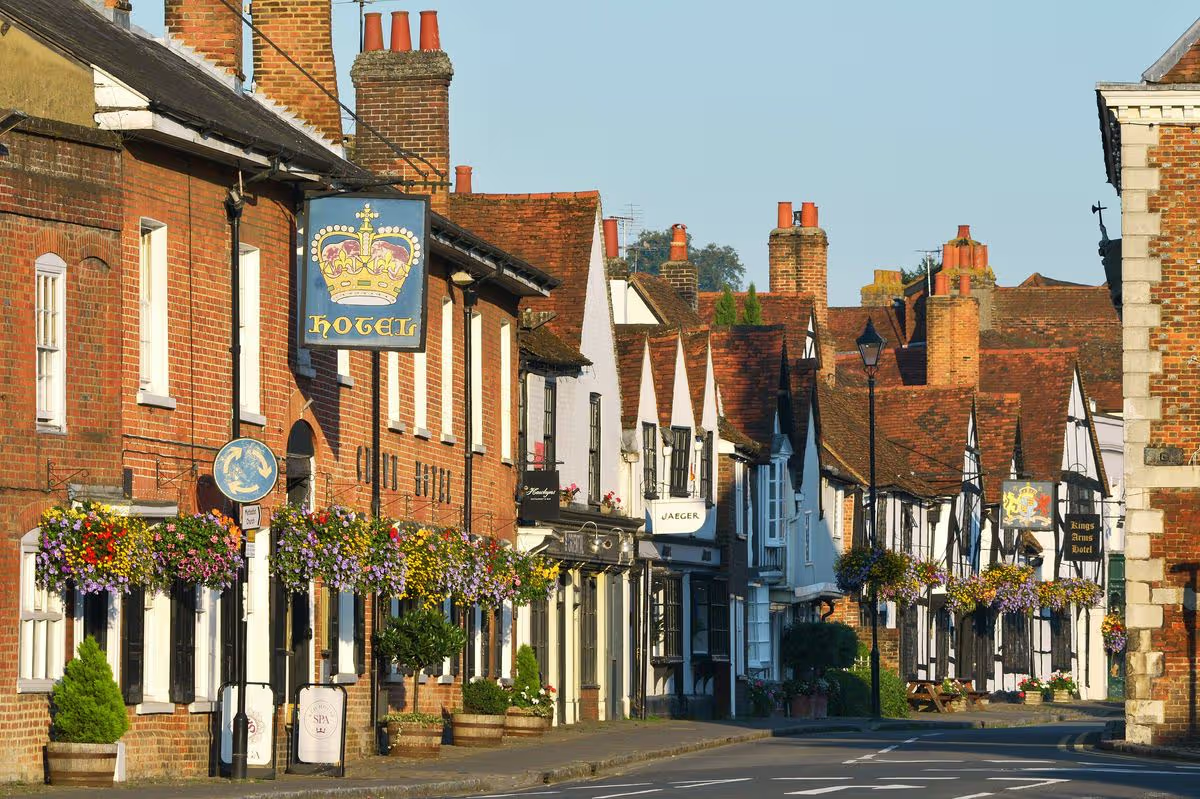
Amersham market town in Buckinghamshire is accessible via the Metropolitan Line and offers Cotswolds-style charm with cobblestone streets, timber-framed cottages and rolling hills
Alice Sjoberg Social News Reporter
15:04, 04 Apr 2026
This picturesque town is located on the London Underground, making for a perfect day trip away (stock image)(Image: Jim Dyson, Getty Images)
With spring now in full swing and the weather hopefully turning warmer and brighter with each passing day, it can be a real treat to escape the chaos of London and discover somewhere new. The good news is, you won’t need to venture far to find a picture-perfect market town that ‘feels like the Cotswolds‘.
Travel-loving couple The Weeshas regularly take to Instagram to share their top tips for exciting places to explore, whether closer to home or further afield. If you’re stuck for ideas on where to head for a day trip, the duo have shared footage from their visit to a charming little town that’s reachable via the London Underground, yet feels worlds away from the capital.
“This charming town is 50 minutes from London by tube,” they wrote on the video, which featured clips of the stunning-looking destination.
They also added in the post’s caption: “Nope, that’s not the Cotswolds. You can visit the English countryside without leaving the London Underground map.”
Content cannot be displayed without consent
The footage went on to reveal a courtyard complete with a clocktower, framed by a beautiful border of blooming flowers. It then cut to a shot of a bridge, its wooden fence adorned with an array of plants and flowers. The video also showcased a stunning fountain, cobblestone streets, timber-framed cottages, and a river winding its way through the village.
So where exactly is this picturesque market town, and how do you get there? The couple explained: “Just hop on the Metropolitan Line and in under an hour, you’ll arrive in Amersham, the last stop on the line – and one of England’s most charming villages, with cobblestone streets, timber-framed cottages, cosy pubs, and rolling Chiltern hills.”
Nestled in the Chiltern Hills of Buckinghamshire, Amersham is a market town and civil parish situated 27 miles northwest of central London. You may well recognise it, even if you’ve never set foot there before.
Made up of two distinct areas – Old Amersham and Amersham-on-the-Hill – the town’s history stretches back to pre-Anglo-Saxon times, even earning a mention in the Domesday Book of 1086.
So what’s there to do in Amersham that makes it worth the trip? You can take a leisurely stroll through Old Amersham, perusing boutique shops and antique stores. Weather permitting, a walk through the Old Amersham memorial gardens is a must, along with a visit to St Mary’s Church, which dates back to around 1140 A.D.
When hunger strikes, the travelling duo suggest grabbing a meal at The Crown Inn or The Kings Arms, which featured in Four Weddings and a Funeral.
“This makes for a slow, scenic, and budget-friendly day trip from London,” they wrote in their post’s caption. To reach the destination, just hop on the Metropolitan Line from Baker Street to Amersham Station (Zone 9). A return ticket will set you back roughly £10.
Weekly insights and analysis on the latest developments in military technology, strategy, and foreign policy.
With its facilities in the Middle East frequently targeted by Iranian missiles and drones, U.S. Central Command is looking for better ways to protect its troops and capabilities. This week, the command and its subordinate units put out two calls for information from companies that can design and provide hardened infrastructure, including underground facilities, as well as shelters. The need for hardened shelters is something that The War Zone has been raising for years, especially when it pertains to aircraft.
The attacks have been so intense that they’ve forced “many American troops to relocate to hotels and office spaces throughout the region,” The New York Times reported on Thursday, citing military personnel and American officials. “So now much of the land-based military is, in essence, fighting the war while working remotely, with the exception of fighter pilots and crews operating and maintaining warplanes and conducting strikes.”
You can see video from one of those Iranian attacks, on the U.S. Navy base in Bahrain, below.
The troop relocations spurred Iran’s powerful Speaker of the Parliament Mohamed Bagher Ghalibaf to mock the U.S. war effort in a post on X.
How can the US, which can’t even protect its own soldiers at its bases in the region and instead leaves them stashed away in hotels and parks, protect them on our soil?
— محمدباقر قالیباف | MB Ghalibaf (@mb_ghalibaf) March 27, 2026
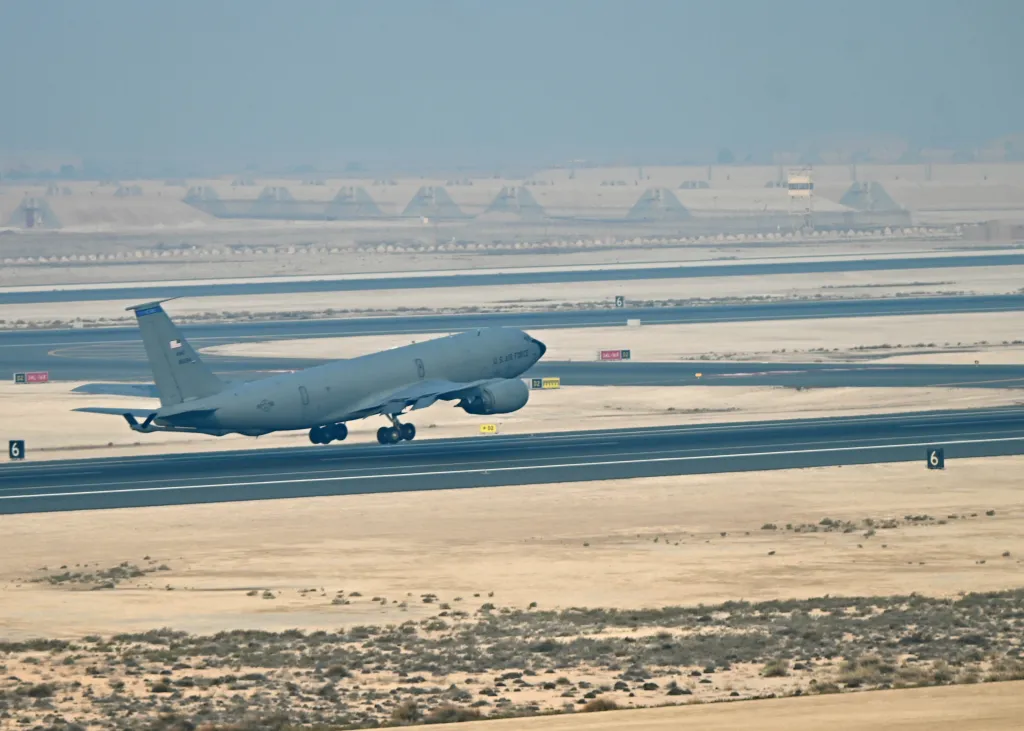
On Wednesday, U.S. Air Forces Central (AFCENT) put out a call for vendors who are able to help bolster force protection at Al Udeid Air Base in Qatar, the largest American military installation in the Middle East. Like many other bases in the region, it has come under frequent attack from Iran. AFCENT is seeking information from companies able to plan and design “a hardened, underground, secure, Combat Center Building…and squadron operations buildings supporting a variety of airframe and missions to include, but not limited to, bombers, fighters, and unmanned aircraft systems for intelligence, surveillance, and reconnaissance (ISR).”
The sources sought solicitation, which could lead to a sole-source contract award, states that the plan may also seek construction of additional facilities, including administrative offices, command and control facilities, operational readiness and life support facilities for specialized personnel, elevators, and a parking garage. However, there is a long lead time for this project, even if it gets approved. A contract solicitation won’t be issued until April 2027, with the award anticipated in January 2028.
CENTCOM is looking for companies who can design a hardened, underground sheltered command center at Al Udeid. (U.S. Air Force photo by Senior Airman Sarah Williams) Senior Airman Sarah Williams
The underground shelter plan for Al Udeid is part of Strategic Master Plan 2040 (SMP2040), “a portfolio of over 170 Qatar-funded projects worth $10 billion that will be carried out from the first quarter of 2026 until 2040,” according to AFCENT. “Most of the projects are designed and will be constructed by Qatar with a few being U.S.-designed and constructed.”
It is unclear whether the new shelter project was spurred by current events, but a Feb. 3 AFCENT release on SMP2040 makes no mention of such structures. That fact that the plan will take years to come to fruition also raises questions about why it had not been unveiled sooner, given that Al Udeid has long been known to be a target of potential Iranian attacks. It is also not publicly known whether the proposed Combat Center Building at Al Udeid will replace or augment the current Combined Air Operations Center (CAOC) that serves as a command and control headquarters for U.S. and allied aircraft operating across the Middle East. We’ve reached out to AFCENT for clarification, but they deferred us to CENTCOM, which declined comment.
Attacks on and damage to Al Udeid from Iranian missiles can be seen below.
This satellite imagery is noteworthy. It appears to show at least two precise impact points on a large bunker used by U.S. forces at Al Udeid Air Base in Qatar 🇶🇦, located at 25°06’45.71″N 51°20’43.17″E.
In a more immediate request, CENTCOM is looking for vendors capable of providing “prefabricated, transportable, hardened shelter systems designed to protect personnel from blast and fragmentation threats,” according to a sources sought posting on Monday. “All proposed solutions must be deliverable to the Aqaba Air Cargo Terminal at King Hussein International Airport in Aqaba, Jordan.”
Unlike the Al Udeid plan, CENTCOM is looking for a quick turnaround on these shelters, asking that vendors submit “three potential delivery options reflecting estimated timelines of 3 days, 15 days, and 30 days.”
“Responses shall include a comprehensive description of the materials used in fabrication, including composition, structural design, and any reinforcement features,” according to the solicitation. “Vendors must also clearly identify the protection level of each proposed bunker, including the highest level of threat (e.g., blast force, fragmentation, or ballistic impact) the system is designed to withstand.”
The total quantity of these shelters is currently unknown and vendors are being asked to provide pricing structures “that reflect any available economies of scale.” The timeline for this project is unclear. Responses are due today, but there is no contract award deadline listed in the solicitation. CENTCOM declined our request for details, citing operational security concerns.
“Vendors are requested to submit three potential delivery options reflecting estimated timelines of 3 days, 15 days, and 30 days.”
“The USG’s review of documentation priorities are delivery timeline first, followed by protection level of the bunker systems.”
The most recent incident took place earlier this month when Barksdale Air Force Base in Louisiana experienced waves of drone incursions. The base is home of B-52 Stratofortress bombers and nuclear weapons storage facilities, and is a key part of the airborne leg of America’s nuclear triad.
I have spent a good part of my career just getting people to believe this was actually happening. Now we are here. With 15 drones, you can lose roughly 1/4 of the B-52 force as it sits idle on the ground. This was always the most concerning scenario. Time to move to hardening.… https://t.co/bBgE5taas9
One of the biggest concerns we have raised over the years is the lack of shelters at the massive and highly strategic Andersen Air Force Base on the island of Guam. The base, a key location for U.S. power projection in the Pacific, will be a prime target for Chinese long-range missiles in the event of a war.
Friday morning, retired Air Force Lt. Gen. David Deptula, now dean of the Mitchell Institute, concurred with our concerns about the lack of shelters and other hardened infrastructure.
“It absolutely has been needed and I made that case back when [Al Udeid] was being built,” Deptula told us. “But it’s all about money. That, along with not hardening aircraft shelters in Guam.
Deputla added that he tried to get hardened shelters built in Guam back when he was Director of Air and Space Operations for Pacific Air Forces more than 20 years ago.
“We were passed over due to other priorities at the time,” he explained.
As for the concept for hardened infrastructure at Al Udeid, Deptula said he was not aware of the plan, “but it is too little too late for this war.”
The reluctance about hardened shelters may be starting to change. Last year, the U.S. Army Corps of Engineers (USACE) announced anti-drone updates to the Modular Protective System-Overhead Cover (MPS-OHC). MPS-OHC was originally developed during the Global War on Terror era in response to indirect fire threats like artillery shells, rockets, and mortar rounds that U.S. forces were facing in Afghanistan and Iraq. The modular shelters, while still hardened, could provide a more temporary and cost-effective way to protect aircraft, other equipment and personnel from drones.
A Modular Protective System-Overhead Cover. (US Army Corps of Engineers)
Meanwhile, weeks before Epic Fury was launched, the Pentagon released new guidelines for hardening civilian and military facilities in the homeland from the growing threat from small drones that The War Zone has long warned about. These concerns have been spurred by years of incursions over U.S. bases and critical facilities and were hammered home by Ukraine’s 2025 near-field attack, dubbed Operation Spider Web, that wiped out a large number of Russia’s bombers with concealed arrays of drones stashed near airbases.
Epic Fury, of course, presents a different threat as U.S. bases get hit by ballistic missiles and large drones like Shahed-136s, in addition to first-person view (FPV) drones. Regardless, this conflict has once again highlighted the need to find better ways of protecting American troops and assets.