WHO needs to hop over to France for some wine tasting when the UK is home to some that is better?
Kent is often called the Garden of England, and is home to many award-winning wines.
Sign up for the Travel newsletter
Thank you!
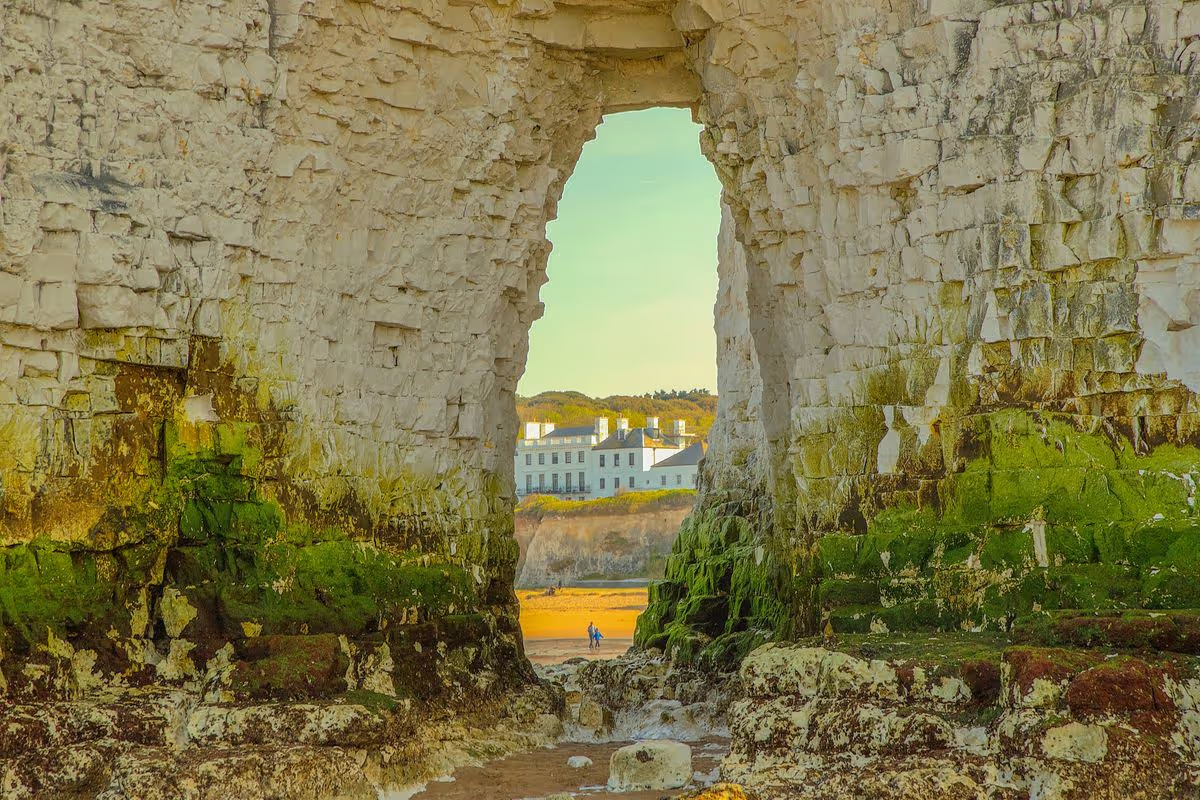
The Five Bells is the village’s only pubCredit: Booking.comBrabourne is often overlooked but has a great wine sceneCredit: TripAdvisorThe pub has a huge beer garden that opens in the summerCredit: Booking.com
This has seen the opening of vineyard massively increase in recent years, with big names including Chapel Down and Balfour.
However, a small village that has remained off the beaten track is Braebourne.
With no nearby train stations – it sits between Ashford International and Westenhanger – it is often overlooked.
Yet is is home to Braebourne Vineyard, which offers unique wines such as a Pinot Noir.
Liverpool’s L1 postcode has been crowned one of the UK’s coolest areas – from street art to buzzing nightlife, here’s what makes it special
I lived in one of the UK’s ‘coolest postcodes’(Image: Dave Porter / 500px via Getty Images)
Every year, cities, towns and villages from right across Britain battle it out to claim a spot on the coveted “cool” list. Experts assess everything from culinary offerings to community spirit and outdoor access before crowning the top 10 “coolest postcodes” spanning England, Wales, Scotland and Northern Ireland.
This year, the Times has championed Liverpool – specifically the L1 postcode, which I proudly called home for four years.
The publication dubbed it the ultimate destination for “modern-day mop tops” pointing to Hollywood A-listers Paul Mescal and Barry Keoghan, who’ve been soaking up the city’s atmosphere whilst shooting their Beatles biopic.
The Times wrote: “This L1 pocket neatly edges into the vibey Baltic Triangle, a historical area that’s now an engine room of converted warehouses, food markets and venues such as Camp and Furnace – which has hosted everyone from Mogwai to Martha Wainwright – as well as grassroots spaces like Arts Bar Baltic, a creative hub café-bar hybrid.”
Having lived slap-bang in the middle of the Baltic Triangle between 2018 and 2022, I can vouch for its magnetic pull.
Come the weekend, the area bursts into life as revellers from across Liverpool and beyond descend upon its buzzing bars, nightclubs, cafés and artistic haunts.
There’s never a dull moment – something exciting is always happening. The neighbourhood boasts four key attractions that are rapidly putting it on the map for visitors from beyond the city, reports the Express.
Street art
Every corner of the area showcases vibrant artwork that transforms urban spaces into living galleries. From tributes to the Beatles to the famous Liver bird wings, and an entire skatepark serving as a canvas for constantly evolving designs, the Baltic Triangle bursts with colour.
Visitors can stroll through what feels like an open-air exhibition of artistic expression.
Food
Hunger isn’t an option in Liverpool, particularly not in the Baltic Triangle. Central to the area is the Baltic Market, a sprawling food hall offering everything from burritos to pizza and Thai cuisine.
With vendors rotating regularly, there’s always something fresh to discover.
Nightlife
While the district buzzes during daylight hours, it truly comes alive after dark. Industrial warehouses transform into massive entertainment venues, hosting everything from DJ sets to live performances, and famously gave birth to Bongo’s Bingo.
There’s genuinely something to suit all tastes, whether it’s the Irish pub Punch Tarmey’s, Boxpark, Camp and Furnace, or neighbourhood brewery Love Lane.
Creativity
Simply passing through the Baltic Triangle can spark inspiration, thanks to the wealth of cultural happenings. The yearly Sound City music festival takes over its spaces, whilst Arts Bar Baltic regularly stages Books In Bars sessions where bibliophiles can find their next page-turner.
For those needing an energy boost, 92 Degrees Coffee and Ditto Coffee are available, alongside workspaces and conference facilities at Baltic Creative for productive sessions.
Liverpool Street station in London is set to undergo a huge transformationCredit: Network Rail Property and ACMEBut the upgrades could see up to 10 years of disruption for travellersCredit: Unknown
One architect who has opposed the plans said during a recent campaign meeting that the disruption could last for 10 years.
As part of the planning process, Network Rail has revealed the extent of disruption thatcommuterswould face despite the station remaining open during the works.
There would be an impact on some London Overground routes on Greater Anglia services including those from Chingford, Cheshunt and Enfield Town.
Documents reveal that platforms 1 and 2 which are used by London Overground trains would be closed for up to two years.
Proposals also suggest that later on, the area between platforms 9 and 10 would be needed for the building of a new upper concourse.
But Network Rail says these platforms as well as platforms 16 and 17 would remain open throughout the work.
Services could possibly face ‘thinning’ which is likely to result in overcrowding – particularly at rush hour.
The Stansted Express could possibly face disruption too.
Part of why Liverpool Street is so busy is due to the addition of the Elizabeth Line which was added in 2022.
However this would be unaffected by the construction to the main station.
Plans reveal a new office building above the main concourseCredit: Network Rail Property and ACMEOn top of the new building will be rooftop gardens
If the proposals go ahead, work would start at the beginning of 2029 and last seven years, with the new station completed by mid-2036.
Network Rail’s scheme is set to be considered by theCity of London Corporation’s planning committee on February 10, 2026.
Network Rail recently revealed a new fly-over video to show their proposed plans which has a large concourse area set to ease congestion during busy times.
It includes increased step-free access across rail and underground platforms, eight new lifts and more escalators which will increase from four to ten.
To reduce queues, additional ticket barriers would be added along with more toilet and family facilities on all levels.
On the upper concourse will be more cafes and food outlets and outside will be more green spaces.
Renders also show what the new office building that’s set to be built above the station concourse near the Grade II* listed Andaz Hotel will look like – with rooftop gardens.
Talking about the potential disruption, a spokesperson for Network Rail said to The Standard: “The scheme has been carefully designed and phased to ensure that the station remains open and operational during the works.
“There will be changes to entrances and routes and the only platform closure can be accommodated across the remaining platforms for that short period.
“We are engaging with our transport partners and ensuring customers can continue to use Liverpool Street with as little disruption as possible during the works is as important as the transformation for the future.”
United Kingdom Prime Minister Keir Starmer is on a three-day state visit to China as he seeks to deepen economic and security ties with the world’s second-largest economy after years of acrimonious relations.
This is the first trip by a UK prime minister to China since Theresa May met Chinese President Xi Jinping in 2018.
Recommended Stories
list of 4 itemsend of list
Here’s what you need to know about the trip aimed at mending ties at a time of global uncertainties:
What’s on Starmer’s agenda for China?
The UK PM met Xi and Chinese Premier Li Qiang in Beijing on Thursday. He will next head to Shanghai to meet British and Chinese business leaders, according to his official itinerary.
After their meeting on Thursday, Starmer and Xi called for a “comprehensive strategic partnership” between the two nations.
“China-UK relations experienced setbacks in previous years, which were not in the interests of either country,” Xi said. “In the current complex and ever-changing international situation … China and the UK need to strengthen dialogue and cooperation to maintain world peace and stability.”
In his opening remarks, Starmer told Xi the two nations should “work together on issues like climate change, global stability during challenging times”.
The prime minister is accompanied by a delegation of nearly 60 representatives of businesses and cultural organisations, including banking conglomerate HSBC, pharmaceutical giant GSK, carmaker Jaguar Land Rover and the UK’s National Theatre.
Starmer told Bloomberg there will be “significant opportunities” for UK businesses in China in an interview this week in the run-up to his trip.
His trip is also expected to mark a reset in UK-China relations, which have been strained in recent years. Starmer underlined his intentions during his meeting with Xi on Thursday.
“China is a vital player on the global stage, and it’s vital that we build a more sophisticated relationship where we can identify opportunities to collaborate, but of course, also allow a meaningful dialogue on areas where we disagree,” Starmer told Xi, according to the Reuters news agency.
British Prime Minister Keir Starmer, fourth right, and Chinese President Xi Jinping, fifth left, with their delegations participate in a bilateral meeting in Beijing on Thursday, January 29, 2026. [Carl Court/Pool Photo via AP Photo]
Why does the UK want to reset its relationship with China?
Starmer has framed his trip to China as a pragmatic move despite ongoing concerns back home about Beijing’s human rights record and potential national security threat.
“Like it or not, China matters for the UK,” Starmer said in advance of his trip to Beijing.
“As one of the world’s biggest economic players, a strategic and consistent relationship with them is firmly in our national interest. That does not mean turning a blind eye to the challenges they pose – but engaging even where we disagree,” he said.
China has rejected the allegations of human rights violations in parts of the country.
While few details have been released yet, Jing Gu, a political economist research fellow at the UK’s Institute of Development Studies, said reviving economic ties would require expanded “market access, predictable regulation and fair treatment of UK firms” alongside clear “guardrails”.
“This is not a question of being ‘pro-China’ or ‘anti-China’,” she said in a statement.
China offers a potential economic lifeline to the UK, whose economy has struggled in the decade since it embarked on its departure from the European Union in 2016.
A report by the nonpartisan National Bureau of Economic Research (NBER) in the United States estimated last year that Brexit reduced UK gross domestic product (GDP) by 6 to 8 percent, with the impact accumulating gradually over time. Investment is also down 12 to 18 percent, according to NBER estimates, and employment is down 3 to 4 percent.
The UK’s GDP is estimated to grow 1.4 percent in 2026, according to Goldman Sachs, as it faces new economic challenges from US President Donald Trump’s decisions and announcements.
The UK was not exempt from Trump’s tariff war despite its decades-long “special relationship” with the US. As a NATO member, the UK has also watched with alarm as Trump recently threatened to annex Greenland and impose up to 25 percent tariffs on any country that opposed him.
Starmer is not the only US ally looking to diversify economic ties. His trip to China follows in the footsteps of French President Emmanuel Macron, Australian Prime Minister Anthony Albanese, South Korean President Lee Jae Myung, Finnish Prime Minister Petteri Orpo and Canadian Prime Minister Mark Carney.
What strained the UK’s relationship with China?
The UK has longstanding concerns with China’s human rights record, but its relationship with Beijing took a turn for the worse after mass antigovernment protests swept Hong Kong, a former British colony, in 2019.
The UK was alarmed by the political crackdown that followed the 2019 protests and Beijing’s decision to impose legislation in 2020 that criminalised “secession, subversion, terrorist activities, and collusion with a foreign country or with external elements to endanger national security”.
In the aftermath, the UK opened a special immigration scheme for the citizens of Hong Kong born before the city’s 1997 return to Chinese sovereignty. British officials have continued to criticise Hong Kong’s national security trials, including the prosecution of pro-democracy businessman Jimmy Lai, who is a UK citizen.
Allegations of Chinese spying in the UK and China’s support for Russia in the Ukraine war have also frayed the ties.
Steve Tsang, director of the SOAS China Institute in London, told Al Jazeera that he did not expect any concessions in this area during Starmer’s visit. “Beijing will work to support Starmer to present the visit as a success, but it will not make any concession in areas that matter to China, such as human rights,” he said.
What about security concerns?
Concerns about Chinese spying have been a front-page issue in the UK over the past year, with the head of the domestic intelligence agency MI5 recently saying “Chinese state actors” pose a national security threat “every day”.
Despite these worries, Starmer’s government this month approved Beijing’s plan to open a “mega embassy” in London that critics say could become a hub for espionage in Europe.
The embassy’s approval also follows the collapse of a legal case against two British men charged with spying for China. The decision by prosecutors to withdraw charges at the eleventh hour remains highly controversial in the UK.
China has denied the spying claims, with its Ministry of Foreign Affairs calling them “unfounded” accusations.
Starmer’s trip, however, emphasised areas of potential security cooperation between China and the UK.
Following his meeting with Xi, the Prime Minister’s Office announced that law enforcement would cooperate with Chinese authorities to stem the flow of synthetic opioids into the UK and cut off the supply of small boat engines to criminal gangs.
Engine-powered boats are used to smuggle people across the English Channel, according to Starmer’s office.
The agreement will include “intelligence sharing to identify smugglers’ supply routes and direct engagement with Chinese manufacturers to prevent legitimate businesses being exploited by organised crime”, his office said.
British PM Keir Starmer’s China visit is the first by a UK leader in eight years and marks a thaw in frosty relations.
Published On 29 Jan 202629 Jan 2026
Share
The United Kingdom’s Prime Minister Keir Starmer has met with Chinese President Xi Jinping in Beijing in the first trip of its kind by a British leader in eight years.
Starmer said before his trip that doing business with China was the pragmatic choice and it was time for a “mature” relationship with the world’s second-largest economy.
Recommended Stories
list of 4 itemsend of list
“I have long been clear that the UK and China need a long-term, consistent and comprehensive strategic partnership,” Starmer said on Thursday.
During their meeting, Starmer told Xi that he hopes the two leaders can “identify opportunities to collaborate, but also allow a meaningful dialogue on areas where we disagree”.
Xi stressed the need for more “dialogue and cooperation” amid a “complex and intertwined” international situation.
The meeting between the two leaders in Beijing’s Great Hall of the People on Thursday was due to last about 40 minutes, and will be followed by another meeting between Starmer and Chinese Premier Li Qiang later in the day.
Starmer is in China for three days and is accompanied by a delegation representing nearly 50 UK businesses and cultural organisations, including HSBC, British Airways, AstraZeneca and GSK.
The last trip by a UK prime minister was in 2018, when Theresa May visited Beijing.
Strengthening economic and security cooperation was at the top of the agenda during the Xi-Starmer meeting, according to Al Jazeera correspondent Katrina Yu.
“[Starmer] has the very big task of bringing this diplomatic relationship out of years of deep freeze, so the focus when he talks to Xi Jinping will be finding areas of common ground,” Yu said from Beijing.
China was the UK’s fourth-largest trading partner in 2025, with bilateral trade worth $137bn, according to UK government data.
Starmer is seeking to deepen those ties with Xi despite criticism at home around China’s human rights record and its status as a potential national security threat.
Besides business dealings, Starmer and Xi are also expected to announce further cooperation in the area of law enforcement to reduce the trafficking of undocumented immigrants into the UK by criminal gangs.
Relations between the UK and China have been frosty since Beijing launched a political crackdown in Hong Kong, a former British colony, following months of antigovernment protests in 2019.
London has also criticised the prosecution in Hong Kong of the pro-democracy media tycoon Jimmy Lai, who is also a British citizen, on national security charges.
Starmer’s trip to China comes as both Beijing and London’s relationship with the United States is under strain from President Donald Trump’s tariff war.
Trump’s recent threats to annex Greenland have also raised alarm among NATO members, including the UK.
ONE of the UK’s original Victorian seaside towns is set to get even more beautiful – thanks to a multi-million pound train station renovation.
Scarborough Train Station has revealed new images of the £14million upgrade which is set to be completed by March.
Sign up for the Travel newsletter
Thank you!
Work started on upgrading Scarborough train station in 2025Credit: UnknownThe work is set to complete on March 31, 2026Credit: Unknown
Repairs have been underway at the station in the popular seaside town at the cost of £14million.
The project includes a new station roof, drainage system as well as the restoration of the stonework and general preservation of the Grade II-listed building.
Still yet to be finished is the waiting room and ticket office which will also be refurbished.
The changes made are set to ‘enhance passenger experience’ at the station – which has remained open during the works.
One of the most recognisable parts of Scarborough Station is the clock tower which is being restored thanks to a grant of £203,000 from the Railway Heritage Trust.
Ann Shannon, scheme project manager for Network Rail, said: “We’ve been able to repair all four clock faces, fully refurbish the tower and finials, and upgrade the uplighting.
“The finish line is now in sight, and visitors will see a real difference both inside and outside the station, with the beautifully restored clocktower providing the crowning glory.”
Trains from Scarborough generally call at Sheffield and York.
This saw an increase of tourists visiting the town and the addition of bathing ‘machines’ – for people to change intoswimwearwhich arrived in 1735.
With a rising number of holidaymakers, it opened a train station in 1845 to connect Scarborough to York.
Scarborough is well-known for being an incredibly popular destination for families heading to the seaside in the summertime.
The town has two beaches, North Bay Beach and South Bay Beach, and has been welcoming holidaymakers to its shores for over 400 years.
North Bay is the quieter spot along the coast, while South Bay is where you’ll find amusement arcades, cafes and a busy harbour.
Work is still ongoing to restore the clock towerCredit: Network RailThe roof on Scarborough’s train station has been fully repairedCredit: Network Rail
Other seafront attractions include the miniature railway called North Bay Railway, Scarborough Open Air Theatre and Scarborough Sea Life Centre.
The Grand Hotel in Scarborough is one of the seaside town’s most recognisable buildings and sits high above the promenade.
The building was completed in 1867 and at the time was the largest hotel in Europe – and one of the largest in the world.
Despite visiting this city numerous times, I’ve never managed to navigate my way without getting lost – from confusing roads and tram lines to the maze-like train station
This city is my nemesis when it comes to navigating my way around(Image: Getty Images)
With the aid of my phone maps and clear road signs, you’d think I’d be able to comfortably navigate myself around a UK city that I’ve visited countless times. But no matter how many times I drive and walk around Birmingham, I always end up confused and lost, and my recent visit was no different.
As a convenient halfway point to meet my family or friends, and with its Utilita Arena for concerts, I’ve visited the UK’s second-largest city on a number of occasions. I’ve driven into it multiple times, but I’m always left permanently scarred. I mean, have you seen Spaghetti Junction?
I should note that I’m a competent driver and often travel long distances, but driving into Birmingham is no mean feat. I’ve found myself driving back on myself, taking the wrong turning, hitting a dead end, encountering unexpected roadworks, and constantly circling roundabouts – even with the help of Google Maps!
The worst panic of all came when I was driving through the city a few years ago and found myself, alarmingly, driving down the same road as a tram line. My maps had led me in this direction, so I followed, yet the anxiety set in as I saw the tramlines, expecting the trolly-car to come hurtling up into me.
I continued to follow the road with nowhere else to turn, before I thankfully came back to a normal road. Little did I know that this could happen in some areas of Birmingham, as the West Midlands Metro shares some parts of the street with cars.
West Midlands Metro warns of the potential danger. “Please don’t obstruct the tramway – it sounds obvious, but remember we are on fixed rails and can’t get around you,” it pleads.
“Wherever possible, avoid driving directly on the tracks, particularly at speed, because they can become slippery, especially when wet. Please pay attention to highway regulations and remember that trams have different signalling systems to those of cars and other vehicles – even when we are using the same stretch of road.”
Those caught in restricted areas of tram roads could be fined. But it can be confusing for visitors. One resident shared on Facebook: “There are certain parts of the network where you can’t avoid sharing with the trams, Beeston/Chilwell springs to mind, but there are others.”
Another added: “Depends where in the city. There are places where you can drive in the tracks and places where you can’t, normally places where you can’t, you will get stuck.”
Personally, for me, it’s a route I won’t risk again.
Birmingham is sometimes known as the ‘workshop of the world’, thanks to its historical transformation from a medieval market town into a major ‘motor city’. The city prioritised cars as the future of transport, introducing inner ring roads, flyovers, and interchanges to welcome more people into the area and facilitate easier travel.
Yet for me, I vowed never to drive in the city again. And it’s not just me who has failed to navigate the impressive yet complicated roads of Birmingham, including its residents.
One person shared on Facebook: “A lot of drivers in Birmingham are confused by red lights, give way, traffic priority, roundabouts, timed bus lanes, and lane closures.”
Another shared: “I haven’t driven in Birmingham city centre for years now, it’s been confusing for a long time now not just recently.” A third also confessed: “I don’t ever drive in town. Either I would be heading to Scotland or a dead-end street due to getting lost because of the changes.”
From my driving experiences, it meant my recent trip to Birmingham was by train. I wrongly thought it would be the easier option. I boarded the overcrowded, stuffy but thankfully direct train to Birmingham on a Saturday morning, and was relieved to be dodging the traffic and avoid the fear of navigating the roads. But I still found myself lost.
Birmingham New Street Station is large, stretching out across 12 platforms, yet what confused me was the different zones. While they’re clearly labelled and colour-coded for the different platforms, I still found myself lost and confused with various directions and barriers to navigate. Plus, finding the exit was another ordeal for me.
Locating a toilet at the station was even more complicated. I followed the signs, but still had to go back through a barrier with my train ticket. And meeting people at the station is a challenge in itself, requiring me to go through yet another barrier to reach my family, who were in a completely different area.
I must have spent a good 20 minutes wandering around the station, trying to get my bearings and failing miserably. But to my defence, I’ve only boarded the train to Birmingham on a handful of occasions, and it sure beats the roads and extortionate car parking prices.
Only adding to the complications of visiting Birmingham is navigating the roads and paths on foot. In a bid to find my hotel, I turned to my trusty phone maps and followed the route, but I mistakenly risked a shortcut, only to find a boarded-up path and roadworks – Birmingham really doesn’t like shortcuts.
I also encountered a long-winded route to get to dinner that evening, and then on my way back to the station, I was taken through a pedestrian underpass under a roundabout, which was equally confusing. Perhaps my maps were just as confused as I, or maybe it was simply user error.
Whatever the reason, travelling around Birmingham has left me defeated. While it’s a fantastic city with brilliant transport links and a catalogue of restaurants, bars, entertainment venues, and a vibrant nightlife, I have to build up the momentum with every visit, bracing myself for getting lost in the well-connected yet confusing city.
Do you have a travel story to share? Email webtravel@reachplc.com
THERE’S nothing worse than seeing the word ‘cancelled’ appear whilst waiting for a flight.
If you live in fear of a flight being cancelled last minute these UK airports saw the highest cancellation rate of 2025 – and Southampton Airport was at the very top.
Sign up for the Travel newsletter
Thank you!
Southampton Airport saw the most cancellations in 2025Credit: AlamyA report found that three per cent of its flights were cancelled in 2025Credit: Alamy
The regional airport in the south of England recorded the highest cancellation rate of all major UK airports last year, according to AirAdvisor.
AirAdvisoranalysed Civil Aviation Authrity (AA) data across 20 of the busiest UK airports to figure out whichis the least reliable.
For the second year in a row, Southampton Airport experienced the highest amount of flight cancellations.
The report found that three per cent of its flights were cancelled in 2025.
Although, this is an improvement on 2024 when 3.3 per cent of services were grounded.
Data revealed that Southampton Airport had almost three times as many flight cancellations as the national average – which is 1.09 per cent.
A spokesperson for Southampton Airport told Sun Travel: “An airline’s decision to reluctantly cancel a flight can be due to a number of factors including weather issues, air traffic congestion, delayed arrivals or technical issues with aircraft.
“We will continue to work with our airline partners and their handling agents to support them in their operations.”
From Southampton Airport passengers can fly to Europe and within the UKCredit: Alamy
Just below Southampton Airport was Aberdeen Airport which had 1.6 per cent of its flights cancelled last year.
The UK’s busiest airport, London Heathrow also “exceeded the national average for cancellations” according to AirAdvisor.
Between January and November 2025, 1.4 per cent of flights at Heathrow were cancelled.
At the other end, Bournemouth Airport recorded the lowest cancellation rate of any major UK airport.
Between January and October 2026, it saw just 0.17 per cent of its scheduled services cancelled.
Other airports that performed well last year included Luton, Stansted, East Midlands International, Bristol and Belfast International, where cancellations were less than half the national average.
Anton Radchenko, CEO of AirAdvisor, said: “Air passengers in the UK can breathe a sigh of relief as we head into 2026, with most trend data suggesting that flight cancellation rates at British airports are decreasing.”
WATCHING sport in the pub, like queuing and putting the kettle on, is one of Britain’s great national pastimes.
And unless you’re going to the stadium, there’s no better place to catch the big match than down your local.
Sign up for the Travel newsletter
Thank you!
From stadium seat gardens to TVS in toilets – some pubs are for the ultimate sports fansCredit: Thinking Drinkers
While loads of locals simply put the telly on in the corner, there are those venues who go that extra yard to make the big match experience a truly memorable one.
As The Thinking Drinkers – professional pub-goers and huge sports fans – we’ve picked the best sports pubs and bars across Britain.
Ranging from sizeable city centre sports outfits to historic pubs, quirky boozers and lovely locals – here’s where to go that even if you don’t like sport, you’ll have a good time.
Let’s find out who made the starting line-up in the Thinking Drinkers Sports Pub XI.
This London pub is rightly famous among fans of everything from football and rugby to ice hockey, Gridiron and even handball.
Boasting 39 HD TV’s, access to hundreds of sports channels and an awesome audio setup with the ability to ‘zone’ sound and commentary of up to 6 games at once, it’s no surprise that it has won numerous industry awards.
The King Street Brew House, Cambridge
This recently refurbished brewpub serves up loads of live sport alongside some decent drinks, including its own freshly brewed beers, and a cracking menu (including a curried lamb croissant).
If you’re in Cambridge, it’s certainly worth a punt.
Most read in Best of British
Ye Olde King & Queen, Brighton
Situated a short stroll from the seafront, this vast grade-II listed Mock Tudor castle of sport is like being in the Traitors.
A huge protector screen dominates the main bar with TVs scattered everywhere showing all domestic and European footy action.
Close to Turf Moor, home of Burnley FC, this now legendary local has become a football institution since renaming itself after ex-manager Sean Dyche who, back in 2018, secured European qualification.
It’s got stadium-seating in the garden, plenty of screens and there’s ‘claret’ everywhere (not blood or Bordeaux but Burnley FC memorabilia).
They also serve Benedictine – a French herbal liqueur loved by locals since it was famously drunk by soldiers of the East Lancashire Regiment during World War One.
Perhaps not the best pub for Preston fans.
The Royal Dyche has the best pub gardenCredit: Thinking DrinkersThey also serve Benedictine – a French herbal liqueur loved by localsCredit: 2FNWMEY Burnley Fan’s at The Royal Dyche pub ahead of Premier League match at Turf Moor, Burnley. Picture date: Wednesday May 19, 2021.
Brotherhood of Pursuits and Pastimes, Leeds
Like Dominic Calvert-Lewin, this illustrious Leeds city centre sports bar is a stylish looking fellow.
Quality cocktails, fantastic food and a great 4K screen set-up and surround sound audio.
There’s not a single spot where you can’t clearly see and hear the action and, in the event of a sporting clash, they’ll dedicate areas of the bar to the different events.
The Murderers, Norwich
One of Norwich’s oldest locals, and named after notorious murder of a former landlord’s daughter back in 1895, this makes for a great cosy pub to watch the game.
But thankfully, when there’s a big game on, that doesn’t dampen the lively match day atmosphere – enhanced by a well-kept range of real ales and numerous screens skilfully snuck into all the pub’s snugs, nooks and crannies.
The Box, Manchester
With 35 top-of-the-range tellies this Deansgate venue doesn’t just have football but cricket, Gridiron, rugby, boxing and F1.
Fairweather fans can occupy themselves with some shuffleboardor some ‘bandeoke’ – karaoke with a live backing band on stage.
The food’s good, there’s brewery fresh Budweiser Budvar on tap and two-pint Steins to swig.
You won’t be short of TVs at some of these pubsCredit: Thinking Drinkers
Bloodsports, Central London
This down-to-earth dark, dimly lit dive bar and late-night hang-out has 30 screens showing a combination of live sports and horror flicks.
Open till 2am every night, it boasts Britain’s best ‘Bloody’ Mary menu, proper burgers and there’s even an Alfred Hitchcock’s Pyscho photo booth.
Golaccio, Huddersfield
If Luciano Pavarotti belting out ‘Nessun Dorma’ brings a tear to your eye or you spent much of the 1990s watching Serie A on Channel Four, then get yourself down to this retro love letter to the golden age of Italian footy.
Draped in old-school football shirts, scarves and posters from iconic Italian clubs, there are four large screens and a pull-down projector, banging Italian-inspired burgers and regular football quizzes.
Ye Olde Golf Tavern, Edinburgh
This awesome Edinburgh boozer is perched on the edge of one of the oldest golf courses in the world, dating back to 1456.
So, when the final whistle blows on one of the bar’s many screens, you can hire a couple of clubs for a few quid and tackle 18-holes of pitch’n’putt.
Ludo Bar, Cardiff
This ‘tidy’ temple of televised sport only opened last October but it has already established a strong following among sports fans of all persuasions.
Grab a beer from a very respectable range of local breweries before sliding into a booth to watch your chosen match on request.
Or, alternatively, bask in the glow of the UK’s largest ultra high definition screen in the garden – complete with a retractable roof.
There are even TVs in the toilets, which you won’t miss a moment of the game.
Ben McFarland & Tom Sandham, The Thinking Drinkers, recently rode a tandem bike from Land’s End to John O’Groats to ‘help save the British pub’. Watch the “Great British Pub Ride” on their YouTube Channel here.
Ye Olde King & Queen in Brighton looks more like a castleCredit: Alamy
Thanet Council called the news “disappointing” for the park which has undergone a major revamp in the past decade.
In a statement, the theme park said: “The Scenic Railway has completed its journey as a roller coaster and will now take well-earned retirement from operation as a ride.
“This is not the end but a new beginning.
“We are committed to developing a new long-term vision that will not only showcase this remarkable Grade II listed structure, but reimagine its purpose so it can continue to be enjoyed by future generations in a fresh and meaningful way.
“This summer we will be hosting a pop-up exhibit celebrating the history of The Scenic Railway.
“In the longer term, it will be re-invented for people to enjoy in a different way.”
The ride has certainly had a difficult history, being destroyed by a fire in both 1948 and 2008.
Another fire in 2014 also broke out on the ride although this caused less damage.
As someone who used to live in Margate, visiting the theme park was always one of my favourite things to do.
Free to visit, it means you can just wander around and take in the atmosphere without paying a penny.
The iconic rollercoaster was forced to close back in 2024Credit: Alamy
But the thrill of the Scenic Railway – which still had a rather terrifying manual brake operated by a person – still beats other rollercoasters in my eyes.
Where else can you be thrown about a rickety track, with a few life-fearing drops before coming up to views of the ocean?
Thankfully there are other rides at the theme park that will still be open this summer.
This includes the Pirate Ship, Big Wheel and Rock ‘N Rollercoaster.
The UK’s best gastropub has been crowned, beating off competition from thousands of venues. It’s a spot that’s much loved-by celebrities and famous for pouring the best Guinness in the country
12:34, 27 Jan 2026Updated 13:16, 27 Jan 2026
This classic British pub has become iconic in the capital(Image: Mike Kemp/In Pictures via Getty Images)
The top gastropubs across the UK have been named, and the winner is a spot that has been enjoyed by many celebrities and was praised for its “premium quality, homemade food, focusing on the best of British produce”.
The Devonshire in Soho, which prides itself on offering a warm and welcoming vibe and has the style of a traditional British pub, took the number one spot in the new ranking. The venue sits on one of the lively neighbourhood’s narrow streets, amongst theatres, restaurants, and busy shops.
Downstairs is a wood-panelled bar which looks a lot like many of the historic pubs found in this part of the capital. Tourists and Londoners just finishing work crowd around the bar, often spilling out onto the street on sunny days, giving the pub a friendly, lively atmosphere.
What sets The Devonshire apart from other pubs in the area is its claim to serve the “perfect pint of Guinness”, with bar staff obsessed about getting the perfect pour. Its bar snack menu offers the chance to try the cuisine on offer, and includes snacks such as sausage on a stick, scotch eggs, and chips, among other British favourites.
Upstairs, the restaurant has a more upmarket vibe, and the handwritten menus feature seasonal specials and local ingredients. With an on-site butcher and baker on the team, you can be assured that everything is fresh and local. Highlights include Scottish beef, which is dry-aged and butchered on-site, and seafood from Devon, including lobsters and hand-dived scallops.
The Devonshire has gained a number of celebrity fans in recent years. Last summer, A-listers including Margot Robbie, Jon Bon Jovi, and Ed Sheeran were spotted among its diners. Yungblud and Florence Pugh even surprised punters by taking on duties behind the bar and having a go at pulling pints.
In second place was The Unruly Pig in Woodbridge, which, by contrast, sits among the Suffolk countryside. This 16th-century inn has a traditional pub vibe with wooden beams and a roaring fireplace, but adds a contemporary twist with colourful modern artworks on the walls.
The menu is a fusion of British and Italian cuisine, which they’ve dubbed ‘Britalian’, and uses fresh ingredients that are sourced locally whenever possible. In the bar, there’s a wide selection of craft beers as well as over 60 choices of wine and fizz to accompany your meal.
The menu changes monthly, and in addition to its a la carte selection, the restaurant offers a three-course lunch menu for £35pp, with a choice of three dishes per course. It also offers a popular Sunday lunch, where you can opt for a sharing roast platter for two or dishes such as iberico pork and parmesan gnocchi.
Another London venue, The Red Lion & Sun, came in third on the list. The pub, set in leafy Highgate Village, has two beer gardens that are incredibly popular in the summer. And in fourth place was The Woolpack Inn, set in the quaint Cotswolds village of Slad, which offers real ales and hearty cuisine.
Full list of top 100 gastropubs in the UK
The Devonshire, Soho, London
The Unruly Pig, Woodbridge, Suffolk
The Red Lion & Sun, Highgate, London
The Woolpack Inn, Slad, Gloucestershire
The Star Inn, Harome, York
The Angel at Hetton, Hetton, North Yorkshire
Parkers Arms, Clitheroe Lancashire
The Rat Inn, Anick, Northumberland
The Rum Fox, Clitheroe, Lancashire
The Cornish Arms, Tavistock, Devon
Canton Arms, Stockwell, London
The Dog at Wingham, Wingham, Kent
The Abbey Inn, Byland, North Yorkshire
The Three Horseshoes, Batcombe, Somerset
The Broad Chare, Newcastle
The Gunton Arms, Thorpe Market, Norfolk
The Baring, Islington, London
The Merry Harriers, Hambledon, Surrey
The Fordwich Arms, Canterbury, Kent
The Bell, Langford, Oxfordshire
The Kentish Hare, Tunbridge Wells, Kent
The Crown, Burchetts Green, Berkshire
The Marksman, Hackney, London
The Hero, Maida Vale, London
The Kerfield Arms, Camberwell, London
The Sportsman, Seasalter, Kent
The Mariners, Rock, Cornwall
The Bull, Charlbury, Oxfordshire
The Coach, Marlow, Buckinghamshire
The Highland Laddie, Leeds
The Pipe and Glass Inn, South Dalton, East Yorkshire
The Silver Cup, Harpenden, Hertfordshire
The Waterman’s Arms, Barnes, London
Heft, High Newton, Cumbria
The Tamil Crown, Islington, London
Harwood Arms, Fulham, London
The Killingworth Castle, Woodstock, Oxfordshire
The Gurnard’s Head, St Ives, Cornwall
The Bull & Last, Highgate, London
The Kinneuchar Inn, Leven, Fife
The Tartan Fox, Newquay, Cornwall
The Queen of Cups, Glastonbury, Somerset
The Knave of Clubs, Shoreditch, London
The Mason’s Arms, Bampton, Oxfordshire
The Wild Rabbit, Kingham, Oxfordshire
The Black Bear Inn, Bettws Newydd, Monmouthshire
The French House, Soho, London
The Loch & The Tyne by Adam Handling, Old Windsor, Berkshire
The Shibden Mill Inn, Halifax West Yorkshire
The White Horse, Chester, Cheshire
The White Swan at Fence, Fence, Lancashire
The Cross at Kenilworth, Kenilworth
The Castle Inn, Castle Combe, Chippenham
The George, Kempsford, Fairford
The Hoop, Stock, Essex
The Scran and Scallie, Edinburgh
The Black Bull, Sedbergh, Cumbria
The Edinburgh Castle, Manchester
The Bull’s Head, Craswall, Herefordshire
The Camberwell Arms, Camberwell, London
The Parakeet, Kentish Town, London
The Boat, Lichfield
The Longs Arms, South Wraxall, Wiltshire
The Anchor and Hope, Southwark, London
The Pelican, Notting Hill, London
The Pack Horse, Hayfield, Derbyshire
The Drapers Arms, Islington, London
The Hand and Flowers, Marlow, Buckinghamshire
St Kew Inn, Bodmin
The Three Fishes, Mitton, Lancashire
The Bull Inn, Totnes
The Clarence, Glasgow
The Dog & Gun Inn, Skelton, Cumbria
Heathcock, Cardiff
The Fat Badger, Notting Hill, London
The Chagford Inn, Chagford
The Eagle, Farringdon, London
The Clarence Tavern, Stoke Newington, north-east London
The Five Elms, Weedon Aylesbury, Bucks
The Horseguards Inn, Tiilington, Petworth, West Sussex
The Oarsman, Marlow
The Two Pigs, Barton under Needwood, Burton on Trent
The Lady Mildmay, Newington Green, north-east London
The Royal Oak, Witney, Oxfordshire
The White Hart, Lydgate, Oldham
WildMoor Oak, Bromsgrove
The Double Red Duke, Clanfield, Oxfordshire
The Blue Stoops, Kensington, London
The Crown at Bray, Bray, Maidenhead
The Bucks Head, Sevenoaks, Kent
The Parlour, Kensal Rise, London
The Dog and Pickle, Essex
The Burleigh Arms, Cambridge
The Charlton Arms, Ludlow
The Suffield Arms, Gunton
The Hare & Hounds, Vale of Glamorgan
The Sun, Felmersham, Bedford
Pyne Arms, Barnstaple
The Standard Inn, Portscatho, Cornwall
The Swan, Bampton
Have a story you want to share? Email us at webtravel@reachplc.com
Only a few parts of this long-forgotten railway line remain standing, but it once carried up to 2,000 people a year on their final journeys along with their mourning loved ones clad in black
Brockwood Cemetery still has a few remaining sections of track where the London Necropolis Railway ran(Image: Surrey Advertiser – Grahame Larter)
The Victorians have a reputation for dealing with death in strange ways, from photographing the dead to their obsession with Memento Mori objects, reminding them of the inevitability of death. But one almost forgotten part of Victorian history is particularly creepy and involves a long-abandoned railway line.
Early into Queen Victoria’s reign, the city faced a horrific problem. It had doubled in size thanks to the Industrial Revolution, bringing the population up to 2.5 million, many of whom lived in crowded, unsanitary conditions, causing outbreaks of conditions such as Cholera. London was the largest city in the world, but it also had insufficient sewage facilities and poor water quality, leading to disease and death. A Londoner born in the 1840s had an average life expectancy of just 36.7 years.
London’s churches soon found their graveyards were full to capacity, leading to the horrific practice of exhuming the recently deceased to make way for newer burials. As a solution, a huge new cemetery was planned in Brookwood, Surrey, but the plodding horse and carriages of the time would have taken hours to transport a body to this location. Therefore, the idea for the London Necropolis railway was formed.
The London Necropolis railway station was built next to Waterloo, and had a beautiful, ornate exterior typical of Victorian architecture. Here, the bodies of people of all ages and social classes were readied for their final 23-mile journey to the new Brookwood Cemetery in leafy Surrey, a world away from the grubby streets of London.
Coffins were issued a one-way ticket, while the mourners accompanying them would get a return ticket to take them back into the city after the service. Once the trains arrived in Brookwood, they made two stops in the Anglican and Nonconformist parts of the cemetery, depending on the religion of the deceased.
While all sorts of people were laid to rest in Brookwood, the rich, of course, enjoyed a better class of funeral than the Victorian poor. A first-class funeral came with a choice of burial plots and the ability to erect a permanent memorial. Those who chose a second-class funeral could put up a gravestone or other memorial for an additional cost, but if they failed to do so, the grave could end up being reused.
In third class were people who had a pauper’s funeral, paid for by their local parish. While these people weren’t given their own gravestone, they did get separate graves, which were much more dignified than the horrific burial practices going on at London’s graveyards at the time. The London Necropolis Company (LNC) carried out the burials, and about 80% of the funerals it held were third class, for those whose families couldn’t afford a service.
First and second class passengers had a separate waiting area, and their loved ones’ names were announced as their coffins were carried onto the train, a ceremonial touch not afforded to those headed to unmarked graves.
As London grew, and with the building of the London Underground, proper sewage systems, and overground railways, many churchyards stood in the way. The Necropolis Railway took on a huge new project, relocating the bodies from 21 churchyards across the city to the Surrey cemetery
Trains ran daily, and Sundays were a particularly busy day for funerals. It was the only day of the week when many workers had off, and by scheduling their loved ones’ funerals, they could avoid taking an extra day off.
The London Necropolis Railway ran until 1941, when a World War Two bomb destroyed the London station and track. By that point, funeral directors were increasingly using motorised hearses, and in the post-WW2 reconstruction of the city, the destroyed funeral train service wasn’t seen as a priority.
Visit Westminster Bridge House and you can still see some of the façade of the old station building, although the old sign is boarded up. However, in Brookwood Cemetery, the remains of this unusual chapter of history are still on display. You can still see parts of the track, and plaques commemorate the 200,000 people who reached their final resting place on this unique train line.
Have a story you want to share? Email us at webtravel@reachplc.com