A Russian strike on a market in Nikopol, Ukraine, killed five people and injured at least 19 others. Photo courtesy Ukraine’s prosecutor’s office
April 4 (UPI) — A Russian drone attack on a market in Nikopol, Ukraine, killed five people and injured at least 19 others Saturday, local officials said.
The strike hit the town in southeastern Ukraine, just across the Dnipro river from Ukrainian land now occupied by Russia, the BBC reported. Nikopol faces regular attacks from Russia due to its proximity.
Oleksandr Hanzha, the head of the regional military administration, said there were three women and two men among the dead. The injured included a 14-year-old girl, Sky News reported.
The nearby city of Sumy was also targeted by strikes overnight, with 11 people injured, the national police said. Among the damaged buildings were residential areas and utility networks.
The country’s State Emergency Service also reported strikes at a three-story office building in Kyiv, causing a fire on the first floor.
All told, the Ukrainian military said it down 260 of the 286 drone strikes launched toward its airspace overnight.
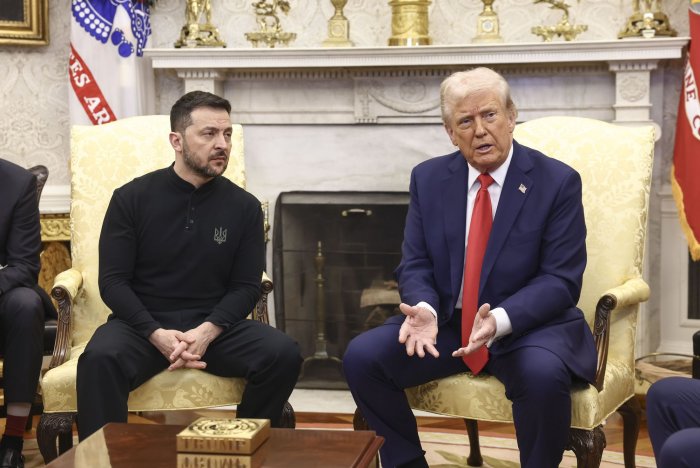
President Donald Trump meets with Ukrainian President Volodymyr Zelensky inside the Oval Office of the White House in Washington on February 28, 2025. Photo by Jim Lo Scalzo/UPI | License Photo
Ukrainian President Zelenskyy says Moscow and Tehran are ‘brothers in hatred’; claims Iran’s drones ‘contain Russian components’.
More than 200 Ukrainian military experts are in the Gulf region and wider Middle East helping governments in their defence against Iran’s drone attacks, Ukraine’s President Volodymyr Zelenskyy has said.
In an address to dozens of members of the United Kingdom Parliament in London on Tuesday, the Ukrainian leader said 201 Ukrainian anti-drone experts are in the region and another 34 “are ready to deploy”.
Recommended Stories
list of 4 itemsend of list
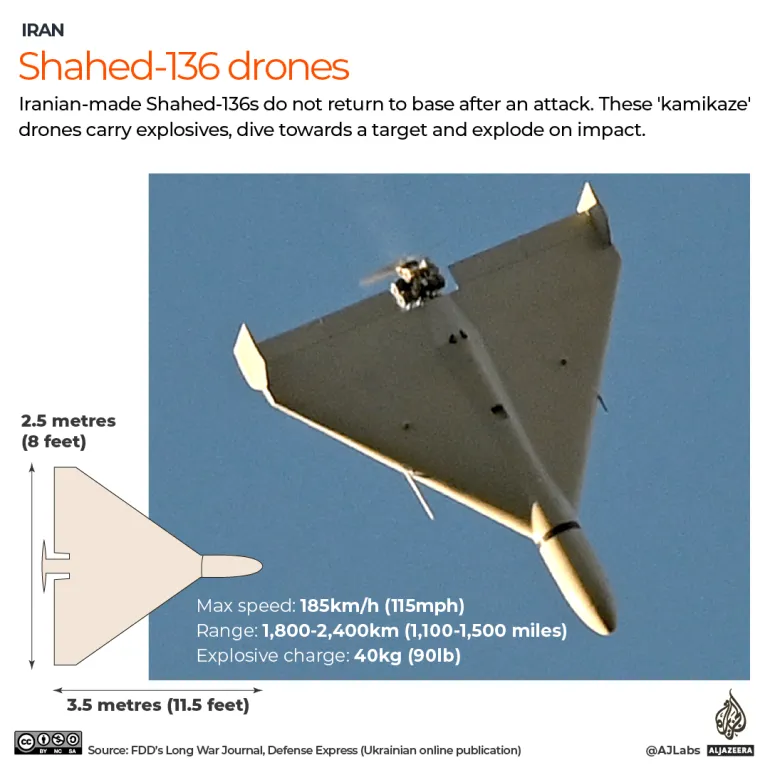
“These are military experts, experts who know how to help, how to defend against Shahed drones,” Zelenskyy said in his speech, referring to the Iranian-designed “kamikaze” drones that Russia has been using in its war against Ukraine since 2022.
“Our teams are already in the Emirates, Qatar, Saudi Arabia, and on the way to Kuwait,” the Ukrainian leader said.
“We are working with several other countries – agreements are already in place. We do not want this terror of the Iranian regime against its neighbours to succeed,” he said.
Last week, the Ukrainian leader said military teams had been sent to several Gulf states and Jordan.
Zelenskyy, who met with UK Prime Minister Keir Starmer and NATO chief Mark Rutte earlier on Tuesday, said Russia had received the Shahed-136 drones from the Iranians, who had “taught Russia how to launch them and gave it the technology to produce them”.
“Russia then upgraded them. And now we have clear evidence that Iranian Shaheds used in the region contain Russian components,” Zelenskyy said, describing the drones as designed for “low-cost destruction of expensive critical infrastructure”.
“So what is happening around Iran today is not a faraway war for us, because of the cooperation between Russia and Iran,” he said.
“The regimes in Russia and Iran are brothers in hatred, and that is why they are brothers in weapons. And we want regimes built on hatred to never win – in anything,” he added.
The Ukrainian leader then addressed his country’s newly developed prowess in drone warfare and manufacturing, claiming that 90 percent of Russian losses on the front lines in Ukraine are being “caused by our drones”.
Ukraine has moved on from making sea and aerial drones to producing interceptors that target drones, he said, adding that Ukraine is capable of producing at least 2,000 interceptors per day – half of which are required for its own defence and the remainder available for use by Kyiv’s allies.
“If a Shahed needs to be stopped in the Emirates – we can do it. If it needs to be stopped in Europe or the United Kingdom – we can do it. It is a matter of technology, investment, and cooperation,” he said.
While Ukraine has become one of the world’s leading producers of sophisticated, battlefield-proven drone interceptors, US President Donald Trump has said he does not need Ukraine’s help with countering Tehran’s drones targeting military targets in the Middle East.
After meeting with Zelenskyy at 10 Downing Street, Starmer said Russian President Vladimir Putin “can’t be the one who benefits from the conflict in Iran, whether that’s oil prices or the dropping of sanctions”.
During Zelenskyy’s visit on Tuesday, London and Kyiv signed a deal on a “defence partnership”, which is said to combine “Ukraine’s expertise and the UK’s industrial base to manufacture and supply drones and innovative capabilities”.
March 17 (UPI) — Speaking to the British Parliament on Monday, Ukrainian President Volodymyr Zelensky warned that the rise of artificial intelligence and inexpensive drone technology has made “mass drone warfare” quicker and more common across the globe.
“The evolution of threats never stops,” he said in a speech touting Ukraine‘s advances in technology allow the country to defend against and monitor attacks by Russia.
During his visit to Britain, Zelensky also met with King Charles III and Prime Minister Keir Starmer, with whom he agreed to a partnership to boost global defensive capabilities across Europe to protect against a rise in low-cost, high-tech military technology. The agreement capitalizes on Ukraine’s technological expertise and Britain’s industrial ability to manufacture and supply resources, the British government said.
Britain plans to invest $667,000 in an AI center in Kyiv.
Zelensky told Parliament that Ukraine faces nearly nightly attacks from Russia and uses nearly 1,000 interceptor drones each day to protect the country. He said Ukraine can produce interceptors on that scale, but the country needs a system in place to stop the attacks by Russia and Iran, which is using weaponry made from Russian supplies.
Zelensky pointed to the military bases in Cyprus as an example, The Guardian reported.
“This is what our security proposal could look like. Our experts would place interception teams and set up radars and acoustic coverage, and these would all work if Iran launched a large-scale attack similar to Russian attacks,” he told Parliament.
“We would guarantee protection. This is the kind of reinforcement we offer, and it may soon be needed across Europe.”
During their meeting at No. 10 Downing Street, Starmer told Zelensky that “the focus must remain on Ukraine” despite new conflict in Iran, the BBC reported.
Russian President Vladimir Putin “can’t be the one who benefits from a conflict in Iran, whether that’s oil prices or the dropping of sanctions.” He was referring to the United States’ recent easing of sanctions on Russian oil to combat rising gas and diesel prices.
Zelensky offered his thanks to Starmer for the support from Britain.
“You have stood with us all through this difficult winter,” Zelensky said.
Ukrainians march together through the streets of London to the Russian Embassy to mark the first anniversary of the Russian invasion of Ukraine on February 24, 2023. Photo by Hugo Philpott/UPI | License Photo
Weekly insights and analysis on the latest developments in military technology, strategy, and foreign policy.
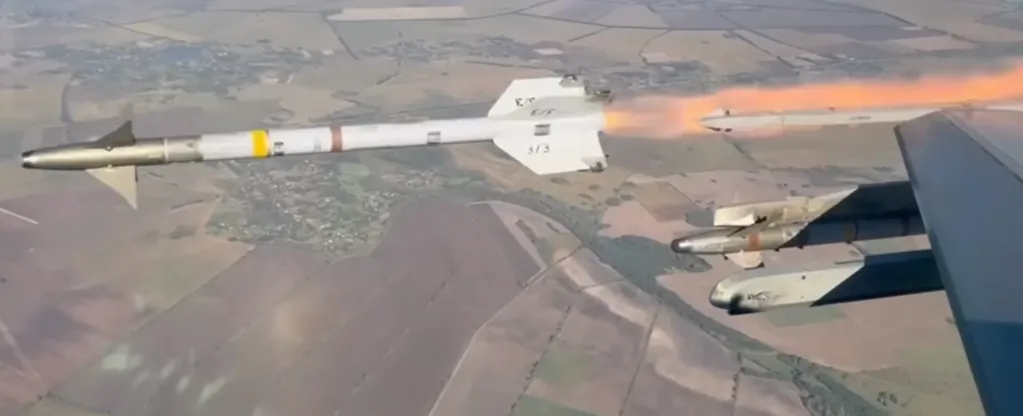
For more than three weeks, Ukraine was left with only “a handful” of U.S.-made AIM-9 Sidewinder air-to-air missiles for its F-16 fleet, after the supply of the weapons dried up. This is the conclusion of a Reuters report, citing three sources, all of whom are said to have direct knowledge of the situation. It also comes as Kyiv is increasingly in competition with the U.S. military and its Gulf allies as they come under continued pressure from Iranian drones and missiles in the Middle East.
A live AIM-9L/M launched from the wingtip rail of a Ukrainian F-16. Ukrainian Air Force screencap
The shortage of infrared-guided air-to-air missiles occurred between late November and mid-December of last year, the three sources said. This was a critical time, just before Russia began its winter campaign of bombardment against Ukrainian cities and infrastructure.
According to one of the sources, during the period when AIM-9s were in short supply, F-16 pilots were forced to fly daytime sorties and instead try to shoot down drones with their internal 20mm M61 Vulcan cannon. This is hardly ideal, since the Russian drone attacks normally come at night, but gunning down targets in the hours of darkness is judged too dangerous.
An armorer loads an F-16 with 20mm ammunition for its M61A1 cannon. Ukrainian Air Force screencap
🚨 BREAKING
🇺🇦 Video reportedly shows a Ukrainian Air Force F-16AM using its M61A1 Vulcan rotary cannon to shoot down a Russian Shahed-136 attack drone over Ukraine.
If confirmed, this would mark one of the first publicly seen gun kills by a Ukrainian F-16 against a Shahed… pic.twitter.com/ULIuDHcVyY
As we have discussed many times before, taking out slow-moving drones via another fixed-wing aircraft with guns can be very challenging and downright dangerous, especially for fast jets. There is also the risk of the grenade-like cannon rounds impacting the ground below over a relatively wide area, potentially killing innocent people. Doing it at night is a whole other level of danger.
Meanwhile, the situation was reportedly so desperate that pilots were flying F-16s loaded with missiles that had failed to launch on earlier missions, after these weapons had undergone another round of maintenance. This achieved mixed results, a source said.
So far, Ukrainian F-16s have been noted flying with older AIM-9L/M Sidewinders as well as the more modern AIM-9X Sidewinder infrared-guided air-to-air missiles.
Compared with the AIM-9L/M, the AIM-9X offers a more potent short-range air-to-air missile capability that can be used in conjunction with the F-16’s Joint Helmet Mounted Cueing System (JHMCS) for high off-boresight (HOBS) engagements. Even without JHMCS, the AIM-9X is a very valuable weapon that is particularly relevant for defending against drones and cruise missiles.
It’s worth noting, too, that Ukrainian F-16s use the radar-guided AIM-120 Advanced Medium-Range Air-to-Air Missile (AMRAAM). These can also be employed against drones and cruise missiles, but are more expensive weapons than the Sidewinders. Each AMRAAM costs around one million dollars, meaning they are not prioritized for use against drones.
Air-to-air with two F-16s. Both jets carry wingtip AMRAAM. Ukrainian Air Force screencap
According to the three sources, the Sidewinder shortfall was plugged in December when additional missiles were received from undisclosed partners. These reportedly arrived just in time to help defend against one of the largest Russian attacks of the winter.
A fourth source, also anonymous, told Reuters that Canada and Germany had supplied Kyiv with Sidewinders in recent months. Canada has confirmed it’s now delivering AIM-9M-8 missiles from Canadian Armed Forces stocks. “This new donation will complement the past donation of hundreds of Canadian AIM missiles and related components that are being used by Ukraine for its air defense,” Canada’s Department of National Defense said.
Interestingly, the timing of the apparent missile shortage also coincides with the appearance of another air-to-air weapon for the Ukrainian F-16.
In early December, TWZ reported on the appearance of laser-guided 70mm Advanced Precision Kill Weapon System II (APKWS II) rockets on Ukrainian F-16s. This was not an unexpected development, since these rockets would provide an extremely valuable, lower-cost option for engaging long-range kamikaze drones and subsonic cruise missiles. TWZ has been very closely tracking the evolution of the APKWS II in the air-to-air role, a capability U.S. Air Force F-16s began using in combat last year, as we were first to report.
What is believed to be the first known footage showing an F-16 fighter jet operated by the Ukrainian Air Force intercepting a Russian Shahed/Geran-type long-range OWA-UAV with the APKWS II low-cost, laser-guided anti-aircraft rockets.
Without a durable supply of Sidewinders, the APKWS II would have been an even more useful weapon for the Ukrainian Air Force, although there’s nothing to suggest, at this point, that the laser-guided rockets were hurried to Ukraine to make up for the AIM-9 shortfall.
It’s also not clear to what degree the reported Sidewinder shortage was connected with the new system by which the United States supplies Ukraine with weapons.
President Donald Trump introduced the Prioritized Ukraine Requirements List (PURL) system, replacing the direct military aid sent under the Biden administration.
Under PURL, weapons are sold by the United States to NATO allies, which then deliver them to Ukraine.
A tracked self-propelled Buk-M1 system — known in the West as SA-11 Gadfly — that has been adapted to fire the RIM-7 Sea Sparrow, a missile that previously provided point defense for numerous NATO and allied warships. Operational Command East
In the case of the AIM-9L/M and RIM-7, one likely factor in the shortages is the simple fact that these are older weapons, production of which has now ceased, meaning that there is only a finite number available. Surplus stocks have likely been whittled down to a point where remaining users are more cautious about giving them up. At the same time, the individual rounds are aging and also expiring.
Regardless of weapons supplies, the Ukrainian Air Force says it has made good use of its F-16s in the fight against Russian drones and cruise missiles.
As of the beginning of this year, the Ukrainian Air Force said its F-16s had destroyed “more than a thousand” aerial targets, including Shahed-type long-range one-way attack drones.
Ukrainian explosives experts and police officers examine parts of a Shahed-136 drone following an attack in Kharkiv on June 4, 2025. Photo by SERGEY BOBOK / AFP SERGEY BOBOK
The Ukrainian Air Force flew its first F-16 combat sorties against aerial targets in August of 2024.
According to one Ukrainian F-16 pilot, on one occasion, one of his squadrons destroyed six cruise missiles and seven attack drones in a single sortie. This is a remarkable tally, by any measure, and would have required extremely precise use of the gun, even if all available missiles were successfully expended.
На шляху до F-16: ексклюзивна історія від українського пілота
With Russia continuing to bombard Ukraine, any potential holdup in the delivery of critical air-defense effectors is a significant problem. Since the start of Russia’s full-scale invasion, Ukraine has been desperately seeking additional air defense assets, particularly those of Western manufacture.
Currently, there is no end in sight for the conflict in Ukraine, which means the demand for air-defense effectors, including Sidewinders, will continue.
This is also being felt by Ukraine as it seeks to secure critical missiles for its Patriot air defense systems.
Volodymyr Zelensky, the president of Ukraine, stands in front of a Patriot air defense missile system at a military training area in Germany. Photo by Jens Büttner/picture alliance via Getty Images picture alliance
Even before the conflict in Iran, bottlenecks in the production of the U.S.-made Patriot meant that Ukraine’s stockpiles were drained and its European allies were on waiting lists for future deliveries. The Ukrainian shortfalls have made it easier for Russia to find gaps in Ukraine’s air defenses, something that has been felt especially heavily by Ukrainian cities and energy infrastructure.
According to some analysts, Gulf states possess only days of interceptors if Iran maintains a sustained level of drone and missile attacks. Yesterday, Gen. Dan Caine, the chairman of the Joint Chiefs of Staff, said that Iran had fired more than 500 ballistic missiles and 2,000 drones since the start of the campaign. He said that the U.S. has sufficient munitions for the Iran operation.
While Ukraine may have plugged its Sidewinder gap for now, the apparent shortage late last year underscores the vulnerability of the country’s air defenses and its continued reliability on Western allies. With many of these allies now looking at the potential demands of a sustained conflict in the Middle East, growing pressure on air-defense effectors could well see Russia emerge as one of the big beneficiaries.
Weekly insights and analysis on the latest developments in military technology, strategy, and foreign policy.
The makers of the Ukrainian Sting interceptor drone told The War Zone that despite growing interest in the Middle East for their product, they are not yet allowed to sell them outside the country. Other Ukrainian drone manufacturers, like SkyFall, are also reportedly interested in providing interceptors to the region.
However, “the Ukrainian government is engaged in bilateral discussions with partner countries about supplying drones,” he added.
Should the law change, Wild Hornets has the capacity to provide drones to foreign nations, Roslin explained.
“As part of those discussions, the Wild Hornets are ready to fulfill whatever need may fall on us to help Ukraine’s strategic partners if called on to do so.”
There seems to be a willingness to make key changes to the law to make it happen. Ukrainian President Volodymyr Zelensky stated that Ukrainian military experts were in the Middle East to share their experience after four years of bombardment by Russian Shaheds and that 11 nations are interested in obtaining these interceptors and other counter-drone systems.
President Zelenskyy:
More than ten countries have already turned to us for support in defending against Iranian Shahed drones.
“These are, in fact, the same attack drones that the Iranian regime supplied to Russia and trained Russians to use against the civilian population of… pic.twitter.com/b0sxTwg0kz
It is no surprise that there would be wide interest in counter-drone drones. With a price tag of roughly between $1,000 and $2,500 a piece, they are a small fraction of the cost of the multi-million dollar Patriot interceptors or even less expensive types, still costing a million dollars or more, being used by the U.S. and allies.
Beyond cost, the interceptor drones, 3-D printed weapons that look like 1950’s-era toy rockets, are far easier and quicker to produce than surface-to-air missiles.
Small enough to fit inside a backpack, they can reach speeds of up to 173 miles an hour, according to Wild Hornets. Some of Ukraine’s interceptors “combine thermal imaging with radar tracking and AI-assisted guidance, with a human operator taking manual control for the final seconds of the intercept,” Military Times noted. Sting interceptors are manually operated by pilots, Roslin stated.
Meet STING: the 3D-printed interceptor that looks like a DIY hobbyist project but is currently disrupting global defense massively. With the #IranWar intensifying, the UAE and Qatar are placing massive orders for this tiny Ukrainian drone. It’s a specialized anti-drone solution… pic.twitter.com/cTUQNknqe6
In a post on X, Wild Hornets denied it was in direct negotiations with Saudi Arabia to sell the Sting drones, a claim made Thursday by The Wall Street Journal.
“Recent reporting by The Wall Street Journal, citing anonymous sources, suggested that Saudi Aramco, the world’s largest oil company, is in negotiations with Wild Hornets regarding the purchase of interceptor drones to protect oil facilities from Iranian UAV attacks. This information does not reflect the current position or activities of our company. “
Wild Hornets “regularly receives inquiries from representatives of countries across the Middle East and the European Union regarding potential exports of the STING interceptor system, which has proven highly effective against Shahed-type drones in real combat conditions,” the X post continued.
Ukrainian defense company Wild Hornets, the manufacturer of the highly successful STING interceptor drone used against Shahed-type UAVs, states that it is not currently engaged in export negotiations with any country or… pic.twitter.com/GMk00EoRrH
Wild Hornets is reportedly one of at least two Ukrainian companies whose interceptors are garnering interest in the Middle East in the wake of Iranian Shahed attacks.
Today Iran launched military drones (likely Shahed-type) at Saudi Aramco’s Ras Tanura refinery, causing fires and forcing a temporary shutdown of one of the world’s biggest oil plants. The attack comes amid intensified Iran-US/Israel conflict.#SaudiArab#ARAMCO#IranWarpic.twitter.com/Tj1gh6wlWD
Earlier this week, another large Ukrainian drone producer called SkyFall said its manufacturing capacity had outgrown Ukraine’s ability to purchase its systems and the company was ready to export, according to Reuters.
“We have had interest and inquiries from our (allies) and countries in the Middle East,” a company representative told the outlet.
The SkyFall Shahed interceptor drone. (SkyFall)
While these small drone interceptors have proven successful in Ukraine and show real promise for applications elsewhere, their baseline capabilities are quite different from an actual surface to air missile, especially medium and long-range types. They have to be distributed far more broadly in order to be able to effectively respond to incoming drone threats, whereas a SAM can cover a much larger area and respond far quicker to the threat due to their high-speeds.
The lack of response speed also means that early warning is more critical, especially for area defense duties, as opposed to defending a specific facility or small area of a population center. Regardless, their cost differential and ease of deployment can overcome many of these drawbacks, especially when paired with tailored tactics, in order to get the price of interceptors far down and putting more defenses in more areas.
There are other inexpensive alternatives to costly interceptors that have taken center stage in conflicts as of late.
A U.S. Air Force F-15E Strike Eagle down-range in the Middle East with an air-to-air loadout that includes six seven-shot 70mm rocket pods, as well as four AIM-9X and four AIM-120 missiles. (CENTCOM) CENTCOM
The U.S. also has a ground-based system, called Vampire, that also uses these APKWS rockets. This system is deployed in small numbers to the Middle East and in larger numbers to Ukraine.
The Vampire ground-based interceptor system. (L3Harris) L3Harris
In addition, the U.S. reportedly sent 10,000 interceptor drones used in Ukraine to the Middle East.
“It is small enough to fit in the back of a midsize pickup truck, can identify drones and close in on them, using artificial intelligence to navigate when satellite and electronic communications are jammed,” according to the wire service.
A Polish soldier is seen as he operates an interception drone of the American MEROPS counter drone system during tests at the Nowa Deba military training ground, southeastern Poland, on November 18, 2025. (Photo by Wojtek RADWANSKI / AFP) WOJTEK RADWANSKI
“I’m not familiar with the particular offer, but the interceptors in general, we’ve had a number of new capabilities being fielded,” Cooper told us during a press conference held at CENTCOM headquarters in Tampa. “Obviously, I’m not going to talk about it from the operational perspective of what those are, but I think you have seen over a period of time us kind of get on the other side of this cost curve on drones in general.”
“If I just walk back a couple of years, remember what you used to always hear, we’re shooting down a $50,000 drone with a $2 million missile,” he added. “These days, we’re spending a lot of time shooting down $100,000 drones with $10,000” weapons.
Meanwhile, President Donald Trump has dismissed the need for Ukrainian help in combating Iranian drones and War Secretary Pete Hegseth on Friday downplayed the threat from Iranian drones and missiles. He proclaimed that one of Epic Fury’s main goals is diminishing Iran’s capacity to launch and build these weapons.
“Their missile launchers and drones being destroyed or shot out of the sky,” he told reporters, including from The War Zone. “Their missile volume is down 90%. Their one way attack drones yesterday down 95%.”
Hegseth: Iran has no real air defenses, air force, or navy left. Their missiles, launchers, and drones are being destroyed.
Missile attacks are down about 90%, and one-way attack drones dropped about 95%.
Still, the interest in the Middle East for Ukrainian drone interceptors remains high.
“This phone has been ringing off the hook,” Oleg Rogynskyy, the chief executive of Uforce, a conglomerate of Ukrainian defense technology start-ups, told The New York Times.