The EU also announced that it officially added almost 1,600 new sanctions on Russia’s military industrial complex.
Published On 12 Oct 202612 Oct 2026
Ukraine’s Volodymyr Zelenskyy has accused Russia of violating the “energy ceasefire” that United States President Donald Trump unilaterally announced at the weekend and promised to respond if the attacks continue.
Speaking at the Warsaw Security Forum via videolink on Monday, the Ukrainian president urged the US to step in to ensure that Moscow abided by the truce, noting that there have already been “Russian violations of the energy ceasefire announced by President Trump.”
Recommended Stories
list of 4 itemsend of list
“We are waiting for the details of the conditions between the Americans and Russians, and we are waiting to see what specific steps the Americans are ready to take,” said Zelenskyy, who expressed surprise at the ceasefire deal.
“This energy ceasefire, it can work, and it can become a major step toward ending the war if the Americans truly step in now and make sure Russians respect it … If Russia does not agree to an energy ceasefire, we will respond,” Zelenskyy told the Warsaw Security Forum.
Trump’s announcement on Sunday that the two countries had agreed to an “energy ceasefire” caused confusion. It came two days after Trump declared a temporary easing of US sanctions on Russian diesel, prompting outrage from European allies and Kyiv, who said it would only embolden Russian President Vladimir Putin.
Both Ukraine and Russia have been launching mutual attacks on each other’s energy infrastructure for months, adding to upward pressure on global energy prices that have risen amid the US-Israeli war on Iran.
Trump has previously taken to his Truth Social account to announce truces or other arrangements before either Kyiv or Moscow confirmed them.
“An energy ceasefire and other steps to reduce escalation and guarantee security are truly needed here in reality, not just on Truth Social,” Zelenskyy added.
European leaders expressed encouragement at the proposed ceasefire, but agreed with Zelenskyy that it had not taken effect.
“I have not noted, over the last 48 hours, any energy ceasefire coming from the Russian side,” French President Emmanuel Macron told reporters at a Paris autoshow.
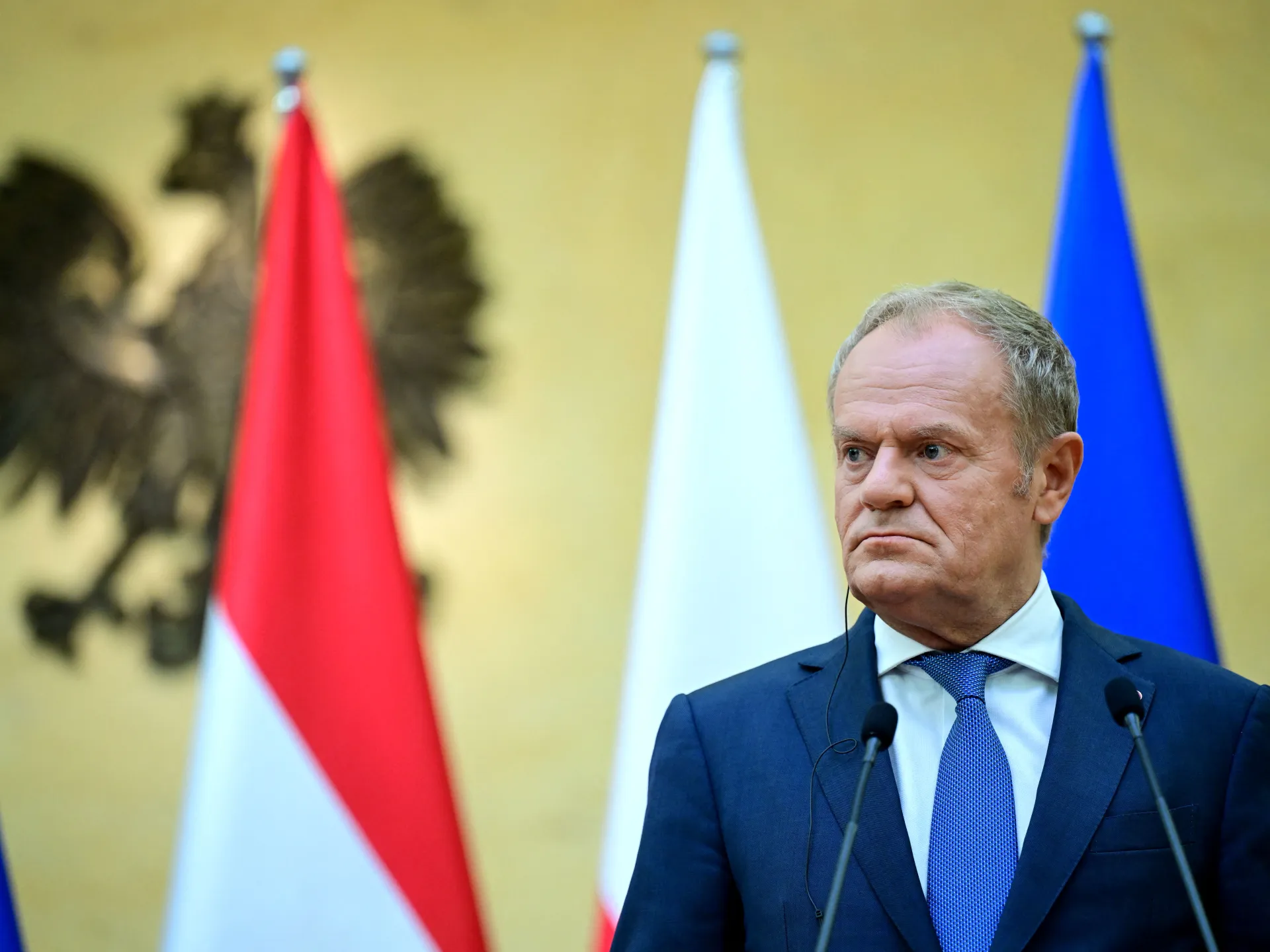
At the Warsaw Security Forum, Polish Prime Minister Donald Tusk said that “Russia is not interested in a ceasefire, de-escalation, or peace … that is why I will go to Brussels to urge all European partners to consider increasing sanctions.”
In Brussels, the European Union announced that it has officially added almost 1,600 new sanctions on Russia’s military industrial complex, including individuals and entities involved in its four-and-a-half-year war, in a bid to maintain pressure on Moscow.
“This is the single largest expansion of our sanctions list since Russia started its war,” EU foreign policy chief Kaja Kallas wrote online. “Europe is again showing a united front … We are making it significantly harder, slower and more expensive for Russia to produce the weapons it uses to kill Ukrainians,” she added.
Meanwhile, Russia attacked Ukrainian gas production facilities belonging to its state oil and gas company Naftogaz in the Kharkiv region overnight, which caused a fire, the company said on Monday.
“The attack damaged critical equipment. Our employees are doing everything possible to repair the damage as quickly as possible and prevent risks to the stable operation of the energy system,” Naftogaz acting CEO Sergii Fedorenko wrote on Telegram.
A day earlier, Zelenskyy had said that Ukraine was ready to halt attacks on Russian oil refineries if Moscow ceased its own attacks on Ukrainian energy infrastructure.
German chancellor visits Kyiv amid air raid sirens, pledging strong support as Russian strikes disrupt the capital.
Published On 4 Oct 20264 Oct 2026
Russia has struck a key bridge in Kyiv just as German Chancellor Friedrich Merz arrived in the Ukrainian capital to meet President Volodymyr Zelenskyy.
The unannounced visit, marked by the sound of air sirens and explosions, came on Sunday to underscore Germany’s support for the nation at a time when Russian attacks on Ukrainian cities are increasing.
Recommended Stories
list of 3 itemsend of list
In a written statement, Merz said he “travelled to Kyiv today because Ukraine needs all our support in the coming weeks”.
“If Russia is not stopped, its war machine will sooner or later turn against us,” he said.
Ukraine’s President Volodymyr Zelenskyy meets German Chancellor Friedrich Merz at the memorial of fallen Ukrainian soldiers at Independence Square in Kyiv, October 4, 2026 [Dan Bashakov/AP Photo]
Merz and Zelenskyy met at the National Academy of Sciences, which was struck by a Russian drone on September 28.
Zelenskyy told Merz that Kyiv’s citizens are going through “terrible nights and days” due to the ongoing Russian attacks.
Merz was accompanied by his economy minister, as well as executives from several large German companies, such as Siemens Energy and Diehl Defence.
Ukraine and Germany are also expected to finalise a deal to produce drones and other weapons together that can travel more than 600 miles (965.6km) in an effort to strike deeper into Russia.
Germany has been one of Ukraine’s staunchest supporters. In April, the two countries signed a military pact worth more than $4bn. On Sunday, a $1.1bn military aid package is set to be announced, alongside $394m to repair damage to Ukraine’s energy sector.
Merz’s visit comes a day after Russia warned foreign diplomats and nationals to leave the capital to avoid getting hurt.
Russia’s Ministry of Defence promised to intensify strikes on Ukraine after Zelenskyy said in an interview with the Reuters news agency that it is doubling down on targeting Russian oil refineries after several civilians were killed and wounded over the weekend.
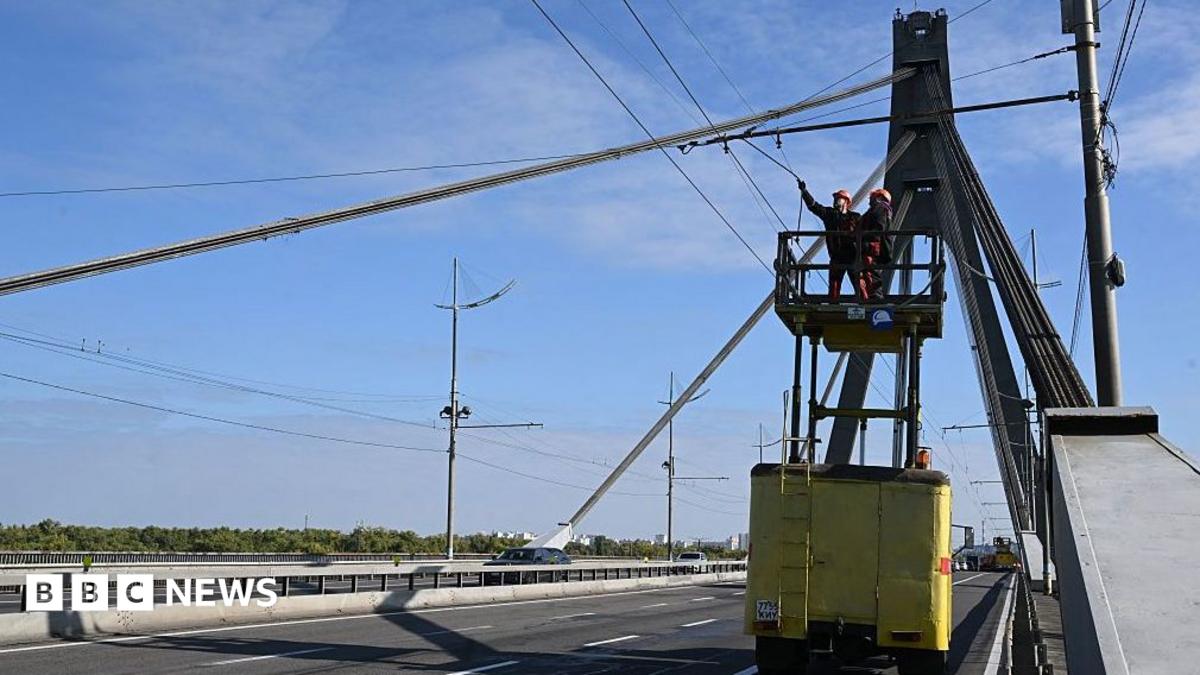
The strike that hit the Northern Bridge over the Dnipro River on Sunday also damaged a road and the supply of hot water in the area, according to a social media statement from Kyiv Mayor Vitali Klitschko. It is the second bridge in the capital to be hit this weekend.
Russia’s all-out war on Ukraine is in its fifth year. Both sides have increased the number of drone and missile attacks on infrastructure, logistics and military sites in recent months.
After the Pivdennyi Bridge was attacked, passengers described how dust from a blast wave entered their carriage through the ventilation system.
Ukrainian President Volodymyr Zelensky said Putin had decided that there were “no rules now” when attacking Ukraine.
In an interview with the Financial Times, he said: “The Russians have failed to occupy us. So now they are carrying out massive attacks and mass killings.”
He added: “They want to destroy our bridges… our data centres, the internet, mobile networks, hospitals, kindergartens, schools, universities – everything. They want people to flee their cities.”
Putin on Thursday insisted that Russia’s attacks on Ukrainian economic targets were a direct response to Ukraine’s strikes on Russia’s oil refineries and its ships in the Black Sea.
“Now from every direction we’re receiving calls ‘let’s stop’. But they started it,” Putin said after a wide-ranging speech at the Valdai foreign policy forum.
The Kremlin leader admitted Kyiv had “got some results” from its refinery attacks and Russia had lost about 1% of its GDP. Ukraine maintains it began attacking Russian oil infrastructure because it helps the Kremlin finance the war.
Russia has targeted Ukrainian energy infrastructure, ramping up attacks every winter since Putin launched a full-scale invasion in February 2022.
Taking a break from fighting Russians in the Kostiantynivka sector of the eastern Donetsk region, the commander of a Ukrainian uncrewed ground vehicle (UGV) unit spoke with us about innovations in the use of these systems. One was the first deployment of a UGV specifically designed for amphibious operations to deliver supplies to frontline troops in areas impeded by water obstacles. Large areas of the front line are bisected by rivers and wetlands, and the country has many other small waterways and marsh areas. As we have frequently reported, the use of UGVs by both Ukraine and Russia has exploded as the ubiquity of aerial attack drones makes it far too dangerous for human battlefield movements.
In an exclusive interview with TWZ, the commander of the 93rd Separate Mechanized Brigade’s “Alter Ego” UGV unit, who goes by the call sign “Electric,” offered us unique insights into the challenges of developing amphibious UGVs and how they were deployed.
In the first of two parts, Electric talks about why Alter Ego developed amphibious UGVs – including modifying a Triton variant for this – and how the unit made them work. The second part features his insights into using heavy ‘bomber drones’ to drop UGVs behind enemy lines for kamikaze raids. In addition, a representative of Brave1, Ukraine’s weapons technology accelerator, spoke about developing these systems at scale.
Some of the questions and answers have been slightly edited for clarity.
Q: How did the need for amphibious UGVs for logistics operations first come up?
A: We had this idea for a long time, but recently one of the departments of the Ministry of Defense asked for our help to solve this problem, so that the UGV could overcome water obstacles.
There was a crucial need for this kind of means at certain parts of the front, but the units that are located there didn’t have the capacity by themselves to solve this task. So our battalion was asked to solve this problem because we are one of the most experienced units in terms of UGVs.
A first-ever logistics mission on an amphibious UGV: the robot covered 40 kilometers across land and water.
Operators of the “Alter Ego” unit (93rd Brigade) deployed the robotic system across mixed terrain. Facing water obstacles, the UGV seamlessly switched to swimming mode to… pic.twitter.com/rH8waq04a4
Q: How long did it take to design and test the amphibious UGV, and what went into that process?
A: The whole process from development to battle deployment took less than three months.
Q: What did you have to do to make this work?
A: First of all, we looked at amphibious solutions that were on the market, not only in Ukraine, but in the world, and we took two separate approaches. One was taking one of the main UGVs that our unit is using on the ground, and we made it amphibious. And the other approach was that we took one of the solutions that was on the market that already had amphibious capabilities, and we solved several disadvantages that it had. And at the moment, we are using both.
Q: What did you have to do to make the UGV amphibious, and then what were some of the obstacles that had to be overcome to get this operational?
A: First of all, we have to explain that there are different solutions on the market that kind of work on the testing ground — like they can swim, they can drive on the ground, and in the vision of the manufacturer, they are working. But the fact is that these solutions are not ready for the reality on the front line, which is often very different from what is on the testing ground.
And the second point is that the unit has its own workshops where people work near the front line, and the experts, the engineers that work there, they have a very high level of competence to evaluate different solutions and select the one that has potential. And that’s what’s completely different between this unit and everyone else, like manufacturers and others who are working on these solutions, because they don’t understand what’s needed on the battlefield.
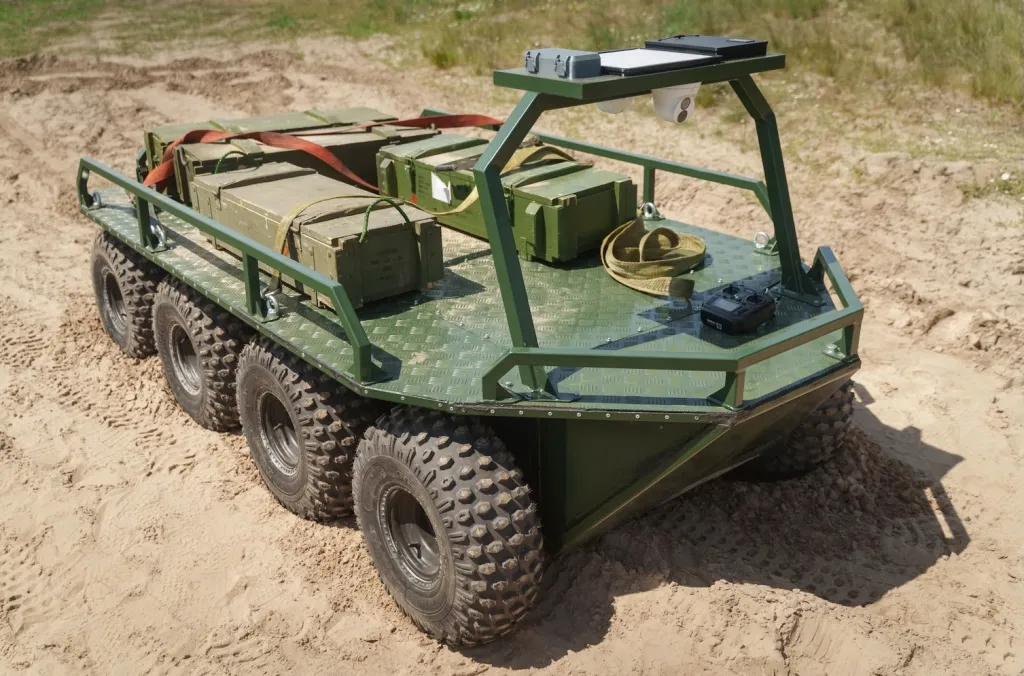
The Alter Ego unit’s uncrewed amphibious ground vehicle (UGV). (Brave1)
Q: So what did you have to change to make it work?
A: Regarding the amphibious one, basically the unit changed almost everything that that UGV had, starting from electronics, the software, the waterproofing, the communications – we basically changed everything. Regarding the one that we already used on the ground, we basically tried to retain what was allowing it to be an effective UGV on the ground, and we added waterproofing and specific mechanics, so that it can work in the water environment.
Q: You mentioned communications. What kind of communications did you add?
A: The communication means that was installed on the UGV by the manufacturer was not sufficient at all. Basically, it didn’t have enough quality for the battlefield situation. It was not working. But we already have our own communications that we were working on, and we have a lot of experience because we have been working for a long time in this UGV area. So we basically helped to install a sufficient level of communications on this UGV.
Q: So how does the amphibious UGV communicate with the controller? Does it use Starlink or some other satellite communications system for navigation?
A: This is satellite navigation, but not only. Satellite navigation is a part of this communication system.
Q: What are the other parts?
A: It’s better not to talk in detail about the other part of the communication system.
Triton amphibious UGV communications and camera systems. (Brave1)
Q: There were probably a lot of different missions that could have been used for this first amphibious UGV logistics delivery. Why was this particular mission chosen?
A: The Alter Ego unit has so much experience in terms of UGVs, and not just experience of using UGVs, but the experience of being the first in the world. We had one of the first evacuation missions, we had one of the first strike missions using UGVs, the paratrooper UGV, and now the amphibious UGV. So basically, we have the systems to make it work for the first time when nobody knows how to conduct this mission.
Q: No, I mean why did this particular mission get chosen to be the first one?
A: There are certain places on the front line where we have water obstacles that prevent logistics from being done by UGV. At the moment, UGVs are carrying hundreds of tons of logistics, probably the most compared to any other means on the front line, but before this, these water obstacles would prevent UGVs from providing logistics for those parts of the front, and that need can’t be fully satisfied by UAVs or other means. That’s why we did this mission with the amphibious UGV, and now our task here is to scale this technology and provide this logistics system for other similar parts of the front where there are water obstacles.
Kostiantynivka, Ukraine. (Google Earth)
Q: Tell me about where and when this mission took place and what it was like to watch it unfold.
A: So unfortunately, we can’t provide information about when and where this operation took place. But regarding how it went and what we felt, this was another big challenge, because this is something that wasn’t done before, and nobody thought this is real. So this was quite difficult, and to tell the truth, the mission didn’t succeed on the first try, actually, and it required a lot of effort in terms of planning, preparing, engineering, and basically it required 100% effort from everyone involved in that mission.
Q: How many times did it fail before, and what went wrong?
A: We had one failed attempt. The reason for failure was a certain technical problem. After that, we analyzed what went wrong, and we worked on solving those issues. Basically, it’s something that nobody had tried to do, it’s kind of hard to know what can go wrong before you actually try it. So the best way to find a solution like that is to try and then iterate on that attempt and make it better and better and better.
Also, I would like to add that although this was the first successful mission regarding an amphibious UGV, it’s not that there was no work on that before that. We were actively talking to and collecting the experience of everyone who was working on these kinds of missions before, and that was also a reason why this mission succeeded.
Q: How far did the amphibious UGV go for this mission?
A: So the UGV went 40 kilometers one way, and then it returned. So probably around 70 kilometers in total, and it carried food and other supplies.
Q: Did this UGV come under Russian fire on this mission?
A: Yes, and it survived.
Q: How does the UGV switch from water to land operations?
A: So the UGV has two separate control systems, one for water and one for land, and basically it switches to the one that is required at the moment. That’s how it can operate in both environments.
The Alter Ego unit’s uncrewed amphibious ground vehicle (UGV). (Brave1)
Q: Is that autonomous, or is that something that the controller at the base has to do as they watch the UGV on its mission?
A: At the moment, the operator fully controls the UGV manually. And basically, before, the operators of UGVs only knew how to move them on land, but now they also had to learn how to move them in the water. So not only was the technology itself developed, but we also had to prepare the operator and come up with tactics for this UGV.
Q: Did you use AI on this mission in any way, and if so, how?
A: We didn’t use AI.
Q: Have there been other missions using amphibious UGVs?
A: Yes.
Q: Can you say how many and what was delivered?
A: No.
Q: Is this designed only for logistics missions, or will it be used in the future for strike missions, either as a one-way attack system or as a platform for machine guns or other weapons?
A: We can use it in different ways in the future.
Q: Mud season is fast approaching, when much maneuvering becomes impossible or severely degraded because of how difficult it is to move in the thick, oozing slop. Will your amphibious UGVs work in the mud?
A: I think it can operate in the mud in the same way it operates in the water.
In the next segment of our interview, Electric talks about using bomber drones to deliver UGVs behind the lines, and a Brave1 representative talks about how the organization is working to develop these systems at scale for wider use.
The Wall Street Journalreported Wednesday that more than half of Ukraine’s F-16s are currently in what a Western source described as “maintenance limbo.” The same source told the newspaper that, at the current rate of operations and maintenance, Ukraine could exhaust the remainder of its available aircraft by the end of the year.
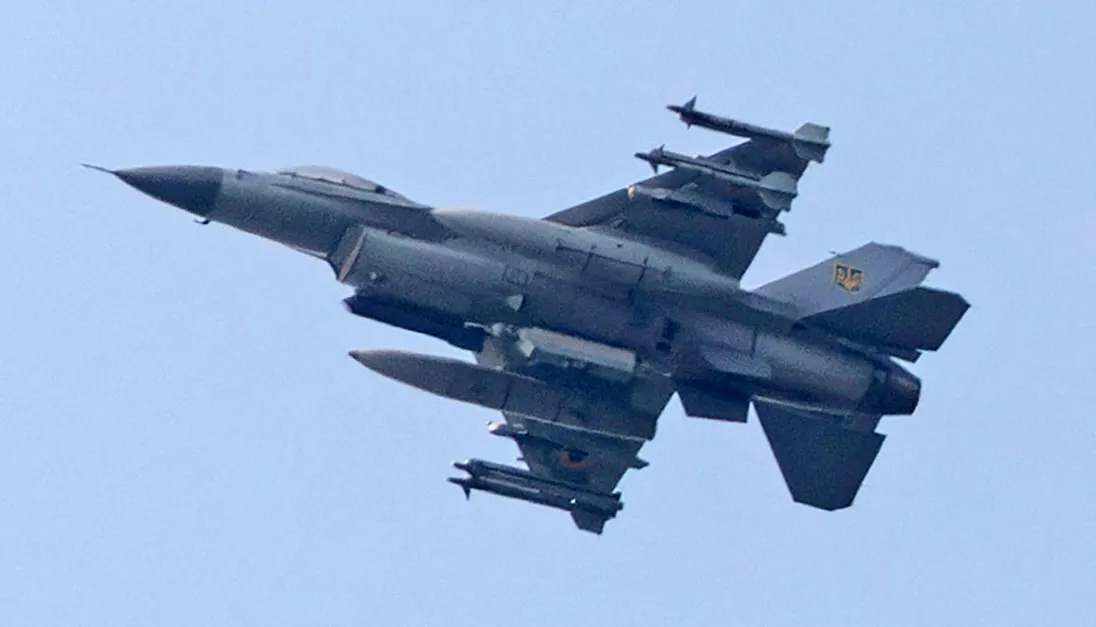
An F-16 over the Kyiv region on August 18, 2026. The jet carries four Sidewinder missiles, a Sniper targeting pod, and an AN/ALQ-131 electronic countermeasures pod. Photo by Roman PILIPEY / AFP ROMAN PILIPEY
The Ukrainian Air Force declined to provide the WSJ with figures on the status of the fleet. Open-source analysis suggests that Ukraine may have received around 40-50 F-16s so far. However, a proportion of these are held back for training elsewhere in Europe, while there have been five confirmed losses. Approximately 110 F-16s have now been promised by a coalition comprising Belgium, Denmark, the Netherlands, and Norway.
This is a growing issue, especially because right now F-16s are playing an important role in intercepts of jet powered Geran-4/5. https://t.co/ZtMFBSLAy1
The report follows TWZ’s recent reporting on a separate constraint affecting the F-16 force: Ukraine is struggling to maintain adequate stocks of air-to-air missiles for its fighters. AIM-9 Sidewinders and AIM-120 Advanced Medium-Range Air-to-Air Missiles (AMRAAM) have been heavily used against Russian cruise missiles and drones, and Ukrainian F-16 pilots have reportedly had to ration their missile shots. Aircraft have increasingly had to rely on their internal 20mm cannon when suitable missiles are not available. This is a far from ideal substitute, as you can read about here, but Kyiv is reportedly now negotiating for tens of thousands of additional rounds of 20mm ammunition.
Ukrainian F-16s have apparently been carrying laser-guided 70mm Advanced Precision Kill Weapon System II (APKWS II) rockets, which should provide an extremely valuable, lower-cost option for engaging long-range drones and subsonic cruise missiles. The exact status of this weapon in Ukrainian hands is unclear, but there is so far limited evidence of extensive use by its F-16s, at least in the public domain.
All these problems are closely related because the same high operational tempo that is consuming Ukraine’s missile stocks is also putting additional hours on the already well-worn F-16 airframes.
The aircraft have become a critical important component of Ukraine’s air-defense effort, particularly as Russia has expanded its use of increasingly sophisticated one-way attack drones, as we wrote about only yesterday. WSJ reports that Russia has launched around 2,000 jet-powered drones against Ukraine this month, compared with approximately 350 in June. The newer, jet-powered drones can reportedly reach speeds of up to 375 miles per hour, making them more difficult for Ukraine’s interceptor drones to engage and increasing the importance of conventional fighters. At the same time, the stocks of effectors for ground-based air defense systems are being reduced, in some cases to a critical level, increasing the reliance on crewed fighters to take up the slack.
A Ukrainian drone attempts to intercept a Russian Geran-4 jet-powered drone. GUR
F-16s are well-suited to the counter-drone and counter-cruise missile mission, but using them extensively against large numbers of relatively inexpensive targets presents a difficult sustainment problem. In fact, the lower speed and altitude differential between the F-16 and a jet-powered drone, compared to a propeller-driven one, makes the higher-performance weapon an easier target for the crewed fighter in most scenarios.
However, every sortie adds flight hours to the aircraft, while each missile engagement draws from an inventory that Ukraine and its Western partners have to replenish. As the aircraft accumulate hours, they reach scheduled inspection and maintenance intervals, increasing demand on a maintenance network that is already supporting a fleet operating under wartime conditions.
The United States has established a substantial support arrangement for that purpose. In January, the Pentagon awarded Belgian company Sabena Aerospace Engineering a contract with a ceiling of approximately $235.5 million for intermediate- and depot-level maintenance of Ukrainian F-16 aircraft and engines, together with associated material-management support. The contract runs through January 2029, with approximately $69.7 million initially obligated.
The contract provides an indication of the scale of the infrastructure required to keep the Ukrainian F-16 fleet operational. It also highlights why the reported turnaround times in Belgium are significant. A typical phase-inspection that would normally take approximately two to six weeks in the United States is reportedly taking as long as 40 weeks in Belgium.
A 40-week turnaround does not necessarily mean that an aircraft spends 40 weeks continuously undergoing a phase inspection. The overall period an aircraft is unavailable can also include waiting for parts, additional repairs, scheduling, and other work. It is unclear exactly how many Ukrainian F-16s are currently affected by these various factors.
U.S. Air Force engine shop where airmen remove the engine of an F-16 during a phase maintenance inspection in the United States. U.S. Air National Guard photo by Master Sgt. Christopher Stewart/Released Master Sgt. Christopher Stewart
At the same time, the reported turnaround times do point to a substantial capacity problem. Ukraine operates a relatively small F-16 fleet, so aircraft that remain unavailable for extended periods have a disproportionate effect on the number of fighters that can actually be generated for combat missions. Its mission spectrum also includes air-to-ground sorties, putting more demand on the hard-pressed F-16 fleet.
F-16 fighters are the best way to counter new Russian jet-powered drones.
Ukrainian F-16 aces have shot down about 2,500 drones of all types and about 650 cruise missiles.
Jet drones are exactly the kind of target F-16s shoot down very well, and it usually costs $25,000 or… pic.twitter.com/ajxYN9K0yK
The F-16s have finite airframe lives, require increasingly substantial inspections as they accumulate hours, and depend on a supply chain for engines, components and other parts. The missiles used to destroy the targets are another finite resource. It should also be recalled that the jets supplied to Ukraine are among the oldest still in operational service. Although upgraded to F-16AM/BM standard, the airframes have accumulated a lot of hours and fatigue.
There is an additional complication with the air-to-air missile inventory, too. AMRAAM is not used only by Ukrainian F-16s, but also employed by its NASAMS ground-based air-defense systems. Sidewinders, too, have both air-launched and surface-launched applications. The same broader Western supply chain therefore has to support both fighter operations and some of Ukraine’s surface-to-air missile systems. Stocks of both AMRAAM and Sidewinder have been eroded by Ukraine, as well as by combat actions in the Middle East.
Southern Ukraine, a Ukrainian NASAMS surface to air missile system intercepts a Russian drone with an (SL)AIM-120B AMRAAM. pic.twitter.com/LTeDDHaECp
At the same time, Ukraine is continuing to receive additional F-16s. Belgium has said it will transfer three more aircraft to Ukraine before the end of this year. More aircraft will increase the potential size of the force, but they will also add to the requirement for spare parts, engines, technicians and depot capacity.
“There is an important agreement with Belgium on the transfer of three F-16 fighter jets by the end of this year,” Ukrainian President Volodymyr Zelensky wrote on X. “We will work to receive these aircraft through an accelerated procedure.”
There is an important agreement with Belgium on the transfer of three F-16 fighter jets by the end of this year. We will work to receive these aircraft through an accelerated procedure. We have already received urgent deliveries of F-16 ammunition from Belgium and other…
— Volodymyr Zelenskyy / Володимир Зеленський (@ZelenskyyUa) September 29, 2026
Zelensky said Ukraine had already received “urgent deliveries” of F-16 weapons from Belgium and Spain, among other countries.
The alternatives to the F-16 are also limited in the near term. Ukraine continues to operate the Soviet-era MiG-29 Fulcrum and a small number of Su-27 Flankers, but these aircraft are themselves aging and are also required for strike missions. In their favor, the Soviet types were designed around a different concept of operations, making them easier to maintain in the field, and Ukraine has its own support infrastructure to sustain them.
The French Mirage 2000-5F force provides another Western option, but deliveries have been relatively limited, and additional aircraft are arriving incrementally rather than in numbers that can quickly compensate for a major reduction in F-16 availability. The longer-term fighter replacement plan is more ambitious. Sweden has agreed to provide 16 Gripen C/D fighters, with the first aircraft expected in early 2027, while a separate agreement covers the purchase of 16 new Gripen E fighters whose deliveries are not scheduled to begin until early 2029.
🇫🇷🇺🇦 French-delivered Dassault Mirage 2000-5F fighter jet in service of the Ukrainian Air Force during flight somewhere over Ukraine. pic.twitter.com/eBCjtx2Gjc
That leaves the F-16 as the principal Western fighter capability available to Ukraine for the immediate future, increasing the significance of any prolonged disruption to its maintenance pipeline or its supply of air-to-air weapons. Ukraine needs enough aircraft to maintain a meaningful combat presence, enough missiles to arm them for the missions they are being asked to fly, and enough maintenance capacity to keep those aircraft available as their flight hours accumulate.
All this is becoming more important as Russia’s aerial campaign evolves. If the increase in faster jet-powered drones continues, Ukraine may have to devote still more fighter sorties to countering them at the very same time that a large portion of its existing F-16 fleet is reportedly unavailable and its stocks of air-to-air missiles are under serious pressure.
Russian forces have again struck the Ukrainian capital, Kyiv, hours after a drone hit the National Academy of Sciences in the historic centre of the city, killing at least two people.
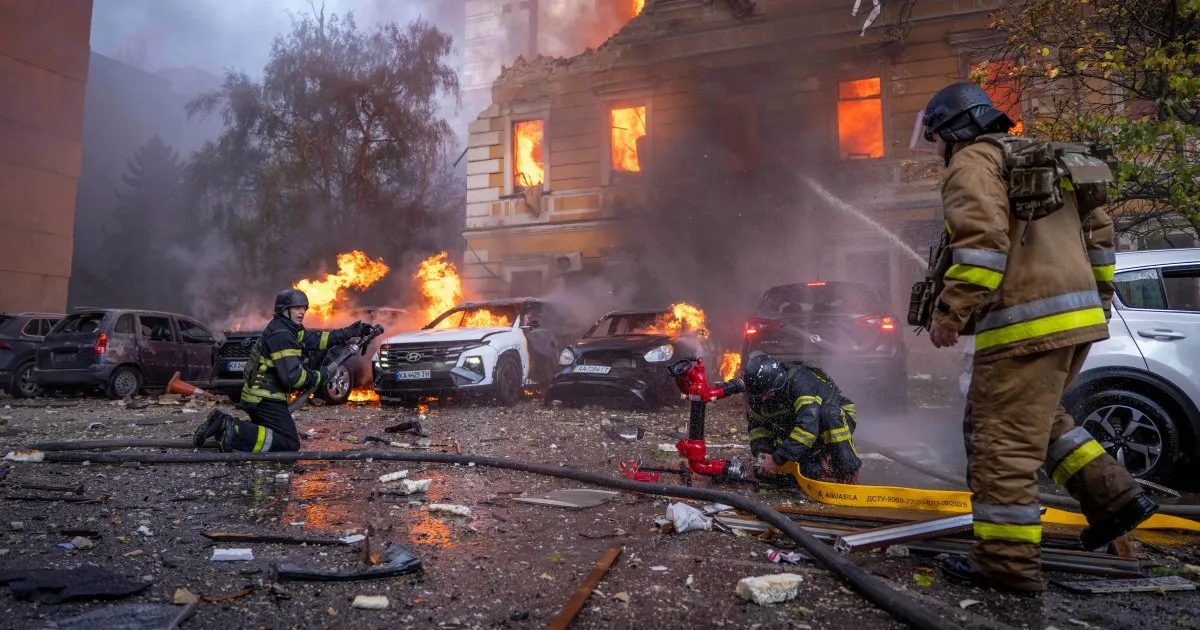
Explosions were heard across Kyiv early on Tuesday, with Mayor Vitali Klitschko saying missile debris had fallen in the courtyard of one building while a second had caught fire in another part of the city.
Recommended Stories
list of 3 itemsend of list
The attacks come as Russia has begun hitting Kyiv and other Ukrainian cities with faster, high-flying jet drones.
Emergency officials said the strike on the National Academy of Sciences on Monday killed two people, with one person’s body recovered from the rubble later in the evening.
Video shared online appeared to show a fast-moving drone slamming into the building at a steep angle and exploding, sending smoke into a clear sky. People were seen leaning out of windows as bright orange flames engulfed part of the building.
Volodymyr Horbulin, a former secretary of Ukraine’s National Security and Defence Council, told the public broadcaster Suspilne that he was at work at the academy when it came under attack. He said his assistant, who was near the building, was killed and that he was also slightly wounded.
The academy is near the German Embassy, a cathedral, the national opera and government buildings.
In a statement, the academy called the attack “Russian terror” and “barbarity” aimed at “peaceful people who were simply at their workplaces”.
Foreign Minister Andrii Sybiha accused Russia of cynicism for hitting a scientific institution during the workday.
“Russia is deliberately expanding the boundaries of what it believes the world will tolerate,” he said in a statement, urging Ukraine’s allies to provide more air defences.
Jet-powered drones
Ukrainian President Volodymyr Zelenskyy said Russian forces also hit a medical facility in Kyiv on Monday. He said at least nine people had been killed in Russian drone strikes throughout the country, while more than 80 people were wounded.
In his nightly video address, Zelenskyy said Ukraine was still having difficulty countering the faster, high-flying Russian jet-powered drones.
“New interceptors are being actively tested,” he said. “Some combat groups are using them, but, of course, some details still need to be refined to achieve enough effectiveness and scale. We are speeding up the developers.”
According to the Ukrainian president, 90 of 120 drones fired on Ukraine on Monday were jet-propelled, rather than propeller-driven, with an interception rate for this type of drone at 57 percent.
Widening targets
Officials said the Russian strikes on Kyiv also targeted a pharmaceutical company and petrol stations. In other cities and regions, civilian facilities, businesses and communications infrastructure were hit.
In the southeastern city of Dnipro, a Russian drone attack on a business centre killed three people and wounded 19, according to officials. Another person was killed in a logistics office in Synelnykove, southeast of Dnipro, the regional governor said.
Emergency services said an attack on infrastructure in the southeastern city of Zaporizhzhia wounded 32 people.
Al Jazeera’s Jonah Hull, reporting from Kyiv, said Russia has been hitting economic targets across Ukraine “in a rolling series of strikes that have been ongoing for six days now”, during the day and night.
“Data centres increasingly being hit, as well as digital and communications infrastructure,” he said. “Kyiv Star, the country’s biggest cell provider, was hit on Sunday, as was the second biggest, Vodafone Ukraine. The government is said to be preparing for the worst: a total blackout in communications should that come.”
The Russian attacks have brought Kyiv “firmly into the eye of this war”, Hull added.
Ukraine has also increased attacks on Russia, targeting oil refineries as well as online retailers to try to undermine revenues and support for Moscow’s war effort.
Zelenskyy said on Monday that Ukraine struck Russian oil facilities in the Krasnodar region and two defence plants.
Both sides have denied deliberately targeting civilians.
It’s stunning to comprehend how much has changed since Russia began its invasion of Ukraine. The conflict quickly turned into one dominated by artillery, with both sides scrambling to source shells wherever possible. Drones have since replaced tubed artillery as the ‘king of battle’ along the front, but cannons still have an important place on the battlefield. The commander of a new combined drone-artillery brigade offered some fresh insights into how his guns are now being deployed to achieve effects that drones still can’t provide.
As we have frequently documented, the ubiquity of drones has changed the nature of combat, especially when it comes to artillery. Not only can drones hold artillery positions at risk, many are cheaper than shells and easier to produce at scale. Most types are also precision guided munitions capable of hitting moving targets with pinpoint accuracy and can also provide battlefield surveillance. However, they are not a panacea, especially amid the cat-and-mouse game of electronic warfare countermeasures and improving kinetic and passive defenses.
In a recent interview with the Ukrainian Oboronka news outlet, Lt. Col. Vitalii Korniienko, commander of the 7th Artillery Brigade, talked about the changing nature of artillery warfare. Korniienko, whose unit is part of the Ukrainian National Guard, explained what is being done to keep his array of domestically produced Bogdana 155mm systems, donated weapons like M777 howitzers, remaining Soviet-era 2S7 Pion 203mm self-propelled howitzers and other guns, relevant. Here are some takeaways from that discussion.
How The Game Changed
“Guns used to be massed at positions to create an ‘artillery wall’ and a barrage of fire,” the lieutenant colonel said. “That practice is gone now. So, how effective is artillery today? We can create an artillery barrage, but what is the point of mindlessly churning up the earth? I’d rather send 20 FPV drones to destroy the target. The cost of that mission is $20,000.”
A soldier from the 13th Khartiia Brigade of Ukraine’s National Guard hones his FPV drone piloting skills during a training flight in the Kharkiv region, Ukraine. (Photo by Viacheslav Madiievskyi/Ukrinform/Future Publishing via Getty Images) Future Publishing
“Alternatively, I could fire 200 shells, but the cost would be astronomical,” he pointed out. “Plus, if we fired 100 shells from a gun in a single day, it likely wouldn’t survive until evening. The sky is full of drones; every shot gives away the position, leading to detection and an attempt to dismantle it using every available means. Nowadays, a typical mission involves a series of up to 10 shots. First, 3–5 shells for ranging, followed by fire on the target. That’s a minimum of five shells, with each costing at least $2,000.”
What Does The Drone-Artillery Brigade Do Differently?
“It is a concept of ours that was approved: combining artillery and drones within a single brigade,” Korniienko said. “Drones take out enemy artillery and logistics, while our guns provide cover for the infantry, destroy targets, and pin the enemy down in their dugouts. This way, we mitigate the limitations of both systems and boost overall effectiveness.”
Ukrainian troops firing a domestically produced 2S22 “Bogdana” self-propelled howitzer against Russian forces near the front line in the Zaporizhia direction. (Photo by Maksym Kishka/Frontliner/Getty Images) Frontliner#VIDEO
“Our primary operations are focused within the corps’ area of responsibility—targeting positions 10 kilometers deep or farther behind enemy lines. Of course, we will also engage closer targets if requested by the brigade holding the defense. In addition, we are shifting logistics tasks from pickup trucks to ground-based robotic systems. They are already transporting ammunition to drone and artillery positions, as well as food and fuel for generators.”
What Artillery Can Do That Drones Can’t
“Let’s be honest: 95% of strikes right now are carried out by drones,” Korniienko explained. “Yet, we cannot simply abandon artillery. The focus of our operations has shifted from merely striking the enemy to destroying, suppressing, and halting the actions of assault groups and armored columns—and the need for that remains as critical as ever. There are tasks that only artillery can handle.”
“For instance, we currently have several enemy targets in the Kupyansk sector that drones cannot reach due to electronic warfare (EW) interference, while slow fiber-optic drones are simply shot down,” the officer noted. “What do we do? We call in artillery. Nothing affects its shells. Fog, strong winds, snow, or headwinds—it makes no difference to artillery; it will operate regardless.”
Preparing Artillery For The Modern Battlefield
“At the beginning, both we and the Russians might have had two or three guns at a single position,” Korniienko proffered. “The enemy was doing this as late as 2023. Then it tapered off, because if you deployed six guns, an hour later they’d be gone. No one drives out into an open field anymore. Today, a gun wouldn’t even make it to the position without being spotted.”
Ukrainian National Guard troops prepare a ‘Bogdana-BG’ artillery installation from a dugout position. (Photo by Sofiia Bobok/Anadolu via Getty Images) Anadolu
As a result, the artillery crew’s deployment “is prepared in advance,” the officer stated. “First, anti-aircraft drone teams ‘clear’ the sky above the site of enemy reconnaissance assets. The position itself is a fully underground-dugout caponier with well-camouflaged access routes. We put a lot of effort into ensuring the artillery doesn’t get destroyed. Losing a gun is a huge blow to us.”
Short Range Versus Long Range Shells
“There is currently an ongoing debate about phasing out ‘short’ shells and switching entirely to long-range variants,” the officer stated. “This is intended to protect artillery from drone strikes.”
“What exactly is a ‘short’ shell, and should we stop using it?” he asked rhetorically. “The M107 155mm round is what is known as a ‘short’ shell. It is inexpensive and mass-produced; all our allies—and even our own country—manufacture it. We have sufficient stocks of them for combat operations. While accurate, its range is limited to 14–18 km, depending on the propellant used.”
Army
Long-range options “include the M795 and its foreign equivalents,” Korniienko explained. “These are longer, heavier, and significantly more expensive. With high-quality propellant, they can reach 30 km, or even further if equipped with a base-bleed unit. However, both these shells and the necessary propellants are in short supply.”
Army
“I do not believe abandoning the M107 is the right move,” the officer suggested. “Long-range shells cause faster barrel wear and compromise position concealment; firing a long-range charge produces a massive burst of flame from the muzzle—visible for kilometers at dusk or dawn.” “Besides,” he added, “18 km is a respectable range. If the gun is positioned 15 km back, it still has a 3-km margin to spare. That is sufficient for engaging frontline infantry. In my view, the ideal mix for most brigades would be 60% long-range shells and 40% standard M107 rounds.”
Big Versus Small Guns
“I operated 105mm guns in the Serebryanka area, on the Kharkiv axis,” Korniienko noted. “Based on intercepted communications, the enemy thought it was a mortar and searched for it within a five-to-six-kilometer range. But the howitzer was positioned eight or nine kilometers away and fired out to 10–12 kilometers.”
“There is almost no muzzle flash, just a bit of dust,” he added. “The shell arrives, and the enemy doesn’t even hear the sound of the shot. It’s compact and lightweight—you can transport it on a pickup truck. So yes, it would be useful.”
An L119 lightweight towed howitzer. (Via X)
“I’d also like to see the development of 203mm artillery; why move away from that caliber?” the officer wondered aloud. “Our ‘Pion’ systems fire a massive 100-kilogram shell capable of punching through at least two floors of a building or a bunker. And it’s reasonably accurate, too. You wouldn’t want to be on the receiving end when guns like that are firing at you. Overall, I believe we need competition. Right now, the ‘Bogdana’ is evolving under wartime conditions, which is good. But in a few years, momentum could stall. They might just keep producing the same system without significant upgrades because there’s no incentive to innovate. Yet, the nature of war doesn’t stand still.”
Wary Of Asian Shells
“We have a wide range of shells from different countries, and the ones coming from the West are fine,” Korniienko said. “However, their counterparts produced in certain Asian countries… the quality is frankly poor.”
“What is wrong with them?” queried Korniienko, who did not name the country in question. “On paper, the shell weight is listed as 46 kilograms, but when we weigh them, we find 46.9 or 45.4 kg. And that half-kilogram difference—give or take—has a huge impact on where the shell lands.”
As a result, “we no longer trust the standard firing tables provided with the shells; instead, we compile our own for each manufacturer. We weigh every batch and sort them by weight so that the difference between the ‘piles’ is minimal, ensuring a reasonably tight grouping. I can’t afford to make a mistake that causes a shell to land 2 kilometers off-target—right where our infantry guys are positioned. I should add that our artillerymen are actually wary of shells from one specific country. There have been instances where they tore off the muzzle brake or even caused the barrel to burst. A barrel burst is a disaster.”
Homegrown Is The Best
Korniienko said his unit was one of the first to test the Bogdana system, adding that he prefers it to other guns.
“We tested them and provided feedback to the manufacturer, which was then used to refine the design,” he explained. “It is a solid gun now, and it is my preferred choice. It might not be the absolute best, but I am very satisfied with the support and service.”
“If there’s a breakdown, the gun is back in position within a day or two,” he pointed out. “For instance, a gun broke down today, and we needed a repair team from the manufacturer. I know I’ll have it fixed by the day after tomorrow. They arrive in the morning, and by midday, the gun is ready. Then it takes another day or two to get it back to the position. That is very fast.”
That’s a very different experience than what he sees with donated weapons like the U.S.-made M777.
Ukrainian soldiers prepare to fire an M777 howitzer at Russian forces. (Photo by Diego Herrera Carcedo/Anadolu Agency via Getty Images) Anadolu
“As for the Western partners helping us—we are deeply grateful,” the officer avowed. “However, by the time you actually receive a part—say, a sensor—the gun might have been sitting idle for six months. And you can’t try to fix it yourself, because that would void the warranty.”
While artillery may no longer be the reigning weapon of war, as far as Ukraine is concerned, it has not been relegated to the dustbin of history yet either.
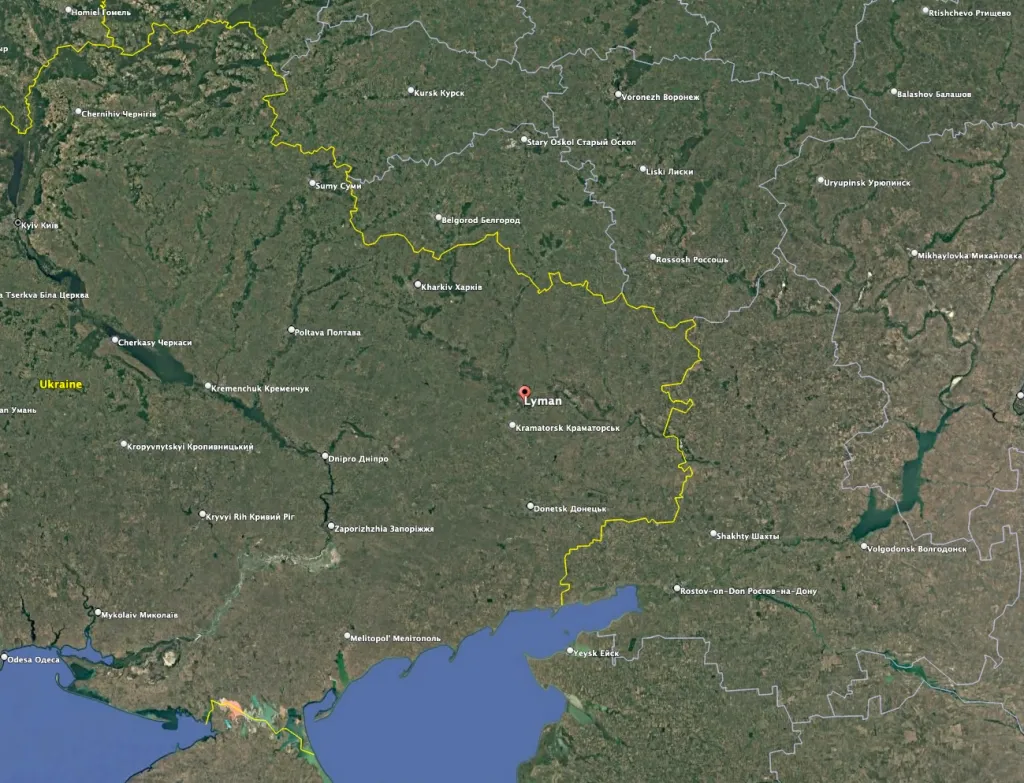
Ukraine claims it has recently regained about 125 sq. km. of territory near the town of Lyman in the eastern Donetsk region during what has been dubbed Operation Vivaldi. Rodion Kudryashov, a Ukrainian colonel and deputy commander of the Third Army Corps, offered some insights into this offensive and what made it different.
Though the operation is still ongoing, the success of Vivaldi began long before any troop movements, Kudryashov explained in an editorial he published in Ukrainian Pravda.
Ukraine is making advances near the town of Lyman, located in the Donetsk region. (Google Earth)
“After the Third Army Corps was formed, we changed the command system of its subordinate units,” he noted. “Some brigades came to the corps after very heavy fighting, with losses, manning problems and, most importantly, eroded trust in their leadership.”
Third Army Corps Commander Brig. Gen. Andriy Biletsky “then set out one of our key principles: a commander must be responsible for the entire cycle, from training a soldier to the result on the battlefield,” Kudryashov pointed out. “In some places that meant replacing a commander. In others it meant restructuring a staff or strengthening the NCO chain. In some cases we had to build, almost from scratch, processes that on paper should have been working long ago.”
At issue was changing the culture from a more rigid Soviet-era model, with a cumbersome chain of command, to a modern, more flexible one better suited for the current conflict.
“A modern commander has to handle an enormous flow of information and make decisions quickly,” the deputy commander proffered. “He has to understand what unmanned systems, logistics, reconnaissance and adjacent units can do, while not smothering initiative at lower levels with endless approvals. An army where every decision takes hours to travel up and down the chain loses to an army that makes the same trip in minutes.”
Once those changes were put in place, the Third Army Corps had to first stop Russian advances in the sector before it could move forward.
VIVALDI 🎼🎶
GoPro footage from Ukrainian assault troops who took part in the Vivaldi counteroffensive, which resulted in the liberation of five settlements in the Lyman direction. pic.twitter.com/2SVXSKlEX0
“When the corps took over its area of responsibility, our first task was not an offensive,” the officer said. “We had to stop the situation from deteriorating and stabilize the forward edge.”
“The enemy was pressing. In some sectors our combat formations were losing cohesion,” he underscored. “The Russians were actively using infiltration tactics: small groups seeped between positions, massed in our rear, threatened logistics and gradually eroded the defensive line.”
“We had to stabilize the forward edge and stop the infiltration,” Kudryashov said. “We had to rebuild command, put in commanders capable of making decisions, form new teams and reconstitute units. We had to set up the surveillance-and-strike system and sustain the front line. We had to stockpile ammunition, drones and other resources, understand the enemy, and plan the next step before the previous one was finished. Only after that could we move forward.”
By June, the corps was able to secure the front “in the sector from Borova to Lyman and eliminate the enemy’s infiltration zones,” Kudryashov continued. “That sounds less impressive than the word ‘offensive,’ but no offensive ever happens without it.”
“You cannot plan a complex operation if you don’t know where your forward edge will be tomorrow,” the deputy commander extrapolated. “You cannot build up forces if your logistics are constantly under threat. And you cannot form a strike group if your units are always forced to patch new breaches. So the first phase of ‘Vivaldi’ was not an advance at all. It was creating the conditions that made an advance possible in the first place.”
Once the front was stabilized, the next step was shaping the battlefield for the offensive. The corps’ unmanned systems units went to work against Russian logistics, striking a pipeline and depots. That forced the enemy to change its fuel and lubricant supply routes.
Ukraine’s 3rd Army Corps released new footage of search-and-strike operations on the Lyman front. FPV drone operators from the 60th Mechanized Brigade’s FATUM unit targeted Russian armored vehicles, a Grad multiple rocket launcher and personnel. #Ukrainepic.twitter.com/1iNG7z2N1c
“The operation also involved the corps’ brigades, its reconnaissance and unmanned units, and attached forces from the SSO (Special Operations Forces), GUR (Defense Intelligence) and DPSU (State Border Guard Service),” the deputy commander said. “To counter infiltration, a joint headquarters was set up to coordinate special and reconnaissance units at the tactical level under a single concept.”
“In my view, this is one of the main characteristics of modern war,” he further stated. “It is not 10 strong units that each fight well on their own. It is 10 different elements that start working as one system at the right moment.”
An interesting new detail from Ukraine’s 3rd Army Corps about Operation Vivaldi on the Lyman axis.
The Corps says Ukrainian forces carried out a flanking maneuver and, for the first time, airlifted unmanned ground vehicles behind Russian lines, while also suppressing Russian… https://t.co/ZEq8C75bN4pic.twitter.com/KgKcZ0Zs2P
The influential, Kremlin-connected Rybar Telegram channel has acknowledged Ukrainian gains in this sector.
“In the first half of summer, Russian units gradually advanced in Lyman,” Rybar wrote this morning. “However, in August, the enemy launched counterattacks and, by the first week of September, regained some positions, and also began attempts to recapture Shandryholovo and Zarechnoye.”
“The enemy did not inflict significant losses on Russian troops, as the concentration of units of the West group of forces in the salient remained relatively low,” Rybar added. “However, later, the UAF deployed reserves to launch an offensive towards Zherebets in order to align the front along the water barrier and return it to the configuration of the end of 2025.”
rybar now saying the 144th division is still falling back. the 3rd corps is still advancing and destroying an entire army group as they move. this is historic. pic.twitter.com/2jOa8KR9oA
Though the battle is still in flux, Kudryashov said there are lessons the rest of the Ukrainian military should heed.
“Winning one battle is not yet winning the war,” he said. “The enemy is learning too. He changes tactics, looks for weak spots and tries to scale what works for him.”
“So our task is to be faster, not only in physically moving forward but also in our ability to see, think, decide and put into practice what delivers results,” the deputy commander avowed. “And to do everything possible so that our soldiers pay the lowest possible price for every next kilometer of Ukrainian land.”
The Latest
On the battlefield, in addition to the gains Ukraine has made near Lyman, it has also largely been able to hold off Russian advances across the front lines. Here are some key takeaways from the latest Institute for the Study of War assessment of frontline operations:
Sumy: Russian forces recently conducted an infiltration mission east of Sumy City, and they continue to conduct glide bomb strikes against frontline settlements in northern Sumy Oblast to set conditions for future offensives.
Kharkiv: Russian forces continued offensive operations in northern Kharkiv Oblast and in the Borova, Kupyansk and Velykyi Burluk directions on Sept. 21 and 22 but did not advance.
Donetsk: Ukrainian forces reportedly continue counterattacks in the Lyman direction, including southeast of Lyman, as Russian forces are attempting to use redeployments to stabilize the area. Russian forces continued offensive operations east and southeast of Slovyansk near Rai-Oleksandrivka and toward Mykolaivka and Fedorivka Druha on Sept. 21 and 22 but did not advance. During this period, they also tried to advance in the Novopavlivka and Oleksandrivka directions but made no gains, as Ukrainian forces counterattacked in both areas.
Zaporizhia: Ukrainian forces recently advanced or maintained positions in western Zaporizhia Oblast.
Kherson: Neither Russian nor Ukrainian forces reported ground activity in the Kherson direction on September 22.
Russian Offensive Campaign Assessment, September 22, 2026: The Russian Ministry of Defense (MoD) falsely claimed that Russian forces have encircled Dobropillya — an intensification of the Kremlin’s cognitive warfare campaign alleging encirclements across various sectors of the… pic.twitter.com/yMoAcyVIme
In his speech to the U.N. General Assembly this afternoon, Ukrainian President Volodymyr Zelensky called for Russia to end its war and said it was paying a heavy price — and exacting a terrible toll — for little territorial gain.
“This ridiculous and never-ending war with Ukraine must be ended,” the Ukrainian leader urged. “I do not know a single world leader who would say otherwise. I do not know anyone who is openly for this war, except one man.”
He was referring to Russian President Vladimir Putin.
“Ladies and gentlemen, for almost five years now, Russian generals have been trying to carry out Putin’s crazy order to seize our eastern land, the Donetsk region,” Zelensky continued. “And just this year, from January through August, the Russian army lost 248,964 people on the battlefield in Ukraine in eight months. Twenty-one countries in the world have smaller populations… than the number of Russian troops lost in just eight months.”
‘Patient Zero’ Putin, Russia-Ukraine war & Trump: Zelensky addresses UN
“It’s madness, but they still keep going there to die because that is what Putin wants,” Zelensky suggested. “After losing so many people, Russia managed to capture just over 1,000 square kilometers of our land this year, and we have already liberated a significant part of it. Russia is a country that already has 17 million square kilometers of its own land without any Ukrainian territory, by the way. So to add another 1,000 square kilometers, Putin is paying with 248 people for every kilometer. Does anyone still think that he is reasonable? And moderate?”
“Russia’s leader, Patient Zero, the man from whom this war began and spread into the world, becoming the largest war in Europe since World War II, will inevitably leave this war,” Zelensky proffered. “But the longer Putin is able to wage war, the more evil he will leave behind in this world. Today, nothing in war works the same way it did, by the way, in 2022, except the courage of people.”
Russian missile and drone barrages have “caused damage, but they didn’t break us,” the president proclaimed. “We build our defense. What is really difficult for us now is Russian ballistic missiles and their new jet-powered Shaheds — Iranian technologies.”
Residential buildings stand against the backdrop of smoke from a Russian attack on Kyiv. (Photo by Bohdan Diev/Global Images Ukraine via Getty Images) Tatyana Kudel’s’ka
“Just imagine this: since the beginning of this year, Russia has already used more than 2,100 missiles of different types again against us, against Ukraine, our people and our children,” Zelensky stated. “More than 950 of them were ballistic missiles. In eight months of this year, Russia used 63,000 attack drones of different types against Ukraine, our people, and more than 7,700 of them were jet-powered Shaheds, truly destructive and very dangerous weapons. Just think about it. The Russians launch jet-powered Shaheds every hour, every hour, against our cities, our economy, our infrastructure. Our combat aircraft are fighting them 24/7, and this is part of Russia’s strategy to create a new threat every hour, to make life harder for the economy and to disrupt people’s lives, and to stop children from being able to study, to study at school.”
Speaking at the Sixth Summit of the International Crimea Platform in New York on Wednesday, Zelensky said the return of Crimea is a condition for any return to normal relations with Russia.
“Disrespect for international law began in 2014, when Russia entered Crimea,” the Ukrainian leader stated. “There can be no full return to normality without Crimea, the restoration of security, the protection of people and lives, the release of prisoners held by Russia, and a return to the fundamental principles of international law. Territorial integrity matters, state sovereignty matters, and human lives matter. And Russia must learn this.”
Участь Володимира Зеленського в шостому саміті міжнародної Кримської платформи
Tuesday, Zelensky met with U.S. President Donald Trump.
Among the topics of their three-hour meeting were a path to end the war and a renewed discussion about the licensing of Patriot air defense interceptors so they can be built in Ukraine. The country is struggling to defend against Russian ballistic missiles because of the dearth of these munitions.
“Just had a positive and productive meeting with President Trump on the sidelines of the UN General Assembly,” the Ukrainian leader stated on X. “Both the United States and Ukraine want this senseless Russian war to end before winter. We discussed possible de-escalation steps that could pave the way to diplomacy.”
“I am grateful that, in parallel with this, our teams continue to work on launching the production of Patriot interceptor missiles in Ukraine,” Zelensky noted. “This is exactly what will help protect lives if Russia rejects negotiations and continues to rely on ballistic terror against our people this winter and beyond. We also discussed other bilateral and multilateral issues, including the winter air defense package for Ukraine. Thank you to President Trump, his team, and all the American people for their support.”
I just had a positive and productive meeting with President Trump @POTUS at UNGA. Both the U.S. and Ukraine want to see this senseless Russian war ended before winter. We discussed potential de-escalatory steps that can open up the way to diplomacy. I am grateful that in the… pic.twitter.com/Ayvsj9It3m
— Volodymyr Zelenskyy / Володимир Зеленський (@ZelenskyyUa) September 22, 2026
For his part, Trump said negotiations about Patriots are ongoing but offered no commitments.
“We’re talking about that,” Trump stated. “We’ll be talking about that now. If you would have come in at the end, we would have had an answer. But we’ll be talking about that. I mean, we talk about it all the time. Very capable people, really amazingly capable people.”
This isn’t the first time the two leaders have talked about a Patriot licensing deal. The issue came up back in July. As we noted at the time, such a deal faces big challenges.
First of all, it could face bureaucratic and regulatory hurdles, like getting congressional approval. Major security concerns exist, not just by having license production of a very sensitive weapon in Ukraine but also having to do with whatever facility will perform the work, which would become a top target for Russia. Even if they got the clearance to move forward, delivery of new weapons will still take years due to the time it takes to build the facility and to source long-lead components.
Even Lockheed Martin, one of the world’s biggest arms makers, currently produces only about 650 PAC-3 MSE interceptors a year, or just shy of two per day. However, under a contract with the Pentagon inked in January, Lockheed is committed to boosting Patriot PAC-3 MSE annual production to 2,000 in the years to come.
You can read more about the headwinds a Patriot licensing deal would face, even if it were to come to fruition, in our initial story here.
A Patriot interceptor. (DOW) Department of Defense
Ukraine’s president also confirmed that “Kyiv is ready to agree to an energy truce on the condition that Russia does not attack its energy, electricity and heating infrastructure as well as its water supplies,” CNBC reported. “Trump has previously called on Ukraine to stop targeting Russian oil refineries with drone strikes, which he says are ‘hurting the world’ as fuel supply disruptions from the Ukraine and Iran wars propel U.S. diesel prices to a record high.”
Ukraine’s repeated attacks on Russian oil infrastructure is having a major impact.
“Russian refinery throughput fell to 3.8 mb/d, its lowest level in more than 20 years and roughly 30% below a year earlier,” according to a recent report by the International Energy Agency (IEA). “Reported gasoline output is down by 20% compared with 2025 levels, while diesel production is estimated to have fallen by nearly 30%, prompting the government to restrict fuel exports to protect domestic supplies.”
Amid the U.N. General Assembly meeting, strikes by both sides continued.
“At least 16 people were killed and 59 others injured in Russian attacks across Ukraine over the past day, as Russia launched several waves of ballistic missiles at Kyiv overnight,” the Kyiv Independent reported, citing local authorities.
“Two people were killed and eight others injured in Kyiv, where Russian ballistic missiles struck the capital in three waves overnight,” the publication added. “Residential buildings, a maternity hospital, energy, and logistics infrastructure were among the sites damaged, according to President Volodymyr Zelensky.”
“Russia launched 282 attack drones of various types overnight, including jet-powered drones, as well as Zircon anti-ship missiles and Iskander-M, S-400, and KN-23 ballistic missiles,” the news outlet stated, citing the Ukrainian Air Force. “Ukrainian air defenses shot down 227 aerial targets, including 219 drones, four Zircon missiles, three ballistic missiles, and one Banderol munition. Strikes were recorded at 13 locations, while debris from downed targets fell at 10 locations.”
A difficult night for Ukraine as Russia continued attacking our civilians, launching a ballistic missile attack on Kyiv, and attacking Kyiv and other Ukrainian regions with drones. The air raid alert in Kyiv was turned on at 3:28 a.m. and hasn’t turned off since.
Ukraine’s strikes on Russian energy infrastructure continued.
“Over the past 24 hours, two oil refineries were hit – one in Bashkortostan and one in the Samara region. There were also strikes in the Black Sea,” the Ukrainian Defense Ministry stated on X. “We are taking the war back to where it came from. We are bringing peace closer for Ukraine. I thank the units involved for their precision.”
I thank our warriors for the results they achieve every day in carrying out Ukraine’s long-range sanctions. Over the past 24 hours, two oil refineries were hit – one in Bashkortostan and one in the Samara region. There were also strikes in the Black Sea.
In an effort to defend against Ukrainian attacks, Russia continues to use netting to protect its energy facilities. You can see a recent example in the video below.
After more frequent Ukrainian strikes on Russian oil refineries and fuel depots, Moscow and the Moscow region decided to cover potential targets with anti-drone nets.
Finland’s President Alexander Stubband Zelensky this morning “signed an Agreement on Enhanced Defense and Security Cooperation under the Drone Deal format,” the Finnish Defense Ministry said in a statement. “It will enable defense materiel cooperation between the two countries.”
“The agreement will enable Finland and Ukraine to transfer technology and knowledge, pursue research, development and innovation cooperation and promote joint manufacturing and drone technology development between their industries,” the MoD stated. “Another objective is to simplify administrative processes, for example regarding the granting of export authorizations, to make the transfer of defense materiel and technologies between the two countries as efficient as possible.”
Finland and Ukraine take their defence cooperation to the next level
Today, we signed a drone deal with @ZelenskyyUa. The agreement enables, among other things, the joint production of defence materiel. Defence sector companies in Finland are ready, and the joint effort can now… pic.twitter.com/UUh2kZPPpk
With electronic warfare interfering with how drones controlled by radio frequencies operate, Ukraine is testing a new system of small radio beacons placed on the ground that allow drones to navigate without GNSS — including missions deep inside Russia. While many systems might not need this fix, some of the lower-end drones might.
Ukraine is testing and scaling this technology as part of a layered navigation system designed to keep drones autonomous in heavily jammed environments.
“The concept is quite simple,” the BBC wrote. “If the enemy jams the signal coming from above—specifically from GNSS (Global Navigation Satellite System) satellites, which determine the precise coordinates, speed, and time of any object on Earth—then specific points must be created to provide that same signal from below.”
The idea is to guide the drones by triangulating their location.
“To achieve this, special small devices—radio beacons—are either installed on the ground or air-dropped across a specific area. Their coordinates are known; thus, when a drone flies through the area, it receives coordinate data and signal transmission timing from several beacons. From there, it is a matter of basic geometry: the UAV calculates its own spatial position using data on the distance to the beacon and its altitude above the ground.”
GPS can be jammed. Ukrainian drones still need to fly.
A new beacon network is helping solve that problem.
Small radio beacons placed on the ground allow drones to navigate without GNSS or a constant communications link — including missions deep inside russia.
In the age of robots, uncrewed ground vehicles (UGVs) are playing a larger role in combat. The following video shows one UGV rescuing another one by pushing it back on its wheels.
A Ukrainian logistics UGV comes to the rescue of its overturned teammate, helping get the stranded ground robot back on its wheels. pic.twitter.com/q7d5I2tyOe
Warsaw also says it has scrambled military planes in response to a Russian attack in western Ukraine, close to its border.
Published On 17 Sep 202617 Sep 2026
Polish Prime Minister Donald Tusk says that intelligence information suggests Russia plans to launch drone and missile attacks against countries supporting Ukraine.
Warsaw’s leader outlined the assessment during an address to parliament on Thursday, saying that the attacks will be meant to weaken NATO’s ability to act collectively in response.
Recommended Stories
list of 4 itemsend of list
“According to intelligence assessments, Russia’s plan … includes hybrid drone and missile strikes against countries supporting Ukraine, including Poland,” Tusk said.
European countries suspect Moscow of being behind a series of acts of sabotage in recent months to put pressure on the allies, especially Germany, helping Kyiv in its bid to resist Russia’s full-scale invasion – something the Kremlin has vigorously denied.
“These potential strikes would be quote-unquote ‘accidental’ in nature, intended to paralyse or at least weaken the resolve of NATO states to invoke the relevant NATO provisions in the event of aggression against a member country,” Tusk added.
He did not elaborate on which intelligence agencies had provided the warning.
He also said such attacks by Russia could coincide with “political changes in certain European countries granting power – or at least a powerful voice – to those who, increasingly invoking noble slogans of peace, pacifism and needless casualties, will call for peace – or rather, the total capitulation of Ukraine”.
Tusk appeared to be referring to the advance of more Russia-friendly parties such as Alternative for Germany (AfD) and National Rally in France.
Air raid near border with Poland
Earlier on Thursday, Poland said it had scrambled military planes in response to a Russian attack in western Ukraine, close to the Polish border.
Airports in Rzeszow and Lublin were temporarily closed, and residents of two eastern regions of Poland received air raid warnings. Local media reported that sirens had sounded and that pupils in some schools had sought shelter.
“Very close to the Polish border, not far from Dorohusk, a petrol station was most likely attacked again,” Tusk said.
On Sunday, a Russian drone hit a passenger train in Ukraine, just two kilometres (1.6 miles) from the Polish border.
Defence Minister Wladyslaw Kosiniak-Kamysz said Poland was strengthening airspace protection.
“We have increased F-16 and helicopter activity, and are reinforcing our air defence and rapid response systems,” he wrote on X.
Tusk said he would visit Ukrainian President Volodymyr Zelenskyy on Friday to discuss cooperation within the Integrated Anti-Ballistic Missile Coalition, a group of European countries developing an air defence system with Ukraine as a cheaper alternative to the US-built Patriot.