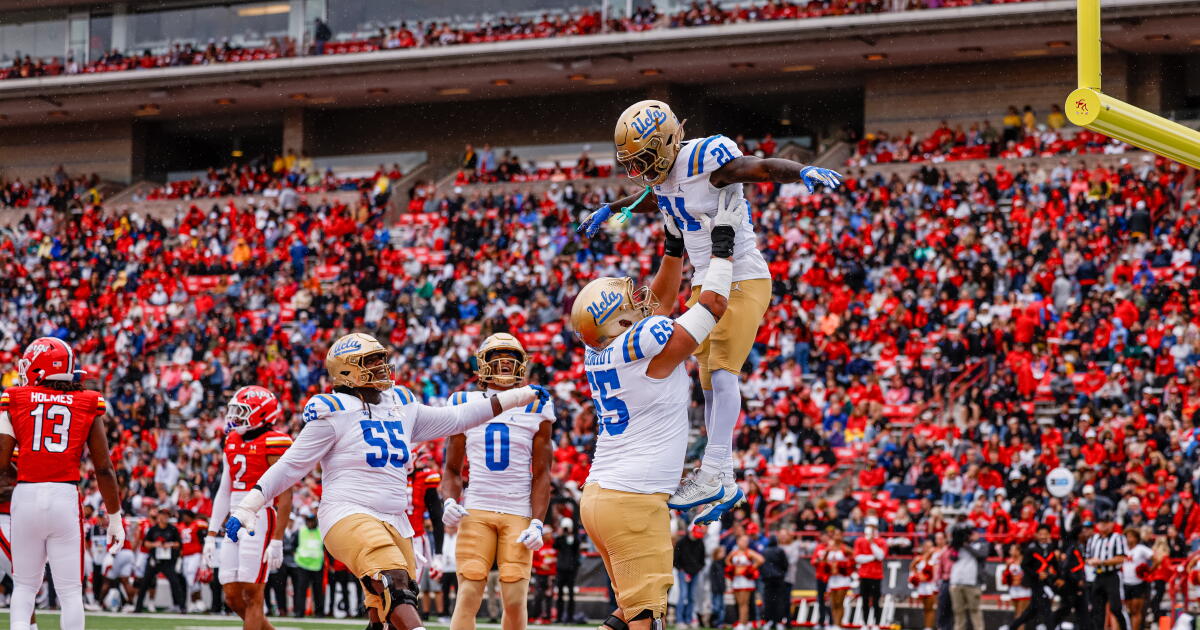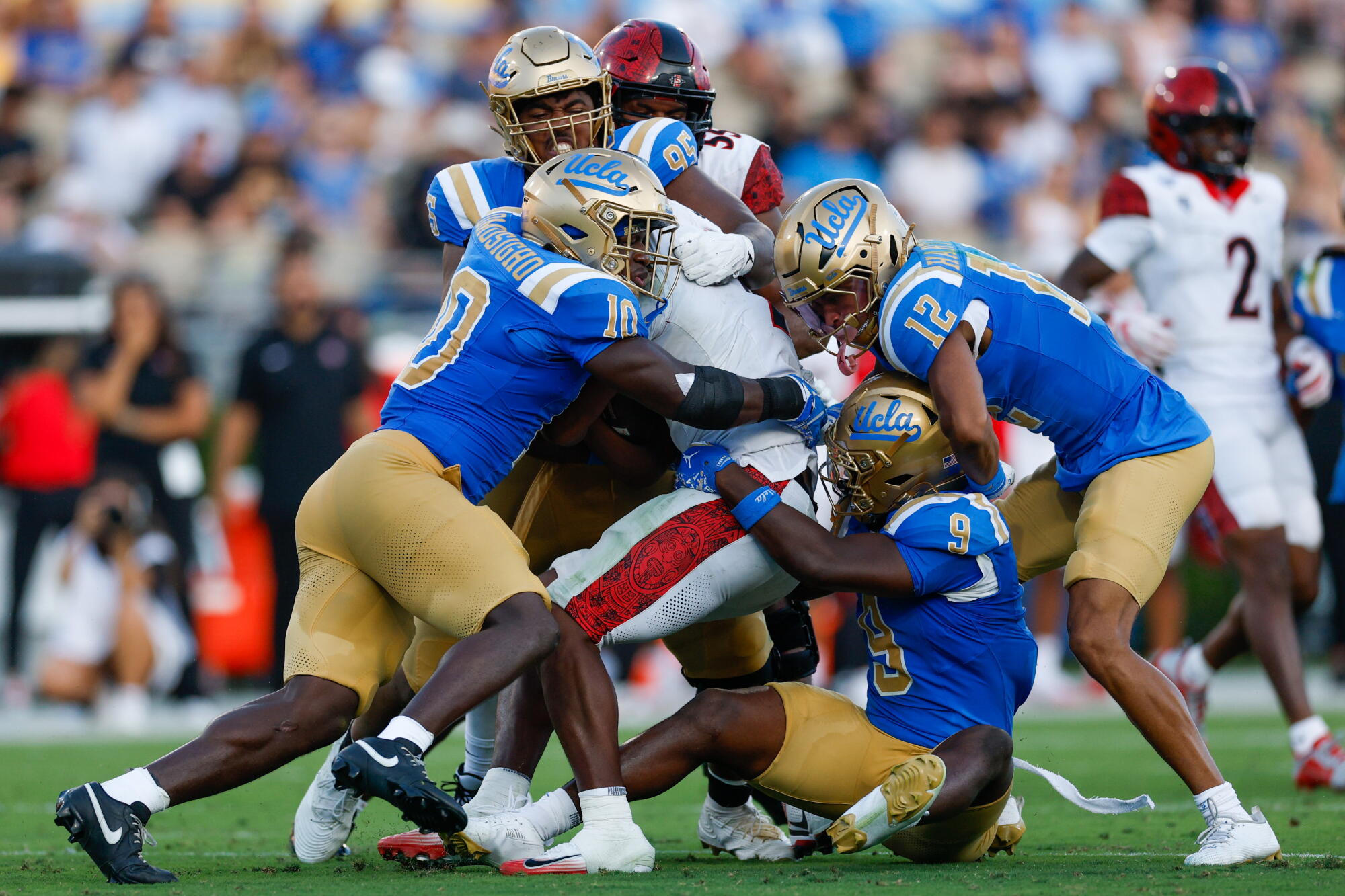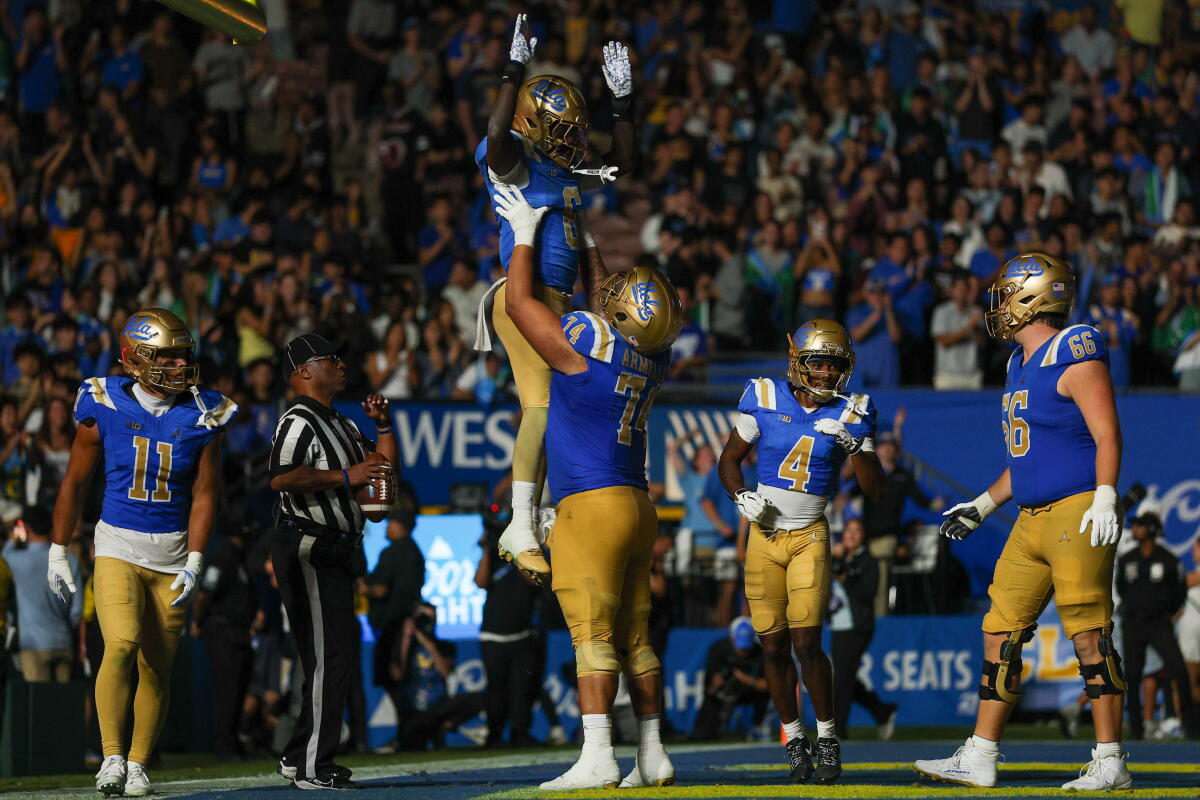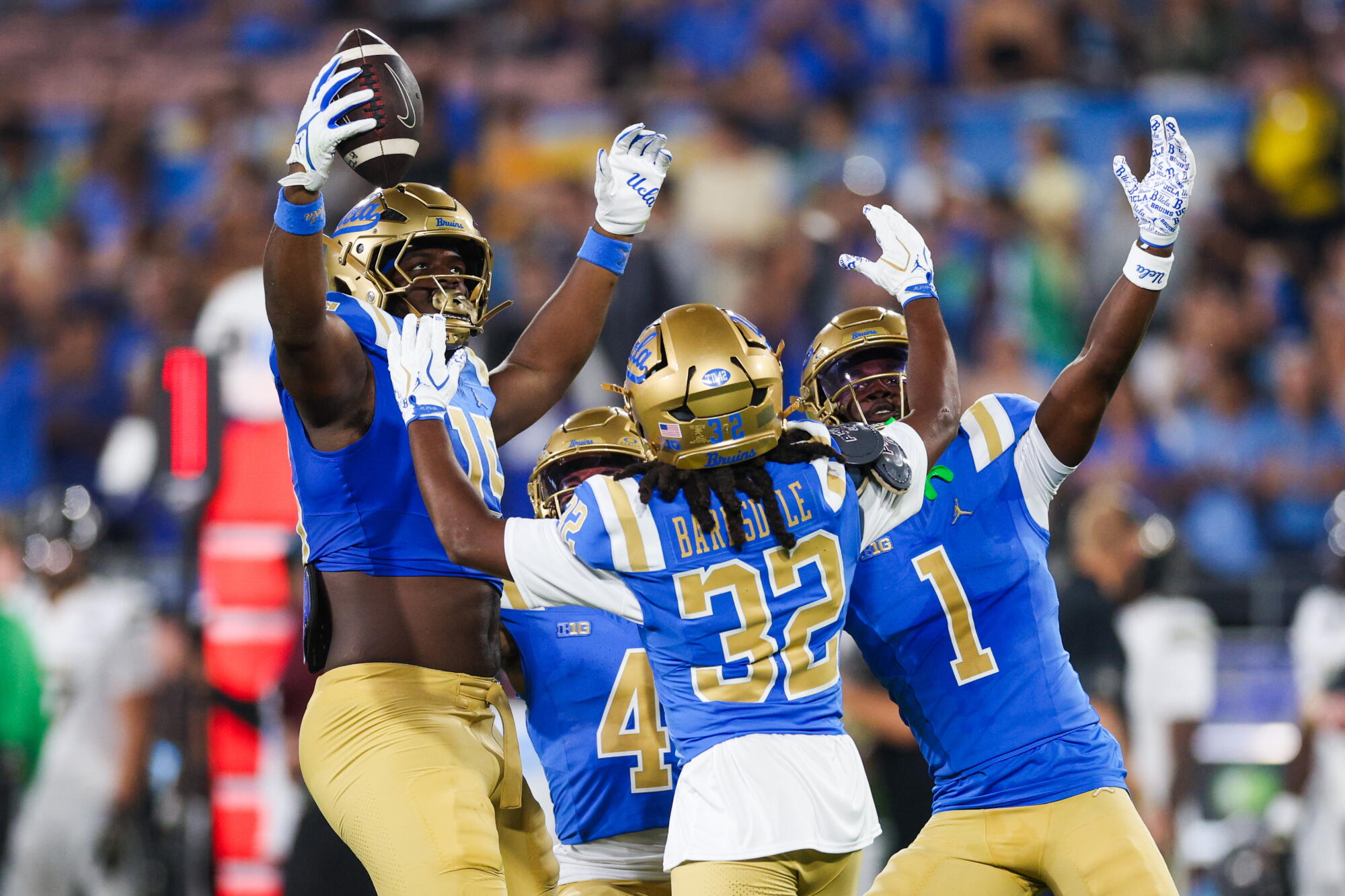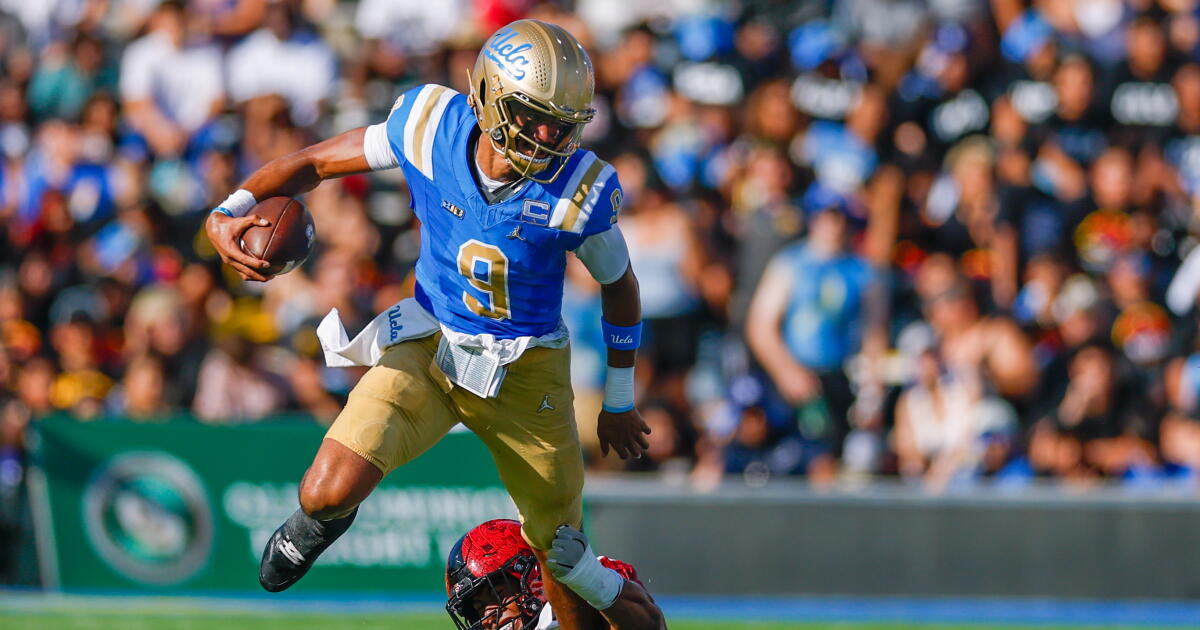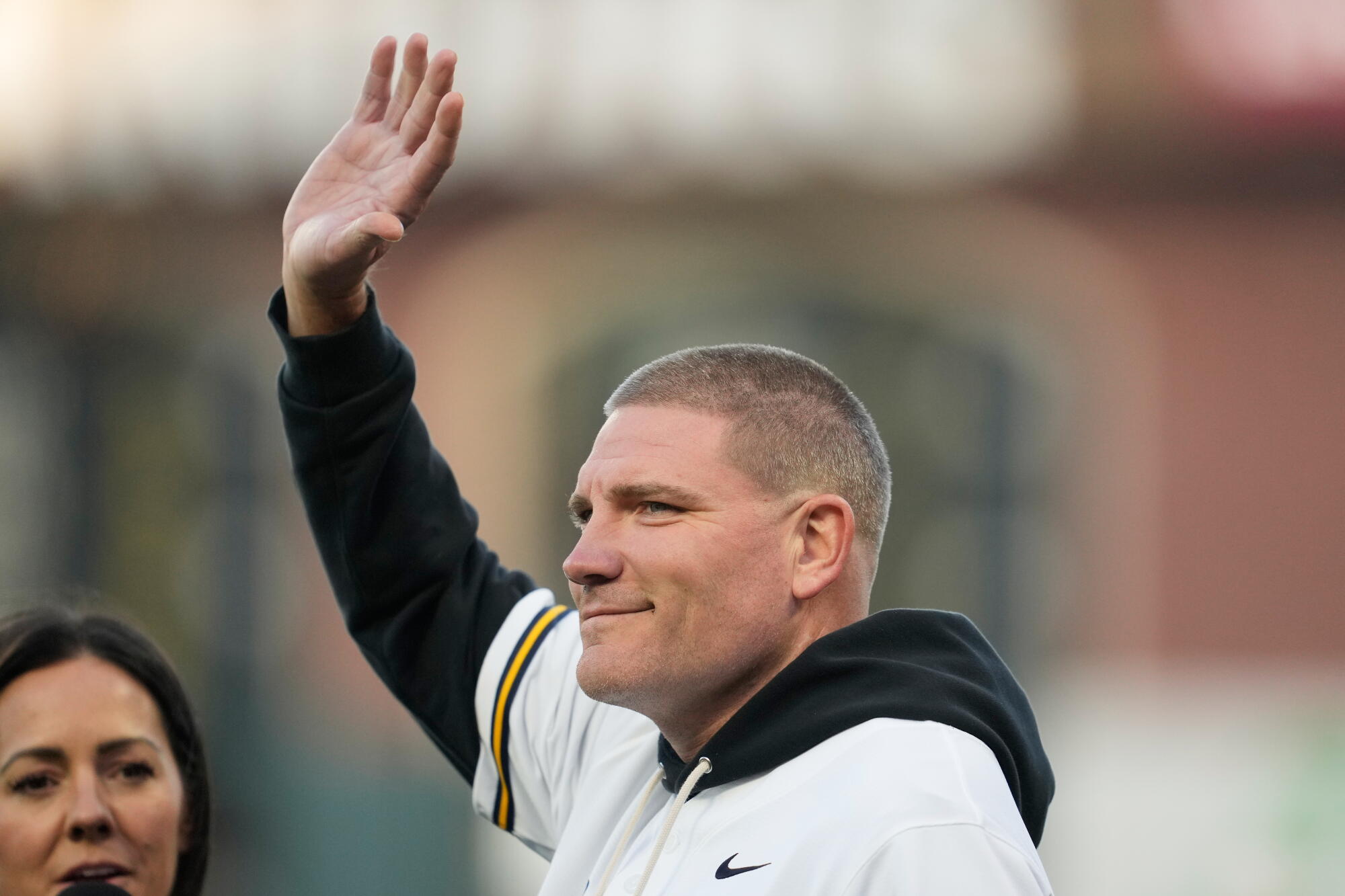
Former NFL quarterback Derek Carr has joined UCLA’s coaching staff as a special advisor to coach Bob Chesney.
The Bruins announced the hiring Monday of the 35-year-old Carr, who is volunteering in his first major coaching role.
The longtime Raiders starter will help Chesney and the Bruins’ offensive staff with game planning and strategy, and he will work with UCLA‘s quarterbacks.
“His experience, leadership and football knowledge will be an incredible resource for our coaching staff and student-athletes,” Chesney said in a statement. “What stands out most is his passion for the game and his commitment to developing young people. Derek will have a tremendous impact on our players and is a great addition to our program.”
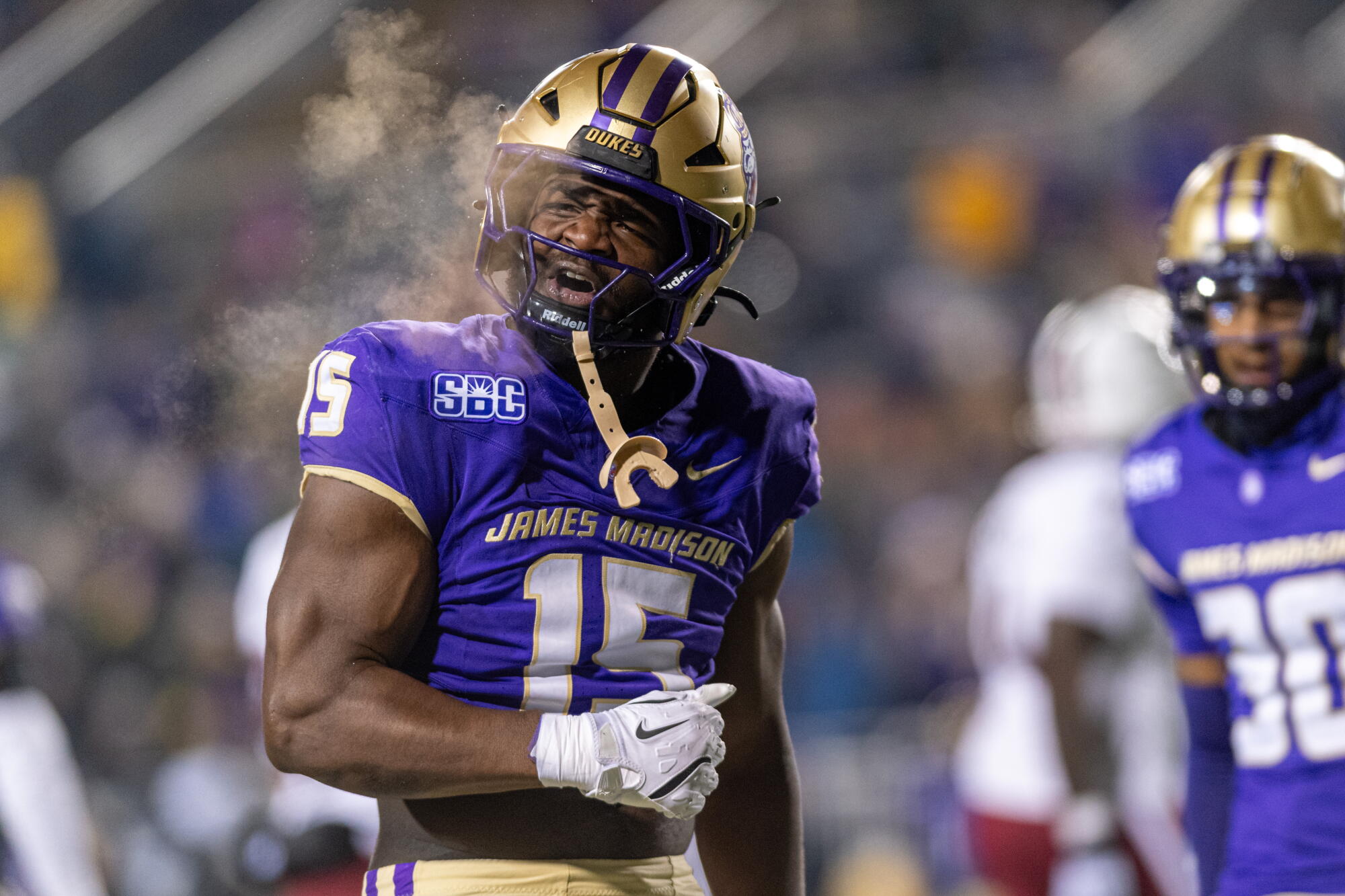
Chesney and his staff are in their first season in Westwood after he was hired away from James Madison last December. Carr’s connection to the job was through Bruins general manager Darrick Yray, an offensive assistant and an assistant director of football operations at Fresno State during Carr’s prolific career with the Bulldogs.
“I’ve known Darrick for a long time and have great respect for the work he’s done throughout his career,” Carr said in a statement. “The opportunity to help coach Chesney, the staff and the quarterbacks at UCLA was one that really excited me. I’m looking forward to sharing my experiences and helping support the program in any way I can.”
Carr is 22nd in NFL history after passing for 41,245 yards during his 11-season career with the Raiders and the New Orleans Saints. He is the Raiders’ career leader in yards passing, completions and passing touchdowns.
Carr was a four-time Pro Bowl selection in Oakland and Las Vegas. After two subsequent seasons as the Saints’ starter, Carr retired from the NFL in May 2025 because of a serious right shoulder injury.
Carr’s No. 4 is retired at Fresno State after he passed for 12,842 yards and 113 touchdowns, leading the nation in both categories in 2013 while winning the Sammy Baugh Trophy.
At UCLA, Carr will work with presumptive starter Nico Iamaleava, the Tennessee transfer and Long Beach native who passed for 1,928 yards and 13 touchdowns last season for the Bruins. Iamaleava’s younger brother, Madden, is expected to be their backup quarterback in his second season in the program.
Even before this high-profile addition to his staff, Chesney was already building early momentum in his significant rebuilding project at a program that has foundered over the past decade.
Chip Kelly produced six mediocre seasons before he bolted from Westwood in February 2024, leaving the Bruins in the lurch after that winter’s coaching cycle had largely ended. Former UCLA star DeShaun Foster took over on short notice, but was fired three games into his second season last fall before the Bruins finished 3-9.
His two older brothers were both Division I athletes with Dominic Davis playing football and running track at USC and Diab Davis running track at California.
For a dual-sport athlete with big dreams like Pleasant, having mentors in his two brothers to lean on and gain advice from was everything he ever needed.
But once the four-star Gardena Serra product made it to Oregon for his first year of college football, he struggled to adapt and get situated in Eugene, Ore., — he needed another older brother.
Defensive back Rodrick Pleasant signals downfield during a UCLA football preseason practice.
(Isabella Serafini/UCLA Athletics)
And it was former Oregon and Chargers cornerback Nikko Reed who stepped up to the plate and guided Pleasant through his first two years of Power Four football.
Reed’s impact on Pleasant was so profound that the UCLA cornerback promised himself that he would be the Reed to other younger players.
And now it is the senior’s time to pay it forward.
“That’s what I’ve taken pride in in the spring, being a leader, being a guy that can talk too, being the guy that I needed when I was a young kid,” Pleasant said on the second day of UCLA preseason camp. “I’ve had great leaders for me when I was at another place, and that’s what I’ve been trying to work on and be there for the guys because I know I’ve dealt with stuff that they’re going through, so that’s what’s been the biggest thing for me.”
Pleasant got his first taste of leadership throughout spring practices. He was recovering from a shoulder injury suffered at the tail end of the 2025 season and had to sit out of team and contact drills.
On the sideline, Pleasant had to learn to impact the game and the players around him without stepping onto the field.
The 2025 All-Big Ten honorable mention honoree quickly found out that by coaching others, he could also help himself.
“Being out there and being able to coach the guys and help the guys. If you can coach it, you can play it,” Pleasant said. “It wasn’t a frustration. I believe in the staff. I believe in what we’re doing here and they had me limited … for a certain reason. I trust the process.”
The Gardena native could have entered the transfer portal after head coach DeShaun Foster was fired three games into the 2025 season. And he had another chance after the season ended with his position coach Demetrice Martin left for Arizona State.
But the Bruins new coaching staff left a lasting impression on Pleasant.
“It’s a family-oriented place. You see, their families running around here, their kids. They’re people at the end of the day, and being around them is special,” Pleasant said. “So knowing that they treat their families like that, and have their families around us, I appreciate it.”
And no one left a stronger imprint then Chesney, who Pleasant said has been the same guy ever since their meeting.
Despite five new cornerbacks joining the team through the transfer portal and 2026 recruiting class, the comfort induced by the family-oriented coaching staff has allowed Pleasant’s leadership to flourish, supporting one of the deepest position groups on the team.
“We’ve been jelling. . We’ve been practicing for a very long time together and the chemistry is there,” Pleasant said. “It’s exciting. A lot of dudes are on the same page together, so that’s what I’m really excited about.”
Pleasant is determined to be a leader among the defensive back group and in the locker room, being the person Reed was to him.
And one of the first players he took under his wing was sophomore cornerback Osiris Gilbert, a UConn transfer.
“That’s my guy. He’s a young guy. He’s going to be special,” Pleasant said of Gilbert. “He has talent. He’s a competitor, and I’m excited about this season for him. He has a lot to give out to us, and he’s going to bring a lot out of us.”
Rodrick Pleasant, center, of Gardena Serra wins the 100 meters state championship in 10.20 seconds in 2023. Jaelon Barbarin, left, of Simi Valley finished sixth and Anthony Flowers of South Torrance was fourth.
(Nick Koza)
While Pleasant’s leadership is centered around UCLA football, it does not end there.
The defensive back and former 100-meter sprinter who broke the California state record in the 100-meter dash with a time of 10.14 at the CIF Southern Section Masters Meet in 2023 is also supporting the Los Angeles Jets Track Club.
“I went to the [USA Track and Field] Junior Olympics this past weekend and it’s just great seeing the young kids,” Pleasant said. “I’m a Jet at heart, and being out there and watching them run, it brings back memories. I’ve done it and the youth is a special place. Being somebody that they can see has done it before is like no other. So that’s why I wanted to get back. I like to be there because I know I needed somebody.”
A slew of online discourse unfolded last week after Turning Point USA spokesman Andrew Kolvet shared that a college-aged member of the conservative nonprofit told him, “A burrito shouldn’t cost $20.”
“Yeah, a lot of this is a hangover from COVID and Biden-era inflation, but the lived experience is the same: It just feels like basic things cost too much,” Kolvet wrote in the viral X post, which has racked up more than 3 million views.
The online controversy highlights a deep frustration for young adults in Los Angeles. While politicians appear to be debating inflation for their own ends, students are struggling with the reality of not being able to afford food.
A $20 burrito sounds “unjustifiable” to Klarissa Palacios, who graduated from USC in May with bachelor’s and master’s degrees in law, history and culture. While in school, Palacios interned at various city hall offices and said her hourly salary eventually reached $25 — a key consideration for college students, she said, because many young people determine a meal’s affordability based on how many work hours can pay it off.
With minimum wage in L.A. at $18.42 per hour as of July, college students earning this rate would need to work for more than an hour in order to pay for just one burrito, Palacios pointed out.
“I’m Mexican, so I grew up with free burritos at home, anytime I wanted. $20 is pretty steep,” she said. “I’m expected to eat three times a day. If I’m spending $20 per meal and I work eight hours, then that means I’m only really getting paid five hours.”
Noticing a need for affordable meals, Palacios and fellow USC student Josiah Herfurth spent this past semester hosting $10-per-person lunches at their college apartments, dubbing the offering Cafe 10:31. The idea budded from a survey they sent to fellow members of their campus ministry, which found that the leading reason students weren’t attending post-church lunches at restaurants ranging from In-N-Out to sit-down ramen spots was because they wanted to save money, not for a lack of transportation or time.
So Palacios and Herfurth began paying out of pocket for bulk Costco runs that fed as many as 40 people per event. On the menu? Tacos, chili, hot dogs and conversation.
“It started with being just a USC college student thing, and ended up being just a general young adults thing,” Herfurth said, referring to how word quickly spread to UCLA and Cal State Long Beach students, as well as the young adult community at their church.
Herfurth is used to meal prepping in bulk, and said it’s a common practice among college students hoping to cut costs. He and his roommates would use up to six stove burners at a time to prepare meals together, he said.
“It was always more fun for me when I could share something with someone else, and it also made things cheaper,” Herfurth said. “That was the key to me.”
“Just hearing about this dumb $20 burrito debate so just thought I’d make the losers on social media angry before going to bed,” Crenshaw wrote. “Stop whining, get a job, eat ramen like the rest of us did in college, on a budget with four roommates.”
But Megan Monroe, who graduated from UCLA in June, said it’s unrealistic to eat packaged ramen like the iconic Cup Noodles brand for every meal.
“Just because someone else did it, doesn’t mean that was the right thing to do,” Monroe said. “Nutrition has come such a long way. … I think it’s for the best that we’re steering toward a better, nutritional diet.”
Still, Monroe is a stickler for keeping her diet affordable.
Even though UCLA’s dining halls are recognized as the best in the country, Monroe opted out of the campus meal plan her junior year. Her required freshman and sophomore year plans came out to about $9 per visit, but when she moved to an off-campus, university-owned housing complex, she had the choice to opt into a plan that would cost about $15 per visit. She deemed it too expensive.
“I was like, I can cook for less than that,” Monroe said.
Since her dining hall days, Monroe now makes one Trader Joe’s trip per week, which usually comes out to about $45. She typically has milk and cereal for breakfast and is known among friends to eat a homemade take on a classic deli combination “360 days of the year”: a cold sandwich, a piece of fruit and a bag of chips.
Monroe does dine out once per week, including for burritos — she favors the $11 burrito at Brother’s Cousins Tacos in Sawtelle.
In a burrito city like L.A., prices can range dramatically, such as Burritos La Palma’s $5 homestyle burritos, where the menu recommends ordering two or three per person for a satisfying meal. When former taco stand El Ruso opened its flagship in Studio City last month, burritos wrapped in 18-inch Sonoran flour tortillas and stuffed with rib-eye or chile Colorado were priced at $20 each. It’s not uncommon to find breakfast burritos that exceed $20, like the $24 wrap with beef machaca and shrimp offered on Daisy Margarita Bar’s weekend brunch menu.
For students at other universities, campus dining varies in affordability.
When Joshua Min started at Cal State Long Beach in 2025, a $315-million renovation project had just shut down its University Student Union through 2028.
In light of the closure shuttering certain food options on campus, the university gathered an array of local food trucks — with most meals within the $15 to $20 range, Min said. Not wanting to spend additional funds, he opted into a meal plan offered for commuter students like himself, with 50 meals for the 16-week semester that came to about $10 per meal.
Min said he had minimal complaints of the food itself; he often filled up his plate with chicken, rice, fruit and vegetables. But he found himself rationing the meal swipes, starting the semester conservatively and ending with extras, which he used by inviting his friends to come with him.
After that semester, Min opted to pack turkey or tuna salad sandwiches for school, using bulk ingredients that his family buys from Costco.
Min said he ultimately was disappointed at Cal State Long Beach’s selection of food trucks, as a student who prioritizes cutting his cost of living.
“It seemed like they just cobbled up these ideas at the last minute,” he said. “I respect the effort, but I think a lot of students were left unheard and hungry.”
UCLA head coach Bob Chesney coined it at the beginning of preseason camp last year in Harrisonburg, Va., before leading James Madison to a 12-2 record, a Sun Belt championship and its first College Football Playoff appearance.
“You either compete or complain, you can’t do both,” Chesney said on Aug. 5, 2025. “You are either full of pride and won’t allow yourself to have mental, physical and emotional lack of discipline and toughness, or you fill yourselves with pity and you have a lack of all three of those things.”
Chesney carried that same tune on his first day of fall camp in Westwood, leading his new team.
The Bruin faithful got its first taste of their newly minted head honcho at his introductory news conference on Dec. 9, where he made promises of turning around the football program, elevating it to its height of the past, and reengaging the Bruin community.
UCLA quarterback Nico Iamaleava looks to throw a pass during the first day of preseason camp at Spalding Field on Thursday.
(Ronaldo Bolanos/Los Angeles Times)
And Chesney has not wavered since.
From his halftime speech at a UCLA men’s basketball game versus Indiana — where he proclaimed that the Bruins would be Big Ten champions — to throughout spring practice and all through Big Ten media day last week, Chesney has stayed consistent.
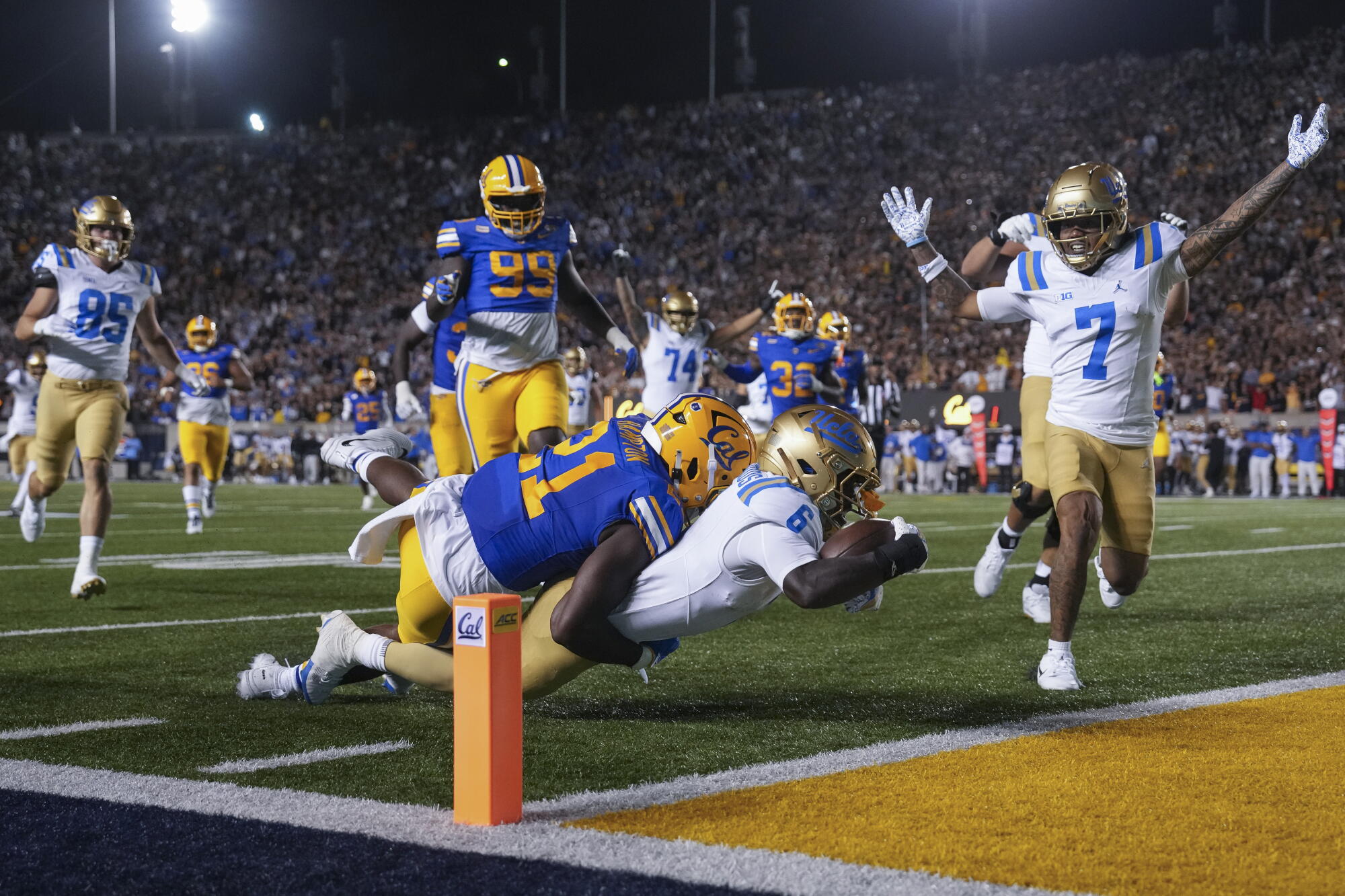
And that consistency includes the way he is training his players leading up to UCLA’s opener against California, where the former Pac-12 rivals will meet for a night game between two first-year head coaches.
Chesney has emphasized, throughout his short tenure in Westwood, that while physical development is imperative in the offseason, the mental side of the game carries the same weight. Central to that, is putting players in adverse situations in the offseason to get them battle-tested come game day.
“Those are the moments that test you. Pay no attention to a virtue that’s not been tested in fire, and that’s ultimately something that we got to be able to do is put them in situations where we’ve tested them in fire,” Chesney said. “We know how they’re going to react and how they’re going to respond. We know when the moment’s on the line. That’s the most important thing that we can do out here. That’s what this whole entire camp is ultimately about.”
In order to test his players’ resiliency, Chesney has implemented “compete periods” throughout his time in Westwood to emulate the speed and intensity of live reps.
Alongside competition has been grading everything a player does, so there is no ambiguity as to where a player stands on the depth chart or in the program.
Chesney also talked about the structuring of his practices, specifically with having some in the morning and afternoon to expose his players to the heat. pic.twitter.com/3Ee5K7bYWE
Outside of the actual drills and exercises Chesney implements, the coach has also purposefully scheduled some of his practices in the afternoon to expose his players to the intense Los Angeles heat — his version of throwing his players into the fire to help get them acclimated and test their mental toughness.
Chesney’s mental training ultimately serves as a litmus test in discovering who is cut from a different cloth.
“Procedural discipline was a big part of what we want to make sure that we’re constantly talking about,” Chesney said. “And then, how quickly can I get to the next play? How much do I love being coached, and how hard am I going to be coached and accept that coaching and make myself get better?”
With passion and excitement emanating from players on the first day of fall camp, and less than a month away from the first game of the season, Chesney highlighted that it is about striking a balance: testing his players’ resolve but also not being reactionary.
The new head coach underscored that it can be easy for impulse and emotion to take over, but uplifting one another and letting mistakes refine you rather than define you is integral to success.
UCLA defensive linemen Jacob Busic (97) and Anthony Jones (15) run drills during the first day of preseason camp at Spalding Field on Thursday.
(Ronaldo Bolanos/Los Angeles Times)
Central to that is teammates, particularly within the same position group, celebrating the success of one another rather than letting the depth chart dictate morale.
“If someone’s above you and perceived to be above you, what are you doing? Are you trying to elevate your game and compete with them, or are you trying to knock them down and pull them back towards you?” Chesney asked.
“The best teams in the world love that that guy above him is a little better, and they are chasing him every single day. We have a good amount of that on our team, and it’s got to continue because we are going to need everybody, whether they know it or not,” he said.
UCLA will not play its first game until Sept. 5.
However, battles will be won and lost within the team along the way.
But to Chesney, it is how you respond to those successes and failures that prevail.
Maurice Jones-Drew will forever be etched into the memories of the Bruin faithful.
Whether it was his 322 rushing yard and five-touchdown performance against Washington in 2004.
Or his electrifying punt returns — boasting a career average of 23.2 yards per return which ranks second in NCAA history.
Or his unanimous All-American selection as an all-purpose back and returner in 2005.
The tailback captured the hearts and eyes of everyone who watched.
And while the current generation of Bruins never saw the three-time Pro Bowler play in the blue and gold, they will see the same surname stitched on the back of a UCLA jersey in 2027 with three-star recruit Duece Jones-Drew, who committed to his father’s alma mater on May 3.
Sign up for UCLA Unlocked
A weekly newsletter offering big game takeaways, recruiting buzz and everything you need to know about UCLA sports.
By continuing, you agree to our Terms of Service, which include arbitration and a class action waiver. You agree that we and our third-party vendors may collect and use your information, including through cookies, pixels and similar technologies, for the purposes set forth in our Privacy Policy such as personalizing your experience and ads.
Despite Maurice’s affinity for the place he once called home, he hoped that his son would not follow his footsteps to Southern California.
“I wanted to push him away from UCLA as much as possible because I wanted him to go there because he wanted to go there,” Maurice said. “I wasn’t really involved in the recruitment as much because I wanted him to enjoy and go through this process like I did. I wanted him to go to a school that he wanted to go to because it’s his football career. It’s his life. It’s going to be his journey, and I wanted him to feel comfortable wherever he went.”
So the 2017 UCLA Athletics Hall of Fame inductee stuck to his word.
Duece talked to all the coaches. The 5-foot-8 De La Salle running back visited other schools without his father to eliminate any bias or influence. He even drove down by himself from the Bay Area to Los Angeles for UCLA’s Junior Day.
And initially, it looked like Duece was going to stay away from his father’s alma mater after the firing of head coach DeShaun Foster and the potential exit of running backs coach AJ Steward.
But new head coach Bob Chesney retained Steward and the running backs coach encouraged Duece to attend Junior Day.
And shortly after Duece visited UCLA, he knew where he wanted to play — so much so that his parents had to stop him from committing too early.
“Coach Chesney came in and he really changed my mind on what UCLA was, and coach Steward really was on me about getting to campus and experiencing what the new coaching staff was like,” Duece said. “I went there for the Junior Day in January and I fell in love. I love what they believe in and how they compete every day to be the best version of themselves.”
Despite the urge to commit on the spot, the three-star prospect heeded his parents’ advice and took his final visits to the other schools on his list, which included California, Arizona and Utah.
And after juxtaposing his experiences on all his other visits to his experience in Westwood, he had a clear decision.
“My parents always taught me to be myself, and I knew that UCLA was the best school for me, education-wise, and having my dad be there and be such a great player there as well,” Duece said. “I wanted to commit when I went down there in January, but I listened and waited, and I feel like that was the best decision for me. To go visit other schools and see where UCLA stood on my board, and they stood leaps and bounds above Cal and Arizona.”
Throughout the recruitment process, Maurice worried that it would be easy for people to assume that his son only got offered by UCLA because of his legacy there or that he pushed him to commit to the Bruins.
But despite all of the encouragement he gave his son to not hastily pick UCLA, when Duece made his commitment official, there was no one more ecstatic.
“When he picked UCLA, I was excited. I don’t know what the word would be. It’s probably more than that,” Maurice said. “But I was happy that he felt comfortable going somewhere because these next three, four years are where you’re going to make the most leaps and bounds going from a young man to a man, and to be able to pick a school and feel the same way that I felt when I picked UCLA, it was everything I thought it would be.”
Maurice also noted that his son has the same opportunity he had when he committed to former UCLA head coach Karl Dorrell in 2002 — to turn around a struggling program and create a long-lasting legacy.
But that would only be possible with the right people at the top.
And for Maurice, it felt right with Chesney.
“We preach certain things in our household, and coach Chesney preaches and practices those things,” Maurice said. “Hearing coach Chesney talk, hearing all the coaches talk, their strength staff, their training staff — everybody’s on the same page. It’s constant communication. They have a plan of how they operate, how they raise young men on and off the field. It’s a great opportunity to go to a place that needs to be put back where it needs to be.”
Above all, Maurice is looking forward to being a fan.
“I know he’s a terrific player, he’s a great student and I’m excited to see what he can do,” Maurice said of his son. “I don’t know if I still have any records, but if I do, I’m sure they’ll be broken by the time he’s out of there. I can’t wait to watch him and cheer for him and love him up and hug him and do all the stuff that dads get to do when they watch their boys.”
Time for the Bruins to go camping
UCLA preseason camp kicks off on Thursday on the UCLA campus. Chesney and his staff will lead the Bruins through workouts at Great Park Sports Complex in Irvine from Aug. 10-14. Many coaches opt to spend at least a few days away from campus during preseason workouts to promote more team bonding. UCLA will kick off Chesney’s debut season at Cal on Sept. 5.
Betts wins prestigious Honda Cup
UCLA center Lauren Betts shoots over Duke’s Toby Fournier during an Elite Eight game in Sacramento on March 29.
(Eric Thayer / Los Angeles Times)
Former UCLA All-American Lauren Betts earned one more award to cap her successful run as a Bruin.
Betts was named 2026 Honda Cup winner at the Collegiate Women Sports awards last week, becoming the seventh Bruin and 20th basketball player to win the top award in college women’s sports. Honda awards are presented to top performers in 12 NCAA sports and they compete for the top overall prize — the Honda Cup.
Betts helped UCLA win its first women’s basketball NCAA national championship, earning the tournament’s most outstanding player award. She led UCLA in scoring (17.1) and rebounding (8.8) while averaging 27.7 minutes per game.
Do you have a comment or something you’d like to see in a future UCLA newsletter? Email newsletters editor Houston Mitchell at houston.mitchell@latimes.com. To get this newsletter in your inbox, click here.
I was feeling good about UCLA football, until Bill Plaschke promised Bruin greatness. Hey, Uncle Bill, could you please retract your prediction, considering your track record? Maybe then, the Bruins will have a chance!
Jack Wolf Los Angeles
Despite his middling record, Times columnist Bill Plaschke has once again entered the prediction business. Unrestrained as ever, he predicts greatness for UCLA football, courtesy of its new head coaching hire, Bob Chesney. However, Bill fails to quantify what he expects the team to achieve? Is it simply a winning record? A victory over crosstown rival USC? Or, dare I mention, a national championship? I guess we’ll all have to wait.
Rob Fleishman Placentia
Bob Chesney has won before. Winning at UCLA is another matter. But when Bill Plaschke starts pumping sunshine, history warns against climbing aboard the Bruin bandwagon unless it comes with an extended warranty and roadside assistance. Until then: “Westwood Ho!”
A UCLA jersey worn by Lew Alcindor in the 1968 NCAA national championship game and the 1969 Final Four is set to garner more than $1 million at auction.
The man who has owned it for the past half century — a former Los Angeles resident who was a huge fan of the player now known as Kareem Abdul-Jabbar — didn’t have to pay nearly as much for the historic piece.
In fact, he paid no money at all. Instead, he traded for it after a Lakers game in the Forum parking lot back sometime in the mid- to late-1970s, giving up one of his prized possessions as a teenager living in South Gate:
His transistor radio.
“I used to listen to Dodger games on it under my pillow,” said the auction’s consignor, a man named David who asked to have his last name withheld because of privacy concerns.
Back then, David and some friends would often take the bus to the Forum, where they would try to convince fans to give them their extra tickets to attend the Lakers game that night. Afterward, they would wait in the parking lot for players to leave the building.
A UCLA jersey, worn by Lew Alcindor during the 1968 national championship game and a 1969 national semifinal, is up for bid at Grey Flannel Auctions.
(Grey Flannel Auctions)
“We were young and crazy. We waited till the players came out and kind of talked to them,” said David, who says he once walked with Wilt Chamberlain to his car. “And there were other kids there. We would trade stuff, and that is basically how I got the jersey.”
By then, Abdul-Jabbar was a star with the Lakers, after winning three NCAA titles under legendary UCLA coach John Wooden and leading the Milwaukee Bucks to an NBA championship in 1971.
The young man who was originally wearing the No. 33 Bruins jersey that night was actually a USC fan, David said, so the trade was fairly easy to pull off.
“Back then transistor radios were real popular,” David said.
Over the decades, he mostly kept the jersey stored away neatly, occasionally pulling it out for a look or to show others. Recently, David said, he was “just cleaning things out” and decided it was time to part ways with the cherished item.
“I said, you know, someone else will really enjoy this,” David said. “And they’ll display it, and people can enjoy it more than I will stuck in some kind of storage thing.”
According to Michael Russek, director of operations for Grey Flannel Auctions, David didn’t know a lot about the jersey’s history when he first brought it in, only that it was issued by UCLA and had likely been worn by Alcindor in some game at some point.
Photo-matching revealed that he had worn it in several games, including some very significant ones. He wore it while scoring 34 points with 16 rebounds in UCLA’s 78-55 victory over North Carolina in the 1968 national championship game and also during multiple games the following season, including the Bruins’ 85-82 victory over Drake in a national semifinal game (Alcindor had 25 points and 21 rebounds).
UCLA’s Lew Alcindor steals the ball and dribbles away from a group of North Carolina players
(Harold Filan / Associated Press)
“That’s when it really started to come together that we have something that’s truly special,” Russek said.
As of Friday morning, bidding had reached $850,101, with a 22% buyer’s premium bringing the price to nearly $1.04 million. The auction ends Aug. 16.
David said he was “very surprised at how it took off so quick. I’m not familiar with these kind of auctions or jerseys, really. But there’s a lot of alumni from UCLA down there, and a lot of people would like something like that.”
The current Oregon resident added that he hasn’t thought about what he’s going to do with all that cash.
“I’m not the kind of person who does plans for money until I have it,” he said.
CHICAGO — In the nearly nine months since he was hired as head coach at UCLA, Bob Chesney has won over a lot of hearts and minds with his unwavering sense of belief.
First, he won over his star quarterback, Nico Iamaleava, who opted to stick with the Bruins after a 3-9 season a year ago. He won over 45 new transfers, who came to UCLA as part of the portal’s 11th-ranked class and seems to be winning over recruits, too, with UCLA currently ranked in the top 10 among 2027 classes. He even won over once-dormant Bruin donors, who, according to the school’s athletic department, have now poured over $41 million in private support into UCLA athletics over the past fiscal year, an increase of 80% from the previous year.
“It’s his energy, man,” Iamaleava said. “He brings a different type of energy.”
At this point, the only thing it seems Chesney hasn’t won yet at UCLA is an actual football game.
He couldn’t do anything about that Wednesday from the podium at Big Ten media days. Though, as far as first impressions go in this conference, Chesney certainly had a leg up on his predecessor, who stumbled through his own opening address two years ago.
But as the season draws nearer and a new era of Bruin football begins, all the enthusiasm does beg the question: What does a successful debut actually look like for Chesney at UCLA?
Chesney said Wednesday he had no interest in setting those expectations or “in putting artificial limits on ourselves.”
“Outcomes have to be earned,” he said. “And I think in the end, potential is a gift, right? The work is becoming. That’s the work.”
Considering UCLA’s recent history, you can understand why Chesney wouldn’t want to wade too far into setting expectations. Hope, after all, may be his most valuable resource at the moment.
The Bruins are coming off a season in which they won just three games, their fewest in more than 54 years. They’ve reached the nine-win mark once in the past decade. And just two UCLA coaches in a half-century — Jim Mora and Terry Donahue — have clocked a winning campaign in their debut seasons with the Bruins.
“There’s no better place I’d rather be at this moment in time,” Chesney said. “I strongly believe in the power of what UCLA is.”
The collective Big Ten media seems less convinced, having voted the Bruins to finish 13th in their preseason conference poll. That’s exactly where they finished last season.
But there are some things working in Chesney’s favor. For one, a schedule that includes just four opponents picked to finish in the top half of the Big Ten.
It doesn’t hurt, either, that his quarterback got a full spring and summer under his belt as a Bruin. Iamaleava didn’t join the program until late in the process last season after his transfer portal drama dragged out through the spring and summer. Then once he started to find his bearings, UCLA’s coach was fired.
There was no such uncertainty this offseason, as Chesney moved to quickly retain Iamaleava.
“It was a matter of making sure he understood we had a plan,” Chesney said. “That was the most important thing we could do to make sure he stuck around and he did.”
Not only was Iamaleava impressed with his plans to prepare him for the NFL, but he found himself right away swept up in the coach’s personality.
“When you first talk to him,” Iamaleava said, “it kind of sounds like you’re talking to a poet or something, the way the words roll off.”
Chesney is counting on Iamaleava to make things move smoothly for UCLA’s offense this season. But the most marked difference for the Bruins on that side of the ball should be the ground game.
The Bruins boasted one of the least dynamic rushing attacks in the Big Ten a season ago, as Iamaleava led the team with just 505 rushing yards. Their lead running back, Jalen Berger, rushed for a meager 364 yards over the course of the season.
Meanwhile, at James Madison, Chesney had three running backs with as many yards last season. The Dukes rushed for the fifth-most yards (3,381) of any Football Bowl Subdivision team.
Their lead rusher, Wayne Knight, followed Chesney to UCLA and should step in as one of the best backs the Bruins have had in years. Of the 30 backs in college football with over 200 carries, Knight averaged the most yards per carry last season (6.63).
“There’ll be a commitment to playing that style of football,” Chesney said.
The rest is mostly just a projection, a fact that Chesney openly acknowledges.
“Everything here is ultimately conceptual,” he says.
But one change has already taken hold, if you ask Iamaleava. One that might appear unrecognizable from recent history at UCLA.
“He’s definitely changed the mindset in there, just how you feel. I don’t know how to explain it,” Iamaleava said.
“When Ches walks into a room, he just brings that winning mentality.”
Welcome to UCLA Unlocked, our weekly newsletter featuring all things Bruins athletics. To sign up to get this newsletter delivered every Monday to your inbox, click here.
But Plaschke reported his philosophy has quickly forged deep roots in Westwood, where Chesney’s optimism fits in seamlessly at the school built on John Wooden’s Pyramid of Success. There’s also some very strong Ted Lasso energy brewing, which makes sense since the character is partially inspired by Wooden values.
A weekly newsletter offering big game takeaways, recruiting buzz and everything you need to know about UCLA sports.
By continuing, you agree to our Terms of Service, which include arbitration and a class action waiver. You agree that we and our third-party vendors may collect and use your information, including through cookies, pixels and similar technologies, for the purposes set forth in our Privacy Policy such as personalizing your experience and ads.
We’ve heard from some UCLA fans were irritated about a potential Plaschke curse after he announced Chesney will make the Bruins winners, but its seems the Bruin faithful are just going to have get used to a growing bandwagon.
The UCLA hype should go national Wednesday, when quarterback Nico Iamaleava, defensive back Cole Martin and linebacker Samuel Omosigho join Chesney during Big Ten football media days.
It’s Chesney’s first chance to meet the national and regional media covering the Big Ten. He is naturally an exceptional public speaker and inevitably will be compared to his predecessor, who went viral for his difficulty the first time he stepped into the Big Ten spotlight.
It’s not a fair comparison, but Chesney is sure to score high marks despite a healthy amount of cynicism among Big Ten blue bloods and whispers throughout the league that UCLA’s high 2027 recruiting ranking is a bit inflated. Perhaps that’s the biggest compliment for UCLA, going from being ignored or laughed at to taking a few jabs over your glowing reviews.
Shortly after UCLA returns from media days, the team will kick off preseason camp. We’ll start to get a closer look at the Bruins’ offseason weight room progress and the team will work to prepare for a deceptively difficult opener at California, another long overlooked team with considerable hype entering the 2026 season.
Betts shines in Canada
Sienna Betts showed she’s ready to step into her older sister Lauren’s formidable shoes during a women’s basketball exhibition game against Canada.
The Bruins lost 69-55 to the Canadian national team Wednesday, but Sienna Betts looked like a formidable focal point of the UCLA attack.
She finished with 20 points, 12 rebounds and two blocks.
Betts got valuable but limited minutes last season as Lauren Betts, Gabriela Jaquez and Angela Dugalic dominated the paint for the national champions.
Canada and UCLA did not have their full rosters available for the tune-up, with Bruins Timea Gardiner, K.K. Bransford, Somto Okafor and Lina Jerkovic missing the game.
The excursion gave a heavily overhauled UCLA roster a chance to face different and formidable competition before setting off on sight-seeing adventures, a team bonding opportunity that likely will mean more to the coaching staff than the final score.
UCLA alums win AUSL title
Bruins alum Jadelyn Allchin won Athletes Unlimited Softball League championship MVP honors after helping lead her team to its second consecutive AUSL title.
UCLA softball great Lisa Fernandez is the Talons’ general manager. Her roster and the entire league is packed with former Bruins who are helping AUSL grow at a rapid rate.
Connor Dullinger offered a great look at the role the Bruins have played in the growth of pro softball and explains why Fernandez is thinking bigger, pushing for global gains so that softball can be a permanent fixture at the Olympics.
Do you have a comment or something you’d like to see in a future UCLA newsletter? Email newsletters editor Houston Mitchell at houston.mitchell@latimes.com. To get this newsletter in your inbox, click here.
The 2003 Honda Award winner. A 2024 second-team All-American. The single-season NCAA home run record holder. And a freshman of the year honoree.
The Portland Cascade’s Megan Grant fields the ball during a game against the Oklahoma City Spark on July 4 in Edmond, Okla.
(Courtesy of AUSL)
All of whom never dreamed of being a professional softball player. Not because their love for the sport dwindled. Nor because professional routes were not an option. Pro softball leagues have existed since 1976, but they have lacked the visibility and accessibility imperative to flourishing and gaining popularity.
“From my experience growing up, and it’s the same amongst a lot of athletes that are my age, we didn’t have a lot of role models to look up to,” said Chicago Bandits outfielder Jessica Clements, who spent her senior season at UCLA in 2025. “We had Jennie Finch, Natasha Watley, Monica Abbott, but the odds of playing professionally were slim. There wasn’t a lot of opportunity, and a lot of younger kids were unsure of what the environment would look like in many years.”
The AUSL — which launched in 2025 and builds off previous iterations of professional softball — saw a 181% increase in average viewership across ESPN platforms in one year, including a record-high 404,000 viewers for a June 21 game between the Portland Cascade and Texas Volts.
Among the 96 active players in the AUSL, 13 are former UCLA softball players — omitting two general managers, a head coach and an assistant coach that are a part of the AUSL and hail from the Westwood program — making UCLA the most well-represented school in the league. That pipeline was on full display this weekend at Texas A&M’s Davis Diamond, where the Utah Talons — who boast a roster with five former Bruins, including UCLA softball associate head coach Lisa Fernandez as the general manager — clinched their second straight AUSL title over the Chicago Bandits on Sunday. UCLA alum Jadelyn Allchin was named the AUSL championship MVP.
And UCLA softball’s presence in all facets of AUSL is no coincidence.
The Bruins feature 12 NCAA championships and 119 All-American honorees, both of which rank first all time, and that’s not including an AIAW title and one All-American before the NCAA era. But while the program is known for its accolades, the influence UCLA and its players have made on the sport stretches far beyond any banners or trophies.
“When you look at the history of softball in the last 40 years, you can’t see a U.S. national team, any pro venture or excellence at any level of softball without having an influence of UCLA in it,” said Oklahoma City Sparks general manager Kirk Walker, who spent 24 years coaching as an assistant coach in Westwood.
There have been only three coaches — Sharron Backus, Sue Enquist and Kelly Inouye-Perez — in UCLA history, all of whom created unparalleled success and a program built on a standard of excellence and a familial culture. But no aspect of the UCLA culture may be more significant than the “Bruin Bubble” — a concept at the very heart of the program centered on alumni involvement.
“It comes from the women who were there from the beginning, paving the way for players like us and players that are to come,” said Sparks infielder Delanie Wisz, who competed at UCLA from 2020 to 2022. “The idea of the ‘Bruin Bubble’ and buying into something bigger than yourself, coach Sue Enquist, coach Sharron Backus and coach Inouye-Perez have done a really good job of keeping that at the forefront, and making sure that we’re playing for something much bigger than any individual award.”
While the childhood aspirations of the Bruins in the AUSL never reached the height of professional softball, a common goal connected them all — playing for their dream school in Westwood and learning from individuals who have achieved immeasurable success greater than any record or championship.
Utah Talons General Manager Lisa Fernandez shows off her 2025 AUSL championship ring in Salt Lake City, Utah.
(Courtesy of AUSL)
Backus and Enquist set the foundation for what softball is today, paving the way for new opportunities by sacrificing for the greater good of softball’s future.
While the duo set the trail ablaze, they have passed the baton to a trio of coaches — Inouye-Perez, Walker and Fernandez, who have spent a combined 72 years in Westwood.
And the group has not stopped running since.
The Bruins are not only responsible for creating the next generation of pro softball players through the UCLA program, but also furthering the message and mission of Backus and Enquist.
“From when I was in college to now, there’s been a big shift in how things go,” said Rachel Garcia, two-time Honda Cup winner at UCLA and a Volts pitcher in the AUSL, “but at the end of the day, Lisa Fernandez, Kelly Inouye-Perez, Kirk Walker, that would be who I’d want to play for every single day, because I know that they are able to give the girls what they need in order to perform at the best that they can be.”
While Inouye-Perez continues to steer the Bruin ship, Walker and Fernandez serve in general manager roles for the Sparks and Talons, respectively.
The Utah Talons’ Jordan Woolery fields the ball during a July 11 AUSL game against the Oklahoma City Spark in Edmond, Okla.
(Morgan Givens / AUSL)
Grant emphasized that all three coaches could easily walk away because of the imprint they left and the resume they built. Yet, Inouye-Perez and Fernandez not only chose to stick around the game, but to reinvest their time in furthering the league and sport altogether.
“I accept the responsibility to help carry the torch and move it forward, and hand it off to the Jennie Finches and the Cat Ostermans,” Fernandez said. “They’re going to hand it off to the next generation that are going to continue to build this game and hopefully it’ll become something where little girls can go, ‘I’m going to be a professional softball player, and be a role model for those who have the opportunity to watch me.’ And at the end of the day that’s the true value.”
Integral to pushing the game forward is taking advantage of the traction and momentum gained by the 2028 Summer Olympics, where softball will return to the stage for the first time since 2021.
Fernandez highlighted that when softball was added to the Olympics in 1996, it was the pinnacle of the sport. But when it was removed following 2008 because the IOC didn’t see enough global competition for the gold medal, she felt that she failed. It was a setback that inspired her push to get the sport to a place where it did not have to rely on the host country to include it among Olympic events.
“A mission that’s close to my heart is the growth of the sport globally because it is so important for it to be in the Olympics, not just in 2028 but in 2032,” said Talons pitcher Megan Faraimo, who competed at UCLA from 2019 to 2023. “I don’t want to be the last generation to make it into the Olympics. I want to protect the future of everyone coming after me, and that means capitalizing on it being in L.A. We can use that to then push the sport into 2032 and hopefully get back on that Olympic rhythm.”
New UCLA football coach Bob Chesney has won over cynics with his unflinching optimism and attention to detail.
(Allen J. Schaben/Los Angeles Times)
The new football coach has infused the completely rebuilt program into a place so energetic, his players run around sharing their inspiration to complete strangers.
“Yeah, we’re gonna win here,” Chesney says.
This shared spirit starts every morning in this building, in the team meeting room, where Chesney orders his players to stand and sing the school fight song as if they are standing on the field after a victory.
The words to the song are displayed on a giant screen, which increasingly isn’t used because most of his players have now learned the song by heart. Those who fail to sing get tagged with a red laser pointer, so pretty much everyone croons.
“I’m not gonna let people put limits on us,” Chesney says. “I’m not gonna let them tell us what we can and can’t do.”
“People say why here?” Chesney says. “I say, why not here?”
He shows up for my early afternoon visit last week dressed uniquely for a $33.75 million coach of a Big Ten school on the outskirts of Hollywood.
He is dressed like a player. Black shirt, black shorts, thin sheen of sweat adorning his expressive forehead.
“Been lifting weights,” he says.
Are weight machines set aside for the coaches?
“Lifting with the players,” he says. “These guys are telling me what to do.”
UCLA coach Bob Chesney stands on the field in between players and shouts instructions during a spring practice.
(Robert Gauthier/Los Angeles Times)
Full disclosure: I arranged my visit full of skepticism about this guy that has UCLA fans swooning.
C’mon. Seriously? He’s ready for this? How can he be ready for this?
The son of a small-town high school football coach in Pennsylvania coal country, Chesney had risen from obscurity to … more obscurity. He had previously coached at four different small schools you couldn’t find on a map. Salve Regina? Assumption? What?
This will be Chesney’s first shot under the bright lights. And he is taking that shot with a program whose best shots couldn’t hit the broad side of a barn.
The Bruins have not been to the Rose Bowl game in 28 years, and he is going to fix that? They have not won a Rose Bowl game in 41 years, and he was going to change that culture?
The celebrated Chip Kelly couldn’t do it. The emotional Jim Mora Jr. couldn’t do it. The cheerleading Rick Neuheisel couldn’t do it. The cerebral Karl Dorrell couldn’t do it. The affable Bob Toledo thought he had done it until his team inexplicably quit on him just 60 minutes from a berth in the national championship game.
I had covered all of these coaches, hearing their annual promises, seeing their annual collapses, realizing USC had a stranglehold on the college football money and attention in this town, and I had come up with an inescapable conclusion.
What Chesney is trying to do with UCLA football can’t be done.
Then I met him.
The best word to describe initial impressions of the 48-year-old former college safety would be, wow.
He talks fast. He oozes belief. He sells UCLA. He sells himself. He doesn’t shrink from his giant task. He doesn’t rationalize or equivocate his team’s sordid history.
He’s like one of those charming smart kids who never takes no for an answer.
“I feel it,” he says.”I feel it.”
No wonder his recruiting has been phenomenal, ranked seventh nationwide for the class of 2027, a trend that began this summer with 42 transfers, many of whom will start. No wonder he has been recognized by fans while hanging out in West Hollywood or Griffith Observatory or Dodger Stadium, where he’s already sat wide-eyed in a meeting with Dodger manager and UCLA grad Dave Roberts and Sandy Koufax.
He feels it, and the Bruin Nation feels it with him.
“Everybody’s included,” he says. “You wanna be included? C’mon, you’re included.”
As the self-proclaimed driver of the Bruin bandwagon in recent years — only to be derailed by midseason every time — I’ll pass on the inclusion. I’ve got to see it before buying it. But right now, Chesney has worked me up into such a lather that, yeah, I’m believing.
First, Chesney points to his resume, a litany of small schools who accumulated big victories, a dossier that includes only one losing season and none in the last seven years.
His head coaching career started at Division III Salve Regina (Rhode Island), where he turned eight consecutive losing seasons into three straight winning seasons.
“‘You can’t win there, nobody can win there’ is what they said,” Chesney says. “We won there.”
James Madison coach Bob Chesney and running back Wayne Knight celebrate after winning the Sun Belt championship on Dec. 5 in Harrisonburg, Va.
(Robert Simmons / Associated Press)
Then there was Division II Assumption in Massachusetts, where he took a team that had two winning records in 17 years and led them to five consecutive winning records and three straight playoff appearances.
“They said, ‘You can’t do it, nobody can do it,’’’ Chesney says. “We did it.”
Then there was Holy Cross, also in Massachusetts, where he took the team to a record five straight Patriot League championships while advancing as deep as the FCS quarterfinals.
“They told us, ‘The academics are too tough, the tuition is too high, you can’t win there,’’’ Chesney recounts. “We won there.”
Finally there was James Madison in Virginia, where he took a team whose stars had all followed Curt Cignetti to Indiana and still triumphed, leading them to a Cinderella appearance in the College Football Playoff.
“A lot of people doubted it, a lot of people didn’t believe it could work,” Chesney says. “We’ve proved a lot of people wrong throughout the years.”
After his resume, Chesney points to his surroundings. He is more awed by UCLA’s gravitas than any other football coach I can remember. It’s clear he can sell the school because he has such respect for the school.
“Here you’re a handshake away from changing your life … the school has an 8% acceptance rate, you’re walking around this campus with valedictorians and future CEOs and doctors and lawyers,” he says. “You’re surrounded by greatness, you have a chance to breathe this rare air that very few people get a chance to breathe.”
But for Chesney to fill this air with a football championship requires a price. It is a price that, so far, many potential donors have been reluctant to pay. But in today’s college football world, it is the cost of doing business.
Face it, Cignetti couldn’t have changed Indiana’s fortunes so rapidly if it wasn’t for Mark Cuban money. Chesney believes he can do the same thing here … with a little push.
Longtime UCLA donor Angelo Mazzone chipped in $10 million recently, and more such gifts are needed for UCLA to be able to pay the players that bring them a championship.
”There’s a major financial commitment that comes with getting those four- and five-star kids, but we can really turn the tables with that kind of help,” Chesney says. “Every single thing that is needed is here, we just have to make sure we get the support from the people on the outside that we need to actualize our dream.”
UCLA coach Bob Chesney shares his vision for the program during his introductory news conference on Dec. 9.
(Allen J. Schaben/Los Angeles Times)
He’s doing all the right things while chasing that dream.
Even as his bosses are pushing to move the team out of the Rose Bowl to SoFi Stadium, he loves the Rose Bowl, and took his team there for its spring game on a weekend that began with him standing outside the brightly lit marquee with his father and his son in the dark.
“It was one of those moments, I was like, man, the history of this place … to me to play in the Rose Bowl, what an honor and a privilege,” he says.
The game actually drew a decent spring crowd of 10,000-12,000, partially because Chesney had worked so hard at banging the drum. He and his players even brought pizzas to various campus groups in hopes of enlisting support.
“You want to be around this program, you can be around this program,” he says.
Then there’s his opinion of USC. He doesn’t have one. He never mentions them. For a UCLA coach, this is a good thing.
“I guess we’re perceived to be in their shadow, and for whatever reasons we weren’t an option the last couple of years, but look at our recruiting, I know we’re becoming an option for L.A. again,” Chesney says. “I think you can change a lot of people’s opinions on who they want to be rooting for.”
As in all levels of football, it all comes down to the quarterback, and Chesney had his first win by convincing budding star Nico Iamaleava. The kid was roundly criticized in this space for holding out and then walking out on his Tennessee team last year, but he has since grown up, and could be the sort of game-changer that Chesney requires.
“Watching Nico with his athletic ability, his arm, creating plays after the play with his legs, I have very high hopes,” says Chesney.
There are potentially outstanding transfers at half of the positions, and, with some solid returning players — this is a team that beat seventh-ranked Penn State, remember — the Bruins have a decent foundation.
UCLA coach Bob Chesney pats running back Anthony Woods on the helmet during the team’s spring game at the Rose Bowl on May 2.
(Allen J. Schaben/Los Angeles Times)
Throw in a favorable 2026 schedule that doesn’t include Ohio State or Penn State or Washington or Iowa, and one thinks they might even have a chance at making some miracles.
“You’re going to see a different brand of football, one that is united, that is passionate, that is physical, that is tough, that has a lot of fun playing together,” he said.
You’re also going to hear a sound that died in the brief DeShaun Foster era, a sound that has never lasted more than a couple of weeks in the last 30 years.
That rumble is the Bruin football bandwagon. It’s revving up again. The inimitable force that is Bob Chesney wants to include you on the start of its journey.
Based on Thursday’s practice, after which UCLA spoke with the media for the first time since its dominant title run, it’s clear that the Bruins intend to remain on top, even with a target on their back and a revamped roster.
Success leaves clues
One would think a defending champion pursuing a repeat would, well, just try to run it back.
Entering her 16th season as UCLA coach, Close is emphatic about the importance of process over outcome — or journey over destination — and leaning into the beauty of the grind.
“We get to walk out and live out what we learn from the championship run,” Close said. “But we’re also not trying to repeat a championship outcome. We’re trying to repeat a championship process. And success leaves clues. There are things that we want to make sure we carry over from what we learn.
“But this is a new art project. This is a new identity. This is a new chance. The standards don’t change, but the way we go about it is going to be unique to this team, and that’s really fun to explore.”
The 98%
UCLA coach Cori Close speaks during a news conference on April 4.
(Ronaldo Bolanos / Los Angeles Times)
Part of the “championship process” Bruins fans can expect to hear about is the “98%.”
Close repeated it. Players repeated it. It’s a mentality Close wants the Bruins to keep in mind throughout the season.
“What I mean by that is 98% of the game is played without the ball,” Close explained. “Can you become a better screener? Can you learn someone else’s tendencies? Can you talk more on defense? Can you become a better rebounder? How many ways can we learn from each other and be better ‘98%’ players? And if we do that, we’ll be on our way.”
Possessing the ball — the two percent — does matter. But players who can thrive without the ball will establish a team that, in Close’s eyes, is one that can be difficult to beat.
Sienna Betts’ role
UCLA forward Sienna Betts, left, speaks to her older sister, UCLA center Lauren Betts before a game in December.
(Caroline Brehman / Associated Press)
Sienna Betts, the younger sister of UCLA icon and Washington Mystics rookie Lauren Betts, is set to have a key role this season, especially as a returning sophomore on a team with many new players.
“It’s going to be different,” Sienna said, referencing the Bruins losing six players to the WNBA. “But I mean, I’m excited. And it’s not the first time I’ve been in a position like this; I mean, not at this level, obviously. So, I’m just excited to be in this new role. And I have coaches who are here to help me.
“I’m just planning on doing whatever coach Cori needs from me, whatever the team needs, and, you know, game to game.”
The 6-foot-4 forward is primed to be the Bruins’ anchor in the paint. She demonstrated her leadership during Thursday’s practice as well as some bully ball inside.
Betts, who is left-handed, mentioned her focus on right-handed shooting this offseason, in addition to preparing for increased touches. She averaged six points and four rebounds over 28 games as a freshman. Close said she is improving quickly.
“The younger players have grown into new roles,” Close said. “I think you could see glimpses of that [with] how Sienna’s already started to do that, even maybe ahead of where I thought she’d be at this point.”
Aarnisalo’s return
UCLA guard Elina Aarnisalo controls the ball against Mississippi in the Sweet 16 of the 2025 NCAA tournament.
(Young Kwak / Associated Press)
Elina Aarnisalo, who played for UCLA as a freshman in 2024-25, is back in Westwood after spending her sophomore season with North Carolina.
The 5-foot-10 guard averaged 5.1 points, 3.4 assists and 2.2 rebounds as a freshman, but saw her scoring double (10.2) in Chapel Hill. Aarnisalo, a native of Finland, said she is more confident, not only as a player but also as a communicator.
“Obviously, there’s going to be a lot of spots on the team open now after a big draft class,” Aarnisalo said. “And a lot of seniors leaving, that obviously interested me too. Talking with Cori [about] what my role could be on this team and what we could accomplish this year … just knowing the standards at UCLA, how we practice, how they focus on individual work; I’ve seen it, and I’ve seen my old teammates [and] how they’ve succeeded in this environment, which is why I wanted to come back.”
Aarnisalo averaged 21 minutes per game as a freshman and 27 as a sophomore. She stands a good chance of seeing her playing time increase this season.
New faces, same goal
Former Texas Christian guard Donovyn Hunter is among the new players on the UCLA roster.
(Tony Gutierrez / Associated Press)
The Bruins will look starkly different next season after essentially exchanging six WNBA-ready players for five enticing transfers.
Those newcomers are Texas Christian guard Donovyn Hunter, Iowa State forward Addy Brown, Arkansas guard Bonnie Deas, Notre Dame guard KK Bransford and Aarnisalo.
“These girls are obviously really talented, come from really different programs,” Betts said. “It takes a second to adjust to coach Cori’s rhythm, and her offense, and just how she runs practice and games. But I think they’re doing a great job integrating in, and they’re all just great human beings off the court and on the court. So, I’m really excited for this group.”
Close admitted she has been very busy following the Bruins’ title win. She had to retool the roster while simultaneously celebrating the previous one.
“Of course, I’m not complaining, but it has been a great challenge and an incredible, intense thing,” Close said. “I mean, literally, the minute after the UCLA women embracing tougher standards in title-repeat bid game, we are on the phone with recruits from the locker room, and the next day, the transfer portal opens. So, I mean, this has been nonstop.”
UCLA’s first test is north of the border
The Bruins will face Canada’s women’s national team in an exhibition on July 22 in Victoria, British Columbia.
While UCLA is far from a polished product, facing Canada’s best is, if anything, a great opportunity to gain even more exposure and improve team chemistry.
“We’re trying to get better. We’re trying to get more physical,” Aarnisalo said. “So we’re going to be in better shape when the actual game starts and the season starts. So it’s an everyday process.”
Timea Gardiner trending upward
Bruins forward Timea Gardiner is expected to play in Canada after missing last season as a medical redshirt with a knee injury.
Gardiner, who transferred to UCLA in 2024 after spending two years at Oregon State, averaged 7.6 points, 3.4 rebounds and 18 minutes per game with the Bruins.
Seven years after gaining fame as UCLA’s “perfect 10 gymnast” and 13 years since last competing at an elite level, Katelyn Ohashi has returned to gymnastics with new goals and the same outlook.
“I want to have fun with it,” Ohashi said on a video conference Thursday, less than two weeks after making her return to competitive gymnastics at the American Classic. “I want to see how far I can go with it, and how far I can push myself.”
Still only two competitive routines into her comeback, Ohashi said the idea of competing in a home Olympics at the 2028 Los Angeles Games is “a beautiful thing to think about.”
She is plotting her own path. The 29-year-old’s first elite meet since 2013 was on June 27, when she tied for third on beam and performed a floor routine with light tumbling passes. She will compete at the U.S. Classic on July 18 with hopes of qualifying for the U.S. championships, which determines the national team roster.
Katelyn Ohashi performs during the “Gold Over America Tour” at Crypto.com Arena on Sept. 25, 2021.
(Katharine Lotze / Getty Images)
Competing on only beam and floor, Ohashi needs to reach 26.80 points in her routines to qualify for the national championships. The meet in August would be her first U.S. championship as a senior gymnast. Gymnasts typically make senior debuts at 16 years old. More than a decade older than some of her competitors, Ohashi can’t help but giggle at how circuitous her path has been.
“It’s really funny, also,” Ohashi said through laughter, “because, like, I’m pretty much a senior citizen.”
The deadline for a female gymnast’s Olympic dreams used to be 16 years old, Ohashi was told. But watching Simone Biles, Suni Lee, Jade Carey and Jordan Chiles win team gold at the Paris Olympics inspired Ohashi. The team, which also included 16-year-old Hezly Rivera, was the oldest U.S. women’s gymnastics team in the Olympics since 1952. Every gymnast who competed in the team final was in her 20s.
In 2024, the then-27-year-old Biles was the oldest U.S. female gymnast to qualify for the Olympics since 1952. When Ohashi recently called her longtime friend about her plan to return to elite gymnastics after a 13-year retirement, Biles “thought I was crazy,” Ohashi said.
“Which,” Ohashi continued, “most people, I think, might.”
Ohashi has nothing left to prove. In her first senior international competition at 15, she beat Biles for the 2013 American Cup all-around crown — the last time Biles lost an all-around title. After injuries derailed her promising elite career and the sport’s abusive culture robbed her of her joy, Ohashi reached superstar status while rediscovering her love of the sport with UCLA. She won a team NCAA title and the floor individual title in 2018. As a senior, her perfect 10 floor routine garnered 500 million views, landed her in Rolling Stone magazine and drew sold-out crowds to almost all of UCLA’s meets.
Since her final college routine in 2019, Ohashi was loving her retired athlete life. She did speaking appearances, traveled and published a book of her poetry. She enjoyed all the time and freedom she had.
She still missed the gym.
“I have not been able to replicate the feeling or the joy, sensations, adrenaline that gymnastics or competing brings,” Ohashi said.
Staying connected in the sport by participating in Biles’ “Gold Over America Tour” in 2021 and 2024, Ohashi would often joke of a comeback. Calculating her age and looking toward an Olympics in the city that helped her fall in love with gymnastics again, Ohashi knew that if the joke was ever going to become real, it had to be soon.
So Ohashi started working with a personal trainer, lifting weights for three hours a day for four days a week. In January, she moved back to her hometown of Seattle, in part to be closer to her family, and started training with Cale Robinson at Pacific Reign Gymnastics in Woodinville, Wash.
Most skills came back seamlessly, even ones she hadn’t executed in competition since she was 16. The first month felt great. Then fatigue started setting in. Ohashi loved that challenge.
Former UCLA star gymnast Katelyn Ohashi performs during the “Gold Over America Tour” at Crypto.com Arena on Sept. 25, 2021.
(Katharine Lotze / Getty Images)
Because Ohashi, who suffered a back fracture and injuries to both shoulders during her elite career, can’t do as many reps as she did as a teenager, she makes each one count more now. Between training her upgraded skills, she focuses on conditioning and religiously attends physical therapy sessions.
Still early in her comeback, Ohashi said she’s “physically getting there.” She is mentally stronger than ever.
“There are still those hard days, but it’s a lot easier when I know that I’m doing it for me, and me only,” Ohashi said. “And only I can push myself on those days.”
Ohashi wants to push past the baseline she set at the American Classic, where her two-event total was 24.65 points. The meet, which was staged in a gym with one set of bleachers and fans sitting on mats, was an intimate warm up for the arena stage Ohashi will take at the U.S. Classic in Hartford, Conn.
Ohashi walked into her first elite meet in 13 years next to Carey, who, at 26, is trying for her third Olympics. Entering the gym, Ohashi giggled that so many of the judges from a decade ago were still there. She recognized so many coaches. She was greeting everyone and waving. Carey looked at her in shock and asked what she was doing.
When Gabriela Jaquez checked into Friday’s game against the Sparks, it was so familiar. The aura of the arena, the cheers from her friends and family.
But it was actually Jaquez’s first time playing on that court. Growing up in Camarillo, she spent her childhood watching Lakers and Sparks games, as she said, “back when it was Staples Center.”
At Crypto.com Arena, though, she was a professional. Months after winning a national title with UCLA, Jaquez was facing her hometown WNBA squad as a member of the Chicago Sky.
“All the legends that have played here, all the games that I have attended here,” she said ahead of Friday’s game. “I’m just like, I walked out there, I told Jacy [Sheldon,] my teammate, that I was like, ‘This is so crazy.’ Like I’m just playing in here. I’ve watched so many games.”
Sign up for UCLA Unlocked
A weekly newsletter offering big game takeaways, recruiting buzz and everything you need to know about UCLA sports.
By continuing, you agree to our Terms of Service, which include arbitration and a class action waiver. You agree that we and our third-party vendors may collect and use your information, including through cookies, pixels and similar technologies, for the purposes set forth in our Privacy Policy such as personalizing your experience and ads.
In her first WNBA season, Jaquez has averaged 23 minutes, 8.7 points, 3.9 rebounds and 1.2 assists per game. She has started 15 games, but came off the bench Friday when she scored a team-leading 15 points with five rebounds and shot six for 12 in front of what she said was two suites full of friends and family.
Jaquez was the Sky’s first-round selection at fifth overall a week after she helped the Bruins to their national title. She was one of six UCLA players taken in that draft and five in the first round, setting a WNBA record for a single program.
“It’s a very quick transition,” Jaquez said. “I don’t think you can fully prepare for that transition just because I don’t think there’s anything like it. But I did know that it was going to be quick and it was going to be fast, but I just try to stay grateful through it all.”
Sparks coach Lynne Roberts faced Jaquez in the Pac-12 while Roberts was at Utah and nearly recruited Jaquez to join the Utes many years ago.
The Chicago Sky’s Gabriela Jaquez drives to the basket under pressure from the Wings’ Azzi Fudd on Sunday in Dallas.
(Sam Hodde / Getty Images)
“[UCLA coach] Cori [Close] and I were joking the other day,” Roberts said. “I was close [with Jaquez] and she just kept saying, ‘Well, I’m just waiting to see what UCLA does.’ So I was texting Cori, like, ‘Would you please cut her loose or offer her?’ I’ve always been a big fan of hers. But I think all those guys, they learned how to play with other stars. I think that’s a key in being a WNBA player. You’ve got to learn you’re not the one anymore. And I think at UCLA with that roster they had, they all had to learn how to, you know, sacrifice something to get the ultimate goal. So they’re coming in as team players.”
Close did not cut Jaquez loose and she went on to become a hometown hero with the Bruins. After three solid seasons, Jaquez became a much stronger scoring threat as a senior, shooting a career-high 53.9% with 13.5 points per game during the NCAA title-winning season.
Already established as a strong rebounder and defender, adding that offensive element raised her draft stock year-over-year higher than any other prospect.
“There’s so much to learn coming into this league,” Jaquez said. “I don’t know if I could really name one [thing], but it’s just a lot of games. That’s kind of like the main one that comes to my mind is just the amount of games that you’re playing.”
UCLA Bruins Angela Dugalic, Kiki Rice, Gianna Kneepkens, Lauren Betts and Gabriela Jaquez pose at the WNBA draft. All five were selected in the first round of the draft.
(Angelina Katsanis / Getty Images)
The seniors and graduate students on the 2025-26 UCLA national championship team remain close. Jaquez has faced off against former teammates Charlisse Leger-Walker, Gianna Kneepkens and Kiki Rice.
“We still keep that senior group chat alive, just kind of updating each other,” Jaquez said. “Obviously, when we play each other I’ll text, ‘I’m coming into town,’ or they’ll text me and we always can get dinner the night before, and so that’s always super special. Especially me being in a new state [and] a new city, as I’ve been in Southern California my whole life until now, it’s great to see familiar faces and I’m really grateful that I could catch up with my [former] teammates.”
Roch Cholowsky headlines Bruins in MLB draft
No. 1 MLB draft pick Roch Cholowsky throws a ceremonial first pitch before the White Sox played the Athletics in Chicago on Sunday.
(Nam Y. Huh / Ap Photo/nam Y. Huh)
After an elite UCLA career, Roch Cholowsky was drafted by the Chicago White Sox with the No. 1 overall pick Saturday.
He became the third Bruin to be selected No. 1, joining Gerrit Cole (2011) and Chris Chambliss (1970).
On Monday, MLB.com reported Cholowsky passed his physical and is set to receive a record-setting signing bonus of $10.35 million. The White Sox have not yet announced the deal.
Cholowsky’s bonus tops the $9.3 million bonuses the Reds gave Chase Burns and the Rockies gave Charlie Condon in 2024, according to MLB.com.
Cholowsky said he was thrilled to be drafted by Chicago, where he enjoyed pre-draft meetings with team officials and mingled in the clubhouse of a team that entered the All-Star break leading the AL Central.
“It really felt like to me like a college clubhouse,” Cholowsky told the Associated Press. “It’s just a different feel in there.”
Cholowsky was one of 10 Bruins selected in the MLB draft.
Logan Reddemann (No. 38, Colorado Rockies), Mulivai Levu (No. 70, Cincinnati Reds) and Roman Martin (No. 111, Athletics) joined Cholowsky getting selected on the first day of the draft.
Bruins Cal Randall (No. 146, St. Louis Cardinals), Will Gasparino (No. 161, Philadelphia Phillies), Dean West (No. 222, Toronto Blue Jays), Cashel Dugger (No. 256, Washington Nationals), Michael Barnett (No. 587, Minnesota Twins) and Justin Lee (No. 609, Philadelphia Phillies) were drafted on the second day.
Walt Hazzard to be inducted into Collegiate Basketball Hall of Fame
UCLA’s Walt Hazzard carries the NCAA national championship trophy as the team arrives at LAX in 1964.
(Harold Matosian / Associated Press)
Former UCLA player and coach Walt Hazzard will be inducted into the National Collegiate Basketball Hall of Fame, a selection committee announced Monday.
Hazzard, who died in 2011 at the age of 69, was a senior co-captain on the 1963-64 UCLA basketball team that won the first national title in the program’s history and posted a 30-0 record. He averaged a career-best 18.6 points for the title-winning team, earning most outstanding playerhonors at the Final Four. He also won national player of the year honors.
The 6-foot-2 point guard who grew up in Philadelphia won an Olympic gold medal in 1964 and was a two-time All-American under the direction of Bruins coach John Wooden.
Hazzard went on to coach at Compton College, Chapman and UCLA, leading the Bruins to an NIT title and Pac-10 regular season tournament titles during his four seasons leading the program. His Hall of Fame induction, however, is solely based on his performance as a player.
The 2026 induction class was selected by a committee comprised of college basketball leaders from around the country. The National Collegiate Basketball Hall of Fame is administered by the National Assn. of Basketball Coaches Foundation.
Do you have a comment or something you’d like to see in a future UCLA newsletter? Email newsletters editor Houston Mitchell at houston.mitchell@latimes.com. To get this newsletter in your inbox, click here.
The Major League Baseball draft is filled with unfamiliar names. Even the most knowledgeable fans have difficulty knowing much about the mostly anonymous high school and college players taken by the 30 teams through 20 rounds.
Every year, however, a handful of names ring a bell. This year’s draft, held the last two days in Philadelphia ahead of Tuesday’s All-Star Game, was no exception.
Bonds. Thome. Pettitte. Sabathia.
The accomplishments of the fathers or uncles of those draftees loom large. Other high picks hope to eclipse the accomplishments of relatives who had brief MLB or long minor league careers: No. 1 overall pick Roch Cholowsky out of UCLA is a prime example.
And draft picks whose relatives have ties to the Dodgers or Angels draw interest: Salmon, Ebel, Gasparino, Willits and Bard qualify.
No player wants to be branded as a “nepo pick” — taken as a favor to a relative. But even those can turn out to be brilliant. The Dodgers took Mike Piazza in the 62nd round of the 1988 draft largely because his father, Vince Piazza, was a childhood friend of manager Tommy Lasorda. Piazza, of course, became a Hall of Fame catcher with the Dodgers and New York Mets.
A brisk walk through this year’s picks with intriguing bloodlines:
— Roch Cholowsky, SS, UCLA. First overall pick by the Chicago White Sox. His father, Dan Cholowsky, was the 39th pick in 1991 by the St. Louis Cardinals and played eight minor league seasons. He’s now a scout for the Cincinnati Reds. To focus on baseball, Roch gave up a scholarship offer to play quarterback at Notre Dame. He is the Bruins’ first No. 1 pick since Gerrit Cole in 2011.
— Jacob Lombard, SS, Gulliver Prep (Fla.). No. 14 pick by the Miami Marlins His father, George Lombard, played parts of six seasons with four MLB teams from 1998 to 2006 and is the Detroit Tigers’ bench coach. Jacob’s brother, George Lombard Jr., was the 26th pick in the 2023 draft. Jacob was one of 11 shortstops taken in the first 40 picks this year.
— Trey Ebel, SS, Corona High. No. 25 pick by the Milwaukee Brewers Milwaukee made his brother, Brady, the No. 32 pick a year ago. Their father, Dino Ebel, has been the Dodgers’ third base coach since 2019 and spent the previous 13 years as a coach for the Angels. Strength and conditioning training with MW Athletix’s Keith Coury helped lift Trey into the first round.
Landon Thome, the 34th pick in the MLB draft, and his father, Hall of Famer Jim Thome.
(Nam Y. Huh/AP Photo/Nam Y. Huh)
— Landon Thome, 2B/3B, Nazareth Academy (Ill.). No. 34 pick by the White Sox. His father, Jim Thome, ranks eighth on the career home run list with 612 and was a first-ballot Hall of Famer in 2018. Like his dad, Landon is a left-handed hitter with a sweet swing. He also has something his dad lacked: speed. Landon stole 54 bases this spring.
— Gavin Grahovac, 1B, Texas A&M. No. 81 pick by the Angels. His cousin Garrett Mitchell was the No. 20 pick out of UCLA in 2020 and is in his fifth MLB season with the Brewers. His father, Mike Grahovac, was a fourth-round pick in 1989 but topped out in class A. Scouts project Gavin as having the potential to hit 30 homers a year.
— Peyton Bonds, OF, Rutgers. No. 90 pick by the San Francisco Giants. His uncle, Barry Bonds, is a seven-time MVP who holds the MLB record with 762 home runs. His grandfather Bobby Bonds hit 332 homers during a 14-year career that ended in 1981. And his father, Bobby Bonds Jr., played 11 seasons in the minor leagues. Peyton is a 6-foot-5, 230-pound center fielder with speed and improving power.
— Rylan Lujo, OF, Georgia. No. 109 pick by the Angels. His grandfather is Rennie Stennett, a versatile player whose nine seasons with the Pittsburgh Pirates were bracketed by World Series titles in his 1971 rookie season and 1979 finale. Lujo converted from the infield to center field at Georgia and has plus speed.
— Jaxon Willits, SS, Oklahoma. No. 141 pick by the Angels. His brother Eli was the first pick in last year’s draft, going to the Washington Nationals. Their father, Reggie, played parts of six seasons with the Angels and is now a coach at Oklahoma. Jaxon, 21, is older than Eli, who was the youngest player to go No. 1 overall at 17 years 216 days. Both are switch-hitters.
— Will Gasparino, OF, UCLA and Harvard-Westlake High. No. 161 overall to the Phillies. His father, Billy Gasparino, has been a Dodgers executive for 11 years. He is the vice president of baseball operations after being promoted in 2024 from vice president of amateur scouting. Will, a 6-6 right-handed power hitter, transferred from Texas to UCLA before the 2026 season.
— Luke Pettitte, RHP/DH, Dallas Baptist. No. 248 to the New York Yankees. His father, Andy Pettitte, won five World Series pitching for the Yankees. While Andy remains on the Hall of Fame ballot the next two years, his son will be working through the minor leagues, perhaps as a two-way player. Luke had Tommy John surgery after two years pitching for Dallas Baptist, then batted .337 with 16 home runs as a designated hitter last spring.
— Jack Salmon, OF, Nevada Las Vegas and Corona del Mar High. No. 559 by the Angels. His uncle Tim Salmon is an Angels legend, a key component of their 2002 World Series championship team who played his entire 14-year career in Anaheim. His father, Mike, had a short stint in the NFL with the San Francisco 49ers and played football at USC.
— Luke Bard, C, Houston Christian. No. 583 by the Dodgers. His father, Josh Bard, spent 10 seasons in the majors with five teams and is the Dodgers’ bullpen coach. Luke batted .345 last season at Houston Christian.
— Carsten Sabathia III, 1B, Houston. No. 611 by the Brewers. His father, CC Sabathia, was a first-ballot Hall of Famer last year who finished his 19-year career with 251 wins and 3,093 strikeouts. He spent one memorable half-season with the Brewers, going 11-2 with a 1.65 ERA to help them to the playoffs in 2008. Carsten played two years at Georgia Tech before transferring to Houston. He was the third-to-last pick in the draft.
PHILADELPHIA — The Chicago White Sox selected UCLA shortstop Roch Cholowsky on Saturday with the first pick of the MLB amateur draft.
A 6-foot-2 right-handed hitter, Cholowsky was a Golden Spikes finalist at UCLA and had a 1.088 OPS with 21 homers and 60 RBIs in his junior season.
Cholowsky is the third UCLA player to be drafted No. 1 overall, joining Gerrit Cole (2011, Pittsburgh Pirates) and Chris Chambliss (1970, Cleveland Indians). The two-time Big Ten player of the year and conference defensive player of the year also won National Player of the Year honors from ABCA/Rawlings, Baseball America, D1Baseball and Perfect Game.
The White Sox had the top selection for the first time since taking Harold Baines in 1977. Chicago got the No. 1 pick after it lost 102 games last season and won the draft lottery. The White Sox have pegged Cholowsky as a future star that can help them win their first World Series title since 2005.
Kentucky, Michigan and Gonzaga had courted Kusturica, a 6-foot-9 Serbian who is among the top 17-year-old players in Europe. Recruiting websites listed Kusturica as a five-star prospect, and college basketball analysts at Field of 64 and other outlets project Kusturica could be a top-five 2028 NBA draft pick.
UCLA announced it received a signed grant-in-aid agreement from Kusturica, who will join the Bruins for the upcoming season.
He adds to a freshman class that already included three-star center Javonte Floyd from Cedar Grove High in Atlanta and four-star forward Joe Philon III from Montverde Academy in Tampa, Fla. — both of whom signed in April and enrolled in summer classes — and Gunars Grinvalds of Latvia, a former Real Madrid forward who committed to the Bruins on June 5.
𝐖𝐞𝐥𝐜𝐨𝐦𝐞 𝐭𝐨 𝐖𝐞𝐬𝐭𝐰𝐨𝐨𝐝!
The Bruins have signed incoming freshmen Gunārs Grīnvalds and Nikola Kusturica – from Latvia and Serbia, respectively. The duo will join UCLA as freshmen in 2026-27.
“We are very excited to add Nikola to our program,” Cronin said. “Nikola is an elite prospect with great size, skill and a competitive fire which is hard to find. As a 6-foot-9 guard, he can play all over the floor. He impacts the game as a scorer, playmaker and shot blocker. For a very young player, Nik has had a decorated career with the Serbian national team and his club team in Barcelona. UCLA appreciates the support of his international team and his club for their cooperation and development of Nikola.”
Kusturica is expected to arrive in Westwood early next month and join team workouts that began on Thursday and continue for eight weeks.
Kusturica signed with FC Barcelona’s youth team in 2023 and became the youngest athlete to play in the Spanish club’s program. He helped FC Barcelona win the U18 Adidas Next Generation Tournament championship in May, averaging 16.2 points, 6.5 rebounds and 3.2 assists in six games and collecting 20 points and 10 rebounds in the finals against Real Madrid.
This month, Kusturica averaged a team-leading 24.6 points, 6.9 rebounds and 2.7 assists in seven games for Serbia at the FIBA U17 World Cup in Istanbul, Turkey, shooting 46.8% from the field and 72.9% from the free-throw line, including a team-high 37 points in Serbia’s loss to the U.S. in Sunday’s gold-medal game.
He was named the tournament’s best defensive player and earned all-star honors after leading his team with 16 steals and 12 blocks.
Competing in Spain’s U22 league during the 2025-26 season, Kusturica averaged 13.5 points, 7.5 rebounds and 1.9 assists in 19 games and scored in double digits 16 times.
Last year, Kusturica was named the most valuable player of the FIBA U16 EuroBasket tournament in Tbilisi, Georgia, after averaging 20 points, 7.7 rebounds and 3.4 assists per game.
He led Serbia to its first U16 EuroBasket title since 2007, contributing 18 points, 14 rebounds, eight assists and five steals in a 99-86 victory over Lithuania in the finals.
One person clearly influential in UCLA’s recruitment was Yogi Jovanovic, UCLA’s director of international recruiting and an assistant coach. Like Kusturica, Jovanovic is Serbian and has been coach of the country’s U20 national team and is on track to be an assistant coach for Serbia’s Olympic team during the 2028 Games in Los Angeles.
Grinvalds also signed a grant-in-aid agreement. The 6-7 forward competed for Real Madrid in Spain’s Liga ACB.
Two months ago at the U18 Adidas Next Generation Tournament in Greece, the 18-year-old averaged 12 points, 5.3 rebounds and 1.3 assists in six games with Real Madrid.
“Gunars can really shoot the ball at an elite level,” Cronin said. “We like that he has good size at his position. Gunars is interested in his development and continued improvement as a player. We believe he is a great fit here at UCLA as he’s an excellent student and a very hard worker.”
Welcome to UCLA Unlocked, our weekly newsletter featuring all things Bruins athletics. To sign up to get this newsletter delivered every Monday to your inbox, click here.
SAN FRANCISCO — Jordin Canada is the only person in the world with a UCLA-inspired pair of Air Jordan 4028 PEs, and she was excited to use them to represent her Bruins when the Atlanta Dream came to California last week.
“That’s my alma mater,” she said with a smile. “Any chance I get to support them and rep them, I will.”
Canada, who was an All-American in four years at UCLA, was rocking the blue-and-yellow shoes in shootaround before her Dream took on the Golden State Valkyries. The Los Angeles native had a quiet first outing against the Valkyries but bounced back with a season-high 23 points in their next matchup, then had 10 assists against the Seattle Storm on Saturday.
She is averaging 11.5 points and a career-high 7.0 assists as the leader of the third-best offense in the WNBA. Her 30.5 minutes per game are a step up from last season.
That’s because she’s done so much to facilitate the Dream offense and run it through Atlanta’s bigs.
Sign up for UCLA Unlocked
A weekly newsletter offering big game takeaways, recruiting buzz and everything you need to know about UCLA sports.
By continuing, you agree to our Terms of Service, which include arbitration and a class action waiver. You agree that we and our third-party vendors may collect and use your information, including through cookies, pixels and similar technologies, for the purposes set forth in our Privacy Policy such as personalizing your experience and ads.
“She’s made my job easy,” Dream star Angel Reese said. “I mean, when you have a point guard that can score and also facilitate to me… Her and I had a talk a little bit before the season started about how I can be better for her than pick and roll, but also like coming down on the rebound, I can get the ball and push and flip, flip it to her, and she can start the offense… So she’s made it a lot easier, really easy, and she’s just a great player, she’s a great leader for us offensively and defensively.”
Canada’s 3.6 rebounds per game also are a career high as teams lock in defending Reese and the other versatile Atlanta players such as Naz Hillmon and Rhyne Howard.
Shooting 46.7% from the field, Canada has capitalized on her minutes by being the most efficient possible this season and being enough of a threat that teams have to guard her, while she also can send the ball to one of Atlanta’s top scorers.
“Being aggressive on the offensive end and trying to be more efficient, talking to Cam [Brown], who’s my position coach, and [head coach Karl Smesko], just seeing ways I could be more effective and more efficient in my position,” Canada said. “So just watching a lot of film, watching the areas where I need to improve, and just trying to make sure that I do that consistently, day in and day out, every game, and skin to my spots, and making the right decisions.
Atlanta Dream guard Jordin Canada attempts a pass against the Storm at Climate Pledge Arena on Saturday in Seattle.
(Jack Compton / Getty Images)
The Dream are fourth in the WNBA standings behind their consistent starters. With that group, Canada has become one of the most dynamic point guards in the WNBA in her ninth season.
“Her speed is pretty level,” Valkyries coach and former UCLA player Natalie Nakase said. “At UCLA, she was fast. I think now she’s like, for some reason, she looks a lot stronger, I think, from her college years, and I think she really has bought into a system under Karl of what she is doing.”
Tyler Bilodeau drafted by Nets
Former UCLA forward Tyler Bilodeau was selected by the Brooklyn Nets in the NBA draft.
Bilodeau, a 6-foot-9 transfer from Oregon State, averaged 15.5 points and 5.1 rebounds in 64 games at UCLA. The Kennewick, Wash., nativeled UCLA in scoring in his junior and senior seasons, averaging a team-best 17.6 points in 2025-26 and finishing second on the team in rebounding (5.6). Bilodeau earned third-team All-Big Ten Conference honors both seasons. He ranked No. 1 in the Big Ten in three-point shooting as a senior, knocking down 46.4% of his attempts.
“We’re all so thrilled for Tyler to get drafted by Brooklyn,” UCLA coach Mick Cronin said in a statement released by the athletic department. “He is a tremendous young man and a tireless worker who really excelled in our program. He’s come a long way since his days at Kamiakin High School, and it’s simply a testament to the work ethic that Tyler and his family have embodied. He’s a versatile player who really improved his three-point stroke during his two years in Westwood. I can’t wait to see him take that next step with Brooklyn. All of us at UCLA are so proud of him.”
Zoey Molomo, Katelyn Ohashi Shine at American Classic
Zoey Molomo, competing at the United States Gymnastics Olympic trials in 2024, placed second on vault and floor and third in the all-around and bars at the 2026 American Classic.
(Abbie Parr / Associated Press)
Zoey Molomo, who is joining UCLA’s gymnastics program for the 2027 season, placed second on vault and floor and third in the all-around and on bars at the American Classic.
Molomo qualified for the U.S. Gymnastics Championships with an all-around total of 52.700.
UCLA alum Katelyn Ohashi, who returned to competitive gymnastics after a seven-year absence at age 29, tied for third on balance beam. In her first competition since the 2019 NCAA championships and her first elite competition since winning the 2013 American Cup, Ohashi scored 13.150 on balance beam to earn bronze.
Do you have a comment or something you’d like to see in a future UCLA newsletter? Email newsletters editor Houston Mitchell at houston.mitchell@latimes.com. To get this newsletter in your inbox, click here.
“After a few years of contemplating whether I wanted to continue chasing a dream I had as a little kid, I have decided to go for it,” Ohashi wrote. “I’m taking it one day at a time; one skill, one event, one dream. I don’t have any regrets in my career and I want to be able to continue saying that no matter what happens. So here goes nothing!”
Katelyn Ohashi accepts the trophy for best play during the 2019 ESPY Awards at Microsoft Theater in Los Angeles.
(Kevin Winter / Getty Images)
Ohashi thanks Pacific Reign Gymnastics, a U.S. national training center in Woodinville, Wash., “for taking a chance on me.” Her post also includes a video of herself at the gym performing a couple of floor skills — with her signature broad smile across her face. The clip uses the same audio of a phone buzzing and ringing as the video Serena Williams posted earlier this month to announce her return to competitive tennis.
Also on Tuesday, Pacific Reign posted on Instagram several photos of Ohashi working out at its facility, along with the caption, “Queen Kate trains to reign.” The gym also announced on its Instagram Story that Ohashi would compete Saturday at the American Classic event in Minneapolis.
Little else is known about Ohashi’s comeback plans. The Times reached out to an agency that represents the gymnast but received no immediate response. Pacific Reign referred questions pertaining to Ohashi to the same agency.
Born in Seattle, Ohashi made her senior elite gymnastics debut at the 2013 American Cup, where she outscored U.S. teammate Biles for all-around gold. Later that year, Biles would win the first of her record six world championships in the all-around.
Ohashi became a fan favorite while competing for the Bruins from 2015 to 2018. She earned nine perfect scores on the floor and two on the beam, with video from a January 2019 floor routine reportedly garnering 240 million views across various platforms (including a repost from future Vice President and Democratic presidential candidate Kamala Harris).
The same routine won Ohashi two 2019 ESPY Awards, for best play and best viral moment.
In 2018, Ohashi was the co-national champion in the floor exercise and helped the Bruins win their seventh and most recent NCAA title. The 10-time All-American last competed in the 2019 national championships, where she placed third on the beam and helped UCLA finish third in the team competition.
She’s back!!! Two-time NCAA champion @katelyn_ohashi will be competing in this weekend’s American Classic, marking her return to elite gymnastics after 13 years!
Cameras flash, capturing VIP guests emerging from luxury cars.
It has all of the makings of a Hollywood premiere.
Only the carpet that lines the entrance is royal blue instead of scarlet red. The “stars” are teenage football players on recruiting visits. The luxury car is parked on the turf of Spaulding Field. And the Hollywood show is in Westwood.
Despite the parallels, the feeling remains the same — something is brewing within the UCLA football program and it may yield awards.
And no group has felt the smoke of the Chesney Train more than the 2027 recruiting class.
Sign up for UCLA Unlocked
A weekly newsletter offering big game takeaways, recruiting buzz and everything you need to know about UCLA sports.
By continuing, you agree to our Terms of Service, which include arbitration and a class action waiver. You agree that we and our third-party vendors may collect and use your information, including through cookies, pixels and similar technologies, for the purposes set forth in our Privacy Policy such as personalizing your experience and ads.
The Bruins boast the No. 12 recruiting class in the nation and fourth best in the Big Ten, improvements of 50 and 11 spots, respectively, from the previous year, according to 247Sports’ composite rankings. UCLA had not produced a top-15 class since 2016.
Chesney’s inaugural group features 22 commits, including six four-star recruits, and is headlined by five-star defensive back Juju Johnson, who ranks as the third-best recruit from California and the second-best cornerback in the nation, per 247Sports.
However, to UCLA football general manager Darrick Yray — who spent the last four seasons at Florida State, signing a top-20 class each year — stars and rankings mean nothing without fit.
“It starts and stops with being developed in all areas, socially, academically, spiritually and athletically,” Yray said. “Those four pillars of a young man, we’re trying to attract here, but also are they going to fit in all four of those areas of what we are and what we hold our standard to. They need to be a great steward of what it means to be a student-athlete at UCLA.”
After a talk with my family and god I’m shutting my recruitment down and I’m 100% locked in with UCLA. Very happy to be apart of the bruin family and excited to ball out in my city. #GOBRUINNSSSS🧸🧸🧸🧸 @UCLApic.twitter.com/CGbD2ELDCI
Chesney underscored a similar message during spring practices, illustrating that being a Bruin does not stop once you leave the gridiron.
Talent sets the foundation for what the coaching staff looks for, but character sets the ceiling for what they can become, Yray said.
And this motto is central to the staff’s recruitment efforts.
“You want guys who are intrinsically motivated rather than extrinsically,” Yray said. “It’s easy to get up when everyone’s watching and there’s 80,000 people in front of you. It’s what you’re doing when no one’s looking, it’s how you’re working, it’s how you’re studying. We want to be consistent across the board in everything that we do.”
These efforts partly were to cultivate connections in an area saturated with talent, but also to establish relationships in an area Chesney has little experience in.
Providing accessibility also means instilling transparency.
Some players may not fit for UCLA, and UCLA may not fit for some players. And the only litmus test of finding the personnel who will thrive in the Chesney system is forming relationships off the field — allowing authenticity to rise to the top.
“It comes back to relatability. It’s not just football, it’s not just transactional, and it can’t be that way, in order for this to work,” Yray said. “I want to be genuine, and that’s what we want to be here too. This is what you’re going to get. It’s not going to change six months later. That’s how we’re going to be 24/7.”
It was this relatability and energy that drew in four-star wide receiver Kingston Celifie.
The Calabasas product — who boasted offers from California, Arizona and Kansas — first noticed Chesney’s energy on the field, seeing him run around to every position group and even get involved in drills.
But after more conversations, the staff’s collective determination to not only revitalize the program but also develop the whole individual gave Celifie confidence in UCLA, prompting the wide receiver to shut down his recruitment.
“Coach Chesney, he has great energy, which I was attracted to, and ultimately that’s why I committed. I just felt like it was home,” Celifie said. “I feel comfortable here. The official visit, everyone was celebrating all the accomplishments, and I really got to see the coaches outside of the football life, which was great.”
The acquisition of Celifie not only signified a major addition to the 2027 class, but also marked the start of the Bruins keeping homegrown talent in Los Angeles.
In making recruits feel at home when they’re on campus, it is imperative to make sure every part of their visit is tailored to them, Yray said.
While showing off the perks of the program and Los Angeles — through visits to Santa Monica and VIP tours from Dodgers manager Dave Roberts, a UCLA alum — is an integral part of the process, each recruit requires something different to ensure that the experience is what Yray called an “all-inclusive vacation.”
“What are the areas that are going to change their opinion of someplace, and are you checking off those boxes to make sure that they’re having the best experience every single time that they come here,” Yray said. “It can’t be a cookie-cutter mentality; it has to be individualized. If you were going somewhere, you want to have the best experience possible for 24 hours straight.”
Visits are not just a uniform formality, they are a one-of-a-kind experience.
JSerra’s Godschoice Eboigbodin is a 6-foot-5, 260-pound defensive end from Nigeria.
(Eric Sondheimer / Los Angeles Times)
And no visit may have been more special than that of three-star edge Godschoice Eboigbodin.
During at-home visits with defensive ends coach Sam Daniels, the JSerra product was able to connect on a personal level with Daniels, describing him as “family” and “just another one of my friends.”
And at Eboigbodin’s official visit at UCLA, his birth family from Nigeria and host family in Southern California were able to come together for the first time, celebrating his accomplishments and giving the future Bruin confidence that UCLA was home.
“That was the first time both my families met — my real parents and my parents here. I was so excited,” Eboigbodin said. “That is why I had a really good time at my official visit at UCLA because it was really cool having them meet each other, connecting the families together. I was ecstatic.”
Chesney has yet to coach a game at UCLA, let alone one at the Power Four level. Yet, the momentum he has generated is real.
Not only is the 2027 recruiting class exceptional, but also the transfer class that will make up the majority of next season’s starters is excited to build the foundation of the program.
“Guys are bright-eyed and bushy-tailed, coming to work every single day,” Yray said. “We’re excited at the opportunity as a staff of what this presents, and we get to do this, at the greatest place in the world to do it. There’s no better location, there’s no better rich history. There’s really no excuse … to not have success here.”
Record-setting baseball team takes home hardware
From left, UCLA’s Dean West, Roch Cholowsky, Mulivai Levu and Roman Martin share pregame vibes before a 3-2 loss to Saint Mary’s during an NCAA regional at Jackie Robinson Stadium on May 29.
(Scott Strazzante/For The Times)
Since our last UCLA Unlocked newsletter, the Bruins baseball team earned more hardware.
UCLA first baseman Mulivai Levu was named an ABCA/Rawlings Gold Glove winner for the second consecutive season, becoming the first Bruin to win multiple Gold Gloves.
Levu had a .996 fielding percentage while committing two errors all season. He converted 446 putouts, had 21 assists and assisted on 42 double plays.
UCLA coach John Savage was named the Skip Bertman Coach of the Year by the College Baseball Foundation.
The Bruins were 52-8, matching the program record for wins, and their 48-6 regular-season mark was the best in school history. UCLA became the first wire-to-wire No. 1 team, opening and closing the season atop the top 25 in every major poll.
Named after the first coach inducted into the College Baseball Hall of Fame, the coach of the year award celebrates leaders on and off the field.
“I am truly honored to receive this award. Having Skip Bertman’s name on the trophy says everything,” Savage said in a news release. “He’s the legend of legends in this game. As a young coach out West, I always admired and looked up to Skip.”
Savage is the third-longest-tenured coach in UCLA baseball history and has a 776-489-2 record.
Junior shortstop Roch Cholowsky earned first-team All-America honors from Perfect Game, the National Collegiate Baseball Writers Assn., American Baseball Coaches Assn./Rawlings and Baseball America. Cholowsky hit .320 with 21 home runs, 60 RBIs and 73 runs scored while anchoring UCLA’s infield defense with a .965 fielding percentage. He ranked among the national leaders in OPS (1.088), slugging (.636) and on-base percentage (.452), starting all 60 games at shortstop.
Outfielder Will Gasparino was named a first team All-American by the NCBWA. Gasparino hit .314 with 20 home runs, 64 RBIs and 99 hits, finishing among the conference leaders in extra-base hits and total bases. He also posted a perfect 1.000 fielding percentage with 114 putouts.
Closer Easton Hawk earned first-team NCBWA and first-team ABCA/Rawlings All-America honors after posting a 1.93 ERA with 14 saves and 52 strikeouts across 34 appearances, holding opponents to a .187 average. He gave up nine earned runs all season.
Levu and pitchers Wylan Moss and Logan Reddemann earned second-team All-America honors from the NCBWA, while pitcher Angel Cervantes was named to the Perfect Game Freshman All American team.
Do you have a comment or something you’d like to see in a future UCLA newsletter? Email newsletters editor Houston Mitchell at houston.mitchell@latimes.com. To get this newsletter in your inbox, click here.
Diversity in last year’s streaming films followed the same downward trend as theatrical releases, a new study found, with the percentage of people of color directing, writing and leading films diminishing.
In past years, streaming was considered a more accessible outlet for early-career female or BIPOC filmmakers, which was reflected in data about gender and racial representation. According to Part 2 of UCLA’s 2026 Hollywood Diversity Report, which was released Wednesday and analyzed all of the original English-language films distributed on major streaming platforms in 2025, that trend reversed across every category studied.
The share of streaming films directed by women declined to just over 23%, the lowest it’s been since 2022, when the annual study began analyzing streaming and theatrical films separately. Among those female directors, an overwhelming majority (81%) were allotted budgets below $20 million, while more than a quarter of the films directed by white men exceeded $50 million.
Only about 31% of streaming films last year had BIPOC directors, down 10% since 2024, when the proportion more closely reflected U.S. demographics.
“This is an industry in flux — and in reverse, especially when it comes to diversification,” Darnell Hunt, UCLA’s executive vice chancellor and provost and the report’s co-founder, said in a statement.
“Unfortunately, as we’ve seen with theatrical films, we’re now seeing the impact of this current political climate in very meaningful and concrete ways,” he continued. “As budgets tighten, opportunities for filmmakers of underrepresented backgrounds are always the first to be squeezed out.”
Despite losing ground behind the scenes and in front of the camera, women and people of color continued to drive streaming viewership in 2025, the report found.
The year’s biggest streaming hit, “KPop Demon Hunters,” was also the most-watched original Netflix film of all time, and according to Neilsen ratings, it was most streamed by women in Latinx households, followed by women in Asian and Black households. The report acknowledged the film as a “bright spot” in a disappointing year for diversity.
Michael Tran, a sociologist who co-authored the report, noted that the film’s impact and earnings potential could have been even greater with a theatrical release.
“It was a missed opportunity for theaters,” Tran said. “We’ve tracked how diverse films tend to succeed at the box office, here and abroad. For ‘KPop Demon Hunters,’ we could have been talking about record-breaking box office receipts in addition to topping the ratings.”
When “KPop Demon Hunters” did briefly screen in theaters — for two days last August, with over 1,750 locations domestically and more than 1,150 sold-out screenings — it was the No. 1 movie that weekend, earning about $18 million in ticket sales (though Netflix does not report exact box office figures).
Data from the report also indicated that streaming films with at least somewhat diverse casts tended to outperform in terms of audience and social media engagement.
However, overall cast diversity in streaming films declined in 2025. For the first time since 2022, films with a majority-BIPOC cast did not represent the plurality of streaming titles. Most notably, the percentage of lead actors of color dropped from a high of 51% in 2024 to 36% in 2025.
Report authors called it an “industry-wide chilling effect” reminiscent of a similar decline in diversity among theatrical films in 2024. That said, streaming films continued to star BIPOC leads more often than their theatrical counterparts, the study found.
The overall number of streaming films also declined. While the annual UCLA report typically examines the top 100 original, English-language movies across streaming platforms, this time, there were only 89 for researchers to analyze.
In addition to studying race and gender demographics in the film industry, the report also examined on-camera representations of disability. According to the study, while adults with a disability make up at least 26% of the U.S. population, actors with a known disability represented 6.5% of total streaming movie actors, which is in line with the previous year.
According to the study’s authors, streamers hoping to compete in a fast-paced, globalized market should increase their diversity efforts in light of these results.
“Kids under 18 are already majority BIPOC. There’s no going back if a studio wants to be profitable and relevant to Gen Z and Gen Alpha,” said report co-founder and co-author Ana-Christina Ramón. “Severing all brand loyalty now will only make it more difficult to regain long-term subscribers in the future.”
Beneath azure skies and fluffy white clouds, three giggling toddlers and their mothers arrive at a candy-colored water park in the town of CoComelon.
It’s the opening of “Fast Little Fishy Splash Water Park Adventure,” a three-minute episode of “CoComelon,” the popular children’s cartoon series that is perhaps as controversial as it is appealing to young children.
Moonbug Entertainment, the studio behind “CoComelon,” says the episode, which debuted on YouTube in May, is the result of a years-long collaboration with a UCLA think tank.
In an unconventional move for a privately held entertainment company, the studio released its child development guidelines on its website Tuesday. Moonbug’s head of communications Bao Nguyen said the company began to incorporate findings from the research into its creative process in late 2025.
“It’s a great example of what we’ve been trying to do,” said Rich Hickey, Moonbug’s chief creative officer, referring to the episode. “Inclusive storytelling and learning through play — they’re all evident within that episode.”
Nina and Cody, ecstatic about visiting their neighborhood splash pad, run through fountains and hop in kiddie pools, but protagonist JJ is a bit more skeptical.
With support from his friends and his mother, who offers him goggles and a pair of orange arm floaties, JJ decides to face his fears. He joins his friends under a tipping bucket, and — spoiler alert — realizes that he actually enjoys playing in water. (“I just love to swim, swim, swim,” he sings.)
The guidelines, called the “Moonbug Learning Principles Framework,” are informed by academic research and advise that Moonbug shows should help young viewers navigate “real life moments” and “model positive relationships among children and their friends and caregivers.”
Other priorities include creating shows that encourage kids to learn through play, as this helps them develop their imagination and creativity, and featuring characters from diverse backgrounds (“CoComelon’s” Nina is Mexican American, Cece is Korean American and Cody is Black) — and giving said characters depth — across all Moonbug shows.
“We’re a digital-first company and we realized that there may be some … hesitation to sharing online content with children,” Hickey said. “This is really to keep building on the trust we think we’ve built.”
“CoComelon” is Moonbug’s flagship preschool show, and the series’ origins date back to 2006 when commercial director Jay Jeon shared a YouTube video of an alphabet cartoon set to music. The videos began to revolve around toddler JJ in 2017.
By 2020, “CoComelon” was the most-watched YouTube channel in the world, averaging 3.5 billion monthly views. That year, the show made its streaming debut on Netflix — where it broke ratings records — and was bought by London-based entertainment company Moonbug.
Moonbug was then acquired by Candle Media, a firm led by ex-Disney execs Kevin Mayer and Tom Staggs, for a reported $3 billion. Disney+ has since obtained the exclusive streaming rights to “CoCoMelon.”
“CoComelon‘s” image woes aren’t new. The series has developed a reputation for keeping children glued to the screen, as seen in videos that have gone viral on social media of babies bolting to the television upon hearing the marimba theme song.
In 2020, a Guardian columnist wrote that “CoComelon” was “like crack” for a preschool child. A New York Times report in 2022 gave the public more insight into Moonbug’s audience development process, which included testing “CoComelon” videos on young children to make its shows as attention-grabbing as possible.
The program has been a hot topic on parentingforums. The exchange typically goes something like this: Someone asks if “CoComelon” is “bad” and a gaggle of parents weigh in. “Very overstimulating,” said a user in one Reddit thread. “It moves too fast for kids’ brains to process, which can cause a speech delay,” wrote another.
Asked to respond to the criticism, Hickey said he believes Moonbug makes “age-appropriate content” and produces a range of videos to cater to different moments throughout a child’s day, from slow bedtime videos to faster-paced ones meant to encourage movement, Hickey said.
In 2023, Moonbug recruited the Center for Scholars and Storytellers, a think tank at UCLA that bridges entertainment media and psychology research, to “create the best possible product” for its audience, Hickey said.
The center was tasked with analyzing Moonbug’s content and crafting the learning principles to guide the studio’s future preschool programming, which also includes the “Blippi” and “Little Angel” franchises.
A scene from Moonbug Entertainment’s “Blippi’s Job Show.”
(Jessica Perez / Moonbug)
Moonbug also asked the center to determine if there was research showing that audiovisual content could be addicting for preschoolers, said Yalda T. Uhls, an assistant adjunct professor of psychology at UCLA and executive director of the Center for Scholars and Storytellers. Uhls said the center’s review of existing peer-reviewed research found that there was no such evidence.
And despite oft-repeated claims that long-form content is better for kids than short-form content, “there isn’t really actually any evidence for that,” Uhls said. “It’s very inconclusive.”
The center found that preschool children struggle to learn as much from content with frequent cuts, though consuming it doesn’t impact their attention span negatively, Uhls said.
As such, the principles the center crafted recommend Moonbug “minimize distractions and tangential songs or storylines” when characters are navigating real-life situations to make sure it does not interfere with preschool children’s ability to learn lessons.
The center interviewed members of Moonbug’s creative teams and formed an advisory council of academic experts in child development to evaluate a selection of Moonbug’s episodes, assess the quality of socio-emotional learning and find areas for improvement, Uhls said.
“The content certainly had a lot of places where it could improve, but it wasn’t horrible,” Uhls said. “There was some learning within the episodes. … It wasn’t all good, it wasn’t all bad.”
Uhls said she recalled several instances of episodes modeling unsafe behavior, but declined to share specifics.
The center plans to continue to work with Moonbug to integrate child development research much earlier in the studio’s creative process and aid with the integration of the learning principles into its content slate, Uhls said.