On Monday, Flav offered “a real celebration” for the women’s team.
“If the USA Women’s Hockey team wants a real celebration and invite ,,, I’ll host them in Las Vegas,” Flav wrote on social media. “Do some nice dinners and shows and good times. I’m sure I can get a hotel and airline to help me out here and celebrate these women for real for real.”
He added: “But I gots to invite my Bobsled + Skeleton team too.”
The idea has only grown bigger.
“Letz go even bigger and better,” Flav wrote Tuesday. “ALL Female US Olympians and Paralympian medalists are invited out to celebrate in Viva Las Vegas for the SHE GOT GAME Weekend ,,, Hit a guy up and LETZ GOOO.”
On Thursday, Flav announced the event would be held July 16 to 19 in partnership with MGM Resorts and the Gist sports media brand.
“I wanna give a special shout out to MGM Resorts,” Flav wrote. “many people offered to help the hockey team,,, but when I said I wanted to include ALL women who earned medals from the winter games + USABS,,, they didn’t hesitate and stepped up to be REAL partners with 100+ rooms.”
He added: “They also offered food and hospitality, spa, ground, event space, after parties, and to host the parade and party for the PUBLIC to celebrate our women for FREE.”
MGM Resorts confirmed Friday that it is hosting the event.
“Planning is underway and details will be shared soon as we get ready to celebrate our incredible USA athletes in a way only MGM Resorts knows how: world-class hospitality, high-energy fun, and memorable experiences,” the company said in a statement emailed to The Times.
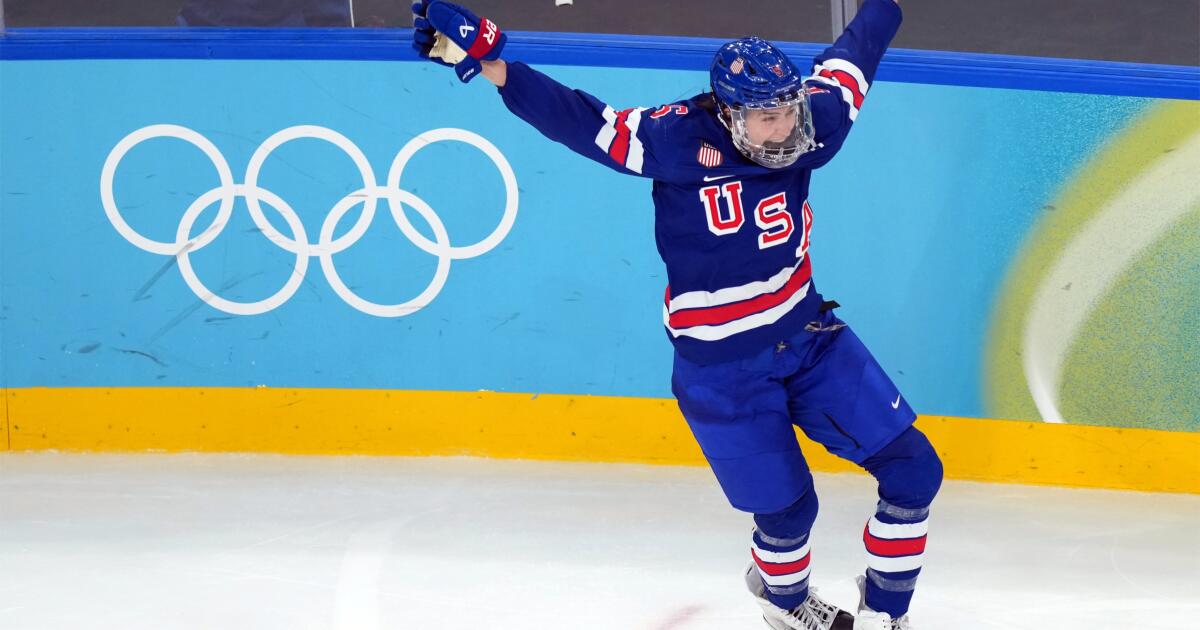
MILAN — A gold medal that seemed firmly in the grasp of the U.S. women’s hockey team nearly slipped through its fingers in the final of the Milan-Cortina Games on Thursday, but the Americans rallied to win 2-1 on Megan Keller’s goal just over four minutes into overtime.
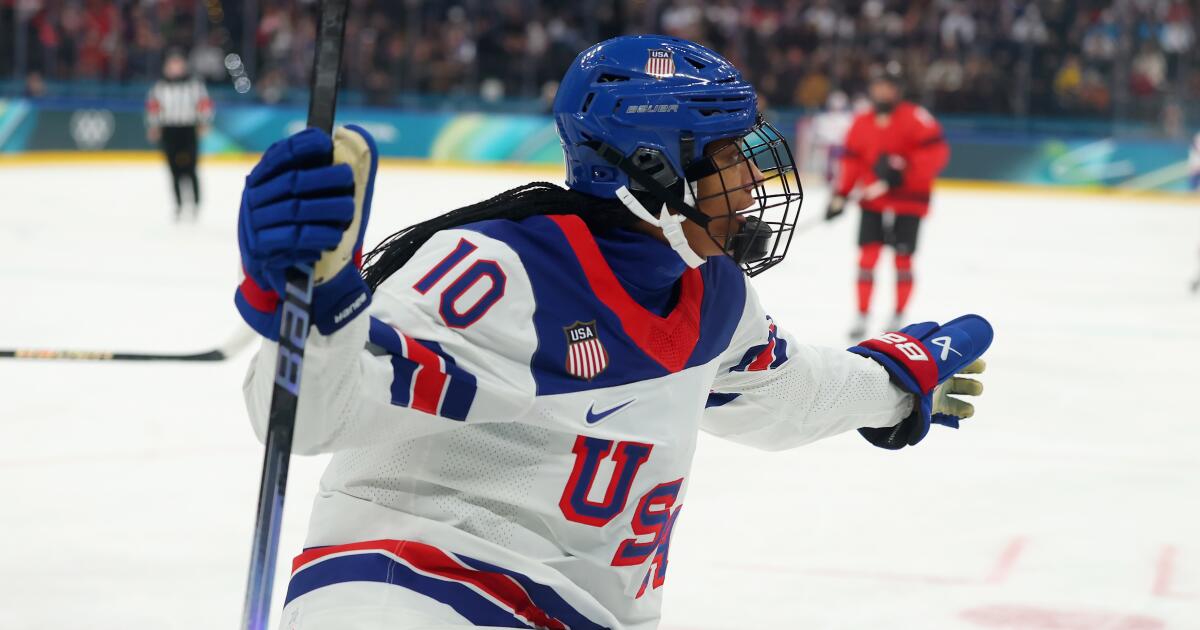
Kristin O’Neill’s shorthanded goal less than a minute into the second period gave Canada its goal while Hilary Knight matched that for the U.S. with 2:04 to play, deflecting a Laila Edwards’ slap shot from the high slot through her legs and past Canadian goalie Ann-Renee Desbiens to send the game to the extra period.
The goal, Knight’s 15th in Olympic competition, broke the American record and came seconds after U.S. coach John Wroblewski had pulled his goalie for an extra attacker.
Keller then won it, taking a long Taylor Heise pass on the left wing, racing into the Canadian zone, stickhandling around defender Claire Thompson before beating goalie Desbiens cleanly.
The gold was the second in the last three Olympics for the Americans, who are ranked No. 1 in the world. Both have come against Canada while the victory was the eighth straight for the U.S. over their northern neighbor dating to last April’s world championship.
The overtime rules are unique for gold-medal games, with the teams playing three-on-three for 20-minute periods, with the first goal deciding the winner. Games cannot end in a shootout.
In the preliminary round, overtimes were limited to five minutes, followed by a five-round shootout. In the knockout stage, the overtime period was extended to 10 minutes, followed by a shootout.
None of that figured in Thursday’s result.
The young Americans, who had 12 women playing in their first Olympics, looked uncharacteristically rattled in a scoreless first period in which they took two penalties — one for too many players on the ice — and were outshot 8-6. It was just the third time in the tournament the U.S. went an entire period without a goal.
Things got worse 54 seconds into the second period when O’Neill outskated Edwards up the center of the ice on a breakaway, took a short centering pass from Laura Stacey, then deked U.S. goalie Aerin Frankel to the ice before beating her to her gloved side for the first goal of the game.
That snapped a 352-minute scoreless streak for the U.S. and marked the first time the Americans trailed in Milan.
For much of the game Canada was faster, smarter and more poised. And Desbiens was spectacular in goal. In Canada’s group-play loss to the U.S., she was pulled in the third period after giving up five goals. This time she came within two minutes of shutting out a team that had scored 31 times in its previous six games.
CORTINA D’AMPEZZO, Italy — It’s all downhill after 40.
Downhill at screaming speeds, that is, fast enough to capture Olympic gold, which is precisely what 41-year-old Elana Meyers Taylor did Monday night in the women’s monobob.
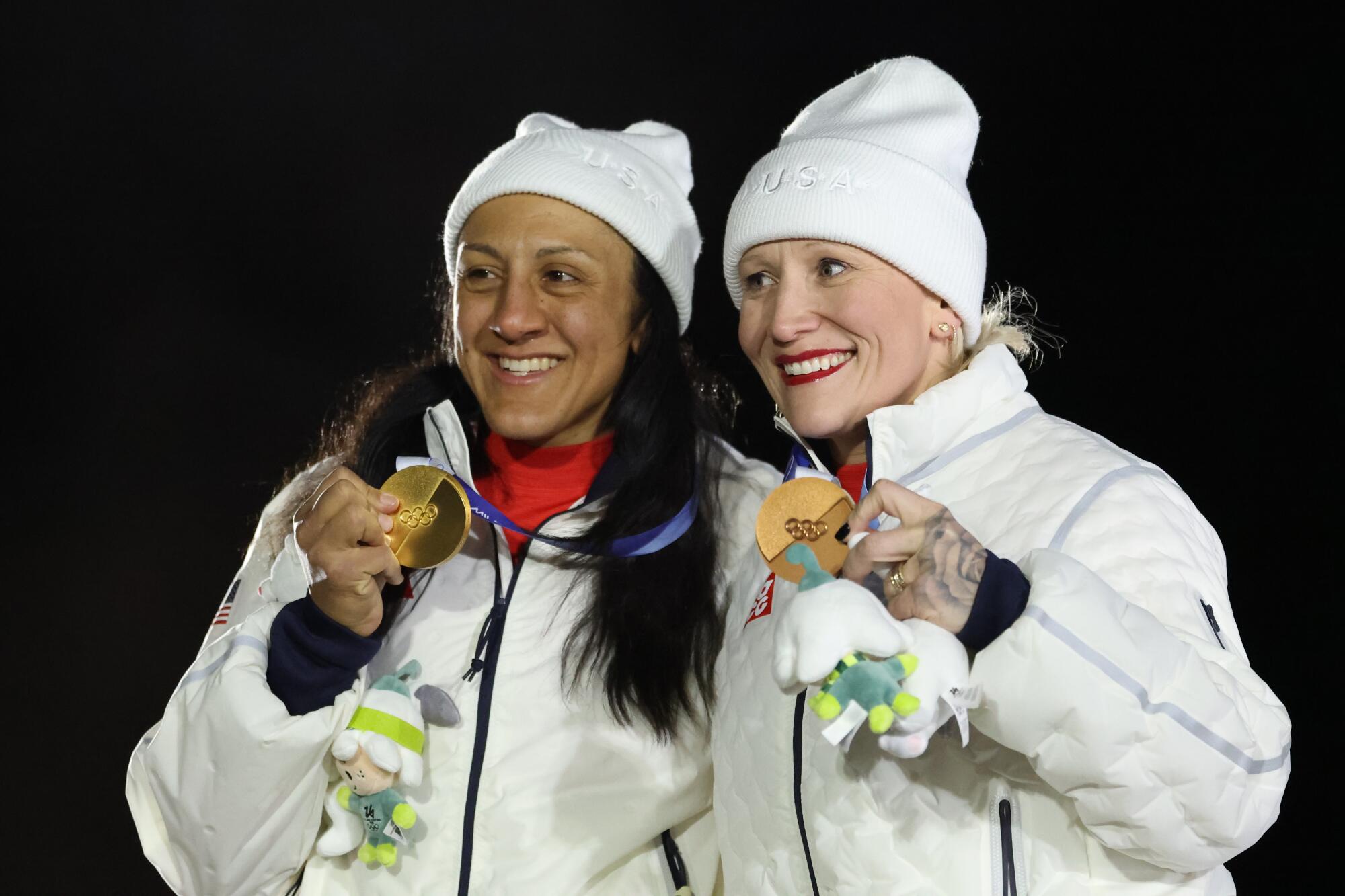
America’s most successful female bobsledder finally got her gold medal. She was four one-hundredths of a second faster than Germany’s Laura Nolte — compiled over four heats — netting her sixth Olympic medal.
Those prizes — a gold, three silvers and two bronzes — tied Meyers Taylor with speedskater Bonnie Blair as the most decorated U.S. woman in Winter Olympic history.
“I still can’t even put into words what this means having the gold medal,” Meyers Taylor said. “It’s still surreal.”
She became the oldest American woman to win a gold medal at the Winter Games, having covered the winding course four times in two days in a total of 3 minutes, 57.93 seconds.
American gold medalist Elana Meyers Taylor and bronze medalist Kaillie Humphries pose for a photo during the medal ceremony for monbob bobsled in Cortina d’Ampezzo, Italy, on Monday.
(Julian Finney / Getty Images)
Monobob is a women’s event that made its debut at the Beijing Olympics four years ago. Only one person competes, pushing the sled at the start and piloting down the course at speeds of 70 to 80 mph. There were 20 competitors in the inaugural event, and American Kaillie Humphries — who claimed the bronze Monday — won the first gold medal in the event.
The triumph came after Meyers Taylor went a whole World Cup season without standing on a podium, finishing 10th in the standings.
“The season was miserable,” she said, noting she has suffered back problems for months.
Her husband and two young children were waiting for her at the finish line, and Meyers Taylor is about as down-to-earth as an elite athlete can get. Both of their children have special needs and are deaf.
American Elana Meyers Taylor celebrates after winning the monobob bobsled competition in Cortina d’Ampezzo, Italy, on Monday.
(Al Bello / Getty Images)
She taught them some new words in sign language in the days leading up to the race.
“We went over what ‘champion’ is,” she said, adding she also taught them to sign “bobsled race” and “gold.”
Asked about her pre-race assessment that a gold medal would mean everything and nothing to her, she smiled and said: “It still is everything, and it still is nothing. Because at the end of the day, in six days I’ve got school pickups and dropoffs in the middle of Texas.”
Humphries — who has three golds and two bronzes in her career — was tied with Meyers Taylor heading into the fourth and final heat. They are both mothers who split time between intense training and all the challenges of parenthood.
“I hope it inspires other people to go out and chase it, whatever it may be,” said Humphries, 40.
“I grew up in a sport where if you have kids once you get to 40, it’s all downhill and alumni … I get to be proof that that’s not true.”
American gold medalist Elana Meyers Taylor and bronze medalist Kaillie Humphries celebrate with Humphries’ son after the monobob competition at the Winter Olympics in Cortina d’Ampezzo, Italy, on Monday.
(Julian Finney / Getty Images)
Meyers Taylor, who was born Oct. 10, 1984, is eight days older than American ski racing legend Lindsey Vonn, who is recovering from a violent crash in the women’s downhill and has undergone multiple operations in the last week.
“I was at the Alpine race when she went down, and that was heartbreaking,” Meyers Taylor said.
“To do that at 41, she’s incredible.”
Humphries said staying atop the sport will be quite a challenge for the monobob medalists.
“These girls are young,” she said. “They’re putting up a good fight. I won’t lie, the starts are challenging, so we’ve got some work to do.”
MILAN — The U.S. advanced to the final of the women’s hockey tournament at the Milan-Cortina Olympics with a 5-0 rout of Sweden on Monday and will meet the winner of the second semifinal between Canada and Switzerland in Thursday’s gold-medal game.
The goals came from Cayla Barnes, Taylor Heise, Kendall Coyne, Hayley Scamurra and Abbey Murphy. Hannah Bilka had two assists while Aerin Frankel turned back 23 shots in pitching the Americans’ fifth consecutive shutout, running their scoreless streak to more than 331 minutes. The unbeaten U.S. has scored at least five times in each of its six games, outscoring opponents 31-1 overall.
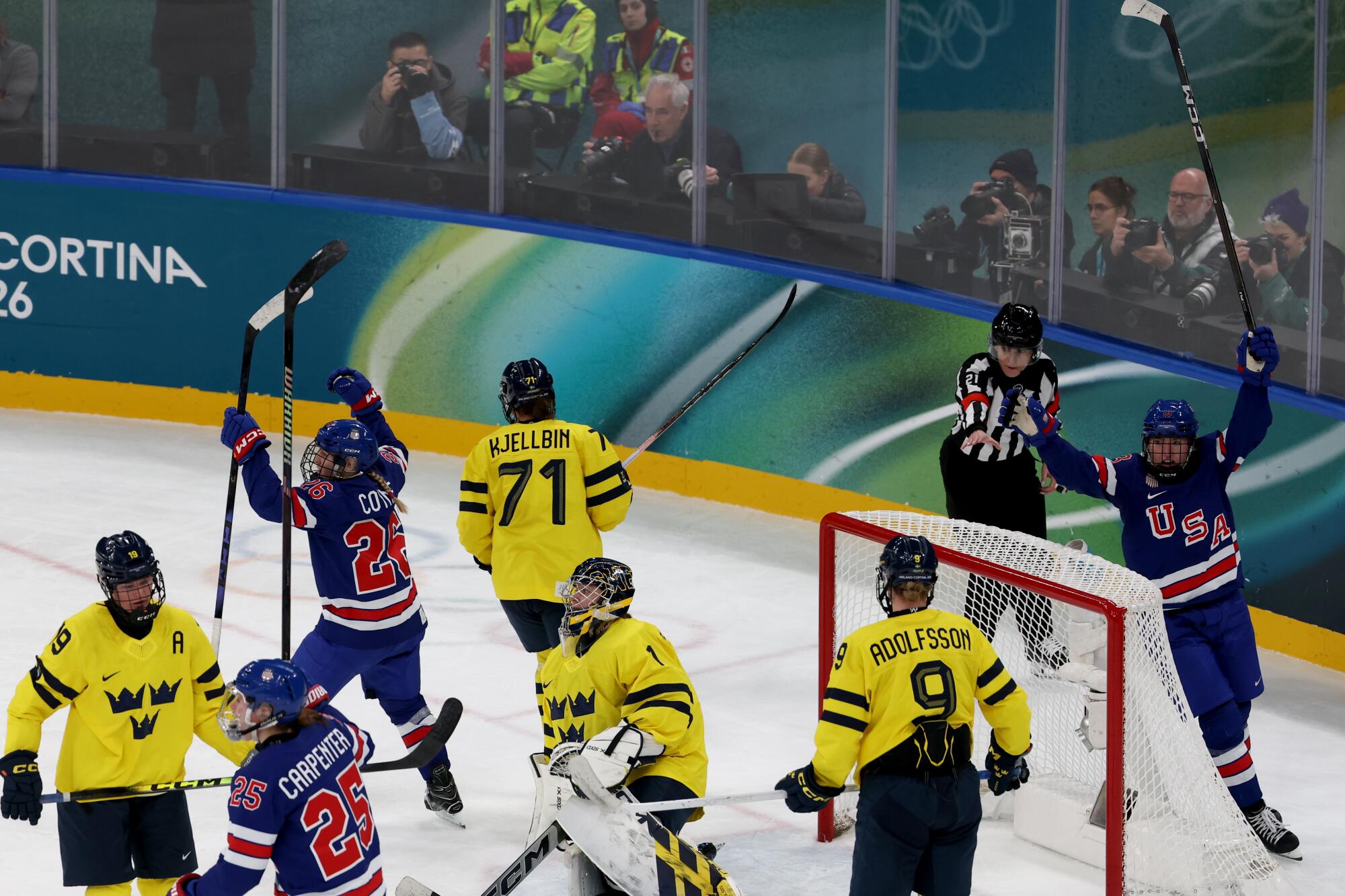
Kendall Coyne, top left, celebrates with her teammates after scoring against Sweden in the second period Monday.
(Robert Gauthier / Los Angeles Times)
Barnes got things started 5:09 into the first period, taking a pass from Kelley Pannek behind the goal line, settling it inside the right faceoff circle, then blasting a shot over the shoulder of Swedish goalie Ebba Svensson Traff for her first goal of the Games. Barnes is the 15th American to score in the tournament.
But that was all the U.S. would get in a first period in which it built a 13-2 shot advantage.
Heise doubled the advantage midway through the second period, although Bilka did most of the work, taking the puck at center ice and driving hard up the right wing before slipping a deft pass across the front of the goal for Heise, who had an easy tap-in.
Six minutes later Murphy made it 3-0 and the rout was on, with Coyne and Scamurra adding goals 109 seconds apart to extend the U.S. lead to 5-0 heading into the second intermission.
U.S. forward Abbey Murphy, right, scores past Sweden goalkeeper Ebba Svensson Traff in the second period Monday.
MILAN — The U.S. won its group and will advance to the quarterfinals of the Milan-Cortina Winter Games as the top seed after routing Canada 5-0 on Tuesday at the Milano Santagiulia Ice Hockey Arena.
Two of the goals came Hannah Bilka with Carolina Harvey, Kirsten Simms and Laila Edwards scoring one apiece.
The win was the seventh in a row for the U.S. over Canada, dating to last April’s world championships. And the Americans dominated from the start, taking its earliest lead of the tournament on Harvey’s goal 3:45 into the first period.
The score came following a faceoff, with Haley Winn working the puck to the high slot for Harvey, who fired a neat wrister by Canadian goalie Ann-Renee Desbiens for her second goal in Olympic competition and her second in as many nights.
Abbey Murphy set up the next one, sending a behind-the-back pass from the end boards to the front of the goal for a wide-open Bilka, who made it 2-0 with a right-handed finish with less than three minutes left in the first period.
The U.S. made it 3-0 on a disputed goal 81 seconds into the second period with the referees, after a long review, ruling that Simms had pushed the puck through a mass of bodies in the crease and across the goal line. Canadian coach Troy Ryan challenged the goal but lost, earning a bench minor for delay of game.
The next U.S. goal was indisputable with Bilka blasting a short one-timer by Desbiens seven minutes before the second intermission. Abbey got her third assist and Harvey her second on the play. With eight minutes left, Edwards closed out the scoring from the high slot — almost the exact same place from where Harvey got the opening goal — driving Desbiens from the game with Ryan bringing on Emerance Maschmeyer to close things out.
The U.S. has scored exactly five goals in each of its four games, scoring in all 12 periods it has played in the Olympic tournament.
Aerin Frankel turned away 20 shots in goal, posting the third shutout in as many games for the U.S., which ran it scoreless streak to 151 minutes.
Canada was playng without its captain, Marie Phillip-Poulin, who left Monday’s win over Czechia after taking a heavy hit along the boards from Kristyna Kaltounkova that left her unable to put weight on her right leg.
The three-time Olympic gold medalist and four-time world champion was listed as day-to-day.