u. s. team

Despite some irritating flaws, 2026 World Cup a rousing success

The largest, longest and most complex World Cup in history came to a close Sunday, with Spain beating Argentina 1-0 in extra time. But FIFA president Gianni Infantino didn’t bother waiting for the final result before passing judgment on the tournament.

“By all means this World Cup has exceeded all expectations,” he said during a reception at Trump Tower two days before the final kicked off. “This has not just been the greatest FIFA World Cup of all time. It is the greatest human social and cultural event that mankind has ever witnessed.”

No, but it was pretty good, with FIFA emerging as the World Cup’s biggest winner, allowing Infantino to reportedly shore up support within the organization despite a number of norm-shattering decisions during the tournament.

Attendance topped 6.8 million, a World Cup record averaging more than 65,000 fans a game. FIFA estimated the cumulative global TV audience topped 5 billion people across linear television, digital streaming and social platforms while more than 1.8 billion people were expected to watch the final, according to the BusinessStats website, making it the most-viewed sporting event in history.

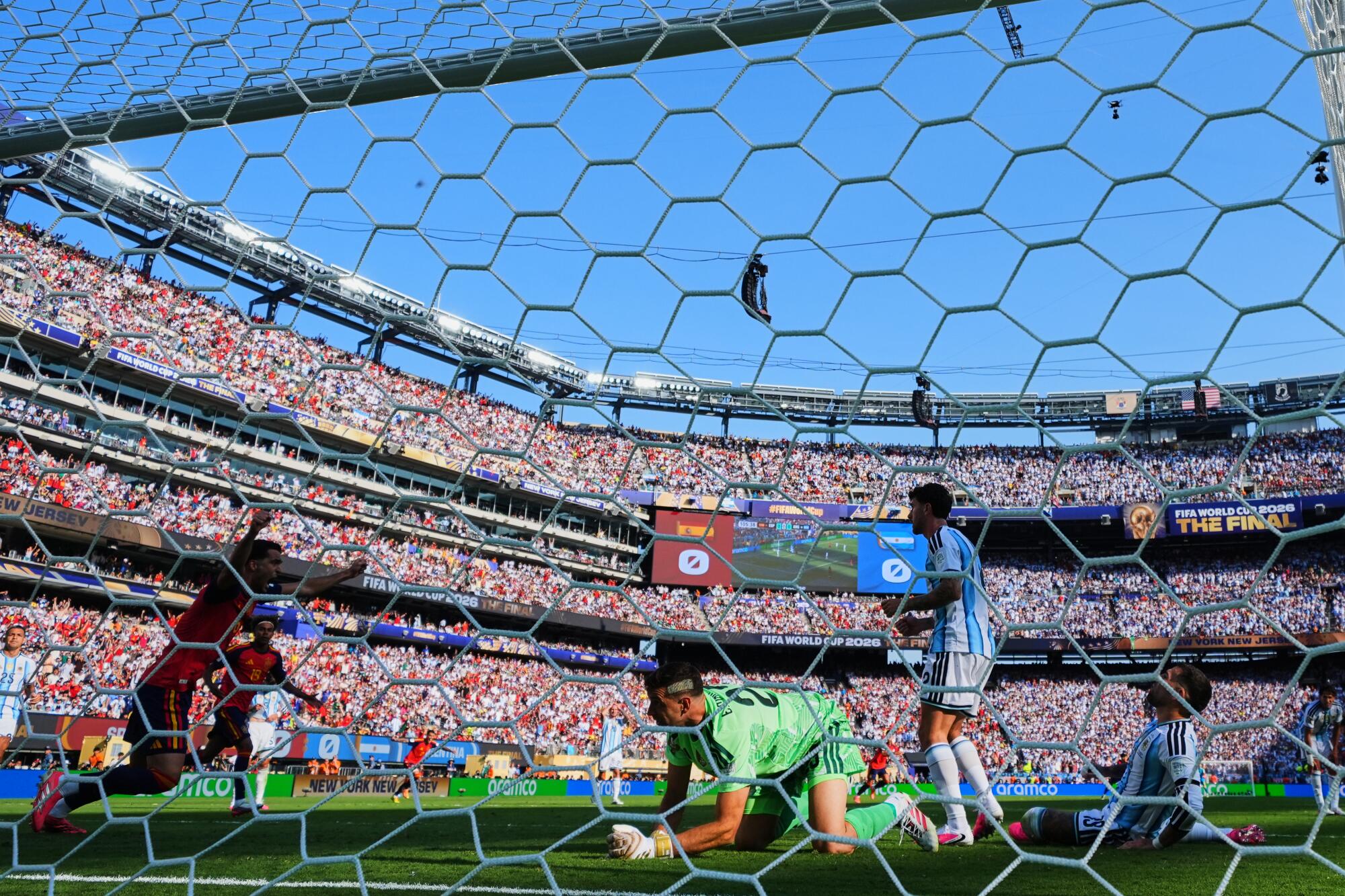
Argentina goalkeeper Emiliano Martínez reacts as Spain's Ferran Torres scores during the World Cup final.

Argentina goalkeeper Emiliano Martínez reacts as Spain’s Ferran Torres scores during the World Cup final in East Rutherford, N.J., on Sunday.

(Julio Cortez / Ap Photo/julio Cortez)

Exact figures won’t be known for a few days.

Revenue for the four-year World Cup cycle is anticipated to reach $13 billion, making it the first $10-billion sporting event in history — bolstering Infantino’s case for reelection as FIFA’s president next year.

The final was among the most expensive U.S. sporting events of all time, with the get-in asking price for a single ticket on the secondary market peaking at about $7,400 three hours before kickoff and the average purchase price topping $10,800. One seat sold for $32,502, which is either a good thing or a bad thing, depending on whether you’re buying the ticket or selling it.

Inglewood’s SoFi Stadium hosted eight games, including two of the U.S. team’s three group-stage games and Spain’s quarterfinal win over Belgium. The matches had a total attendance of 561,656 people, about 99.6% of capacity — that’s more than each of the first three World Cups drew for the entire tournaments.

U.S. and Paraguay oversized flags are featured on the pitch before a World Cup match at SoFi Stadium on June 12.

U.S. and Paraguay oversized flags are featured on the pitch before a World Cup group stage match at SoFi Stadium on June 12.

(Allen J. Schaben/Los Angeles Times)

Weather disrupted just a handful of matches, not the dozen or more that were feared, and the logistical nightmares of staging the 39-day tournament across three countries for the first time — the U.S. co-hosted the event with Mexico and Canada — never materialized. The expansion to 48 teams and 104 games, meanwhile, made room for a number of surprises that gave the tournament its life and sparkle.

Tiny Cape Verde, the second-smallest country to qualify for a World Cup, made a memorable debut, playing Spain to a scoreless draw in its opener, then taking Argentina to extra time before falling in the cruelest way possible, on an own goal, in the knockout rounds.

Norway, playing in the tournament for the first time this century, made it to the quarterfinals behind its hulking striker Erling Haaland, who quickly became a fan favorite while the team’s supporters saw their synchronized “Viking Row” celebration go viral.

Canada and Egypt both won World Cup games for the first time, advancing to the Round of 16, with Egypt becoming one of nine African teams to make it to the knockout rounds. Of FIFA’s six continental confederations, only UEFA, representing Europe, did better than Africa, sending 13 teams beyond the group stage.

Argentina’s Lionel Messi erased any doubt that he’s the greatest player in World Cup history — if not soccer history — by willing his team to the final and winning the Silver Ball, runner-up for the tournament’s most outstanding player. On Sunday, Messi was thwarted in his attempt to win a second straight World Cup and third Golden Ball, but he walked off the field at MetLife Stadium as only the second man to play in three World Cup finals.

And he finished his record-setting sixth tournament as the all-time leader in games (34), assists (12) and goal contributions (33), more than standing the test of time. Two of the players Spain started against Argentina in the final hadn’t even been born when Messi, 39, made his World Cup debut in 2006.

But if those were the highlights, there were also lowlights.

This was by far the most political World Cup in history and the first in which a host country, the U.S., was actively at war with a participating one, Iran.

Iran defender Ramin Rezaeian celebrates with teammates after scoring during a World Cup match against New Zealand.

Iran defender Ramin Rezaeian celebrates with teammates after scoring during a World Cup match against New Zealand at SoFi Stadium on June 15.

(Allen J. Schaben/Los Angeles Times)

That had all kinds of ramifications, starting with the State Department’s refusal to grant visas to more than a dozen members of Iran’s official delegation. Iran was also forced to move its base camp from Tucson to Tijuana, and though it played all its games in the U.S., it was denied permission to remain in the country after each match, an option granted to every other team.

Despite the harassment, Iran did not lose a game, playing to three draws despite having three goals — any of which would have sent it to the knockout rounds — erased by video reviews.

The State Department also denied entry to Omar Abdulkadir Artan, a decorated Somali referee, turning him away at Miami International Airport in June, citing “vetting concerns.” Artan, named Africa’s top referee last year, had a valid entry visa and was selected by FIFA to work the tournament last April.

Iran wasn’t the only team to have its World Cup ended early by technology. Although the video assistant referee (VAR) system was adopted primarily to alert the head official to potential clear and obvious errors or serious missed incidents, in this tournament it became intrusive, eliminating Croatia on evidence from a NASA-level ball sensor and costing Egypt what would have been a game-winning score for a perceived foul that took place nearly 100 yards from the goal.

Coaches and players are still allowed to make mistakes, but the technology now has referees making calls on things that are imperceptible to the naked eye, something critics say has removed any sense of judgment or nuance, robbing the game of much of its drama.

“Football is an art. That’s why we love it,” said Christina Unkel, a former FIFA referee and a rules of the game analyst for multiple TV networks. “When you do pursue black and white — objectivity is what they’re trying to get to, and I get it; they want to eliminate as much subjectivity as possible — what everyone is hating is this perfection thing.”

Then there was the official’s call that President Trump took credit for overruling from 2,800 miles away.

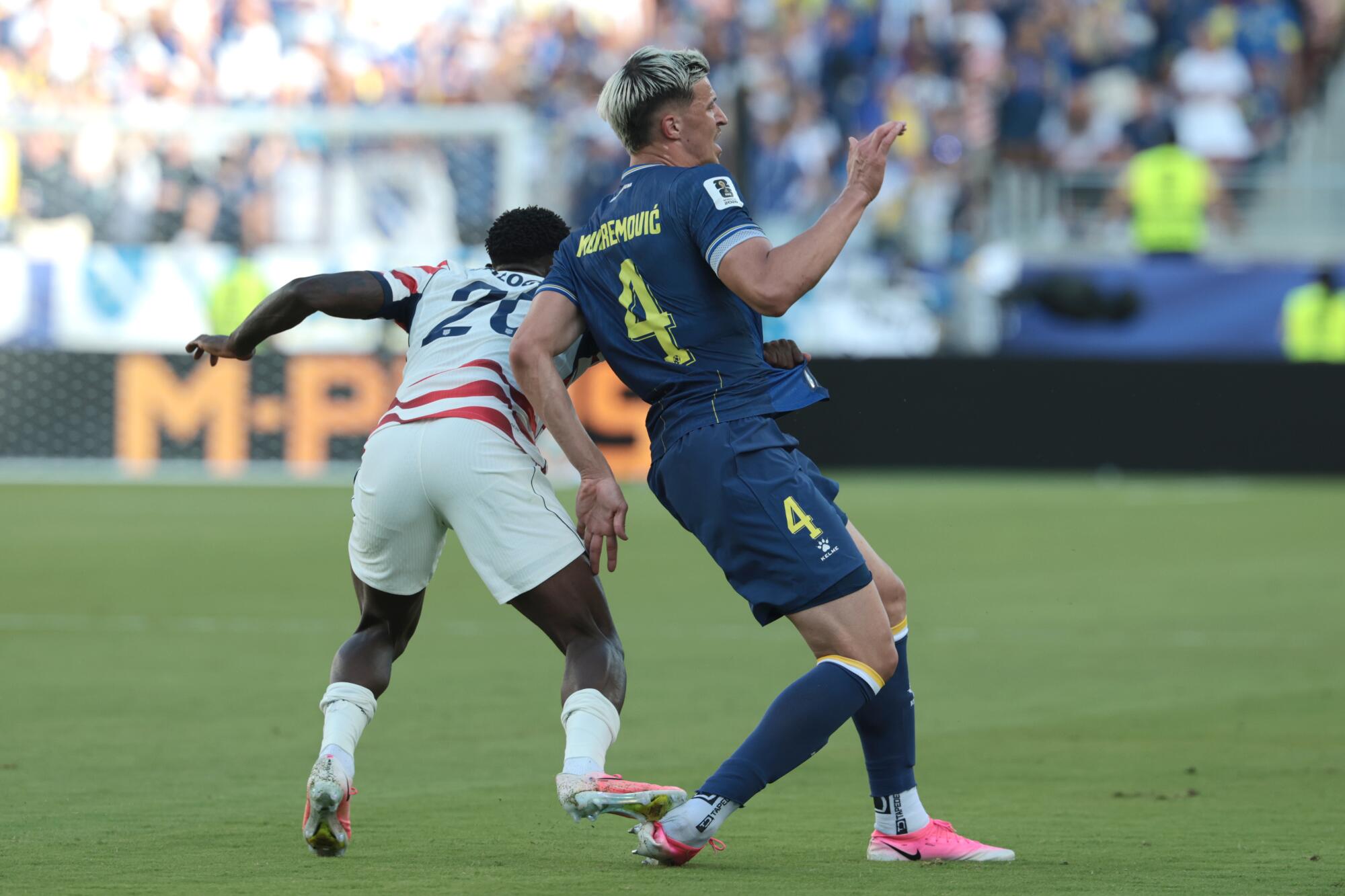
When striker Folarin Balogun, the U.S. team’s leading scorer, was given a red card in the second half of his team’s Round of 32 win over Bosnia-Herzegovina, he was immediately suspended from the Americans’ next elimination game with Belgium. But Trump admitted he phoned Infantino three times, lobbying for the suspension to be rescinded.

U.S. forward Folarin Balogun steps on Bosnia-Herzegovina defender Tarik Muharemovic's foot and received a red card.

U.S. forward Folarin Balogun stepped on Bosnia-Herzegovina defender Tarik Muharemovic’s foot during a World Cup match and received a red card at Levi’s Stadium on July 1.

(Robert Gauthier/Los Angeles Times)

Less than 30 hours before the Belgium game, the card penalty was suspended and Balogun was placed on one year’s probation by FIFA’s disciplinary committee, marking just the second time in World Cup history that a player who received a red card was allowed to play in his team’s next game. The international uproar that followed overwhelmed the U.S. team, which played its worst game of the tournament against Belgium.

“I could almost see within my teammates a bit of nerves,” Balogun said in an interview with CBS, “because it’s something that is so unique.”

Trump, who was booed as he saluted the national anthem Sunday from a luxury box before the game, was booed again by the crowd of 80,663 when he strode onto the pitch for the awards ceremony afterward.

UEFA, the FIFA confederation in which Belgium plays, protested the decision to let Balogun play, saying it had “crossed a red line.” It was far from the only bright red line Infantino crossed in this tournament. And some of that line crossing could set dangerous precedents.

Allowing the U.S. to turn away the Somali official and limit the Iranian team’s time in the country, for example, could embolden future World Cup hosts to do the same. What’s to stop Morocco, co-host of the 2030 tournament, from banning officials and players from Algeria over the two countries’ territorial dispute in the Western Sahara? And if a red card is handed to a player from Spain, another 2030 co-host, would the Spanish prime minister call Infantino to try to get it rescinded? Despite FIFA’s insistence that the disciplinary committee works independently, many believe Trump’s meddling worked.

But as always with FIFA, money speaks the loudest, so Infantino’s norm-shattering behavior over the last year doesn’t seem to have cost him much support. The Guardian reported last week that as the World Cup neared its successful conclusion, nearly 200 of FIFA’s 211 member associations are endorsing Infantino’s bid for reelection to a fourth term as president next March.

Which is why Spain wasn’t the only winner in this tournament.
Source link

Trump’s World Cup meddling was a culprit in brutal U.S. exit

Is everybody happy now? You good, Mr. President?

Put our boys in a blender, President Trump did, with those phone calls to FIFA President Gianni Infantino. Messed with their mojo by politicking to get American striker Folarin Balogun’s red card rescinded.

We’ll have to check VAR, but it might be the first time Trump succeeded at having a decision overturned.

Probably because this time what he sought to overturn — discipline stemming from Balogun’s accidental contact in the United States’ victory over Bosnia and Herzegovina — actually was unjust. Balogun should not have received a red card.

The problem is, having our President butt in here was a joke. Unfunny and out of bounds, offsides, an own goal — all of the things.

It put the U.S. team at the center of a geopolitical maelstrom, which is exactly what they did not need in the hours before the biggest match of their lives and the biggest match in the history of the U.S. men’s soccer program.

Some 40 or 50 million viewers were expected to tune in; how many of them watched for the first time? And what sort of impression did Monday’s 4-1 blunder-filled meltdown against Belgium make? That we stink at soccer — still?

If you were one of them, please, believe your soccer-fan friends when they tell you the Americans played much better in previous matches.

But so much for a magical run. On their home turf, the Americans pulled up lame before the finish line (aka, for the U.S. team’s purposes, its first quarterfinals since 2002).

To their credit, after the debacle, members of the U.S. team didn’t complain about anything being rigged. They didn’t use the distraction as an excuse. And they didn’t point fingers at anyone — anyone at all.

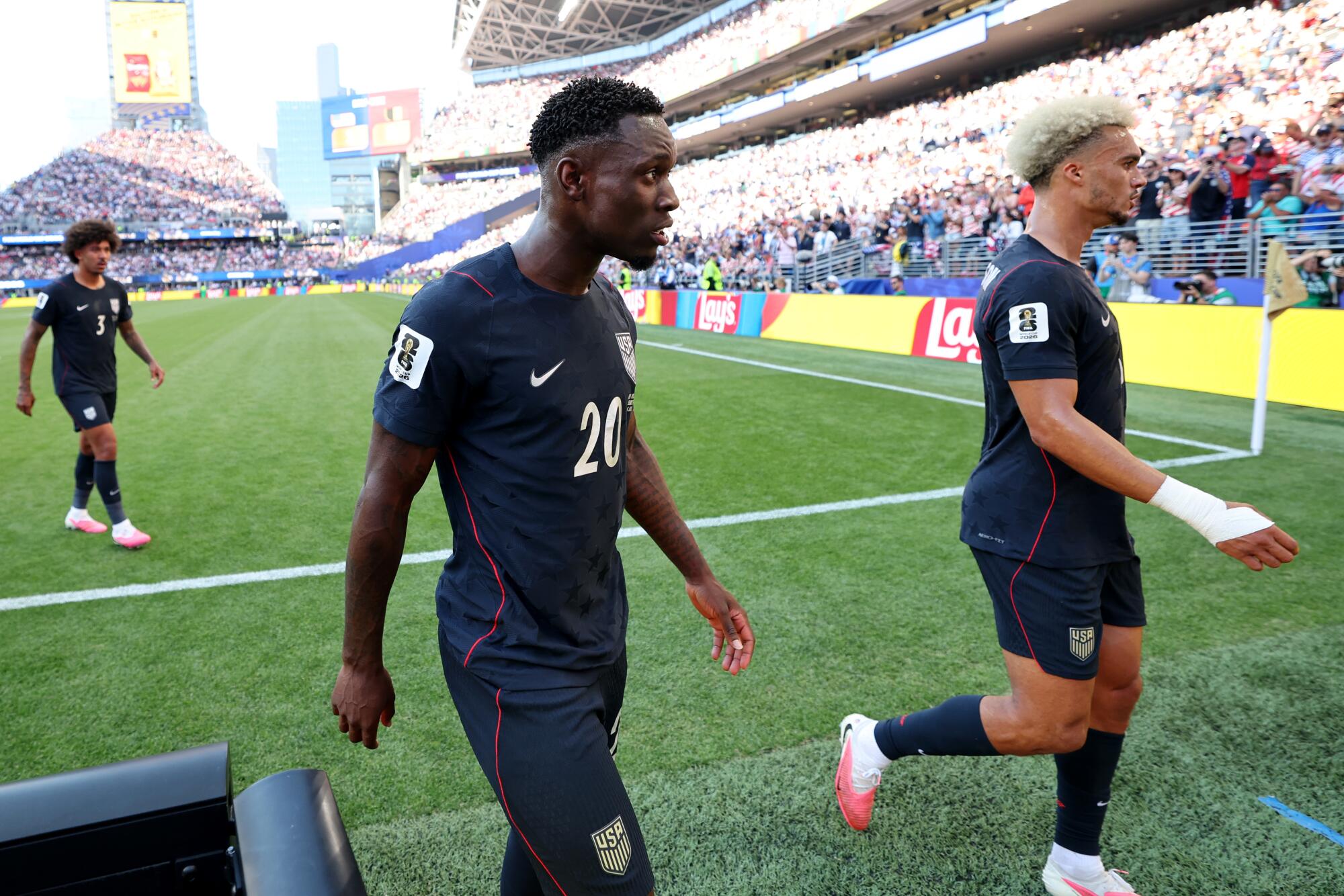
U.S. striker Folarin Balogun (20) walks to the locker room at halftime against Belgium in the World Cup.

U.S. striker Folarin Balogun (20) walks to the locker room at halftime against Belgium in the World Cup on Monday at Lumen Field in Seattle.

(Allen J. Schaben / Los Angeles Times)

“We’re playing on home soil,” defender Chris Richards said. “So the only pressure we put on ourselves is to perform for our country, and ultimately didn’t feel the way we wanted to today. But I don’t think the antics of the last 24 hours had anything to do with it.”

No, they said the “debate,” or “outside noise” or “political manipulation” — as Tim Ream, Alex Freeman and coach Mauricio Pochettino described what others are calling “Balogate” — were not to blame for the gut-punch that answered the question: Why not us?

Because the U.S. is not yet good enough to beat the world’s great teams. Especially not when their pregame preparation includes having to try to block out an international uproar.

To have any hope against the Belgians in the round of 16 — a matchup between FIFA’s Nos. 9- and 17-ranked sides — the Americans needed to be going full-tilt, to be focused and ferocious and probably also a little bit lucky.

Instead, they looked shook, rattled. And they got rolled.

They were the worst version of themselves at the worst time, which was so weird from a team that had been on its front foot from the first whistle against Paraguay.

Not Monday. Against Belgium, they were on their heels from the outset. Heavy touches, slow afoot, playing like they had the weight of the World Cup on their shoulders.

And all that White House maddening meddling — for what?

Balogun started and played most of the match, but it could just as well have been reserve striker Ricardo Pepi. Or you or me, Balogun was that ineffective.

His play of the day came postmatch, when he approached Belgian coach Rudi Garcia and the two had a respectful exchange. A real diplomat, that Brooklyn-born, Britain-raised American by birthright.

This loss was a real team effort, of course. Christian Pulisic came off in the 59th minute after twisting his right ankle — leaving this World Cup without a goal in the four matches he appeared.

Matt Freese, the Harvard-educated starting goalkeeper, had a brain cramp of epic proportions when he stepped outside of the box and failed to corral a ball. Belgium’s Charles De Ketelaere kicked it loose and set up Hans Vanaken, whose shot traveled behind Ream for an easy score that made it 3-1 in the 57th minute.

There was a lot of poor decision-making with this match, on and off the pitch.

In the end, Trump’s appeal to Infantino did more harm than good. But what if some good could come from it?

Hey, FIFA, what about giving teams a process to appeal cards, like our American athletes in the NBA, NFL and MLB have?

Offering a suggestion box wouldn’t be opening Pandora’s box, not if it were a transparent and regular part of the game that would, hopefully, offer increasingly fair outcomes in a tournament where every match is so monumental — as our President recognized, much too enthusiastically.

U.S. coach Mauricio Pochettino waves to the crown after a 4-1 loss to Belgium at the World Cup on Monday.

U.S. coach Mauricio Pochettino waves to the crown after a 4-1 loss to Belgium at the World Cup on Monday.

(Allen J. Schaben / Los Angeles Times)

Source link

Folarin Balogun urges U.S. to stay poised despite unjust red card

Like a good striker, Folarin Balogun never loses sight of the goal. And the goal for the U.S. team in this summer’s World Cup hasn’t been just to win, which they’ve done, but to inspire.

And that’s how Balogun found himself on the field, shaking hands with Brazilian referee Raphael Claus, about 45 minutes after Claus gave him a controversial red card in Wednesday’s win over Bosnia-Herzegovina, a red card that will keep him out of Monday’s round-of-16 game with Belgium.

“Little kids are watching, and we have to show them the correct way to handle things, even when you think it’s unjust,” Balogun said Friday.

“It’s not an excuse to be disrespectful, to not do the right thing. I’m aware that the World Cup might be the first time a lot of American viewers are tuning in. So it’s important, whether things happen to you good or bad, just to continue to be yourself.”

That doesn’t mean Balogun didn’t think the red card was unjust. He does. And he definitely thinks something bad happened to him and his team since Balogun, the Americans’ leading scorer with three goals in as many games, will have to sit out the team’s most important game in a generation.

It’s just means that Balogun, who celebrated his 25th birthday Friday, is also mature enough to understand a game — even a World Cup elimination game — is just a game.

“It’s been a roller coaster,” he said before the team’s training session at the University of Washington. “There’s been lots of different emotions. I’ve been upset, I’ve been happy. But for me, it was just important to stay calm. I never want to react out of anger and out of emotion.”

Balogun, who had given his team a 1-0 lead in the waning seconds of the first half, collided with Tarik Muharemovic 16 minutes into the second half, and when the Bosnian defender planted his right leg below Balogun’s right foot, the American inadvertently stomped on his right ankle, twisting it awkwardly.

U.S. forward Folarin Balogun steps on Bosnia-Herzegovina defender Tarik Muharemovic's foot and received a red card.

U.S. forward Folarin Balogun steps on Bosnia-Herzegovina defender Tarik Muharemovic’s foot and received a red card.

(Robert Gauthier/Los Angeles Times)

Both players went down and Claus did not signal a foul or pull card. But after the video assistant referee urged him to watch a replay, Claus walked away from the monitor and flashed the red card. That left the U.S. to finish Wednesday’s game with just 10 men and disqualified Balogun for Monday’s game. U.S. Soccer said Friday FIFA’s disciplinary committee did not add any games to Balogun’s suspension.

“There’s the scenarios that you simply can’t avoid,” he said, “and it has to be taken into context when it’s being reviewed. I felt it wasn’t on this occasion. There’s nowhere else to put your leg. It’s going to be unavoidable.

“I think a yellow card would have been fair. [But] it’s something that’s happened, so we have to move forward, and I have to accept it. The most important thing is just to focus on the bigger picture, which is Belgium.”

Replacing Balogun won’t be easy since he’s emerged as one of the team’s most effective and creative players, either scoring of setting up the go-ahead goal in all three of the U.S. wins.

“We’ve got guys that can fill in and have to be ready for the opportunity to step up,” midfielder Tyler Adams said. “When you miss a player like Balo, obviously things change a little bit. But we’ve been flexible. Guys have shown that they’re ready to play.”

The most likely replacements are Ricardo Pepi and Haji Wright. Pepi, who scored 16 goals for PSV in the Dutch Eredivisie this season, played 90 minutes in place of Balogun in the U.S. loss to Turkey in the final group-stage match. Wright, who had 17 goals for Coventry City in the English Championship, played in all four U.S. games in the 2022 World Cup, scoring once, but he has made just one appearance in this summer’s tournament.

“Balo is an important part of our team, and it’s a disappointing way for him to miss the next game,” said Wright, who grew up in Culver City and spent three years in the Galaxy academy. “But, I’ll always be ready and prepared for whatever comes.”

A victory over Belgium would send the U.S. to the quarterfinals of a World Cup for just the second time. It would also give it four wins in the tournament, double the number of victories in any previous World Cup and marking the first time the Americans have won twice in the knockout stages in the same tournament.

U.S. forward Ricardo Pepi pursues the ball during a World Cup match against Bosnia-Herzegovina at Levi's Stadium.

U.S. forward Ricardo Pepi pursues the ball during a World Cup match against Bosnia-Herzegovina at Levi’s Stadium in Santa Clara , Calif., on Wednesday.

(Robert Gauthier/Los Angeles Times)

It’s a moment, Adams acknowledged Friday, many players have waited for their whole lives.

“You need to embrace the moment, that’s for sure,” he said. “To have the opportunity to play in a round-of-16 game — which, obviously, last World Cup we did, but it was the first knockout game, not the second — it’s exciting. It was nice to get a little bit of a taste of what it feels like to play with something a little bit more on the line in the last game. I think that’s good preparation.

“Advancing and taking this thing as far as we can is the most important thing. We have a good opportunity here to do so.”

Source link

U.S. looks to make more World Cup history in round of 16 vs. Belgium

Mauricio Pochettino’s team continues to do things in this summer’s World Cup that no U.S. team has ever done before.

Its three wins are the most in a single tournament. So are the 10 goals in four games. It has the best goal differential ever and its two shutouts ties a record.

Yet all that means absolutely nothing to the players.

“They’re great milestones,” captain Tim Ream said. “But I don’t think anybody’s even once mentioned the different things that we’re doing. We’re focused on what we’re doing daily on the training ground, because that puts us in the best possible position to to put these performances.

“So yeah, not aware or even worried about records that we’re breaking.”

Well, except for maybe one.

With Wednesday’s gritty 2-0 over Bosnia and Herzegovina, a game the U.S. finished with just 10 men, the Americans won a game in the World Cup knockout stage for just the second time. That sends them on to a round-of-16 meeting with Belgium on Monday in Seattle where a win would be — you guessed it — historic.

“It’s cool and it’s great and it’s an accomplishment,” midfielder Weston McKennie said of the records. “But at the same time, we have high expectations for ourselves. That’s what we expect of ourselves, what we expect of our team.

“We just want to focus on Belgium now and continue to try to make history.”

That chore got a good deal more difficult because of an unwanted team record that was also set Wednesday. When Folarin Balogun scored a goal late in the first half then drew a red card early in the second, he became the first American — and third player ever — to get one of each in the same World Cup knockout game.

“Cool record,” defender Chris Richards said.

But while the goal, Balogun’s third of the tournament, proved to be all the U.S. needed to beat Bosnia, the red card — which cannot be appealed according to U.S. Soccer — means he’s suspended for the game with Belgium.

“It’s just so unfortunate, honestly,” Christian Pulisic said. “Looking back at it, it seems so harsh. I just told him he’s done so much for us, and now we’ve got his back.”

The red card came in the 64th minute with the U.S. protecting a 1-0 lead built on Balogun’s goal just before the intermission. The American striker was battling hulking Bosnia defender Tarik Muharemovic for a loose ball when he inadvertently raked Muharemovic’s right calf with his studs up, then landed on his ankle, twisting it awkwardly.

Brazilian referee Raphael Claus did not flash either card before stopping play at the behest of the video assistant referee. But after consulting a slow-motion reply, Claus gave Balogun a red card for a dangerous challenge.

“For me, never is this a red card,” said Pochettino, now the winningest U.S. coach in World Cup history. “Watching after on TV, never was [it his] intention to step up on the player. That was a normal action in football.”

Maybe. But Claus sent Balogun off just the same, leaving the U.S. to protect a one-goal advantage for the final 30 minutes while playing a man down. It was probably the sternest test the Americans have faced in the tournament.

“It would be easy to have an excuse if they did score,” McKennie said. “But that’s not the type of team we are.”

For Ream, the challenge was actually no challenge at all.

“Would it be weird if I downplayed this and said [I] wasn’t even fazed by it?” he said. “It didn’t feel like we were down a man. We were still able to carve out chances and we were still able to keep hold of the ball. Everybody knew their roles.

“It felt really calm and felt really, really easy and simple for us in that moment.”

And that allowed another hero to shrug off the pain of his own wounds and step up big.

Early in the second half a Bosnian player stomped on Malik Tillman, shredding his boot and cutting his right foot (but not drawing a red card). During the hydration break, Tillman was able to change shoes and in the 82nd minute, his white sock turning red with blood, he found himself standing over a free kick just outside the Bosnian penalty area.

“I’ve been dreaming about this game. I’ve been dreaming about, yeah, maybe taking a free kick and scoring,” said Tillman, who bent the ball off the gloved right hand of Bosnian keeper Nikola Vasilj and into the net for his first World Cup goal. “I trained for this in our practices and then it actually came true.”

So did the team’s dreams of reaching the round of 16, only now they’re arriving without their leading scorer, who will have to watch the Belgium game from the stands. Balogun’s absence, however, creates opportunity for others, with Haji Wright and Ricardo Pepi the most likely candidates to take his place.

And if this U.S. team has proven anything, it’s proven that it loves nothing more than embracing opportunities to prove people wrong.

“We’re going to miss him for the next game but we know that if it’s Pepi or Haji, whoever, is going to step up next and they’re going to do the job just as well as he did,” Richards said of Balogun. “One thing about this team is we’re really a big family and we’re shown it this whole tournament.

“Coming in, there was a lot of question marks about our whole team in general. Game by game we started to put ourselves right. Because we knew we had it the whole time.”

Source link

Born in Brooklyn, raised in London, Folarin Balogun lights up the World Cup for the U.S.

If a pregnant Nigerian woman had been allowed to board a plane 25 years ago, the U.S. team’s path through this summer’s World Cup may have unfolded much differently. Instead, a gate agent turned her away, insisting it wasn’t safe for her to fly from New York to London.

So Florence Balogun returned to Brooklyn, where she had been visiting relatives, and waited for her second son to be born. And when Folarin arrived a few weeks later, entering the world just hours before Independence Day dawned, he did so as an American citizen.

It was that quirk of fate that allowed Balogun, who lived just two months in the U.S., to represent the country on soccer’s biggest stage.

“I’m extremely proud my individual journey will come full circle now,” he said before the tournament started. “Especially the World Cup being here, the opportunity to represent my nation. It’s going to be something special for me.”

The first game certainly was, with Balogun scoring twice in the first half of a dominant 4-1 win over Paraguay, becoming the first American with multiple goals in a World Cup game in 96 years while introducing himself to a country that may have known his name, but not his unique talent.

“If you don’t know the type of player he is, you could see it today,” midfielder Weston McKennie said. “It’s the World Cup, everyone steps up to their maximum. In the past a lot of people maybe have not made him out to be a player like that.

“He showed everyone he’s willing to do the dirty work as well.”

Balogun once had his pick of countries to represent. His birth in Brooklyn made him eligible to play for the U.S., his longterm residency in London made him eligible to play for England and his parents’ nationality qualified him to play for Nigeria.

He picked the U.S.

And he’s not the only one on the American team who had a choice. Half the men on the World Cup roster — including Christian Pulisic, Gio Reyna and Malik Tillman, who each had a goal or an assist against Paraguay — are dual nationals, meaning they’re playing for the U.S. because they want to, not because they have to.

“You’re more American if you were not born over there because you had the choice to choose and you chose America,” Kenneth Dest, the Surinamese-American father of Dutch-born defender Sergiño Dest, said in an HBO Max documentary.

If America is a nation of immigrants, it only seems right that it should be represented in the World Cup by a team of immigrants. Like Tillman and Dest, who were born and raised in Europe, the sons of U.S. soldiers. Or forwards Tim Weah, the Brooklyn-born son of the former president of Liberia, and Alejandro Zendejas, who was born in Mexico but became a U.S. citizen at 13 after his father was naturalized.

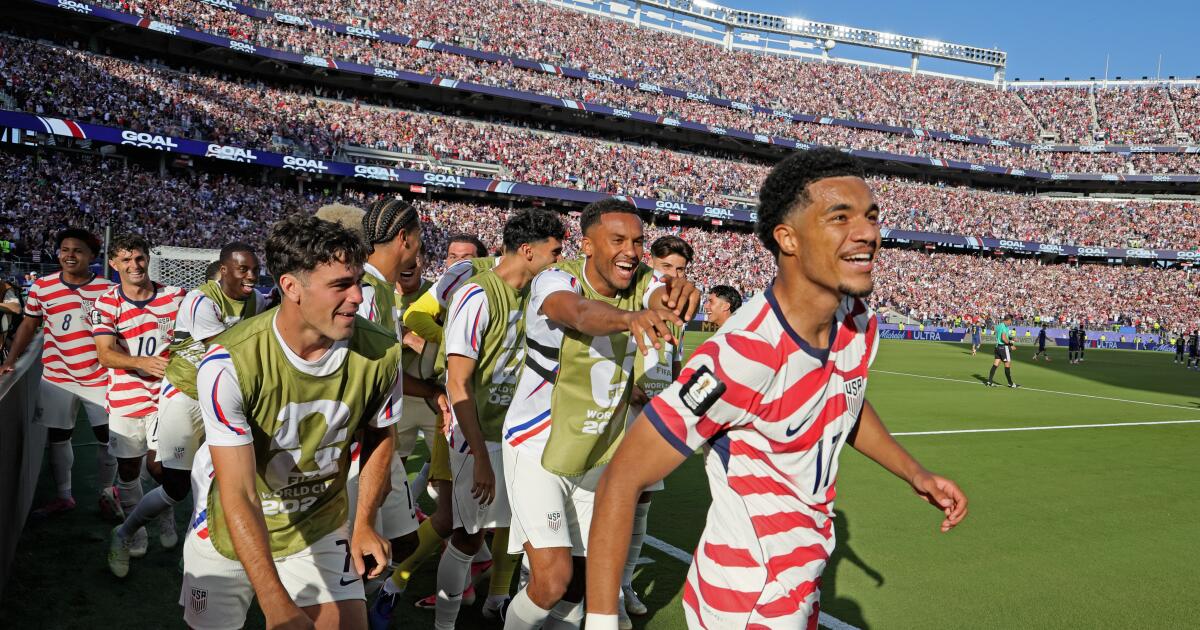
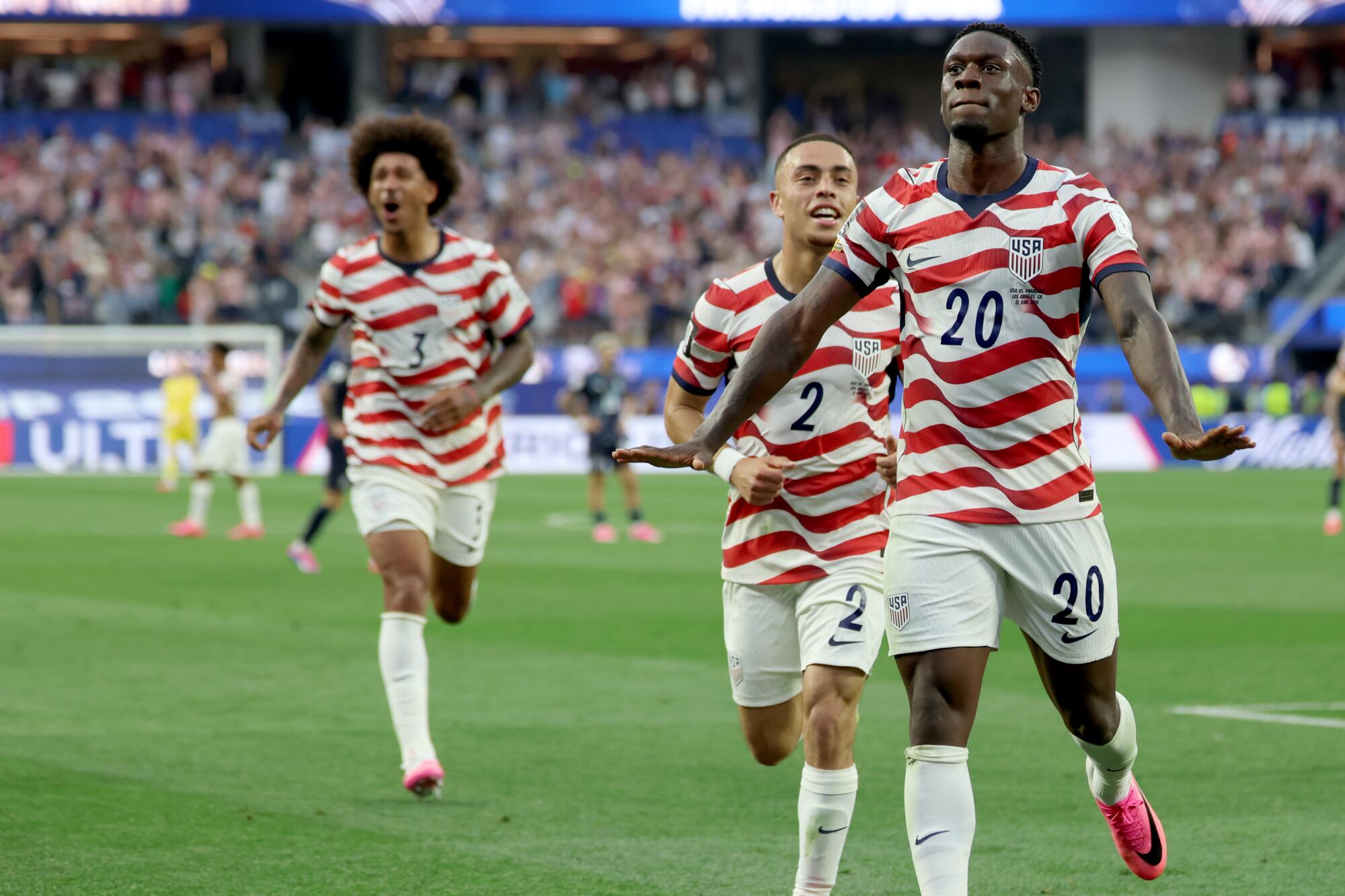
U.S. forward Folarin Balogun, right, celebrates his goal with Sergiño Dest (2) and Chris Richards (3) against Paraguay.

U.S. forward Folarin Balogun, right, celebrates his goal with Sergiño Dest (2) and Chris Richards (3) against Paraguay.

(Robert Gauthier / Los Angeles Times)

The paternal great-grandmother of goalie Matt Turner fled religious persecution in Lithuania, with his Jewish ancestors changing their family name from Turnovski to Turner when they arrived at Ellis Island. The parents of midfielder Cristian Roldan came to the U.S. to escape civil wars in Central America, his father from Guatemala and his mother from El Salvador.

They didn’t wind up wearing the same uniform by accident, however. The recruitment of dual nationals dates to the 1980s under Hungarian-born manager Bob Gansler, who qualified the U.S. for the World Cup for the first time in 40 years with a team that included players born in Uruguay, Greece, Germany and El Salvador.

It really began to scale up about 15 years ago under Bob Bradley and his successor Jurgen Klinsmann. Gregg Berhalter then took it to another level, recruiting more than a dozen dual nationals — including Dest, Tillman, Balogun and Turner — in his five years as coach.

The practice isn’t limited to the USMNT. When France won the World Cup in 2018, 16 of the 23 players on the team came from families that recently immigrated from places like Zaire, Cameroon, Morocco, Angola, Congo or Algeria. More than half the players on Algeria’s team in this summer’s tournament were born in Europe while only seven men on Morocco’s roster are from Morocco.

Even Japan, famously homogeneous, has a Black goalkeeper who was born in Arkansas to a father from Ghana.

“Inclusion always pulls sport forward,” said Ronen Dorfan, a journalist and sports historian based in Budapest.

Still, Balogun’s journey is unusual — and not just because of the way it started.

He was two months old when he and his mother finally made it to London and eight years later he was good enough to enter Arsenal’s academy system. He made his junior international debut with England at 17, then three months later was invited to play four games for the U.S. U18 team.

But Balogun’s future appeared to be with England, especially after he scored seven times in 13 appearances with the U21 team, then followed that up with a career-high 21 goals for Reims in France’s Ligue 1 in 2022-23.

Yet neither performance earned him a call-up to a senior national team that was deep at forward.

So the U.S., which desperately needed a fast, technical, two-footed No. 9, pounced, getting Balogun to withdraw from England’s U21 training camp to make a secret visit to Florida. Once there, U.S. Soccer arranged for him to sit courtside at an NBA game, receive VIP passes to Universal Orlando, attend spring training with the Yankees and meet with a number of U.S. national team players.

With a schedule like this, his visit didn’t stay secret for long. After studying pictures Balogun had posted on social media, some U.S. fans determined he was in Orlando and began peppering his feeds with American flag emojis. Others found him at his hotel and urged him to commit to the U.S., a plea his parents, citing a quirk in fate, had been making for years.

You’re American, they argued. You were born there.

Six weeks later he did commit, with FIFA approving his request to switch allegiances from England to the U.S. A month after that, he scored his first senior international goal in the 2023 Nations League Finals and he’s never looked back. Because if Balogun, 24, felt overlooked in England, he’s felt looked after in the colonies.

“When I committed and throughout this whole cycle and the whole journey to me being at this point, I’ve always said the fans gave me so much motivation, showed me so much support,” said Balogun, who speaks in a pronounced London accent. “The most important thing has been to repay that.

“I just want to continue to show the fans I made the right decision. I want to continue to make the fans proud as well.”

He made a great start on that in his World Cup debut.

Source link

World Cup: U.S. offense shines in win over Paraguay

It was a game eight years in the making. The first World Cup match on American soil in more than a generation and the start of a tournament that has the potential to alter the direction of soccer in this country for the next generation.

And the U.S. seized on every bit of that opportunity Friday, with Christian Pulisic setting up two goals and Folarin Balogun scoring twice in his World Cup debut, sparking an impressive 4-1 victory over Paraguay in a game that was far more one-sided than the score indicated.

The U.S., which needed a big effort to start the tournament, was on the front foot from the start, going in front to stay in the seventh minute — although it was Paraguayan midfielder Damián Bobadilla who got credit for the goal after stepping in front of Balogun and deflecting in a cross from Weston McKennie.

Pulisic, the American star who is under intense pressure to perform in this tournament, set up the goal, pushing the ball between a pair of defenders before poking it on for McKennie in the center of the box. Bobadilla then did the rest, inadvertently sticking his right foot in front of the ball and bouncing it by Paraguayan keeper Orlando Gil.

Balogun appeared to double the lead coming out of the hydration break midway through the opening half, but the goal was negated by an offside call. That only delayed the second goal, however, with Balogun making it 2-0 by one-timing in a perfect feed from Pulisic from the penalty spot in the 31st minute.

Balogun added to the U.S. advantage just before the intermission, running on to a perfectly weighted through ball from Malik Tillman, stepping through a challenge from Omar Alderete entering the penalty area and turning around Paraguayan captain Gustavo Gómez before left-footing a shot into the top left corner to complete his first brace for the national team.

Gil was just a spectator on the play, with no chance to best the save. The goal marked the first time Paraguay had given up three scores in a World Cup game — much less one half — since 2002 and it came at the end of what was arguably the best opening 45 minutes a U.S. team has played in the tournament in decades.

Gio Reyna scored the fourth U.S. goal on the final play of the game.

Pulisic left in favor of Sebastian Berhalter to start the second but the U.S. continued to dominate in every way it was possible to dominate, controlling the ball for nearly 60 of the 90 minutes and completing more than twice as many passes. Paraguay’s first shot on goal didn’t come until the 73rd minute when Mauricio, a halftime substitute, took advantage of a slow-reacting U.S. defense to pull a goal back.

U.S. coach Mauricio Pochettino also got a solid game out of center back Chris Richards, playing for the first time since tearing two ligaments in his left ankle a month ago.

The Americans will face Australia in the second of three group-stage games next Friday in Seattle, where a draw will all but guarantee them a spot in the round-of-32, something Pulisic said should be just the first objective for this team.

This World Cup is the largest and most ambitious sporting event in history, with three host countries — Canada and Mexico, in addition to the U.S. — and a record 48 teams playing 104 games in 16 cities spread across four time zones. A long run by the American team, playing on home soil, could excite a nation and give soccer the kind of boost it hasn’t seen since 1994, the last time a World Cup was played here.

It could also change the narrative of a tournament whose run-up was clouded by outrageously high ticket prices, travel bans, the threat of ICE raids at tournament venues and the war in the Middle East, the first to pit a World Cup host against a World Cup qualifier.

And the U.S. portion of that tournament opened with pomp despite those circumstances, with Thai pop star Lisa, Nigerian recording artist Rema and Brazilian singer Anitta headlining a 10-minute mini concert staged before a massive replica of the World Cup trophy set over a blue map of the U.S. Katy Perry mounted a stage of her own an hour later to debut her song “Wonder” as the flags of the 48 participating countries circled around her.

President Trump did not attend the game, just as Mexican president Claudia Sheinbaum skipped her country’s opener Thursday in Mexico City and prime minister Mark Carney missed Canada’s first game Friday in Toronto. Secretary of State Marco Rubio took Trump’s place in the Hollywood-heavy crowd of 70,492 that packed SoFi Stadium, one which included Tom Cruise, David and Victoria Beckham, Halle Berry, Rob Lowe, Becky G, Jaime Foxx, Paris Hilton, Bill Gates, Justin Trudeau and Kareem Abdul-Jabbar.

That crowd was a sea of blue and red — the U.S. and Paraguay share the same colors — but the cheering was primarily for the Americans since Paraguay rarely mounted a threat.

Source link

Thousands welcome U.S. men’s soccer team to SoCal ahead of World Cup

With its World Cup opener just four days away, the U.S. team moved into its temporary home in Irvine on Monday, where the players found thousands of new Southern California neighbors waiting in line to watch them kick a ball.

After the U.S. announced that Orange County Great Park would be its base for at least the group stage of the tournament, the City of Irvine held a raffle for passes to see the team train in its only public workout.

Thirty-two thousand people applied and 5,500 received access on a warm Monday morning to watch the team rush through a light 45-minute practice that was notable primarily because it was the first in which injured center back Chris Richards was fully involved. Richards tore two ligaments in his left ankle playing for Crystal Palace, his English club team, on May 17 and hadn’t played or fully trained since. The team is rushing to get him ready in the hopes he can play at some point in the three-game group stage.

But the practice was also notable because it was the first at Championship Soccer Stadium, about 50 miles southeast of SoFi Stadium in Inglewood, where the U.S. will open its World Cup on Friday against Paraguay.

“[The] environment and facilities are crazy. It’s more than we expect,” U.S. coach Mauricio Pochettino said of the venue. “We are so grateful.”

Championship Soccer Stadium is owned and managed by the city, which has leased it to the Orange County Soccer Club of the second-tier USL Championship. But the club was temporarily evicted in late April to make space for the national team — which is just fine with them.

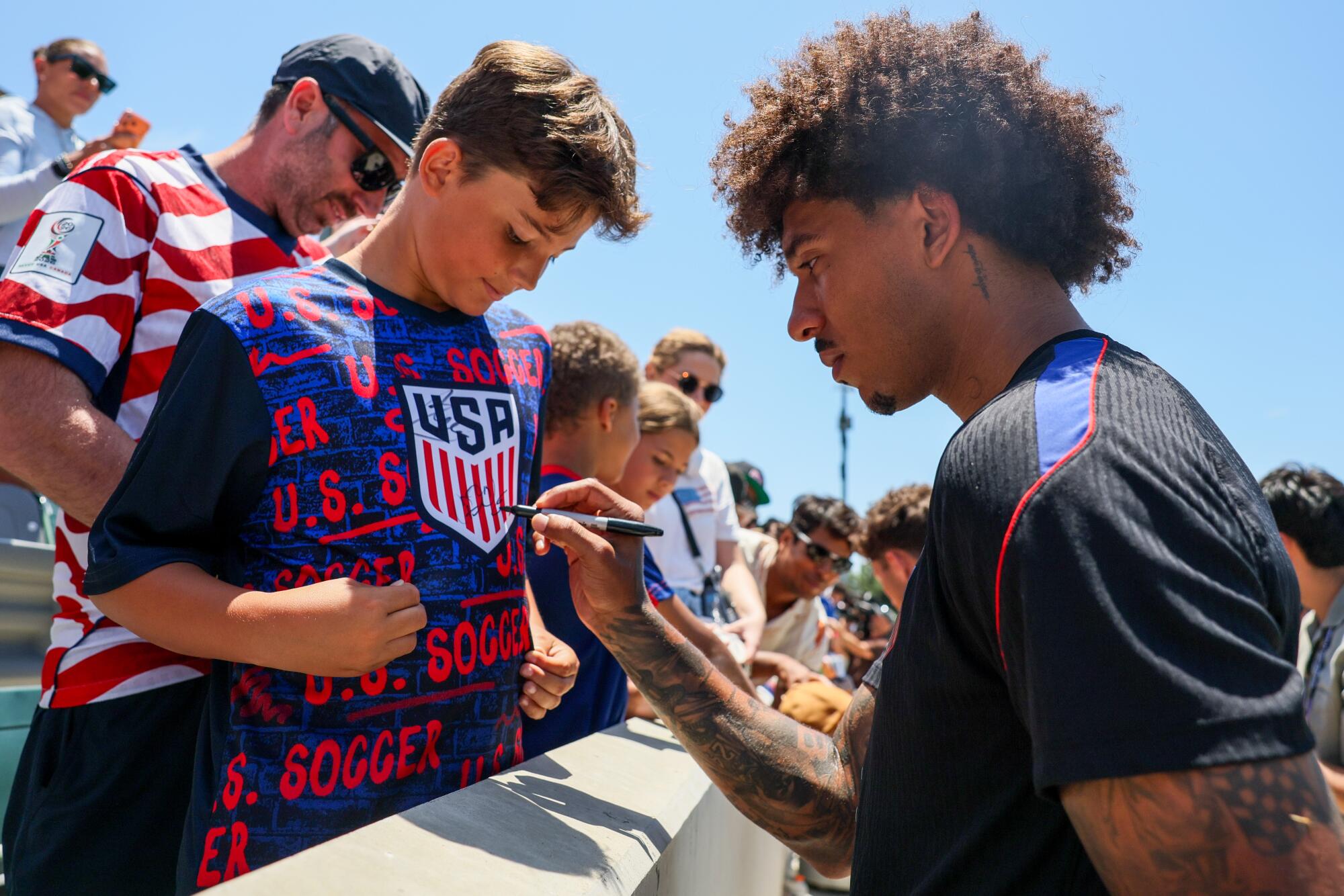
Irvine, CA - June 08: USMNT player Chris Richards autographs the shirt of a young fan.

U.S. men’s soccer player Chris Richards autographs the shirt of a young fan during a team practice Monday.

(Ronaldo Bolaños / Los Angeles Times)

“How can you not be excited about the host nation training in your facility?” said Dan Rutstein, president of business operations of the Orange County club.

“We’re proud to be associated with the U.S. national team. We wouldn’t want to ever block anything, even if we could.”

(And they couldn’t, the city said.)

The Great Park is a sprawling 500-acre complex built on the site of the former Marine Corps Air Station El Toro, which closed in 1999 after 56 years training pilots for conflicts from World War II through the first Gulf War. In 2001, voters approved a proposal to convert the space into a public park and nature preserve, one which now includes, among other things, five sand volleyball courts, four basketball courts, 25 tennis courts, 12 softball and baseball fields, the ice arena where the Ducks practice and 25 soccer fields, including the pristine one FIFA just installed inside the 5,500-seat stadium.

“The idea was that this would be a quality facility, a great park that we hope will rival San Diego’s Balboa Park and other great parks across the country,” Irvine mayor Larry Agran said. “It took a lot of nurturing, a lot of time, a lot of work.”

Bringing the World Cup — or at least a World Cup team — to Irvine also took a lot of time and work. Agran said the city put out feelers about hosting a training base five years ago and made the first cut in 2024 when the Great Park was placed on a list of options distributed to tournament qualifiers.

Over the next two years, Rutstein said, about a dozen national teams sent representatives to have a look while Sam Zapatka, the operations manager of the USMNT, said he scouted 27 facilities from Seattle to San Diego. After his first visit to the Great Park, however, he said he stopped looking and in March, the team announced it would train in Irvine.

On Monday, when the players filed out of the stadium’s locker room, which FIFA expanded and upgraded, they were greeted by rhythmic clapping and chants of “USA! USA!”

1

U.S. men's soccer player Weston McKennie takes part in a training session at

2

U.S. men's soccer players (from left) Weston McKennie, Christian Pulisic and Sergino Dest take part in a training session.

3

U.S. men's national soccer team coach Mauricio Pochettino waves to fans attending practice on Monday.

4

U.S. coach Mauricio Pochettino speaks to players after

1. U.S. men’s soccer player Weston McKennie takes part in a training session at Orange County Great Park. (Ronaldo Bolanos / Los Angeles Times) 2. (Ronaldo Bolanos/Los Angeles Times) 3. U.S. men’s national soccer team coach Mauricio Pochettino waves to fans attending practice on Monday. 4. Pochettino speaks to players after drills at Orange County Great Park on Monday. (Ronaldo Bolanos / Los Angeles Times)

“I think we’ve all been, I wouldn’t say overwhelmed, but possibly surprised by the excitement and the buzz,” said captain Tim Ream, who led the team onto the field. “Pulling up here with 5,500 fans ready to watch a training session is incredible.

“We get to train in an actual stadium with a good pitch. The support, really, from all the kids out there is amazing. You want to feel like you have a good home base, right? So really, we’re looking forward to being here.”

Especially after 5,000 of your neighbors show up for the housewarming party.

Source link

It’s official: 13 players with World Cup experience make U.S. roster

Mauricio Pochettino knows the joy of making a World Cup roster. But he also knows the misery of being left off one.

In the first case, you want to celebrate; in the second, you want to be left alone.

The U.S. coach said he kept both emotions in mind when informing players they had — or had not — made the roster for next month’s tournament, a roster that was formally announced Tuesday during a sun-splashed, made-for-TV rally in the shadow of the Brooklyn Bridge, about 13 miles from where July’s World Cup final will be played.

“The most important event is to be in any single roster,” said Pochettino, who made Argentina’s team for the 2002 World Cup after being passed over four years earlier.

So when Pochettino decided which 26 men would be on his team this summer, each of them got a WhatsApp message, followed by a video, sent out at 1 p.m. Eastern Time Friday. Defender Tim Ream said he received the message as he walked to his car after training with his club team in Charlotte, N.C.

“It made me stop in my tracks and immediately call my wife to let her know,” he said. “We both had been anxious and excited for the announcement.

“I’m not overly emotional, but it was definitely a relief and there was a little bit of bit of quivering, for sure, with my family when I found out.”

Christian Pulisic was alone in Milan, where he plays in Italy’s Serie A, when his phone lit up.

“I was just relaxing. Then I saw the message pop up and got excited,” he said.

The 29 players from the provisional roster who didn’t make the cut? They each got a simple email. And no explanation.

“I know it is so painful. It was so painful for me,” Pochettino said.

“When I didn’t make the roster, I didn’t want my coach to call me,” he added. “Because we care a lot, we don’t want to say nothing to confuse the player. A player who didn’t make the roster, they don’t want to hear me say, ‘Oh [too bad].’”

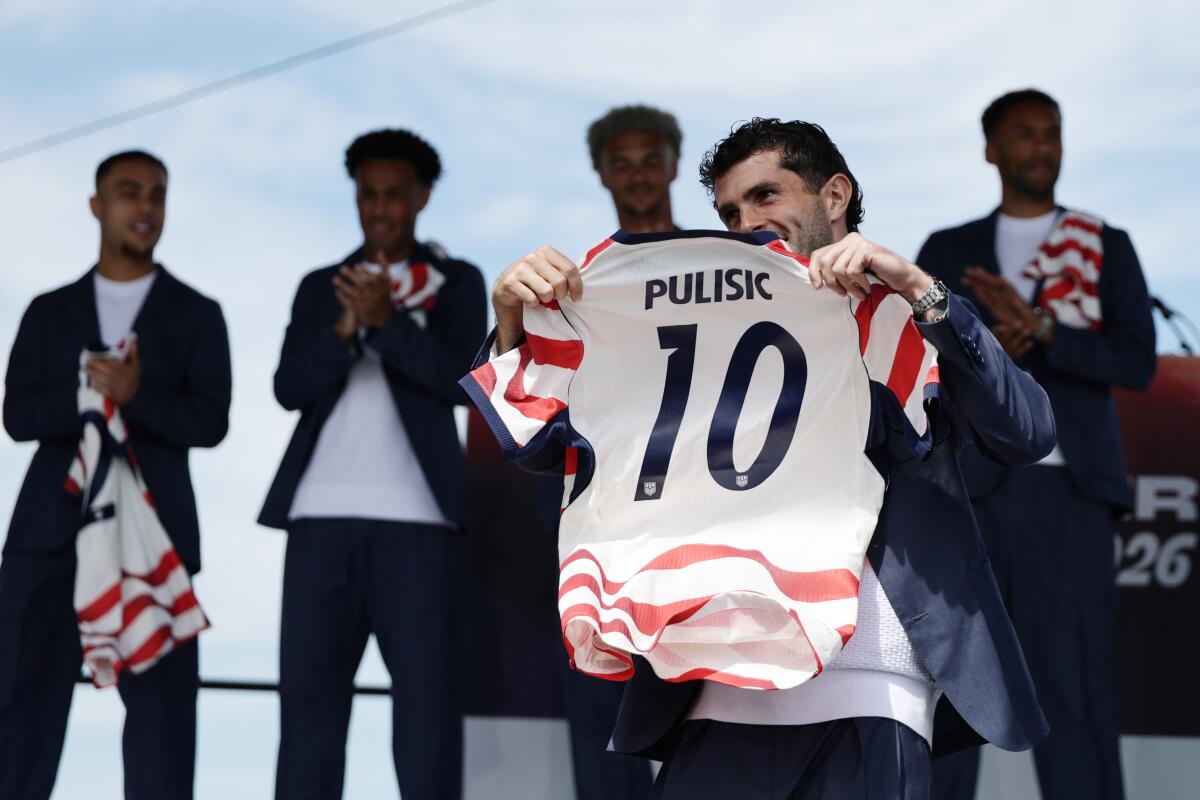
Christian Pulisic holds up his U.S. jersey during a rally Tuesday in New York.

Christian Pulisic holds up his U.S. jersey during a rally Tuesday in New York.

(Adam Hunger / Getty Images)

Ream and Pulisic are two of 13 players who are returning to the World Cup after making the team in Qatar four years ago, part of a list that includes midfielders Tyler Adams, Gio Reyna and Weston McKennie and defenders Sergiño Dest and Antonee Robinson. They will be joined by defenders Miles Robinson and Chris Richards, both of who missed the last World Cup because of injury, and forward Ricardo Pepi, one of the final cuts in 2022.

Richards was chosen despite tearing two ligaments in his left ankle playing for Crystal Palace earlier this month. Pochettino had no new information on the injury Tuesday but said the final World Cup roster doesn’t need to be filed with FIFA until Sunday; after that, teams can replace players up to 24 hours before their opening match in the event of injury or illness.

Reyna’s inclusion was also a minor surprise since he has played just one full 90-minute game for club or country in the last four years. In the last World Cup in Qatar, he was nearly sent home for a perceived lack of effort in training after he learned he wouldn’t be a starter in the tournament.

But Pochettino said picking him was an easy decision.

“I really trust in him,” Pochettino said. “He’s a different player. A different talent. The roster needs to have a player like him.”

There were also notable omissions, among them midfielders Diego Luna and Tanner Tessmann. Luna, who plays in MLS for Real Salt Lake, has been a regular under Pochettino, playing in 17 of the U.S. team’s 18 games in 2025. But he missed time earlier this season with a knee injury and sat out of his club team’s last two games with a muscle problem

Tessmann had been called into six training camps under Pochettino and was seen as a potential starter for the U.S. before being shut down by his French club, Lyon, at the end of the season, leaving his fitness for the World Cup in question.

Pochettino declined to talk about either player — or anyone else left off the team.

“We are not going to talk about the players that are not on the roster,” he said. “That’s disrespectful to the players who are on the roster.”

Raising questions about who should have been included, the coach said, necessarily leads to questions about who should have been left off.

“That was my decision to pick that 26,” he said

Pochettino said he didn’t settle on a roster until the day before players got the WhatsApp videos — or the simple email.

“We wanted the right balance with the right players,” he said.

Among the first-time World Cup selections are midfielder Malik Tillman, the German-born brother of LAFC midfielder Timothy Tillman; Mexican-born attacker Alejandro Zendejas, who plays for Club América in the Liga MX; and Vancouver Whitecaps midfielder Sebastian Berhalter, son of Gregg Berhalter, the U.S. coach in the last World Cup.

Berhalter said he was in Qatar four years ago, cheering on his dad’s team. This year, his dad will be cheering for him.

“If you believe in your dream and put in the work, you never know what might happen,” he said from the stage after being introduced to the crowd at Tuesday’s rally.

The team will open training camp in Atlanta on Wednesday ahead of friendlies with Senegal in Charlotte, N.C., on Sunday and against Germany on June 6 in Chicago. The team will then move to the Orange County Great Park in Irvine for final preparations for its World Cup opener against Paraguay at SoFi Stadium in Inglewood on June 12.

ROSTER

Goalkeepers: Chris Brady (Chicago Fire), Matt Freese (New York City), Matt Turner (New England Revolution)

Defenders: Max Arfsten (Columbus Crew), Sergiño Dest (PSV), Alex Freeman (Villarreal), Mark McKenzie (Toulouse) Tim Ream (Charlotte FC), Chris Richards (Crystal Palace), Antonee Robinson (Fulham), Miles Robinson (FC Cincinnati), Joe Scally (Borussia Mönchengladbach), Auston Trusty (Celtic)

Midfielders: Tyler Adams (AFC Bournemouth), Sebastian Berhalter (Vancouver Whitecaps), Weston McKennie (Juventus), Gio Reyna (Borussia Mönchengladbach), Cristian Roldan (Seattle Sounders), Malik Tillman (Bayer Leverkusen)

Forwards: Brenden Aaronson (Leeds United),Folarin Balogun (AS Monaco), Ricardo Pepi (PSV), Christian Pulisic (AC Milan), Tim Weah (Marseille), Haji Wright (Coventry City), Alejandro Zendejas (Club América)

Source link