North Korea launches ballistic missile ahead of U.S.-South Korea military exercise

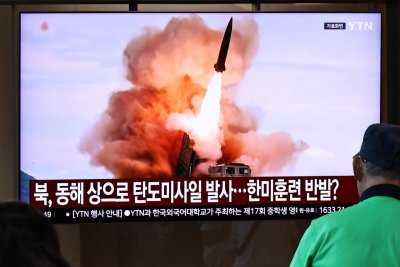
North Korea launched a ballistic missile toward the East Sea Wednesday, Seoul’s Joint Chiefs of Staff said. In this photo, people watch a news report on the launch at Seoul Station. Photo by Yonhap
SEOUL, Aug. 11 (UPI) — North Korea fired a ballistic missile toward the East Sea on Wednesday, the militaries of Seoul and Tokyo said, its second such launch in less than a week as the United States and South Korea gear up to kick off their major summertime joint military drill.
The missile was fired from the Wonsan area on North Korea’s east coast at around 6 a.m., South Korea’s Joint Chiefs of Staff said in a text message to reporters.
“The detected North Korean missile flew over 700 kilometers (435 miles), and South Korea and the U.S. are currently conducting a detailed analysis regarding its exact specifications,” the JCS said.
The military did not specify the type of missile involved, although the distance the projectile traveled falls within the range of short-range ballistic missiles.
South Korean and U.S. intelligence authorities tracked and shared information on the launch from its initial stage, while Seoul also exchanged information related to the ballistic missile with Japan, the military added.
“Under a robust South Korea-U.S. combined defense posture, the military is closely monitoring North Korea’s various movements and maintaining the capability and readiness to overwhelmingly respond to any provocation,” the JCS said.
Japan’s Defense Ministry also detected the launch, saying the missile flew about 429 miles, reached a maximum altitude of roughly 56 miles and fell outside Japan’s exclusive economic zone.
Defense Minister Shinjiro Koizumi condemned the launch at a press briefing, saying the North’s weapons tests “threaten the peace and security of our country, the region, and the international community.”
Koizumi said the launch violated relevant U.N. Security Council resolutions and noted that Japan had lodged a strong protest with North Korea through diplomatic channels at its embassy in Beijing.
Hawaii-based U.S. Indo-Pacific Command said it detected the launch and was consulting with regional allies and partners.
“Based on current assessments, this event does not pose an immediate threat to U.S. personnel or territory, or to our allies,” the command said in a statement.
The launch came days before the United States and South Korea are set to begin their annual summertime joint military drills. The 11-day Ulchi Freedom Shield exercise kicks off Monday and will focus on preparing for evolving threats from North Korea, military officials said earlier this week.
North Korea routinely denounces the allies’ joint exercises as rehearsals for an invasion and frequently responds with weapons tests. On Thursday, Pyongyang fired a short-range ballistic missile toward the East Sea.
The allies stressed that the joint exercise is defensive in nature.
“We’re up here today announcing Ulchi Freedom Shield to the entire world before it even starts,” U.S. Forces spokesman Col. Ryan Donald said at a press briefing Monday. “UFS is not a pretext, it’s not a provocation. It’s a transparent, longstanding defensive training event.”