u. s. president

Trump-Xi talks in Beijing: What’s at stake

President Trump’s first visit to China in nine years is a high-stakes trip reflecting the rivalry and mutual dependence of two superpowers hoping to avoid a collision course — even if Trump cast it more as a meeting between close friends and business partners.

Speaking to reporters before departing Washington on Tuesday, Trump downplayed tensions between the two countries, including on trade, calling Chinese President Xi Jinping a “wonderful guy” and a friend and saying the working relationship between the two countries is “very good.”

Trump acknowledged China’s might — saying that the Asian nation and the United States are clearly the world’s two superpowers — and that the focus of the meeting “more than anything else will be trade.”

“We’re gonna have a great relationship for many, many decades to come,” Trump said. “My relationship with President Xi is a fantastic one. We’ve always gotten along, and we’re doing very well with China, and working with China’s been very good — so we look forward to it.”

Trump also downplayed the importance of the meeting for the war in Iran. He said Xi might be able to help the United States reach a deal to end the war, but that he doesn’t need it, “because we have Iran very much under control.”

The state visit marks the first by an American president to China since Trump’s trip here in 2017, only months into his first term. President Biden never came, becoming the first to not do so since diplomatic ties were normalized, an absence that underscored simmering distrust and animosity between Washington and Beijing that has only worsened since.

  • Share via

In the capital, security forces sealed off an area around the Temple of Heaven roughly the size of 400 football fields ahead of the U.S. president’s visit, anticipating a stop at the monument to imperial China and Confucian thought.

On his previous trip, Trump received the rare honor of a state banquet inside the Forbidden City. This time he is expected to dine at the Great Hall of the People, an imposing structure off Tiananmen Square that hosts high-level gatherings of the Chinese Communist Party.

Trump’s positive spin on Tuesday aside, his agenda for meetings beginning Thursday with Xi highlights the vast array of American interests that depend on — and often clash with — Beijing’s policies.

After launching a trade war against China at the beginning of his second term, Trump now comes hat in hand requesting an extension of a tariff truce, fearful Xi might follow through on his threats to halt the export of rare earth minerals to the United States that are vital to the manufacturing of American goods, including everyday consumer equipment and advanced defense technologies.

His visit comes as a ceasefire in the war with Iran, brokered with help from Beijing, is on “massive life support,” according to the president. Trump is expected to appeal to Xi for assistance in getting Tehran to restore free and open passage through the Strait of Hormuz.

And in a dramatic reversal, the Trump administration has begun discussions with the Chinese about establishing a channel of communication on artificial intelligence, alarmed that recent technological leaps could pose global risks.

All of these requests are expected to come at a cost.

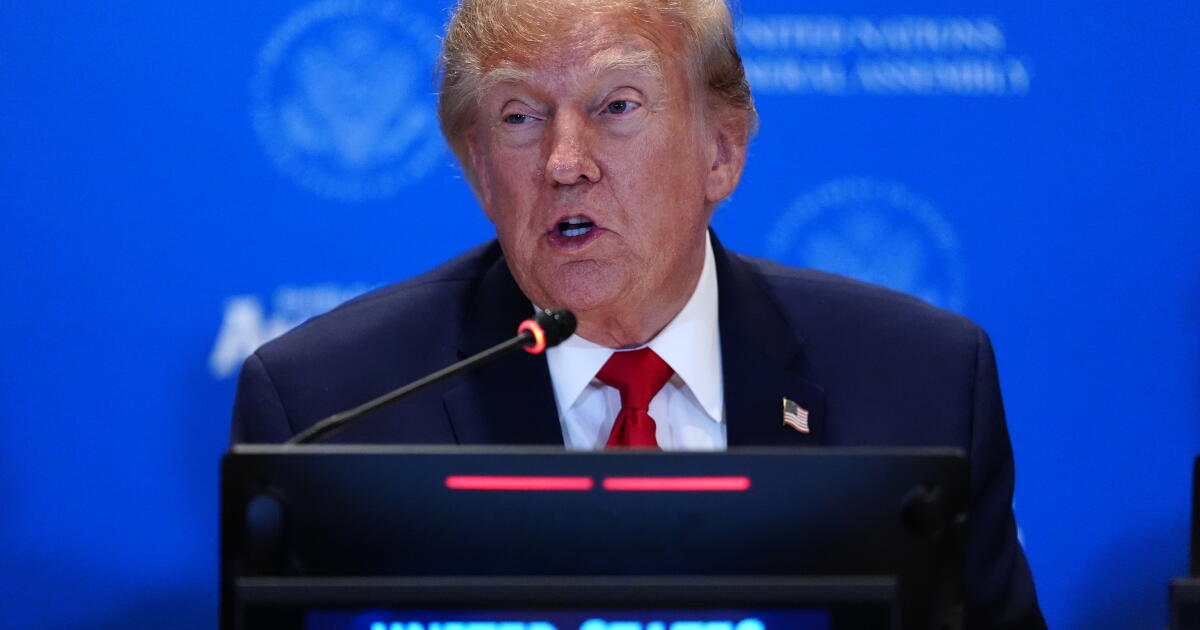
A man in a dark suit and wind-blown gold-colored tie

President Trump departs the White House on May 12, 2026, for his second state visit to China.

(Kevin Dietsch / Getty Images)

In earlier remarks before the trip, Trump said he expected U.S. arms sale to Taiwan — including one already approved by Congress — to become a chip in the negotiations.

“I’m going to have that discussion with President Xi,” Trump said. “President Xi would like us not to, and I’ll have that discussion. That’s one of the many things I’ll be talking about.”

The notion that U.S. support for Taiwan is a negotiable matter is sure to rattle America’s allies throughout the region, from Japan to the Philippines, which are reliant on U.S. security guarantees amid China’s Indo-Pacific military aggression.

Despite geopolitical tensions, both sides are expected to announce business and investment agreements, underscoring how deeply intertwined the world’s two largest economies remain.

China plans on making a significant purchase of Boeing aircraft, and the president has brought 17 American corporate leaders with him on the trip to discuss additional opportunities, including Apple’s Tim Cook, BlackRock’s Larry Fink, Meta’s Dina Powell McCormick and Tesla’s Elon Musk.

The two leaders are expected to have other opportunities to talk in person throughout the coming year, including potential meetings at the Group of 20 summit in Florida, the APEC summit in Shenzhen, China, and a state visit in Washington that Trump said he will host for Xi at some point in the coming months.

Trump on Tuesday said Xi’s visit will be “toward the end of the year” and “exciting.” He also lamented that the ballroom he is building on the White House grounds — on the site of the historic East Wing he demolished — won’t be ready in time.

Jennifer Hong, senior director at the Institute for Indo-Pacific Security, said her concern is that the state visit becomes part of a “tyranny of calendaring,” where the Chinese agree to schedule more high-level meetings sought by Trump that put off vital U.S. decision-making.

“I do think this trip is necessary for the U.S. government — I think that there are things that are on hold because he doesn’t want to rock the boat,” Hong said, noting the Trump administration’s delay in arms sales to Taiwan, despite the packages already having received congressional approval.

“I’m just worried this will be a stringing along of promises, or maybe some reprieve for a year or so,” she added, “as we continue to handicap ourselves on national security matters for the sake of more meetings.”

Trump on Tuesday repeatedly dismissed China’s potential help in resolving the war in Iran, which has driven up prices domestically and around the world as oil shipments through the strategic Strait of Hormuz have been badly disrupted and U.S. efforts to fully reopen the channel have so far been unsuccessful.

“I don’t think we need any help with Iran, to be honest with you,” Trump said. “They’re defeated militarily.”

Trump also said the financial pain many Americans are feeling from the war, including at the gas pump, simply isn’t a factor — “not even a little bit,” he said — in his ongoing negotiations with Iran.

“The only thing that matters when I’m talking about Iran [is that] they can’t have a nuclear weapon,” he said. “I don’t think about Americans’ financial situation. I don’t think about anybody.”

Source link

How a Dodgers prospect became an advisor to four U.S. presidents

The ninth in an occasional series of profiles on Southern California athletes who have flourished in their post-playing careers.

When the Dodgers drafted David Lesch in January 1980, they had visions of his fastball lighting up radar guns at Dodger Stadium.

He never made it that far.

Lesch never climbed above the lowest rung on the minor league ladder, where he pitched just 10 innings and gave up more runs, hits and walks than he got outs. Less than 18 months after he was drafted, Lesch, wracked by a rotator cuff injury, was released, his major league dream over before he was old enough to legally buy a beer.

“I went to Disney World after that,” he said.

But that wasn’t the only decision the Dodgers made that changed Lesch’s life. When he was drafted, the team gave him just a small bonus, but sweetened the deal by offering to pay for college if he ever went back to school. For the team, it seemed a safe bet.

“They probably have this algorithm saying ‘this is the No. 1 draft pick. If he doesn’t make it, he’s not going back to college. He’ll be assistant baseball coach of his high school or something,’” Lesch said.

Oops.

Lesch not only went back to college, but he also wound up getting three degrees, including a master’s and a PhD from Harvard. It was arguably the most important investment in humanity the Dodgers made since signing Jackie Robinson, because Lesch went on to become one of the world’s top experts on the Middle East, writing 18 books and more than 140 other publications while advising four presidents and a cadre of United Nations diplomats.

David Lesch interacts with students in his history class at Trinity University in San Antonio.

David Lesch interacts with students in his history class at Trinity University in San Antonio.

(Lucero Salinas / Trinity University)

“That was the best deal,” Lesch, 65, said by phone from San Antonio, where he is the Ewing Halsell Distinguished Professor of History at Trinity University.

“Without that I probably could not have said yes to Harvard because of the price. The Dodgers committed to paying.”

And by doing so, the Dodgers may have altered history just a bit.

Lesch’s regular meetings with Syrian president Bashar al-Assad, which ended with Lesch facilitating an important if temporary breakthrough in U.S.-Syrian relations? The diplomatic and conflict-resolution work in Syria and the wider U.N. initiatives on regional issues throughout the Middle East? The thousands of students Lesch inspired to go on to perform important diplomatic and public-service roles of their own?

None of that happens if Lesch’s shoulder had held on or if the Dodgers had reneged on their deal.

“It was very fortunate that he hurt his rotator cuff. Baseball’s loss is academia’s gain,” said Robert Freedman, a scholar and expert on Russian and Middle Eastern politics who taught Lesch at the University of Maryland Baltimore County.

“I’ve been teaching for, I guess, 60 years now and I can tell when a student can see a complex problem and can penetrate right to the heart of the problem very quickly. He was one of those students.”

Still, it took a slightly offhand comment from Freedman, who now teaches at Johns Hopkins, to launch Lesch on his post-baseball career.

“We were having lunch and he was looking for a project and I mentioned to him ‘you know, there hasn’t been a good American scholar doing work on Syria for many, many years,’” he said.

“That struck his interest.”

Playing a child’s game and managing life-and-death Middle East politics share very little in common. But Lesch made the transition seamlessly.

“It is like he’s several different people, or has been,” said journalist and author Catherine Nixon Cooke, whose book “Dodgers to Damascus: David Lesch’s Journey from Baseball to the Middle East” traces those parallel lives.

“I’m wondering if, in a sense, it all worked out the way it was supposed to,” Cooke continued. “Even though his dream was to be a major leaguer, David certainly has reinvented himself to this really remarkable man following a completely different path.

“It was the Dodgers who paid for him to go to Harvard and so it’s kind of a weird thing. Baseball took away his dream because he got hurt, but baseball also gave him his backup plan.”

Lesch was still a teenager when, 20 minutes into his first spring training camp in Vero Beach, Fla., Dodgers manager Tommy Lasorda plucked him off a minor league practice field to pitch batting practice in the main stadium.

Waiting for him were Ron Cey, Bill Russell, Steve Garvey, Davey Lopes and Reggie Smith, the heart of a lineup that would win a World Series a season later.

It was the first time — and nearly the last — that Lesch faced big-league hitters. And it didn’t start well.

Batting practice pitchers throw from behind an L-shaped screen that protects them from comebackers and Lesch had never used one. That, combined with his understandable nervousness, caused him to short-arm his first fastball, which sailed at Cey’s head, sending him sprawling into the dirt.

“He got up and gave me this mean look,” Lesch said. “I remember it so vividly right now. I really thought I was going to be released that day.”

Instead, he gathered himself and finished the session, earning pats on the back from both Garvey and Lasorda. The incident, he said, has colored the rest of his life.

“I’ve met with presidents, prime ministers, been in war zones, all sorts of things,” Lesch said. “Anytime I say ‘well, you know, this should make me nervous,’ I think about that episode and the fact that I made it through and did OK.”

In high school, Lesch had focused on basketball and baseball. Academics? Not so much. So after spending his freshman year of college at Western Maryland College, he transferred to Central Arizona, a junior college, so he would be eligible for the January 1980 draft, allowing him to trade his books in for a baseball.

The so-called secondary draft, which was discontinued six years later, was specifically targeted toward winter high school graduates, junior college players, college dropouts and amateurs who had been previously drafted but did not sign. As a result, the bonuses teams offered winter draft picks were just a fraction of what players taken in the June draft received.

Lesch’s was so low, he can’t even remember what it was.

“I want to say $10,000 to $15,000,” he said. “No more than $20,000.”

When it became clear the Dodgers weren’t going to budge on the money, Lesch’s father, Warren, a family physician in suburban Baltimore, pulled out the Harford County phone book and looked up the number for Baltimore Orioles coach Cal Ripken Sr. Lesch played high school ball against Ripken’s son Cal Jr., who had been a second-round draft pick of the Orioles two years earlier. So his father thought the Ripkens might have some advice on what to ask of the Dodgers.

David Lesch, a former Dodgers draft pick, stands on the baseball diamond at Trinity University in San Antonio.

David Lesch, a former Dodgers draft pick, stands on the baseball diamond at Trinity University in San Antonio.

(Lucero Salinas / Trinity University)

“Ripken goes ‘does your son like school and is he smart?’” Lesch’s older brother Bob remembers. “So Ripken suggested if they offer you XYZ bonus money, take less and say ‘I’ll take this amount, but you have to cover education if he doesn’t make it.’”

Neither side thought that clause would ever be triggered; Lesch, a big, intimidating right-hander who threw bullets from behind Coke-bottle eyeglasses, wasn’t headed to a classroom, he was going to Dodger Stadium.

Until he wasn’t.

Lesch missed a couple of weeks with a back injury. By overcompensating for the sore back, he developed paralysis in the ulnar nerve in his right arm, limiting him to five appearances in his first minor league season.

He arrived healthy for his second spring in Vero Beach and threw three no-hit innings in his first outing against double-A and triple-A players, creating such a buzz that Ron Perranoski, the Dodgers’ major league pitching coach, showed up to watch his second game. By then the shoulder and back stiffness that shortened his first season had returned, and Lesch was rocked. Perranoski left early and unimpressed.

Lesch’s delivery had one major flaw: He threw directly overhand, as opposed to three-quarters or even sidearm, which can increase velocity but also places additional strain on the shoulder and elbow. As a result, his fastball could top out in the mid-90s one day, but when the stiffness and pain returned, it left him throwing in the low 80s.

The inconsistency continued to plague Lesch, and eventually the Dodgers decided they’d seen enough and released him. When he got back to Maryland, Lesch’s father sent him to see an orthopedic surgeon, who found the problem wasn’t in his back or elbow but rather the rotator cuff.

“We didn’t live in the era of pitch counts. So he just pitched,” said David Souter, a high school and college teammate who went on to develop big-league pitchers.

“He had the ability if he was developed and stayed healthy. I think he probably overthrew and tore his rotator cuff and nobody knew it.”

If Lesch had come along 10 years later, when rotator cuff surgeries were common, he might have returned to the mound. But in 1981, a rotator cuff injury was a death sentence for a pitcher.

“It’s just a crapshoot based on physiology,” Lesch said. “I probably was destined. Something would have happened.”

If he could do it over again, Lesch said he would change one thing.

“I’d throw sidearm,” he said. “It’s much less stress.”

He threw to big league hitters just one more time. Following the strike that interrupted the 1981 season, Ripken Sr. phoned Lesch back and asked him to throw batting practice at Memorial Stadium to help the Orioles prepare for the resumption of play. As a reward, the Orioles let Lesch hit — he never had batted in the minors — and he drove a pitch over the left-field wall, then dropped the bat and walked away.

He never stepped on a major league field again.

The Dodgers’ investment in Lesch’s education appeared manageable when he enrolled at a satellite campus of the University of Maryland, in part because his brother Bob was the school’s sports information director.

But it was 1981 and the Middle East was at the forefront of geopolitics. Lesch became convinced the Middle East would be central to world affairs for decades to come. Inspired and encouraged by Freedman and another professor, Lou Cantori, he applied to graduate school at Harvard, Georgetown, Johns Hopkins and the University of Chicago, knowing he couldn’t afford any of those schools on his own.

“I probably could not have said yes to Harvard when they accepted me because of the price,” Lesch said. “The Dodgers had committed to paying and whatever it was, it was a lot more collectively — my undergraduate MA and PhD — than I had gotten in the bonus.”

That wasn’t the only time his baseball background worked in his favor. Years after starting at Harvard, Lesch stumbled upon written evaluations of his application and learned that his grade-point average and other factors were similar to those of other applicants, but it was his athletic career that had swung enough votes in his favor to get him accepted.

“Failure is at the core of sports. And so you have to have this resiliency,” Lesch said. “What a lot of the top colleges have found is that these young kids out of high school who somehow get a 4.6 GPA, they come in — and I’ve seen this as a professor — they get their first C and they’re distraught.

“Athletes stick with it. They say ‘how can I turn this around? How can I get better?’ Admissions departments across the board have looked at athletes much differently.”

The struggles Lesch experienced on the diamond did not follow him into academia. Yet becoming an expert on the Middle East definitely was a backup plan.

“His first passion was clearly baseball and basketball,” said Souter, the former teammate. “Every kid dreamed … that.”

If the shoulder injury wasn’t a strong enough sign that that dream was over, the fire that destroyed Lesch’s childhood home a few years later was. The flames, which severely burned both his parents, also erased his baseball career, consuming all the photos and memorabilia he had collected, save for the championship ring from his one minor league season, which he found buried in the embers. It was the only thing to survive the blaze intact.

David Lesch's championship ring from his one minor league season with the Dodgers.

David Lesch’s championship ring from his one minor league season, the only surviving keepsake of his professional career after a his family’s home was destroyed in a fire.

(Courtesy of David Lesch)

A post-graduate trip to Syria, the first of more than 30 visits he has made to the country, sealed the deal a few years later. The love he once had for baseball he now felt for a strange and mysterious place that was as old as history itself yet as secretive as the classical ciphers.

Soon Lesch was helping arrange high-level meetings between Syrian president Hafez al-Assad and President George H.W. Bush, a baseball fan who seemed as interested in Lesch’s Dodgers days as his Middle Eastern expertise. But his big break came during the first presidential term of Bush’s son George W. Bush, when Bashar al-Assad, who succeeded his father as Syria’s president, welcomed Lesch for the first of many interviews that informed his book, “The New Lion of Damascus: Bashar al-Assad and Modern Syria.”

“His forte is listening,” Cooke, the biographer, said of Lesch, whose polite, unassuming manner reflects an adult life spent mostly in San Antonio. “When he goes in to try to mediate something, he is a big listener. There is a side of David that doesn’t talk much. But he’s listening.”

The book humanized al-Assad and opened, for a time, the possibility of normalized relations between Syria and the West, with Lesch serving as an unofficial liaison between Damascus and Washington, as well as other Western capitals.

“He’s absolutely a critical player in what we would call two-track diplomacy,” Freedman said. “If the government wants to reach out but doesn’t want to take the political consequences, they send somebody to sound out the situation.

“It’s absolutely critical that we have people like that who can speak the language and understand the overall context, which sadly is lacking in the current administration.”

David Lesch teaches students in his history class at Trinity University in San Antonio.

David Lesch teaches students in his history class at Trinity University in San Antonio.

(Lucero Salinas / Trinity University)

But that opening closed as quickly as it opened. Lesch’s close contacts with al-Assad raised suspicions among some in Syria, and Lesch was poisoned twice. His relationship with al-Assad was severed completely shortly afterward when he criticized al-Assad for failing to implement promised reforms and becoming a “bloodthirsty tyrant.” The Syrian civil war took nearly 700,000 lives and displace another 6.7 million people before al-Assad and his family fled into exile in Russia in 2024.

“Many governments think that they can reduce war to a calculation,” Lesch said. “What we cannot measure accurately or fully appreciate is the human element. We cannot assess a people’s sense of grievance, passion, revenge, ideological commitment and historical circumstances that shaped the nature of their response and staying power.

“This is where academics can make a contribution to policy, giving it the depth and insight gleaned from years of study and learning the culture and the people.”

Baseball’s loss wasn’t just academia’s gain. It may prove to be humanity’s as well.

“I don’t really have any regrets,” Lesch said. “My career turned out great. I could not think of doing anything else at this point and, in fact, in a way I’m glad [baseball] didn’t work out.”

Source link