u. s. history

Trump marks 80th birthday with UFC event as big political issues loom

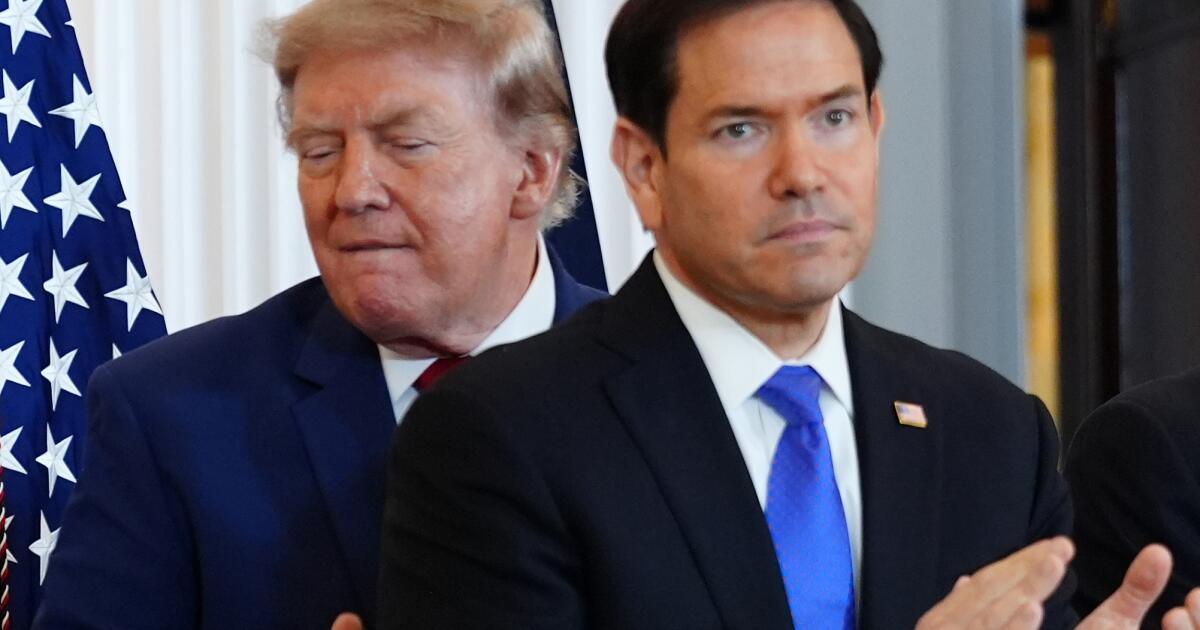
President Trump planned to mark his 80th birthday on Sunday with a celebration that once would have seemed unfathomable: a cage-fighting show on the storied South Lawn of the White House.

In the week ahead, some hard realities of the office have threatened to overshadow the ostentatious UFC mixed martial arts extravaganza, where combatants sealed inside a wire-mesh octagon try to punch, kick, chop and pummel each other into submission.

Trump has found himself boxed into an unpopular and costly war he helped start in Iran. An agreement to end the conflict could be close, but the crucial details are still to be negotiated. Meanwhile, about a mile from Trump’s birthday bash, crews pried the president’s name off the John F. Kennedy Center for the Performing Arts facade after a judge ruled that renaming it to include Trump was not allowed.

Regardless, the president will walk out of the White House and be surrounded by Cabinet leaders, top administration officials, Republican lawmakers and 4,000-plus spectators screaming themselves hoarse in a temporary arena under “The Claw,” a spaceship-like metal arch fitted with lighting, sound equipment and large screens. Thousands more will be watching on big screens from the nearby Ellipse.

“This event is a one-of-one event, incredible event. I love it,” said UFC chief Dana White, a close friend of Trump, during a Friday night hype session at the Lincoln Memorial where pairs of fighters shoved and scuffled for the cameras under the stoic gaze of Honest Abe’s marble likeness.

Trump has sought to tie Sunday’s event — which features seven fights running past midnight — to larger, months-long celebrations of the 250th anniversary of the signing of the Declaration of Independence.

But it is much more geared toward feting himself, so much so that the Group of 7 summit for leaders of industrialized nations pushed back their get-together so that the president could attend his cage-match party and then fly straight to France for the meetings.

The weather, though, could put a damper on things. Strong thunderstorms and heavy lightning disrupted Friday’s Lincoln Memorial event, and the forecast for Sunday evening also looked threatening.

“I’m sick and tired of hearing about the weather,” White declared Friday, before conceding that he’d prefer to hold future UFC events inside arenas only.

A very different 80th birthday celebration

When Trump’s predecessor, President Biden, turned 80 in November 2022, he celebrated with a private family brunch at the White House, a reminder of just how much and how quickly things have changed.

Asked about the contrast, White House spokesperson Allison Schuster said that the fight “will be one of the most entertaining nights in American history” and said that the timing was appropriate. “Having this spectacle take place at the people’s house on Flag Day during our nations’ semiquincentennial anniversary is a fitting tribute,” Schuster said in a statement, apparently including a punctuation error in referring to “nation’s.”

When he turned 80, Biden was the oldest president in U.S. history, and was months away from launching a reelection bid that he would ultimately abandon after a disastrous debate against Trump and mutiny among Democrats concerned that voters would perceive him as too old to handle a second term.

Trump has now supplanted Biden as the oldest person to be elected U.S. president. He’s constitutionally barred from running again, yet constantly toys with the notion publicly. That’s despite polls showing rising public skepticism about Trump’s mental and physical health — recalling concerns Biden faced as he turned 80.

A Washington Post/ABC News/Ipsos poll conducted in April found that less than half of U.S. adults think Trump has the mental sharpness or physical health to serve effectively as president.

The White House countered with a lengthy statement from Trump’s former White House physician, Republican Rep. Ronny Jackson of Texas, saying that Trump’s “stamina, focus, and strength are exceptional and on display every day. Claims to the contrary are pure fiction.” Jackson added that polling concerns were “being propagated by the same biased, liberal, Trump-hating press that completely ignored the absolute cognitive and physical disaster that was President Biden.”

Trump has nonetheless undergone four publicly announced physical examinations this term alone, with White House physician Dr. Sean Barbabella recently declaring him in “excellent health.”

‘Bread and circuses’ — Trump-style

The UFC event is an apt metaphor for Trump’s pugilistic political style. He has also long been a practitioner of political misdirection, purposely presenting people with something other than his presidency to focus on when things aren’t going well.

With the war in Iran grinding on despite weeks of assurances from Trump that its end is nigh, gas prices staying high, renewed concerns about inflation and plummeting job approval ratings for Trump — a White House birthday party unlike anything America has ever seen is definitely a diversion.

“This is all distraction,” said Mike Fontaine, a classics professor at Cornell University, who likened it to the gladiatorial games of Imperial Rome, when combatants brutalized each other for public entertainment meant to bolster rulers’ popularity and quell potential unrest.

“This is a classic strategy,” Fontaine said. “In ancient Rome, the phrase would be ‘bread and circuses.’”

Trump says the UFC is paying for the event, and though its full cost hasn’t been divulged, the National Park Service said in a court filing that $60-plus million and tens of thousands of hours of labor have gone into it, while seven government agencies have “allocated significant resources and manpower.”

UFC also announced Friday that it was adding as an official partner for the event World Liberty Financial to create a $250,000 athlete bonus pool for Sunday night’s winners. The cryptocurrency company is co-owned by the Trump family, founded with the president’s special envoy Steve Witkoff and run by the diplomat’s son Zach. The arrangement further blurs lines between the Trump family’s financial interests and the events and construction projects the president has prioritized and used government resources to pull off, which many critics and political analysts have labeled corrupt.

Still, Fontaine said that when it comes to a personal flair for pageantry, Trump’s second-term tendency to lean into “hardcore masculinity and brute fighting” is marrying the UFC’s blood sport with Trump’s distinctive sense of humor and enduring sense of showmanship.

“President Trump has a once-in-a-generation talent for this stuff,” he said.

Weissert writes for the Associated Press.

Source link

5 can’t-miss items at the Huntington’s America 250 exhibit

A cross section of a 250-year-old Pasadena oak tree that was uprooted in a 1993 windstorm is among the first things visitors will see upon entering the Huntington’s new exhibit, “This Land Is…” Jagged cracks in the trunk, which was once rooted in the Huntington’s lawn, are feebly held together by wooden joints.

It’s a fitting emblem of what’s to come in a long-planned show curated to coincide with the country’s upcoming semiquincentennial, and crafted to pose land itself as central to the country’s complex past. After taking in the exhibit, attendees can draw their own conclusions about the land’s role as a “geographical and metaphorical space of promise, struggle, and belonging.”

  • Share via

On a recent late afternoon, the Pasadena sun drilled down on the facade of the Huntington’s MaryLou and George Boone Gallery, where the show’s organizers waited beside four chiseled columns with their hands tucked behind their backs, swaying in anticipation.

“It’s the first time anyone is seeing it,” said Linde B. Lehtinen, the museum’s senior curator of photography.

Joining her are Josh Garrett-Davis, curator of Western American history, and Armando Pulido, assistant curator for special projects. All three smile with excitement.

For the better part of the last two and a half years, Lehtinen and Garrett-Davis have spearheaded the curation of “This Land Is…,” which opens Sunday and runs through early next year.

For them the fallen oak tree represents hope amid disturbance: Another once-towering elder on the museum’s North Vista was uprooted during a windstorm in 2025 — one of its acorns has since sprouted and now stands more than 6-feet tall.

Still, it only brushes the surface of an exhibition that seamlessly draws upon a plethora of works crafted across U.S. history. Want to plan a visit? Here are five things you shouldn’t miss seeing.

Woody Guthrie’s guitar, inscribed with ‘This Machine Kills Fascists’

In 1940, Woody Guthrie sat in a Midtown Manhattan hotel, toiling over lyrics for what would become “This Land Is Your Land.” Today, it’s been adopted as a quasi-anthem for the U.S. and the epitome of American progressivism.

For this exhibition, the museum acquired Guthrie’s C.F. Martin and Co. guitar, a seamless blend of spruce, mahogany, celluloid, ebony and mother-of-pearl. On its back, a carved inscription reads, “This Machine Kills Fascists.”

“The idea for ‘This Land Is…’ emerged … because the scope and breadth of his voice in terms of his activism and how prolific he was … and thinking about how he reflected on and experienced American land,” Lehtinen said.

Alongside the guitar is a copy of the Declaration of Independence, annotated by John McKesson, secretary of New York’s Fourth Provincial Congress, in the days following July 4, 1776. According to Lehtinen, the two objects were paired as instruments of protest and change.

“We talked to [Guthrie’s] granddaughter Anna Canoni, and she said to us at one point that he used guitars like pens or tools, and that was so appropriate to how we were thinking about its relationship to this document,” she added.

A map of the Butte Community, Gila River Relocation Center drawn by an internee.

A map of the Butte Community, Gila River Relocation Center drawn by an internee.

(Robert Gauthier/Los Angeles Times)

Japanese flower farmers photographed before, during and after internment

Not far from the Guthrie guitar is a panoramic portrait of the Kuromi family, posing amid a flower farm that stood where Los Feliz Boulevard is now. To its right is a watercolor painting of the Gila River War Relocation Center in Arizona, where many members of the family were forcibly transported to and imprisoned during World War II.

“I was looking at a historic preservation report, and the name was the same as my mechanic in Los Feliz,” Garrett-Davis said. “The next time I went to get my oil changed, I took a printout of that panorama and was going to show it to them and ask, ‘Do you know anything about this? Is this related?’

“I walked into their office, and a copy of that photo had been on their wall for years. In 10 years, I had never noticed it,” he said with a laugh.

After their internment, the Kuromi family returned to their farm in 1945 to find their equipment stolen. The process of regaining access to their land was slow, but they eventually settled back in, and operated the farm until losing their lease in 1961.

‘A Harvest of Death’ and mail from home on the Civil War front

One of the most grotesque displays on view is an albumen print of an 1863 photo titled “A Harvest of Death,” taken by Timothy H. O’Sullivan after the Battle of Gettysburg. Within its frame lies the bodies of fallen soldiers, sprawled out and lifeless on the grass.

“That evocative title signals some of the other things that we have been thinking about, whether it’s looking at gardens or loss … in this case, these are bodies that have been left, and they’re decomposing,” Lehtinen said.

Paired with the print is a letter from a young woman named Harriet Bailey to her uncle on the front lines of the Civil War, containing seeds delicately etched with drawings of a ship, facesand a dog. The two pieces represent a stark contrast in experiences during the same conflict, once again touching upon the theme of hope amid disturbance.

“This is a remnant of home that he’s actually being sent while on the battlefield,” she continued. “So, the joy and lightness to what is an incredibly somber moment in American history.”

A creative, photo-laden map of the Colorado river Otis R. "Dock" Marston on display at the "This Land Is…" Exhibition.

“Archiving the Watershed” is a collection of artifacts from the Colorado River assembled by Otis R. “Dock” Marston on display.

(Robert Gauthier/Los Angeles Times)

The Colorado River, mapped out through an adventurer’s eyes

This display is described as a “tiny slice” of the Huntington’s archive on Otis Reed “Dock” Marston, a historian and river runner who made it his life’s goal to collect information on the Colorado River. According to Garrett-Davis, Marston had around 185 binders full of photographs, often placed on a cut-out map of where they were taken and organized mile-by-mile, from below the U.S.-Mexico border all the way into Utah.

This taps into a focal point of the exhibition: adapting it to a West Coast perspective. In this way, the idea of independence is viewed expansively as it unfolds across time and place.

“The Huntington has a wonderful collection of presidential papers and documents relating to the Colonial era, but we also have materials on California … from the lens of the West,” said Huntington President Karen R. Lawrence.

“We can show the West’s visual culture at the same time that we can show the original copies of the Declaration of Independence … we have a breadth that’s quite rare.”

Noni Olabiisi's, "Troubled Island" mural on canvas, depicting the struggling of the Haitian revolution in reds and blacks.

Artist Noni Olabiisi’s, “Troubled Island” mural on canvas, depicting the struggling of the Haitian revolution.

(Robert Gauthier/Los Angeles Times)

‘Troubled Island’ and a mirrored struggle

The Haitian Revolution may seem out of place in an exhibition celebrating the U.S., but Haiti was the second independent nation in the Western Hemisphere. Its independence from the French was proclaimed in 1804, just two decades after the American colonies signed the Treaty of Paris.

In the mural “Troubled Island,” Noni Olabisi chronicles the Haitian struggle for independence, including how suffering under French colonists led to the 1791 slave rebellion. The piece was first painted for the William Grant Still Arts Center in West Adams in 2003, referencing an opera of the same name.

The opera was composed by Still with a libretto from the Missouri-born poet, playwright, novelist and social activist Langston Hughes, who connected Haiti’s struggle for freedom to his home country’s.

“We wanted to focus on parts that might seem peripheral but are actually quite central to American history,” Garrett-Davis said.

Three years later, Olabasi would render the same powerful mural on canvas.

‘This Land Is…’

Where: The Huntington
When: June 14 to Jan. 11, 2027
Cost: $29 to $34, depending on date and season
Info: huntington.org

Source link

Congressman sees parallels to WWII Japanese detention in today’s raids

The congressman returned home last Fourth of July to startling stories in Southern California as immigration patrols swept through communities, and one constituent told him about starting to carry a passport as proof of the right to be in the country.

Rep. Mark Takano, whose American-born parents were both incarcerated as young children with their families during the forced relocation of Japanese Americans during World War II, could not help but see the parallels between that chapter of American history and this one.

“I do feel like there’s a similarity of circumstance of my own 2-year-old father and my 1-year-old mother being labeled as enemy aliens and they’re considered a danger to national security,” the Riverside Democrat told the Associated Press in a recent interview.

“They’re put into these incarceration camps,” he said. “Similar arguments have been made by this administration — that immigrants pose a grave danger to our country and it’s for the security of our country that we’re doing this.”

Echoes of history

President Trump’s campaign to achieve the largest mass deportation operation in U.S. history is at an inflection point. Americans are seeing what it looks like to round up, detain and deport thousands of people, particularly in the aftermath of the deaths this year of Renee Good and Alex Pretti, U.S. citizens protesting the federal crackdown in Minneapolis.

The White House changed the leadership at the Department of Homeland Security as it reframes its approach. New Secretary Markwayne Mullin promised to keep the department off the front pages.

But Trump is also under mounting pressure from conservative groups not to let up on the goal of deporting 1 million people a year. The president’s Republican allies in Congress are fueling the immigration and deportation actions with billions of dollars in special funds.

Takano, the ranking Democrat on the House Veterans’ Affairs Committee, has drawn from his own family history — and the country’s eventual redress to Japanese Americans who were detained — to challenge Trump’s approach.

“We look back on that era of history as a shameful one, as a time when our political leaders failed the Constitution, failed the American people,” he said.

One family’s story among many

A high school history teacher before being elected to Congress in 2012, Takano grew up in Southern California and came to understand the family stories.

His grandfather Isao Takano arrived in the U.S. from Hiroshima and married Kazue Takahashi, a U.S.-born citizen. Together they settled in Bellevue, Wash., and started a business growing tomatoes, strawberries and chrysanthemums for the marketplace in Seattle.

When the U.S. entered the war after the Japanese attack on Pearl Harbor, they were among some 120,000 people of Japanese ancestry, immigrants and those born in the U.S., forcibly relocated.

His father, William, was 2 years old when his family was sent in 1942 to the incarceration camp at Tule Lake in Central California. His mother, Nancy Tsugiye Sakamoto, born in California to American-born parents, was a year old when she was relocated to the detention facility in Heart Mountain, Wyo.

Then, as now, he said, people are being swept up in the anti-immigrant detentions.

“Will Americans generations from now visit ‘Alligator Alcatraz’ and think to themselves, how could our government do this?” Takano said during a House floor speech, referring to the Trump administration’s immigration detention facility in Florida.

“These future generations of Americans will look to us, the Congress, to see what we did to try to stop it.”

A Reagan-era law seen as model

Takano remembers his father taking him to see the land the family once owned. He learned about his great-uncles who served in the Army’s 442nd Regimental Combat Team of Japanese American soldiers; one was killed in action in Italy. He recalls his own father later collected donations for the national redress campaign.

In 1988 Congress passed the Civil Liberties Act, which sought to apologize for the “grave injustice” that had been done and provide $20,000 to each person detained. President Reagan signed it into law.

Takano’s parents were among those who received a letter of apology from the federal government, he said, and a payment.

Talks are underway among some in Congress, he said, for a similar redress to the people who have had their car windows smashed in, their homes raided and livelihoods upended as part of Trump’s immigration enforcement operations.

“Remarkably the country did come to realize the mistake,” he said. “I believe we’re living through one of those eras of mistakes, and I believe we can come out of this moment stronger.”

Mascaro writes for the Associated Press.

Source link