u. s. citizen

Immigration officials grilled over U.S. citizen deaths during oversight hearing

The leaders of the agencies enforcing President Trump’s immigration crackdown faced tough questioning on Capitol Hill on Tuesday, with one Democratic lawmaker asking the head of ICE if he would apologize to the families of two U.S. citizens killed by federal agents and called domestic terrorists by Homeland Security Secretary Kristi Noem.

Todd Lyons, acting head of Immigration and Customs Enforcement, declined to apologize to the families of Renee Good and Alex Pretti during the hearing but said he welcomed the opportunity to speak to Good’s family in private.

“I’m not going to speak to any ongoing investigation,” Lyons said.

For the first time since the federal operation in Minneapolis led to the deaths of Good and Pretti, the heads of three immigration agencies testified before the House Homeland Security Committee.

Along with Lyons, the other witnesses were Joseph Edlow, director of U.S. Citizenship and Immigration Services, and Rodney Scott, commissioner of Customs and Border Protection. Their agencies fall under the Department of Homeland Security.

Democrats and some Republicans have called for increased oversight of the Trump administration’s immigration operations since the shootings last month of Good and Pretti, both 37, by federal agents.

In the aftermath of the shootings, the administration replaced Gregory Bovino, a Border Patrol official who led the charge in Minneapolis, with border policy advisor Tom Homan, a former ICE official. Officials also withdrew some agents and began requiring those in Minneapolis to wear body cameras.

“We must take the temperature down and look at the record of enforcement actions through rational eyes,” said the committee’s chair, Rep. Andrew Garbarino (R-N.Y.).

Garbarino asked for commitment from the ICE and CBP leaders to give the committee the full reports and findings of the investigations into the shootings of Good and Pretti once those conclude. Scott and Lyons agreed.

Scott, the CBP commissioner, told the committee members that officers face an unprecedented increase in attacks by people who interfere with law enforcement action. He said these actions are “coordinated and well-funded.”

“This is not peaceful protest,” he said.

Lyons, the ICE leader, told lawmakers that his agency has removed more than 475,000 people from the U.S. and conducted nearly 379,000 arrests since President Trump returned to the White House. He said the agency has hired more than 12,000 officers and agents.

He condemned so-called sanctuary jurisdictions, which limit the collaboration between local law enforcement and ICE, as well as the rhetoric from public officials against ICE.

Lyons testified that 3,000 out of 13,000 ICE agents wear body cameras. Scott estimated that about 10,000 of 20,000 Border Patrol agents wear cameras, adding that “we’re building that program out.”

The agency heads faced intense questioning from Democrats on the committee, including those from California.

Rep. Eric Swalwell (D-Dublin) asked Lyons about his comment last year that the deportation process should work “like Amazon Prime, but with human beings.”

Lyons said the comment had been taken out of context.

“I did say that we need to be more efficient when it comes to removing individuals from the United States, because ICE doesn’t detain people punitively — we detain to remove,” he said. “I don’t want to see people in custody.”

“Well, speaking of human beings, how many times has Amazon Prime shot a nurse 10 times in the back?” Swalwell responded.

Swalwell asked how many agents have been fired for their conduct under Lyons’ leadership. Lyons said he would get that data.

“Can you tell us if, at least — God, I hope at least one person has been fired for their conduct since these operations have begun,” Swalwell said.

Lyons said he wouldn’t talk about personnel.

Swalwell was the one who asked Lyons if he would apologize to the families of Good and Pretti. He also asked if Lyons would resign from ICE. Lyons declined.

Rep. Lou Correa (D-Santa Ana) questioned Lyons about whether carrying a U.S. passport is enough for people to avoid being detained or deported. An October report by ProPublica identified more than 170 instances of U.S. citizens who were detained at raids or protests.

Lyons said U.S. citizens shouldn’t feel the need to carry their passports.

“No American citizen will be arrested for being an American citizen,” Lyons said.

Correa said a number of U.S. citizens in his district, which is majority Latino, have been detained, some for several days.

Lyons said he wasn’t aware of any cases of detained American citizens.

“Are you surveilling U.S. citizens today?” Correa asked.

Lyons said there is no database for protesters.

“I can assure you there is no database that’s tracking down citizens,” he said.

This is a developing story and will be updated.
Source link

Essay: Bad Bunny’s Super Bowl halftime show will be a history lesson for the ages

Bad Bunny is constantly making history. Last Sunday he broke a new record by winning album of the year at the Grammys for his 2025 album, “Debí Tirar Más Fotos,” which was the first fully Spanish-language album to claim the title; and come Feb. 8, a.k.a. Super Bowl Sunday, he’ll be the headlining act at the Super Bowl halftime show.

Yet he is also teaching history. Bad Bunny’s latest record is not only a celebration of Puerto Rico and its people, but it offers a window into some of the challenges the embattled territory is currently facing — including massive migration, displacement and an infrastructure on the brink of collapse. In a moment when education is under attack, both in the United States and Puerto Rico, Bad Bunny is using pop culture’s biggest stage to offer the world a history lesson. And in this political context, that matters greatly.

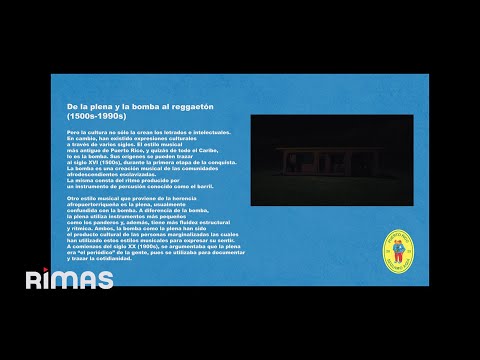
In December 2024, I was contacted by Bad Bunny’s team to produce 17 pages outlining Puerto Rican history, to pair with each song’s YouTube visualizer for “DTMF.” Altogether, they have been viewed more than 775 million times.

I later produced 40 slides jam-packed with historical and cultural facts about Puerto Rico, which were screened at Bad Bunny’s 31-show residency in San Juan. These ranged from facts about the history of women’s suffrage to the founding of Puerto Rico’s oldest punk band, La Experiencia de Toñito Cabanillas.

When Bad Bunny was announced as the NFL’s choice to headline the halftime show, I was hardly surprised by the backlash from conservatives — including multiple Fox News hosts, podcasters and even President Trump, who said, “I don’t know who he is. I don’t know why they’re doing it … [It’s] crazy.”

As communities of color celebrated on social media, critics raised two questions: Why would a Spanish-speaking artist — even if he is the most-streamed artist on Earth — be chosen for that stage? And why wouldn’t they choose a more patriotic, Anglo-American artist?

While undoubtedly xenophobic in nature, these questions highlight their acute ignorance about the place that birthed Bad Bunny, and its ongoing entanglement with the United States.

Puerto Rico was first colonized by the Spanish from 1493 until 1898, the year that the United States occupied the country as part of the Spanish-American War. Later, in 1917, Puerto Ricans became U.S. citizens through the Jones Law. Eventually, we drafted a constitution and became a Commonwealth of the United States in 1952. But there is never one single historical narrative.

What these facts occlude, however, is that Puerto Ricans are second-class citizens who cannot vote for the president — and those in the archipelago are not fully protected by the U.S. Bill of Rights. According to the U.S. Supreme Court’s early-20th century Insular Cases, we belong to the United States, but we are not part of it.

Put simply: We are a colony of the United States in the 21st century.

When drafting the historical narratives for “DTMF,” Bad Bunny understood that Puerto Rican history is often unknown, even to our own people. He was interested in making history available for those who don’t have access to higher education. He wanted me to write these narratives in a candid manner to be read by people in the barriadas y caserios (working-class neighborhoods and the projects). These were the places where I came of age in Puerto Rico.

With the success of “DTMF,” Puerto Rican history was amplified to the world. I’ve had countless conversations with journalists from around the globe, who marveled at how little they knew about Puerto Rico’s history or its relationship to the United States. This is precisely what I think drives those debates about language and who gets the right to claim Americanness — a lack of information.

And even though Bad Bunny is a U.S. citizen, conservatives have organized an alternative “All-American Halftime Show,” which reveals how “Americanness” is policed through language and race. This is the product of willful ignorance.

Puerto Rico’s history is also that of Latin American, Caribbean, United States and Latinx communities. I believe Bad Bunny’s performance will invite people to understand the beauty and complexity of our people’s history, even if it makes outsiders uncomfortable. That he will also be doing so entirely in Spanish in a moment when Latinx people in the United States are being arrested or interrogated by federal agents for speaking in Spanish — or simply for having an accent? That matters.

Of course, artists alone will not save us from the perils of racism and xenophobia — I learned that from my time in the punk community. We cannot just wait on anyone, especially not celebrities, to change institutions without some people power to back them up.

Yet given his enormous reach — just this week his latest album hit No. 1 on Apple Music in China — Bad Bunny has the power to move the cultural needle. And if there’s one thing to take from the Grammys ceremony last Sunday, it’s that he’s not alone — other artists have taken a stand on anti-immigrant violence. They are living up to the moment. That matters too.

So while conservatives organize their bland counter to the Super Bowl halftime show — with none other than Kid Rock as headliner — Bad Bunny will be offering the world a much more valuable history lesson, full of sazón, batería y reggaetón.

Jorell Meléndez-Badillo is the author of “Puerto Rico: A National History and associate professor of Latin American and Caribbean History at the University of Wisconsin-Madison.

Source link

U.S. citizens shot at, dragged by immigration agents, testify before congressional Democrats

One of the brothers of Renee Good, the 37-year-old mother of three who was shot and killed by an immigration agent in Minneapolis, told congressional Democrats on Tuesday that he needed their help.

Luke Ganger said their family had taken some consolation in the thought that his sister’s death might spark a change.

“It has not,” he said.

That is why Ganger and people who had been violently detained by immigration agents gathered to share their experiences with ICE and to ask the government to rein in an agency they described as lawless and out of control.

Tuesday’s forum — not an official hearing because Republicans did not agree to it — was led by Rep. Robert Garcia (D-Long Beach), the top Democrat of the House Oversight Committee, and Sen. Richard Blumenthal (D-Conn.), the top Democrat of the Senate Permanent Subcommittee on Investigations. It was held not in the Capitol, but a nearby Senate office building.

Garcia and Blumenthal convened the forum to gather testimony “on the violent tactics and disproportionate use of force by agents of the Department of Homeland Security.”

All of the incidents referenced in the forum were captured on video.

Democrats heard from three U.S. citizens who are residents of San Bernardino, Chicago and Minneapolis. Also present were Good’s two brothers and an attorney representing their family.

Good’s killing on Jan. 7 has led to a wave of national protests — further inflamed after agents fatally shot ICU nurse Alex Pretti, 37, two weeks later. Protesters have called on federal agents to stop using violence in pursuit of the Trump administration’s mass deportation effort.

Sen. Richard Blumenthal (D-CT), Luke Ganger and Brent Ganger arrive to a public forum

From left, Sen. Richard Blumenthal (D-Conn.), Luke Ganger and Brent Ganger arrive to a public forum on violent use of force by Department of Homeland Security personnel.

(Win McNamee / Getty Images)

“Let’s be very clear: these stories are not just about Minneapolis,” Blumenthal said. “These stories span the country.”

Blumenthal called for a “complete overhaul, a rebuilding” of the Department of Homeland Security and its sub-agencies. Such an overhaul, he said, would require body-worn cameras, that officers wear identification and rigorous use-of-force training and policies; acts of violence would require full investigations under the supervision of an independent monitor. Without those reforms, he said he wouldn’t support more funding for DHS.

Ganger said the “surreal scenes” taking place in Minneapolis and beyond are not isolated and are changing many lives.

“The deep distress our family feels because of Renee’s loss in such a violent and unnecessary way is complicated by feelings of disbelief, distress and desperation for change,” he said.

Ganger said his family is “a very American blend” that votes differently and rarely agrees fully on the details of what it means to be a citizen of the U.S. Despite those differences, he said, they have always treated each other with love and respect.

“We’ve gotten even closer during this very divided time in our country,” he said. “We hope that our family can be even a small example to others not to let political ideals divide us.”

The panel heard from Martin Daniel Rascon, of San Bernardino, and three others who described harrowing experiences with immigration agents. Rascon was in a truck with two family members last August when they were stopped by more than a dozen federal agents who pointed rifles at them, shattered a window and then shot at the car multiple times.

Francisco Longoria, the man driving the truck and Rascon’s father-in-law, was later arrested and charged by federal authorities, who alleged he had assaulted immigration officers with his truck during the incident. Longoria’s attorneys said he drove off because he feared for his safety. The charges were dropped a month later.

Marimar Martinez, 30, of Chicago, was shot five times by U.S. Customs and Border Protection agents and then labeled a domestic terrorist and charged with assaulting the agents who shot her. Those charges were also later dropped.

“I’m angry on your behalf, Miss Martinez,” said Rep. Ro Khanna (D-Fremont). “Tell me, what do you want this government to do to apologize to you?”

“I’m sorry. You’re not a domestic terrorist,” she said. “That’s it. For them to admit that they were wrong about everything that they said about me. I just want accountability.”

Aliya Rahman, of Minneapolis, was dragged from her car on the way to a doctor’s appointment and detained by ICE agents after telling them she has a disability. Rahman has autism and is recovering from a traumatic brain injury.

DHS said Rahman was arrested because she ignored multiple commands. Rahman said it takes time for her to understand auditory commands.

Rahman said agents yelled threats and conflicting instructions that she couldn’t process while watching for pedestrians. As she hit the ground face first, she said, she felt shooting pain as agents leaned on her back. She thought of George Floyd, who was killed four blocks away.

Rahman said she was never told she was under arrest or charged with a crime. The agents taking her to the federal Whipple Building referred to detainees as “bodies.” She said she received no medical screening, phone call or access to a lawyer, and was denied a communication navigator when her speech began to slur.

Eventually, she became unable to speak.

“The last sounds I remember before I blacked out on the cell floor were my cellmate banging on the door, pleading for a medic and a voice outside saying, ‘We don’t want to step on ICE’s toes,’” she said.

Rahman said she later woke up at a hospital, where doctors told her she had suffered a concussion.

Rep. Robert Garcia (D-CA) speaks in front of a poter with photos of Alex Pretti and Renee Good

Rep. Robert Garcia (D-Long Beach) speaks during a public forum on violent use of force by Department of Homeland Security personnel.

(Win McNamee / Getty Images)

Garcia called the forum a step toward accountability because Congress has the right to step in when constitutional rights are violated. He said Democrats have tracked at least 186 incidents of problematic uses of force by federal immigration agents.

“It’s important for the public to recognize that this administration has lied, has defamed and has smeared people that have been peacefully protesting,” he said.

Antonio Romanucci, the attorney representing Good’s family, and who also represented the family of George Floyd, said that while he has handled excessive force cases for decades, “this is an unprecedented and deeply unsettling time.” Floyd was murdered by a Minneapolis police officer in 2020.

“The occupation by ICE and CBP in our cities is way beyond their mission, leading to unnecessary provocation that causes needless harm and death,” he said. “These operations in multiple states have routinely and consistently included violations of the Constitution.”

The current path to hold federal officers accountable is narrow, he said. Congress could pass legislation to add language making it easier for people to file civil lawsuits in cases such as Good’s.

Source link

Homeland Security ramps up surveillance in immigration raids, sweeping in citizens

Luis Martinez was on his way to work on a frigid Minneapolis morning when federal agents suddenly boxed him in, forcing the SUV he was driving to a dead stop in the middle of the street.

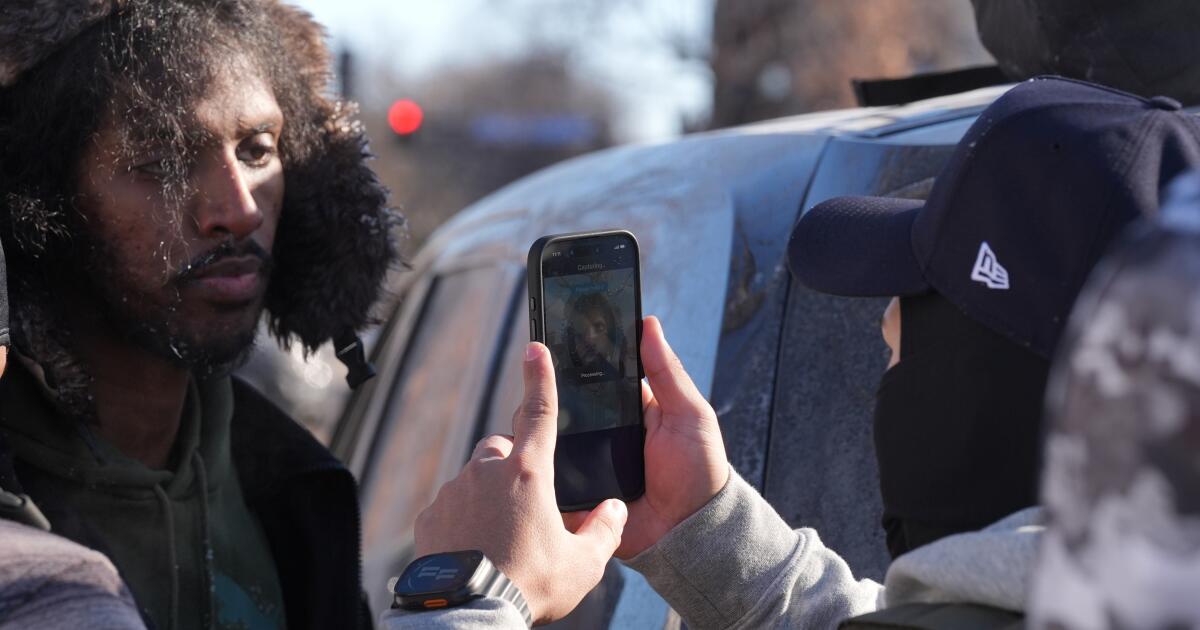
Masked agents rapped on the window, demanding Martinez produce his ID. Then one held his cellphone inches from Martinez’s face and scanned his features, capturing the shape of his eyes, the curves of his lips, the exact quadrants of his cheeks.

All the while, the agent kept asking: Are you a U.S. citizen?

The encounter in a Minneapolis suburb this week captures the tactics on display in the Trump administration’s immigration crackdown in Minnesota, which it describes as the largest of its kind and one that has drawn national scrutiny after federal agents shot and killed two U.S. citizens this month.

Across Minnesota and other states where the Department of Homeland Security has surged personnel, officials say enforcement efforts are targeted and focused on serious offenders. But photographs, videos and internal documents paint a different picture, showing agents leaning heavily on biometric surveillance and vast, interconnected databases — highlighting how a sprawling digital surveillance apparatus has become central to the Trump administration’s immigration crackdown.

Civil liberties experts warn the expanding use of those systems risks sweeping up citizens and noncitizens alike, often with little transparency or meaningful oversight.

Over the past year, Homeland Security and other federal agencies have dramatically expanded their ability to collect, share and analyze people’s personal data, thanks to a web of agreements with local, state, federal and international agencies, plus contracts with technology companies and data brokers. The databases include immigration and travel records, facial images and information drawn from vehicle databases.

In Martinez’s case, the face scan didn’t find a match and it wasn’t until he produced his U.S. passport, which he said he carried for fear of such an encounter, that federal agents let him go.

“I had been telling people that here in Minnesota it’s like a paradise for everybody, all the cultures are free here,” he said. “But now people are running out of the state because of everything that is happening. It’s terrifying. It’s not safe anymore.”

Together with other government surveillance data and systems, federal authorities can now monitor American cities at a scale that would have been difficult to imagine just a few years ago, advocates say. Agents can identify people on the street through facial recognition, trace their movements through license-plate readers and, in some cases, use commercially available phone-location data to reconstruct daily routines and associations.

When asked by the Associated Press about its expanding use of surveillance tools, the Department of Homeland Security said it would not disclose law enforcement sensitive methods.

“Employing various forms of technology in support of investigations and law enforcement activities aids in the arrest of criminal gang members, child sex offenders, murderers, drug dealers, identity thieves and more, all while respecting civil liberties and privacy interests,” it said.

Dan Herman, a former Customs and Border Protection senior advisor in the Biden administration who now works at the Center for American Progress, said the government’s access to facial recognition, other personal data and surveillance systems poses a threat to people’s privacy rights and civil liberties without adequate checks.

“They have access to a tremendous amount of trade, travel, immigration and screening data. That’s a significant and valuable national security asset, but there’s a concern about the potential for abuse,” Herman said. “Everyone should be very concerned about the potential that this data could be weaponized for improper purposes.”

Facial recognition

On Wednesday, Homeland Security disclosed online that it has been using a facial recognition app, Mobile Fortify, that it said uses “trusted source photos” to compare scans of people’s faces that agents take to verify their identity. The app, which Customs and Border Protection said is made by the vendor NEC, uses facial comparison or fingerprint-matching systems.

The app was in operation for CBP and ICE before the immigration crackdown in the Los Angeles area in June, when website 404Media first reported its existence.

In interactions observed by reporters and videos posted online, federal agents are rarely seen asking for consent before holding their cellphones to people’s faces, and in some clips they continue scanning even after someone objects.

In two instances seen by an AP journalist near Columbia Heights, Minn., where immigration officials recently detained a 5-year-old boy and his father, masked agents held their phones a foot away from people’s faces to capture their biometric details.

The technology resembles facial recognition systems used at airports, but unlike airport screenings, where travelers are typically notified and can sometimes opt out, Martinez said he was given no choice.

According to a lawsuit filed against the department by the state of Illinois and the city of Chicago this month, Homeland Security has used Mobile Fortify in the field more than 100,000 times. The Department of Homeland Security told AP that Mobile Fortify supports “accurate identity and immigration-status verification during enforcement operations. It operates with a deliberately high-matching threshold,” and uses only some immigration data.

Without federal guidelines for the use of facial recognition tools, the U.S. Commission on Civil Rights warned in a September 2024 report their deployment raises concerns about accuracy, oversight, transparency, discrimination and access to justice.

Body-camera footage

Last year, the Trump administration scaled back a program to give Immigration and Customs Enforcement officials body cameras, but administration officials said some agents tied to the fatal shooting of Minneapolis ICU nurse Alex Pretti were wearing them and that footage is now being reviewed.

Gregory Bovino, who was the administration’s top Border Patrol official charged with the immigration crackdown in Minneapolis until Monday, began wearing a bodycam in response to a judge’s order late last year.

Body-camera video could help clarify events surrounding federal agents’ killing of Pretti, who was filming immigration agents with his cellphone when they shot him in the back.

Administration officials shifted their tone after independent video footage emerged raising serious questions about some Trump officials’ accusations that Pretti intended to harm agents.

Emerging technologies

Homeland Security and affiliated agencies are piloting and deploying more than 100 artificial intelligence systems, including some used in law enforcement activities, according to the department’s disclosure Wednesday.

Congress last year authorized U.S. Customs and Border Protection to get more than $2.7 billion to build out border surveillance systems and add in AI and other emerging technologies.

In recent weeks, Homeland Security requested more information from private industry on how technology companies and data providers can support their investigations and help identify people.

Meanwhile, longtime government contractor Palantir was paid $30 million to extend a contract to build a system designed to locate people flagged for deportation. On Wednesday, the Trump administration disclosed it’s using Palantir’s AI models to sift through immigration enforcement tips submitted to its tip line.

Homeland Security has also been exploring partnerships with license-plate reader companies like Flock Safety to expand their tracking capabilities.

Rachel Levinson-Waldman, who directs the Brennan Center for Justice’s Liberty and National Security Program, said more funding for government surveillance tools changes the landscape.

“We are developing these technologies for immigrant enforcement,” she said. “Are we also going to expand it or wield it against U.S. citizens who are engaging in entirely lawful or protest activity?”

Burke and Tau write for the Associated Press. AP freelance photojournalist Adam Gray contributed to this report from Minneapolis.

Source link

Senate Democrats and White House strike deal to avert shutdown, continue ICE debate

Senate Democrats reached a deal with the White House late Thursday to prevent a partial government shutdown by moving to temporarily fund the Department of Homeland Security for two weeks, providing more time to negotiate new restrictions for federal immigration agents carrying out President Trump’s deportation campaign.

The deal follows widespread outrage over the fatal shootings of two U.S. citizens — Renee Nicole Good and Alex Pretti — by federal agents in Minneapolis amid an aggressive immigration crackdown led by the Trump administration.

Under the agreement, funding for the Department of Homeland Security will be extended for two weeks, while the Pentagon, the State Department, as well as the health, education, labor and transportation departments, will be funded through Sept. 30, Senate Minority Leader Chuck Schumer’s office confirmed to The Times.

While the Senate could approve the deal as early as Thursday night, it is unclear when the House will vote for the package. To avert a government shutdown, both chambers need to approve the deal by midnight EST Friday.

After the agreement was reached, President Trump wrote on Truth Social that he was “working hard with Congress to ensure that we are able to fully fund the Government without delay.”

“Republicans and Democrats in Congress have come together to get the vast majority of the Government funded until September, while at the same time providing an extension to the Department of Homeland Security (including the very important Coast Guard, which we are expanding and rebuilding like never before),” Trump said.

He added: “Hopefully, both Republicans and Democrats will give a very much needed Bipartisan ‘YES’ Vote.”

The move to temporarily fund DHS is meant to give lawmakers more time to negotiate Democratic demands that include a requirement that federal immigration agents use body cameras, stop using masks during operations and a push to tighten rules around arrests and searches without judicial warrants.

The breakthrough comes after Senate Democrats — and seven Senate Republicans — blocked passage of a spending package that included additional funding for DHS through Sept. 30 but not enough guardrails to muster the 60 votes needed to pass the chamber.

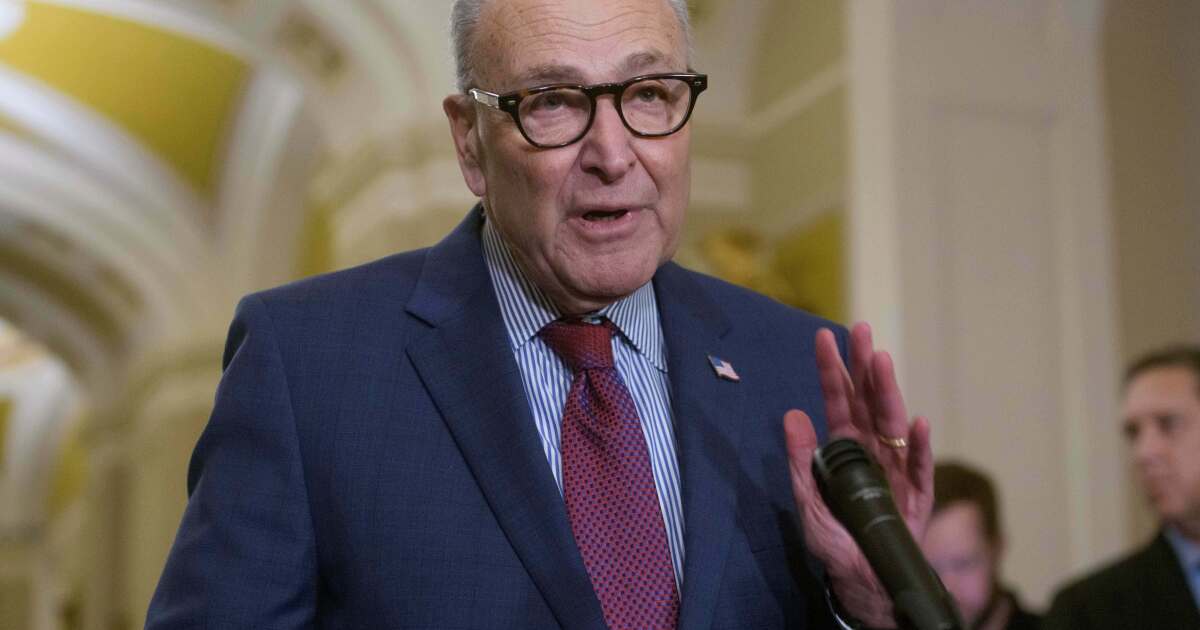
“Republicans in Congress cannot allow this violent status quo to continue,” Senate Minority Leader Chuck Schumer (D-N.Y.) said after the vote. “We’re ready to fund 96% of the federal government today, but the DHS bill still needs a lot of work.”

Speaking on the Senate floor, Sen. John Barrasso (R-Wyo.) condemned Democrats for jeopardizing funding for other agencies as they pushed for their demands.

“It would be disastrous to shut down FEMA in the middle of a major winter storm. It’s affecting half the country, and it appears that another storm is along the way,” he said. “A shutdown would mean no paychecks for our troops once again, no money for TSA agents or air traffic controllers.”

The standoff comes after federal ICE agents shot and killed Pretti, an American citizen and nurse who attempted to help a fallen woman during an ICE operation in Minneapolis. Pretti’s death was the second fatal shooting of a U.S. citizen by federal agents in the city in less than two weeks, following the killing of Good earlier this month.

Source link

Immigration raids pick up in L.A. as federal tactics shift. Arrests happen in ‘as fast as 30 seconds’

At a recent training session for 300 immigration activists in Los Angeles, the main topic was Minnesota and the changes to federal immigration tactics.

For the last few months, federal law enforcement officers have intensified their efforts to locate and deport immigrants suspected of living in the country illegally. They have used children as bait, gone door-to-door and at times forcibly stormed into people’s homes without judicial warrants.

But it was the fatal shootings of Renee Good and Alex Pretti, two U.S. citizens protesting immigration raids in Minnesota, that sparked a growing backlash of the federal government’s aggressive actions and caused activists to reconsider their own approach when monitoring Immigration and Customs Enforcement.

“One quick note about de-escalation,” Joseline Garcia, the community defense director for City Council District 1, told a crowd at St. Paul’s Commons in Echo Park. “What we would do when it came to de-escalation is we’d tell people their rights, try to get their information and try to reason with the ICE agents and pressure them to leave.”

“Things have changed a ton in the past two months, so that’s not something we’re willing to put you all at risk to do,” she added. “There is risk here and we are always encouraging people to stay safe and please constantly be assessing the risks.”

The immigration crackdown began in Los Angeles last summer but has continued in the region even after the national focus shifted to Chicago and now Minneapolis. The last month has seen a new series of arrests and actions that have left local communities on edge.

While the scope of the sweeps and the number of arrests in Los Angeles appear to be down overall compared with last summer, daily immigration operations are being documented across the city, from street corners in Boyle Heights to downtown L.A.’s Fashion District.

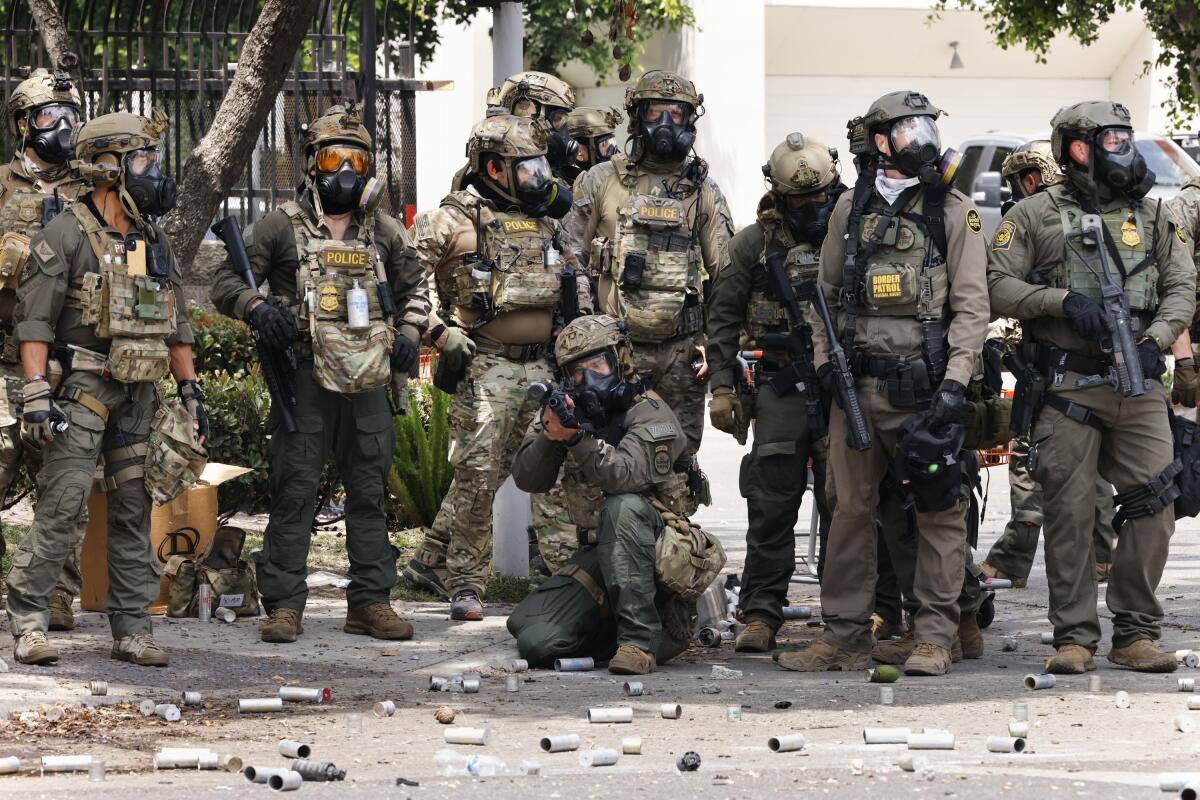
Federal agents holding less-lethal projectile weapons in Los Angeles

Federal agents carry less-lethal projectile weapons in Los Angeles in June.

(Carlin Stiehl / Los Angeles Times)

A spokesperson from the Department of Homeland Security did not respond to The Times’ requests for comment. In a previous statement the department said Border Patrol agents were continuing to operate in the city to “arrest and remove the worst of the worst criminal illegal aliens.”

Earlier this month, renewed fears spread among shoppers in the Fashion District after federal agents conducted an immigration sweep that shut down local commerce to check vendors’ proof of citizenship. Days later a federal agent opened fire at a suspect, who the Department of Homeland Security said rammed agents with his vehicle while attempting to evade arrest, during a targeted operation in South Los Angeles.

Local immigration activists say they have noticed a change in immigration agents’ tactics. The change has forced activists to also adjust their tactics.

“What we’re seeing now are large numbers of officers to grab anywhere from one to five people, not necessarily questioning them, and then moving out as quickly as possible,” said Juan Pablo Orjuela-Parra, a labor justice organizer with the National Day Laborer Organizing Network.

Maribel C., associate director of Órale, a Long Beach-based immigrant advocacy group that was established in 2006, said rapid response volunteers in Long Beach have reported similar tactics by immigration agents.

“In as fast as 30 seconds” a target can be “literally taken off the streets” by federal agents, leaving no time for a rapid response volunteer to relay “know your rights” information or get the detainee’s name, said Maribel, who is not providing her full name to protect her safety.

Immigrant rights advocates say one thing that has not changed is federal officials continue to detain immigrants with no criminal history.

On Jan. 20, exactly one year into the Trump administration’s second term, the U.S. Department of Homeland Security said about 70% of people whom the agency has arrested have been convicted or charged with a crime in the United States.

In the first nine months of the administration’s immigration crackdown, from Jan. 1 to Oct. 15, a Times analysis of nationwide ICE arrests found that percentage to be about the same.

In Los Angeles, the same analyses found that of the more than 10,000 Los Angeles residents who were arrested in immigration operations, about 45% were charged with a criminal conviction and an additional 14% had pending charges.

Between June and October of last year, the number of arrests has fluctuated significantly.

The arrests peaked in June with 2,500 people who were apprehended — including those who have pending criminal charges or were charged with immigration violations — but the following month the number fell to slightly more than 2,000. After further drops, a small spike in arrests occurred in September, with more than 1,000 arrested and then dramatically dropped in October with fewer than 500 arrests.

Officials have not released detailed data since then.

“I think what’s happened in Minnesota is terrifying for everyone in the country because those tactics that are being implemented in Minnesota are going to be the same tactics that are going to be implemented elsewhere,” Maribel said.

After a second fatal shooting of a U.S. citizen by federal officers, the Trump administration is moving to scale back its presence in Minneapolis and in the process bumping Border Patrol commander Gregory Bovino out of the state, with border advisor Tom Homan taking his place.

Bovino led and participated in highly visible immigration operations in Los Angeles, Chicago, Charlotte, N.C., and Minneapolis, sparking outrage and mass demonstrations.

At the training event in Echo Park, organizers said the recent events in Minnesota are jarring and forcing them to reconsider the safety of activists who protest or document immigration raids. Those activities will continue, they said, but with a focus on safety.

“Over the past two weeks, we saw that they’re escalating to the point of killing people that are exercising their rights,” Garcia said.

Source link