twostate

As the UK sanctions Israeli settlements, is the two-state solution dead? | Israel-Palestine conflict News

British Foreign Secretary Ed Miliband has said the United Kingdom will sanction illegal Israeli settlements in the occupied West Bank, describing the move as “overdue” and necessary to “salvage” a two-state solution to the Israeli-Palestinian conflict.

He made the comments on Tuesday as 11 nations joined the UK in supporting or ⁠considering curbs on trade in goods with settlements that are a barrier to a future Palestinian state.

Recommended Stories

list of 3 itemsend of list

But analysts say the step is far from enough to drive momentum for Palestinian statehood, threatened by ever-expanding settlements in the West Bank and an increasingly hostile Israeli political environment.

Tahani Mustafa, a lecturer in international relations at King’s College London, told Al Jazeera the latest anti-settlement measures are “modest” and unlikely to have a significant impact on ambitions for Palestinian statehood.

“After three decades of breakneck settlement expansion, Palestinian territory is only being held together by its sinews,” said Mustafa. “If what remains is still territorially viable as a state, it is only barely so. Much more decisive action is needed to salvage the two-state solution and a durable lasting solution to the conflict.”

Settlements dividing Palestinian territory

More than 30 years after the Oslo Accords set out a negotiating process aimed at resolving the Israeli-Palestinian conflict, the creation of a Palestinian state alongside Israel has remained the foundation of international efforts to forge peace.

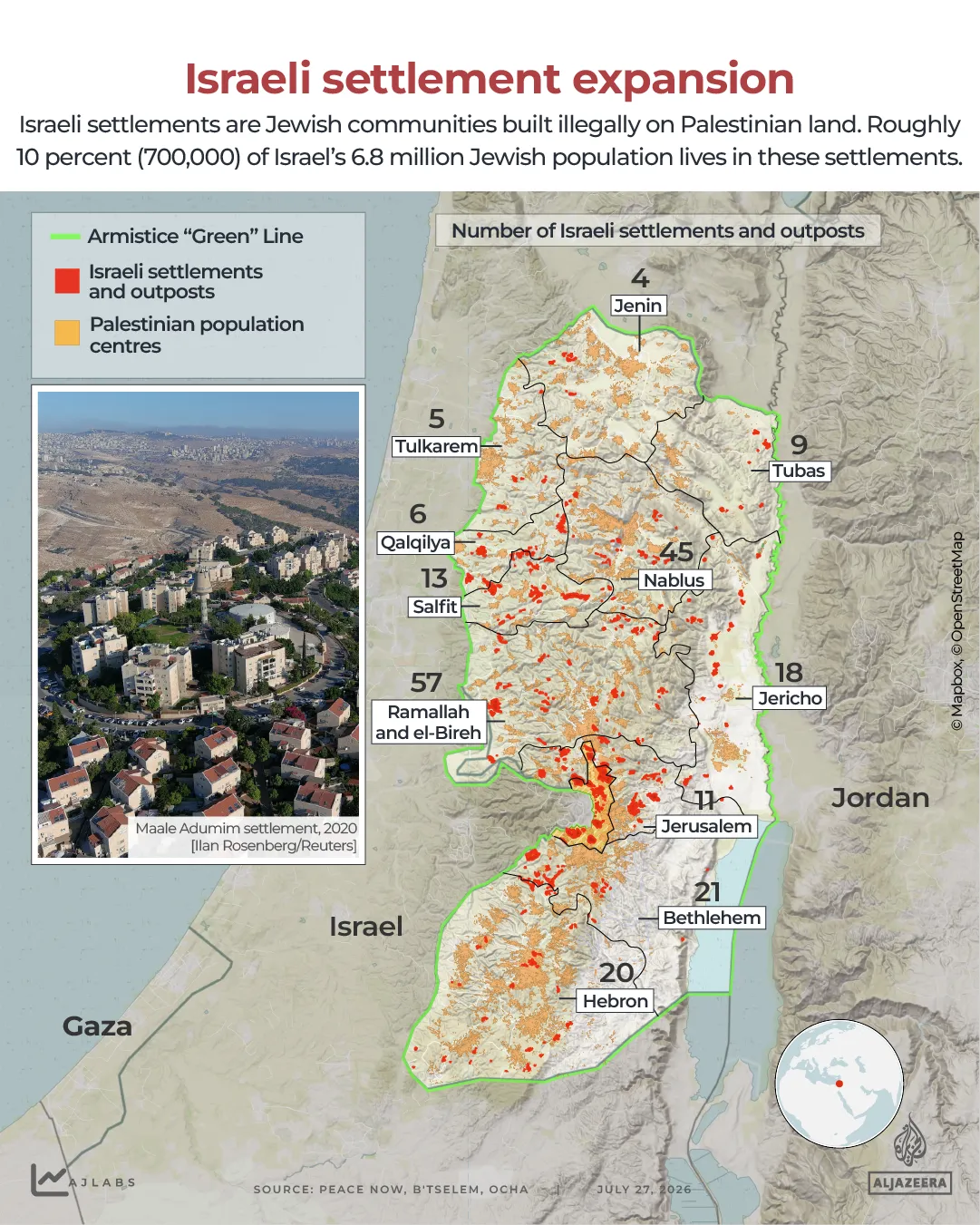
But since the Oslo process began in 1993, the number of Israeli settlers in the West Bank, including occupied East Jerusalem, has ballooned from about 260,000 to more than 700,000, according to the Palestinian Bureau of Statistics, posing a glaring roadblock to the plan.

The challenge is not just the raw number of settlers, but their geographic spread. Today, many Israeli settlements are embedded deep inside West Bank areas that would be needed for a contiguous Palestinian state, including near major Palestinian urban centres such as Nablus, Salfit and Hebron.

Israel’s recent E1 settlement plan, which would build thousands of illegal housing units between the Israeli settlement of Maale Adumim and East Jerusalem, is a case in point. The plan would effectively split the West Bank in two and fully sever it from East Jerusalem, which Palestinians seek as their future capital.

INTERACTIVE - Occupied West Bank - Settlement expansion JULY 27, 2026
(Al Jazeera)

Experts have long said Israel will need to dismantle some of its West Bank settlements, as it did in the Gaza Strip in 2005, to make room for a cohesive Palestinian state. But many Israeli settlements, especially those closer to Israel’s pre-war 1967 borders, would likely need to be addressed through land swaps.

“A complete withdrawal from some of the deeply embedded settlements is highly unlikely,” so land swaps would be the only way to create some form of Palestinian “territorial integrity”, Andreas Krieg, associate professor at King’s College London, told Al Jazeera.

However, such an arrangement – under which Israeli settlements close to the pre-1967 borders would become part of Israel and some “northern Arab-Israeli communities would be integrated into a Palestinian state” – would be “highly controversial” and face blowback from multiple communities, said Krieg.

He argued that Israelis would be certain to oppose any forced withdrawal from West Bank settlements, while some “Arab-Israelis may not want to live within a Palestinian state”.

Palestinian citizens of Israel make up approximately 21 percent of Israel’s overall population but are treated as second- or third-class citizens at the institutional level. According to rights groups, several dozen Israeli laws actively discriminate against Palestinian citizens across a number of issues, including education and housing.

Israeli ‘consensus’ against Palestinian state

Beyond the physical obstacle created by settlements is the Israeli political landscape, in which the idea of a Palestinian state has become toxic.

The government of Prime Minister Benjamin Netanyahu appears to be among the most hardline in Israel’s history on the issue. Netanyahu has emphatically ruled out the prospect of a Palestinian state, while his far-right Finance Minister Bezalel Smotrich, who also oversees Israeli settlements in the West Bank, has celebrated blocking Palestinian statehood as a badge of honour.

epa13202737 Israeli Finance Minister Bezalel Smotrich meet with families during the inauguration of the new Israeli outpost settlement of Mitzpe Makada near the West Bank Palestinian village of Dura, in the Mount Hebron area near Hebron, West Bank, 31 August 2026. The inauguration of the settlement follows the announcement of four new settlements in the Hebron Hills by the Hebron Hills Regional Council and Israeli authorities. EPA/ABIR SULTAN
Israeli Finance Minister Bezalel Smotrich meets with families during the inauguration of the new Israeli outpost settlement of Mitzpe Makada near the Palestinian village of Dura in the West Bank, August 31 [Abir Sultan/EPA]

The views of Netanyahu’s most influential domestic critics do not deviate much. His top rival in elections slated for October, former military chief Gadi Eisenkot, has promised not to allow the establishment of a Palestinian state. And Naftali Bennett, a Netanyahu rival from the far right, fervently opposes Palestinian statehood.

As for the Israeli public, a June poll by the Council for a Secure America found that only 22 percent of Jewish Israelis favour a two-state solution, while 63 percent oppose it.

“The consensus within Israel, socially and politically, does not allow for any party to make any steps towards a Palestinian state,” said Krieg.

Meanwhile, Israel’s closest ally, the United States, is unlikely to apply significant pressure over Israel’s settlement policy so long as President Donald Trump remains in office for the next two and a half years, he added.

Krieg said a “best-case scenario” is for Israel’s next elected government to reverse some of the country’s recent settlement advances.

John Strawson, professor at the University of East London, said that any new Israeli government is “unlikely to support a Palestinian state”, but that a more moderate Israeli government may at least “stop the ethnic cleansing and other moves which are aimed at making that impossible”.

“Removing Netanyahu is the first step towards a two-state solution,” said Strawson.

Two states are the ‘only alternative to violence’

If the two-state model is still alive at all, it is largely due to pressure from the international community.

More than 150 countries, including the majority of European Union nations, have recognised Palestinian statehood. And several Arab states with whom Israel seeks better ties have indicated Palestinian statehood is a precondition for normalisation with Israel.

Krieg said Tuesday’s move by the UK and the 11 other mostly European nations is an “overdue step in the right direction”, but also “shows the laziness and lack of creativity on the part of the international community to actually think outside the box in terms of a two-state solution”.

Anders Persson, a political scientist specialising in the Israeli-Palestinian conflict, said that while the settlement sanctions are concerning to Israel, other previous anti-settlement measures, such as 2013 EU restrictions on funds for Israeli entities operating in occupied Palestinian territory, “changed little on the ground”.

He said the latest sanctions may be “too late” and “too limited … to save the two-state solution”.

Strawson said that while a two-state solution may “seem optimistic”, it is the only alternative to “permanent war and violence”.
Source link

South Korean civic leaders rally for ‘One Korea’ amid two-state debate

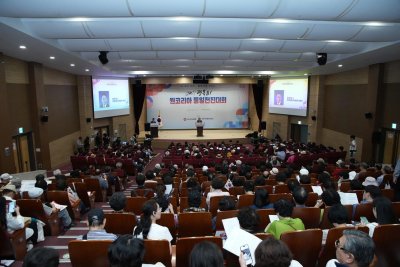
1 of 2 | About 500 civic, religious, political and academic leaders, North Korean defectors and members of separated families listen to remarks by Jang Man-soon, chairman of the Committee for Ten Million Separated Families, during the Liberation 81 One Korea Unification Rally at the National Assembly Members’ Office Building in Seoul on Aug. 11, 2026. Participants gathered in support of a “One Korea” vision.
Photo courtesy of Citizens’ Solidarity for One Korea

Aug. 11 (UPI) — About 500 South Korean civic, political and religious leaders, North Korean defectors, separated families and academics gathered at the National Assembly Members’ Office Building on Tuesday to reject the permanent division of the Korean Peninsula and call for a national movement for peaceful reunification.

The “Liberation 81 One Korea Unification Rally,” held four days before South Korea marks the 81st anniversary of liberation from Japanese colonial rule, was jointly hosted by Citizens’ Solidarity for One Korea and Rep. Song Seok-jun of the People Power Party, chairman of the National Assembly Foreign Affairs and Unification Committee.

Participants rallied under the slogan “Two Koreas No! One Korea Yes!” and framed the debate as a choice over whether South Korea should institutionalize the peninsula’s division or preserve reunification as a constitutional objective, a human rights issue and a long-term national vision.

The gathering comes as both Koreas are redefining their relationship.

North Korean leader Kim Jong Un declared in late 2023 that North and South Korea should no longer be regarded as partners pursuing reunification but as two hostile states. North Korea has since revised its constitution to remove references to reunification and define its territory as bordering the Republic of Korea to the south.

In South Korea, President Lee Jae Myung’s administration has pursued a policy of “peaceful coexistence” aimed at reducing tensions and restoring dialogue with Pyongyang.

The shift has been reflected in government policy and education materials.

In March, the National Institute for Peaceful Unification Education, which is affiliated with the Unification Ministry, published its 2026 textbooks incorporating what it described as a “peaceful two-state” framework.

The materials acknowledged the current reality of two separate systems while calling for inter-Korean relations to develop into a cooperative relationship aimed at eventual reunification. The definition of reunification was also revised from one emphasizing integration under a liberal democratic order and market economy to “the process of forming a new, unified community.”

The policy direction became clearer last week when Unification Minister Chung Dong-young presented President Lee with a blueprint for “peaceful coexistence” that includes what the ministry calls a “two-state relationship oriented toward unification,” while leaving the question of eventual reunification to future generations.

The plan also calls for referring to North Korea by its official name, the Democratic People’s Republic of Korea, and replacing terminology the ministry considers confrontational, including the “main enemy” label.

South Korea has traditionally treated inter-Korean relations as a special relationship rather than ordinary relations between two foreign states, a principle reflected in the 1991 Inter-Korean Basic Agreement.

Organizers of Tuesday’s rally said they support peace and dialogue but argued that institutionalizing the two Koreas as separate states, even under a framework intended to promote peaceful coexistence, could ultimately normalize permanent division.

In welcoming remarks, Song said the South Korean Constitution “clearly aims for peaceful unification based on the basic free and democratic order,” adding that with North Korea’s nuclear threats and a grave international environment, South Koreans “must not ignore or misjudge the reality of division.”

Jang Man-soon, co-chairman of Citizens’ Solidarity for One Korea and chairman of the Committee for Ten Million Separated Families, said recognizing North Korea as an entirely separate state could conflict with South Korea’s constitutional framework and affect the identity and rights of separated families, people displaced from North Korea and North Korean defectors.

South Korea’s Constitution defines the territory of the Republic of Korea in Article 3 as “the Korean Peninsula and its adjacent islands.” Article 4 requires the country to seek peaceful unification based on the basic free and democratic order.

Jang, a second-generation member of a separated family, also questioned whether Pyongyang’s two-state policy could be characterized as mutual respect while North Korea continues to threaten South Korea with nuclear weapons and missiles.

For separated families, he argued, the issue extends beyond diplomatic terminology. Permanently recognizing the peninsula as two foreign states could change how South Korea views people whose hometowns and relatives remain north of the border.

“True peace begins with restoring the freedom and human rights of North Korean residents,” Jang said, according to organizers.

Former lawmaker Thae Yong-ho, who defected after serving as a senior North Korean diplomat, said in a keynote speech that Pyongyang has removed concepts such as national reunification and one Korean people from its constitution and political framework, even as a “peaceful two-state” discourse has emerged in the South.

Thae warned that such an approach “could lead to the permanent division of the Korean Peninsula.”

Speakers also argued that reunification should be viewed as a human rights question involving North Korea’s roughly 25 million people, rather than solely as a territorial or political issue.

Korean American Kenneth Bae, president of New Korea Foundation International, who was detained in North Korea for 735 days, said reunification should mean more than combining two territories.

He said it should reconnect separated families and create conditions in which North Koreans can live with freedom, dignity and basic human rights.

Kang Chol-hwan, head of the North Korea Strategy Center, who spent 10 years in a North Korean political prison camp, called for expanding North Koreans’ access to outside information and making human rights a central part of reunification efforts.

The rally also sought to present an alternative national vision rather than simply oppose a two-state framework.

Seo In-taek, permanent co-chairman of Action for Korea United, proposed a civic movement centered on the “Korean Dream,” a vision of a unified Korea grounded in freedom, human rights, freedom of religion, peace and shared prosperity.

“People are moved not by slogans but by a clear vision they can share,” Seo said, according to organizers.

Seo said reunification should not belong to a single political party, ideology or administration and called for a nationwide civic movement to change perceptions that division is permanent and reunification impossible.

Citizens’ Solidarity for One Korea sent a questionnaire on the two-state debate to all 299 members of the National Assembly on Aug. 4, asking lawmakers about permanent two-state relations and South Korea’s constitutional commitment to peaceful reunification. Eight lawmakers responded, the rally’s moderator announced during the event.

Representatives of youth, Protestant and Buddhist communities, separated families, overseas Koreans and North Korean defectors then took the stage in turn to deliver “One Korea” resolutions pledging a unified Korea grounded in liberal democracy and human rights.

The rally concluded with young representatives born in the two Koreas reading a joint resolution calling for denuclearization, improvements in North Korean human rights and peaceful reunification under South Korea’s constitutional order, followed by a unification performance in which participants sang “Our Wish Is Unification” and chanted “Two Koreas No! One Korea Yes!”

Organizers said the campaign will continue with the 2026 Korean Dream Han River Festival, a public event focused on Korean reunification planned for Oct. 3 at Ttukseom Hangang Park in Seoul.

Source link