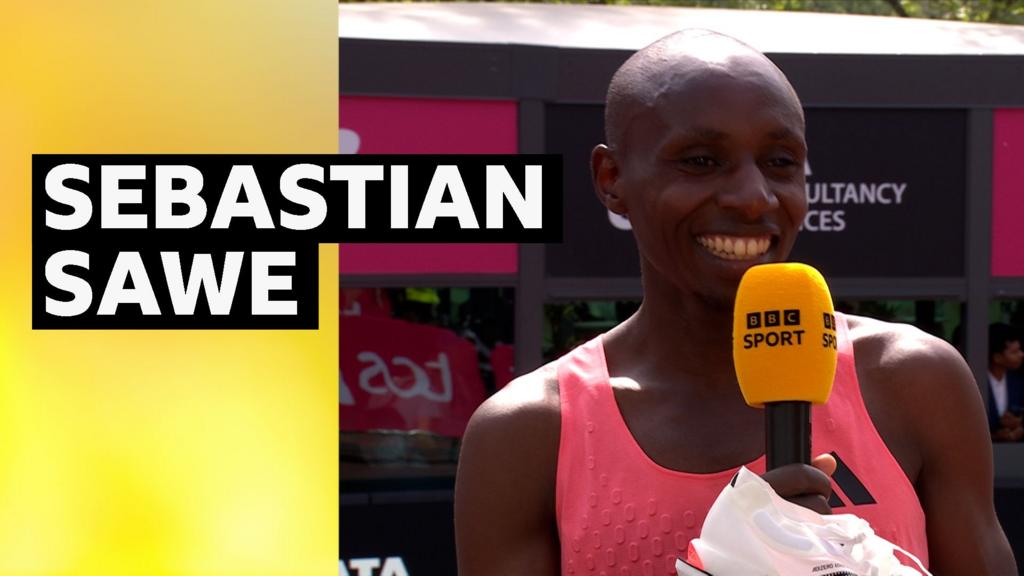
Sabastian Sawe sets world record, breaks two-hour marathon mark
LONDON — The fabled two-hour barrier for a marathon has been broken, officially, in an once-inconceivable achievement in sports.
Not by one runner, but two.
In a race for the ages, Sabastian Sawe of Kenya won the London Marathon in 1 hour, 59 minutes and 30 seconds on Sunday, shattering the previous men’s world record by an astonishing 65 seconds.
“What comes today is not for me alone,” the 29-year-old Sawe said, “but for all of us today in London.”
Just 11 seconds further back was Ethiopia’s Yomif Kejelcha, who — running in his first-ever marathon — also covered the 26.2-mile (42.2-kilometer) course in under 2 hours.
Completing the podium was Uganda’s Jacob Kiplimo, who broke the previous world-record time — set by Kenya’s Kelvin Kiptum in Chicago in 2023 — by seven seconds, finishing in 2:00:28.
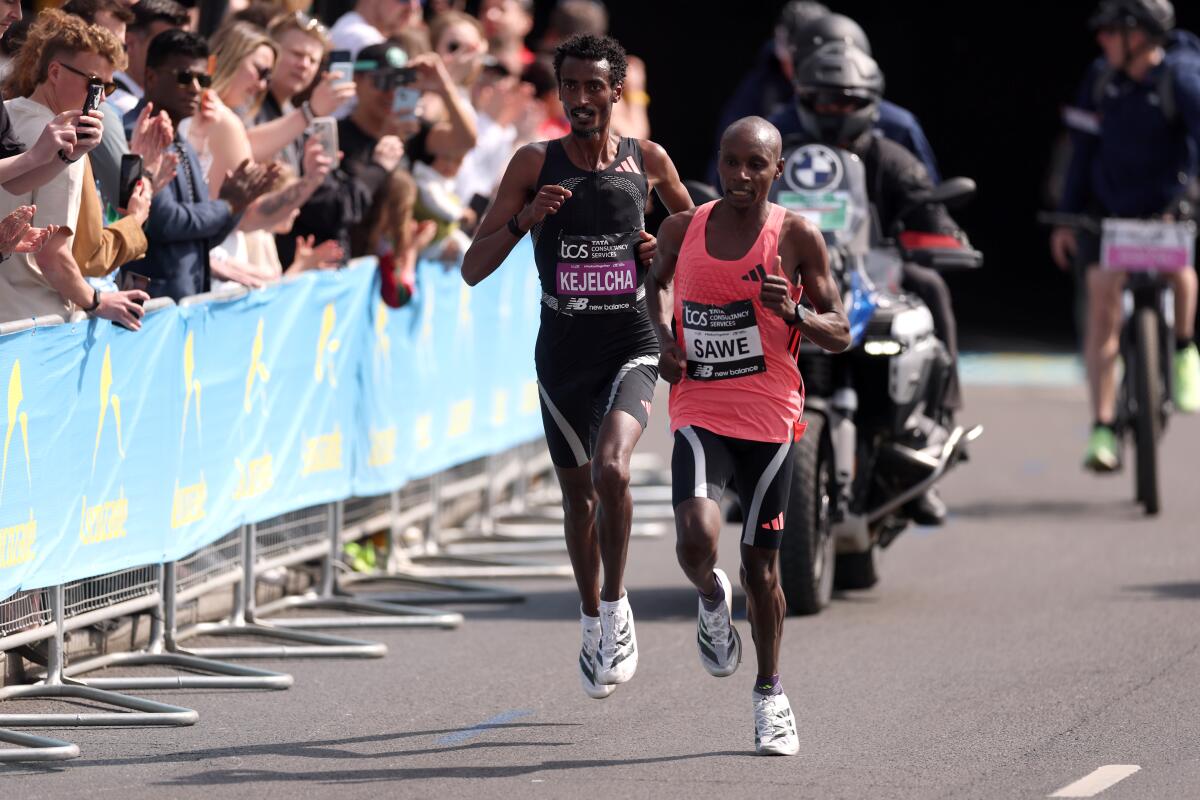
In an exhilarating sight, Sawe ran quicker as the marathon went on, covering the second half of the race in 59 minutes and 1 second. He pulled clear with Kejelcha after 30 kilometers and then made his solo break in the final two kilometers, sprinting along the finish on The Mall to loud cheers.

Sabastian Sawe of Team Kenya runs ahead of Yomif Kejelcha of Team Ethiopia during the London Marathon on Sunday in London.
(Warren Little / Getty Images)
Sawe, who retained his title in London, said it was a “day to remember for me” and thanked the huge crowds who lined the streets of the British capital to witness what might be regarded as a feat marking the peak of human physical achievement.
“I think they help a lot,” he said, “because if it was not for them you don’t feel like you are so loved … with them calling, you feel so happy and strong.”
Under two hours has been done before — unofficially
Breaking two hours in a marathon has been a long time coming — and has been done before.
However, when Eliud Kipchoge — the Kenyan long-distance great — achieved the feat in Vienna in 2019, it was in a specially tailored race called the “1.59 Challenge” that was arranged by British billionaire Jim Ratcliffe in favorable conditions, on a 6-mile (9.6-kilometer) circuit, and using rotating pacemakers.
That meant it wasn’t classed as an official race setting, so Kipchoge’s time of 1:59:40 didn’t go in the record book.
In any case, Sawe surpassed that time by 10 seconds on a mostly flat course across London in dry, sunny conditions.

Sabastian Sawe, of Kenya, smiles and holds up his adidas shoe with his world-record marathon time written on it Sunday in London.
(Alex Davidson / Getty Images)
“The goalposts have literally just moved for marathon running,” Paula Radcliffe, a former winner of the London Marathon, said during commentary of the race for the BBC.
At the turn of the century, the world’s best time for the men’s marathon was 2:05:42, set by Khalid Khannouchi in Chicago in 1999.
Khannouchi broke his own record by four seconds in 2002 — the last time the fastest men’s marathon was run in London — and it has been whittled down gradually over the last 24 years by a succession of Kenyan and Ethiopian runners, including Haile Gebrselassie, Wilson Kipsang, Kipchoge and most recently Kiptum.
Assefa wins fastest-ever women’s-only marathon
A record was also set in the women’s race, with Ethiopia’s Tigst Assefa pulling away with about 500 meters remaining to win in 2:15:41 and defend the title in the fastest-ever time in a women’s-only marathon.
However, it was 16 seconds slower than the course record set by Radcliffe in 2003 when it was a mixed race.

Tigst Assefa celebrates as she crosses the finish line during the London Marathon women’s race in a record time Sunday.
(Ian Walton / Associated Press)
Kenya’s Hellen Obiri was 12 seconds back in second place in a personal-best time on her London debut and compatriot Joyciline Jepkosgei was third, a further two seconds adrift. It was the first time three women have run under 2 hours, 16 minutes in a marathon.
“I screamed when I finished because I knew I was breaking the world record,” Assefa said.
“I felt much healthier today and have worked really hard on my speed and all my training has paid off.”
Swiss double in wheelchair races
In the wheelchair races, there was a Swiss double with Marcel Hug powering to a sixth straight men’s title — and eighth in total — and Catherine Debrunner beating Tatyana McFadden in a close finish to defend the title.