Contributor: The last shreds of our shared American culture are being politicized
At a time when so many forces seem to be dividing us as a nation, it is tragic that President Trump seeks to co-opt or destroy whatever remaining threads unite us.
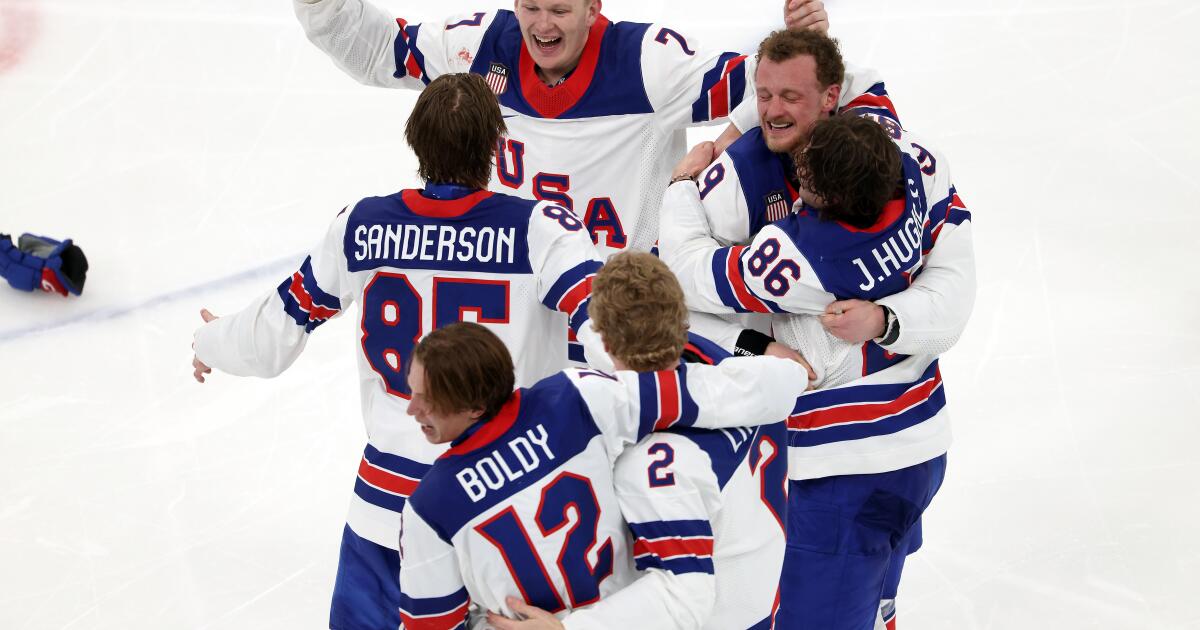
I refer, of course, to the U.S. men’s Olympic hockey team winning gold: the kind of victory that normally causes Americans to forget their differences and instead focus on something wholesome, like chanting “USA” while mispronouncing the names of the European players we defeated before taking on Canada.
This should have been pure civic oxygen. Instead, we got video of Kash Patel pounding beers with the players — which is not illegal, but does make you wonder whether the head of the Federal Bureau of Investigation has a desk somewhere with neglected paperwork that might hold the answers to the D.B. Cooper mystery.
Then came the presidential phone call to the men’s team, during which Trump joked about having to invite the women’s team to the State of the Union, too, or risk impeachment — the sort of sexist humor that lands best if you’re a 79-year-old billionaire and not a 23-year-old athlete wondering whether C-SPAN is recording. (The U.S. women’s hockey team also brought home the gold this year, also after beating Canada. The White House invited the women to the State of the Union, and they declined.)
It’s hard to blame the players on the men’s team who were subjected to Trump’s joke. They didn’t invite this. They’re not Muhammad Ali taking a principled stand against Vietnam, or Tommie Smith and John Carlos raising fists for Black power at the Olympics in 1968, or even Colin Kaepernick protesting police brutality by kneeling during the national anthem. They’re just hockey bros who survived a brutal game and were suddenly confronted with two of the most powerful figures in the federal government — and a cooler full of beer.
When the FBI director wants to hang, you don’t say, “Sorry, sir, we have a team curfew.” And when the president calls, you definitely don’t say, “Can you hold? We’re trying to remain serious, bipartisan and chivalrous.” Under those circumstances, most agreeable young men would salute, smile and try to skate past it.
But symbolism matters. If the team becomes perceived as a partisan mascot, then the victory stops belonging to the country and starts belonging to a faction. That would be bad for everyone, including the team, because politics is the fastest way to turn something fun into something divisive.
And Trump’s meddling with the medal winners didn’t end after his call. It continued during Tuesday night’s State of the Union address, when Trump spent six minutes honoring the team, going so far as to announce that he would award the Presidential Medal of Freedom to goalie Connor Hellebuyck.
To be sure, presidents have always tried to bask in reflected glory. The main difference with Trump, as always, is scale. He doesn’t just associate himself with popular institutions; he absorbs them in the popular mind.
We’ve seen this dynamic play out with evangelical Christianity, law enforcement, the nation of Israel and various cultural symbols. Once something gets labeled as “Trump-adjacent,” millions of Americans are drawn to it. However, millions of other Americans recoil from it, which is not healthy for institutions that are supposed to serve everyone. (And what happens to those institutions when Trump is replaced by someone from the opposing party?)
Meanwhile, our culture keeps splitting into niche markets. Heck, this year’s Super Bowl necessitated two separate halftime shows to accommodate our divided political and cultural worldviews. In the past, this would have been deemed both unnecessary and logistically impossible.
But today, absent a common culture, entertainment companies micro-target via demographics. Many shows code either right or left — rural or urban. The success of the western drama “Yellowstone,” which spawned imitators such as “Ransom Canyon” on Netflix, demonstrates the success of appealing to MAGA-leaning viewers. Meanwhile, most “prestige” TV shows skew leftward. The same cultural divides now exist among comedians and musicians and in almost every aspect of American life.
None of this was caused by Trump — technology (cable news, the internet, the iPhone) made narrowcasting possible — but he weaponized it for politics. And whereas most modern politicians tried to build broad majorities the way broadcast TV once chased ratings — by offending as few people as possible — Trump came not to bring peace but division.
Now, unity isn’t automatically virtuous. North Korea is unified. So is a cult. Americans are supposed to disagree — it’s practically written into the Constitution. Disagreement is baked into our national identity like free speech and complaining about taxes.
But a functioning republic needs a few shared experiences that aren’t immediately sorted into red and blue bins. And when Olympic gold medals get drafted into the culture wars, that’s when you know we’re running out of common ground.
You might think conservatives — traditionally worried about social cohesion and anomie — would lament this erosion of a mainstream national identity. Instead, they keep supporting the political equivalent of a lawn mower aimed at the delicate fabric of our nation.
So here we are. The state of the union is divided. But how long can a house divided against itself stand?
We are, as they say, skating on thin ice.
Matt K. Lewis is the author of “Filthy Rich Politicians” and “Too Dumb to Fail.”